Saint Gianna Beretta Molla and Pietro Molla: A Physician, a Mother and the Husband Who Kept Her Memory
An Italian pediatrician who died a week after the birth of her fourth child, and the engineer husband whose letters and testimony shaped how the Church came to know her.
At a Glance
- Gianna
- Born October 4, 1922, Magenta, Italy. Died April 28, 1962, Ponte Nuovo di Magenta, aged 39.
- Pietro
- Born July 1, 1912, Mesero. Died April 3, 2010. Not beatified or canonized.
- Marriage
- September 24, 1955, Basilica of San Martino, Magenta
- Gianna's Cause
- Venerable July 6, 1991. Beatified April 24, 1994. Canonized May 16, 2004, by Pope John Paul II.
- Feast Day
- April 28 in the Roman Catholic calendar. No established Eastern feast.
- Patronage
- Mothers, physicians, unborn children, pregnant women and families
Who They Were
Gianna Beretta Molla was an Italian pediatrician, wife and mother of four who died in 1962 at the age of 39. Pope John Paul II canonized her on May 16, 2004. She is honored especially by mothers, doctors and anyone involved in the care of the unborn.
Her husband Pietro Molla was a mechanical engineer and industrial executive. He is not a saint, and no cause for him has been opened with official standing. Yet he cannot be left out of her story. His letters, his testimony and his decades as a widower and father shaped how the world came to know her.
The popular version of her story is short: she refused to end her pregnancy and died so her daughter could live. The documented version is more careful and, in some ways, more moving. This article follows the documented version and marks where devotion has simplified it.
Childhood and Family
Giovanna Francesca Beretta was born on October 4, 1922, in Magenta, near Milan, and baptized a week later on October 11. Her parents were Alberto Beretta and Maria De Micheli. She was the tenth of thirteen children. Both parents were members of the Franciscan Third Order, and the household was marked by daily prayer, charity and trust in Providence.
The family moved to Bergamo in 1925 and later to Genoa. Gianna received First Communion on April 4, 1928, and Confirmation on June 9, 1930. Family life also brought early sorrow. Her older sister Amalia died in 1937. Both parents died in 1942, her mother on April 29 and her father on September 10, when Gianna was still a young student.
In March 1938 she attended a retreat led by a Jesuit priest, Father Michele Avedano. Notes from this period show a teenager already asking what God wanted of her. The seriousness of her later choices did not appear suddenly. It had been prepared by years of prayer and discipline.
Several of her siblings also took vocations of service. Her brother Alberto became a Capuchin priest and medical missionary in Brazil, and her brother Giuseppe became a priest. Their example shaped her sense that medicine could be a kind of Christian service.
Medical Studies and Practice
Gianna began medical studies at the University of Milan in November 1942 and continued at the University of Pavia from 1945. She completed her degree in medicine and surgery on November 30, 1949. She opened her practice in Mesero on July 1, 1950, and qualified as a specialist in pediatrics at the University of Milan on July 7, 1952.
Her work focused on mothers, infants and poor patients. She was active in Catholic Action and the Society of Saint Vincent de Paul. From 1956 she was involved with services for mothers and young children in Ponte Nuovo and gave voluntary medical help in local schools.
She thought of medicine as a service to Christ present in the sick. Her writings on this theme survive as letters, notes and reflections rather than as a finished treatise, but they show consistent seriousness about the doctor's calling.
For a time she considered following her brother to Brazil as a missionary physician. Concerns about her health led her advisers to discourage the plan, and she stayed in Italy. There is no documented dramatic conversion in her life. She was raised in the faith and deepened it steadily.
Pietro and the Courtship
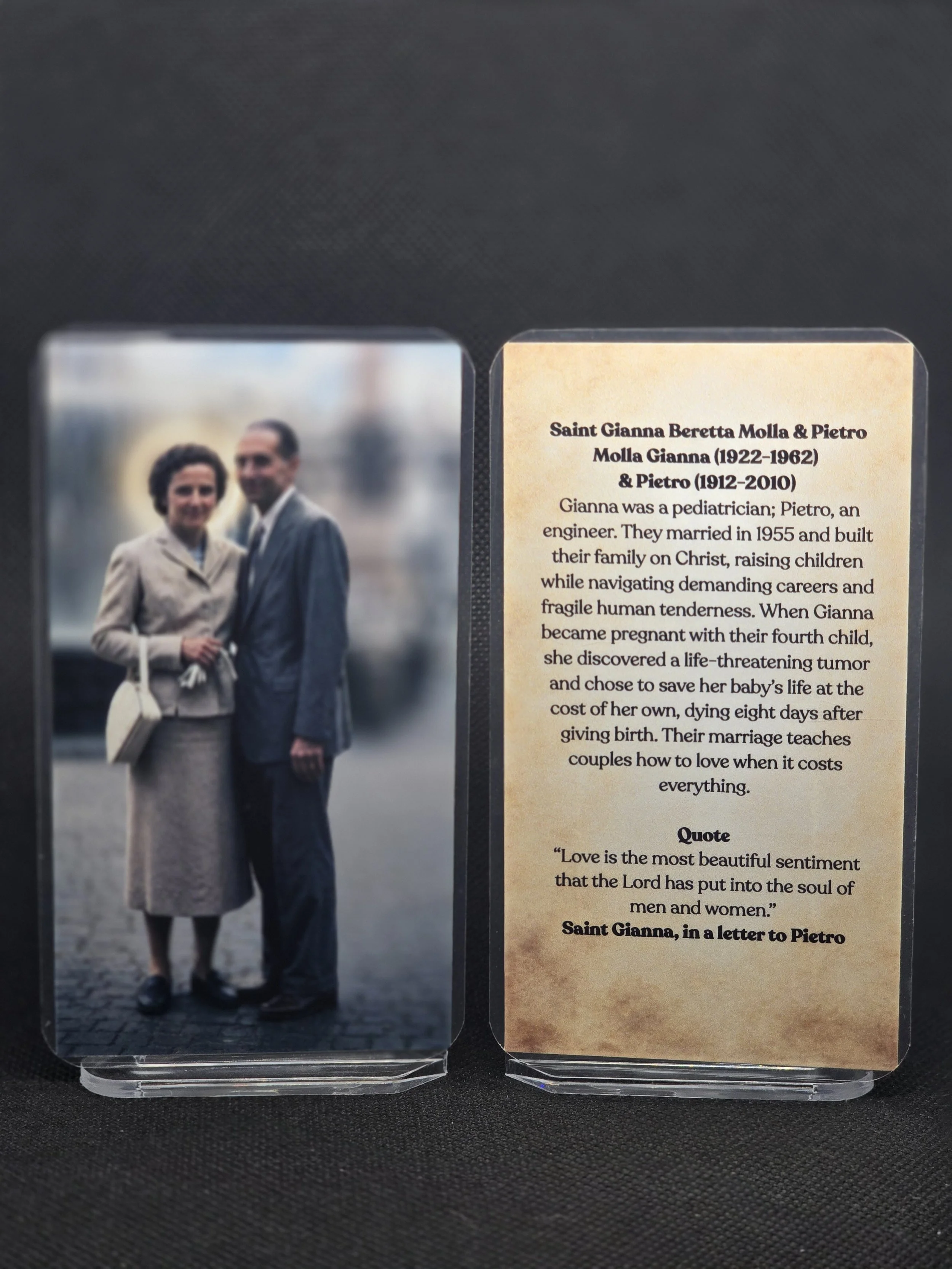
Pietro Molla was born on July 1, 1912, in Mesero. He trained as an engineer and rose to a senior post at SAFFA, an Italian industrial company. He was a practicing Catholic, and testimony from his family describes a man whose faith shaped both his work and his home.
The diocesan shrine's chronology places their first public meeting on December 8, 1954, and their engagement on April 11, 1955. They married on September 24, 1955, in the Basilica of San Martino in Magenta. Gianna was 32 and Pietro was 43.
Their courtship letters have been published in English as The Journey of Our Love by Pauline Books and Media in 2014. In a letter dated September 13, 1955, Gianna describes Pietro as a spiritual example from whom she hoped to learn. In another dated February 22, 1958, she praises his faith and prayerfulness. These letters show that Pietro was an active partner in her spiritual life and not merely a bystander to her sanctity.
Marriage and Motherhood
The couple had four children who lived past birth. Pierluigi was born on November 19, 1956. Maria Zita, called Mariolina, was born on December 11, 1957. Laura was born on July 15, 1959. Gianna Emanuela was born on April 21, 1962.
UNCERTAIN: some short biographies call the last pregnancy her fourth. Gianna Emanuela has reported that her mother also had two miscarriages after the first three children, so the 1962 pregnancy may have been the fifth. It was in any case her fourth live birth.
Gianna continued to work as a physician while raising small children. She understood marriage as a vocation to holiness in ordinary life, not as a lesser path. That conviction is one of the most consistent themes in her letters, and it is the reason her cause was welcomed by many married Catholics.
The Final Pregnancy
In September 1961, during the second month of her fourth pregnancy, doctors discovered a uterine fibroma, generally understood to be a benign tumor. According to the diocesan chronology, surgeons at San Gerardo Hospital in Monza removed a large fibroma on September 6, 1961, without ending the pregnancy.
Accounts usually describe three options that were discussed: ending the pregnancy to treat her condition, removing the uterus, or removing the fibroma while preserving the pregnancy. Gianna chose the third. This matters. She did not refuse medical care. She accepted an operation that treated her condition and protected her child, and she asked that the child's life be given priority.
TRADITION: a famous line is often repeated, in which she tells the doctors to save the child if they must choose. Versions of this account circulate in devotional literature and in testimony from her family and friends, but the exact wording differs from telling to telling, so it is best treated as a faithful summary and not a verbatim quotation.
A 2024 study in Church Life Journal by Abigail Jorgensen cautions against retellings that claim she refused all treatment or chose certain death. Catholic moral teaching distinguishes direct abortion from treating a serious maternal illness when the death of the child is not intended, and her story should not be read as a rule that every pregnant woman must decline life-saving care.
Her Death
On April 20, 1962, Gianna entered San Gerardo Hospital. Her daughter Gianna Emanuela was born by Caesarean section on April 21, which was Holy Saturday. Soon afterward Gianna developed a fever and severe abdominal pain, and her condition was diagnosed as septic peritonitis.
At her own request she was taken home to Ponte Nuovo, where she died at about eight in the morning on April 28, 1962, one week after the birth. Her funeral was on April 30, and she was buried in Mesero. Her remains were moved to the Molla family chapel in 1965.
UNCERTAIN: the exact way the infection developed cannot be fully reconstructed from the public sources. The immediate cause of death was postpartum septic peritonitis. It is inaccurate to claim that the fibroma itself killed her.
Mariolina died on February 12, 1964, of an acute kidney illness, and she was buried with her mother. Pietro raised the remaining children and lived until April 3, 2010. He is described in the family accounts as buried in the same family chapel.
Beatification, Canonization and Miracles
The cause was opened in the Archdiocese of Milan. Pope John Paul II recognized her heroic virtue on July 6, 1991, beatified her on April 24, 1994, and canonized her on May 16, 2004, in Saint Peter's Square. Pietro and their three surviving children attended the canonization, with Pietro then aged 91. She was canonized as a lay woman, wife and mother and not as a martyr.
Two miracles were approved. The first involved Lucia Silvia Cirilo, a Protestant woman in Grajau, Brazil, who developed a severe fistula after a stillbirth in 1977. After Capuchin sisters and nurses prayed through Gianna's intercession, she recovered in a way the investigation judged medically unexplained. The decree was issued on December 21, 1992.
The second involved Elisabete Comparini Arcolino, also in Brazil, who had serious complications in a pregnancy, including bleeding and early rupture of the membranes. Her daughter Gianna Maria was born on May 31, 2000. The decree was issued on December 20, 2003.
These were cases investigated by the Church and judged sufficient for the cause. That is not the same as universal scientific agreement. Other reports of answered prayer, such as those about infertility or difficult pregnancies, belong to devotion unless they have been formally studied. Relics are held at her burial place and at shrines such as the one in Warminster, Pennsylvania, which should be understood as claims about relics held by those institutions.
Why They Matter to Eastern Christians
Gianna and Pietro Molla were Latin Catholics. There is no established Eastern Catholic feast for Gianna, and no Orthodox church has glorified her or added her to a synaxarion. She should not be presented as an Orthodox saint, and no distinct Eastern liturgical office for her was found in the sources.
There are nonetheless themes that Eastern readers may recognize. The Eastern tradition holds that marriage is a path to holiness and that the family is a small church. Gianna's letters show spouses helping one another toward God, which fits that understanding. Her view of medicine as service to Christ in the sick also echoes the ancient Eastern ideal of the physician saints, such as Cosmas and Damian, who healed without payment.
The Gospel passage in Matthew chapter 25, in which Christ identifies himself with the sick, is shared by all Christians. A reader from any tradition can admire a doctor who took that passage seriously. That admiration is thematic and biographical, not a claim of common liturgical veneration.
Lord Jesus, you cared for the sick and blessed little children. Watch over every mother who carries a child, every doctor who cares for her, and every family waiting in hope. Give courage to those facing hard decisions, wisdom to those who treat them, and peace to those who grieve. Through the prayers of Gianna and Pietro, help us love life and trust in your will. Amen.
This short prayer was written for this page. It is not an official prayer of the Church. A prayer attributed to Gianna herself, in which she submits to whatever God permits, is published by the Saint Gianna Shrine.
Lessons from Gianna and Pietro
The first lesson is about accuracy. Gianna's real story, in which she accepted surgery and protected her child, is stronger than the legend in which she refused everything. Telling it carefully respects her and respects mothers who face their own medical decisions.
The second lesson is about marriage as shared work. Their letters read as a conversation between two people trying to help one another reach God. Pietro's role as a faithful witness for almost five decades after her death is part of why her story has been preserved so well.
The third lesson is about ordinary vocation. Gianna was a busy doctor and mother, not a nun or a founder. The Church holds her up as a model of holiness in the middle of a normal, crowded life.
Finally, the story reminds us that sanctity is not only about the moment of death. The Church recognized her whole life of faith, marriage, medicine and charity, and not only the circumstances of her last illness.
Frequently Asked Questions
A Saint Whose Husband Held the Story
Gianna and Pietro Molla remind us that holiness is built in kitchens, clinics and letters as much as in dramatic moments. If their story speaks to you, the prayer card below can keep it close.
View Prayer Card