Venerable Sergio and Domenica Bernardini: A Widower, a Mother of Ten and a Family That Gave Eight to the Church
A miller who lost almost everything and a farm woman who left school after third grade raised ten children in the Italian countryside, and Pope Francis declared them Venerable in 2015.
At a Glance
- Sergio
- Born May 20, 1882, Sassoguidano, Modena. Died October 12, 1966, Verica.
- Domenica
- Born April 12, 1889, Verica. Died February 27, 1971, Modena.
- Occupation
- Miller, farmer and skilled worker (Sergio); farm wife and mother (Domenica)
- Marriage
- May 19, 1914 per the Dicastery (some sources say May 20)
- Status
- Declared Venerable by Pope Francis on May 5, 2015. Not beatified or canonized.
- Tradition
- Latin Catholic. No known Eastern connection.
- Who They Were
- Sergio's Early Life and the Years of Loss
- Domenica Bedonni
- Courtship and Marriage
- A Home Like a Small Church
- Ten Children and Eight Vocations
- Trials, Scruples and the Final Years
- The Path to Venerable
- Why They Matter to Eastern Christians
- Lessons for Families Today
- Sources and How to Read the Record
- Frequently Asked Questions
Who They Were
Sergio and Domenica Bernardini were an ordinary Italian couple from the hills of the Modena region in Emilia-Romagna. He was a miller, farmer and skilled worker. She was a farm wife who left school after the third grade. Neither wrote theology, founded an order or held office in the Church. What set them apart was the home they built and the children it produced.
They had ten children. Six of their daughters entered religious life, five with the Daughters of St. Paul and one with the Franciscan Handmaids of the Good Shepherd. Both of their sons became Capuchin friars. Two daughters, Maria and Paola, married. One of the sons, Giuseppe Germano Bernardini, later became Archbishop of Smyrna (Izmir) in Turkey.
Pope Francis declared both spouses Venerable on May 5, 2015, with the announcement following the next day. Venerable is the first formal step of recognition: it means the Church has found their lives to be marked by heroic virtue. It is not beatification and it is not canonization, and no miracle has yet been approved in their cause.
Sergio's Early Life and the Years of Loss
Sergio Bernardini was born on May 20, 1882, in Sassoguidano, in the province of Modena. His parents were Giulio Bernardini and Cunegonda Barbuti. He grew up in a farming family and learned the work of the mill and the land. By his own later account he also had a youthful habit of blasphemous speech, which he worked hard to overcome as he matured in faith.
On June 8, 1907, he married Emilia Romani. The next few years were devastating. Between 1908 and 1912, Sergio's father and mother, his brother, his wife Emilia and their three children, Mario, Medardo and Igina, all died. In a span of about four years he lost nearly his whole family, and he was left in debt.
Biographers often describe this as the crisis that shaped him. A man could have become bitter after such a run of funerals. The cause materials present him instead as someone who kept praying and kept working, and whose faith deepened rather than broke. That judgment belongs to the Church's investigation and to his admirers, but the facts of the deaths themselves are documented.
In search of work and a way to repay what he owed, Sergio emigrated to the United States and worked in the mining industry around Chicago. He suffered an accident there that fractured his jaw. He returned to Italy in 1913 and soon after began the next chapter of his life.
Domenica Bedonni
Domenica Bedonni was born on April 12, 1889, in Verica, a hamlet in the Modena hills. Her parents were Enrico Bedonni and Matilde Caselli. A caution is useful here: many popular pages repeat 1888 as her birth year and 1979 as the year of her death. The dates given by the cause are April 12, 1889, and February 27, 1971.
Her schooling ended after the third grade, as was common for rural girls of her time. She grew up in a devout household and, as a young woman, considered religious life. Her first fiance died of pneumonia. After that loss she came to see marriage and family as her path.
Her letters, preserved as part of the cause, show a woman of plain language and steady faith. She was not an intellectual figure, and she did not need to be. Her witness was the daily labor of a farm household and the habit of turning every difficulty into prayer.
Courtship and Marriage
Sergio and Domenica met after his return from America. Accounts describe a courtship of about four months. They were two people who had each already known grief, and they approached marriage soberly. Sergio was a widower with a painful past and little money. Domenica had lost her fiance. Each seems to have recognized in the other a serious Christian.
The Dicastery for the Causes of Saints gives May 19, 1914, as their wedding date. UNCERTAIN: some sources say May 20. The one-day difference is probably a matter of recording, and it does not change the story.
They settled into the rhythm of rural life: work in the fields and mill, Mass, the rosary, and children arriving over the following years. They were not wealthy at any point. Their household was held together by shared labor and shared prayer rather than by comfort.
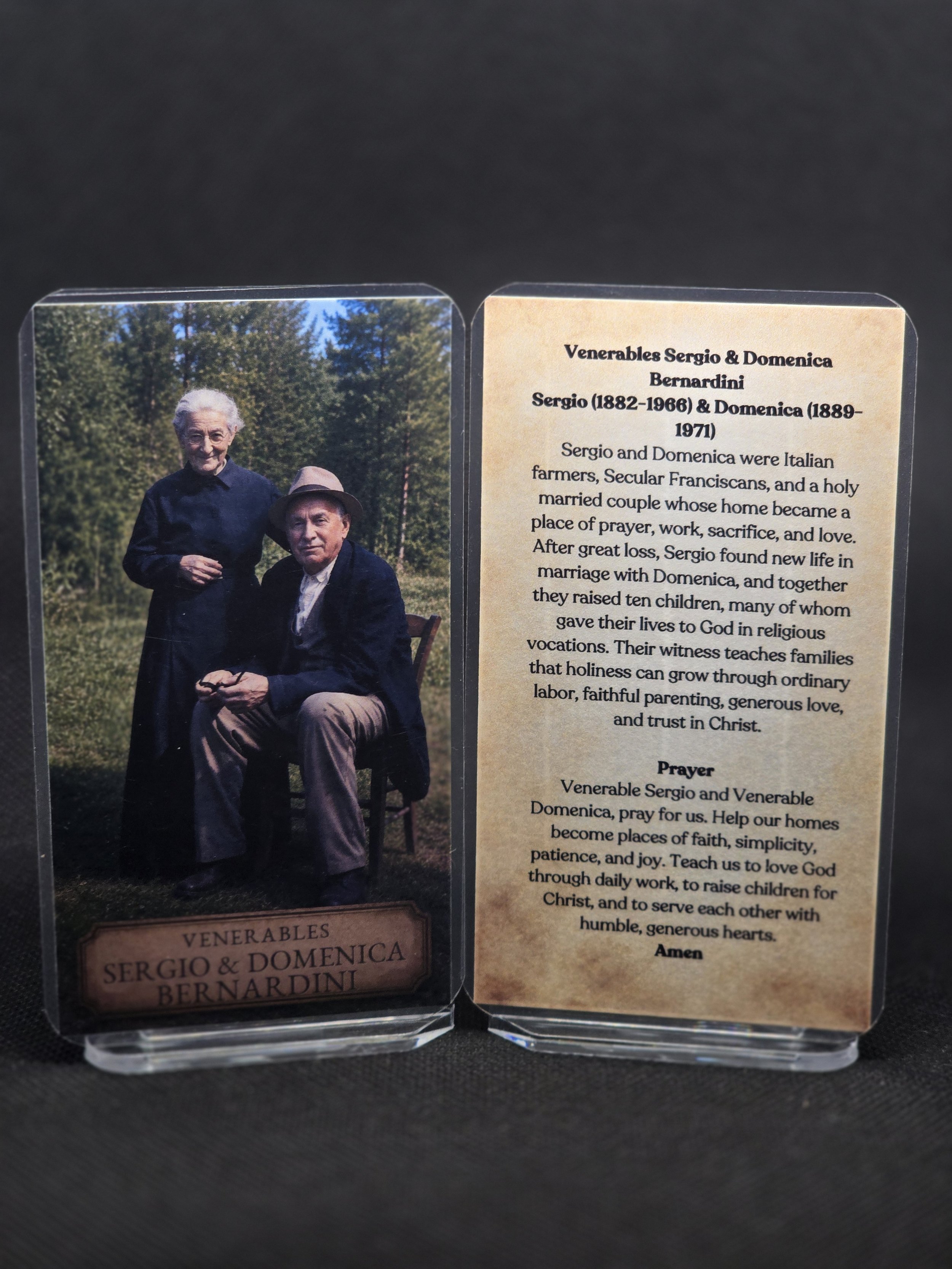
A Home Like a Small Church
The heart of their witness was the way they raised their children. Family prayer was the daily structure of the house. The children grew up seeing both parents at Mass and at the rosary, and seeing them treat work, sickness and money problems as matters to bring to God.
Around 1928 the couple became Pauline Cooperators, associates of the Society of St. Paul, a connection that fits with the later vocations of five daughters to the Daughters of St. Paul. Around 1938 to 1939 they became tertiaries of the Franciscan family, which likewise fits with the two sons who became Capuchins and the daughter who joined a Franciscan congregation.
In 1951 they set up a chapel in their home with the Blessed Sacrament reserved there. For a farm family to maintain a chapel inside their own house was unusual, and it is one of the details most often cited about their spiritual life.
Their story is easy to romanticize. The documents do not claim that raising ten children was easy or that every day was peaceful. They claim that the parents made faith the organizing principle of the household, and that the results, measured in vocations and in the character of their children, were remarkable.
Ten Children and Eight Vocations
Of the ten children, eight daughters and two sons, eight entered religious life. Five daughters joined the Daughters of St. Paul. One daughter joined the Franciscan Handmaids of the Good Shepherd. Both sons became Capuchins. Two daughters, Maria and Paola, married and had their own families.
The best known of the children is Giuseppe Germano Bernardini, a Capuchin who became Archbishop of Smyrna (Izmir) in Turkey. He died on December 3, 2023. His office placed a son of this Italian farm family at the head of a small Catholic community in a historic Christian city of the East, which is one of the few threads connecting the family to the wider Christian world.
The couple also supported a young Nigerian seminarian, Felix Alaba Job, who later became Archbishop of Ibadan. The family regarded him as an adopted son. UNCERTAIN: sources differ on whether this began in 1963 or 1964, and no legal adoption is established, so it is best understood as a spiritual and practical family bond.
Trials, Scruples and the Final Years
The Bernardinis lived through the First World War, the rise of fascism and the Second World War in a region that saw heavy political tension. The Vatican account mentions that in 1948 some local communists contemplated killing Sergio because of his visible Catholic commitment. UNCERTAIN: a fire in 1922 is also sometimes reported, but details vary and it should be read cautiously.
Sergio died on October 12, 1966, in Verica. In his final illness, which included arteriosclerosis, he is said to have suffered scruples and anxiety, an experience familiar to many devout people in old age. Domenica nursed him through it. TRADITION: Domenica believed that before he died he saw the Virgin Mary. This is a family and devotional report, not an approved apparition or a proven event.
Domenica lived another four years. She suffered a stroke on February 22, 1971, and died on February 27, 1971, in Modena. The parish register records her age as 82, but by the documented birth date she was 81, which is one of several small discrepancies in the record.
Their remains were later brought to the Capuchin Church of St. Francis in Pavullo nel Frignano, where they rest in the first chapel on the left, with some remains also associated with Verica. UNCERTAIN: the exact date of the transfer is not clearly established in the sources I could check.
The Path to Venerable
The cause for the Bernardinis was opened at the diocesan level in Modena. The diocesan inquiry ran from May 20, 2006, to May 18, 2008. For Sergio it held 29 sessions and heard 24 witnesses. For Domenica it held 27 sessions and heard 22 witnesses. The Church then examined the legal validity of the inquiry, issuing decrees on November 20, 2009, and February 20, 2010.
The theological consultors in Rome voted on December 18, 2014, and the cardinals and bishops of the Congregation (now Dicastery) for the Causes of Saints did so on April 21, 2015. Pope Francis authorized the decree of heroic virtue on May 5, 2015, and the Holy See Press Office announced it on May 6.
The cause treats the two spouses together, which is itself significant. In many causes a husband or wife is an incidental figure. Here the marriage is the subject. Their prayer was approved by Archbishop Benito Cocchi on November 5, 2009, and a prayer for married couples was later approved by Archbishop Erio Castellucci on May 2, 2022.
Beatification would require an approved miracle attributed to their intercession. At present only devotee testimonies are reported, and none has been formally recognized. They have no feast day assigned.
Why They Matter to Eastern Christians
Sergio and Domenica Bernardini were Latin Catholics. They lived in northern Italy, belonged to Franciscan and Pauline lay movements, and have no known connection to an Eastern Catholic or Orthodox church. There is no Eastern liturgical commemoration of them, and Orthodox Christians do not venerate them as saints.
There are still reasons an Eastern reader might pause over this story. Eastern Christianity has always held that marriage is a path to holiness, and that the family is a small church, the phrase the Fathers used for a household shaped by prayer. The Bernardini home, with its chapel and daily prayer, fits that vision closely.
The sacrifice of children to religious life also has a familiar echo in Eastern monastic cultures, where a family that gives a son or daughter to the monastery is honored. And the career of their son Archbishop Giuseppe Bernardini in Izmir places the family near the ancient Christian lands of Asia Minor, where Smyrna was one of the churches addressed in the Book of Revelation.
None of this makes them Eastern saints. It makes them a Western witness that Eastern readers can respect for the same reasons they respect their own married saints.
Lessons for Families Today
The first lesson is that grief does not have to end a life of faith. Sergio lost almost everyone close to him within a few years and still built a household centered on prayer. His story speaks to anyone who has had to start again after a loss.
The second lesson is that holiness fits ordinary labor. Neither spouse had status, wealth or education. They farmed, milled, cooked, raised children and prayed. Their cause is a reminder that the Church recognizes holiness in kitchens and fields as well as cloisters.
The third is the value of a spouse who helps the other along. Domenica nursed Sergio through his final scruples, and Sergio's perseverance shaped the household she helped build. Their marriage was not two separate pieties placed side by side but a shared life moving in one direction.
Finally, the account is a gentle caution against measuring success only by outcomes. Eight vocations from one family is striking, but the cause points to the parents' fidelity, not to the number.
Lord Jesus, you were born into a family and blessed the home at Nazareth. Bless every husband and wife who work, grieve, rejoice and pray together. Give them patience in hard seasons, forgiveness when they fail, and faith strong enough to hand on to their children. Through the prayers of Sergio and Domenica, may our homes become small churches. Amen.
This short prayer was written for this page. It is not an official prayer of the Church. The approved prayers for the cause are available through the diocese of Modena.
Sources and How to Read the Record
This article draws on the documentation published by the Dicastery for the Causes of Saints, the Holy See Press Office announcement of May 6, 2015, a scholarly study published in Mysterion in 2017 by Caroleo and Galluccio, and the committee site for the cause, coniugibernardini.it. Where sources disagree, the differences are marked above as UNCERTAIN.
Popular pages about the couple sometimes repeat wrong dates for Domenica, confuse the date of their wedding by a day, or describe the support of Felix Alaba Job as a formal adoption. When in doubt, the cause documents and the Holy See announcements are the safest guide.
Venerable status means the Church has recognized heroic virtue, not that every biographical detail has been proven. The family traditions, such as the vision of Mary at Sergio's death, are included as traditions and labeled that way.
Frequently Asked Questions
A Marriage That Became a Witness
Sergio and Domenica Bernardini show how a family of modest means and heavy sorrow can become a school of faith. If their example speaks to you, the prayer card below can keep it near your home.
View Prayer Card