Saint Eustace and Saint Theopista: The Stag Vision, a Family Tested Like Job and the Bronze Bull
The beloved legend of a Roman general who saw a cross between a stag's antlers, lost everything, and found his family again, and what history can and cannot confirm.
At a Glance
- Names
- Eustace (Eustathius, Placidas), his wife Theopista (Tatiana), sons Agapius and Theopistus
- Period
- Traditionally under Trajan and Hadrian, early second century; UNCERTAIN as history
- Place
- Traditionally Rome; the Acts are legendary
- Feast day
- September 20 (Byzantine and traditional Western date)
- Recognition
- Ancient cult; no canonization date; Fourteen Holy Helpers in the West
- Patronage
- Hunters, people in sudden misfortune, those threatened by fire
Who Was Saint Eustace?
Saint Eustace is one of the best loved martyrs of both the Eastern and Western Churches. According to the traditional story, he was a Roman general named Placidus who saw a shining cross between the antlers of a stag while hunting, was baptized with his wife and two sons, lost all his wealth, was separated from his family, and was at last reunited with them before the whole family died for the faith.
That story is told in the Acts of Saint Eustace, a text that scholars regard as legendary. The Catholic Encyclopedia classifies it as a legendary composition, probably from around the seventh century. So this article takes a careful approach. It tells the story the Church has told for centuries, marks the unverified parts as TRADITION, and says plainly what can and cannot be shown.
The core fact is simple. Christians venerated Eustace and his family from early times, and the cult is well documented. What cannot be shown is that every episode in his biography actually happened. Historians cannot even confirm for certain that a Roman soldier by this name existed. The devotion is real and old, and the biography is a story.
Placidus the Roman Commander
TRADITION: the Acts say that before his baptism the man was named Placidus (or Placidas) and served as a distinguished commander under Emperor Trajan, who reigned from AD 98 to 117. He was wealthy and married, and he had two sons. Although he worshiped the Roman gods, the story calls him generous toward the poor.
His wife is traditionally called Tatiana before baptism, though some Western versions give her earlier name as Trajana. After baptism she became Theopista, a name meaning roughly "faithful to God." The sons became Agapius and Theopistus. These names come from the hagiographical tradition, and manuscripts vary in spelling them.
UNCERTAIN: nothing independently establishes the family's background, rank or wealth. Some writers have tried to identify Eustace with an officer named Placidus mentioned by the Jewish historian Josephus, who served under Vespasian in the Jewish War. Cardinal Baronius proposed this link, but nothing ties that officer to Christianity or to Eustace's family. A man named Placidus did exist. That does not show that he was the saint.
The Vision of the Stag
TRADITION: the central scene occurs on a hunt. Placidus pursued a stag until the animal stopped and turned to face him. Between its antlers shone a cross with an image of Christ, and a voice told the hunter that Christ had come to call him. The story recalls the conversion of Saul in Acts 9 and of Cornelius in Acts 10, whose prayers and charity prepared him for the Church. These are literary and theological parallels, not proof that the vision occurred.
TRADITION: Placidus went home and found that his wife Tatiana had received a separate revelation. They went to a Christian bishop and were baptized with their sons, taking the new names Eustace and Theopista. According to the account kept by the Orthodox Church in America, the family was then admitted to the Eucharist.
Eustace returned to the place of the vision and, the story says, learned that he would suffer trials like those of Job. The account is ancient within Christian literature. Saint John of Damascus used material from the Eustace tradition in the third treatise of his Defense of the Holy Images, after AD 730, although a scholar of the text notes that the passage survives in a later manuscript tradition. The tale is strong evidence for how Christians told stories and built devotion, not for what happened in a forest.
Loss, Separation and Reunion
TRADITION: after their baptism, calamity struck the family. Servants died, animals perished and possessions were lost. The family left in poverty and journeyed on. On a sea voyage a ship captain took Theopista away from her husband and sons, and as Eustace traveled on with the boys, a lion and a wolf carried them off while he was crossing a river. Eustace did not know that both boys survived, rescued by strangers.
TRADITION: Eustace lived in obscurity and poverty. In time, Roman soldiers found him because the empire needed his skill for another campaign. Called back to command, he unknowingly enlisted his own sons. Their identities were gradually discovered, and Theopista was found and reunited with her husband and children. The story ends with their return to Rome.
These episodes follow a pattern familiar in ancient romances: separation, mistaken identity, recognition and reunion. The Catholic Encyclopedia compares the tale with the family-recognition story in the Clementine Recognitions. Some scholars have also looked for parallels in Indian storytelling, but UNCERTAIN: similarity does not prove that the author borrowed from any particular Indian or Buddhist work.
The Bronze Bull
TRADITION: after a victorious campaign, Eustace refused to join in sacrifices to the Roman gods, and Emperor Hadrian ordered the whole family to be thrown to wild beasts. The animals would not touch them, so the emperor had them shut inside a hollow bronze bull and heated by fire. The Acts say that they died together and that their bodies were found unharmed by the flames.
UNCERTAIN: no contemporary court record, army document or reliably dated eyewitness account supports this execution. The setting is plausible in a broad sense, since Christians were legally vulnerable under Trajan and Hadrian, but the details cannot be demonstrated. The tradition should not be used as evidence for a specific empire-wide campaign against Christian military families.
The traditional dating of the death varies. The Catholic Encyclopedia gives AD 118, Vatican News speaks of about AD 140, and these are traditional dates, not established ones. The bronze bull itself became so closely linked to the family that it appears as an attribute in later art, along with the stag.
Sant'Eustachio and the Relics
The documented history of Eustace's veneration becomes firmer in medieval Rome. The church of Sant'Eustachio existed by the early ninth century, and the Catholic Encyclopedia cites evidence from AD 827 and allows that it may be older. A surviving medieval inscription of 1196, from the reconsecration of the church under Pope Celestine III, records the claim that relics of Eustace and his companions rest beneath the altar.
These are documented claims of possession, not proof that the relics are authentic. Other relics were traditionally linked with Saint-Denis and with Saint-Eustache in Paris, and their identification is also uncertain. The Roman tourism authority notes an urn beneath the high altar of Sant'Eustachio that is associated with the family.
Eustace and his family were honored long before the modern procedures for papal canonization existed, so there is no canonization date. It would be misleading to assign a year or to suggest that they went through a formal investigation of the modern kind. The same is true of any Orthodox glorification date, since their cult simply grew in the early Church.
Eustace and the Fourteen Holy Helpers
In the Western Church, Eustace became one of the Fourteen Holy Helpers, a group of saints invoked in particular dangers and sufferings, which became especially popular in late medieval Germany. His link to hunters arose naturally from the stag vision, and his link to fire from the story of the bronze bull. People in sudden misfortune also turned to him, because his story is one of everything being lost and then given back.
His iconography is easy to recognize: a stag bearing a cross or an image of Christ between its antlers, a hunter or soldier, and sometimes a bronze bull. The vision of Saint Eustace was a favorite subject of medieval and Renaissance painters, including Pisanello, whose painting hangs in the National Gallery in London.
A very similar stag-and-cross vision appears in the story of Saint Hubert, another patron of hunters, and the two saints are often confused. They belong to separate hagiographical traditions, and Hubert is especially linked to Liège, while Eustace's story is set in imperial Rome.
Eustace in the Roman Martyrology
The revised Roman Martyrology of 2004 keeps Eustace's commemoration on September 20, but it no longer repeats the older account of the family's martyrdom in detail. This reflects a difference between recognizing that a cult is old and accepting a particular story of death. Eustace is not on the current General Roman Calendar for the whole Church.
In the Byzantine tradition the family is honored together on September 20, as the Greek Orthodox Archdiocese and the Orthodox Church in America both show. The Catholic Encyclopedia also records November 2 as an Eastern observance, and medieval Western calendars used dates around November 1 to 3, but these should not be confused with current Byzantine practice.
For the Eastern Churches, the memorial is a collective one. The hymns speak of the whole household, father, mother and sons, sharing one victory in Christ, which is a different emphasis from the Western tradition, where Eustace alone often stands in the foreground.
O God, who called your servant Eustace through the beauty of creation and kept his family through every loss, we pray for all who have lost home, health or loved ones. Hold families together when they are scattered, bring home those who are far away, and give us the patience of Job and the hope of Theopista. Through the prayers of Saints Eustace, Theopista, Agapius and Theopistus, keep us faithful until we are all reunited in your kingdom. Amen.
This is a short prayer written for this page. It is not an official liturgical text. For the Church's own hymns, see the troparion and kontakion for September 20 published by the Orthodox Church in America.
Why They Matter to Eastern Christians
Eustace and his family have a well documented place in Byzantine worship. The Orthodox Church in America publishes a troparion and a kontakion for the day, and the Greek Orthodox Archdiocese commemorates them together on September 20. This gives a firm basis for speaking about their importance in Orthodox and Byzantine Catholic devotion, whatever one thinks of the details in the Acts.
Their story carries themes that Eastern Christians prize. Grace can call a person who has not yet heard the Gospel, as it called Cornelius. Endurance means fidelity within suffering, not freedom from it, as the example of Job shows. And a Christian household can bear a shared witness, with the wife receiving her own revelation and choosing baptism herself.
The tale also connects to the Eastern teaching about holy images. A scholar of the text has examined how the stag vision functioned in the theology of icons during the iconoclast controversy, since John of Damascus used it in defense of sacred images. These connections show the importance of the family in Eastern tradition. They do not prove the historical accuracy of the Acts, and there is no evidence of a special link between them and the Maronite Church.
Frequently Asked Questions
A Saint for Families Who Have Lost Everything
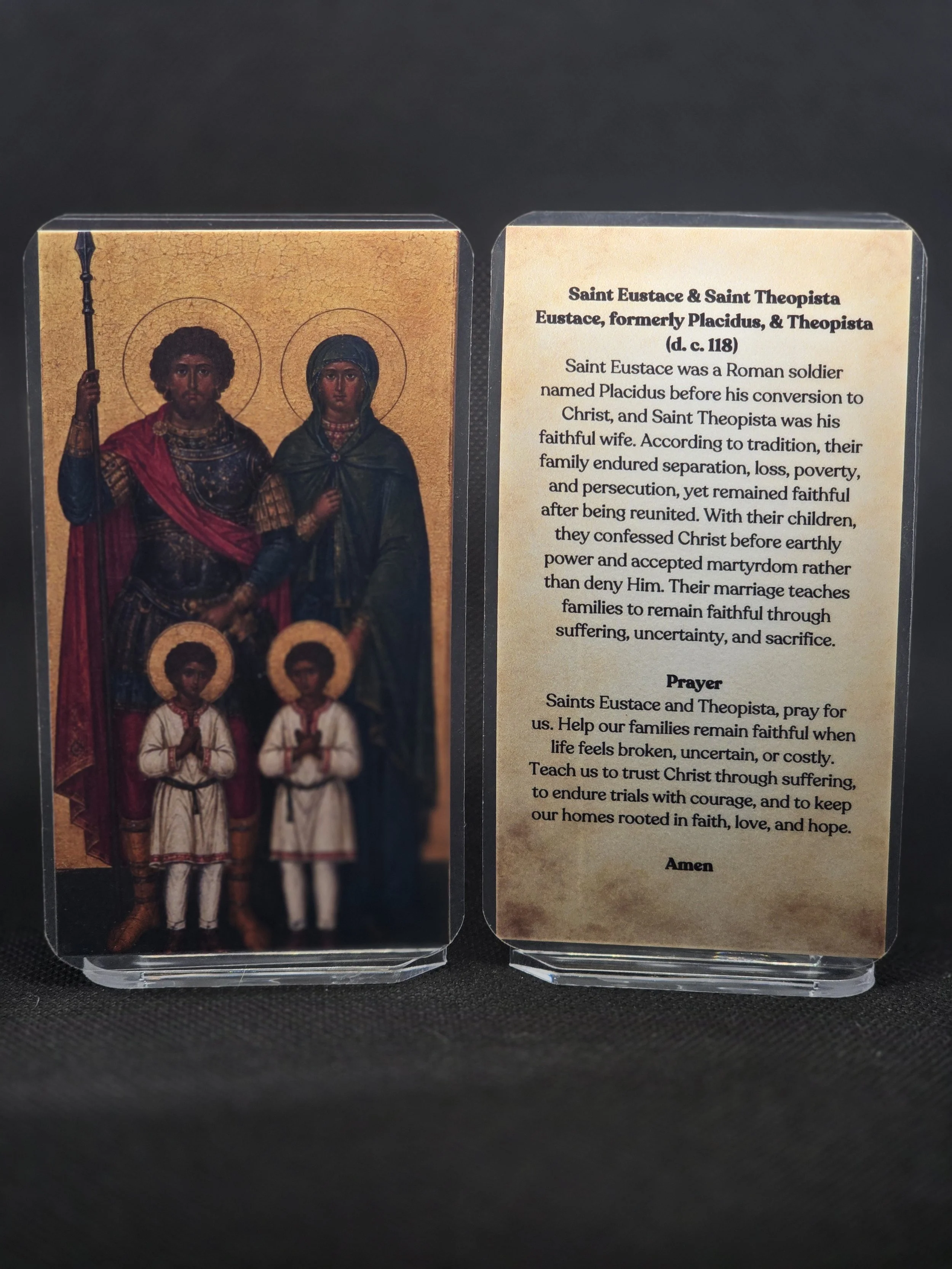
Whatever the historians conclude about the details, Christians have turned to Eustace and his family for centuries when life fell apart. If you would like their prayer card as a reminder that nothing is lost to God, you can find it below.
View Prayer Card