Blessed Franz Jägerstätter: Austrian Farmer, Husband and Martyr of Conscience, with His Wife Franziska
An Austrian farmer and sacristan who refused the oath to Hitler, and the wife whose love and difficult consent made his witness possible.
At a Glance
- Franz
- Born May 20, 1907, St. Radegund, Upper Austria; executed August 9, 1943, Brandenburg an der Havel
- Franziska
- Born March 4, 1913, Hochburg; died March 16, 2013, St. Radegund, aged 100
- Marriage
- April 9, 1936; three daughters together
- Recognition
- Franz beatified October 26, 2007, in Linz Cathedral; Franziska was never beatified
- Memorial
- May 21 (Diocese of Linz) or August 9 (Dicastery for the Causes of Saints list)
- Associations
- Conscience, peace, resistance to tyranny; Franciscan tertiary
- Who Was Franz Jägerstätter?
- A Village Boy Named Huber
- Hildegard and a Complete Biography
- Marriage and a Pilgrim Honeymoon
- The Annexation and a Lone No
- Conscience, Counsel and Franziska
- Arrest, Prison and Sentence
- Ashes, Relics and a Long Silence
- Beatification and Devotion
- Why He Matters to Eastern Christians
- Frequently Asked Questions
Who Was Franz Jägerstätter?
Franz Jägerstätter was a farmer in the small Austrian village of St. Radegund, in Upper Austria. He was a husband, the father of daughters, the sacristan of his parish and a member of the Third Order of Saint Francis. On August 9, 1943, he was executed by guillotine at Brandenburg an der Havel, Germany, for refusing to serve in the army of Nazi Germany. He was thirty-six years old.
The Catholic Church recognized him as a martyr, and Pope Benedict XVI approved the decree on June 1, 2007. Cardinal José Saraiva Martins presided at his beatification in Linz Cathedral on October 26, 2007. He is Blessed Franz Jägerstätter, and he has not been canonized.
An important distinction runs through this article. Franziska, his wife, was not beatified. She is an honored witness, and her life is a part of the story, but she should not be called Blessed in an article about official Church titles. Where this article speaks of the couple, it means a married pair whose letters and choices are among the best documented of any Catholic witnesses of the twentieth century.
A Village Boy Named Huber
Franz was born on May 20, 1907, in St. Radegund. His mother, Rosalia Huber, was an unmarried farm servant, and his father, Franz Bachmeier, was a farm laborer. Poverty kept them from marrying, and his father died during the First World War. The boy was born Franz Huber and spent much of his childhood with his maternal grandmother, Elisabeth Huber.
In 1917 his mother married a farmer named Heinrich Jägerstätter, who adopted the boy and gave him the name by which he is known. Franz had limited formal schooling, but he loved reading, and his adoptive grandfather encouraged him. It would be a mistake to treat him as an uninformed peasant. He became a serious independent reader, especially on religious and moral questions.
His youth was not saintly in the usual sense. He enjoyed company, sometimes fought with other young men, and became known for owning one of the first motorcycles in the village. Between 1927 and 1930 he worked in the iron-ore mines at Eisenerz in Styria, where, according to the sources, he went through a significant crisis of belief and identity.
Hildegard and a Complete Biography
In 1933, before his marriage, Franz became the father of a daughter, Hildegard, whose mother was Theresia Auer. The Diocese of Linz acknowledges this relationship and records that he kept up a good relationship with his daughter. A complete biography should not leave this out, and the Church itself does not hide it.
It matters for how we read his life. Franz did not begin as a model of virtue. He was a young man who made serious mistakes, as many do, and who grew into a very different kind of person. His story is often told as a conversion, but the sources show something more gradual: a return to committed Catholic practice through reading, struggle, responsibility and marriage, not through a single dramatic event.
Franziska Schwaninger was born on March 4, 1913, in Hochburg, Upper Austria, the child of Lorenz Schwaninger and Maria Zeitelmeier. She grew up in a large farming family in which prayer and interest in current events were part of life. She worked on the family farm and in the kitchen of an inn, and the couple met through the local social world around an inn and its bowling alley.
Marriage and a Pilgrim Honeymoon
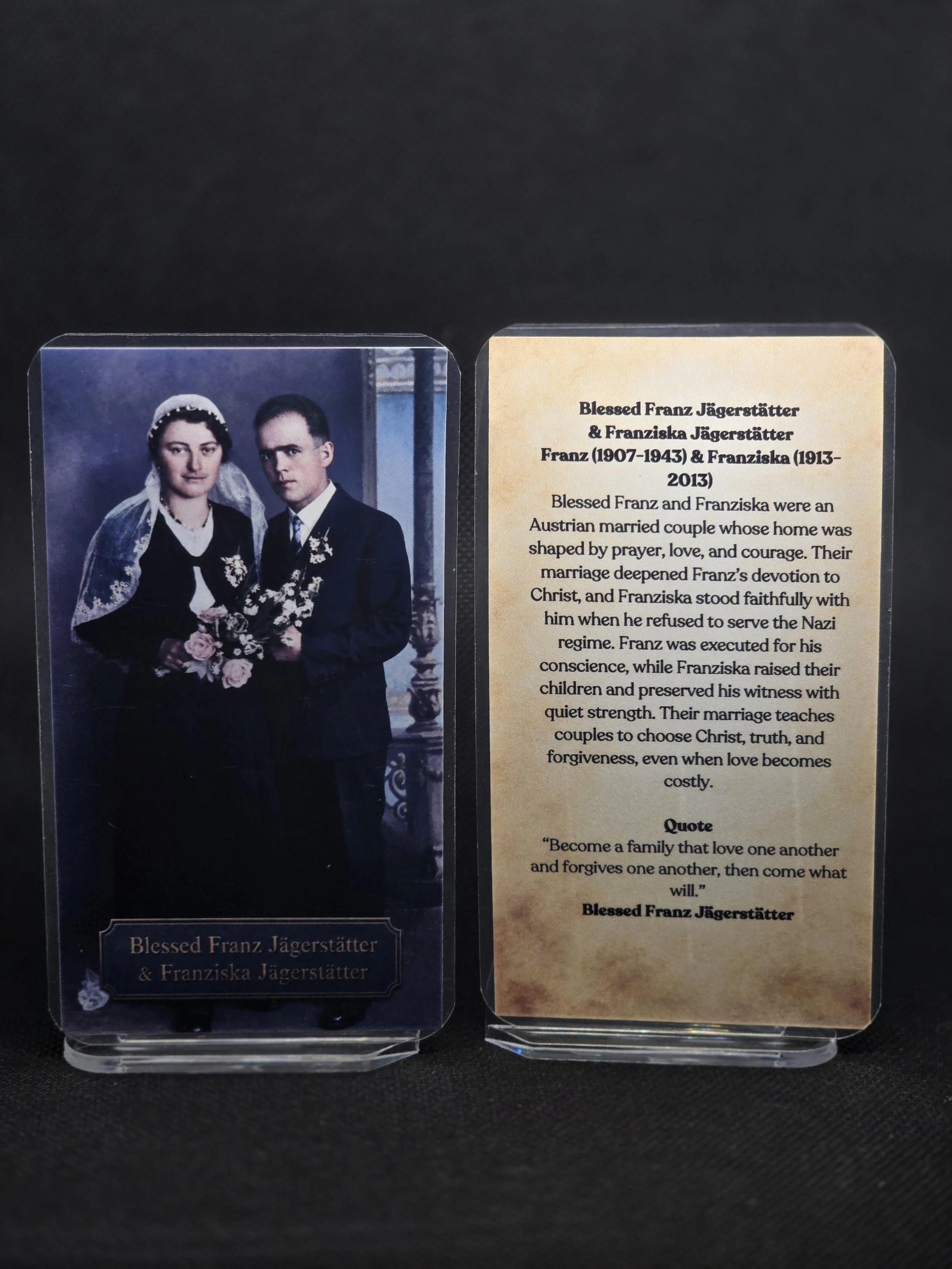
Franz and Franziska were married on Holy Thursday, April 9, 1936, and they spent their honeymoon on a pilgrimage to Rome. Their daughters Rosalia, Maria and Aloisia were born in 1937, 1938 and 1940. The family worked a small farm, and their surviving letters show affection, shared faith and worry about the ordinary tasks of raising children and keeping up the land.
Franziska encouraged shared prayer, Bible reading and frequent communion. Franz became more involved in parish life and eventually served as the sacristan, the person who prepares the church for services. UNCERTAIN: Vatican material places the start of his sacristan work in 1936, while a detailed Linz biography places it in 1941. The later date is supported by other accounts, and parish records would need to be checked.
On December 8, 1940, while serving briefly in the military, Franz was received into the Third Order of Saint Francis. His letters confirm this. He was not a theologian, priest or founder of any institution. His vocation was marriage, farming and service to his parish, and the Church recognized in that ordinary life a heroic witness.
The Annexation and a Lone No
Nazi Germany annexed Austria in March 1938, and a referendum on the annexation took place on April 10. Franz had at first planned to stay away, but he went and voted no. The Vatican biography says he was the only person in St. Radegund to vote against the annexation. Other accounts say that local officials suppressed his ballot.
UNCERTAIN: his opposition is firmly documented, but the official vote count cannot show how many people privately disagreed, especially under the intimidation of the time. It is safer to say that he was remembered as the village's only openly known dissenter.
He grew more convinced that Christianity and National Socialism were incompatible. He had watched the regime persecute Catholic clergy, and he learned of the killing of disabled and psychiatric patients. He came to see a military oath to Hitler as something a Christian could not take. His writings show a man who read, thought and prayed over the matter for years.
Conscience, Counsel and Franziska
Franz was called up in 1940 and trained for a time, then was released to farm. When more conscription notices came, he sought advice through prayer, fasting and conversations with priests. He also met with the bishop of Linz, Joseph Calasanz Fließer, who warned him about his duties as a husband and father and did not endorse his refusal. Many contemporaries thought his decision irresponsible toward his family.
Franziska first tried to talk him out of it. She understood that his choice could leave her a widow and their daughters fatherless. In the end she supported him, but the sources show that this came through fear, disagreement and pressure. It would be false to say she encouraged her husband's death or was at peace with it from the start. Her consent was costly, and it belongs to the heart of the story.
His position cannot be reduced to a blanket pacifism. He opposed service under the Nazi regime, which he judged to be waging an unjust war, and he offered to serve as a medic, a proposal that was rejected. A scholar of his writings, William Stewart Skiles, argues that they do not necessarily rule out service under a government he thought just.
Arrest, Prison and Sentence
Franz reported to the induction center in Enns on March 1, 1943. The more detailed chronology based on his letters says he formally declared his refusal on March 2. He was arrested and held in Linz, then transferred to Berlin-Tegel in May. His refusal also covered the oath of unconditional loyalty to Hitler.
On July 6, 1943, the Reich Military Court sentenced him to death for undermining military morale, an offense the Nazis called Wehrkraftzersetzung. His lawyer hoped that his wife and a priest might still persuade him to change his mind. Franziska was allowed one last visit on July 13, and Franz kept to his decision.
He wrote letters to his family from prison, and they express his concern for his wife, his daughters and his farm. On August 9, 1943, he was taken to Brandenburg-Görden prison and executed at about four in the afternoon. The prison chaplain, Albert Jochmann, later testified to his calm and his faith.
Ashes, Relics and a Long Silence
Franz was cremated, and his ashes were saved in an urn. Franciscan sisters helped to keep track of the burial place and to bring the ashes back to Austria. The urn was buried at St. Radegund on August 9, 1946. Several bone fragments had been set aside before the burial, and a documented fragment was later placed in a reliquary in Linz Cathedral.
Franziska went on living in St. Radegund. Some neighbors treated her coldly, but she raised her daughters, ran the farm and kept alive the memory of her husband. Later she served as sacristan for more than thirty years, and she was also a lector, an extraordinary minister of Holy Communion and a leader in the local Catholic women's movement.
The wider world learned of Franz largely through the American sociologist Gordon Zahn, whose 1964 book, In Solitary Witness, brought his story to an international audience. On May 7, 1997, a Berlin court annulled the Nazi death sentence, and the diocesan beatification process was opened the same year.
Beatification and Devotion
Franz was beatified as a martyr, which meant that no miracle was required. The sources show no formally approved miracle attributed to his intercession. At the ceremony on October 26, 2007, Franziska, then ninety-four years old, was present and carried a relic of her husband to the altar. This was the beatification of Franz alone, not a joint beatification of the couple.
TRADITION: Franz described a dream of a train carrying crowds toward destruction, which he understood to stand for the Nazi movement. It comes from his own writings and is not a later legend, but its supernatural character cannot be verified. It is best described as a dream he reported. Franziska also recalled feeling a strange closeness to him around the time of his execution, a personal memory that no one has independently confirmed.
Franziska received the papal Pro Ecclesia et Pontifice distinction in 2010 and died on March 16, 2013, at the age of one hundred. She was buried beside Franz in St. Radegund. The memorial of Blessed Franz is kept on May 21 in the Diocese of Linz, and the Dicastery for the Causes of Saints lists August 9. Because these official sources differ, neither date should be presented as the only one.
God of truth, you gave your servant Franz the courage to follow his conscience at the cost of his life, and you gave his wife Franziska the strength to love him through it. Help us to see clearly, to choose honestly and to stand firm when the world demands what we cannot give. Bless husbands and wives who face hard choices together. Through the prayers of Blessed Franz, keep us faithful to Christ. Amen.
This is a short prayer written for this page. It is not an official liturgical text. Pax Christi Austria and the Diocese of Linz publish their own prayers for Blessed Franz.
Why He Matters to Eastern Christians
Franz Jägerstätter belonged to the Latin Catholic Church. His beatification does not mean that the Orthodox Churches recognize him, and no Orthodox glorification, Byzantine service or feast has been verified. No source supports a claim that he has a place on any Eastern calendar.
Still, his life can be read next to Eastern teaching about martyrdom, repentance and obedience to God before human rulers. The principle of Acts 5, that we must obey God rather than men, stands behind his choice, and Eastern Christians who lived under Communist rule have faced similar choices. These are theological parallels, not evidence of a shared devotion.
His story also carries a quieter lesson that Eastern readers will recognize. Holiness grew in a marriage, a farm and a parish sacristy, and it needed a spouse who prayed, questioned and finally consented at great cost. For anyone who must choose conscience over comfort, the couple's letters are a good place to begin.
Frequently Asked Questions
A Witness Who Was Also a Husband
Franz Jägerstätter did not act alone. He acted from a farm, a marriage and a parish, and with a wife who paid dearly for his choice. If you would like their prayer card as a reminder to follow conscience, you can find it below.
View Prayer Card