Saint Elijah the Prophet: Tishbite, Defender of Covenant Faith and Witness at Horeb
The fiery prophet of ninth century Israel who stood against Baal worship, heard God in a quiet voice on Mount Horeb, and was taken up in a whirlwind.
At a Glance
- Period
- Ninth century BC, northern Kingdom of Israel, reigns of Ahab and Ahaziah
- Origin
- Called "the Tishbite," associated with Gilead; birth not recorded (UNCERTAIN)
- End of life
- No death recorded; taken up in a whirlwind (2 Kings 2)
- Feast day
- July 20 (Orthodox, Byzantine Catholic, Maronite and Roman Martyrology); August 2 on the civil calendar for Julian-calendar Churches
- Recognition
- Biblical prophet honored from ancient times; no canonization date
- Customary intercessions
- Drought and weather, courage in spiritual struggle; spiritual father of the Carmelites
- Who Was Elijah?
- The Tishbite from Gilead
- The Drought and the Wilderness
- The Contest on Mount Carmel
- Despair and the Voice at Horeb
- Naboth's Vineyard and the Cry for Justice
- Elisha and the Whirlwind
- What Is Tradition and What Is Not
- Elijah in Eastern Worship
- Why Elijah Matters to Eastern Christians
- Frequently Asked Questions
Who Was Elijah?
Elijah is one of the most striking figures in the Old Testament. He appears suddenly in the First Book of Kings, announces a drought to the king of Israel, and then disappears and reappears in a series of dramatic encounters that end with his departure from the earth in a whirlwind. His name in Hebrew means "My God is the LORD," and that phrase sums up his whole mission.
Almost everything certain about him comes from the biblical books of Kings, mainly 1 Kings 17 to 19 and 21, and 2 Kings 1 and 2. Those stories belong to the ninth century BC, when Ahab and then Ahaziah ruled the northern Kingdom of Israel. Later Jewish and Christian tradition added many details, and this article tries to keep Scripture and tradition clearly apart, marking the later material as TRADITION.
Elijah matters far beyond his own time. He stands beside Moses at the Transfiguration of Christ, he is honored on July 20 across the Orthodox and Eastern Catholic Churches, and the Carmelite Order calls him its spiritual father. The Church has never assigned him a canonization date, since his holiness is part of the ancient inheritance Christianity received from Israel.
The Tishbite from Gilead
The Bible tells us almost nothing about Elijah's childhood, parents or education. He first appears in 1 Kings 17 as "Elijah the Tishbite," a man associated with Gilead, the region east of the Jordan River. Even the meaning of "Tishbite" and the location of Tishbe are uncertain. Unlike Moses, Samuel or John the Baptist, Elijah has no birth story in the canonical text.
TRADITION: the Orthodox Church in America preserves a hagiographical account that names Elijah's father as Sobach and describes angels surrounding the newborn with fire. It is attributed to Saint Epiphanius of Cyprus, but the exact early source has not been established, so it should be read as a pious tradition and not as a verified event.
TRADITION: some Eastern lives also say that Elijah belonged to the tribe of Levi, even to the family of Aaron, and that he lived as a young ascetic in the wilderness. Scripture does not say this. It does not mention a wife or children either, but silence is not proof that he was celibate. What the text does make clear is his identity: he is a servant of the God of Israel who speaks with authority against the policies of the king.
The Drought and the Wilderness
Elijah's public ministry begins with a bold announcement. He tells King Ahab that no dew or rain will fall except at his word. The story opens a struggle between the worship of the LORD and the worship of Baal, a storm and fertility god honored among Israel's Phoenician neighbors. The queen, Jezebel, was the daughter of the king of Sidon, and her marriage to Ahab brought Baal worship into the royal court.
God then sends Elijah into hiding. He lives beside the brook Cherith, where the text says ravens bring him bread and meat. When the brook dries up, he is sent to Zarephath, a town in Sidonian territory, to stay with a widow. Her small supply of flour and oil lasts through the famine, and later Elijah prays for her son, who had died, and the boy lives.
The Zarephath story shows that Elijah's ministry reaches beyond Israel. Jesus himself recalls it in Luke 4, noting that Elijah was sent to a foreign widow when many widows in Israel went without help. For Christian readers, the episode is a sign that God's mercy is wider than the boundaries people draw.
The Contest on Mount Carmel
After about three years, Elijah returns to confront Ahab and calls the people to Mount Carmel. James 5 gives the length of the drought as three and a half years. Before the people and 450 prophets of Baal, Elijah asks a direct question: how long will they limp between two opinions? The contest is simple. Each side prepares a sacrifice and calls on its god to answer with fire.
The prophets of Baal call from morning until evening without result. Elijah then rebuilds the altar of the LORD, soaks the offering with water, and prays a short prayer. The narrative says fire falls and consumes the sacrifice, and the people proclaim that the LORD is God. Elijah then prays for rain, and the drought ends.
Honesty requires mentioning what follows. Elijah has the prophets of Baal seized and killed at the Kishon Valley. This is part of the ancient world described in Kings, and a responsible biography should not hide it. Its presence in Scripture does not mean that Christians may imitate such violence against religious opponents. In 2 Kings 1, a related story describes fire consuming soldiers sent by King Ahaziah, and the same caution applies.
Despair and the Voice at Horeb
The most human part of Elijah's story comes right after his triumph. Threatened by Jezebel, he runs into the wilderness, sits down under a broom tree and asks God to let him die. He is frightened, exhausted and convinced that his work has failed. An angel wakes him twice and gives him bread and water, and he walks for forty days and forty nights to Mount Horeb.
There God asks him why he has come. Elijah answers that he alone is left. Then comes a famous scene: a great wind, an earthquake and a fire pass by, but the LORD is not in them. After the fire comes what the New American Bible calls a "light silent sound," often rendered as a still small voice. Many Christian writers have seen in this scene a picture of how God is often found in quiet.
God does not scold him. He gives him new tasks and tells him that seven thousand people in Israel have not bowed to Baal. Elijah is never alone, though he felt that way. Pope Francis, in a 2020 audience on Elijah's prayer, connected him with the monastic tradition and described his prayer as joined to concern for others and resistance to injustice.
Naboth's Vineyard and the Cry for Justice
Elijah was not only a defender of right worship. In 1 Kings 21, King Ahab wants the vineyard of a man named Naboth, who refuses to sell it because it is his ancestral inheritance. Jezebel arranges false charges against Naboth, and he is put to death. Ahab then takes the vineyard.
Elijah meets the king in the vineyard and condemns him. The story shows that the prophet's mission includes protecting the innocent and the poor against the powerful. For the writers of Kings, true worship of God and justice toward neighbors cannot be separated.
Notice also the pattern. Elijah is not a court prophet who blesses the king. He speaks independently of the royal establishment, and scholars of the Elijah narratives often point to that independence as one of his defining features. It is one reason the Church fathers and monks later saw him as a model of fearless truth.
Elisha and the Whirlwind
At God's command, Elijah finds Elisha plowing and throws his mantle over him, a sign that Elisha will be his successor. Elisha follows him as his servant and disciple. The relationship becomes one of the great examples of the transmission of prophetic responsibility from teacher to student, a theme that appears often in the hymns for Elijah's feast.
The last journey is told in 2 Kings 2. Elijah and Elisha travel together through Bethel and Jericho to the Jordan River. Elijah strikes the water with his mantle and the river divides, and the two cross on dry ground. Elisha asks for a double portion of Elijah's spirit, a request that commentators link with the inheritance of a firstborn heir.
Then a chariot of fire and horses of fire separate the two men, and Elijah goes up in a whirlwind. The text says he ascended in the whirlwind, and it does not say he rode inside the chariot, though icons usually show him in one. Elijah has no recorded death, no tomb and no relics, and the history of the mantle that fell from him cannot be traced.
What Is Tradition and What Is Not
Many things people say about Elijah come from tradition and not from Scripture. The prophet is not credited with a book of oracles. 2 Chronicles 21 contains a letter attributed to him, addressed to King Jehoram of Judah. UNCERTAIN: this attribution is disputed because of chronology, and it should be described as a biblical text attributed to Elijah, not as an authenticated surviving letter.
TRADITION: Malachi promises that Elijah will return before the day of the LORD, and the New Testament connects that promise to John the Baptist, who came in the spirit and power of Elijah. Some Orthodox hagiography also holds that Elijah will return to confront the Antichrist, associated with the two witnesses in Revelation 11. UNCERTAIN: Revelation does not name those witnesses, and the Orthodox Church in America acknowledges different interpretations.
TRADITION: Jewish custom reserves a cup for Elijah at the Passover Seder and a chair for him at circumcisions, and these practices come from later interpretation. The Carmelites honor Elijah as their spiritual father, but the Order itself arose among Christian hermits on Mount Carmel at the end of the twelfth century, not in Elijah's lifetime. It claims a spiritual inheritance from him, not a historical foundation.
Elijah in Eastern Worship
July 20 is the feast of the Holy, Glorious Prophet Elijah in the Orthodox and Byzantine Catholic Churches, and it is also recorded in the Maronite calendar and the Roman Martyrology. Churches that follow the Julian calendar keep July 20 on a date that falls on August 2 on the civil calendar today. It is a commemorative feast, not a verified anniversary of a birth or death.
Eastern hymns for the feast dwell on his fiery ascent, the encounter at Horeb, his intercession and the passing of his mission to Elisha. The Orthodox Church in America publishes a troparion in the fourth tone and a kontakion in the second tone for the day. Orthodox Christians have traditionally invoked him for rain and good weather, and the Byzantine Catholic custom of blessing vehicles on his feast draws on the chariot imagery.
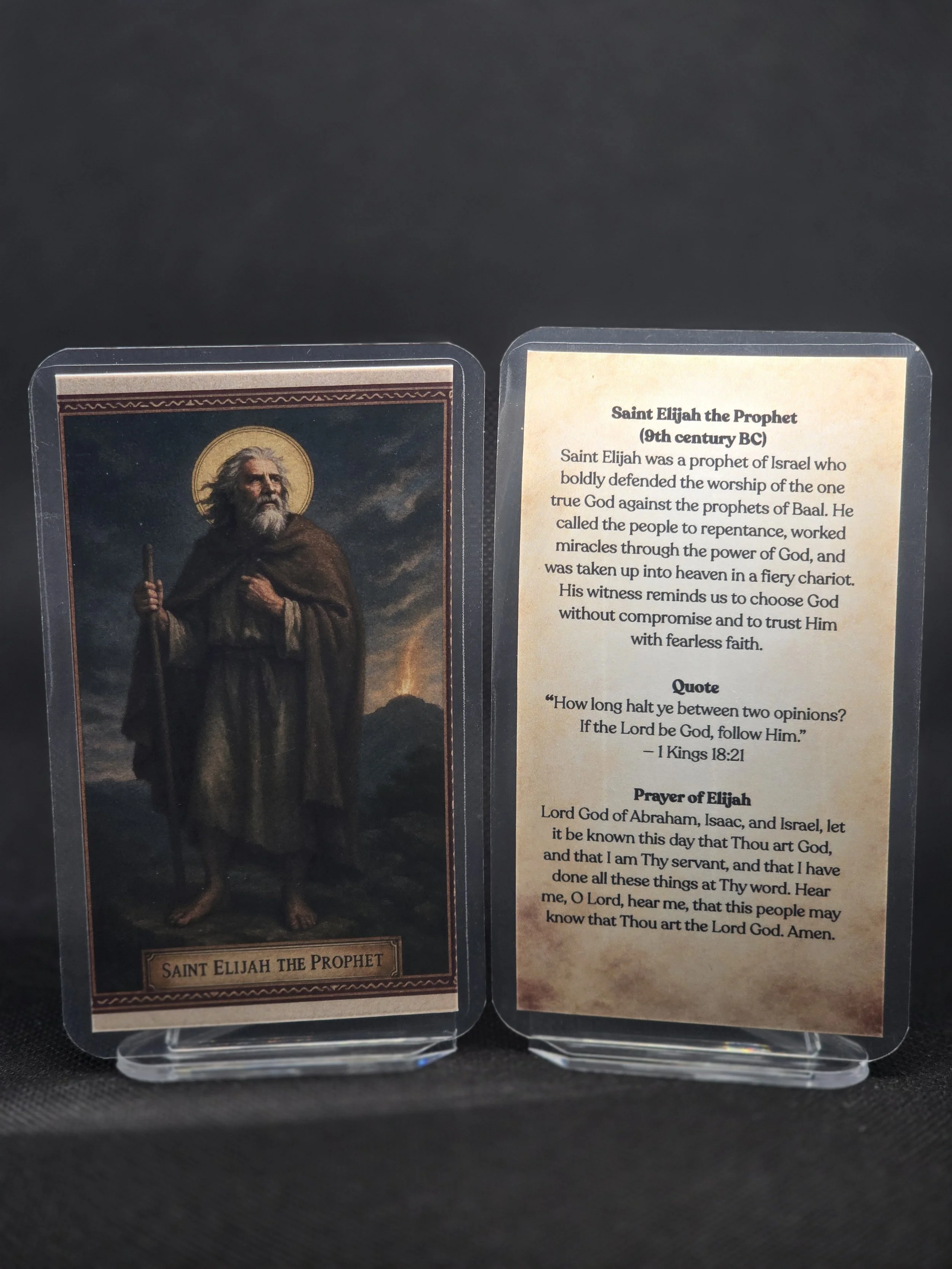
In Eastern icons Elijah is often shown in a fiery chariot, or seated in a cave fed by a raven. The art teaches theology, not a record of detail, and it makes the point that Elijah, a man of action, is also a man of prayer and silence. That union of zeal and contemplation is a large part of why Eastern monks honor him.
Lord God of Elijah, you gave your prophet courage to speak the truth and gentleness to hear you in the quiet. When we are tired, afraid or alone, send us bread for the journey and a word of hope. Teach us to stand for what is right without hatred, and to find you in silence. Through the prayers of the holy prophet Elijah, strengthen us in faith. Amen.
This is a short prayer written for this page. It is not an official liturgical text. For the Church's own hymns, see the troparion and kontakion for July 20 published by the Orthodox Church in America.
Why Elijah Matters to Eastern Christians
Elijah has an unusually high place in Eastern Christianity because his life joins prophetic zeal, desert withdrawal, intercessory prayer and an encounter with the glory of God. Eastern monastic writers have often seen him as a forerunner of the monk, and Horeb as an image of the quiet prayer that follows struggle.
Most important is the Transfiguration. In Luke 9, Moses and Elijah appear with Jesus and speak about what he is about to accomplish in Jerusalem. The Church reads them as representatives of the Law and the Prophets, who point to Christ as the fulfillment of God's revelation. That appearance gives Elijah a permanent place in the Church's Gospel and its hymns.
Elijah is also a saint for people who are worn out. His collapse after Carmel shows that even a zealous servant of God can feel fear, burnout and loneliness, and that God answers with food, rest and a new task. Many people keep his prayer card for courage to stand for God, and for hope when strength has run out.
Frequently Asked Questions
The Prophet of the Still Small Voice
Elijah was bold on Carmel and broken at Horeb, and God met him in both places. If you would like his prayer card as a reminder of courage and of quiet, you can find it below.
View Prayer Card