Saint Elzear and Blessed Delphina of Sabran: Provencal Nobles, Franciscan Tertiaries and a Celibate Marriage
A medieval count and countess of Provence who kept their estates, served the poor, and, according to their earliest biographers, chose to live together in chaste marriage.
At a Glance
- Elzear
- Born c. 1285 or 1286; died September 27, 1323, in Paris
- Delphina
- Born c. 1283 or 1284, probably Puimichel; died November 26, 1360, at Apt
- Status
- Elzear canonized April 15, 1369 (papal letters 1371); Delphina venerated as Blessed
- Feast days
- September 27 (Elzear), November 26 (Delphina), joint Franciscan memorial September 26
- Titles
- Count and Countess of Ariano; Franciscan tertiaries
- Patronage
- No official patronage verified; held up as an example for Christian spouses
- Who Were Elzear and Delphina?
- The Families of Sabran and Signe
- A Marriage Arranged by Families
- Stories of a Celibate Marriage
- Count of Ariano and Lord of Ansouis
- Trials and the Spiritual Franciscans
- Death of Elzear in Paris
- Canonization of Elzear
- Delphina after Elzear
- Miracles and Devotion
- Why They Matter to Eastern Christians
- Frequently Asked Questions
Who Were Elzear and Delphina?
Saint Elzear and Blessed Delphina of Sabran were a married couple of the Provencal nobility who lived in the late thirteenth and fourteenth centuries. He was a count with lands in southern France and in the Kingdom of Naples. She was a countess who outlived him by nearly four decades. Both belonged to the Franciscan Third Order, the lay branch for people who wished to live a penitential life in the world.
They are best remembered for a very unusual claim: that they married, shared a household and a public life, and chose to live together without sexual relations. Their medieval biographers present this as the center of their holiness. This article treats the claim carefully. Contemporaries testified to the couple's continence, and that testimony is part of the record, but no historian can verify the private details of a marriage seven centuries ago.
A note on titles is helpful at the start. They are often called "Saints Elzear and Delphina," but the Church's usage is more precise. Elzear was canonized, while Delphina's process was never completed, and she is venerated as Blessed. The couple's story is better documented than most medieval saints, because part of Delphina's canonization inquiry survives, with the testimony of witnesses who knew her.
The Families of Sabran and Signe
Elzear belonged to the powerful family of Sabran, which held lands in Provence and had close ties to the Angevin dynasty that ruled the Kingdom of Naples. His father, Hermegnaud of Sabran, held the title Count of Ariano in Italy. The year of Elzear's birth is uncertain: the Catholic Encyclopedia gives 1285, while the historian Andre Vauchez gives 1286.
Elzear received a more thorough religious education than most young noblemen of his day. He studied at the Benedictine abbey of Saint-Victor in Marseille, where his uncle William was abbot. That upbringing placed him in contact with monastic prayer and learning before he took on the political and military duties expected of his family.
Delphina, also called Dauphine, came from the noble family of Signe. The historian Marthe Dulong names her parents as Guillaume de Signe and Delphine de Barras. She lost her parents as a child and was raised under the care of relatives, among them religious women who introduced her to prayer and to the lives of virgin saints. Her birth is dated to about 1283 or 1284, probably at Puimichel, though some diocesan accounts give 1282.
A Marriage Arranged by Families
As was normal among nobles, the marriage was arranged by their families, with inheritance and alliances in mind. Sources disagree on the date. Marthe Dulong gives February 5, 1299, while Carl Brandon Strehlke, an art historian who studied the early biographies, gives February 1300. This article therefore speaks only of the years around 1299 and 1300.
According to the early biographical tradition, Delphina had privately promised to remain a virgin before her wedding. Whatever the exact details, the later accounts all treat her wish to preserve her virginity as the crucial fact of the marriage. Elzear, as the heir to a noble house, had every worldly reason to want children, and the sources describe him as struggling with the implications of her decision.
The accounts describe a gradual change in which Elzear accepted her commitment and made a matching vow. This is not simply a modern devotional invention. The idea appears in medieval biographical material and in the testimony around their recognition as holy persons. Still, as Vauchez notes, a historian can establish that contemporaries testified to their continence, but cannot independently confirm what happened in private.
Stories of a Celibate Marriage
TRADITION: the medieval biographies include colorful episodes about how the couple reached this decision. In one, Delphina recounts the story of Saint Cecilia and her husband Valerian, who also lived in chastity, and wins Elzear's sympathy. In another, she pretends to be gravely ill in order to obtain his promise. These stories belong to hagiography and cannot be confirmed as conversations that took place.
The decision became public later. Strehlke places this around 1316, when the couple received permission to return to Provence and openly declare their intention to live chastely. At about the same time, or in 1316 or 1317, they are traditionally said to have joined the Franciscan Third Order. Scholars note limits in the earliest documentation for these dates, so they should be read as approximate.
It is important to say what the couple did not do. They did not leave the world. They kept their property, their titles and their public duties, and they lived out their vocation inside the household of a medieval noble family. That fact is part of why Franciscan tradition has held them up as a rare example of holiness lived among estates, servants and politics.
Count of Ariano and Lord of Ansouis
Elzear's work was largely that of a medieval lord. He managed his lands, served the Angevin monarchy, and carried out military and diplomatic missions. He held authority as Count of Ariano after succeeding to the family possessions in southern Italy, and his duties brought him to the court of King Robert of Naples.
Traditional biographies praise his sense of justice, his patience with difficult subjects and his help to the poor. The Catholic Encyclopedia also reports that he helped defend Rome during the conflict involving Emperor Henry VII. The details of such military service sit awkwardly beside his reputation for gentleness, a reminder that a medieval nobleman could not simply set aside the obligations of rank.
At Puimichel the couple ordered their household around prayer. Strehlke's study of the early biographies describes a household run with something like monastic discipline, with strict expectations about chastity and conduct. Elzear is credited with household regulations. His will, dated July 13, 1317, survives in scholarly literature, and in it he asked to be buried in the Franciscan habit.
Trials and the Spiritual Franciscans
Their way of life was not easy. Medieval noble marriages were bound up with inheritance, and a childless couple could expect pressure from relatives. TRADITION: the early biographies describe family members trying to undermine their chastity, even by arranging temptations in the household. Strehlke also discusses an account involving the physician Arnald of Villanova, who supposedly protected the couple from accusations that the marriage had failed because of physical incapacity. These accounts cannot all be corroborated.
A more serious historical question concerns the Spiritual Franciscans, a movement that insisted on strict Franciscan poverty and sometimes clashed with church authorities. Strehlke argues that the couple had strong connections with supporters of that movement, and that this may have complicated the early efforts to canonize Elzear.
UNCERTAIN: their exact theological commitments and the effect of those friendships on the papal proceedings are debated. Association with controversial Franciscans does not establish that either of them held heretical views, and nothing in the sources suggests that they did. The point is simply that holiness in the fourteenth century unfolded in the middle of real church politics.
Death of Elzear in Paris
Elzear died in Paris on September 27, 1323, while on a diplomatic mission connected with the proposed marriage of Charles of Calabria and Marie of Valois. He was still a layman in the service of the Angevin crown, far from his home in Provence.
His remains were brought back to Provence and buried in the Franciscan church at Apt, as he had wished, in the Franciscan habit. Efforts to have him recognized as a saint began soon afterward. Vauchez identifies a petition to Pope John XXII in 1327 and a formal investigation in 1351 and 1352. The original proceedings have been lost, though an official summary survives.
The Louvre documents an elaborate funerary monument made for Elzear's relics around 1373, of which sculptural fragments survive in museum collections. Some of the carved scenes show reported miracles, including the healing of a crippled person and the raising of a young girl. These images are evidence of medieval devotion, not independent proof of the events they depict.
Canonization of Elzear
Elzear was canonized on April 15, 1369, by Pope Urban V, who was his godson. A surviving papal document of August 4, 1369, already speaks of him as canonized. After Urban's death, Pope Gregory XI issued the formal canonization letters on January 5, 1371.
This explains why some books give 1369 and others 1371. The first is the canonization itself, while the second marks the later issuing of the formal letters. Elzear's feast is September 27 in the Roman Martyrology, and the Franciscan supplement to the Roman Missal gives a joint memorial for the couple on September 26.
The delay of more than forty years between his death and canonization was not unusual for the period. A canonization then required a great deal of money, persistent advocates and favorable politics. Elzear's cause had all three, though not at the same time.
Delphina after Elzear
Delphina lived for decades after her husband. She kept her ties with Queen Sancia of Naples, a patron of Franciscan religious life, and gradually gave up much of her property. Strehlke documents a public vow of poverty in 1333 and the sale of her Provencal estates in 1340. By 1343 she had returned permanently to Provence, where she lived more and more in seclusion.
Her later years were filled with prayer, advice and help to those around her. The Diocese of Avignon credits her with setting up an interest-free lending fund for country people. UNCERTAIN: how it worked and how well it is documented could not be independently verified. The historian Nicole Archambeau has shown that witnesses connected her with efforts to keep the peace and to give spiritual help during war and plague. In 1349 she was reportedly asked to intervene between rival nobles whose quarrel threatened Provence.
Delphina died at Apt on November 26, 1360. UNCERTAIN: older reference works give 1358, but 1360 is better supported by the inquiry documents and is used here. A formal inquiry into her holiness took place in 1363 and recorded the testimony of sixty-eight witnesses, but it was never completed, so she was never formally canonized. The New Catholic Encyclopedia records that Pope Innocent XII confirmed her cult in 1694, and she is venerated as Blessed.
Miracles and Devotion
Some of the miracle stories come from the actual testimony of Delphina's inquiry, not from later legend. One witness, Bartholomea Marcella of Cabrieres, described a serious skin disease that people associated with leprosy. She said that Delphina touched the affected places and prayed, and that she recovered. Another witness, Alacasia Mesellano, reported a painful swelling in her hand that had resisted treatment and that she found healed after Delphina touched it.
A third witness, a legal professional named Laurence, testified that he survived a dangerous fever in a plague year after calling on Delphina and promising an offering at her tomb. Archambeau has studied these accounts closely. They establish that healings were reported to church investigators, not that the medical diagnosis or the supernatural cause can now be verified.
TRADITION: popular devotion also tells of angels visiting the couple. One medieval diptych was long thought to show an angel crowning them, but Strehlke demonstrated that it shows Saints Cecilia and Valerian instead. The painting may be linked to Delphina's circle, but it should not be presented as a portrait of the Sabrans. Their relics are associated with the cathedral of Apt and the church at Ansouis.
Loving Father, you sanctified Elzear and Delphina in marriage and in service to the poor. Bless husbands and wives with patience, honesty and faithful love. Help them to see in one another the face of Christ, to care for the poor together, and to grow in holiness within their home. Through the prayers of Saint Elzear and Blessed Delphina, keep all families in your peace. Amen.
This is a short prayer written for this page. It is not an official liturgical text. The Diocese of Avignon and the Franciscan Missal publish their own prayers for the couple.
Why They Matter to Eastern Christians
Elzear and Delphina belong entirely to medieval Western Christianity. Their lives unfolded in Provence, at the Angevin court and within the Franciscan movement. No source examined shows that they took part in Eastern monastic life, followed an Eastern rite, or are commemorated on the Orthodox calendar, and no Eastern troparion for them is known.
Their story can still speak to Eastern readers by comparison. Eastern Christianity has long taught that prayer, fasting and self-restraint are possible inside ordinary family life, and it honors married saints. The Sabrans offer a Western medieval example of a couple who treated marriage and asceticism as compatible, in a way that Orthodox and Eastern Catholic readers may recognize.
One caution matters. Their personal vow of continence was an exceptional choice, not a rule for Christian spouses, and it should not be read as saying that ordinary married love is a lesser path. Their value to readers lies in what their lives say about marriage, poverty, service to the poor and vocation.
Frequently Asked Questions
Holiness Inside a Marriage
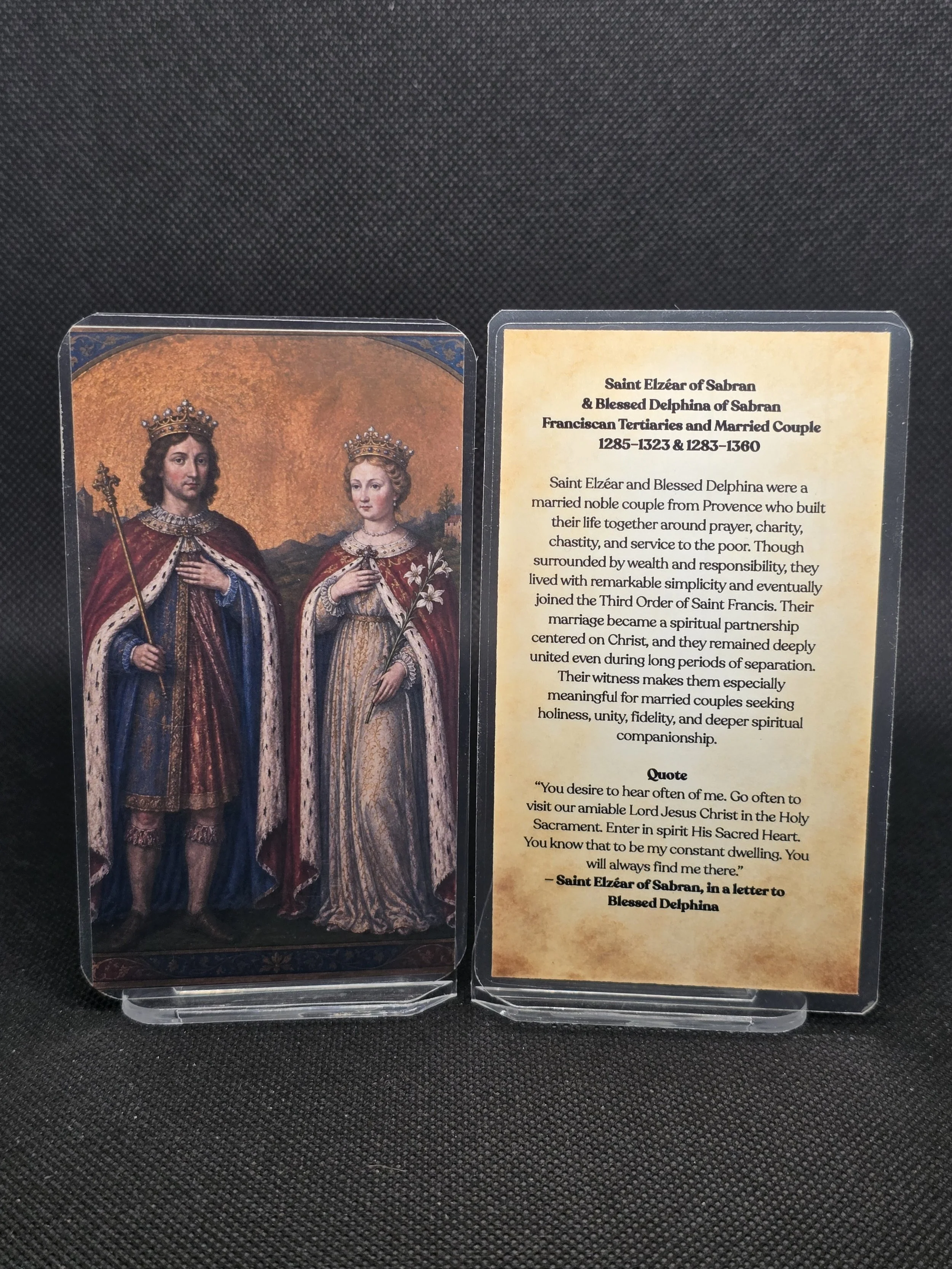
The Sabrans did not leave their estates, their titles or each other. They tried to make a household into a place of prayer and mercy. If you would like their prayer card as a reminder of that calling, you can find it below.
View Prayer Card