Saint Nimatullah Kassab Al-Hardini: Maronite Monk, Teacher of Saint Charbel and Saint of Kfifan
A quiet Maronite monk who taught theology, bound books by hand, and showed Saint Charbel that holiness can be found in the ordinary life of a community.
At a Glance
- Born
- 1808, Hardin, northern Lebanon (baptized Youssef Kassab)
- Died
- December 14, 1858, Kfifan, Lebanon, aged about 50
- Church and order
- Maronite Catholic Church; Lebanese Maronite Order
- Feast day
- December 14 (Maronite calendar and Roman Martyrology)
- Recognition
- Beatified May 10, 1998; canonized May 16, 2004, by Pope John Paul II
- Patronage
- No formal patronage verified; known as the Saint of Kfifan
- Who Was Saint Nimatullah?
- Birth and Family in Hardin
- Schooling at Houb and a Priest Grandfather
- Entering the Monastery at Qozhaya
- Profession, Kfifan and Ordination
- A Monk Who Chose the Common Life
- Teacher, Administrator and Bookbinder
- Teacher of Saint Charbel
- Illness, Death and Tomb
- Miracles, Beatification and Canonization
- Why He Matters to Eastern Christians
- Frequently Asked Questions
Who Was Saint Nimatullah?
Saint Nimatullah Kassab Al-Hardini was a Maronite monk and priest of the Lebanese Maronite Order who lived and died in the mountains of Lebanon in the nineteenth century. He was born Youssef Kassab in 1808 and took the religious name Nimatullah, which is commonly translated as "grace of God." He died on December 14, 1858, at the monastery of Kfifan, at about fifty years of age.
His life had very little drama. He was not a martyr, a missionary or a founder. He taught young monks, bound and repaired books, served his order as an administrator when obedience required it, and prayed. Yet the Church eventually named him a saint, and many Maronites still call him the Saint of Kfifan, after the monastery where he spent his last years and where he is buried.
He is best known today for one of his students. A young monk named Charbel Makhlouf studied at Kfifan while Nimatullah taught there, and Charbel was present at his teacher's death. Together the two men stand at the heart of the monastic revival that Maronites remember with pride. This article follows the Vatican's official biography as its main guide, and it marks clearly where sources disagree or where a story belongs to devotional tradition.
Birth and Family in Hardin
Youssef was born in 1808 in Hardin, a village in the mountains of northern Lebanon. His father was Girgis (George) Kassab and his mother was Mariam Raad, who came originally from the nearby village of Tannourine. The family belonged to the Maronite Catholic community, whose religious life in that region centered on parish churches and the great monasteries of the valleys.
UNCERTAIN: the number of children in the family is reported differently. The 1967 Vatican document that introduced his cause names two brothers and two sisters beside Youssef, which suggests five children. The later official Vatican biography speaks of six children, and some other reference works and devotional sites say seven. Without the original parish records, it is not possible to settle the question, so this article does not give a number.
The vocations in the family are better documented than its size. The Vatican biography says his brother Tanios became a parish priest, his brother Elisha entered the Lebanese Maronite Order and lived as a hermit, and a sister named Msihieh embraced religious life at the monastery of Saint John the Baptist in Hrach. A household that gave several of its children to the Church formed the background for Youssef's own calling.
Schooling at Houb and a Priest Grandfather
As a boy Youssef attended the school attached to the monastery of Saint Anthony at Houb. Reference works name Arabic, Syriac and mathematics among the subjects he studied there. Some Maronite biographies place these studies roughly between 1816 and 1822, though the exact years should be read as approximate.
He then lived for a time with his maternal grandfather, Youssef Raad, a Maronite parish priest in Tannourine. Living in a priest's house meant living inside the rhythm of the parish: daily prayer, the services of the Church, and the care of ordinary villagers. The Vatican biography treats this period as an important influence, because the boy saw both priestly service and a disciplined life of prayer from close range.
The early biographies describe him as a young man drawn to solitude and prayer, who sometimes slipped away from farm work to pray. These accounts were written after his death and reflect later testimony, not independently dated records of his childhood. They are worth keeping, but they are best read as the memory of a community that already considered him holy.
Entering the Monastery at Qozhaya
There is no conversion story in the life of Nimatullah. He was baptized Maronite and stayed Maronite. His turning point was the decision to give his life to God in the monastic tradition of his own Church. In 1828, at about twenty years of age, he entered the Lebanese Maronite Order at the monastery of Saint Anthony in Qozhaya, in the Qadisha Valley.
The Qadisha, often called the Holy Valley, had sheltered Christian monks and hermits for centuries, and the Maronite monasteries there were centers of prayer, farming and manuscript work. At Qozhaya the new novice received his monastic name, Nimatullah, and began a formation built on communal prayer, obedience, fasting and manual labor. He also learned the craft of bookbinding, a skill that would stay with him for the rest of his life.
Monastic life at that time was physically hard. Monks rose early, chanted the offices, worked the terraced fields and kept long fasts. Nimatullah took to this discipline with great seriousness. The sources describe a man who treated small duties as real offerings to God, and that attitude of faithfulness in little things becomes the key to understanding the rest of his life.
Profession, Kfifan and Ordination
Nimatullah made his religious profession on November 14, 1830. He was then sent to the monastery of Saints Cyprian and Justina at Kfifan to study philosophy and theology in preparation for the priesthood. Kfifan was the order's house of studies, and it would remain tied to his name for the rest of his life and beyond.
His health suffered under the combined weight of fasting, study and heavy farm labor. According to the Vatican biography, his superiors moved him to lighter work, and he took up tailoring for a time. It is a small detail, but it shows a pattern: Nimatullah accepted whatever task he was given, whether in the classroom, the workshop or the field.
UNCERTAIN: the year of his ordination. The Vatican's official English biography and the 1967 notice in the Acta Apostolicae Sedis give December 25, 1833. The New Catholic Encyclopedia Supplement of 2010 and at least one Maronite publication give Christmas 1835. This article follows the official Vatican chronology and treats 1833 as the more likely date, while noting that the disagreement exists.
A Monk Who Chose the Common Life
One decision defines Nimatullah's spirituality. His brother Elisha, who already lived as a hermit, encouraged him to leave the common life of the monastery and seek the solitude of a hermitage. Nimatullah declined. He answered, in substance, that practicing virtue among one's fellow monks, day after day, was itself a demanding path to holiness.
This was not a rejection of hermits. The Maronite tradition honors them, and Nimatullah's own student Charbel would later become one. It was rather a conviction that patience, obedience and charity are tested hardest when we must live with other people. A monk who loves his brothers when they are tired, difficult or slow is practicing an asceticism no less real than fasting.
The Vatican biography adds that his superiors sometimes admonished him for being too severe with himself and too gentle with others. That balance is worth noticing. He demanded much of his own conduct and gave generous patience to the monks around him, which is exactly what one would expect from a man who believed that the community was the school of holiness.
Teacher, Administrator and Bookbinder
Nimatullah's principal work was the formation of young monks. At Kfifan he taught theology, especially moral theology, and directed the scholasticate, the section of the monastery where students prepared for the priesthood. Reference works record him as a recognized spiritual guide within his order, a man whom younger monks approached for advice as well as instruction.
The Dicastery for the Causes of Saints also credits him with free teaching initiatives for local young people at Kfifan and later at Bhersaf, remembered as schools held beneath an oak tree. He served as Assistant General of the order from 1845 and held the office again from 1850 and 1856. He is said to have encouraged advanced studies among the monks, including sending members to the Jesuit college at Ghazir, and he repeatedly declined the higher office of Superior General.
Through all of this he kept binding books. The Vatican mentions a Syriac breviary that he bound and used himself, a concrete reminder that he cared for the liturgical books of his community. He is also credited with promoting Marian confraternities and with setting up sixteen altars dedicated to the Virgin Mary, one of which at Kfifan became known as Our Lady of Hardini. UNCERTAIN: no critical edition of his own theological writings has been verified, and large claims about named textbooks or lectures should not be accepted without manuscript evidence.
Teacher of Saint Charbel
The most famous pupil of Nimatullah was Charbel Makhlouf, the hermit who is today one of the best known saints of Lebanon. The Vatican states that Charbel studied at Kfifan from 1853 to 1859, which means that the two men lived under the same roof during the last years of Nimatullah's life. Charbel was present at his teacher's death and funeral in 1858.
The historical link is well supported. What is harder to document is any detailed account of private conversations or of which particular teachings shaped Charbel's later life, and this article does not invent them. It is fair to say that Charbel grew up spiritually in a house where a respected older monk taught that faithfulness, obedience and love of the liturgy were the foundation of monastic holiness.
There is something fitting in the pairing. One saint chose the common life and taught others to prepare for the priesthood. The other, after years in community, withdrew to a hermitage. Maronites sometimes describe the two as complementary signs of the same monastic tradition: the monastery and the hermitage, the school and the silence.
Illness, Death and Tomb
In December 1858, during a spell of bitterly cold weather, Nimatullah fell gravely ill while teaching at Kfifan. The Vatican biography describes pneumonia, while other Church publications mention pleurisy and fever. UNCERTAIN: a precise diagnosis cannot be established from the available sources. The illness lasted about ten days.
According to the official biography, he asked to be placed in a room near the monastery church so that he could hear the monks chanting. He received the Anointing of the Sick while holding an image of the Virgin Mary and entrusted his soul to her. He died on December 14, 1858. TRADITION: devotional accounts say the monks noticed a strange light and fragrance in the room at his death. These are reports of extraordinary experiences, not independently established events.
His grave soon became a place of veneration. Maronite sources report that his tomb was opened in 1864 and that his body appeared unusually well preserved, and that the remains were accessible to pilgrims for some decades before being reburied and later placed in a chapel at Kfifan. TRADITION: the claim of preservation belongs to the devotional record, and no modern published examination of the remains has been verified. His tomb remains at the Monastery of Saints Cyprian and Justina.
Miracles, Beatification and Canonization
The Church's investigation of his holiness moved slowly, as is normal. The Vatican biography places the presentation of his cause in Rome in 1926, and a decree of June 13, 1966, advanced its introduction, which was published in 1967. Pope John Paul II declared his heroic virtues on September 7, 1989, beatified him on May 10, 1998, and canonized him on May 16, 2004, in Saint Peter's Square.
Two healings were examined for his cause. Maronite accounts connect the first, recognized in a decree of July 7, 1997, with a man named Andre Najm, who suffered from a serious blood disorder and recovered after visiting the tomb in 1987. The second, recognized in a decree of December 20, 2003, is linked in accounts with a woman named Rose Bayady, who experienced a lasting but partial recovery of her sight while praying at Kfifan on the day of the beatification. The medical records were not available for this article, so the details come from Church reporting.
Other stories belong to Maronite devotion and should be marked TRADITION. One says that he warned students to move away from a wall shortly before it collapsed. Another tells of an Orthodox man who regained his sight after praying at his tomb, and a third of a Melkite Catholic man healed of a leg ailment after a dream. They show how widely his reputation spread, but they do not carry the same standing as the cases examined by the Church.
O God, who gave your servant Nimatullah a heart that found holiness in patient service among his brothers, grant us the grace to be faithful in small things. Teach us obedience without bitterness, study without pride and prayer that lasts through ordinary days. Through the intercession of Saint Nimatullah, strengthen our faith with good works, and bring us at last to the joy of your kingdom. Amen.
This is a short prayer written for this page. It is not an official liturgical text. Maronites also use prayers published by their own parishes and eparchies.
Why He Matters to Eastern Christians
For Eastern Catholics, and especially for Maronites, Nimatullah is a witness to the Syriac Antiochene monastic tradition: communal prayer, fasting, the chanting of the liturgy, manual labor and obedience. The Vatican places his formation inside that tradition. His life shows that a Maronite monk could be a teacher, a bookbinder and a priest without leaving the ordinary routine of his house.
Orthodox readers will recognize much that is familiar: the discipline of humility, faithfulness to liturgical prayer, and the effort to love one's brothers in a monastery. At the same time, honesty requires a plain statement. Nimatullah was canonized by the Catholic Church, and there is no verified basis for saying that the Orthodox Churches commemorate him on their calendars. His relevance to Orthodox readers is historical and spiritual, not a shared liturgical cult.
Even so, the tradition of an Orthodox man healed at his tomb suggests that devotion to him has crossed confessional lines in individual cases. For anyone who wants to understand how Eastern Christian monasticism formed ordinary saints in the Middle East, the quiet teacher of Kfifan is a good place to begin.
Frequently Asked Questions
A Saint for Ordinary Days
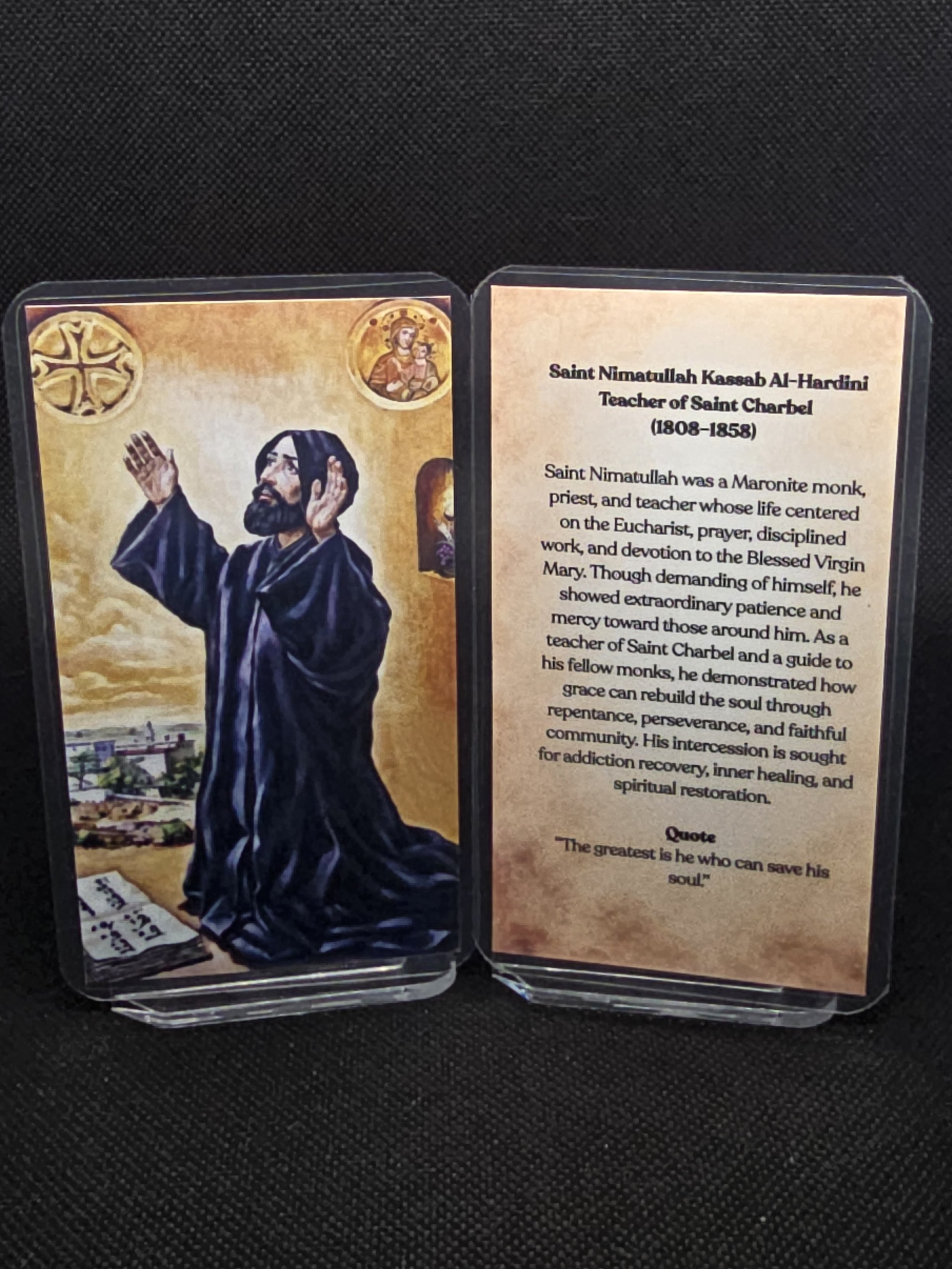
Nimatullah never left his monastery in a blaze of glory. He taught, mended books, held offices he did not want and loved the brothers he lived with. If you would like his prayer card as a reminder that holiness grows in daily faithfulness, you can find it below.
View Prayer Card