Saint Nohra: Martyr of Smar Jbeil and Patron of Eyesight
A martyr whose Syriac name means light, honoured by Maronites in Lebanon for more than five centuries of surviving liturgy, and sought by pilgrims who pray for their sight at his well.
At a Glance
- Born
- Uncertain; traditions name Manhur in Persia or Damanhur in Egypt
- Died
- Uncertain; martyrdom is traditionally placed about 290 or 305, near the end of the third century or the start of the fourth
- Feast day
- July 22 in the Maronite calendar
- Canonization
- No decree found; his cult is older than modern procedures
- Patronage
- Eyesight and those with eye disease
- Titles
- Mar Nohra (Nuhra), martyr; also called Logius or Lucius in some sources
- A Martyr Named for Light
- What the Sources Are
- Names and a Warning About Mistaken Identity
- Birth and Family
- Conversion and Mission
- Persecution and Martyrdom
- The Well at Smar Jbeil
- The Saint of the Eyes
- Churches and Shrines
- Why He Matters to Eastern Christians
- Prayer and Legacy
- Frequently Asked Questions
A Martyr Named for Light
Saint Nohra, written Mar Nuhra in Syriac, is a martyr honoured above all by Maronite Christians in Lebanon. His name means light in Syriac, and that meaning has shaped his place in devotion. People who suffer from eye disease pray to him, and those who seek spiritual sight turn to him too.
The honest starting point is that very little about his life can be proved. We have medieval prayers, a medieval wall painting and a living pilgrimage, but no biography from his own time and nothing he wrote. The details usually told about him, his birthplace, his priesthood, his journeys and the manner of his death, come from later tradition, and the traditions do not agree with one another.
This article keeps the documented parts apart from the traditional ones. Material that comes from later accounts or local legend is marked TRADITION, and what is unknown or disputed is marked UNCERTAIN. The devotion itself is real and old, and that is the part we can speak about with confidence.
What the Sources Are
The firmest evidence is liturgical. A Maronite service book known as the Louaize Fenqitho, copied in 1459, preserves an office for Mar Nohra, including a morning prayer that speaks of his coming from a place called Manhur to Lebanon and of his suffering for Christianity. It shows that he was prayed to in Maronite worship centuries before modern writers told his story. It does not by itself prove the events of the third century.
A second line of evidence is artistic. The art historian Michele Bacci has identified an image of Mar Nuhra, with a Syriac inscription, among the wall paintings of a Syriac rite church at Famagusta in Cyprus. He places it in the movement of Christian art and people from the Lebanese coast to Cyprus around 1300. It shows that devotion to the saint travelled beyond his own valleys.
The third is the present Church. The Maronite Bishop of Batroun, Mounir Khairallah, preached on his feast at Smar Jbeil in 2012, and he said openly that the martyrdom at Batroun and the story of the body in the well have not been established by historical evidence. We follow the bishop's example here and say the same.
Names and a Warning About Mistaken Identity
Besides Nohra, the saint appears in some Maronite sources as Logius or Lucius, and other writers suggest Lucian as a Latin form. No early record shows that all these names belong to one man, so the equivalence is UNCERTAIN.
There is a particular risk of confusion. Some modern accounts of Nohra include episodes that belong to Saint Lucian of Antioch, a different martyr who died in 312. Lucian is remembered for biblical scholarship at Antioch, imprisonment at Nicomedia and for celebrating the Eucharist on his own chest. The Catholic Encyclopedia and the Orthodox Church in America tell his story. Those details should not be placed in Nohra's life without strong evidence, and we leave them out. It is not known whether later writers joined the two traditions on purpose or by accident.
A heritage presentation in Lebanon also links the name Mar Nohra with Saint Onuphrius, but the well known Onuphrius was an Egyptian desert hermit with his own feast on June 12 and a quite different story. The two should not be merged.
Birth and Family
TRADITION: one Maronite account says Nohra was born in the third century at Manhur, which it places in Persia and perhaps near the region of al-Mada'in. It describes a clever young man who turned away from paganism. Another telling, from Radio Maria Lebanon, describes a wealthy pagan family and a birth in Persia or near Alexandria in Egypt, and says an educated Christian friend introduced him to the faith so that he was baptized with his parents.
UNCERTAIN: the manuscript of 1459 names Manhur, but where that was has never been settled. Egypt's town of Damanhur has been suggested as a match. These differences mean we cannot say where he grew up, what religion his family held, or how he came to be baptized.
TRADITION: a local account names a woman called Thecla as his sister, who is said to have travelled with him and been martyred. A chapel of Saint Thecla stands near his church at Smar Jbeil. The church directory itself says that no historical record supports the family tie. His parents' names and any other details of his youth are unknown.
Conversion and Mission
TRADITION: the Maronite account says that Nohra, seeing the emptiness of pagan worship, looked for Christian teaching and gave himself to prayer and the study of Scripture. It adds that he went to Alexandria after hearing of Christian martyrs, was guided by a vision to Antioch, and after the death of his parents was ordained a priest and began to preach.
TRADITION: a second account says he inherited great wealth, gave it all to the poor, and took up the life of a travelling preacher. His missions are said to have reached the cities of the Phoenician coast, among them Acre, Tyre, Byblos, Batroun and Tripoli.
UNCERTAIN: no baptismal record, ordination record or early life of him has been found. His priesthood belongs to the traditional account and should not be treated as a proven fact. The story as told shows what believers wanted to say: that his conversion changed what he did with his money and how he treated the poor.
Persecution and Martyrdom
The setting is believable. The Emperor Diocletian ruled from 284 to 305, and the great persecution of Christians began in 303, with his colleague Maximian also acting against the Church. Even so, that a persecution happened does not prove that a particular martyr story from the era is accurate.
TRADITION: Nohra publicly spoke against pagan worship and refused to sacrifice to the gods. He was arrested, questioned, tortured and put to death. The accounts name different rulers. Some mention Diocletian, others Maximian, and the 1459 manuscript mentions a ruler called Delphinos. They also disagree on place, with one version setting a trial at Antioch and a martyrdom at Smar Jbeil and others pointing to Batroun and its villages.
The dates vary too. Bishop Khairallah gave 290 in his homily, and another local tradition gives 305. Neither is independently proved, and we hold the date as UNCERTAIN.
The Well at Smar Jbeil
TRADITION: the saint was beheaded, and his body was thrown into a well near the old fortress at Smar Jbeil. The well became a place of prayer, especially for troubles of the eyes. Some tellings add that he was cut apart and an angel restored him, which belongs to local legend and not to history.
The anthropologist Nour Farra-Haddad has written about the well of Mar Nohra in a study of shared pilgrimage practices in Lebanon. She found it dry at the time of her research, yet pilgrims still came for a blessing, in some cases by touching the sacred place. This shows an established devotion. It is not a medical proof of healing.
Local accounts describe a blessing of the well on the saint's feast, with offerings, vows and prayers for help. That the pilgrimage exists is better documented than any of the miracles told about it.
The Saint of the Eyes
His link to eyesight arises from his name and from stories. TRADITION: during his sufferings his eyes were torn out, yet he saw again. TRADITION: when he made the sign of the Cross in a pagan temple, idols fell and, in some versions, a voice spoke from an idol. These stories express the victory of Christ over idols, and their supernatural details cannot be tested.
For centuries people in Lebanon have turned to Mar Nohra for diseases of the eye, and also for light of the soul, since his name means light. This patronage is well attested in practice. No medical case or Church inquiry has been found that proves a particular cure as a miracle, and we make no such claim.
The tradition fits an old Christian instinct that physical sight and spiritual sight belong together. The Gospel stories of the blind who see are read in that light, and the saint who bears the name Light becomes a sign of that hope.
Churches and Shrines
The church of Saint Nohra at Smar Jbeil is described as standing near the traditional burial place. Its walls contain reused ancient stone and medieval work. A church directory records an altar ordered under Patriarch Boulos Masaad and finished on July 20, 1870. These details tell the history of the shrine, and they say nothing about finding or identifying the martyr's remains.
Other churches in Lebanon carry his name, including those at Ain el Delbe, Sahel Alma and Bqorqasha. The parish church of Bqorqasha was built in 1909, according to the church directory.
UNCERTAIN: no archaeological identification of his remains, no ancient tomb inscription and no record of a formal translation of relics has been found.
Why He Matters to Eastern Christians
For Maronite Catholics he ties together Syriac worship, the history of Lebanon's Christians and the memory of the early martyrs. The 1459 office links his name with light and with Lebanon, and the Famagusta painting shows Syriac speaking Christians carrying his memory abroad.
For Orthodox readers his story is part of the shared Syriac and Antiochene Christian inheritance, which includes local saints and medieval paintings across the Levant.
UNCERTAIN: we found no reliable sign that the Byzantine Orthodox Churches keep a feast of this Nohra, and it would be wrong to say that all Eastern Churches share his July 22 commemoration. We know of no troparion for him in the Byzantine tradition.
Holy Mar Nohra, martyr of Christ, your name means light and your witness gave light to many. Pray for those who cannot see and for those whose eyes are weak or ill. Pray for the doctors who treat them and the families who care for them. Obtain for us the light of faith and the courage to bear witness. Through your prayers, O Christ our God, have mercy on us. Amen.
This prayer was written for this page. It is not an official prayer. The Louaize Fenqitho of 1459 preserves an old Maronite prayer in the saint's office.
Prayer and Legacy
The 1459 manuscript preserves a prayer of praise to God who kindled divine fire in the heart of his champion Mar Nohra, who endured suffering. It is a prayer to God and not a prayer to the saint, and the full English translation is published by the scholar who studied the manuscript. A modern English prayer to Nohra for the light of the eyes and soul is published by Sawt el Rab, and its age is not known.
His legacy is a name that means light, a dry well that people still visit, and a faith that has kept him in prayer for centuries without needing to settle every question about his life.
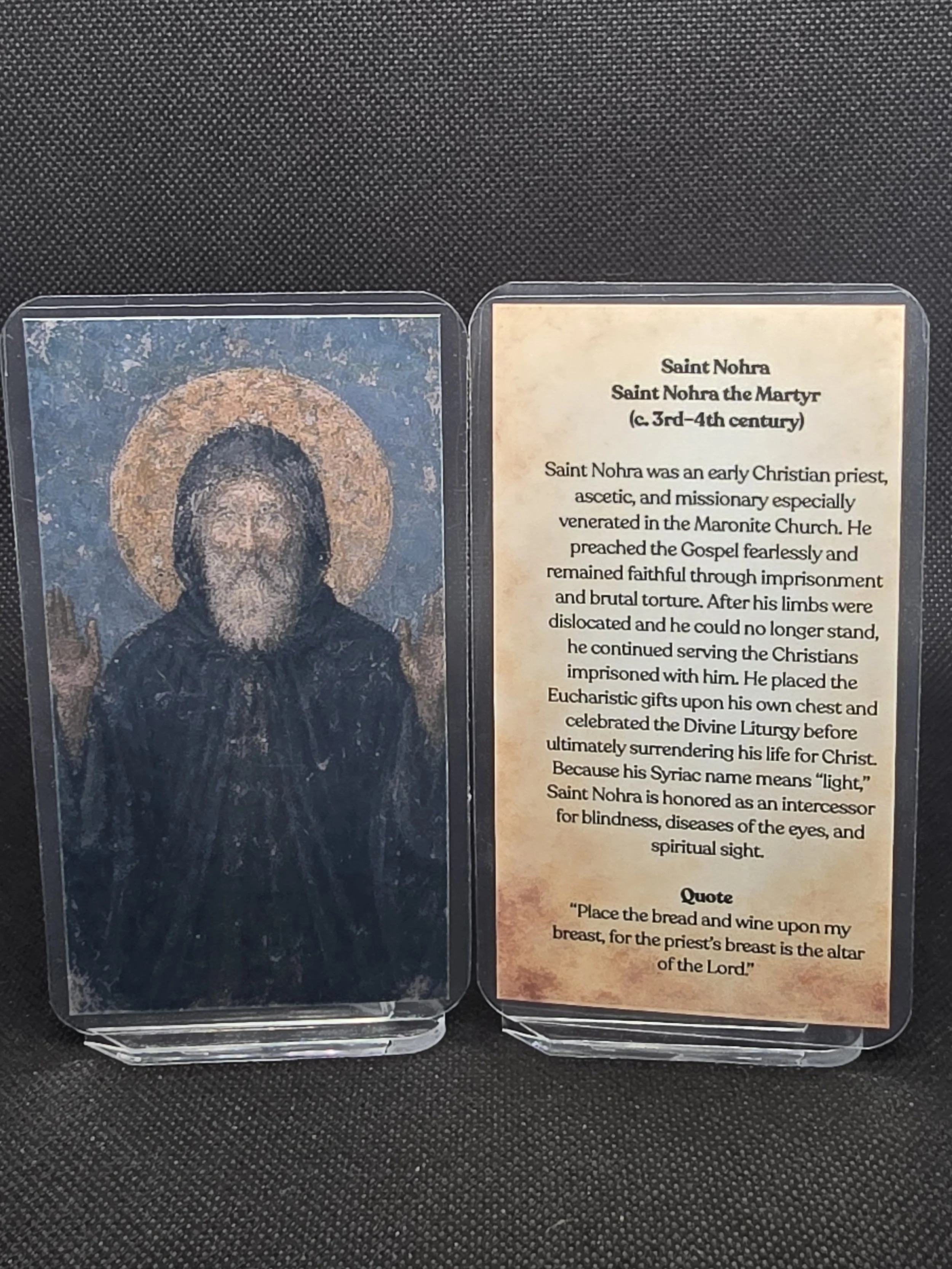
A pocket prayer card with his image is available at The Eastern Church for those who pray for their eyesight and for light in times of darkness.
Frequently Asked Questions
Light in the Dark
Mar Nohra reaches us through prayers copied by hand and a well that people still visit. We cannot say much about his life, but the Church has kept his name for centuries and asked him to help the blind. A prayer card is a small way to join that old prayer.
View Prayer Card