Blessed Abouna Yaacoub: Lebanese Capuchin, Apostle of Lebanon and Servant of the Sick
A Maronite boy from Ghazir who became a Capuchin friar, walked the roads of Lebanon as a preacher, and founded a congregation of sisters to care for the sick, the elderly and the forgotten.
At a Glance
- Born
- February 1, 1875, in Ghazir, Mount Lebanon, then part of the Ottoman Empire; baptized as Khalil al-Haddad
- Died
- June 26, 1954, in Lebanon, aged 79
- Feast day
- June 26, the day of his death
- Venerable and beatified
- Declared Venerable in 1992; beatified on June 22, 2008, in Beirut
- Patronage
- Associated with the poor, the sick, the elderly and people with mental illness; no formal patronage declared
- Titles
- Blessed, Capuchin priest, founder; called the Apostle of Lebanon
- A Friar Who Loved the Cross
- Childhood in Ghazir
- Alexandria and the Call to Be a Capuchin
- Priesthood and Preaching
- Many Small Schools
- The War Years and the Famine
- The Cross at Jall Eddib and the Sisters of the Cross
- Hospitals, Homes and Writings
- Illness, Death and Burial
- Beatification
- Why He Matters to Eastern Christians
- Prayer and Legacy
- Frequently Asked Questions
A Friar Who Loved the Cross
Blessed Abouna Yaacoub is the best known Lebanese Capuchin of the twentieth century. His name in the world was Khalil al-Haddad, and in religion he took the name Jacques, the French form of James, which in Arabic becomes Yaacoub. The word Abouna means our father and is the usual way to address a priest in Lebanon.
He lived through the end of the Ottoman Empire, the terrible famine of the First World War and the years of the French Mandate. In each period he turned toward the people others had left behind, and he gave his last decades to building places of care for them. He was beatified in 2008, and he remains a Blessed, with no canonization on record.
Unlike a saint of the distant past, he is well documented. There are institutional biographies, a large archive of his writings and a Vatican account of his life. Even so, sources disagree on some figures and dates, and this article notes where they do. Material that rests on devotion more than on records is marked TRADITION, and what is unclear is marked UNCERTAIN.
Childhood in Ghazir
Khalil al-Haddad was born on February 1, 1875, in Ghazir, a mountain town northeast of Beirut. The congregation he founded records his baptism on February 21 of the same year at the church of Our Lady of Habchieh. His parents were Boutros Saleh al-Haddad and Shams Yowakim al-Haddad, and the Capuchin minister general confirms that the family was Maronite.
UNCERTAIN: the sources give three different sizes for the family. The Vatican biography calls Khalil the third of five children, the Capuchin minister general the third of eight, and a parish biography the third of fourteen. Without family records we cannot say which is right.
His mother is remembered as a woman of prayer who shaped his faith. His father hoped that schooling would lead to steady work so that Khalil could support the family. He studied at the Saint Francis school in Ghazir, then at Saint Louis School, and later at La Sagesse in Beirut, where he learned Arabic, French and Syriac. The Sisters of the Cross give 1891 as the year he finished.
Alexandria and the Call to Be a Capuchin
In 1892 Khalil went to Alexandria in Egypt to teach Arabic at Saint Mark's College, a school connected with the Christian Brothers. The stay opened a wider world to him and became the setting of his vocation.
A Capuchin biography tells how he was struck by the death of a friar in Alexandria and decided to become a Capuchin priest. The account is supported by testimony within the Capuchin family, though the exact words later put in his mouth cannot be checked and belong to devotional retelling, so they should be taken as TRADITION. His father first resisted and then gave his consent.
The congregation lists the stages that followed. He entered the Capuchin convent of Saint Anthony of Padua at Khashbau on August 25, 1893, received the habit and the name Jacques on March 26, 1894, made simple vows on April 24, 1895 and solemn vows on April 24, 1898. Some secondary biographies give slightly different dates, and the congregation's chronology is the most detailed one we have.
Priesthood and Preaching
Jacques was ordained a priest in Beirut on November 1, 1901. His superiors first gave him administrative and financial duties in Capuchin houses, and only later did his gifts as teacher, preacher and organizer come to the front.
The Vatican describes the years from 1903 to 1914 as a time of intense missionary preaching. He travelled across Lebanon, often on foot, and also preached in Syria, Palestine, Iraq and Turkey. This work earned him the name Apostle of Lebanon, a title of devotion and not an ecclesiastical rank.
He also encouraged lay people to join the Franciscan Third Order, and he organized pilgrimages, processions and celebrations of First Communion. A monthly religious magazine called The Friend of the Family is dated by one historical article to 1913.
Many Small Schools
In 1905 Father Jacques became director of the Capuchin schools in Lebanon. He preferred many small schools in villages to a few large ones, so that more children could be taught close to home.
The Capuchin minister general reports that by 1910 the network had about 230 schools with some 7,500 pupils. Other sources give different totals, so the figures should be read as the Capuchin account.
The same approach marked his later work. He did not wait for large institutions to be built. He started where there was need, with modest buildings and the help of local people, and he trusted that the means would follow.
The War Years and the Famine
When the Ottoman Empire entered the First World War in 1914, the French Capuchin missionaries left Lebanon, and much of the local mission fell to Father Jacques. The years that followed brought a famine in Beirut and Mount Lebanon. The historian Melanie Tanielian has documented how requisitioning, broken trade, shortages and disease caused the disaster.
The Capuchin account says that Father Jacques gave out food, helped destitute families and helped to bury bodies that had been left in the streets. It also tells of arrests and threats and of times when he came close to prison or death.
UNCERTAIN: those stories rest largely on his own memoirs and later biographies, and we cannot confirm each incident from independent records. What is well established is the scale of the famine and his work among its victims.
The Cross at Jall Eddib and the Sisters of the Cross
The Vatican dates his acquisition of land at Jall Eddib, north of Beirut, to 1919. There he set up a large cross and a chapel of Our Lady of the Sea. The Capuchin account says the cross was meant as a place of prayer, including for those who died in the war and for Lebanese living abroad. The site later grew into the Hospital of the Cross, which became a psychiatric hospital. The Vatican gives 1950 for that change and the minister general gives 1951.
A key moment came when he met an elderly priest in a hospital who was neglected and could no longer celebrate Mass. He took the priest into his own care, and the congregation dates the reception to October 4, 1926. The experience led him to found a community for people whom existing institutions did not serve.
Women from the Franciscan Third Order who helped him, with Mary Elias Zougheib, later Mother Mary of the Cross, as the first superior general, became the Franciscan Sisters of the Cross of Lebanon. The congregation names December 8, 1930, as its foundation date and February 1932 as the time it became self-governing. UNCERTAIN: the Vatican biography gives 1920, and the sources do not explain the difference, so 1930 is the better documented date.
Hospitals, Homes and Writings
The institutions linked with Father Jacques include the House of the Sacred Heart in Deir el Kamar, set up in 1933, a hospital for elderly and chronically ill patients, Saint Joseph's Hospital near Beirut, and Saint Anthony's House for poor people. The sources differ on founding and opening dates for several of them. For example, the Vatican places Saint Joseph's Hospital prominently in 1949, while the minister general dates its foundation to 1948.
His sisters cared for elderly and sick priests, for people with mental illness or disabilities, for abandoned children and for the chronically ill. By his own example and by theirs, care was offered to people of every religion in a country of many communities, which the congregation and Capuchin testimony both stress.
He also wrote a great deal: sermons, spiritual instruction, letters and memoirs. The congregation speaks of about 10,000 handwritten pages and the minister general of more than 8,000. These are institutional estimates and not counts of a catalogued archive. The themes that run through them are providence, the Cross, prayer and charity toward the weak.
Illness, Death and Burial
In his last years Father Jacques suffered from leukemia and failing eyesight, and he was worn out by his labour. He died on June 26, 1954, at about three in the afternoon, according to both the Capuchin and the congregation's accounts. The Vatican describes his last hours as given to prayer, especially to the Cross and the Virgin Mary.
The Sisters of the Cross preserve a saying they give as his last words, which in English speaks of the Cross of God as the love of his heart. It is an English translation kept by the congregation and has not been checked against a contemporary record of the deathbed.
His remains are venerated at the shrine of Our Lady of the Sea at the Convent of the Cross. The congregation describes his tomb, a separate bone relic near the altar, and a museum with his belongings and vestments.
Beatification
His cause was opened in 1979. Pope John Paul II declared him Venerable in 1992, and on December 17, 2007, Pope Benedict XVI authorized the decree that recognized a miracle through his intercession. The New Catholic Encyclopedia reports that the healing concerned a woman with advanced cancer. The published decree gives no clinical detail, and we do not repeat names or medical claims that we could not check.
He was beatified on June 22, 2008, in Martyrs' Square in Beirut. Cardinal Jose Saraiva Martins presided for the pope, and the Maronite Patriarch Nasrallah Sfeir took part in the celebration. As of this writing he has not been canonized.
Devotional accounts also speak of dangers escaped and of help in money troubles, which believers read as the work of providence. These are TRADITION and are not individual miracles investigated by the Church. The sisters publish a novena for his intercession, and pilgrims visit his tomb.
Why He Matters to Eastern Christians
Abouna Yaacoub was born into a Maronite family and lived in Lebanon, the heartland of the Maronite Church, yet he became a Capuchin, a Franciscan order whose ministry in the East followed the Latin tradition. His life belongs to both worlds, and his beatification showed it, with the Maronite patriarch taking part in a Catholic celebration.
Pope Benedict XVI spoke of him in an address to the agencies that help the Eastern Churches on June 19, 2008, and held up his care for the poor and suffering as an example for Christians in the Arab world.
For Orthodox readers, his work is a documented example of Christian love for people with mental illness and disability. Parallels exist with Eastern spirituality in his stress on the Cross, prayer and care for the poor. UNCERTAIN: we found no sign that any Orthodox Church honours him formally or keeps a feast for him, and we do not claim it.
Blessed Abouna Yaacoub, friar and father of the poor, you took the forgotten into your home and found Christ in them. Pray for the sick, the elderly and those who live with mental illness. Strengthen the nurses, doctors and sisters who care for them. Teach us to see the Cross as a sign of love and not of defeat. Through your prayers, O Christ our God, have mercy on us. Amen.
This prayer was written for this page. It is not an official prayer. The Franciscan Sisters of the Cross publish a novena and prayers of their founder.
Prayer and Legacy
The Franciscan Sisters of the Cross publish prayers they attribute to their founder, among them a short prayer to the sign of the Cross that asks the Cross of Christ to protect, to fight for and to save us. It is his own prayer and not a liturgical hymn. We found no troparion composed in his honour.
His legacy is a congregation of sisters, a hospital for the mentally ill, homes for the aged and a life spent among people who had no one else.
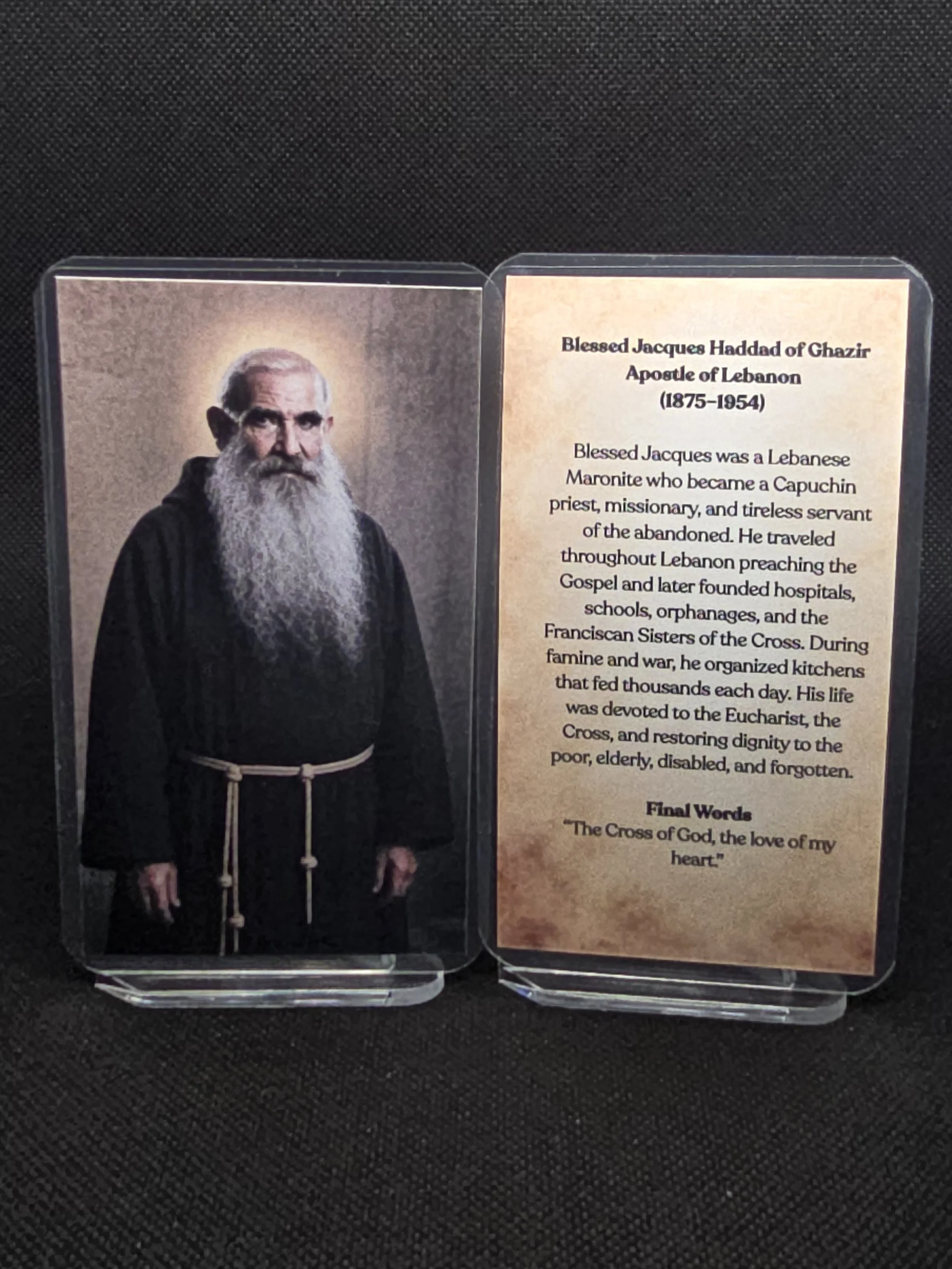
A pocket prayer card with his image is available at The Eastern Church for the sick, for caregivers and for all who work among the poor.
Frequently Asked Questions
Care for the Forgotten
Father Jacques did not set out to build institutions. He set out to answer the person in front of him, and the institutions followed. That is why the Church holds him up, and why a prayer card of this Lebanese friar is a good companion for anyone who cares for others.
View Prayer Card