Blessed Abouna Yaacoub, also written Abuna Yaaqub, Abouna Yacoub, or Abuna Yaakoub, is known in English as Father Jacob Haddad and in French as Father Jacques Haddad or Jacques of Ghazir. Born Khalil Haddad, also written Khalil al-Haddad or Khalil El-Haddad, he became one of Lebanon’s most beloved Catholic figures and earned the title “Apostle of Lebanon.” He was also remembered as the Apostle of the Cross, the Great Builder, the Saint Vincent de Paul of Lebanon, the New Cottolengo, and the New Don Bosco because of the extraordinary number of charitable institutions he established.
Blessed Abouna Yaacoub was born on February 1, 1875, in Ghazir, Lebanon. He was born into a devout Maronite Catholic family and baptized in the Maronite Church under the name Khalil. As a young man, he traveled to Alexandria, Egypt, where he taught Arabic and began discerning a vocation to the priesthood. After returning to Lebanon, he entered the Capuchin Franciscan novitiate and received the religious name Brother Jacques of Ghazir, in honor of the Franciscan preacher Saint James of the Marches. He was ordained a Capuchin priest in Beirut on November 1, 1901.
Although he was born and baptized Maronite Catholic, Blessed Abouna Yaacoub served as a priest of the Order of Friars Minor Capuchin. His life therefore belongs both to Lebanon’s Maronite spiritual heritage and to the worldwide Franciscan tradition. He combined Maronite devotion to Christ, the Eucharist, the Virgin Mary, and the Cross with the Franciscan calling to recognize Jesus in the poorest and most neglected members of society.
Father Jacques became an itinerant missionary and traveled throughout Lebanon preaching the Gospel. His ministry also reached Syria, Palestine, Iraq, and Turkey. He prepared his sermons at night before the Blessed Sacrament and left behind thousands of pages of spiritual writings. His tireless preaching throughout villages, cities, churches, schools, and public gatherings earned him the enduring name “Apostle of Lebanon.”
Education was also central to his mission. As director of the Capuchin schools in Lebanon, he promoted smaller schools and classrooms so that children could receive closer attention. By 1910, the Capuchin educational network under his leadership included approximately 230 schools serving around 7,500 students. He also established the Franciscan Third Order in Beirut and founded a Catholic magazine called The Friend of the Family, recognizing that evangelization had to reach homes as well as churches.
His ministry became even more demanding during the First World War. When the French Capuchins were forced to leave Lebanon in 1914, Father Jacques was entrusted with responsibility for the Capuchin mission. Lebanon was devastated by famine, political violence, disease, executions, and widespread death. Abouna Yaacoub distributed bread to the starving, assisted abandoned families, and buried people whose bodies had been left in the streets. He continued this work despite threats of arrest, imprisonment, and execution, relying entirely upon God’s Providence when his strength and financial resources were exhausted.
After the war, Father Jacques dreamed of raising a great Cross over Lebanon as a memorial for those who had died without proper burial and as a place of prayer for the suffering nation. He built a chapel dedicated to Our Lady of the Sea at Jall-Eddib and erected a monumental Cross nearby. The place eventually became known as the Hill of the Cross and developed into the center of his expanding mission of mercy.
His charitable work began to grow when he encountered sick and elderly priests who lacked proper medical care and could not celebrate Mass. He opened his doors to them, but the needs surrounding him continued to multiply. The mentally ill, chronically sick, disabled, blind, paralyzed, elderly, homeless, orphaned, and abandoned all came seeking help. Father Jacques refused to turn them away simply because they were poor, forgotten, or unable to repay him.
To continue these works of mercy, he founded the Franciscan Sisters of the Cross of Lebanon in 1930. Together, Abouna Yaacoub and the Sisters established hospitals, schools, orphanages, homes for elderly priests, shelters for homeless people, and institutions for those suffering from physical or mental illness. His foundations included the Hospital of the Cross, the House of the Sacred Heart, the Hospital of Our Lady, Saint Joseph’s Hospital, Saint Anthony’s House, Providence House, schools for impoverished children, and an orphanage that cared for hundreds of girls.
Blessed Abouna Yaacoub believed that every suffering person possessed the dignity of someone created in the image of God. His institutions welcomed Christians and non-Christians alike, and the Sisters continued caring for patients without discrimination. He did not separate prayer from charitable action. His love of the Eucharist, the Blessed Virgin Mary, and the Cross gave him the strength to feed the hungry, shelter the abandoned, educate children, and restore dignity to people society had forgotten.
Because of his complete trust in Divine Providence, Blessed Abouna Yaacoub is a meaningful intercessor for families experiencing poverty, unemployment, financial hardship, overwhelming medical expenses, housing insecurity, and the fear of not being able to provide for their children. He may also be sought by caregivers, healthcare workers, priests, religious sisters, teachers, missionaries, people caring for elderly relatives, and those suffering from physical, psychological, or mental illness.
His life speaks especially powerfully to anyone who has reached the limits of personal strength and no longer understands how the necessary resources will be provided. Father Jacques repeatedly began works of mercy without possessing all the money, personnel, or materials required to complete them. He believed that faithful action, persistent prayer, responsible labor, and trust in God’s Providence could open doors that appeared humanly impossible.
After decades of preaching, traveling, building, praying, and caring for the abandoned, Father Jacques died on June 26, 1954. His final hours were spent invoking the Cross and the Blessed Virgin Mary. Thousands came to mourn the priest whom both Christians and Muslims recognized for his compassion and service to Lebanon. Pope Benedict XVI approved his beatification, and he was proclaimed Blessed Jacques Ghazir Haddad in Beirut on June 22, 2008. His liturgical feast is celebrated on June 26, the anniversary of his death.
This prayer card honors Blessed Abouna Yaacoub as a spiritual father of the poor, the sick, the forgotten, and everyone struggling to trust God during prolonged hardship. His witness reminds us that charity is not merely an emotion. It is the decision to recognize Christ in suffering people and to continue serving even when our own resources appear insufficient.
Each prayer card is handmade to order in Austin, Texas. The card is printed on museum-quality photo paper and double laminated for durability. Throughout the process, Blessed Abouna Yaacoub is honored, his intercession is sought, and prayers are intentionally offered for the person who will receive the card.
These are not commercially mass-produced devotional cards. Each card is prepared slowly and reverently because every person, intention, and prayer matters.
Faith Tradition
Catholic: Born and baptized Maronite Catholic; professed and ordained as a Capuchin Franciscan priest.
Feast Day
June 26
Known Names and Titles
Blessed Abouna Yaacoub, Abuna Yaaqub, Abouna Yacoub, Abuna Yaakoub, Father Jacob Haddad, Father Jacques Haddad, Jacques of Ghazir, Jacques Ghazir Haddad, Khalil Haddad, Khalil al-Haddad, Khalil El-Haddad, Apostle of Lebanon, Apostle of the Cross, and the Great Builder.
Sought in Prayer For
Financial hardship, poverty, unemployment, medical expenses, housing insecurity, struggling families, abandoned children, orphans, elderly people, caregivers, priests, religious vocations, hospitals, mental illness, chronic illness, disability, works of charity, and trust in Divine Providence.
Blessed Abouna Yaacoub, also written Abuna Yaaqub, Abouna Yacoub, or Abuna Yaakoub, is known in English as Father Jacob Haddad and in French as Father Jacques Haddad or Jacques of Ghazir. Born Khalil Haddad, also written Khalil al-Haddad or Khalil El-Haddad, he became one of Lebanon’s most beloved Catholic figures and earned the title “Apostle of Lebanon.” He was also remembered as the Apostle of the Cross, the Great Builder, the Saint Vincent de Paul of Lebanon, the New Cottolengo, and the New Don Bosco because of the extraordinary number of charitable institutions he established.
Blessed Abouna Yaacoub was born on February 1, 1875, in Ghazir, Lebanon. He was born into a devout Maronite Catholic family and baptized in the Maronite Church under the name Khalil. As a young man, he traveled to Alexandria, Egypt, where he taught Arabic and began discerning a vocation to the priesthood. After returning to Lebanon, he entered the Capuchin Franciscan novitiate and received the religious name Brother Jacques of Ghazir, in honor of the Franciscan preacher Saint James of the Marches. He was ordained a Capuchin priest in Beirut on November 1, 1901.
Although he was born and baptized Maronite Catholic, Blessed Abouna Yaacoub served as a priest of the Order of Friars Minor Capuchin. His life therefore belongs both to Lebanon’s Maronite spiritual heritage and to the worldwide Franciscan tradition. He combined Maronite devotion to Christ, the Eucharist, the Virgin Mary, and the Cross with the Franciscan calling to recognize Jesus in the poorest and most neglected members of society.
Father Jacques became an itinerant missionary and traveled throughout Lebanon preaching the Gospel. His ministry also reached Syria, Palestine, Iraq, and Turkey. He prepared his sermons at night before the Blessed Sacrament and left behind thousands of pages of spiritual writings. His tireless preaching throughout villages, cities, churches, schools, and public gatherings earned him the enduring name “Apostle of Lebanon.”
Education was also central to his mission. As director of the Capuchin schools in Lebanon, he promoted smaller schools and classrooms so that children could receive closer attention. By 1910, the Capuchin educational network under his leadership included approximately 230 schools serving around 7,500 students. He also established the Franciscan Third Order in Beirut and founded a Catholic magazine called The Friend of the Family, recognizing that evangelization had to reach homes as well as churches.
His ministry became even more demanding during the First World War. When the French Capuchins were forced to leave Lebanon in 1914, Father Jacques was entrusted with responsibility for the Capuchin mission. Lebanon was devastated by famine, political violence, disease, executions, and widespread death. Abouna Yaacoub distributed bread to the starving, assisted abandoned families, and buried people whose bodies had been left in the streets. He continued this work despite threats of arrest, imprisonment, and execution, relying entirely upon God’s Providence when his strength and financial resources were exhausted.
After the war, Father Jacques dreamed of raising a great Cross over Lebanon as a memorial for those who had died without proper burial and as a place of prayer for the suffering nation. He built a chapel dedicated to Our Lady of the Sea at Jall-Eddib and erected a monumental Cross nearby. The place eventually became known as the Hill of the Cross and developed into the center of his expanding mission of mercy.
His charitable work began to grow when he encountered sick and elderly priests who lacked proper medical care and could not celebrate Mass. He opened his doors to them, but the needs surrounding him continued to multiply. The mentally ill, chronically sick, disabled, blind, paralyzed, elderly, homeless, orphaned, and abandoned all came seeking help. Father Jacques refused to turn them away simply because they were poor, forgotten, or unable to repay him.
To continue these works of mercy, he founded the Franciscan Sisters of the Cross of Lebanon in 1930. Together, Abouna Yaacoub and the Sisters established hospitals, schools, orphanages, homes for elderly priests, shelters for homeless people, and institutions for those suffering from physical or mental illness. His foundations included the Hospital of the Cross, the House of the Sacred Heart, the Hospital of Our Lady, Saint Joseph’s Hospital, Saint Anthony’s House, Providence House, schools for impoverished children, and an orphanage that cared for hundreds of girls.
Blessed Abouna Yaacoub believed that every suffering person possessed the dignity of someone created in the image of God. His institutions welcomed Christians and non-Christians alike, and the Sisters continued caring for patients without discrimination. He did not separate prayer from charitable action. His love of the Eucharist, the Blessed Virgin Mary, and the Cross gave him the strength to feed the hungry, shelter the abandoned, educate children, and restore dignity to people society had forgotten.
Because of his complete trust in Divine Providence, Blessed Abouna Yaacoub is a meaningful intercessor for families experiencing poverty, unemployment, financial hardship, overwhelming medical expenses, housing insecurity, and the fear of not being able to provide for their children. He may also be sought by caregivers, healthcare workers, priests, religious sisters, teachers, missionaries, people caring for elderly relatives, and those suffering from physical, psychological, or mental illness.
His life speaks especially powerfully to anyone who has reached the limits of personal strength and no longer understands how the necessary resources will be provided. Father Jacques repeatedly began works of mercy without possessing all the money, personnel, or materials required to complete them. He believed that faithful action, persistent prayer, responsible labor, and trust in God’s Providence could open doors that appeared humanly impossible.
After decades of preaching, traveling, building, praying, and caring for the abandoned, Father Jacques died on June 26, 1954. His final hours were spent invoking the Cross and the Blessed Virgin Mary. Thousands came to mourn the priest whom both Christians and Muslims recognized for his compassion and service to Lebanon. Pope Benedict XVI approved his beatification, and he was proclaimed Blessed Jacques Ghazir Haddad in Beirut on June 22, 2008. His liturgical feast is celebrated on June 26, the anniversary of his death.
This prayer card honors Blessed Abouna Yaacoub as a spiritual father of the poor, the sick, the forgotten, and everyone struggling to trust God during prolonged hardship. His witness reminds us that charity is not merely an emotion. It is the decision to recognize Christ in suffering people and to continue serving even when our own resources appear insufficient.
Each prayer card is handmade to order in Austin, Texas. The card is printed on museum-quality photo paper and double laminated for durability. Throughout the process, Blessed Abouna Yaacoub is honored, his intercession is sought, and prayers are intentionally offered for the person who will receive the card.
These are not commercially mass-produced devotional cards. Each card is prepared slowly and reverently because every person, intention, and prayer matters.
Faith Tradition
Catholic: Born and baptized Maronite Catholic; professed and ordained as a Capuchin Franciscan priest.
Feast Day
June 26
Known Names and Titles
Blessed Abouna Yaacoub, Abuna Yaaqub, Abouna Yacoub, Abuna Yaakoub, Father Jacob Haddad, Father Jacques Haddad, Jacques of Ghazir, Jacques Ghazir Haddad, Khalil Haddad, Khalil al-Haddad, Khalil El-Haddad, Apostle of Lebanon, Apostle of the Cross, and the Great Builder.
Sought in Prayer For
Financial hardship, poverty, unemployment, medical expenses, housing insecurity, struggling families, abandoned children, orphans, elderly people, caregivers, priests, religious vocations, hospitals, mental illness, chronic illness, disability, works of charity, and trust in Divine Providence.
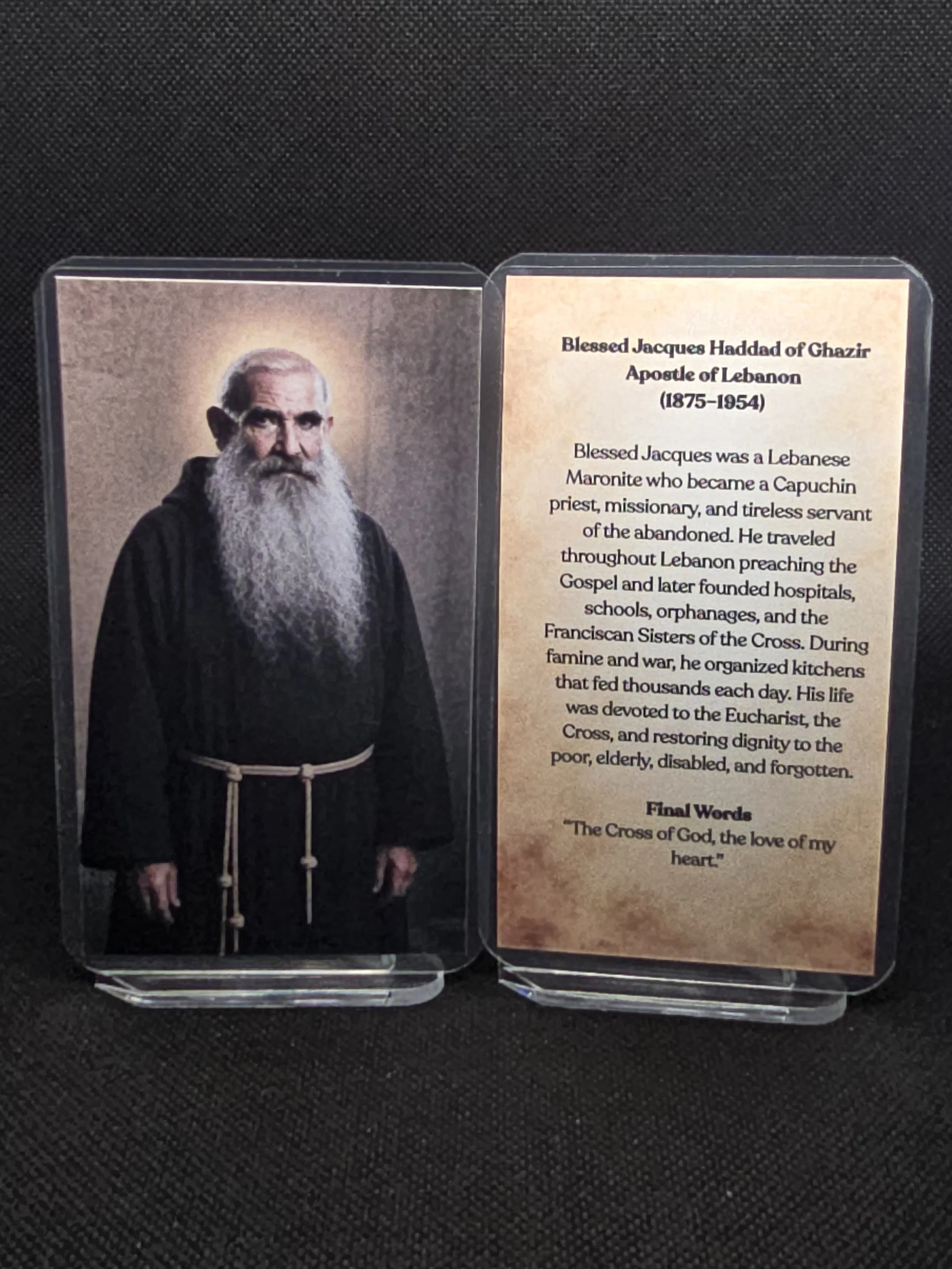 Image 1 of 1