Saint Awtel of Lycia: Hermit and Wonderworker of Kfarsghab
A monk and hermit from Lycia whose memory survives in Syriac sources and, above all, in the Maronite village of Kfarsghab in Lebanon, where his feast is still kept with prayer and a shared meal.
At a Glance
- Born
- Uncertain; tradition names Magdal or Magdaloun in Lycia, in Asia Minor
- Died
- Uncertain; one Maronite tradition says 327, while another account places his life in the sixth century
- Feast day
- June 3 in the Maronite calendar; August 27 is kept locally at Kfarsghab
- Canonization
- No decree found; his veneration rests on long liturgical and local tradition
- Patronage
- The village of Kfarsghab; invoked by travellers and emigrants by local custom
- Titles
- Mar Awtel, Confessor, monk and hermit
- A Saint Known Mostly Through His People
- What the Sources Are
- Two Possible Centuries
- Birth and Family
- Flight, a Storm at Sea and Years Near Constantinople
- Return to Lycia and the Call to Solitude
- Healings and the Conversion of Many
- Death and Burial: What Is Not Known
- The Church at Kfarsghab and the Feast Days
- Devotion Among Emigrants
- Why He Matters to Eastern Christians
- Prayer and Legacy
- Frequently Asked Questions
A Saint Known Mostly Through His People
Saint Awtel, also written Mar Awtel, Awtilios or Aoutel, is a monk and hermit remembered in Syriac and Maronite tradition. The word Mar is Syriac for Lord or Saint. His memory is kept most warmly in the village of Kfarsghab in northern Lebanon and among the families who left it and now live in Australia, the United States and elsewhere.
We should say plainly at the start that little about him can be proved. There is no biography written in his own time, no writing by him, and no certain date for his life. What can be shown is that he is commemorated in the Maronite liturgical calendar, that a church in Kfarsghab bears his name, and that a living devotion has surrounded him for generations.
This article therefore does something a little different from a biography of a well documented saint. It sets out the traditional story, marks it as TRADITION wherever it cannot be checked, and marks what is unknown or disputed as UNCERTAIN. Readers who value honesty about the past may find that this makes his story easier to trust, not harder.
What the Sources Are
Our information comes from a few kinds of source. The first is liturgical: the Maronite calendar published for 2026 by the Eparchy of Saint Maron of Brooklyn lists Saint Awtel, Confessor, on June 3. This is the strongest evidence of his present place in the Church.
The second is a body of Syriac and Arabic hagiography, that is, writing about the lives of saints. The Jesuit scholar Louis Cheikho studied Syriac calendars and synaxaria, which are books of short saints' lives, and wrote about Awtel in the early twentieth century. His work was later summarised by Youakim Moubarac in a large study of Maronite sources. A researcher working on this page was able to see these works only through secondary summaries, so details attributed to them should be checked against the printed volumes.
The third is community tradition, preserved by the Kfarsghab associations and in parish bulletins. These sources are valuable for showing how the saint is loved and remembered. They cannot serve as independent proof of events in the ancient world.
Two Possible Centuries
UNCERTAIN: the most serious historical problem is that the sources do not agree about when Awtel lived. One Maronite tradition places him in the third century and the early fourth, and gives 327 as the year of his death. A second account, passed down through Cheikho and discussed by Moubarac, places him in the sixth century.
These two dates are about two hundred years apart, and they cannot both be right. The fourth century and the sixth century belonged to very different worlds. The sixth century, in particular, was a time of bitter Christological disputes and of strained relations between the imperial Church and Syriac speaking Christians. Nothing in the sources ties Awtel personally to a council, an emperor or a persecution from either age.
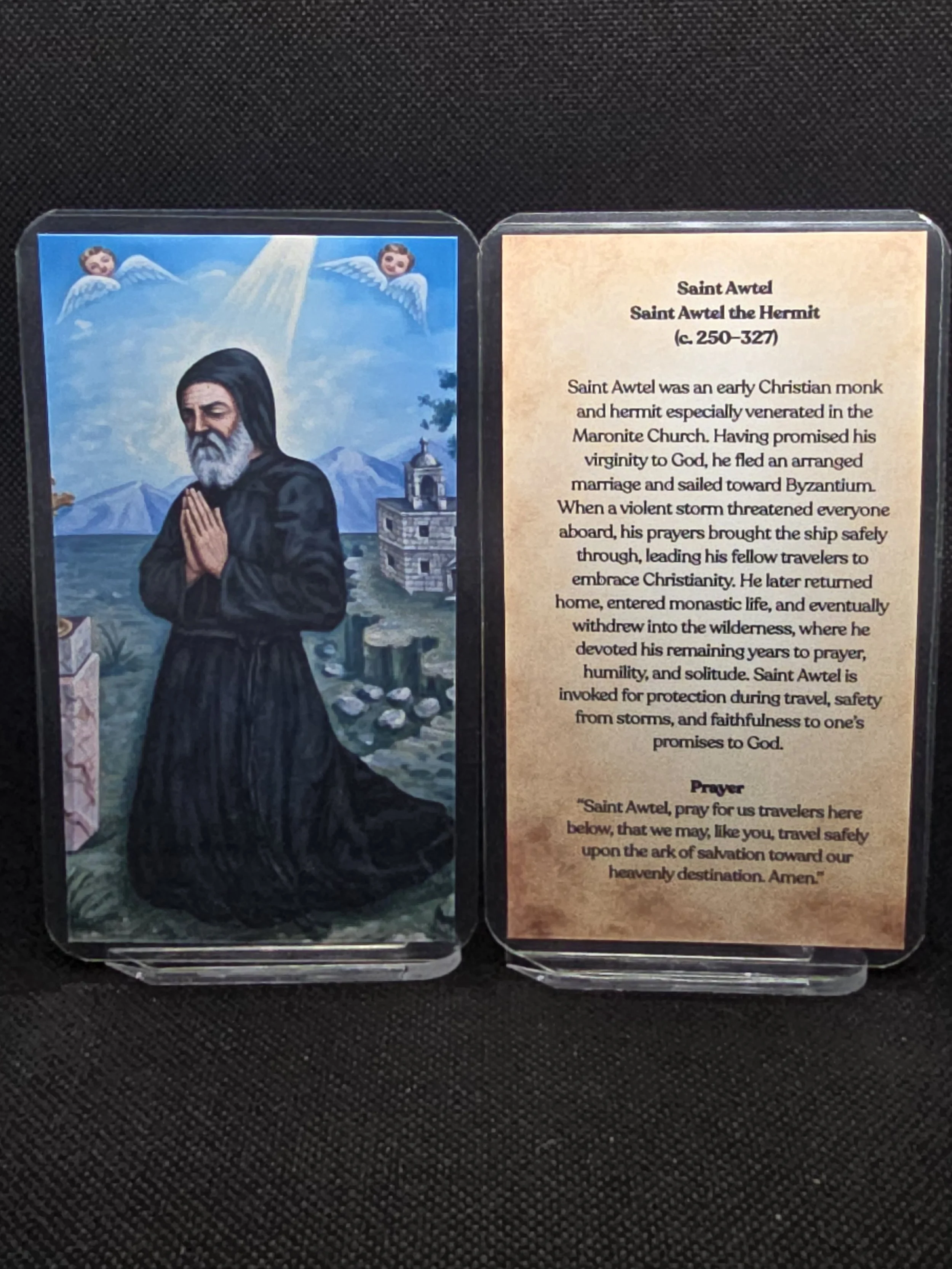
For this reason the date 327 should not be printed as a settled fact, and neither should the sixth century. The most careful description is that he was a monk and hermit of uncertain date, associated with Lycia, and honoured in the Syriac and Maronite tradition. The prayer card of the saint speaks of the sixth century. That reflects one of the traditions, not a proven date.
Birth and Family
TRADITION: according to the account linked with Cheikho, Awtel was born in a town called Magdal or Magdaloun in Lycia, a coastal region of Asia Minor, in what is now southern Turkey. His parents were pagans. As a young man he became a Christian and was baptized.
TRADITION: after baptism he resolved to remain unmarried and give his life to God. His father, or in some versions both parents, opposed this and tried to arrange a marriage for him. Awtel left home rather than give up his decision.
UNCERTAIN: we do not know the names of his parents, the place of his baptism or the town where he grew up. The story follows a pattern found in many early monastic lives, in which a young convert meets family resistance and leaves home. That does not prove the story false, but it does mean historians must separate a familiar literary form from independently documented events. There is also no reliable evidence that he was born in Lebanon. His link with Lebanon comes through the devotion of Kfarsghab.
Flight, a Storm at Sea and Years Near Constantinople
TRADITION: having fled his family, Awtel set out by sea. In one telling he was heading toward Byzantium, the great city later called Constantinople. A violent storm struck the ship. Awtel prayed, the vessel was saved, and the passengers who had seen this came to believe in Christ.
The storm story appears in both main traditions, though the details of the voyage differ. The account linked with Cheikho names a place called Moumista, which has been tentatively identified with Mopsuestia in Cilicia. That identification is UNCERTAIN. The storm also helps explain why Awtel became known as a helper of travellers.
TRADITION: he is said to have spent about twenty years in the region of Constantinople living an ascetic life, a life of prayer, fasting and simple poverty. The figure of twenty years cannot be dated or checked. Different versions place him in a monastery, in Seleucia and Antioch, or in the capital region before he went back to Lycia.
Return to Lycia and the Call to Solitude
TRADITION: after the death of his father, or of both parents in another version, Awtel returned to his homeland. One account says he entered a monastery in Lycia dedicated to Mar Aba, and that people soon spoke of his holiness.
According to a Syriac account summarised by Cheikho and Moubarac, he left the monastery because he did not wish to be made its superior. The tradition presents this as a deliberate refusal of honour. He moved toward a more solitary life, the path of the hermit, which Eastern Christians have long treated as one of the highest forms of monastic prayer.
UNCERTAIN: no foundation charter, inscription or archaeological find has been located that connects a particular monastery with him. He should therefore not be called a documented founder of monasticism. The surviving story presents a pattern of monastic life: fidelity to baptism, poverty, prayer, and avoidance of church office.
Healings and the Conversion of Many
TRADITION: Awtel is said to have preached to pagan neighbours and to have baptized converts. One account tells of a man suffering from a snakebite whom Awtel healed. A Maronite version connects a healing with the conversion of ten thousand people.
The number ten thousand belongs to the language of hagiography, which often uses large figures to express wonder. It is not a verified count, and we should not treat it as a historical statistic. The stories do show what believers wanted to say about him: that his prayer was powerful and that people turned to Christ because of the way he lived.
Another tradition says he settled in a small monastery or ascetic community in Lycia and remained there until his death. As with the rest of his life, this is told by later writers and cannot be confirmed from his own time.
Death and Burial: What Is Not Known
TRADITION: the Maronite account says Awtel died in 327 after a period of monastic and hermit life. Another account places his last years in a desert monastery in Lycia without giving a year.
UNCERTAIN: his burial place is not known, and no tomb or authenticated relics have been identified. There is no record of a translation of his remains. This sets him apart from many saints whose bodies became the centre of a shrine. Awtel's cult has centred not on a tomb but on a village church far from Lycia.
The modern Maronite calendar calls him a Confessor, which in older usage means a saint who bore witness to Christ by a holy life and not by martyrdom. Cheikho also noted a martyr named Uwaytilyos in a calendar associated with al-Biruni, commemorated on September 23, but he did not show that this was the same man.
The Church at Kfarsghab and the Feast Days
The firmest evidence of Awtel's cult is the Church of Saint Awtel in Kfarsghab. A Lebanese church directory reports a first building in 1470, while other descriptions treat that date as an early renovation, so the older date should be held loosely. The church was substantially rebuilt in 1776, and an inscription over the entrance is reported to support this date. A wooden partition is dated 1795 and door decorations 1882. These dates describe the building, and they say nothing about when the saint lived.
His feast is kept on June 3 in the Maronite liturgical calendar, which is the date to trust for the Church's official commemoration. In Kfarsghab itself, the village celebrates him on August 27. Local explanations differ. One says the date marks the saint's protection of the village from plague. Others connect it with a summer gathering or an older festival, so the origin of that date is UNCERTAIN.
Other dates appear in older or online sources, including October 9 in Syriac calendar material discussed by Cheikho, and November 3 on some websites. Their present liturgical use has not been confirmed, and we have not relied on them. No commemoration in the universal Roman calendar has been found.
Devotion Among Emigrants
Many families left Kfarsghab for Australia, the United States and other lands, and they carried their saint with them. The researcher Marie Johanna Karner reports that his feast has been kept in Sydney since 1964 and in Easton, Pennsylvania, since 1981, and describes how his image and his name hold the community together across distance.
A well known local custom is the preparation of hrisse, a slow cooked dish of wheat and meat that is shared at the saint's celebration. The meal is more than food. It gathers the community for prayer, memory and fellowship, and it is documented both in the village and among emigrants.
TRADITION: a story told by emigrants says that a group of villagers escaped the voyage of the Titanic in 1912 because one of their number fell ill and the rest stayed with him. Some tellings credit Awtel's intercession. Accounts disagree about the details, and Karner studies the story as a shared narrative of solidarity. It is not an authenticated miracle, and we mention it as part of how the community remembers.
Why He Matters to Eastern Christians
For Maronite Catholics his importance is clear and well supported. He appears in the official liturgical calendar, a parish in Easton publishes a prayer to him, and Kfarsghab keeps his church and feast. For them he is a protector of the village and of travellers, and a model of a life given wholly to prayer.
His story also shows how Syriac Christians keep the memory of saints whose lives are poorly documented. A Syriac Orthodox synaxarium is reported to have preserved a notice of him, which suggests his memory once travelled beyond the Maronite community. UNCERTAIN: we have not been able to confirm a present feast for him in the Syriac Orthodox or other Orthodox Churches, and it would be wrong to say that all of them keep his commemoration.
The themes of his tradition are familiar across the Eastern Christian world: leaving worldly status, faithfulness to baptism, ascetic discipline, and the movement from community life toward solitude. His story invites readers to value faith that was lived quietly, even when the historian has little to record.
Holy Mar Awtel, hermit and friend of the poor, you left home to follow Christ and found peace in prayer. Pray for those who travel and for those who live far from their homeland. Keep families faithful to the Church and to one another. Help us to prefer humility to honour and to trust God in every storm. Through your prayers, O Christ our God, have mercy on us. Amen.
This prayer was written for this page. It is not an official prayer. A prayer to Mar Awtel has been published by a Maronite parish in Easton, Pennsylvania.
Prayer and Legacy
A prayer to Mar Awtel has been published in a Maronite parish bulletin in Easton, Pennsylvania. It asks for steadfastness in the true faith and honest witness before others. We do not know who wrote it or how old it is, and it should not be called an ancient prayer. We found no traditional troparion or Syriac hymn for him that can be confirmed.
His legacy is a village church, a feast and a shared meal, and a community that has kept faith with a saint across oceans.
A pocket prayer card with his image is available at The Eastern Church for travellers, emigrants and all who seek a life of prayer.
Frequently Asked Questions
A Quiet Witness
Awtel left no writings and no sure dates. He left a church, a feast and a community that still gathers in his name. The Church keeps his memory because simple holiness, even when little is recorded, is worth remembering.
View Prayer Card