Saint Stephen the Protomartyr: Archdeacon of Jerusalem and the First Christian Martyr
The deacon chosen to serve the widows of Jerusalem, who preached before the Sanhedrin, saw Christ standing at God's right hand, and prayed for the men who stoned him.
At a Glance
- Born
- Unknown; neither his birthplace nor his birth date is recorded
- Died
- Traditionally about AD 34 to 36, by stoning outside Jerusalem; the exact year is uncertain
- Feast day
- December 26 in the Roman calendar; December 27 in the Byzantine calendar, with commemorations of the translation of his relics on August 2
- Canonization
- No decree; his veneration is older than formal canonization procedures
- Patronage
- Deacons, and by later devotion stonemasons and bricklayers
- Titles
- Protomartyr, First Martyr, Archdeacon
- The First to Die for Christ
- Name, Background and Family
- Chosen to Serve the Widows
- Preaching, Signs and Opposition
- The Speech Before the Council
- The Stoning
- After His Death: The Church Scattered
- The Discovery of His Relics in 415
- Relics, Shrines and Miracle Reports
- Why He Matters to Eastern Christians
- Prayer and Legacy
- Frequently Asked Questions
The First to Die for Christ
Saint Stephen is the first follower of Jesus whose death is told in the New Testament, and the Church calls him the Protomartyr, the first martyr. His story fills only a little more than two chapters of the Acts of the Apostles, yet it shapes how Christians remember witness, forgiveness and service.
Almost everything certain about him comes from Acts. Later writers added a great deal, especially about the discovery of his relics in the fifth century. This article keeps the two apart. It marks later or legendary material as TRADITION, and it marks what is unknown or disputed as UNCERTAIN.
Stephen wrote nothing that survives. His long speech in Acts 7 reaches us through the narrative of Luke, who gives us the account, so we should read the words as Luke's report of what Stephen said.
Name, Background and Family
UNCERTAIN: Scripture does not tell us where Stephen was born, who his parents were, or what he did before he appears in Jerusalem. His Greek name, Stephanos, means a crown or wreath. Scholars think the name suggests a Greek-speaking Jewish background, but a name alone does not prove where he came from.
He was almost certainly Jewish, since the earliest Jerusalem community was Jewish. Acts 6 describes tension between Greek-speaking and Hebrew-speaking believers, and Stephen is usually counted among the Greek speakers. That is an inference from the setting, and Acts does not say it directly.
TRADITION: some later accounts make him a student of the teacher Gamaliel mentioned in Acts 5:34. The Catholic Encyclopedia notes that this has never been proved, and we cannot treat it as established. Claims that he was wealthy or came from a named city have no support in the text.
Chosen to Serve the Widows
Stephen first appears in a dispute. Greek-speaking believers complained that their widows were overlooked in the daily distribution of help. The apostles asked the community to choose seven men of good standing, full of the Spirit and of wisdom, so that the Twelve could keep to prayer and the word.
Stephen is named first among the seven: Stephen, Philip, Prochorus, Nicanor, Timon, Parmenas and Nicholas of Antioch. The apostles prayed and laid hands on them. The Church has long regarded these seven as the first deacons.
Pope Benedict XVI pointed out in 2007 that Acts does not actually use the word deacon for them. The later Church saw their appointment as the root of the diaconate, and the Eastern tradition names Stephen archdeacon. The title is a development within the Church, and we cannot reconstruct the exact office from Acts alone.
Preaching, Signs and Opposition
Acts says that Stephen, full of grace and power, did great wonders and signs among the people. The text does not describe individual healings. Men from several Greek-speaking synagogues, linked in Acts with Cyrene, Alexandria, Cilicia and Asia, argued with him and could not withstand his wisdom.
Acts then says they secretly persuaded men to claim that Stephen had spoken blasphemous words against Moses and God. They stirred up the people, the elders and the scribes, and seized him and brought him before the council. Acts calls the witnesses false.
The charge, as Acts reports it, was that he spoke against the holy place and the Law and said that Jesus of Nazareth would destroy the Temple and change the customs of Moses. As the council looked at him, Acts says his face seemed like the face of an angel.
The Speech Before the Council
Stephen's answer is the longest speech in Acts. He walks through the history of Israel, beginning with Abraham and moving through Joseph, Moses, the wilderness generation, the tabernacle and Solomon's Temple. He argues that God does not live in houses made by human hands and that Israel has often resisted those whom God sent.
He ends with a charge that his hearers always resist the Holy Spirit and that they have become betrayers and murderers of the Righteous One, which Christians read as Jesus. Benedict XVI read the speech as a Christ-centred reading of the Old Testament and a step in the early Church's understanding of the Temple.
The speech raises questions that would shape early Christianity: the place of the Law, the meaning of the Temple, and how Jesus fulfils the story of Israel. The quarrel belongs to disputes inside the Jewish world of the first century. It gives no basis for blaming Jewish people as a whole, a misuse of the story that the Church has rejected.
The Stoning
Acts says the council was enraged and ground their teeth at him. Stephen, full of the Holy Spirit, looked into heaven and saw the glory of God and Jesus standing at God's right hand. He told them what he saw, and they covered their ears, rushed on him together and drove him out of the city to stone him.
The witnesses laid their garments at the feet of a young man named Saul, and Acts says that Saul approved of the killing. As they stoned him, Stephen prayed, Lord Jesus, receive my spirit, and then, kneeling, cried out, Lord, do not hold this sin against them. Then he fell asleep. The prayers deliberately echo the words of Jesus on the cross.
UNCERTAIN: Acts does not show a formal sentence from the council, so historians debate whether this was a legal execution or a violent mob action. The year is also uncertain. Tradition places it about AD 34 to 36. Acts 8:2 says devout men buried him and made loud lamentation, without naming them or the place.
After His Death: The Church Scattered
A great persecution broke out against the Church in Jerusalem that day, and the believers, except the apostles, were scattered through Judea and Samaria. Acts says that those who were scattered went about preaching the word.
Saul, who had approved of the killing, later became the Apostle Paul. Christian writers from Augustine onward have seen Stephen's prayer for his killers as part of the setting for that change. Augustine said that the Church owes Paul to the prayer of Stephen. That remains a theological reading, though Acts itself does not make the connection explicit.
In this way the first martyrdom marks a turning point in Acts. The community that had stayed mostly in Jerusalem began, through persecution, to carry the Gospel beyond it.
The Discovery of His Relics in 415
The first long account of Stephen's burial place comes about four centuries after his death. In December of 415, a priest named Lucian of Caphargamala reported that he had been shown, in visions, the forgotten grave of Stephen. The story, known as the Revelatio, says Gamaliel revealed that Stephen was buried on his property together with other early Christian figures.
The bishop of Jerusalem, John II, was told, and the remains were honoured and brought into the city, first to the church on Mount Zion. The account reached the Latin West through a translation tied to Avitus of Braga, whose letter of 416 is an early witness to how widely the story spread.
UNCERTAIN: no one can prove that the bones were Stephen's. Hugo Mendez has argued that the Jerusalem church helped to build a local cult of Stephen that raised the city's standing as a place of pilgrimage. His argument questions the discovery story but does not touch the far older account in Acts.
Relics, Shrines and Miracle Reports
Relics attributed to Stephen spread quickly. Accounts place some of them in North Africa and on the island of Minorca within a few years of the discovery. Augustine wrote in The City of God, book 22, chapter 8, about healings connected with the relics, and said that records of nearly seventy miracles had been collected at Hippo in less than two years. These are documented reports from that time. They are not independently verified medical evidence.
TRADITION: Byzantine sources place a translation of relics to Constantinople in the fifth century, and the Orthodox Church in America keeps August 2 for it. The date and path are UNCERTAIN. Empress Eudocia is reported to have built a great church in his honour near Jerusalem, and later tradition links Stephen with the Roman basilica of San Lorenzo fuori le Mura, where he is said to rest with Saint Lawrence. These traditions are old, but the physical authenticity of the relics cannot be tested.
TRADITION: later accounts add that Gamaliel secretly buried Stephen and was himself baptized, and that Nicodemus and Gamaliel's son Abibas were buried nearby. These stories are not in Acts. A later event, the violence against Jews on Minorca in 418 connected with the arrival of relics, shows how a martyr's cult could be used for harm, and it is the work of later men, not of Stephen.
Why He Matters to Eastern Christians
The Byzantine Churches keep Stephen on December 27, the day after the Roman feast, so in the East his commemoration falls inside the Nativity season. It links the birth of Christ with the witness of those who followed him. Byzantine Catholic and Orthodox services preserve hymns that recall his vision, his courage and his forgiveness.
His title of archdeacon ties him to the Eastern understanding of the diaconate, and he stands for the union of service to the poor with proclamation of the Gospel. Deacons in the Byzantine rite still honour him, and his image often appears on deacons' vestments and in the sanctuary doors of icon screens.
The Roman Church keeps him on December 26, so Catholics of both traditions and the Orthodox share one martyr. The difference in dates comes from how each calendar arranged the days after Christmas, and it reflects no disagreement about who he was.
Holy Stephen, first martyr and archdeacon, you served the poor and bore witness to Christ before the council. You saw heaven opened and forgave those who struck you down. Pray for deacons and for all who serve the Church. Pray for those who are hated for their faith. Teach us to answer anger with mercy and to trust our souls to Christ. Through your prayers, O Lord, have mercy on us. Amen.
This prayer was written for this page. It is not an official prayer. The Orthodox Church in America and the Metropolitan Cantor Institute publish the hymns for December 27.
Prayer and Legacy
The Orthodox Church in America and the Metropolitan Cantor Institute publish the texts for December 27, including the troparion of the day. An English Menaion gives a short Tone 3 troparion asking the holy first martyr to entreat the merciful God to grant our souls forgiveness of sins. We do not quote the hymns in full here, and wording differs between translations.
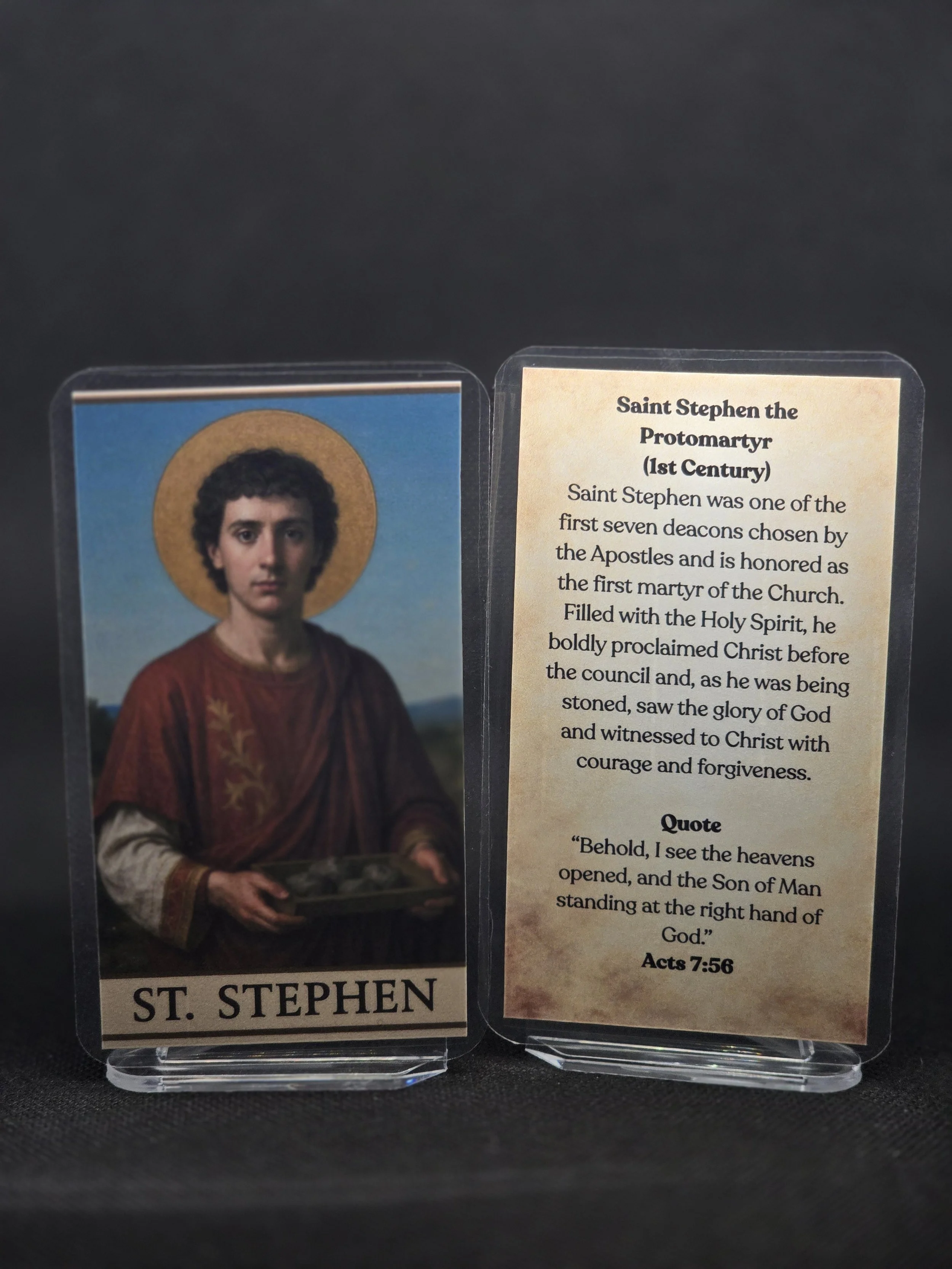
In art Stephen is shown as a young deacon holding a censer, a Gospel book or stones, and the iconographic tradition marks him with a halo and diaconal vestments. His legacy is his last prayer, which Christians have taken as a model for answering violence with mercy.
A pocket prayer card with his image is available at The Eastern Church for deacons, for those who suffer for their faith and for all who pray for their enemies.
Frequently Asked Questions
The First Witness
Stephen died with a prayer for his enemies on his lips. The Church has remembered him not for the stones but for the forgiveness, and that is why his feast comes at the heart of Christmas.
View Prayer Card