Saint Olga of Kyiv: Princess Regent, First Christian Ruler of Rus and Equal to the Apostles
The widowed princess who ruled Kyiv, took harsh vengeance on her husband's killers, then travelled to the Byzantine court and became the first ruler of Rus to be known as a Christian.
At a Glance
- Born
- Uncertain; about 890 is a conventional estimate, and Pskov is traditionally associated with her origins
- Died
- July 11, 969, in Kyiv
- Feast day
- July 11 in the Byzantine calendar, which falls on July 24 on the civil calendar for Churches that follow the Julian calendar
- Canonization
- No surviving decree; the Encyclopedia of Ukraine places her ecclesiastical recognition in the first half of the thirteenth century
- Patronage
- Traditionally associated with widows and with converts to Christianity
- Titles
- Equal to the Apostles, Blessed Great Princess; baptismal name Helena
The Dayspring Before the Sun
Saint Olga of Kyiv ruled the Rus capital in the middle of the tenth century and became the first ruler of the dynasty known to have accepted Christianity. The Primary Chronicle praises her as the forerunner of the Christian faith in Rus, using the image of light that comes before the dawn, and the Church calls her Equal to the Apostles.
The Chronicle that praises her also tells terrible stories of the vengeance she took on the men who killed her husband. Her life therefore has two sides, a ruthless widow in power and a convert who looked toward a Christian future, and the Church honours her for the second without pretending that the first was invisible.
This article marks later or legendary material as TRADITION. It marks what is disputed or unknown as UNCERTAIN.
What the Sources Are
Our evidence comes from several directions. The Primary Chronicle, compiled in Kyiv in its present form in the early twelfth century, gives the long narrative. The Byzantine emperor Constantine VII described a reception of Olga in his Book of Ceremonies. The Continuation of Regino, a German chronicle, records an embassy from Olga to King Otto I. The Byzantine historian John Skylitzes also refers to her conversion.
These sources agree that Olga was a real ruler who dealt with Constantinople and with the West. They disagree about when and where she was baptized, and the Chronicle's dramatic stories are not eyewitness reports. No writing by Olga survives, and the speeches and prayers attributed to her come through the chronicle tradition.
UNCERTAIN: her birth date and birthplace are not recorded. About 890 is a conventional estimate, and Pskov is the place most often associated with her origins. The name Olga is related to the Norse Helga, but a name alone does not prove her ancestry.
Igor, the Drevlians and the Regency
Olga married Igor, ruler of Kyiv, and their son was Sviatoslav. In 945, according to the Chronicle, Igor went back to the Drevlians to collect more tribute after already receiving it, and they killed him near Iskorosten. The chronicler himself shows that the tribute demands were harsh, so the killing is not presented as an unprovoked attack on an innocent man.
Sviatoslav was a child, and Olga became regent. The Encyclopedia of Ukraine places her rule during his minority at about 945 to 957, and she continued to govern during his later campaigns. She was responsible for tribute, security and diplomacy in a realm whose obedience could not be assumed.
The Chronicle says she reorganized the collection of tribute, setting fixed obligations and local centres known as pogosts, so that rulers no longer depended on yearly circuits with armed retinues. The exact scope of these reforms is UNCERTAIN because the detailed account is found in later chronicles. Her association with administrative reorganization is well established.
The Revenge
TRADITION: the Chronicle tells of four acts of vengeance. Drevlian envoys who came to propose that she marry their prince Mal were carried into her court in a boat and thrown into a pit. A second group, invited to bathe before meeting her, was locked in the bathhouse and burned. At a funeral feast for Igor the Drevlians were made drunk and killed, and the chronicle gives the number as five thousand, a figure that cannot be checked.
TRADITION: when she could not take the fortified town of Iskorosten, she is said to have asked for a small tribute of pigeons and sparrows, tied burning material to the birds and let them fly home to set the town alight.
Omeljan Pritsak distinguishes the historical Olga from a literary figure of cunning and revenge, and says the chronicle used heroic narrative traditions. Dimitri Obolensky also notes the semi-legendary character of these accounts. A real campaign against the Drevlians is likely. The methods, speeches and numbers are UNCERTAIN. In the Chronicle's order, these events come before her conversion, so they are not held up as Christian conduct.
Where and When Was She Baptized?
UNCERTAIN: this is the central scholarly dispute. The Primary Chronicle, under about 955, says Olga travelled to Constantinople, where Constantine VII and the patriarch took part in her baptism, and that she received the name Helena. TRADITION: it adds that the emperor wished to marry her and that she escaped by making him her godfather, since that made marriage impossible.
Constantine's own Book of Ceremonies describes receptions of Olga on September 9 and October 18 without giving a year, so calendar calculation allows 946 or 957. It names a priest, Gregory, in her company, but it does not mention a baptism. George Ostrogorsky concluded she was already Christian on arrival. Omeljan Pritsak argued for visits in 946 and 957 and a baptism by Patriarch Polyeuctus in the later one, and Michael Featherstone has defended a Constantinople baptism in 957. Dimitri Obolensky left the time and place open.
John Skylitzes and the Continuation of Regino both speak of a baptism at Constantinople. None of the dates, 954, 955, 957 or about 959, can be treated as proved, and neither Kyiv nor Constantinople can be named with full certainty. What is clear is that she became a Christian in the middle of the tenth century.
Courts East and West
Olga's reception at Constantinople shows the standing of the Kyivan house. The Book of Ceremonies lists the emperor, the empress, officials, interpreters, merchants and Olga's own attendants. Historians have suggested commercial privileges, military help, dynastic arrangements and religious talks among her aims, but the sources do not say which she pursued.
In 959, according to the Continuation of Regino, an embassy from Helena, queen of the Rus, asked King Otto I for a bishop and priests. Libutius was named first and died in 961 before reaching Rus. Adalbert of Trier was then sent and returned in 962 after the mission failed. Historians differ about whether this reflects a change in politics, local resistance or what Olga's embassy actually intended.
The episode shows that her interest in the Church was not limited to Constantinople. TRADITION: later church accounts credit her with churches of Saint Nicholas and Holy Wisdom in Kyiv, the Annunciation at Vitebsk and the Holy Trinity at Pskov, but individual foundations and dates cannot all be confirmed.
A Mother and a Son Who Refused
The Chronicle says Olga urged her son Sviatoslav to be baptized and he refused, fearing that his warriors would mock him. This shows the limit of her influence. Her personal faith could not simply replace the religious culture of the prince and his companions.
Christianity was not new in Kyiv. The treaty with Byzantium of 944, as preserved in the Chronicle, separates Christian Rus, who swore at the Church of Saint Elijah, from pagan Rus. Olga was not the first Christian in Kyiv, but she is the first Christian ruler of the dynasty known to us.
In 968 the Chronicle records a siege of Kyiv by the Pechenegs, in which Olga and her grandsons were trapped until help arrived. The general pressure of the Pechenegs is credible, though the dramatic details belong to the narrative.
Death and Remembrance
Olga died in Kyiv on July 11, 969. The Chronicle says she asked for a Christian burial and not a pagan funeral feast, and that she had a priest to bury her. Her grandson Volodymyr is said to have moved her remains to the Church of the Tithes after Rus became Christian.
UNCERTAIN: the date of the transfer and the later fate of her remains are not known. Reports that her body was incorrupt belong to hagiographical tradition and cannot be confirmed. TRADITION: later Orthodox accounts tell of a vision of light that showed her where to build the church of the Holy Trinity at Pskov.
Her cult is older than any decree. The Encyclopedia of Ukraine places her ecclesiastical recognition in the first half of the thirteenth century. Sean Griffin has shown how Byzantine liturgical texts shaped the Chronicle's picture of her as a second Helena, the mother of Constantine.
Why She Matters to Eastern Christians
For Orthodox Christians she is Equal to the Apostles, kept on July 11. The Orthodox Church in America and the Greek Orthodox Archdiocese both publish her life and hymns. For Ukrainian Greek Catholics and other Eastern Catholics of Kyiv, she belongs to the same Christian inheritance, held in Byzantine worship and in communion with Rome.
Her conversion came a century before the break of 1054, when East and West still shared one Church. Her dealings with both Constantinople and Otto I show that early Rus was part of the wider Christian world.
She did not Christianize the country in her lifetime. Her contribution was preparation: she gave Christianity a place in the ruling house, and her grandson Volodymyr took the step she could not.
Holy Princess Olga, you knew grief and power, and you went in search of the true God. Pray for widows and for those who are left alone with heavy duties. Help converts who must stand apart from family and friends, and guide those who govern to rule with justice. May the light you followed grow in every heart. Through your prayers, O Christ our God, save our souls. Amen.
This prayer was written for this page. It is not an official prayer. The Orthodox Church in America publishes the Tone 1 troparion for July 11.
Prayer and Legacy
The Orthodox Church in America publishes the Tone 1 troparion for Olga, which speaks of a mind raised on the wings of divine understanding and of her rebirth through baptism. We do not quote it in full here. It is available on the Orthodox Church in America's page for July 11.
Her legacy lies in the Christian history of Kyiv and in the conviction that a person with great power and a hard past can still turn toward God.
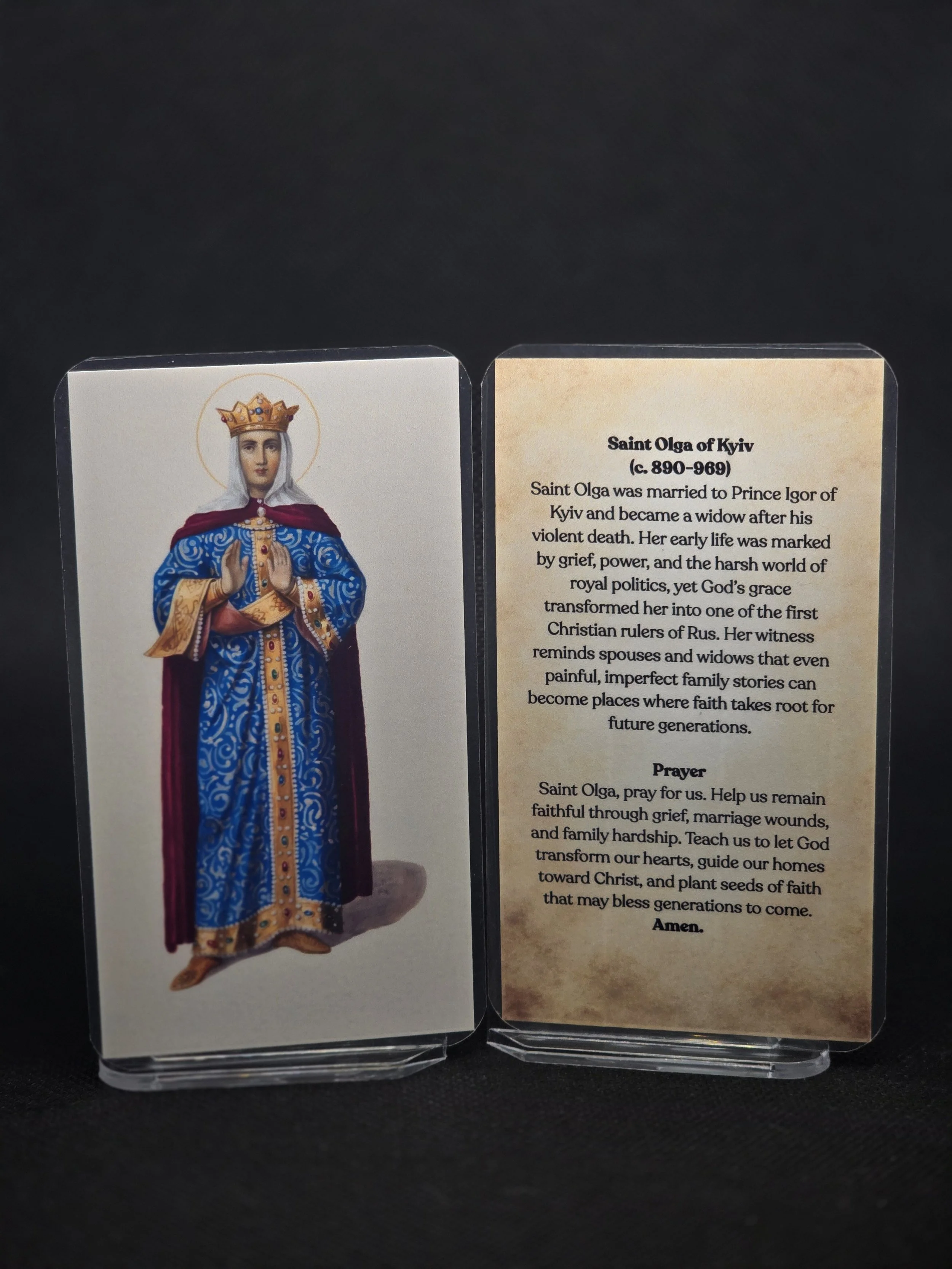
A pocket prayer card with her image is available at The Eastern Church for widows, converts and all who rule or serve in public life.
Frequently Asked Questions
The First Light
Olga did not finish the work. She prepared it. The Church remembers her because a woman who held power in a hard world looked for something larger, and her search helped open the way for a nation.
View Prayer Card