Saint Volodymyr the Great: Grand Prince of Kyiv, Baptizer of Rus and Equal to the Apostles
The pagan warlord of Kyiv who accepted Byzantine Christianity, married into the imperial family and led his people to the waters of the Dnipro.
At a Glance
- Born
- Uncertain; between about 956 and 963, with about 958 commonly used
- Died
- July 15, 1015, at Berestove near Kyiv
- Feast day
- July 15 in the Byzantine calendar, which falls on July 28 on the civil calendar for Churches that follow the Julian calendar
- Canonization
- No single documented decree or date; honoured by early and continuing veneration
- Patronage
- Honoured as a heavenly protector of Ukraine and of the Christian inheritance of Kyivan Rus
- Titles
- Equal to the Apostles, Enlightener of Rus, Holy Great Prince
- A Prince Between Two Worlds
- The Sources and Their Limits
- Family and the Road to Power
- The Pagan Prince
- The Choice of a Faith
- The Byzantine Alliance
- Where and When Was He Baptized?
- The Baptism of Kyiv and the Churches He Built
- Death and Veneration
- Why He Matters to Eastern Christians
- Prayer and Legacy
- Frequently Asked Questions
A Prince Between Two Worlds
Saint Volodymyr the Great, also called Vladimir, ruled Kyiv from about 980 until his death in 1015. He is remembered as the prince who brought Byzantine Christianity to Kyivan Rus and as the man in whose reign the great Christian civilization of the Eastern Slavs began.
The same sources that praise him do not hide his earlier life. Volodymyr came to power through war within his own family. He is reported to have set up pagan shrines and to have kept many wives and concubines. The Church honours him as a saint who changed, and not as a man who never needed to.
This article marks later or legendary material as TRADITION. It marks what historians dispute or cannot know as UNCERTAIN.
The Sources and Their Limits
The main source is the Primary Chronicle, put together in Kyiv a century or more after the events. It has to be used with care, because the chronicler shaped the story to teach a lesson about conversion.
There are other voices. The Arabic Christian historian Yahya of Antioch, writing in the early eleventh century, supports the alliance between Volodymyr and the Byzantine emperor Basil II. Thietmar of Merseburg, a German bishop who wrote around 1012 to 1018, gives a near-contemporary Western view of the ruler of Rus. The monk Jacob wrote a Memory and Praise of Prince Vladimir, whose chronology differs from the Chronicle.
No letter or treatise by Volodymyr survives. Speeches and prayers attributed to him belong to the chronicle texts and are not authenticated writings of his own.
Family and the Road to Power
Volodymyr belonged to the ruling Rurikid house. He was the son of Prince Sviatoslav of Kyiv and Malusha, a woman connected with the household of his grandmother, Saint Olga. His birth year is UNCERTAIN. The Catholic Encyclopedia gives 956, some Orthodox sources give 963, and about 958 is a common estimate.
Olga had accepted Christianity, but Sviatoslav stayed pagan, so Volodymyr grew up where the new faith was known but had not replaced the old ways. According to the Chronicle, Sviatoslav's sons Yaropolk and Oleg quarrelled over the inheritance, Oleg died, and Volodymyr fled to Scandinavia.
He came back with Varangian warriors, took Polotsk and moved against Yaropolk. The Chronicle presents Yaropolk's murder as a step in his rise. The detailed stories of coercion in his marriage to Rogneda of Polotsk are chronicle narrative and have to be told with that caution.
The Pagan Prince
The Chronicle describes Volodymyr setting up idols of the gods at Kyiv, among them Perun, and tells of sacrifice. It also gives the figure of 800 concubines. UNCERTAIN: that number cannot be checked and may be rhetorical, meant to show how far he stood from the Christian ruler he later became.
Under the year 983 the Chronicle tells of a Christian Varangian and his son who refused to give up the boy for sacrifice and were killed. They are remembered as the martyrs Theodore and John. Their exact circumstances, and Volodymyr's own part in them, cannot be independently confirmed, and scholars also notice literary parallels that present the prince first as a persecutor and then as an apostle.
The sharp contrast between the two halves of his life is part of why his sanctity has held people's attention.
The Choice of a Faith
TRADITION: the Chronicle says that in 986 or 987 envoys from several religions came to Volodymyr, Muslims, Jews, Western Christians and Byzantines. He sent his own men to see how each prayed. Those who went to Constantinople were overwhelmed by the Divine Liturgy and told him they did not know whether they were in heaven or on earth.
UNCERTAIN: historians do not take this as a record of real missions. Sean Griffin has shown how the account is arranged around liturgical models, including the conversion of Constantine the Great. The story is valuable evidence of how medieval Christians understood the choice. Its individual speeches and conversations cannot be verified.
The beauty of the Eastern liturgy has been a theme of Eastern Christian self-understanding ever since, and this story is one reason.
The Byzantine Alliance
Better supported is the political side. In 987 the emperor Basil II faced a serious revolt led by Bardas Phokas. Volodymyr agreed to send military help, traditionally about six thousand warriors, in return for the hand of Anna, the emperor's sister. His acceptance of Christianity was a condition of the marriage.
Dimitri Obolensky explained the background of this alliance, and Yahya of Antioch independently supports the agreement and the marriage. The military help is linked with Basil's campaigns into 989, which gives a firmer frame than the conversion legend.
Political motives do not by themselves disprove personal faith. The sources suggest a mixture of conviction, diplomacy and the growing presence of Christianity in Rus.
Where and When Was He Baptized?
UNCERTAIN: this is one of the main disputes about him. The Primary Chronicle says he was baptized at Cherson, called Korsun in Slavic sources, in Crimea, after he captured the city in 988. TRADITION: it adds that he fell blind there and recovered his sight at baptism, in an echo of the conversion of Saint Paul in Acts 9.
Jacob the Monk places his baptism before the capture of Cherson, which would mean he was already Christian when he went there. Historians therefore place his conversion between 987 and 989 without agreeing on a place or a single date. The baptismal name Basil is plausible in light of the link with Basil II.
The year 988 is still the traditional date of the Baptism of Rus and is used by the Catholic and Orthodox Churches for the great anniversary.
The Baptism of Kyiv and the Churches He Built
The Chronicle describes the pagan idols of Kyiv being thrown down and the people called to the Dnipro to be baptized. This was an act of government and not only a spontaneous gathering. It also shows that conversion could involve heavy pressure. Pagan practices lasted for generations, and Christian life took root unevenly across the principality.
His greatest building was the Church of the Tithes in Kyiv, dedicated to the Mother of God and dated by the Encyclopedia of Ukraine to 989 to 996. He assigned a tenth of princely income to its upkeep, and it became a dynastic burial place. The Chronicle also speaks of schools for children and of charity to the poor, and Thietmar of Merseburg gives comparatively early support for the picture of a charitable ruler.
The Church of the Tithes was destroyed in the Mongol conquest of 1240. The history of the remains of Volodymyr and others buried there is complicated, and no relic should be assumed to be authenticated.
Death and Veneration
The Chronicle records his death on July 15, 1015, at Berestove near Kyiv, while he was preparing a campaign against his son Yaroslav, who had refused tribute. He was buried in the Church of the Mother of God, generally identified with the Church of the Tithes. His death was followed by a struggle among his sons, in which Boris and Gleb were killed. They are honoured as passion-bearers.
UNCERTAIN: no single date of canonization or glorification can be named. Metropolitan Hilarion's Sermon on Law and Grace, from about 1037 to 1050, already praises him as a ruler who enlightened his people, which shows how early his memory was honoured. The date when his feast was first generally observed is unknown.
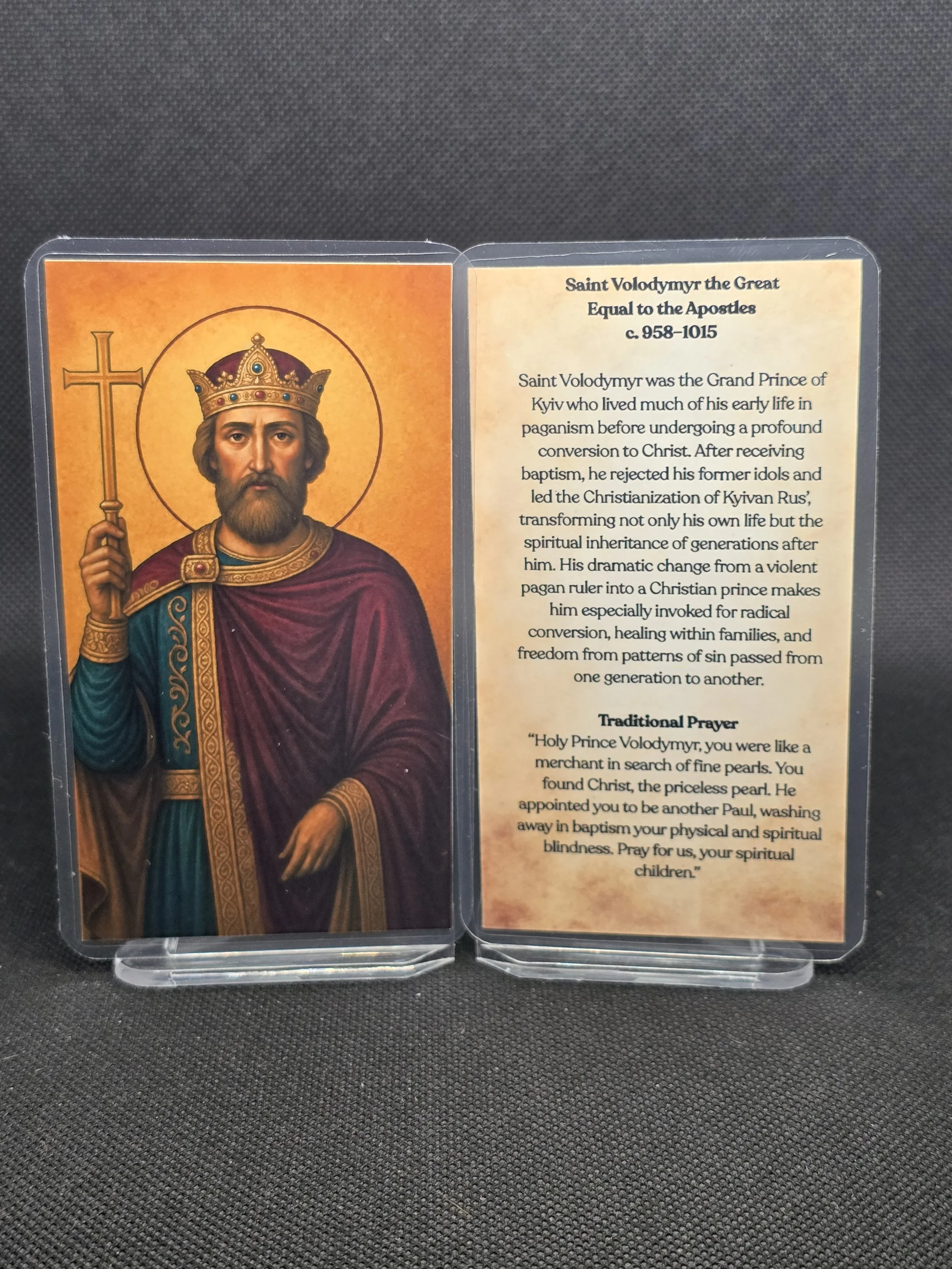
Liturgical texts compare him with Constantine the Great and with the Apostle Paul. Icons show him crowned, with a cross and sometimes a model of a church.
Why He Matters to Eastern Christians
For Orthodox Christians he is Equal to the Apostles, the ruler through whom Byzantine Christianity took firm root in Rus. The title does not mean he was one of the Twelve. It honours a man who did for his people something like what the apostles did for theirs.
For Ukrainian Greek Catholics, and for other Eastern Catholics of the Kyivan tradition, he stands for the Christian inheritance of Kyiv, held in Byzantine worship and in communion with Rome. Pope John Paul II recognized this inheritance in the apostolic letter Euntes in Mundum of January 25, 1988, written for the millennium of the Baptism of Rus.
His baptism took place before the Churches of Rome and Constantinople settled into their later separate forms, so both Catholics and Orthodox honour him. His inheritance also belongs, in different ways, to Ukraine, Belarus and Russia, and a modern national claim should not be read back into the tenth century.
Holy Prince Volodymyr, you were once far from Christ and became a light to your people. Pray for those who rule, that they may govern with justice and mercy. Pray for the nations of Rus and for all who live in war and fear, that the peace of Christ may be given them. Help those who have wronged others to turn back, and keep us faithful to the gifts we have received. Through your prayers, O Christ our God, have mercy on us and save us. Amen.
This prayer was written for this page. It is not an official prayer. The Orthodox Church in America publishes the Tone 4 troparion for July 15.
Prayer and Legacy
The Orthodox Church in America publishes the Tone 4 troparion for July 15, which compares the prince to a merchant seeking fine pearls and speaks of his finding of Christ. We do not quote it in full here. It is available from the Orthodox Church in America.
His legacy is the Church of Kyiv and the Slavic Christian culture that followed. It is a story of a man who was changed, and of a people who were taught to see that change as possible.
A pocket prayer card with his image is available at The Eastern Church for those who ask his help for their nations and families.
Frequently Asked Questions
A Changed Life
The Church does not honour Volodymyr because his life was simple. It honours him because the sources show a man whose power and past gave him every reason to stay as he was, and who instead opened his country to a new faith.
View Prayer Card