Saint Gregory the Wonderworker: Bishop of Neocaesarea, Student of Origen and Apostle of Pontus
A well-educated young pagan who studied under Origen, became the bishop of a nearly pagan city in Pontus and was remembered by the great Cappadocian Fathers as the founder of their Church.
At a Glance
- Born
- About 213, at Neocaesarea in Pontus (modern Niksar, Turkey); birth name Theodore; the year is an approximation
- Died
- About 270; some sources suggest 265 or a few years after 270, so the year is uncertain
- Feast day
- November 17, in the Roman Catholic and Byzantine calendars
- Canonization
- No formal decree; honoured by ancient veneration
- Patronage
- Local patron of Staletti in Calabria; invoked in popular devotion against floods, earthquakes and hopeless situations
- Titles
- Bishop of Neocaesarea, Wonderworker (Thaumaturgus), Confessor, Father of the Church
The Bishop Whom Basil Called a Wonder
Saint Gregory the Wonderworker, known in Greek as Thaumaturgus, was the bishop of Neocaesarea in Pontus in the third century. Two of the great Cappadocian Fathers, Basil the Great and Gregory of Nyssa, wrote about him with reverence, and Basil treated him as a first teacher of his own region's Christianity.
His story has an unusual shape. He began as a young pagan with a promising career in law. He became a Christian student of the great Origen, returned to a city that was hardly Christian at all and, according to later memory, left it almost entirely converted. The miracles that give him his title are part of that memory, but they are not the whole of it.
This article separates what the early sources say from what grew up around it. TRADITION marks stories from later or devotional sources. UNCERTAIN marks what is disputed or unknown.
Theodore of Neocaesarea
Eusebius and Jerome give his birth name as Theodore. He was born about 213 into a wealthy pagan family in Neocaesarea, a city in Pontus, now Niksar in Turkey. The year is a traditional approximation and is UNCERTAIN.
The Panegyric to Origen, the farewell speech traditionally credited to him, says that the speaker's father died when he was fourteen and that his mother arranged an education in rhetoric, Latin and Roman law. He had a brother, Athenodorus, whom Eusebius identifies as the brother of the bishop, and a sister whose husband worked for the Roman governor in Palestine.
UNCERTAIN: some modern scholars question whether the author of the Panegyric was the same man as the bishop. If he was, the details above belong to Gregory's own life. If not, they belong to an unknown student of Origen, and the identification rests on the old tradition.
The Teacher Who Changed His Life
The brothers planned to study law at Berytus, now Beirut, a famous school of Roman law. A journey connected with their sister's husband took them to Caesarea in Palestine, where they met Origen, who had moved there from Alexandria.
According to the Panegyric, Origen did not begin with doctrine. He led his students through philosophy, ethics and the study of nature, and then to Scripture and the Christian faith. The speech describes a relationship of admiration, friendship and a change of life.
Eusebius and Jerome say that the brothers studied with Origen for five years. The older Catholic Encyclopedia reconstructs about seven, and the Panegyric speaks of eight years away from ordinary speech-making, which need not mean eight years under Origen. The five years have the clearest ancient testimony, and the chronology is still UNCERTAIN. The traditional account says Theodore became a Christian and took the name Gregory, but the date and circumstances are not recorded.
Made a Bishop
After his studies Gregory went home to Pontus, where he was expected to practise law. Instead he became bishop of Neocaesarea. Gregory of Nyssa credits Bishop Phaedimus of Amasea with recognising his gifts, and describes an unusual appointment made over the reluctance of a man who wanted solitude.
TRADITION: the story that Phaedimus ordained him while he was far away comes from Nyssa's hagiographical life and cannot be treated as a record of how the ordination was done. The traditional date of about 240 for his consecration is also UNCERTAIN.
Basil, writing about a century later, says that Gregory received a church of only seventeen Christians. That figure is early testimony, but it is not a census. The tradition tells us how the later Church wished to remember the scale of his work.
What He Wrote
Several works are attributed to Gregory, and they differ in how secure the attribution is. The Panegyric to Origen is among the most valuable texts on ancient Christian education, though its authorship is discussed. The Canonical Epistle, a pastoral letter written after raids in Pontus, is widely accepted. Jerome names a paraphrase of Ecclesiastes as his, and scholars generally agree.
The Declaration of Faith, a short Trinitarian creed preserved by Gregory of Nyssa, is more difficult. Some scholars have asked whether all of it comes from Gregory, and Manlio Simonetti notes that its closing formulation may reflect fourth-century debates. Other works, among them To Theopompus and a text addressed to Philagrius, have disputed authorship, and a few pieces were attributed to him without good reason.
The Canonical Epistle is especially useful because it deals with real problems. It addresses Christians who stole property or kept escaped captives during an invasion, and it sets out how such wrongs should be put right. It shows a bishop trying to protect the vulnerable in a time of disorder.
Persecution, Invasion and Controversy
The persecution under the emperor Decius, about 249 to 251, is well known. Later accounts say that Gregory led his people into the hills. TRADITION: soldiers who came looking for him and his deacon saw only trees. The story is devotional testimony and not a corroborated event.
Eusebius names Gregory and his brother Athenodorus among the bishops connected with the discussions at Antioch about the teaching of Paul of Samosata, which shows Gregory's standing outside his own diocese. UNCERTAIN: Eusebius also names a Theodorus among the signatories of the synod letter, and it is not certain that this is Gregory.
Basil had to defend sayings attributed to Gregory against readers who found Sabellian meanings in them. He argued that the words belonged to the setting of an argument and were not a full statement of faith. That discussion shows both Gregory's authority and how hard it is to reconstruct his own thought from fragments.
Death and Relics
Gregory died at Neocaesarea, traditionally about 270. Sources differ by several years, so the date is UNCERTAIN. Nothing early says he died a martyr, and he is remembered as a bishop and confessor.
TRADITION: Gregory of Nyssa says that near the end he asked that no private plot be bought for his burial, so that he would remain without property even in death.
Relics attributed to him are venerated at the sanctuary and former monastery of San Gregorio in Staletti in Calabria, where he is a local patron. Local tradition links their arrival with Byzantine monks, but the transfer and the authentication of the relics are UNCERTAIN.
The Miracles
Basil, in On the Holy Spirit 29.74, speaks of Gregory's power over demons, a river and a lake. That shows that miracle stories were already told within about a century of his death. It is testimony to belief, and not an independent verification.
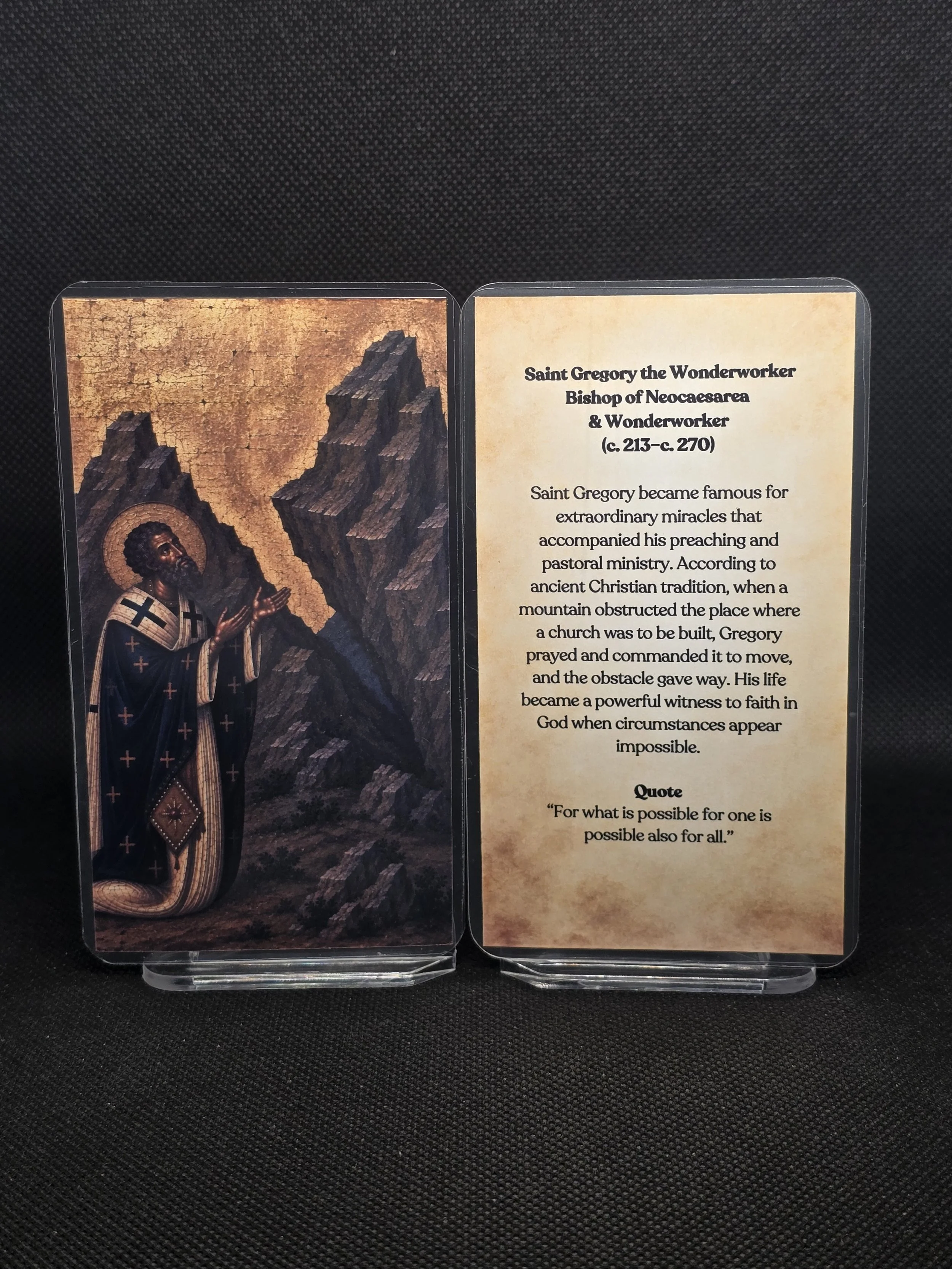
TRADITION: two brothers quarrelled over a lake in their inheritance, and Gregory prayed until the lake dried up. Basil mentions the lake. Later accounts add that he redirected a river, and that he commanded a hill to move so that a church could be built, echoing Matthew 17:20. The mountain tale has no early confirmation.
TRADITION: Gregory of Nyssa also tells that Gregory had a vision in which the Virgin Mary asked the Apostle John to teach him the true faith about the Trinity, and that a creed was written down and kept at Neocaesarea. Whether the vision and the creed go back to Gregory is UNCERTAIN. The best known tradition holds that he began with seventeen Christians and died when only seventeen pagans were left in the city. The symmetry is typical of hagiography, and neither number can be checked.
Why He Matters to Eastern Christians
Basil appealed to Gregory as an authority for the right praise of the Holy Spirit and for the customs of the Church, which makes Gregory an early voice behind the Cappadocian tradition. In Letter 204, Basil says his own religious formation came partly through his grandmother Macrina the Elder, who had heard Gregory's teaching.
Gregory of Nyssa's biography made him a model of the ascetic, evangelising bishop. The Greek Orthodox Archdiocese commemorates him on November 17, and the Ukrainian Greek Catholic Eparchy of Edmonton publishes the commemoration and hymns for the same day. Vatican News also lists him on November 17.
He matters not only because of the miracles but because he was a scholar who became a pastor, and who joined learning, worship and care for the poor and frightened.
Holy Father Gregory, shepherd of Neocaesarea, you taught that learning and prayer belong together. Intercede for students and teachers, for bishops and pastors, and for all who face a mountain they cannot move. Give us faith that works through patient love, and mercy in the troubles of our neighbours. Through your prayers, O Christ our God, enlighten our minds and save our souls. Amen.
This prayer was written for this page. It is not an official prayer. The Orthodox Church in America publishes the traditional troparion for November 17.
Prayer and Legacy
The Orthodox Church in America publishes a troparion for the saint, which praises a life of vigilance and mercy and asks for enlightened minds. We do not quote it in full here. The text and its tone are given in the Orthodox Church in America's page for November 17.
His legacy is the Church of Pontus and Cappadocia, whose later saints looked back to him, and a body of writing that includes the earliest picture of a Christian school.
A pocket prayer card showing the mountain tradition is available at The Eastern Church for those who face what seems immovable.
Frequently Asked Questions
Teacher and Shepherd
Gregory the Wonderworker is remembered for wonders, but his best claim on the Church may be that he turned a good education to the service of an unlikely city. The sources leave much unsettled, and what remains is a bishop whom the Fathers trusted.
View Prayer Card