Saint Demetrios of Thessaloniki: Great Martyr, Myrrh-Streamer and Protector of the City
The martyr whose basilica stands in the heart of Thessaloniki, who became the city's heavenly defender and one of the most beloved military saints of the East.
At a Glance
- Born
- Uncertain; Thessaloniki by tradition, with devotional lives suggesting about 260 to 280
- Died
- TRADITION: about 306, in the persecution under Galerius; the date and place are disputed
- Feast day
- October 26 in the Byzantine calendar, including Orthodox and Melkite Catholic use; October 8 in the older Roman Martyrology
- Canonization
- No formal decree; honoured by ancient veneration
- Patronage
- The city of Thessaloniki; invoked as a protector of cities and, in Eastern devotion, of soldiers
- Titles
- Great Martyr, Myrrh-streamer, Protector of Thessaloniki
- A Basilica Before a Biography
- What the Sources Say
- Family and Early Life
- Preacher, Official or Soldier?
- Nestor, Lyaeus and the Spear
- The Date and the Emperor
- Sirmium and the Question of Origins
- The Basilica and the Relics
- The Miracles and the Protector of the City
- Myrrh and Devotion
- Why He Matters to Eastern Christians
- Frequently Asked Questions
A Basilica Before a Biography
Saint Demetrios is among the most honoured martyrs of the Byzantine world, and Thessaloniki has been called his city for more than fifteen hundred years. Yet the order of the evidence is unusual. The oldest solid proof of his cult is a great basilica built in the later fifth century. The life stories that fill the icon books and sermons come later.
James Skedros, who studied the early cult closely, notes that the earliest undisputed evidence for Demetrios in Thessaloniki is the monumental church itself and not a contemporary martyrdom record. That does not make the saint unreal. It means that a careful biography has to separate the documented cult from the later layers of story.
In this article, TRADITION marks material that comes from later hagiography and devotion. UNCERTAIN marks matters that are disputed or unknown.
What the Sources Say
The main narrative sources are two accounts of his martyrdom, usually called the Passio prima and the Passio altera, together with the Miracles of Saint Demetrios, collected in the seventh century. The monumental edition and commentary on the Miracles by Paul Lemerle remains the standard scholarly work.
The earlier Passion gives very little about his family, rank or trade, and as scholars read it, it does not call him a soldier. The later Passion, with the expanded lives that followed it, adds a noble family and public office.
No writing by Demetrios survives, and neither do trial records or eyewitness accounts. Everything told here about his life is therefore reported through later authors.
Family and Early Life
TRADITION: Orthodox lives describe him as the son of a Roman official, sometimes called the proconsul of Thessaloniki, whose parents were secret Christians. He is said to have been baptized in a private chapel in the family home and to have received his father's position after his death.
The expanded Passion gives him a senatorial family and administrative titles. Christopher Walter and other historians have asked whether this reflects real memory or a later effort to give the patron of the city an impressive Roman background.
UNCERTAIN: nothing reliable is known of his parents, siblings, marriage or exact birthplace. The most careful statement is that the tradition remembers an educated young Christian of good standing.
Preacher, Official or Soldier?
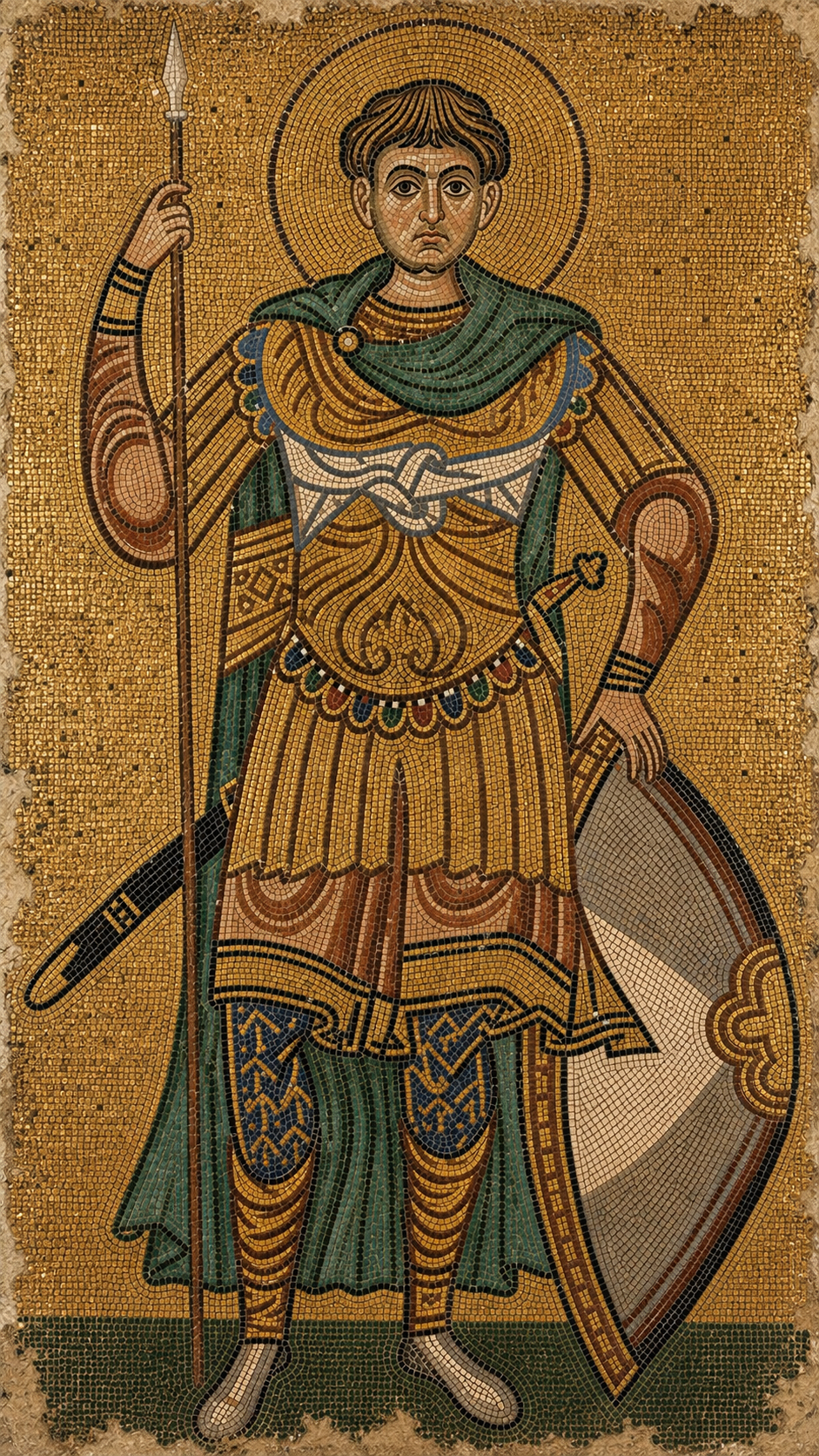
TRADITION: the later Passion presents Demetrios as a governor or commander who was supposed to defend the city and suppress Christianity, and who preached the Gospel instead. In later icons he is a mounted warrior with a spear.
The earlier evidence is quite different. Christopher Walter and others have shown that Demetrios gradually gained military attributes as his role as heavenly defender of Thessaloniki grew. The early mosaics in his basilica show him in civil or court dress and not in armour.
UNCERTAIN: whether he ever served as a soldier or officer cannot be settled. His military character is certain as a feature of his cult, and uncertain as a fact about his life.
Nestor, Lyaeus and the Spear
TRADITION: after his arrest, Demetrios was held in a Roman bath building. The story of Nestor belongs here. Nestor, a young Christian, asked for Demetrios's blessing before facing the emperor's favourite gladiator, Lyaeus, in the arena. Nestor won and the emperor was angry. Demetrios was condemned for supporting him, and Nestor was put to death as well.
TRADITION: Demetrios was killed by soldiers' spears while he was in prison. His servant Lupus is said to have kept cloths stained with his blood, and Christians buried the body in secret.
The troparion for his feast refers to this story, which shows how deeply it shaped his memory. It remains hagiography, however, and no independent Roman record confirms the episode.
The Date and the Emperor
TRADITION: his death is placed about 306, in the Great Persecution, under an emperor often identified as Galerius Maximian, though the accounts use variants of the name Maximian.
UNCERTAIN: neither the year nor the place of death is confirmed by any contemporary source. The older Western calendar keeps him on October 8, as the Acta Sanctorum shows, while the Byzantine calendar keeps October 26. These are different commemorations and not proof of two different deaths.
The setting of persecution is plausible for the early fourth century. But the details of the arrest, the imprisonment and the execution cannot be checked.
Sirmium and the Question of Origins
There is a scholarly problem behind the saint's origins. Early Latin martyrological evidence knows a deacon named Demetrius who was honoured at Sirmium, in present-day Serbia, on April 9. Efthymios Rizos has pointed to a reference to this deacon in the Passion of Pollio.
David Woods, in the Harvard Theological Review in 2000, asked in an article called Thessalonica's Patron: Saint Demetrius or Emeterius? whether the Thessalonian cult grew out of an earlier martyr's veneration. James Skedros answered with a study of the archaeological and historical evidence and found difficulties in that proposal.
UNCERTAIN: whether the Sirmian deacon and the Great Martyr of Thessaloniki were the same person, two separate martyrs or a later merger of traditions has not been settled. A 2026 study has also questioned whether an excavated church at Sirmium can be securely identified with the church in the later martyrdom account.
The Basilica and the Relics
TRADITION: a Roman official named Leontius was healed through the intercession of Demetrios and built a church in his honour. The earliest monumental basilica is commonly dated to the late fifth century, though archaeologists still discuss its building phases and whether an earlier shrine stood there. It was badly damaged in the fire of 1917 and later restored. It is part of the early Christian and Byzantine monuments of Thessaloniki that UNESCO inscribed on its World Heritage List in 1988.
The place of the original body was uncertain even in antiquity. The Miracles tell of the emperor Maurice asking for relics and of Archbishop Eusebios replying that the martyr's resting place was hidden and that the city would not give him up. Another story describes an attempt under Justinian to recover relics from beneath the church. These tales show an early concern over the remains and do not count as archaeological evidence.
Relics venerated as his are kept in the basilica. Church accounts record the return of some from Italy in 1978 and 1980. The ceremonies are documented, but the identity and unbroken history of the remains cannot be established from early sources.
The Miracles and the Protector of the City
The Miracles of Saint Demetrios are important to historians as well as believers. The first collection is attributed to Archbishop John of Thessaloniki in the early seventh century and contains fifteen narratives. A second, by an anonymous author later in that century, has six in the received text, and the dating of single episodes is debated. They record healings and visions and the defence of the city against Avar and Slav attackers.
TRADITION: Demetrios is said to have appeared on the walls as an armed defender and, in another account, as a radiant horseman who frightened the attackers. A further vision shows him refusing to leave Thessaloniki even when heavenly messengers called him away.
These stories reveal how the people of Thessaloniki understood survival in terms of the help of their patron. They do not prove that the apparitions took place.
Myrrh and Devotion
Demetrios is called the Myrrh-streamer because of reports of a fragrant liquid flowing from his shrine or relics. TRADITION: the myrrh was believed to heal, and pilgrims collected it.
Christopher Walter places the emergence of this documented devotion at an uncertain date, probably no earlier than the eleventh century. Some later Orthodox accounts place it much earlier. The difference should be stated and not smoothed over, and the earlier date should not be presented as established history.
His cult spread into Slavic Christianity, where he became a major military and national patron. The Melkite Greek Catholic Church links his warrior imagery with the spiritual armour of Ephesians 6, a reading that does not need his army service to be proved.
Holy Great Martyr Demetrios, you stood by your friend in trouble and gave your life for Christ. Pray for the city that bears your memory and for every city and town. Protect the weak and the frightened, give courage to those who must stand in danger, and bring peace where there is strife. Through your prayers, O Christ our God, have mercy on us. Amen.
This prayer was written for this page. It is not an official prayer. The traditional Tone 3 troparion is published by the Orthodox Church in America and by the Melkite Greek Catholic Church.
Why He Matters to Eastern Christians
For Orthodox Christians he is a Great Martyr kept on October 26, with a troparion in Tone 3 and a kontakion in the liturgical books. The Orthodox Church in America and the Greek Orthodox Archdiocese both publish his life and hymns. For Byzantine Catholics, the Melkite Greek Catholic Church keeps the same feast and publishes his troparion and reflections.
He shows in one figure the courage of the martyr, the loyalty of a city to its patron and the way the Church's images change over the centuries, from a young man in civil dress to an armoured rider.
A pocket prayer card with his image is available at The Eastern Church for those who ask his protection for their cities and families.
Frequently Asked Questions
The City and Its Patron
Whatever the exact facts of his life, the people of Thessaloniki trusted Demetrios with their city for fifteen centuries. The Church remembers him because that trust was rooted in a martyr's faithfulness, and still teaches believers where to put theirs.
View Prayer Card