Saint Menas of Egypt: Soldier, Martyr and Wonderworker of Abu Mena
The soldier martyr whose tomb in the Egyptian desert drew pilgrims from across the ancient world, carrying small flasks stamped with his image between two kneeling camels.
At a Glance
- Born
- Uncertain; Egypt by most traditions, sometimes Nikiu in the Delta; some devotional lives give about 285
- Died
- Uncertain; UNESCO gives 296, the Orthodox Church in America gives 304, and the 1911 Catholic Encyclopedia gives about 295
- Feast day
- November 11 in the Byzantine and older Roman calendars; 15 Hatur (usually November 24) in the Coptic Church
- Canonization
- No formal decree; honoured by ancient veneration
- Patronage
- Invoked for healing, protection in war, travellers, merchants and the recovery of lost things
- Titles
- Great Martyr, Wonderworker; Mina or Mari-Mina in Coptic use
- A Tomb in the Desert and a Flask in Every Port
- Which Menas?
- Family and Early Life
- The Soldier Who Left the Army
- Trial and Martyrdom
- The Dating Problem
- Relics, Camels and the Road to Abu Mena
- Abu Mena: A City of Pilgrims
- Miracles and Devotion
- Why He Matters to Eastern Christians
- Prayer and Legacy
- Frequently Asked Questions
A Tomb in the Desert and a Flask in Every Port
Few saints have left a stronger physical trace than Saint Menas. In the desert southwest of Alexandria, a pilgrimage city grew up around his tomb, with churches, a baptistery, monastic buildings, lodgings for visitors, workshops and baths. Pilgrims took home small clay flasks that held water or oil from the shrine, stamped with his picture: a man in prayer with a camel kneeling on each side. Examples have turned up from Britain to Central Asia.
That is the firmest ground in the story. The man himself is harder to see. The lives of Menas that survive were written long after he lived, they disagree with one another about where he was born and where he died, and scholars have asked how much of them can be trusted.
This article tells the traditional story and says plainly when it is only tradition. Parts that come from later narratives are marked TRADITION. Parts that are disputed or unknown are marked UNCERTAIN.
Which Menas?
There is a naming problem to settle first. The martyr of Abu Mena is kept on November 11 in the Byzantine calendar and on 15 Hatur in the Coptic calendar. He is not automatically the same person as the Saint Menas who is remembered on December 10 with Hermogenes and Eugraphus, and the Orthodox books keep those commemorations and lives apart.
UNCERTAIN: some scholars, including Hippolyte Delehaye as recorded in the Catholic Encyclopedia of 1911, have suggested that several martyr traditions named Menas may once have referred to one martyr whose memory was told differently in different places. Others stress that very little can be recovered at all. This article follows the November 11 saint associated with Abu Mena.
Two broad traditions exist. The Greek lives place his soldiering and death in Phrygia, in Asia Minor, at a city identified with Cotyaeum, modern Kutahya. The Coptic lives make him a native of Egypt. The relationship between the two is not settled.
Family and Early Life
TRADITION: the Coptic Synaxarium names his father as Eudoxius, a Christian governor linked with Nikiu in the Nile Delta, and his mother as Euphemia. It tells that Euphemia was childless and prayed before an icon of the Virgin Mary at Attribes, heard the word Amen, and conceived a son whom the parents named Mina.
TRADITION: the same source says his father died when Menas was eleven and his mother a few years later, and that he then took up his father's position. Other accounts describe him instead as entering the army. Such stories of noble parents, a promised child and early virtue are common in the lives of martyrs.
UNCERTAIN: his birthplace, parents and social rank cannot be confirmed. Ewa Wipszycka, in a 2025 study of the cult, has pointed out how typical these features are of later martyr biographies.
The Soldier Who Left the Army
TRADITION: the best known Greek story shows Menas as a Roman soldier serving in Phrygia under an officer named Firmilian. When imperial orders drew soldiers into pagan ceremonies and into measures against Christians, he left the army and went to live in the mountains, where he gave himself to fasting, prayer and vigil.
TRADITION: some versions add a vision of the crowns prepared for martyrs, which moved him to return to the city. During a pagan festival he is said to have stood up and declared himself a Christian.
UNCERTAIN: one Orthodox account links his departure with an edict of 298. The general persecution known as the Great Persecution began in 303, as Eusebius describes in the eighth book of his Ecclesiastical History. Earlier measures against soldiers did occur, but the dates in the life of Menas should not be taken as secure.
Trial and Martyrdom
TRADITION: after his public confession Menas was arrested and brought before a magistrate named Pyrrhus. The Greek account says the magistrate urged him to return to service and to worship the gods, and that he refused and was scourged and tortured before being beheaded. The Coptic accounts add offers of wealth and honour.
The setting is plausible. Christians who served in the Roman army sometimes found that discipline and public religion pulled in different directions. But the surviving martyrdom accounts are not trial records.
Wipszycka argues that parts of the story were adapted from Saint Basil's homily on the martyr Gordius. If so, that is literary borrowing and not independent testimony. The Church can still honour a martyr whose story was retold with borrowed features, but an honest biography has to say so.
The Dating Problem
UNCERTAIN: no year for his death can be established. UNESCO gives 296 for the saint of Abu Mena, the Orthodox Church in America gives 304, and the Catholic Encyclopedia gives about 295. Some devotional biographies give a birth about 285, but that figure is not independently confirmed.
Because the sources disagree on the emperor, the place and the date, the safest statement is that Menas is an ancient martyr of the age of the great persecutions whose details are lost.
TRADITION: the Greek accounts say he died in Phrygia and that his remains were later taken to Egypt. The Coptic story reaches the same end by a different road.
Relics, Camels and the Road to Abu Mena
TRADITION: the Coptic Synaxarium says his sister rescued his body from fire. The Greek accounts speak of soldiers who preserved the relics. In both traditions the body is carried to Egypt, and the camels carrying it refuse to go farther than the place where he is to be buried. That story explains the two camels in his images.
TRADITION: the Synaxarium also says sea creatures attacked the ship that carried the body and were driven away through divine help.
The archaeology adds a careful note. Excavations found an older underground collective tomb that was later adapted for the cult, and not a new single grave made for the saint. Wipszycka, drawing on Peter Grossmann, suggests that a local martyr may have been remembered at the site while the full biography grew later. The existence of a venerated burial is much better established than the account of how the body arrived there.
Abu Mena: A City of Pilgrims
Archaeological work indicates that building at Abu Mena began near the end of the fourth century, with a church over the tomb in the first half of the fifth. The excavations that began under Carl Maria Kaufmann in 1905 were followed by large campaigns in the twentieth century. UNESCO inscribed the site on the World Heritage List in 1979 and has since reported conservation work to deal with the threat from groundwater.
Pilgrims came for healing and for help in trouble. They bought the stamped ampullae, which held blessed water or oil. William Anderson cautions that the wide spread of the flasks reflects trade and gift exchange as well as travel, so a flask found in a distant country does not prove that its owner went to Egypt.
The pilgrim road itself has been studied. A volume edited by Tomasz Derda and Mariusz Gwiazda describes the town of Marea and Philoxenite as a station on the way to the sanctuary.
Miracles and Devotion
TRADITION: a shepherd found that an ailing sheep recovered after contact with water and sand near the tomb. A ruler's daughter suffering from a severe skin disease is said to have been healed in the same way, and Menas then appeared to her in a dream and showed where his remains lay. Both stories are in the Coptic account of the shrine's consecration.
Przemyslaw Piwowarczyk argues in a 2025 study that an early Greek collection of miracles was formed at Abu Mena in the later sixth century and developed after 614, with a Coptic translation before 641. Those are reconstructions of how the texts grew. They are not proof that the miracles took place, and they do not prove that they did not.
Menas is invoked for the sick, for travellers and merchants, for protection in war and for the recovery of lost things. Those patronages come from devotion and not from a decree.
Why He Matters to Eastern Christians
For Orthodox Christians he is a Great Martyr with a feast on November 11, and the Orthodox Church in America publishes his troparion, which speaks of a man who left an earthly army to win a heavenly crown. For Byzantine Catholics, the Metropolitan Cantor Institute lists him in its November Menaion.
For Copts he is Mari-Mina the Wonder Worker, with a feast on 15 Hatur and a second commemoration of the consecration of his shrine on 15 Paona. The Coptic tradition keeps the fullest body of stories about him.
The Roman Martyrology of the past also records him on November 11, so his memory has been shared between East and West.
Holy Great Martyr Menas, you left the army of the world to serve Christ. Pray for travellers and for those who work far from home, and for all who have lost something and cannot find it. Help us to keep the faith when it costs us something, and to seek first what cannot be lost. Through your prayers, O Christ our God, have mercy on us and save us. Amen.
This prayer was written for this page. It is not an official prayer. The Orthodox Church in America publishes the Tone 4 troparion for November 11.
Prayer and Legacy
The troparion in Tone 4 is a traditional Byzantine hymn and not a prayer written by Menas. We do not quote it in full here. It can be found in the Orthodox Church in America's text for November 11.
His legacy is a place and a picture. The place is the desert city that pilgrims reached by caravan. The picture is the soldier at prayer between the camels, copied on flasks that travelled across the known world.
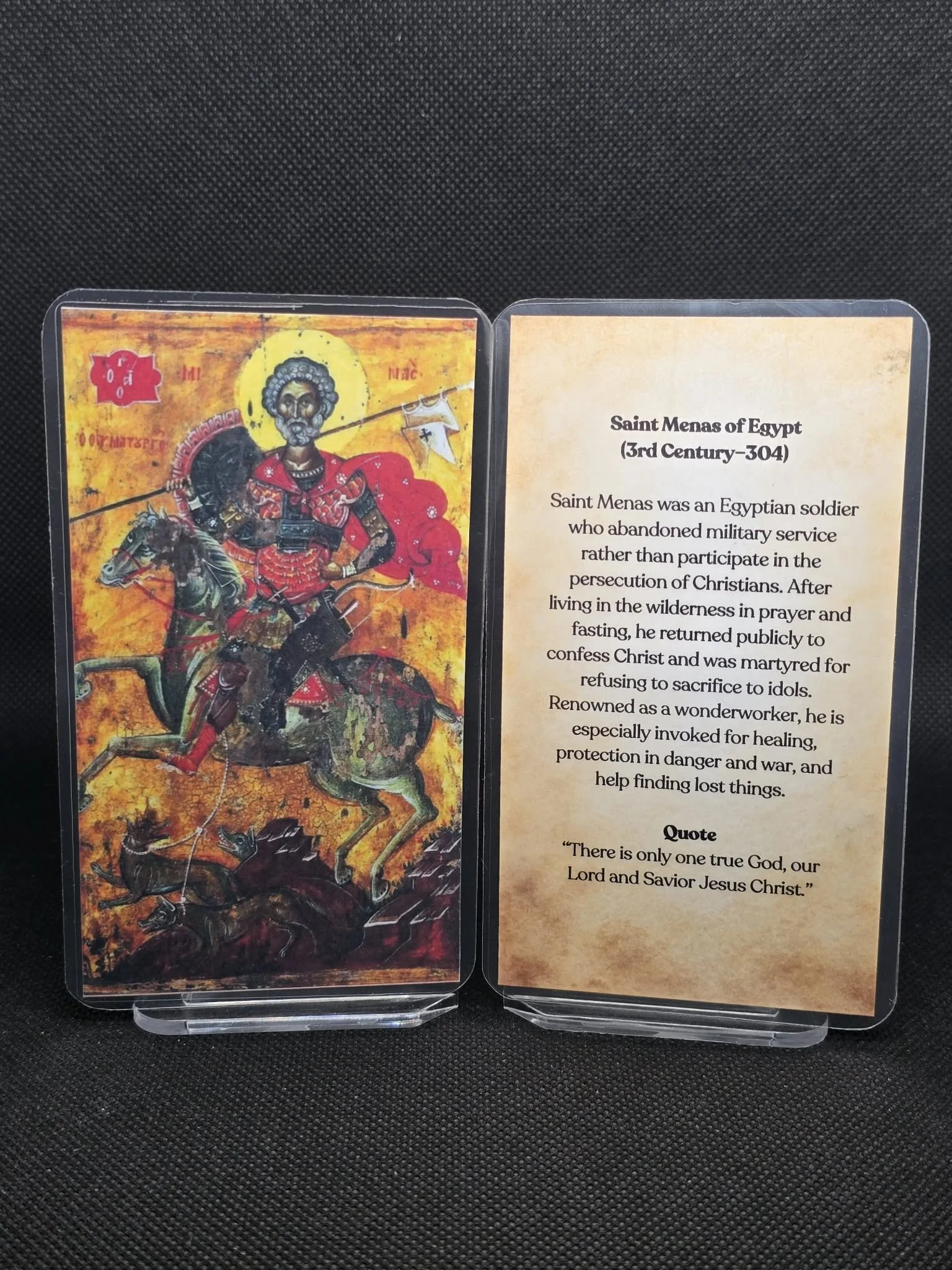
A pocket prayer card with his image is available at The Eastern Church for travellers and for anyone looking for what is lost.
Frequently Asked Questions
A Witness Beyond Words
Menas wrote nothing, and what we know of him comes through the shrine, the flasks and the stories of the faithful. The Church has kept his memory because pilgrims believed that a man who gave up a career for Christ still prays for those who ask.
View Prayer Card