Saints Sergius and Bacchus: Roman Officers, Martyrs and Patrons of the Syrian Frontier
Two Roman officers remembered as companions in faith and in death, whose shrine at Resafa in Syria became one of the great pilgrimage centres of late antiquity.
At a Glance
- Born
- Uncertain; neither saint has a known birth date, birthplace or family
- Died
- Uncertain; traditional dates include about 296, about 303 and about 307, and one scholar has proposed about 312
- Feast day
- October 7 in Orthodox, Byzantine Catholic and Maronite calendars; October 7 in the Roman Martyrology
- Canonization
- No formal decree; honoured by ancient veneration
- Patronage
- Soldiers and steadfastness under persecution; Sergius was especially honoured on the Syrian frontier
- Titles
- Holy Martyrs, Great Martyrs; known in Syriac as Mar Sarkis and Mar Bakhos
- Two Names Joined for Sixteen Centuries and More
- What the Sources Allow Us to Say
- Officers in the Imperial Service
- The Confession Before the Emperor
- The Problem of the Date and the Emperor
- The Death of Bacchus and the Death of Sergius
- Resafa and the Shrine of Sergius
- Miracles and Devotion
- Why They Matter to Eastern Christians
- Questions Modern Readers Ask
- Frequently Asked Questions
Two Names Joined for Sixteen Centuries and More
Saints Sergius and Bacchus are almost always named together. They are remembered as two Roman officers who served at the court of the emperor and who were put to death for refusing to take part in pagan sacrifice. The Church of the East and the Church of the West both keep their feast on October 7, and their names are known from Constantinople to Lebanon.
The first thing to say about them is a distinction that runs through the whole of this article. Their cult is very well documented. Their biography is much less secure. The detailed story of their lives and deaths comes from a Greek Passion, a hagiographical narrative written some time after the events, and not from a court record or a letter by a witness.
Where the story comes from that Passion or from later devotion, it is marked here as TRADITION. Where the evidence is unclear or scholars disagree, it is marked UNCERTAIN.
What the Sources Allow Us to Say
The main narrative source is the Greek Passio antiquior, published by the Bollandists in Analecta Bollandiana, volume 14, in 1895. John Boswell made an English translation of it. It contains long speeches, miracles and the usual features of a martyrdom story, so it cannot be read as a transcript of a trial.
Much firmer evidence concerns the cult of Sergius. In the fifth century Theodoret of Cyrus names Sergius among the martyrs whose festivals had taken the place of older pagan celebrations. In the sixth century Procopius describes the wealth and defences of the shrine city of Sergiopolis. Gregory of Tours also knew stories of Sergius and his shrine.
No writing of either saint survives. UNCERTAIN: their birth dates, birthplaces, parents and early careers are not recorded in any reliable source. The shape of the saints themselves is therefore clearer at the end of their story than at the beginning.
Officers in the Imperial Service
TRADITION: the Passion presents Sergius and Bacchus as men of high standing at the court of the emperor Maximian, who trusted them because of their courage and loyalty. The Catholic Encyclopedia, following this tradition, calls Sergius a primicerius and Bacchus a secundarius, titles that suggest a senior officer and his deputy. Those ranks cannot be checked against any independent record.
They are described as close companions. The Passion is explicit that their bond was one of faith and friendship and not of blood, so the common idea that they were brothers does not come from the earliest narrative. UNCERTAIN: nothing is known of any wife, child or relative of either man.
The late Roman army drew its officers from many peoples and provinces of the empire, and there is no sound evidence for the ancestry of either saint. They are best thought of simply as Christians who served the state and who refused to treat loyalty to the state as a reason to worship idols.
The Confession Before the Emperor
TRADITION: according to the Passion, the two men practised their faith in private while serving in the army. Jealous colleagues told Maximian that they would not worship the gods. The emperor first refused to believe it, and then arranged a ceremony at which the officers were expected to sacrifice.
TRADITION: Sergius and Bacchus refused, and declared that they served Christ. The Passion says they were stripped of their military belts and insignia, dressed in women's clothing, bound with heavy chains and led through the city to be mocked. The Orthodox Church in America repeats this account in its life of the saints.
No independent source confirms these scenes. What the story tells us is how later Christians understood the case: the saints were not rebels against the state, and their refusal concerned worship and not soldiering. The narrative keeps this distinction sharp, and it shapes how the Church has honoured them since.
The Problem of the Date and the Emperor
UNCERTAIN: the Passion names Maximian, but the Roman Empire was ruled by several emperors at once under the Tetrarchy, and the eastern provinces did not always answer to the emperor named in the story. Different sources give different years.
The Greek Orthodox Patriarchate of Antioch follows a date near 296. The Catholic Encyclopedia connects the martyrdom with the persecution of Diocletian, around 303. The Maronite tradition records about 307. Elizabeth Key Fowden has suggested that a martyrdom under Maximinus Daia, around 312, is possible. None of these dates is settled.
David Woods has argued in the Journal of Early Christian Studies that the Passion should be read in connection with the reign of Julian, and Hippolyte Delehaye and Timothy Barnes are also counted among the critical voices. Fowden takes a more favourable view of a historical core. An honest summary is that a real martyrdom is plausible, and the details are not recoverable.
The Death of Bacchus and the Death of Sergius
TRADITION: the prisoners were sent to Antiochus, an official in the province of Augusta Euphratesia, who is said to have owed his career to Sergius. He tried to persuade them to give way. When Bacchus refused, he was beaten so severely that he died, and the Passion says wild animals guarded his body until monks buried it.
TRADITION: Sergius was then made to walk in shoes studded with nails. The Passion gives the road from Souros to Tetrapyrgium to Resafa as nine Roman miles for each stage, eighteen in all. That figure belongs to the narrative and is not an independent measurement of any torture.
TRADITION: an angel is said to have healed his feet in the night, and at Resafa he again refused to sacrifice and was beheaded. The Passion adds that fifteen bishops later moved his relics to a shrine on October 7. Neither the number of bishops nor the circumstances can be verified.
Resafa and the Shrine of Sergius
The strongest historical ground in this whole story is the shrine at Resafa, a frontier town near the Euphrates between the Roman and Persian worlds. The settlement became known as Sergiopolis, the city of Sergius, and Procopius describes its walls, its churches and the imperial favour it received under Justinian.
Bishop Alexander of Hierapolis is linked with the early development of the shrine, before the Council of Ephesus in 431. Elizabeth Key Fowden showed in The Barbarian Plain that devotion to Sergius drew in settled Christians and also Arab communities of the frontier, and that the saint became a figure who could be trusted by people on both sides of the border.
Further west, the emperor Justinian built a church of Saints Sergius and Bacchus at Constantinople between 527 and 536. The building still stands in Istanbul and is known as the Little Hagia Sophia. A church in Rome is also dedicated to them. Where their relics lie today is UNCERTAIN.
Miracles and Devotion
TRADITION: the Passion tells of Bacchus appearing to Sergius after death to encourage him to finish his own contest. It also tells of a fire that exposed an attempt to steal the relics, of healings of the sick and of the taming of wild animals through the prayers of Sergius.
In the sixth century Gregory of Tours recorded stories of cures and of an offering to Sergius in the Glory of the Martyrs, chapter 96. Such accounts show that people believed in the saint's help in that century. They do not prove the supernatural cause of the events described, and the Church asks the faithful to judge them with care.
Devotion spread because the saints were easy to understand. They were soldiers, they were friends, and they chose the cross over a career. That made them patrons of those who serve under orders and who fear that conscience and duty may one day collide.
Why They Matter to Eastern Christians
For Orthodox Christians, Sergius and Bacchus are Great Martyrs with a place in the calendar and hymns on October 7, and the Orthodox Church in America publishes their troparion and kontakion. The Greek Orthodox Patriarchate of Antioch also keeps their memory, which is fitting for a story born in Syria.
For Byzantine Catholics, the Metropolitan Cantor Institute of Pittsburgh provides the proper texts for October 7, including the hymns for Vespers. For Maronite Catholics they are Mar Sarkis and Mar Bakhos, and the Eparchy of Saint Maron records that many churches in Lebanon bear their names. The Roman Martyrology of 2004 also has an entry for October 7, which gives the place as Bethsaloe in Syria, so the memory is shared by East and West.
Since the Julian calendar runs thirteen days behind the Gregorian one in our time, Churches that follow it keep October 7 on what the civil calendar calls October 20.
Holy Martyrs Sergius and Bacchus, you served an earthly ruler and gave your first loyalty to Christ. Pray for soldiers and for all who work under orders, that they may keep their consciences clear. Help friends to stand by one another in trouble, and grant us courage to be faithful in small things and in great. Through your prayers, O Christ our God, save our souls. Amen.
This prayer was written for this page. It is not an official prayer. The Orthodox Church in America publishes the Tone 4 troparion, which ends with the petition that through their intercessions our souls may be saved.
Questions Modern Readers Ask
Some modern writers, beginning with John Boswell, have read the friendship of the two saints as evidence for same-sex unions in the early Church. That reading is disputed. Brent Shaw has noted that most scholars have rejected the identification of Christian rituals of brotherhood with marriage ceremonies, and in any case such a ritual would not tell us about these two men.
What the sources do support is simple. The Passion describes two men who loved each other as companions in Christ, who stood together under pressure and who are remembered together. The Church honours that fidelity, and it does not need to claim more than the texts say.
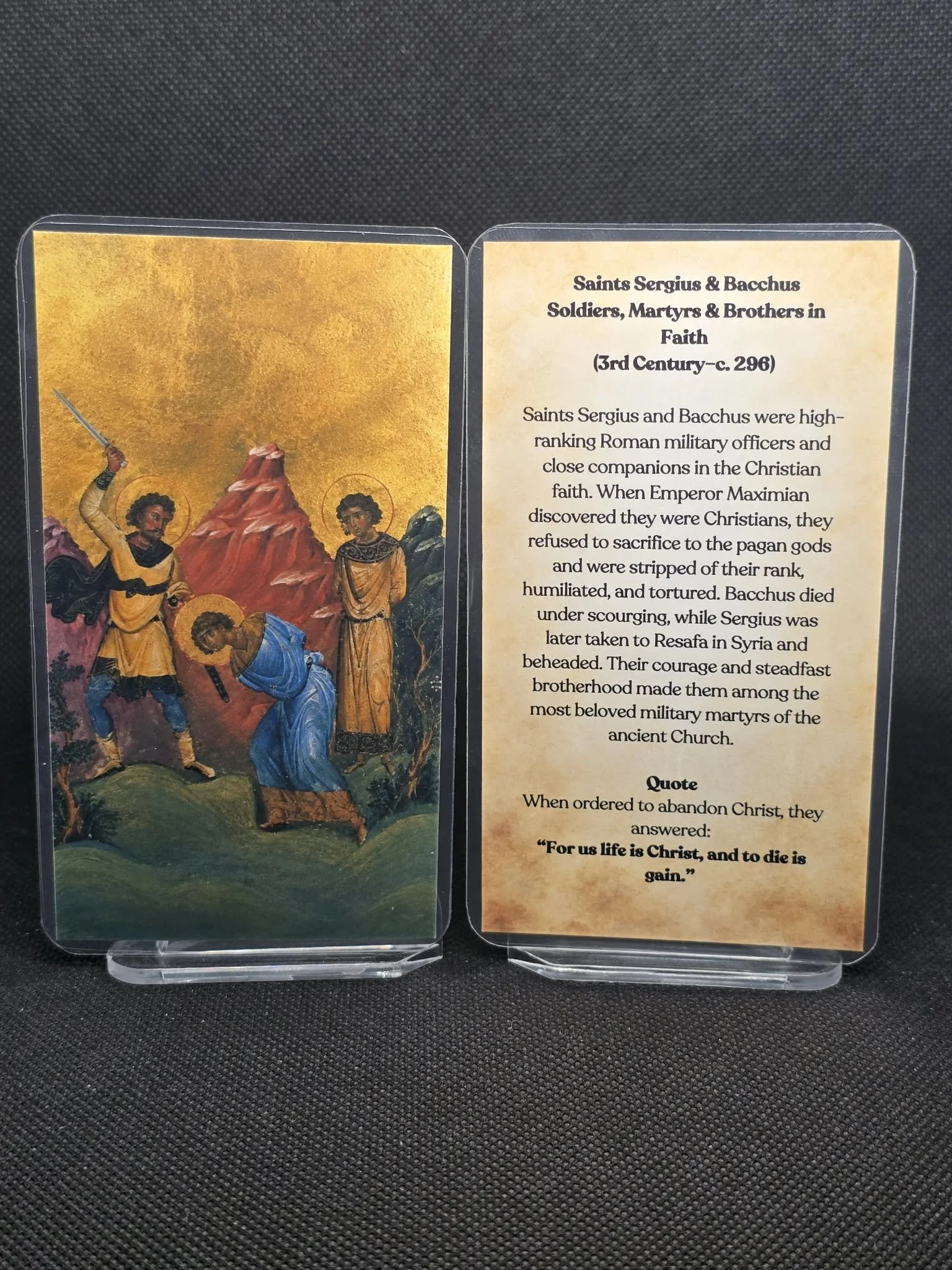
A short prayer card is available at The Eastern Church for those who wish to ask their help, especially soldiers and those who serve under authority.
Frequently Asked Questions
Friends in Christ
Sergius and Bacchus are remembered less for what they wrote or built than for what they refused to do. Whatever the exact facts of their deaths, the Church has seen in them two friends who put worship of God above every other loyalty, and who still help believers to do the same.
View Prayer Card