Saint Artemios of Antioch: Roman Commander, Great Martyr and Healer
The Roman general of Egypt who was beheaded under Julian the Apostate, whose record is complicated, and whose shrine in Constantinople became a famous place of healing.
At a Glance
- Born
- Uncertain; birthplace, parents and birth date are not known
- Died
- About 362, at Antioch, by beheading under the emperor Julian; some devotional sources give 363
- Feast day
- October 20 in the Byzantine calendar; October 20 in Maronite tradition under the name Saint Shallita
- Canonization
- No formal decree; honoured by ancient veneration
- Patronage
- Invoked in Byzantine devotion for hernias and illnesses of the groin; Maronite tradition names Saint Shallita as a patron of animals
- Titles
- Great Martyr; dux Aegypti, the military commander of Egypt
- A Soldier, a Shrine and a Hard Question
- What We Know and What We Do Not
- The Commander of Egypt
- The Search for Athanasius
- Temples, Troops and Julian's Anger
- Why Was He Executed?
- The Martyrdom Narrative and the Relics of Andrew and Luke
- The Healing Shrine in Constantinople
- Julian's Death and the Memory of the Martyr
- Why He Matters to Eastern Christians
- Prayer and Legacy
- Frequently Asked Questions
A Soldier, a Shrine and a Hard Question
Saint Artemios is honoured in the Byzantine Church as a Great Martyr. He is also one of the more complicated saints of the fourth century. He was a real Roman officer, the military commander of Egypt, and he was executed at Antioch under the emperor Julian the Apostate. But the same ancient sources that show him as a martyr also show him taking part in the campaign against Saint Athanasius, the great defender of the Nicene faith.
The man who emerges from the evidence is neither a simple hero nor a villain. The historian Samuel Lieu titled his study of the saint From Villain to Saint and Martyr, and that phrase captures the question. How did an officer who served an emperor hostile to Athanasius come to be venerated across the Christian East, and why did his shrine at Constantinople become one of the busiest centres of healing in the Byzantine world?
This article follows the best sources and keeps the difficult parts in view. Where a story comes from later hagiography, it is marked as TRADITION, and where the evidence is unclear, it is marked UNCERTAIN.
What We Know and What We Do Not
The main ancient sources are Ammianus Marcellinus, the historian of the later Roman Empire, and the church historian Theodoret of Cyrus. They are joined by Julian's own Letter 21 to the Alexandrians, the index to the Festal Letters of Athanasius, the Life of Pachomius, the later Passio Artemii and the seventh-century Miracles of Saint Artemios. Each has its own purpose and bias.
Almost nothing is reliably known about his birth or family. UNCERTAIN: his birthplace, parents and birth date are not recorded. TRADITION: some Eastern accounts say he was Egyptian by birth and rose through the army under Constantine the Great, but there is no independent evidence of that. Theodoret says he received his command in the reign of Constantine, which is useful but comes from a writer of the fifth century.
He left no writings. The speeches in his martyrdom account are literary compositions, and we have no letter, sermon or treatise by him. No monastery, church or charity can be credited to him in his lifetime.
The Commander of Egypt
His clearest historical role was dux Aegypti, the military commander of Egypt, a senior post and not that of a civilian governor, under the emperor Constantius II, who reigned from 337 to 361. In that role he commanded imperial troops and helped carry out the emperor's religious and political policy in a province torn by the Arian controversy.
TRADITION: the Greek Orthodox Archdiocese preserves a story in which Artemios saw Constantine's vision of the Cross, became a Christian and was baptized. That belongs to his devotional biography. His Christianity is plausible and is supported by later ancient writers, but the date of his conversion and his theological views are unknown.
This part of his story has to be told plainly. Artemios was not remembered by every Christian group of the time as a defender of the Nicene faith. The evidence ties him to the imperial administration that opposed Athanasius, and it matters for reading the later veneration with open eyes.
The Search for Athanasius
The index that goes with the Festal Letters of Athanasius, in the entry for 359 to 360, names Artemios and the prefect Faustinus as taking part in the search for Athanasius. It also records their ill-treatment of a consecrated virgin called Eudaemonis.
The Life of Pachomius, in section 88, tells another story. Artemios searches the monastery of Pabau for Athanasius, and one monk refuses to pray with him because of his link with the emperor's opponents of Athanasius.
These accounts cannot be set aside just because Artemios was later honoured as a martyr. UNCERTAIN: whether he personally held a clear Arian position, or simply supported the emperor's church policy, cannot be settled. His part in the anti-Athanasian measures is nonetheless a serious fact for any honest biography.
Temples, Troops and Julian's Anger
Julian's own Letter 21, addressed to the people of Alexandria, names Artemios and accuses him of using troops against the Alexandrians in disputes over temples and religious property. The letter also speaks of statues and valuables being removed from the sanctuary of Serapis. This shows religious conflict under Artemios's command, though it should not be confused with the later destruction of the Serapeum itself.
Theodoret, writing in the fifth century in his Ecclesiastical History III.14, links Artemios with the smashing of pagan idols and says this was why Julian took his property and ordered his execution.
The sources do not agree about the cause. Ammianus says that Artemios was executed after the Alexandrians made grave accusations against him, and he does not give refusal to renounce Christianity as the immediate reason. Theodoret presents it as revenge for his attacks on pagan worship. The later Passio Artemii builds a long confrontation in which Artemios denounces Julian's treatment of Christians and refuses to sacrifice.
Why Was He Executed?
UNCERTAIN: the exact legal proceedings and the main reason for the execution cannot be reconstructed. Artemios may have been punished for religious acts, for abuses in office, for his political loyalties, or for a mix of these.
There is also a chronology problem in Ammianus. He links the news of Artemios's death with the violence against Bishop George of Alexandria, though other evidence places George's death earlier. Historians such as Gabriele Marasco and David Woods have questioned parts of Ammianus's story. Woods also suggests that Artemios had been given a higher military appointment before his death. That is a scholarly proposal and not an established fact.
Marasco's study of the evidence places the execution in the early autumn of 362, and this article uses 362 as the most likely year. Theodoret reports beheading, which became the standard account. The details of any earlier tortures are less secure.
The Martyrdom Narrative and the Relics of Andrew and Luke
TRADITION: the Passio Artemii describes imprisonment, repeated torture, a confrontation with Julian and a vision of Christ strengthening Artemios before his death. These scenes belong to hagiography and cannot be checked.
TRADITION: the Passio also credits him with bringing the relics of the Apostle Andrew and of Saint Luke to Constantinople. The translation of those relics is supported by historical chronicles, but Artemios's personal part in it is UNCERTAIN. The chronicles generally date the arrival to 357, while the Passio places his role about 359, a gap that David Woods has discussed.
The Maronite Synaxarion adds a tradition that a deaconess named Arista carried his body to Constantinople. The date and circumstances of any such transfer are uncertain.
The Healing Shrine in Constantinople
By the sixth and seventh centuries a shrine of Artemios stood in the Church of Saint John the Baptist in the Oxeia district of Constantinople. Samuel Lieu describes a lead sarcophagus in a crypt beneath the sanctuary that was believed to hold his relics. The shrine became a major destination for pilgrims seeking healing. That proves a developed cult, though not that the remains in the sarcophagus were physically his.
The main source for the healing tradition is the Miracles of Saint Artemios, an anonymous Byzantine collection from the seventh century. The standard edition by Virgil Crisafulli and John Nesbitt, with an essay by John Haldon, was published by Brill in 1997 and contains forty-five miracle stories.
TRADITION: the stories report cures of hernias, diseases of the testicles and other illnesses of the groin, and many patients slept at the shrine hoping for a healing dream. Artemios sometimes appears as a physician, and the martyr Febronia appears beside him in stories about women. These are reports of miracles and not medically verified results. The collection is still valuable for what it shows of Byzantine patients, their doctors and their religious practices.
Julian's Death and the Memory of the Martyr
TRADITION: devotion adds that Artemios foretold the death of Julian, and a familiar tale says that the dying emperor admitted that Christ had won. The words attributed to Julian are not backed by any contemporary eyewitness account.
In Maronite devotion he is honoured as Saint Shallita, and the Eparchy of Saint Maron of Brooklyn identifies him with Artemios in the Maronite Divine Office. Maronite tradition names Shallita as a patron of animals, and churches and monasteries in Lebanon carry the name. Syriac scholarship also knows a Mar Shalita as an early monastic figure. UNCERTAIN: not every saint named Shalita is the Roman commander.
His name stood in the older Roman Martyrology on October 20. The dossier we consulted reports that he is not listed under October 20 in the revised 2004 edition. That is a point about one Western book and is not a declaration against his Eastern veneration.
Why He Matters to Eastern Christians
For Orthodox Christians he is a Great Martyr, with a feast on October 20 and a troparion and kontakion in the liturgical books. The Orthodox Church in America publishes the Tone 4 troparion, whose opening says that the holy martyr received an incorruptible crown from God through his sufferings.
For Byzantine Catholics he appears in the calendar on October 20, and a Byzantine Catholic parish publishes proper hymns for the day. One of those sources gives a biographical date that does not fit the historical chronology, so it should not be copied. For Maronite Catholics he has a particular place under the name Shallita.
His example also asks Christians to hold two things together. An officer linked to measures against Athanasius could become the subject of wide veneration, and the Church could remember both facts. That honesty is part of a mature devotion to the saints.
Holy Great Martyr Artemios, you stood before an emperor and gave your life for Christ. Pray for the sick and for all who suffer in body, and for the doctors and nurses who care for them. Obtain for us patience in illness, honesty about our failings and trust in the mercy of God. Through your prayers, O Christ our God, save our souls. Amen.
This prayer was written for this page. It is not an official prayer. The Orthodox Church in America publishes the Tone 4 troparion for the saint.
Prayer and Legacy
The troparion preserves the voice of the Church in his honour, and the Maronite Divine Office has a short petition asking that the prayers of Shallita be with us. We have not quoted either text in full. Both are available from the sources named here.
His legacy is twofold. The first part is the officer in Egypt, whose record in the sources is mixed, and whose death under Julian is well attested. The second is the healer of the Constantinople shrine, whose miracle stories, whatever one makes of them, show the hopes of sick people in the Byzantine world.
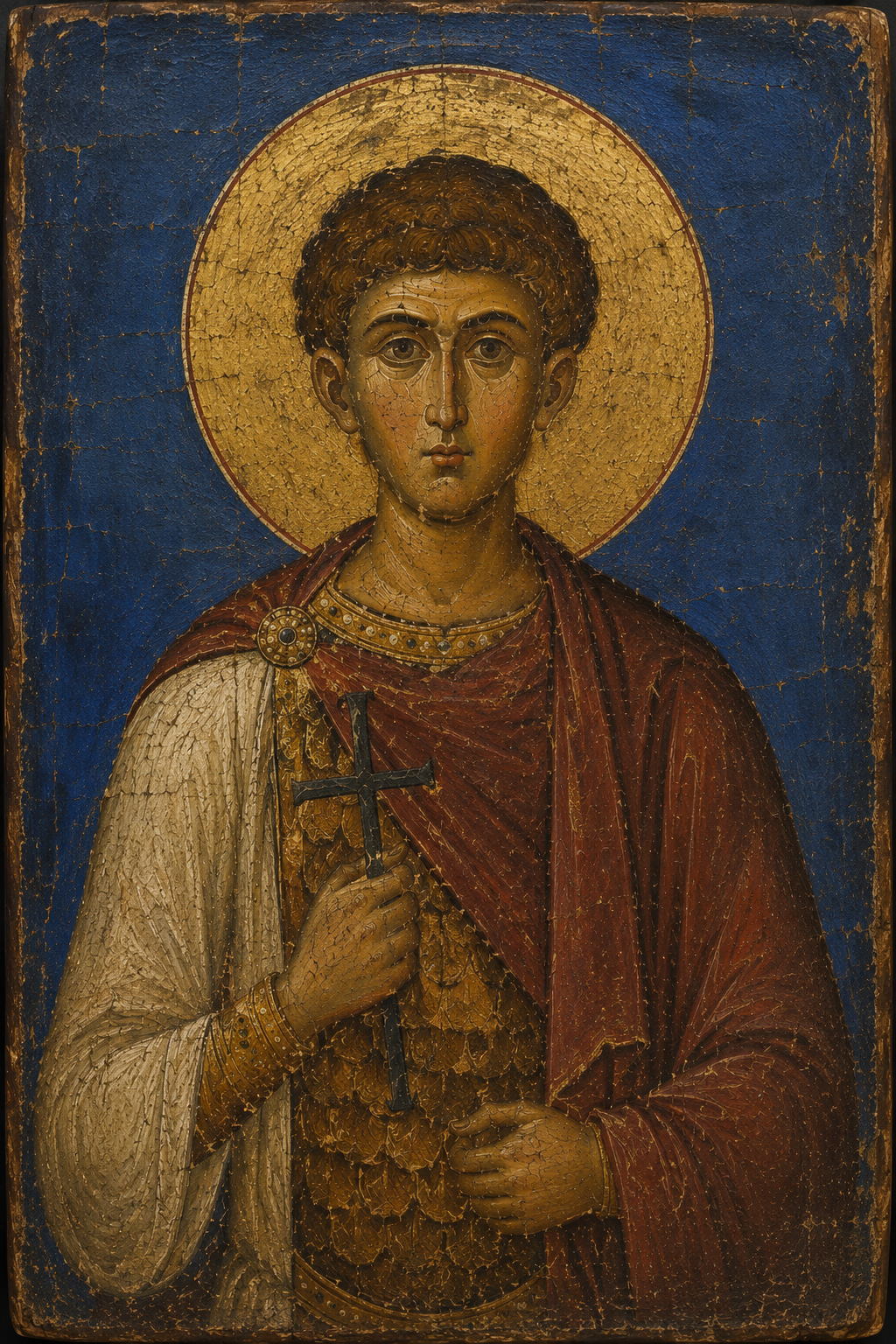
A pocket prayer card with his image is available at The Eastern Church for those who are ill and for those who pray for them.
Frequently Asked Questions
An Honest Memory
The Church remembers Artemios as a martyr and as a healer, and the sources remind us that he was also a man of his office. A saint is not made smaller by an honest record. That record helps us to pray for him, and with him, in truth.
View Prayer Card