Saint Gordius of Caesarea: Centurion, Ascetic and Martyr
The Roman officer from Cappadocia who left the army, lived as a hermit, and returned to Caesarea to confess Christ in a crowded stadium, as told by Saint Basil the Great.
At a Glance
- Born
- Uncertain; a native of Caesarea in Cappadocia (modern Kayseri, Turkey), according to Saint Basil
- Died
- Uncertain; early fourth century, with 304, 315 and 320 all proposed; beheaded outside Caesarea
- Feast day
- January 3 in the Roman Martyrology and in Byzantine Catholic and Orthodox calendars
- Canonization
- No formal decree; an early martyr honoured since the fourth century
- Main source
- Saint Basil the Great, Homily 18, On the Martyr Gordius, probably preached in 373 (a scholarly reconstruction)
- Titles
- Holy Martyr; Gordius the Centurion
A Centurion in the Wilderness
Saint Gordius is one of the few early martyrs whose story was told to the very people who lived near his tomb. He was a Roman centurion from Caesarea in Cappadocia, in what is now central Turkey. When persecution came, he left the army, went into the mountains to pray and fast, and then came back into the city on a day when the whole population was gathered at the horse races, and confessed Christ in front of them. He was arrested, refused every offer to save himself, and was beheaded.
We know about him because the great bishop of Caesarea, Saint Basil, preached a sermon in his honour at the martyrs' shrine outside the city. That homily, together with the later hymns of the Byzantine Church, is the foundation of everything we can say about him.
The article follows Basil as the main witness and marks what comes from later tradition. Several basic facts, including the year of his death and the emperor who persecuted him, are uncertain, and it is better to say so than to hide the gaps.
What Basil Tells Us
Basil's Homily 18, On the Martyr Gordius, is preserved in volume 31 of the Patrologia Graeca. Scholars usually date its delivery to 373, though that is a reconstruction and not a date written in the text. It is a commemorative sermon, preached on the martyr's feast to a large congregation, and not an official trial record.
This matters for how we read it. Basil uses biblical comparisons, rebuilds the speeches of the martyr and magistrate, and compares the martyr to athletes. The homily also tells us that Basil himself received the story through the memory of the community. These features do not make the account false, but they mean that a historian cannot treat every sentence as a verified transcript.
Basil's testimony has a rare strength, however. He is preaching in the place where the events happened, to people who knew the shrine, and the cult of Gordius is already established in his day. That is a very early and local witness.
A Soldier from Caesarea
Basil says that Gordius was a native of Caesarea, and that the city was proud of him. He does not give a birth year or the names of his parents. Later Orthodox lives place his birth near the end of the third century, but this is UNCERTAIN, and nothing is known about his family, his education or his social position.
Basil describes a man who had honoured God from childhood and who entered the Roman army, where his strength and courage brought him to command a centuria, a unit traditionally of about one hundred men, though real units varied in size. We do not know his legion, his campaigns or how long he served.
UNCERTAIN: whether he was baptized when he died. The scholarly introduction to Let Us Die That We May Live describes him as a catechumen at the time of his martyrdom. That should not be turned into a settled baptismal history. Basil's picture is of a respected officer who was ready to give up rank and comfort for the sake of faith, and not of a coward or a deserter.
Leaving the Army
Basil sets the scene with a time of fierce persecution. Imperial orders forbade Christian worship, churches were pulled down, altars overturned, property taken, and families broken by informers. In that crisis, Gordius gave up his command and withdrew from ordinary life.
Basil presents this as a free renunciation of rank and security. He does not say whether Gordius resigned, was dismissed or simply left before he could be removed. UNCERTAIN: some later summaries say that the emperor Licinius expelled him from the army, but that detail is not found in Basil's account.
In the wilderness, according to Basil, Gordius lived by fasting, prayer, night vigil and meditation on Scripture. The bishop compares him to the prophet Elijah, who fled to Mount Horeb from those who wanted to kill him. TRADITION: later Orthodox lives say that Gordius went to the desert of Sinai. Basil mentions Horeb only inside the comparison to Elijah, so Sinai is a later geographical tradition and not a demonstrated fact.
The Day of the Races
Gordius did not remain a hermit. According to Basil, he came to feel ready to confess Christ openly, even if it cost him his life. His chance came at a large public festival in Caesarea, with horse races and chariot contests held in honour of a god of war. Basil fills the stadium with spectators of every kind: pagans, Jews, Christians, children, and slaves released from their duties for the day.
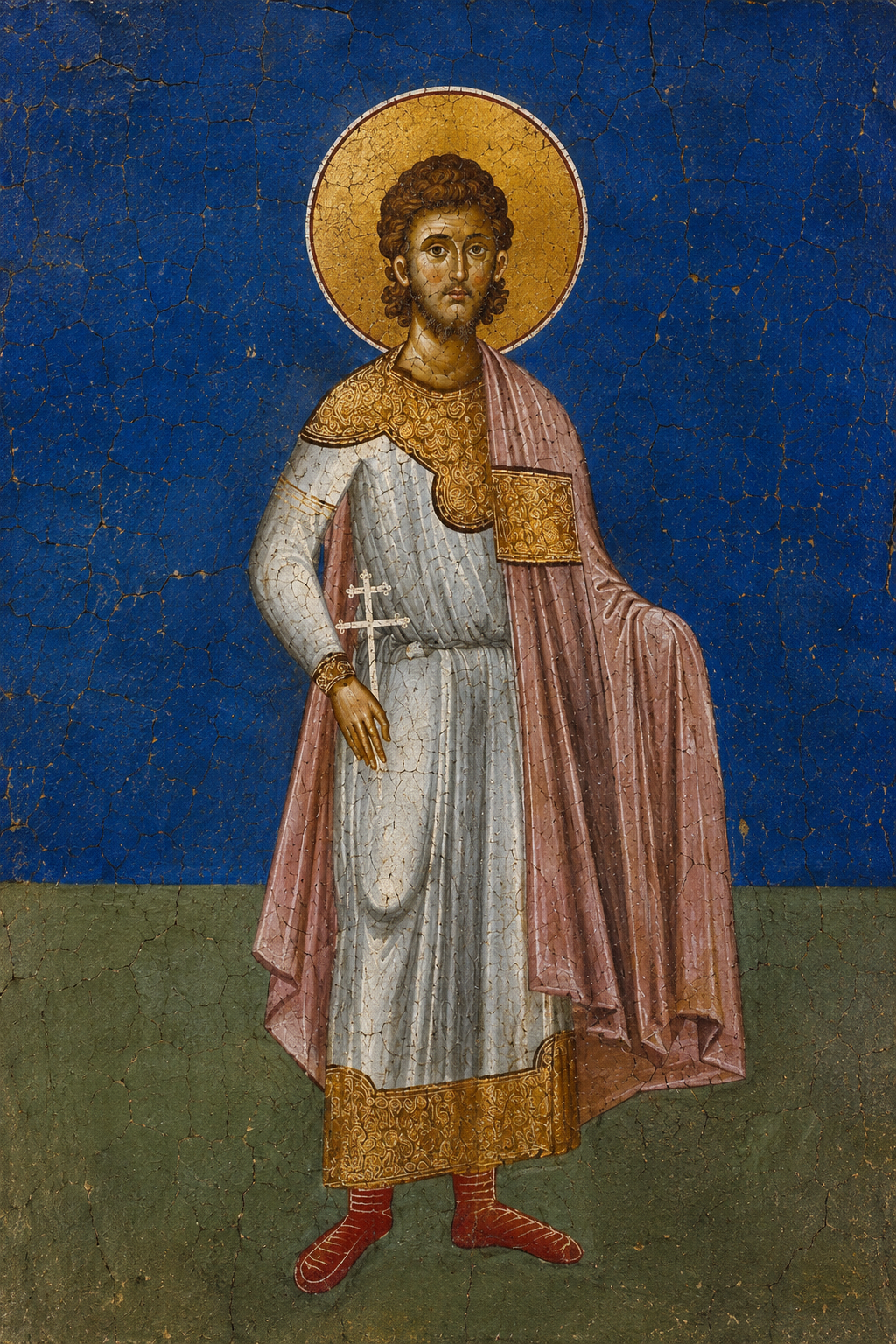
Gordius entered the crowd looking like an ascetic. He had a long beard, worn clothes, a weathered body, a staff and a few belongings. He made himself conspicuous on purpose and spoke out. Basil is careful to say that this was not an accident and that he was not betrayed. Gordius came back to the city to meet the demands that had driven Christians into hiding.
People recognised him. Some Christians were glad to see him, and others called for his punishment. The games were interrupted, and he was brought before the magistrate who presided over the festival.
Before the Magistrate
The magistrate first asked who he was, where he came from and what his service had been. Gordius admitted his former rank and explained why he had left it. He also said that his return was meant to show that he rejected the religious demands put on Christians. The magistrate grew angry. Basil mentions scourges, lead weights, the rack, fire and wild beasts. The homily describes these being ordered or threatened, but it does not prove that each was used, and later short lives that say he endured every torture go further than the source. The details are UNCERTAIN.
When threats failed, the magistrate turned to persuasion. He offered wealth, restored honours and promotion in the army. Gordius refused. Relatives came and begged him to save his life. Others suggested that he could say the words of denial and keep his faith in secret.
Basil gives him a clear answer: confession cannot be split from belief. The speech draws on Romans 10:9 and 10, where faith in the heart and confession with the mouth belong together. Gordius is also made to defend the honour of soldiers by pointing to the centurions in the Gospels and Acts, the one who recognised Christ at the Crucifixion, the one whose faith Jesus praised, and Cornelius. These are Basil's words for him, in the style of an ancient sermon, and not a court transcript.
Death Outside the City
Basil says that Gordius was led out of the city to be executed. On the way he encouraged those with him to stay faithful, and he refused to accept that a few more days of life were worth denying his Saviour. He made the sign of the cross and went calmly toward the executioner. He was beheaded.
The sermon describes angels receiving him into eternal life. That passage belongs to the language of preaching and should be read as theological testimony and not as an eyewitness report.
The place of death is tied to the shrine where Basil preached, outside Caesarea. The scholarly introduction to Let Us Die That We May Live observes that the sanctuary was shared with other martyrs and drew a large congregation. We do not know whether his body lay under the shrine, was kept in a reliquary or was moved later, and no reliable present-day location for relics has been established.
Which Emperor, and Which Year?
Basil does not name the emperor, and so the question has stayed open. The Roman Martyrology links Gordius with the persecution under Diocletian, which began in 303. The Byzantine synaxarion tradition more often names Licinius, who persecuted Christians in the East in his struggle with Constantine. Modern scholars in Let Us Die That We May Live favour the setting under Licinius.
The proposed years follow the same split. About 304 fits Diocletian, and 315 or 320 fits Licinius. A modern Orthodox life gives 320. None of these is established by a contemporary record, so the best statement is that he died in the early fourth century.
Even the day of his memory varies in the old calendars. January 3 is the standard date in Roman and Byzantine sources. The Armenian Passion gives January 2, and the ancient Syriac Breviary and the Martyrology of Jerome keep March 2, a date some scholars think may reflect an earlier commemoration. These variations show a cult that was old and widespread, with local traditions.
Why He Matters to Eastern Christians
Gordius belongs to the shared heritage of Byzantine Catholics and Orthodox, and this is documented and not just a general claim of antiquity. The Byzantine Ruthenian Metropolitan Church's calendar lists him on January 3, and its Menaion gives hymns for Vespers and the Divine Liturgy. The Orthodox Church in America likewise commemorates him and publishes his troparion and kontakion. In the Byzantine calendar the day falls in the forefeast of Theophany.
His story echoes themes that Eastern Christian spirituality prizes. His retreat into the wilderness shows the ascetic ideal of fasting, prayer and detachment, and Basil presents this as preparation for martyrdom. His loyalty to Christ over imperial authority shows that a soldier can be holy, but that no political power can override conscience.
Basil's homily is also a window on how the early Church used the memory of martyrs. Their stories were told not only to honour suffering but to teach believers to imitate their faith. These themes can be seen in Basil's text and in Eastern worship without attributing later mystical theology to Gordius himself.
Holy Martyr Gordius, you laid down rank and comfort for the sake of Christ and spoke the truth when it was dangerous. Pray for soldiers and for all who serve under authority, and for those who are pressed to hide what they believe. Give us courage to say openly what we hold in our hearts. Through your prayers, O Christ our God, save our souls. Amen.
This prayer was written for this page. It is not an official prayer. Its closing words echo the closing petition of the Byzantine troparion for Saint Gordius.
Hymns, Prayer and Legacy
The hymns for his feast tell of perseverance under persecution, the victory of faith over evil and the martyr's intercession. The troparion in Tone 4 speaks of the crown he received for his sufferings and of strength that overcame his adversaries, and it ends with the usual petition, through his prayers, O Christ our God, save our souls. The kontakion honours his ascetic labours and the blood he shed for Christ.
No writings by Gordius are known. His reported words survive only through Basil's sermon, and the hymns were written by the later liturgical tradition. He is not known as a founder of churches, monasteries or schools, and he was not ordained.
What remains is a witness. A man with power and prospects gave them up, spent time in silence, and then returned to speak openly when it would be hard to be silent. A pocket prayer card with his image is available at The Eastern Church for soldiers and for anyone who is asked to hide their faith.
Frequently Asked Questions
Speaking Plainly
Gordius is remembered for a hard choice and a plain answer. He would not split faith from confession, and he would not accept safety for a few words of denial. The story is old, but the question it asks is not.
View Prayer Card