Saint Florian of Lorch: Roman Official, Martyr and Patron Against Fire
The Roman provincial official who confessed Christ at Lauriacum and was drowned in the River Enns, and who became the patron of firefighters across Central Europe.
At a Glance
- Born
- Uncertain; traditionally in the later third century, with Zeiselmauer near Vienna named in some accounts (TRADITION)
- Died
- Traditionally May 4, 304, at Lauriacum (modern Lorch near Enns, Austria), by drowning in the River Enns
- Feast day
- May 4 in the Roman Martyrology; May 4 on the Julian calendar (May 17 on the civil calendar) in some Orthodox calendars
- Canonization
- No formal decree; an early martyr honoured by ancient veneration
- Patronages
- Firefighters, protection against fire and flood, Upper Austria, the Diocese of Linz and, historically, Poland and Krakow
- Titles
- Martyr of Lauriacum; former head of the governor's office in Noricum Ripense
A Martyr by the River Enns
Saint Florian is one of the best known martyrs of the Roman Empire north of the Alps. He died at Lauriacum, in the province of Noricum Ripense, on the Danube frontier, in the age of the Great Persecution. He is honoured today in Austria, Poland and Germany as the patron of firefighters, and he is remembered in the Roman Martyrology on May 4.
Historians accept him as a real martyr, though the story of his death comes to us in a form written much later. His name, his connection with Lauriacum and the manner of his death by drowning are supported by early martyrological tradition. Many of the details that give the story colour, such as the dialogue with the governor, the eagle and the spring, are late legend.
This article tries to separate the two. Where something is tradition, it says so, and where the sources disagree, it says that as well.
What the Sources Say
The main narrative is the Passio Sancti Floriani, catalogued as BHL 3054. A reference work on medieval German sources, Geschichtsquellen des deutschen Mittelalters, dates it to roughly 750 to 800, probably built on an older lost account. A shorter version, BHL 3055, is dated about 750 to 820. How the two relate is still debated.
A second line of evidence is the Martyrologium Hieronymianum, an early list of martyrs, which records Florian's link to Noricum, to Lauriacum and to a past office, and records death by drowning. The historian Reinhardt Harreither, writing for the Diocese of Linz, notes that these sources keep administrative terms from late antiquity, which supports the view that they depend on something older than the medieval text.
The sources give us a name, a place, an office and a manner of death. They do not give us a birth date, a family or a personal writing. No surviving writing by Florian has been identified, and the words that the Passio puts in his mouth cannot be treated as his own.
Early Life and Office
Almost nothing reliable is known about Florian's youth. A biographical note from Vatican City says he was born at Zeiselmauer near Vienna, but this is TRADITION, because the early martyrdom sources do not say where he was born or who his parents were. Popular books disagree on whether he grew up Christian or came to the faith as an adult, and neither claim can be proved.
His office is better attested. The early texts describe him as a former princeps officii praesidis, meaning the head of the staff of a provincial governor. Harreither reads this as a senior civil post, with responsibility for an administrative staff, and not necessarily a military command. This matters because many modern accounts call him a general or the commander of a legion. Those ranks are UNCERTAIN and the sources do not establish them.
The longer Passio says he lived at Cetium, identified with modern St. Pölten, before he went to Lauriacum. It suggests that he knew some of the Roman personnel who later took part in his arrest, which fits his career in the provincial service. His marital status and the dates of his service are unknown.
The Persecution
The Great Persecution began under the emperor Diocletian in 303. Measures against Christians were issued in stages, and in 304 the authorities required sacrifice to the Roman gods more widely. The Diocese of Linz study links Florian's martyrdom to these stricter demands of 304.
According to the Passio, Florian heard that Christians had been arrested at Lauriacum. He did not stay away. He travelled there to support them. Near the city he met soldiers, some of them probably former colleagues, and openly said that he was a Christian. He was brought before the governor Aquilinus, who ordered him to sacrifice. Florian refused.
The broad picture fits what we know of Roman persecution. The exact conversation and sequence of encounters, however, come from a hagiographer working centuries later and not from a court record. The Passio describes a group of forty Christians in prison, but UNCERTAIN: the number may be symbolic, as Harreither suggests, and the names and fates of the others are not known.
Trial and Death
The Passio says that Florian was beaten with clubs and tortured, and that he was condemned to be drowned. The Martyrologium Hieronymianum also records death by drowning in the River Enns near Lauriacum. A heavy stone was tied to his neck, and he was thrown from a bridge. Later retellings added more torments, including flaying and an attempt to burn him alive. UNCERTAIN: these additions cannot be checked and should not be taken as a reconstruction.
Artists nearly always show the stone as a millstone, and the millstone has become one of his marks in art. The Linz study explains that the millstone belongs to later legend. Earlier tradition speaks of a stone without saying what kind.
The traditional date is May 4, 304. No surviving record of the execution fixes it, but it agrees with the persecution under Diocletian. A careful biography can say that Florian was martyred at Lauriacum during the Great Persecution, traditionally in 304.
Burial and the Journey of the Relics
TRADITION: after his death his body was found by a Christian woman, Valeria, who arranged for its burial. Later accounts place the burial at the site where the Abbey of St. Florian now stands, near Linz. The Diocese of Linz clearly separates this story from the better supported facts of the martyrdom. The abbey became an important religious centre and is now associated with the Canons Regular of St. Augustine.
A part of the relics came to Krakow in the twelfth century. The historian Stanislaw Szczur discusses a record in the Krakow cathedral annals that gives 1184, while other annals give 1185 and a Vatican City biography gives 1183. This article uses 1184, because it is the date in the Krakow annal. The transfer took place in the pontificate of Pope Lucius III. Some popular books place it in 1138 and still name Lucius III, which cannot be right.
UNCERTAIN: the full chain of custody from the first burial to the medieval translation cannot be rebuilt, and the Krakow basilica itself notes gaps in the history. Relics are venerated today at Krakow, in connection with the Wawel Cathedral and the Basilica of St. Florian.
Legends and Devotion
Florian's cult grew through stories that began in the Passio and others that came much later. TRADITION: after he was thrown into the Enns, an eagle guarded his body from desecration. TRADITION: when Valeria carried the body and the animals pulling her cart were worn out, a spring appeared. TRADITION: the man who pushed him into the river was struck blind. These tales were popular in medieval art, but none is independently documented.
TRADITION: popular accounts say that Florian put out a fire with a small amount of water or by prayer. There is no reliable evidence for this during his lifetime. It helps to explain why he became the patron of firefighters, but it should not be added to his biography as fact. A better documented point is the fire at Kleparz, near Krakow, in 1528. The church of St. Florian there was damaged but survived, and local tradition credited his intercession, with the legend that he appeared above the flames pouring water. The survival of the church is recorded. The apparition is TRADITION.
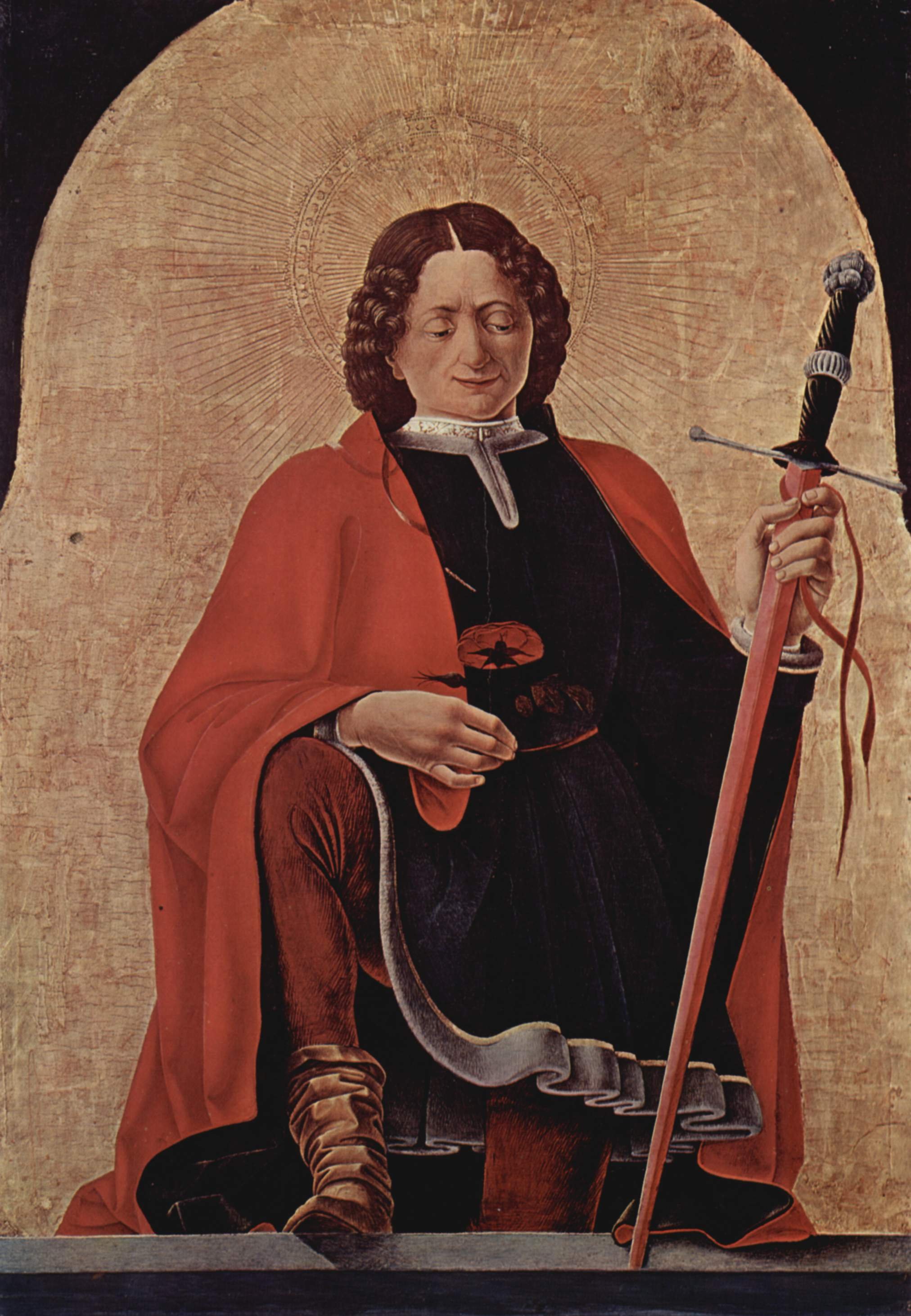
In Poland he was counted among the patron saints of the kingdom in 1436. His devotion is strong in Austria, southern Germany, Poland and nearby regions. In art he is usually shown as a Roman soldier with a banner, pouring water from a bucket on a burning house, with a millstone at his feet. Each year his feast is kept by firefighters and emergency services. We did not find well documented individual healings that could be called verified miracles.
Why He Matters to Eastern Christians
Florian was martyred in 304, long before the divisions between East and West, and so he belongs to the shared history of the early Church. There is direct evidence of Orthodox commemoration. Published Orthodox calendars, including a Russian Orthodox calendar, list Florian and martyrs associated with him on May 4, which falls on May 17 on the civil calendar in churches that keep the Julian calendar.
These calendars show that his veneration is not only Roman Catholic. They do not show that he has the same prominence in every Orthodox jurisdiction. The Orthodox Church in America observes that the Western habit of assigning patron saints to occupations is not followed in the same way throughout Orthodoxy, and it discusses Florian mainly in connection with Catholic devotion to firefighters.
For Eastern Catholics we found no evidence of an official feast or a specific liturgical text for Florian. His strongest link with the Christian East is the witness itself: a Christian official who refused a command that conflicted with his faith, and who went to stand with imprisoned believers when he could have stayed away.
Holy Martyr Florian, you stood with the prisoners and gave your life rather than deny Christ. Pray for those who face fire, flood and danger in the service of others. Guard our homes by night and by day, give courage to firefighters and rescuers, and keep us steady in faith when we are tested. Through your prayers, O Lord, have mercy on us. Amen.
This prayer was written for this page. It is not an official or approved prayer. An older invocation to Saint Florian appears in the Acta Sanctorum.
Prayer and Legacy
An old invocation attached to the martyrdom accounts, preserved in the Acta Sanctorum of 1680, asks the martyr to guard us by night and morning from the harm of fire. The date and author of the invocation are not known. We did not find a dedicated Byzantine troparion for Florian that could be quoted as an official liturgical text.
His legacy lies in two parts. The first is the early martyr of Lauriacum, whose existence and manner of death are supported by early sources. The second is the protector against fire, whose images and miracle stories were shaped by centuries of devotion. A firefighter's helmet and a bucket of water are later symbols. The man behind them was a Christian official who would not sacrifice.
A pocket prayer card with the image of Saint Florian is available at The Eastern Church for firefighters, their families and all who ask for his prayers.
Frequently Asked Questions
Standing With the Persecuted
Florian is remembered for fire, but his witness was about steadiness. He went toward the prisoners when he could have turned away. That is the part of his story that needs no legend.
View Prayer Card