Venerable Nelson Baker: Priest, Apostle of Charity and Builder of Our Lady of Victory
The Buffalo businessman turned priest who rescued a failing orphanage, cared for abandoned children and unmarried mothers, and built a great basilica in Lackawanna, New York.
At a Glance
- Born
- February 16, 1842, in Buffalo, New York (the Vatican decree gives 1841; the date is disputed)
- Died
- July 29, 1936, in Lackawanna, New York
- Feast day
- None officially established; July 29 is the anniversary of his death
- Status
- Venerable, heroic virtues recognised by Pope Benedict XVI on January 14, 2011; not yet beatified or canonized
- Ordained
- March 19, 1876, at St. Joseph's Cathedral, Buffalo
- Titles
- Monsignor; called the Apostle of Charity and the Padre of the Poor
- The Padre of the Poor
- Buffalo, a Merchant Father and an Irish Mother
- A Soldier Who Became a Businessman
- The Call to the Priesthood
- Our Lady of Victory in Paris
- Rescuing the Limestone Hill Charities
- Children, Mothers and the Poor
- The Basilica
- Death, Burial and the Cause
- Miracles, Traditions and Devotion
- Why He Matters to Eastern Christians
- Frequently Asked Questions
The Padre of the Poor
Nelson Baker spent sixty years as a priest in the Buffalo area, and most of that time he was in debt. The debts were not his own. They belonged to the orphanages, the protectory for boys, the infant home and the hospital that he looked after, and he paid them by writing letters, asking for small gifts and trusting that the money would come. By the time he died in 1936, the charities he directed cared for thousands of people, and around his church in Lackawanna stood a basilica that he had built.
He is not yet a saint. The Church calls him Venerable, a title that means the Pope has recognised his heroic virtue. Pope Benedict XVI did so on January 14, 2011. For beatification, a miracle attributed to his prayers must be approved, and as far as the sources we found show, that has not yet happened.
This article follows the official decree, the records kept by the shrine that preserves his memory, and independent histories. Where these disagree, or where a popular claim has weak support, it is marked as UNCERTAIN or TRADITION.
Buffalo, a Merchant Father and an Irish Mother
Nelson Henry Baker was born in Buffalo, New York, on February 16, 1842, according to the shrine and the official cause. UNCERTAIN: the decree published in Acta Apostolicae Sedis and the New Catholic Encyclopedia give 1841. The Vatican document is the weightier source, but the shrine's own publications consistently use 1842. A baptismal or civil record would be needed to settle the matter, so this article gives both.
His parents were Lewis and Caroline Baker. Lewis, a former sailor of German Protestant background, kept a grocery and general store, and the family lived behind it. Caroline was an Irish Catholic whose faith shaped her sons. Nelson was the second of four boys.
He was baptized as an infant in his father's Protestant tradition. As a child he became a Catholic, through his mother's influence. Accounts say he was nine or ten, and the Vatican decree says ten. Older popular accounts name his father's church as Lutheran, while the decree says Reformed, so that detail is uncertain too.
A Soldier Who Became a Businessman
In 1863 Baker joined the New York State militia during the American Civil War. The shrine's biography places him in the 74th New York. The New York State Military Museum records that the 74th Regiment, New York National Guard, entered federal service on June 18, 1863, and served in Pennsylvania during the Gettysburg Campaign. It had a skirmish near Clear Spring, Maryland, on July 10.
A claim often repeated in popular biographies is that Baker fought at the Battle of Gettysburg. UNCERTAIN: the regimental history shows service in the campaign, but it does not place the unit in the fighting at Gettysburg on July 1 to 3, and Catholic News Service reported in 2022 that the unit did not see combat in central Pennsylvania. The accurate statement is that he was a Union militia veteran who served during the Gettysburg Campaign.
After his service he went into the grain and feed business with a partner, Joseph Meyer. The business did well. It gave him a living and, more importantly for his later work, a firm grasp of accounts, suppliers and money.
The Call to the Priesthood
Baker was a member of the Society of St. Vincent de Paul and taught religion to poor children. Through that work he met Father Thomas Hines, who ran the Catholic charities at Limestone Hill, south of Buffalo. Hines encouraged him to consider the priesthood and helped him toward the diocesan seminary.
In 1869 Baker took a trip on the Great Lakes to think about his future. According to the official biography, he came back resolved to become a priest, and his mother told him she had long prayed for that. His brother Ransom took his place in the business. The shrine dates his entry to seminary life to September 2, 1869, while the New Catholic Encyclopedia gives 1870 for his entry to Our Lady of Angels Seminary. The difference may reflect stages of preparation, but that explanation needs the seminary registers.
In November 1871 a serious leg infection left him close to death. He recovered and went on with his studies. The illness is part of his vocation story and a reminder that frail health marked his life as well as his work.
Our Lady of Victory in Paris
The most important spiritual event of his preparation came in 1874, on a pilgrimage to Europe. In Paris he attended Mass at Notre-Dame-des-Victoires, a church dedicated to Our Lady of Victory. He formed a lasting attachment to that title of Mary, and he travelled on to Rome. The Paris shrine had the deeper effect on him.
For Baker the title was more than a devotional preference. He came to see the maternal protection of Mary over his ministry to abandoned children and troubled families. Our Lady of Victory became the theme of his institutions, his fundraising and, in the end, his basilica.
Bishop Stephen Ryan ordained him on March 19, 1876, the feast of St. Joseph, at St. Joseph's Cathedral in Buffalo. He was about thirty-four or thirty-five years old, depending on which birth year is right.
Rescuing the Limestone Hill Charities
Baker's first assignment was to Limestone Hill, where the Catholic charities already included St. Joseph's Orphan Asylum and St. John's Protectory. These were not his foundations, and it is more accurate to call him their rescuer and great developer than their founder.
The institutions were in financial trouble. The official history says that when he came back as superintendent in February 1882 the debt was more than $56,000, while other accounts put it above $60,000, a difference that may come from different accounting dates. He first used his own savings to pay urgent bills, and then realised that personal sacrifice could not keep large institutions alive.
In 1882 he founded the Association of Our Lady of Victory. He wrote to Catholics across the country and asked each to give twenty-five cents a year in return for prayers and membership. The network of small donors grew and the debts were paid. It is an early and influential example of Catholic direct-mail fundraising, built on personal letters and a sense of belonging to a family of benefactors.
Children, Mothers and the Poor
The charities educated boys, taught trades and found work for young men leaving care. According to the history published by Baker Victory Services, he took the bars off the windows of the protectory and preferred a homelike atmosphere. The same source attributes to him the saying that there are no bad boys. It is institutional testimony, and we did not find the words in a document written by him, so it is reported here as an attribution and not as a verified quotation.
In 1891 an experiment in drilling for natural gas on the property produced a good well, called the Victoria Well, and the gas cut the heating bills of the institutions. The drilling and the discovery are well documented. Later devotional accounts read the success as an answer to prayer, which is a matter of interpretation and not a finding of the Church.
The Infant Home took in babies and mothers who faced heavy stigma, including unmarried women. UNCERTAIN: the opening year is 1906 in the Baker Victory Services history and 1908 in the shrine and the official biography. These may mark an opening and a later expansion, but that needs archival proof. The complex grew to include a maternity hospital, a general hospital, nurses' facilities, schools and homes for working boys. Some later accounts estimate that about 100,000 children passed through institutions linked to him, which is an estimate and not an audited count.
The Basilica
On April 8, 1916, a fire damaged St. Patrick's Church, which served the Limestone Hill community. Baker decided not merely to repair it but to build a new shrine to Our Lady of Victory. The architect was Emile Uhlrich, and European and American craftsmen contributed the art.
Construction began in 1921. The first Mass was celebrated on Christmas Day, 1925, and the church was consecrated on May 25, 1926. Pope Pius XI later that year gave it the rank of minor basilica, and institutional sources describe it as the second minor basilica in the United States.
During the Great Depression the charities fed and sheltered thousands. The official cause reports more than 450,000 meals and about 20,000 nights of free lodging in the first three years of the 1930s. These are institutional records and not modern audits, but they show how the work grew under hard times.
Death, Burial and the Cause
Baker worked while his health failed. He died at Limestone Hill on July 29, 1936. The shrine says he was ninety-four, which fits 1842, while the Vatican date of 1841 would make him ninety-five. The official cause estimates that about 500,000 people paid their respects, and other accounts give 300,000 to 500,000. These are estimates.
He was first buried in Holy Cross Cemetery. In March 1999 his remains were moved to the Grotto Shrine of Our Lady of Lourdes in the basilica. UNCERTAIN: the cause gives March 10 and the basilica gives March 11, which may refer to the public ceremony. His tomb is a place of prayer, but his remains are not relics of a canonized saint.
The cause began under Bishop Edward Head, and the shrine records his recognition as a Servant of God on October 7, 1987. The diocesan investigation ran from January 5, 1989, to December 7, 1993, and the Congregation for the Causes of Saints recognised its validity on January 26, 1996. The historical consultants gave their view on December 12, 2000, the theological consultors on February 26, 2010, and the cardinals and bishops on November 9, 2010. Pope Benedict XVI authorized the decree on January 14, 2011.
Miracles, Traditions and Devotion
His reputation for holiness grew during his life and after it. The best known story is the Victoria Well. TRADITION: Baker is remembered as having kept drilling when colleagues urged him to stop and the cost was heavy, and the gas he found in 1891 was taken by supporters as an answer to prayers to Our Lady of Victory. The drilling is history. The miraculous reading is devotional, and no Vatican decree has endorsed it.
TRADITION: institutional histories also tell of money arriving at the moment it was most needed. Such stories show his trust in prayer, but without bank records and letters from the time they should be told as devotional testimony.
Reported healings have been discussed, including recoveries from eye injuries, and some of the proposed medical cases have been challenged. Catholic News Service reported on October 28, 2022, that Monsignor David LiPuma said one proposed miracle had not satisfied the evaluators in Rome. No miracle has been approved. In June 2025 a permanent Father Baker Shrine was dedicated near the grotto that holds his remains.
Lord Jesus Christ, you showed your servant Nelson Baker how to care for children, mothers and the poor. Give us open hands and honest hearts. Comfort every child without a home, help every mother in fear, and strengthen all who work in your name with little reward. Through the prayers of Our Lady of Victory, have mercy on us. Amen.
This prayer was written for this page. It is not an official prayer of the Church. The Our Lady of Victory shrine publishes its own prayer for his canonization.
Why He Matters to Eastern Christians
It should be said clearly that Father Baker was a Roman Catholic priest of the Diocese of Buffalo. We found no evidence that he had a relationship with an Eastern Catholic Church, studied Eastern theology, took part in a Byzantine or Syriac liturgy, or had dealings with Orthodox clergy. He has no Eastern feast and has not been glorified by any Orthodox Church.
Even so, his life shows things that Eastern Christians prize: charity as the fruit of prayer, devotion to the Mother of God, and the link between the Eucharist and care for the poor. The Vatican decree speaks of his care for abandoned children, impoverished families and people suffering racial prejudice. The Christian East has long taught that mercy and hospitality are part of the spiritual life, and readers may see a family likeness without any claim of historical contact.
He is offered here as a witness from the Catholic West whose works of mercy are shared across the churches. Calling him an Eastern saint, or giving him Eastern liturgical honours, has no basis in the sources.
Frequently Asked Questions
Mercy That Keeps Working
Baker did not have a plan for ending poverty. He had a desk, a stack of letters and a mother who had prayed for him. The long record of what came of that is a reminder that mercy is often slow, practical work.
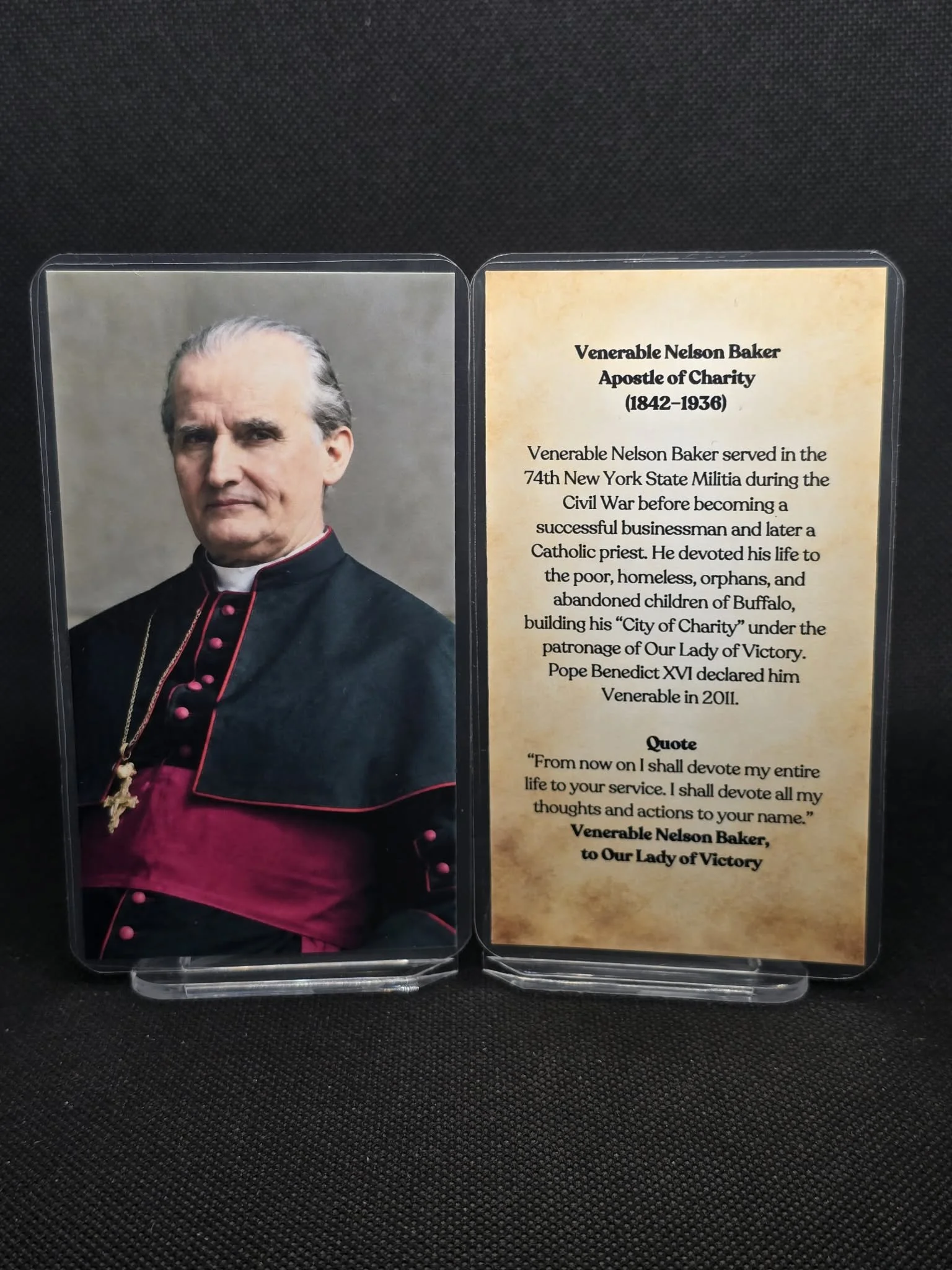
View Prayer Card