Venerable Emil Kapaun: Priest, Army Chaplain and Prisoner of War
The Kansas farm boy who became an Army chaplain, chose to stay with the wounded at Unsan, and died caring for fellow prisoners in a North Korean camp in 1951.
At a Glance
- Born
- April 20, 1916, Pilsen, Kansas, United States
- Died
- May 23, 1951, at the Pyoktong prisoner-of-war camp in North Korea, aged 35
- Feast day
- None officially established; May 23, the day of his death, is used for private remembrance
- Status
- Venerable, by a decree authorized by Pope Francis on February 24, 2025; not yet beatified or canonized
- Cause
- Recognised as an offering of life (oblatio vitae), not as martyrdom
- Titles
- Priest of the Diocese of Wichita, Army chaplain (captain), Medal of Honor recipient
- A Chaplain Who Would Not Leave the Wounded
- A Farm in Pilsen
- Seminary and Priesthood
- Becoming a Chaplain
- Japan and the First Months in Korea
- The Battle of Unsan
- The Prison Camp at Pyoktong
- Easter 1951 and Death
- Remains and the Cause for Sainthood
- Devotion, Stories and Care with Facts
- Why He Matters to Eastern Christians
- Frequently Asked Questions
A Chaplain Who Would Not Leave the Wounded
Emil Kapaun was a Catholic priest from a Kansas farm who served as an Army chaplain in the Second World War and the Korean War. In November 1950, when American forces were overrun by Chinese troops at Unsan, he chose to stay with the wounded instead of escaping. He was captured, and for the next six months he cared for fellow prisoners in North Korean camps until his death on May 23, 1951.
He is not yet a saint. The Church calls him Venerable, a title given when the Pope formally recognises that a person lived the Christian virtues to a heroic degree. For Kapaun, the decree was authorized by Pope Francis on February 24, 2025, and announced by the Holy See on February 25, 2025. It speaks of an offering of life, a category that is distinct from martyrdom. He has not been beatified, and no miracle has yet been officially approved.
This article follows the documented record: Church decrees, the Diocese of Wichita, the United States Army, and the testimony of men who were prisoners with him. Where a story rests on tradition or on a single account, it is marked.
A Farm in Pilsen
Emil Joseph Kapaun was born on April 20, 1916, which was Holy Thursday, on his family's farm near Pilsen, Kansas. His parents, Enos Kapaun and Elizabeth Hajek Kapaun, called Bessie, belonged to the German and Bohemian Catholic community of the region. He was baptized on May 9, 1916, at St. John Nepomucene Church. He had one brother, Eugene.
Farm work shaped him. He helped with the garden and the machinery, and he liked fishing and hunting. The Diocese of Wichita notes that the practical skills he gained on the farm later served him in Korea, where he repaired equipment and improvised containers for the other prisoners.
He went to the Catholic school in Pilsen, taught by the Adorers of the Blood of Christ. He made his First Communion on May 29, 1924, and was confirmed on April 11, 1929. Early testimony, much of it gathered by Monsignor Arthur Tonne for his 1954 biography, describes a quiet, hardworking boy with a good sense of humour. These recollections are valuable, but they come from people who remembered him after he had become famous, so they should be read as character evidence and not as official records.
Seminary and Priesthood
In 1930 Kapaun entered Conception Seminary in Missouri, where he studied classical subjects and philosophy in a Benedictine setting. In 1936 he moved to Kenrick Seminary in St. Louis to finish his theological studies.
Bishop Christian Winkelmann ordained him on June 9, 1940, in the chapel of Sacred Heart College in Wichita, now Newman University. He celebrated his first solemn Mass at St. John Nepomucene Church in Pilsen on June 20, 1940, and was assigned there as assistant pastor.
Kapaun did not undergo a conversion from another religion. He was raised Catholic and grew into his vocation within his own community. The diocesan archives preserve a statement from a letter to his bishop: "When I was ordained, I was determined to spend myself for God." That sentence, from his own pen, describes the priesthood he understood and later lived.
Becoming a Chaplain
The war changed his sense of where he was needed. From 1943 he served as an auxiliary chaplain at Herington Army Airfield in Kansas while continuing parish duties. The work with service members convinced him that military chaplaincy was a real field for priestly ministry.
With his bishop's permission he entered the Army Chaplain Corps on July 12, 1944. He served in the India-Burma theatre in the last stage of the Second World War and was promoted to captain on January 3, 1946.
After the war he studied at The Catholic University of America in Washington, where he received a master's degree in education in 1948. He wrote a thesis on the accrediting of religion in American high schools. He then served briefly as pastor at Timken, Kansas, before asking his new bishop, Mark Carroll, for permission to return to active duty. The bishop agreed, and Kapaun went back to the Army.
Japan and the First Months in Korea
In 1950 Kapaun was serving in Japan with the 1st Cavalry Division. He gave radio talks on the Beatitudes, and portions of them survive in writing, with part of a recording that preserves his voice. They are among the best primary sources for his teaching before captivity, and the Diocese of Wichita has used selections in a Beatitudes novena.
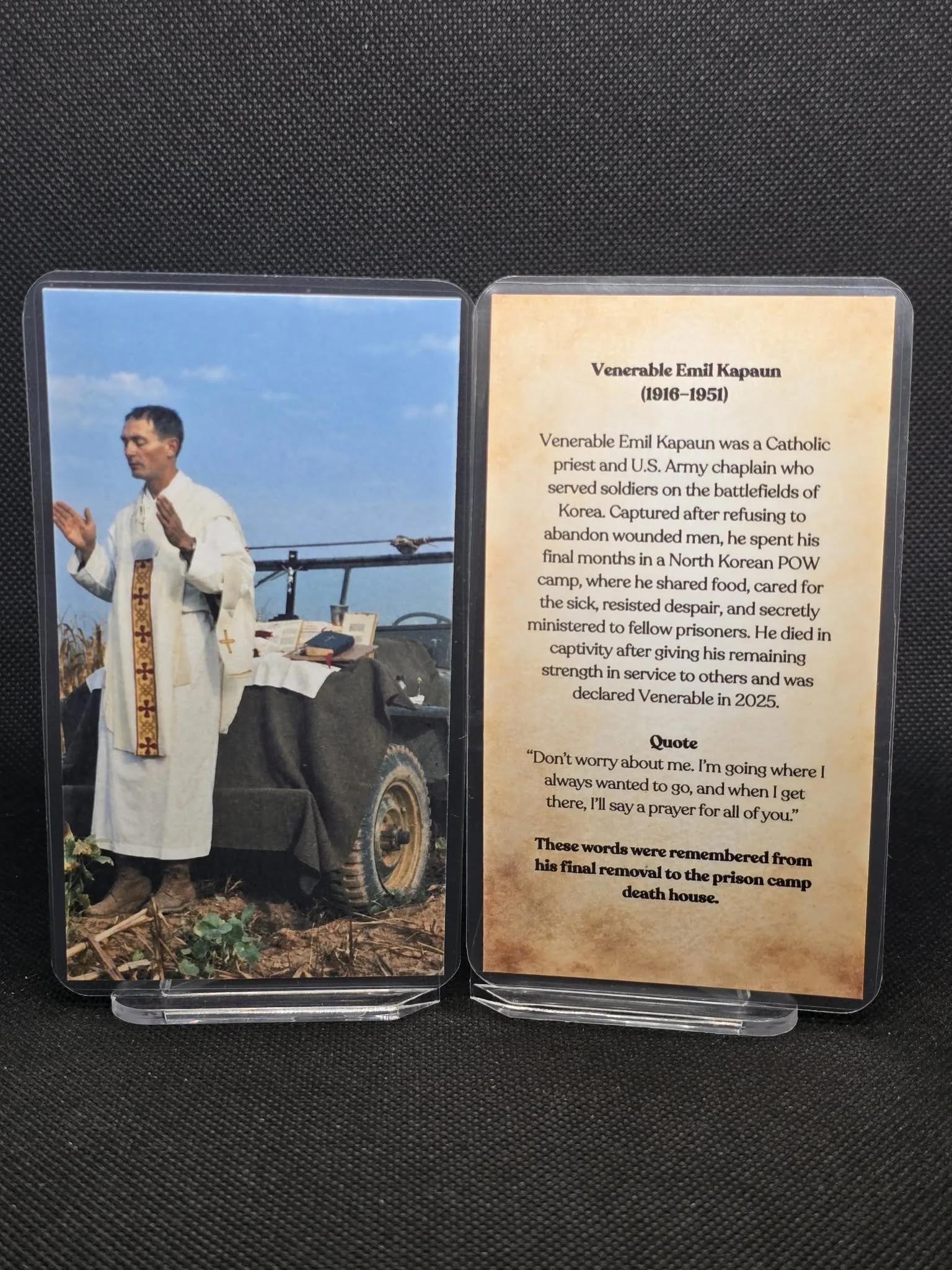
The Korean War began on June 25, 1950, when North Korean forces invaded the south, and Kapaun's division was sent to defend it. In the field he said Mass in the open, sometimes using the hood of a jeep as an altar. A surviving photograph records a Mass he celebrated on October 7, 1950. He heard confessions, visited soldiers in forward positions, ministered to the wounded and dying, and wrote to families of the dead.
On August 2, 1950, near Kumchon, he is recorded as rescuing a wounded soldier under enemy fire, an action for which he received the Bronze Star. The dates and details come from Army and diocesan sources and are consistent across them.
The Battle of Unsan
In late October and early November 1950 Chinese forces entered the war. During the Battle of Unsan, on November 1 and 2, American units were attacked in overwhelming numbers and Kapaun's position was surrounded. The Army record, which later supported his Medal of Honor, says he repeatedly exposed himself to danger to reach the wounded and that he refused chances to escape when that would have meant leaving men who could not move.
He was captured on November 2, 1950. A well documented episode from the first days of captivity concerns Sergeant Herbert Miller, a wounded soldier whom Kapaun carried. When an enemy soldier threatened to shoot Miller, Kapaun intervened. The account appears in later biographies and Army material.
President Barack Obama awarded Kapaun the Medal of Honor posthumously on April 11, 2013. The medal honours acts of courage in battle. It is a military decoration and not a Church judgment, but it records the same acts that his fellow prisoners remembered.
The Prison Camp at Pyoktong
Kapaun was taken to prisoner-of-war camps in North Korea, including Pyoktong, also called Camp 5. Survivors describe severe hunger, disease, overcrowding, cold and brutal treatment. Kapaun looked for extra food, washed the sick, picked lice from the weak, made containers and tools, and encouraged men who were giving up.
The most important contemporary account is by First Lieutenant Ray M. Dowe Jr., a fellow prisoner, who told his story to Harold H. Martin for The Saturday Evening Post on January 16, 1954. Dowe describes Kapaun resisting attempts by communist political instructors to discredit Christianity while continuing to look after the men. A caution is needed here: the account is first-hand, but it was published in the political climate of the Cold War, and the judgments of its author about the motives of individual captors should be separated from what he saw Kapaun do.
Kapaun's care reached beyond Catholics. Testimony records that Protestants, Jews and Muslims were among those he helped, and that many of them remembered him with gratitude.
Easter 1951 and Death
Popular accounts often say that Kapaun celebrated Mass in the camp at Easter 1951. Dowe, the eyewitness, says plainly that he could not, because the necessary equipment was missing. What took place was an Easter prayer service. This is a point worth stating exactly, because it shows how stories grow in the telling.
By spring 1951 his health had broken down. Dowe reports a swollen leg, dysentery and pneumonia. Guards ordered him moved to a camp hospital that the prisoners called a place of death, and Dowe believed that Kapaun had begun to recover before the move and was weakened by being taken from his companions.
He died on May 23, 1951. UNCERTAIN: the exact medical sequence cannot be fixed as firmly as the date. The Defense POW/MIA Accounting Agency names prolonged malnutrition as the main cause, while eyewitnesses describe additional serious illness. His fellow prisoners buried him near the camp.
Remains and the Cause for Sainthood
In December 1954 remains from North Korea were returned to American custody in an exchange called Operation Glory. Some were buried in Hawaii without identification. Modern forensic work later established that one group of remains was Kapaun's, and the Defense POW/MIA Accounting Agency accounted for him on March 2, 2021. His remains came back to Kansas that September and were placed in the Cathedral of the Immaculate Conception in Wichita on September 29, 2021.
The Church's investigation began in 1993 under the Archdiocese for the Military Services, and the Diocese of Wichita took responsibility for the cause in 2008. One American directory gives June 29, 2008, as the date he became a Servant of God, while the diocese describes 1993 as the start and 2008 as the change of responsibility. The diocesan account is clearer and is followed here. A large historical investigation produced thousands of pages, and the positio was submitted in Rome in 2015.
On February 24, 2025, Pope Francis authorized the decree that named him Venerable, as an offering of life. This differs from martyrdom, though many people call him a martyr in everyday speech. For beatification, one miracle attributed to his intercession must be approved. As far as sources we found show, none has yet been approved. The diocese has reported that several possible cases are under study, which is not the same as approval.
Devotion, Stories and Care with Facts
His reputation for holiness began with former prisoners, many of whom credited his practical care and courage with keeping them alive. Such testimony is evidence of heroic conduct. It is not a miracle claim, and the Church treats the two differently.
TRADITION: a frequently repeated story says that an enemy bullet struck a pipe Kapaun was smoking and just missed his face. The diocesan biography records it, but we did not find an independent military record that settles the circumstances, so it is best told as a reported anecdote.
A better documented episode of remembrance concerns Gerald Fink, a Jewish Marine pilot who had been a prisoner, and who made a wooden crucifix in Kapaun's memory. The cross was brought out of captivity and is associated with Kapaun Mount Carmel Catholic High School in Wichita. That is a story of respect between men of different faiths, and not a miracle. Devotion today centres on prayers for his intercession, the diocesan novena, visits to places connected with his life, and remembrance among veterans and military chaplains.
Lord Jesus Christ, good shepherd, you gave your servant Emil Kapaun the grace to stay with the wounded and to serve the hungry and the dying. Look with mercy on soldiers, chaplains and prisoners, and on all who suffer in body or in spirit. Teach us to give ourselves to others without counting the cost, and bring peace to the nations. Amen.
This prayer was written for this page. It is not an official prayer of the Church. The Diocese of Wichita publishes its own prayer for his canonization.
Why He Matters to Eastern Christians
There is no evidence that Emil Kapaun belonged to an Eastern Catholic Church, celebrated an Eastern rite, or has been glorified by any Orthodox Church. His Bohemian family background is not a sign of Eastern Christian affiliation, and any account that suggests otherwise is misleading. He was a Latin-rite diocesan priest.
Even so, his life touches themes that matter deeply to the Christian East: the shepherd who does not abandon the flock, prayer and charity kept alive in extreme want, and love for enemies. Eastern readers who know the stories of prisoners and confessors under atheist regimes will recognise something familiar in a priest who kept serving behind barbed wire.
We found no sourced link between Kapaun and Eastern monastic writings such as the Philokalia, and no established Orthodox devotion to him. For readers who pray for chaplains, prisoners and the dying, his example is offered as a witness from the Catholic West, shared in the spirit of Christian fellowship.
Frequently Asked Questions
Spending Oneself
Kapaun said at his ordination that he meant to spend himself for God. The camp at Pyoktong showed what that sentence could cost. His story invites us to ask where we can stay when it would be easier to leave.
View Prayer Card