Blessed Justo Takayama Ukon: Samurai, Lord of Takatsuki and Martyr in Exile
The Japanese warlord who gave up his lands rather than renounce Christ, and who died in exile in Manila in 1615.
At a Glance
- Born
- About 1552 or 1553, in the Takayama area near Nara; the exact birthplace is uncertain
- Died
- February 3, 1615, in Manila, Philippines (one Philippine Jesuit article gives February 5)
- Feast day
- February 3 in Japan; the Vatican Dicastery lists February 4
- Beatification
- February 7, 2017, in Osaka, presided over by Cardinal Angelo Amato
- Status
- Blessed; not yet canonized
- Titles
- Confessor and martyr in exile, lord of Takatsuki and Akashi, tea disciple of Sen no Rikyu
A Samurai Who Would Not Recant
Justo Takayama Ukon was born into the warrior class of sixteenth-century Japan, a country torn by civil war, and he became one of the most respected Christian lords of his age. He fought, governed and built castles. He also built churches, protected missionaries and, when he was finally told to choose between his lands and his faith, he chose his faith.
He was baptized as a boy under the name Justus, which the Japanese tradition renders Justo. Ukon was his warrior name. For about fifty years he lived as a Christian in a country where the rulers first tolerated the faith, then restricted it, and at last outlawed it. He lost his domain in 1587 and was driven out of Japan in 1614. He died a few weeks after reaching Manila.
The Catholic Church declared him a martyr in 2016, in the sense that he died as a result of hardships endured because of the faith, and he was beatified in Osaka in 2017. He has not been canonized. This article follows the better documented sources and marks what is later tradition or uncertain.
Family and Conversion
Ukon was born about 1552 or 1553. Sources do not agree on the place, but it was the Takayama area near Nara in the Yamato region. His father, Takayama Tomoteru, served the warlord Matsunaga Hisahide at Sawa Castle. Tomoteru is remembered under his Christian name, Dario.
The family came into contact with Christianity through the Jesuit missionaries who were active in the Kyoto and Nara region in the 1560s. According to the historian George Elison, the family was baptized in 1564, when Ukon was about twelve. Some popular accounts give 1563. The baptism is usually connected with a debate held at Sawa Castle between Buddhist monks and a Christian layman, Brother Lourenco, but the details of that story come from missionary reports and should be read with care.
Ukon took the name Justus. His wife is commonly called Justa and is said to have come from the Kuroda circle, but her origin and the details of the marriage are uncertain. What the sources do show is a household in which the faith was not a private matter. The family served a lord, fought for him and, from a young age, was known as Christian.
Lord of Takatsuki
In the early 1570s Ukon rose to command at Takatsuki, between Kyoto and Osaka. The sequence of events after the fall of the local lord Wada Korenaga is told differently by different writers, and the dates should be treated as approximate. What is clear is that by the middle of the 1570s Ukon and his father held Takatsuki under the new power of Oda Nobunaga.
Missionary letters describe him as a firm and just lord. He rebuilt the castle town, had a church built, and encouraged Christian instruction among his retainers and the townspeople. The Jesuit sources, written by men who had every reason to praise him, report large numbers of baptisms in Takatsuki. Such figures are best read as estimates, not exact counts.
One thing his Jesuit friends noticed was that he did not force the faith on his people. They describe him as persuading and setting an example, though the missionaries, like all authors of their time, wrote with an interest in presenting the mission well.
The Crisis of 1578
The best known test of his early life came in 1578. Araki Murashige, a neighbouring lord, rebelled against Nobunaga. Ukon had family and political ties to Araki, and Takatsuki lay close to the rebel territory. Nobunaga, who was then fighting hard to hold central Japan, threatened to destroy the Christian mission in the region if Ukon did not surrender.
Ukon was caught between loyalty to a friend and ally and the safety of the Church and his own people. According to the missionary accounts, he took counsel from the Jesuit Organtino Gnecchi-Soldo and then submitted to Nobunaga. Nobunaga accepted the surrender and rewarded him. Later tradition adds dramatic details, such as Ukon coming unarmed and in the dress of a penitent, and the claim that members of his family were held as hostages. These are common in popular retellings, but they are UNCERTAIN, and the main outline is enough: he chose submission over a war that would have destroyed the mission.
The episode shows a feature of his character that returns throughout his life. He was a soldier and statesman who calculated risks, but he put the faith ahead of personal advantage when the two clearly conflicted.
Takatsuki, Akashi and the Church
After Nobunaga was killed in 1582, Ukon served the new ruler, Toyotomi Hideyoshi, and fought in his campaigns. In 1585 he was given the domain of Akashi on the Inland Sea. Hideyoshi trusted him as a commander, and Ukon used his position to protect Christian communities and to support the Jesuit mission.
He is also remembered as a patron of church building. A church in Kyoto, associated with the Jesuit mission and later known as Nanbanji, was built in the late 1570s, and his name is connected with the support given to it. Cardinal Angelo Amato, in speaking at the beatification, also pointed to his work in forming a charitable confraternity, a lay brotherhood that cared for the poor and for the dead. The sources on the confraternity are mostly missionary reports and later tradition, so the picture is more general than precise.
He lived the faith as a layman: Mass, the sacraments, instruction of his retainers and personal prayer. There are no authenticated writings by him. Apart from a letter addressed to him by Pope Sixtus V, which survives, our knowledge of his inner life comes from what others wrote about him.
The Way of Tea
Ukon was also a man of culture. He is counted among the disciples of Sen no Rikyu, the great master of the Japanese tea ceremony, and in the later lists of the Seven Disciples of Rikyu he appears by name. Tea was a world in which warlords met in a quiet setting, away from the battlefield, and the friendship of a Christian lord with the tea master is well attested in Japanese tradition.
In recent decades some writers have gone further and described the tea ceremony as a kind of Christian liturgy, or have found a hidden Christian meaning in its gestures. These claims are UNCERTAIN. There is no early evidence that Ukon, or Rikyu, understood tea in this way. It is safer to say that Ukon was at home in the culture of his country and saw no contradiction between being Japanese and being Christian.
That point matters for his legacy. He did not live as a foreigner in his own land. He was a Japanese lord who held the Christian faith, and the later persecution made that combination costly.
The Edict of 1587
In July 1587 Hideyoshi, who had until then been friendly toward the missionaries, suddenly ordered them to leave Japan. He then summoned the Christian lords and pressed them to abandon the faith. Ukon refused. According to the sources, he told the ruler that he would give up his lands and his rank rather than renounce Christ.
He lost his domain at Akashi. For some time he lived under the protection of friends, including Christian lords such as Konishi Yukinaga, and then he found refuge with Maeda Toshiie in Kaga, in the region of Kanazawa. Maeda valued his abilities and kept him as a trusted adviser, even though Ukon had no fief of his own to bring. He spent about a quarter of a century there, living modestly, serving his protector as a military and cultural adviser, and continuing to practise the faith in a time when public Christian life was no longer safe.
Hideyoshi's edict was not strictly enforced across the country, and the mission continued in a limited way. But it marked the point at which the Christian lords of Japan were forced to decide whether their loyalty belonged to their ruler or to their faith. Ukon had answered clearly.
Exile to Manila
The final blow came after Tokugawa Ieyasu issued a decree in early 1614 that banned Christianity and ordered the expulsion of missionaries and prominent Christians. Ukon, by then in his early sixties, was ordered to leave. He went to Nagasaki and, with other exiles, boarded a ship bound for Manila in the Spanish Philippines.
The Vatican biography reports that about three hundred people travelled in the exiled group and that the voyage took forty-three days. Other sources give different figures, and the numbers should be taken as approximate. The sources agree that he was received with honour by the Spanish authorities and the Church in Manila. He was by then weakened by the journey, and he fell ill within weeks.
He died on February 3, 1615, though a Philippine Jesuit article gives February 5. He was buried with honours at the Jesuit church of Santa Ana in the walled city of Intramuros. A search for his remains in 2012 did not find them, so the place of his tomb is not known today.
From Death to Beatification
Devotion to Ukon never fully disappeared among Japanese Catholics. The formal cause was opened in the twentieth century. On January 21, 2016, Pope Francis authorised the decree that recognised him as a martyr, in the sense that he accepted exile and the hardships that came with it, and in the end died of them, because he would not renounce the faith.
Because he was recognised as a martyr, no miracle was needed for beatification, and none is recorded in his cause. He was beatified on February 7, 2017, in Osaka, in a ceremony presided over by Cardinal Angelo Amato on behalf of the Pope. He is a Blessed, not yet a canonized saint. The Japanese bishops later approved a prayer asking for his canonization, in 2017.
His feast is kept on February 3 in Japan, according to the Japanese bishops, while the Vatican Dicastery lists February 4. Local calendars may differ, and anyone planning a liturgy should check with the local church.
Why He Matters to Eastern Christians
It should be said plainly that Ukon was a Latin-rite Catholic, evangelised by Jesuits, and that no Eastern Christian connection to him has been found in the sources. He has not been glorified by any Orthodox Church. His cause belongs to the Roman Catholic Church.
Eastern Catholic readers, who are in full communion with Rome, may honour him as a Blessed of the Catholic Church, though liturgical celebration is a matter for each church. Orthodox readers will find in his story a witness that is familiar from their own history: a believer who lost position, home and country rather than deny Christ, and who died far from where he was born.
His life also speaks to Christians who live under pressure from the state. Many Eastern churches, in the Middle East, in the Soviet Union and elsewhere, have known the same choice between safety and fidelity. Ukon belongs to a different tradition, but his choice is one they will recognise.
Lord Jesus Christ, you called Blessed Justo to put you before land, rank and safety. Give us the same courage when we are asked to choose. Comfort those who live far from home, strengthen those who suffer for your name, and make us faithful in small things as in great ones. Through the prayers of Blessed Justo, have mercy on us. Amen.
This prayer was written for this page. It is not an official or approved prayer of the Church. The Japanese bishops have approved a separate prayer for his canonization.
Devotion and Legacy
In Japan Ukon is honoured as one of the best known Christian figures of the sixteenth century. His memory is kept at Takatsuki and Osaka, and in the Philippines the memory of his exile is kept at Manila. Pope Francis wrote about him in a letter of September 14, 2017, and the Japanese bishops have promoted his cause for canonization.
One tradition connects him with an image of Our Lady known as La Japona, brought to Manila by Japanese Christians. This is TRADITION and is not documented well enough to be treated as established history. It shows, at least, how closely the memory of the exiles was tied to Marian devotion.
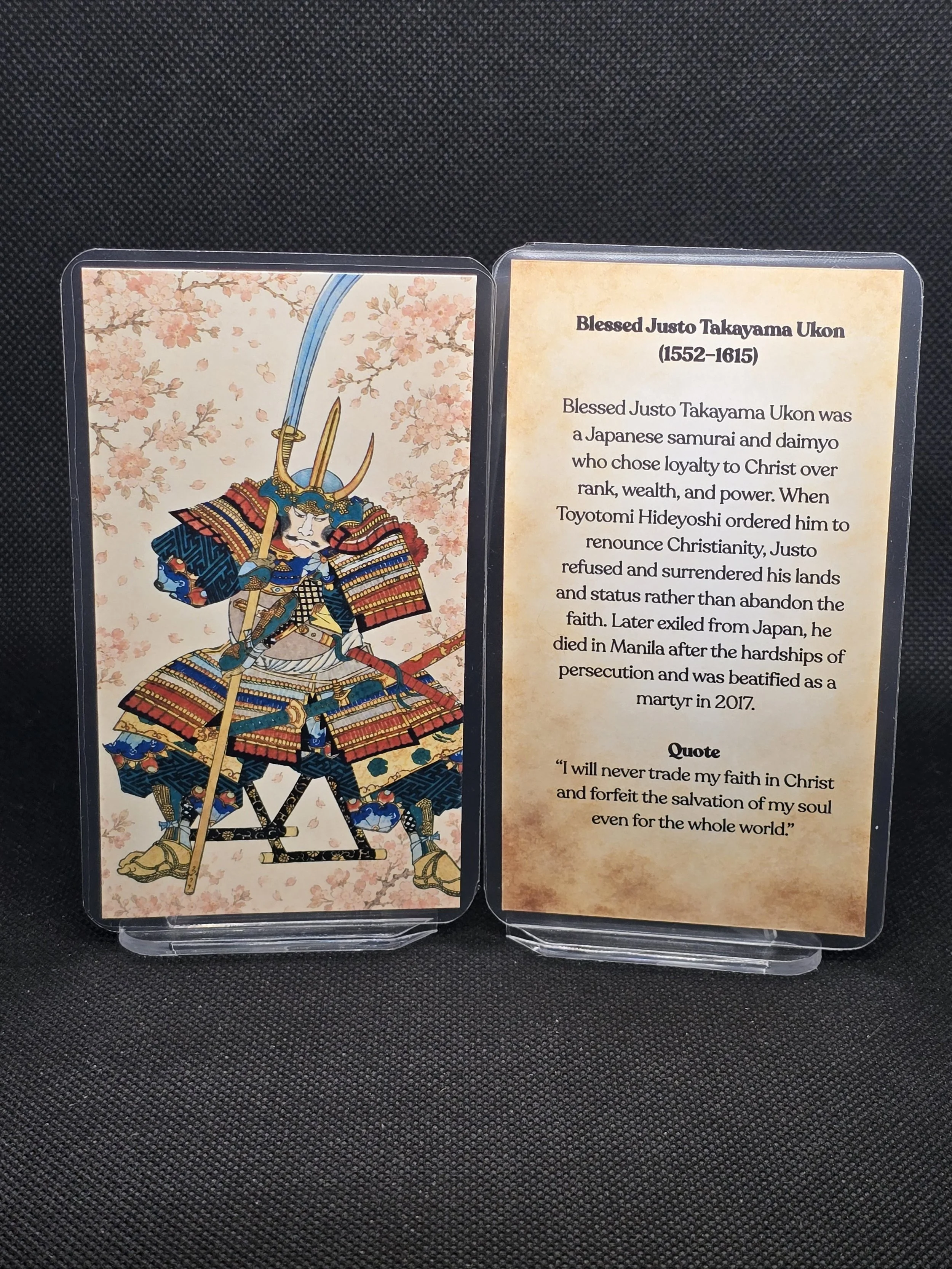
Ukon is often invoked by those who face a hard choice between conscience and comfort, by exiles and refugees, and by people whose faith costs them something at work or in their family. A pocket prayer card with his image is available at The Eastern Church for those who wish to pray with him.
Frequently Asked Questions
Faith Above Rank
Ukon had castles, a name and the favour of the powerful. He gave all of it up with a steady mind. His example does not ask us to be warriors, only to know what we will not trade away.
View Prayer Card