Saint Martin of Tours: The Roman Soldier Who Cut His Cloak in Half and Refused to Fight Again
Saint Martin of Tours: The Roman Soldier Who Cut His Cloak in Half and Refused to Fight Again
Conscripted at fifteen, converted by a beggar, and discharged as a conscientious objector, he became a hermit, then a monk, then, dragged to the office against his own wishes, a bishop who spent twenty-six years tearing down pagan shrines and building the first monasteries of the West.
Saint Martin of Tours at a Glance
- Born
- c. 316, Savaria, Pannonia (modern Szombathely, Hungary)
- Died
- November 8, 397, Candes, Gaul (modern Candes-Saint-Martin, France)
- Venerated In
- The Roman Catholic Church, the Eastern Orthodox Church, and the Anglican Communion
- Canonized
- Pre-congregation; venerated as a saint from shortly after his death, one of the earliest non-martyrs so honored
- Feast Day
- November 11, the anniversary of his burial (Martinmas)
- Title
- Bishop of Tours; Confessor; Patron of France
- Founded
- Liguge Abbey (c. 361), among the oldest monasteries in Western Europe; Marmoutier Abbey (c. 372)
- Known For
- The Miracle of the Cloak; evangelizing rural Gaul; opposing the execution of Priscillian
- Biographer
- Sulpicius Severus, a contemporary disciple who wrote his Life while Martin was still living
- Relics
- Basilica of Saint Martin, Tours, France, rediscovered 1860
- I. A Soldier's Son, a Christian Against His Parents' Wishes
- II. Conscripted at Fifteen
- III. The Miracle of the Cloak, Amiens
- IV. "I Am Christ's Soldier": Facing Julian the Apostate
- V. Saint Hilary of Poitiers and the Island of Gallinaria
- VI. Liguge: The First Monastery of the West
- VII. Bishop of Tours by Trickery and Acclamation
- VIII. Marmoutier and Eighty Cave-Dwelling Disciples
- IX. Tearing Down the Shrines of Rural Gaul
- X. The Priscillian Controversy: A Bishop's Regret
- XI. Death at Candes and a Dispute Over the Body
- XII. His Relics: Desecrated, Demolished, and Rediscovered in 1860
- XIII. Miracles Recorded by Sulpicius Severus and Gregory of Tours
- XIV. His Companions: Connections to Other Saints
- XV. On His Biographer, Since Martin Left No Writings of His Own
- XVI. Monasteries and Basilicas, With Links
- XVII. Legacy: From His Cloak to Veterans Day
- Prayer for the Intercession of Saint Martin of Tours
- Frequently Asked Questions
A Soldier's Son, a Christian Against His Parents' Wishes
Martin was born around the year 316 in Savaria, in the Roman province of Pannonia, in what is today Szombathely, Hungary. His father was an officer of the Roman army, and the family relocated repeatedly to follow his military postings, eventually settling in Pavia, in northern Italy, where Martin spent much of his boyhood. His parents were pagan, and by every account his household had no particular sympathy for the Christian faith that would come to define his life.
Despite this, Martin felt drawn to Christianity from an early age. At around ten years old, against his parents' express wishes, he began attending a Christian church and enrolled himself as a catechumen, formally beginning the long period of instruction that preceded baptism in the ancient Church, a decision that placed him at odds with his own household years before he would ever put on a soldier's uniform.
Part II
Conscripted at Fifteen
Under Roman law, the sons of military veterans were themselves subject to conscription, and at fifteen Martin was forcibly enrolled in the army, following the same path as his father before him. He was eventually posted with a cavalry unit in Gaul, stationed for a time at Amiens. Even as a serving soldier, those around him remarked that Martin lived more like a monk than a man of arms, giving away much of his pay to the poor and living with unusual personal austerity for a young Roman cavalryman.
Part III
The Miracle of the Cloak, Amiens
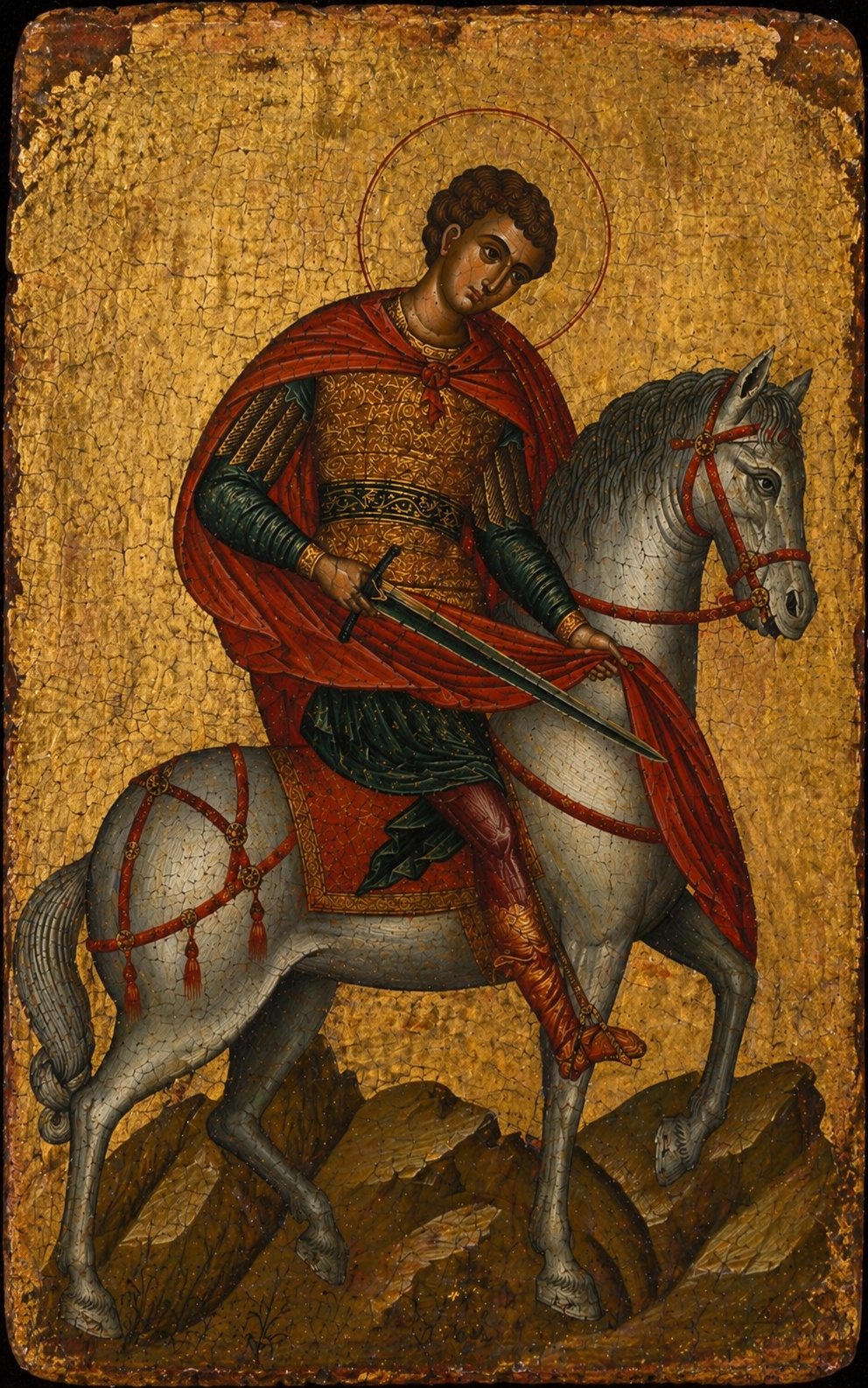
The episode that has defined Martin's popular image for seventeen centuries took place one severe winter at the gate of Amiens. Martin encountered a beggar, nearly naked and shaking uncontrollably with cold, whom no one else passing through the gate had stopped to help. Martin had already given away his money and most of his other clothing to the poor; all he had left was the military cloak on his own back. He dismounted, drew his sword, cut the cloak in two, and gave half to the beggar, keeping the remaining half for himself.
That night, Martin dreamed of Christ wearing the very half-cloak he had given away, surrounded by a multitude of angels. In the dream, Christ turned to the angels and said, "Martin, still only a catechumen, has clothed me with this garment." Martin awoke to find the vision had confirmed everything he had begun to believe. He sought baptism without further delay, receiving it at around eighteen or twenty years of age, depending on the source consulted.
Part IV
"I Am Christ's Soldier": Facing Julian the Apostate
Martin remained in the army for roughly two more years after his baptism. According to his biographer Sulpicius Severus, on the eve of a battle at Worms, as customary bonuses were distributed to the troops, Martin approached his commander and petitioned to be released from military service, explaining that as a soldier of Christ, he could not lawfully take up arms in battle. Accused of cowardice for making this request on the very eve of a fight, Martin offered instead to stand unarmed before the battle line, protected by nothing but the sign of the cross, to prove his refusal came from conviction rather than fear. He was imprisoned for his defiance, but was released not long afterward when the opposing forces sought peace without further battle, sparing him the need to make good on his offer.
Part V
Saint Hilary of Poitiers and the Island of Gallinaria
Discharged from the army, Martin made his way to Poitiers to place himself under the guidance of Bishop Hilary, already renowned for his defense of Nicene orthodoxy against the Arian heresy that still commanded significant support within the imperial court. Hilary ordained Martin an exorcist, a minor clerical order concerned with ministry to the demonically afflicted. Before settling permanently at Poitiers, Martin first traveled home to Pannonia in an attempt to convert his own parents; he succeeded in converting his mother, though his father remained unmoved.
Martin's outspoken opposition to Arianism during this journey home earned him public scourging and expulsion from the province of Illyricum. He made his way toward Milan, where he found himself opposed once again, this time by the city's Arian bishop, Auxentius, who drove him from the city as well. Martin withdrew to the small island of Gallinaria off the Italian coast, living for a time in extreme isolation and reportedly surviving, on one occasion, an accidental poisoning after eating the toxic plant hellebore while foraging for food, an episode his biographer records as one of several close brushes with death that Martin survived through prayer during these wandering years. When Hilary was eventually permitted to return from his own exile around 360, Martin rejoined him at Poitiers.
Part VI
Liguge: The First Monastery of the West
With land donated by Bishop Hilary a short distance from Poitiers, Martin founded a monastic community around the year 361 at a site that came to be called Ligugé, now recognized as among the oldest monasteries in Western Europe, its earliest monks living in the pattern of the Egyptian Desert Fathers, each in his own small hut. Martin's growing reputation for holiness at Ligugé drew increasing numbers of disciples, a reputation sharpened considerably by an episode Sulpicius Severus records in vivid detail: a catechumen under Martin's instruction died suddenly before he could be baptized, and Martin, praying over the body for hours, was credited with restoring him to life, the man later testifying that he had stood at the edge of judgment before being called back.
Part VII
Bishop of Tours by Trickery and Acclamation
By 371, Martin's fame as a holy man had spread well beyond Poitiers, and the people of Tours wished to make him their bishop, a role Martin himself had no ambition for and actively wished to avoid. According to tradition, he was lured out of his monastic retreat under the pretext of visiting a sick person, brought instead into the city, and there elected bishop by overwhelming popular acclamation, a method of episcopal selection not uncommon in the fourth-century Church but one that left Martin, by every account, a genuinely reluctant occupant of the office thrust upon him.
Part VIII
Marmoutier and Eighty Cave-Dwelling Disciples
Even as bishop, Martin initially tried to live in a small cell attached to his own cathedral church, but the constant interruptions of episcopal life drove him to establish a second monastic retreat, Marmoutier, a short distance from Tours on the opposite bank of the Loire River, in a site enclosed between a steep hillside and a bend in the river that made it naturally isolated and difficult to reach. Sulpicius Severus describes eighty disciples eventually gathered there, most of them dwelling in caves hollowed directly out of the overhanging rock, living entirely without private possessions and forbidden even to buy or sell among themselves, a rare firsthand glimpse of monastic community life in Gaul more than a century before Saint Benedict would write his own Rule in Italy.
Part IX
Tearing Down the Shrines of Rural Gaul
As bishop, Martin took direct aim at the pagan religious practices still thriving across the Gallic countryside, well beyond the reach of Christian influence concentrated in the cities. He traveled extensively through his diocese and beyond, preaching, converting, and, where necessary, physically destroying pagan temples and idols, work that made him feared by his opponents and celebrated by his supporters in equal measure. One especially vivid episode recorded by Sulpicius Severus describes local pagans agreeing to let Martin cut down a sacred pine tree they venerated only on the condition that he stand directly beneath it as it fell; Martin agreed, and when the tree began to topple toward him, made the sign of the cross, and it is said to have changed course and fallen safely away instead, a moment his biographer presents as decisive proof to the assembled crowd of the superior power of the God Martin served. Through this sustained campaign of evangelization, Martin is credited with founding many of the first rural parish churches in the Gallic countryside, extending Christian practice well beyond the urban centers where it had previously been concentrated.
Part X
The Priscillian Controversy: A Bishop's Regret
Late in his life, Martin became entangled in one of the most consequential and troubling controversies of the fourth-century Western Church. Priscillian, a Spanish bishop accused of heresy and sorcery, had been condemned by a synod and brought before the secular court of the usurping Emperor Magnus Maximus at Trier, where certain bishops hostile to Priscillian pressed for his execution, an unprecedented step: the first time in Church history a Christian would be put to death by secular authority for heresy. Martin traveled to Trier specifically to plead for clemency, arguing that ecclesiastical matters had no business being settled by the executioner's blade, and secured, or believed he had secured, an assurance from the emperor that Priscillian's life would be spared.
Martin left Trier before the final verdict. Priscillian and several companions were executed shortly afterward regardless. Martin, learning of the betrayal, was reportedly devastated, and for a time refused to remain in communion with the bishops who had pressed for the execution, only reluctantly returning to communion with them later for the sake of interceding on behalf of other condemned individuals whose lives still hung in the balance. Sulpicius Severus records that Martin regarded his own involvement, however well-intentioned, as a moral compromise he carried with real anguish for the rest of his life.
Part XI
Death at Candes and a Dispute Over the Body
Even in extreme old age, Martin continued traveling his diocese to resolve disputes among his own clergy. He died on November 8, 397, at Candes, a town on the Loire he had traveled to specifically in order to make peace between quarreling members of the local clergy, a fittingly active end for a bishop who had spent twenty-six years refusing to sit still. Sensing death approaching, he had himself laid on sackcloth and ashes, the traditional posture of penance, rather than dying in ordinary bedding. Witnesses present reported hearing choirs of angels singing at the moment of his death.
His death immediately produced a dispute: the people of Poitiers, where he had first entered religious life, and the people of Tours, where he had served as bishop for a quarter century, both wanted his body for their own city. Tours prevailed, and his body was carried up the Loire River to the city that had reluctantly made him its bishop twenty-six years earlier.
Part XII
His Relics: Desecrated, Demolished, and Rediscovered in 1860
Martin was buried at Tours on November 11, 397, the date that has served as his principal feast day, Martinmas, ever since. His successors as bishop, Britius and then Perpetuus, built successively larger churches over his tomb, culminating in a substantial basilica dedicated in 471, which became one of the most important pilgrimage sites in the whole of medieval Western Europe, drawing particular devotion from the Merovingian and Carolingian royal courts.
The relics' subsequent history is one of genuine and repeated destruction, honestly recorded rather than glossed over. The tomb and its basilica suffered damage from Norman raids in the ninth and tenth centuries and a major fire in 994. Far worse came in 1562, when Huguenot forces during the French Wars of Religion sacked the basilica from top to bottom, deliberately destroying the tomb and scattering or destroying the relics themselves. The building survived in reduced form until the French Revolution, when it was deconsecrated, used as a stable, and then completely demolished between 1793 and 1802, its stones sold off and two new city streets, Rue des Halles and Rue Descartes, deliberately constructed directly across its former foundations specifically to prevent any future reconstruction.
For decades, the exact location of the tomb was lost entirely. On December 14, 1860, excavations led by the local layman Leon Papin-Dupont rediscovered the site of Martin's tomb beneath houses that had been built over the former basilica grounds, recovering architectural fragments and confirming the tomb's location, a discovery that helped spark a significant nineteenth-century revival of popular devotion to the saint. A new basilica, designed by the architect Victor Laloux in a Roman-Byzantine style, was constructed over the rediscovered tomb between 1886 and 1924, incorporating the two surviving medieval towers, the Tour Charlemagne and the clock tower, as the only physical remnants of the original medieval complex. Martin's tomb remains today in the crypt of this basilica, and the high altar above it is said to contain a relic identified as a portion of his skull.
Readers should understand plainly that Martin's original relics were violently scattered in 1562, and that what is venerated today at Tours descends from the 1860 rediscovery of the tomb site and associated fragments, not from an unbroken chain of custody stretching back to 397. This does not make the 1860 discovery illegitimate, only honestly incomplete compared to relic histories with fewer documented ruptures.
Part XIII
Miracles Recorded by Sulpicius Severus and Gregory of Tours
Martin's contemporary biographer Sulpicius Severus, writing while Martin was still alive, compared him directly to the Apostles and attributed to him an extensive range of wonders: the raising of the catechumen at Ligugé, the felled pine tree that fell away from him, healings of the sick, the casting out of demons from the possessed, and repeated visions, alongside equally repeated accounts of temptation and confrontation by demonic forces that Sulpicius presents as an ongoing spiritual struggle throughout Martin's episcopate. Nearly a thousand years before Saint Francis of Assisi's famous kiss of a leper, Martin is recorded as having kissed and cured a leper at the gates of Paris.
A further, extensive catalogue of miracles attributed to Martin's intercession after his death was compiled roughly a century and a half later by his eventual successor as Bishop of Tours, Gregory of Tours, whose writings remain a primary source for the saint's posthumous cult and its rapid growth across Merovingian Gaul.
Part XIV
His Companions: Connections to Other Saints
Martin's life connects directly to several other major figures of the fourth-century Church:
Saint Hilary of Poitiers
The bishop and future Doctor of the Church under whom Martin first entered religious life, who ordained him exorcist, donated the land for the monastery at Ligugé, and remained a formative influence throughout Martin's early religious formation.
Saint Ambrose of Milan
A contemporary bishop and fellow opponent of Arianism who never personally met Martin but whose own biographer records a striking tradition: that Ambrose, while celebrating Mass in Milan, fell suddenly silent and later explained that he had been mystically present at Martin's funeral taking place at that very moment in distant Tours.
Saint Paulinus of Nola
A wealthy Roman convert to ascetic Christianity and correspondent of Sulpicius Severus, whose letters preserve additional testimony to Martin's reputation during his own lifetime and shortly after his death.
Sulpicius Severus
Not himself formally canonized, but Martin's own disciple and biographer, whose Life of Saint Martin, written while its subject was still alive, became one of the most influential and widely copied works of hagiography in the history of Western Christian literature, effectively establishing the genre for centuries of saints' lives that followed.
Saint Gregory of Tours
Martin's own successor as Bishop of Tours more than a century later, whose extensive writings preserve the fullest surviving record of miracles attributed to Martin's posthumous intercession, and who remains one of the most important historical sources for the whole of Merovingian Gaul.
Saint Brice of Tours
Martin's own immediate and famously difficult successor as Bishop of Tours, whose early tenure was marked by scandal and controversy but who was nonetheless himself later venerated as a saint.
Part XV
On His Biographer, Since Martin Left No Writings of His Own
No personal letters, sermons, or writings by Martin himself survive, and none are known to have existed; unlike some of the great preaching bishops of his era, Martin's own voice reaches us only secondhand, through the testimony his biographer Sulpicius Severus collected directly from him and from those who knew him. What makes this particular case of missing personal writing unusual is the extraordinary quality of the substitute record: Sulpicius Severus's Life of Saint Martin was researched and largely written while its subject was still living, an almost unprecedented approach for ancient hagiography, and the resulting text achieved something like instant celebrity status upon its release, copied and circulated across the Christian world with remarkable speed and establishing conventions of saintly biography that shaped the genre for a millennium afterward.
Part XVI
Monasteries and Basilicas, With Links
Three sites founded by or directly connected to Martin himself remain active today:
Basilica of Saint Martin, Tours, France
Built between 1886 and 1924 over the rediscovered site of Martin's tomb, the modern neo-Byzantine basilica remains the central pilgrimage destination associated with his memory, its crypt holding the saint's sarcophagus and reliquary. basiliquesaintmartin.fr
Ligugé Abbey, France
Founded by Martin around 361 on land donated by Saint Hilary, among the oldest monasteries in Western Europe, destroyed at the French Revolution and refounded in 1853 as a Benedictine community of the Solesmes Congregation, still active today.
Marmoutier Abbey, Tours, France
The second monastery Martin founded, around 372, across the Loire from Tours, where he retreated from the demands of episcopal life among a community of eighty disciples; the site later developed into an influential Benedictine abbey with extensive dependencies across medieval France.
Part XVII
Legacy: From His Cloak to Veterans Day
Few saints have left as many quiet linguistic and cultural fingerprints on the modern world as Martin of Tours. The Frankish kings, and later the Carolingian dynasty under Charlemagne, held Martin's memory and his relic cloak, the cappa, in extraordinary reverence, carrying a fragment of it into battle as a sacred standard believed to guarantee victory. The small tent-like reliquary built to house and transport this relic cloak was called, in Latin, a cappella, a word that passed directly into English as chapel, with the priest responsible for its care giving English the word chaplain as well, both terms tracing their origin directly back to Martin's own half of a soldier's cloak.
His feast day, November 11, carried its own additional weight into the twentieth century when the armistice ending the First World War was signed on that same date in 1918, a coincidence that permanently linked Martin's memory, a former soldier who refused to fight again after his conversion, to the modern commemoration of Armistice Day and Veterans Day observed across much of the world on the same date every year.
Holy Trinity, Father, Son, and Holy Spirit, to You be glory, honor, and blessing, for having given to Your holy Church Saint Martin of Tours, soldier, monk, and bishop, as a model of generosity toward the poor and courage to follow conscience above every earthly command.
We ask You humbly: just as You revealed Yourself to him in the person of a freezing beggar, be pleased to grant us, through his intercession, generosity toward those in need, courage to act rightly under pressure, and the grace we now ask with confidence.
Through Christ our Lord. Amen.
An original English-language devotional prayer composed for use with the Saint Martin of Tours prayer card, drawing on the traditional themes of his veneration in the Catholic Church.
More From Our Store, In Honor of Soldier Saints and Monastic Founders

FAQ
Frequently Asked Questions About Saint Martin of Tours
He Gave Away Half a Cloak and Ended Up Giving the West Its First Monasteries.
Saint Martin of Tours never asked for any of it. He was conscripted at fifteen, converted by a beggar he almost rode past, discharged as a man who refused to fight, and dragged into a bishopric under false pretenses because the people of Tours knew he would refuse to come willingly. What he built out of that reluctance was still standing centuries later: the oldest monasteries in Western Europe, a countryside full of the first rural parishes Gaul had ever seen, and a reputation for mercy so enduring that his own name still hides inside the English words chapel and chaplain, waiting to be noticed.
Ask his intercession. Say his prayer. Remember a soldier who discovered, on one cold night at a city gate, that half a cloak given freely was worth more than the whole of it kept.
Get the Saint Martin of Tours Prayer Card →