Saint John Chrysostom: The Golden-Mouthed Preacher Who Told an Empress the Truth and Died for It
Saint John Chrysostom: The Golden-Mouthed Preacher Who Told an Empress the Truth and Died for It
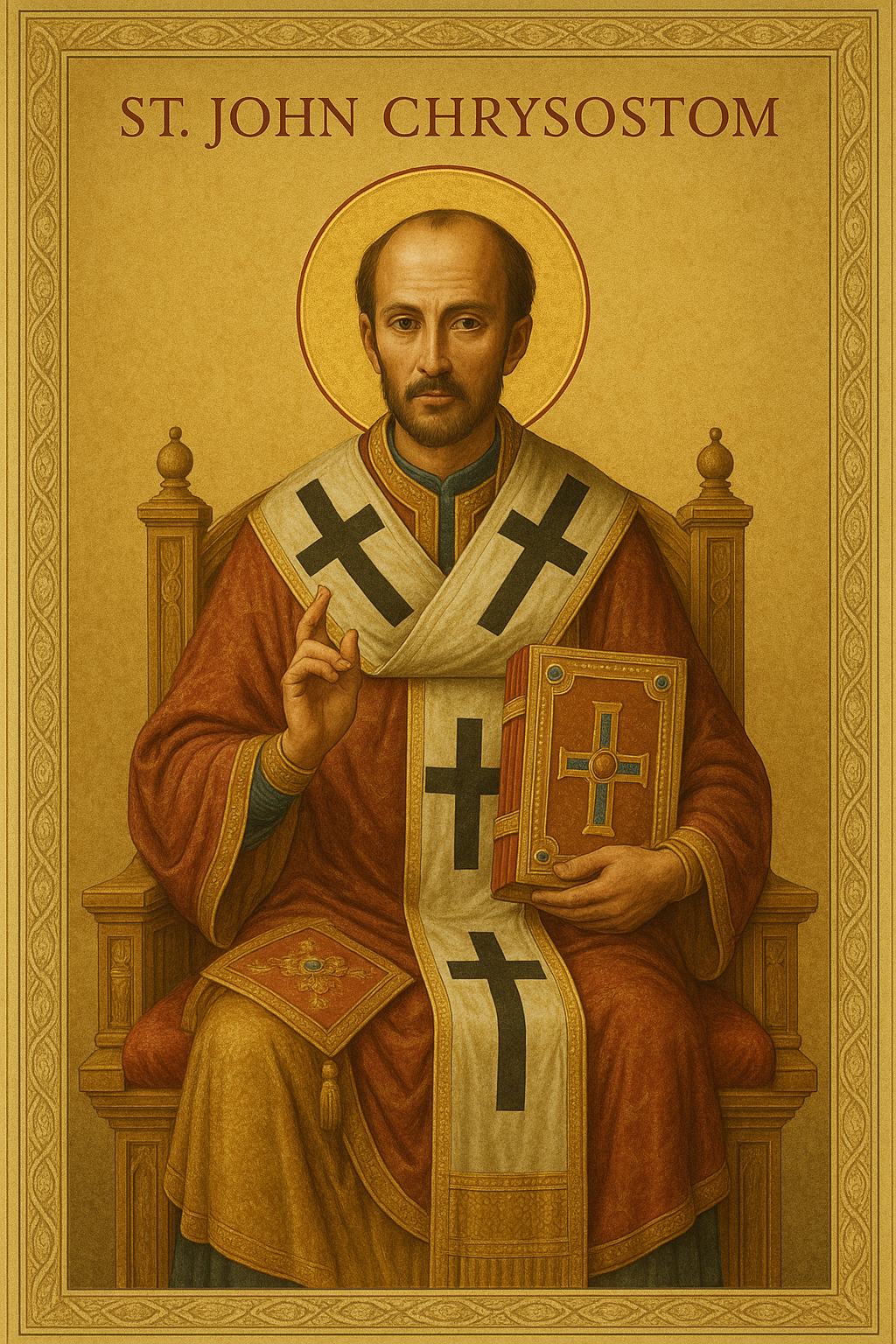
Trained by a pagan orator, formed by a desert cell, and given, by nearly universal agreement across seventeen centuries, the single greatest preaching voice the Christian pulpit has ever produced. He reformed a corrupt capital, was exiled twice for it, and died on a forced march at fifty-nine, still saying thanks.
Saint John Chrysostom at a Glance
- Also Known As
- John of Antioch; Chrysostom, "Golden-Mouthed" (a title first recorded in the sixth century)
- Born
- c. 347, Antioch, Roman Syria
- Died
- September 14, 407, Comana, Pontus, on a forced march into exile
- Venerated In
- The Catholic Church, the Eastern Orthodox Church, Oriental Orthodoxy, the Church of the East, Anglicanism, and Lutheranism
- Canonized
- Pre-congregation; venerated as a saint essentially from his death
- Feast Days
- November 13 (Eastern, principal feast); September 13 or 14 (Western); January 27 (translation of relics); January 30 (Three Holy Hierarchs, with Basil the Great and Gregory the Theologian)
- Title
- Archbishop of Constantinople; Doctor of the Church; Patron of Preachers
- Known For
- The largest surviving body of writing of any Greek Father; the Divine Liturgy that bears his name; reform-minded preaching against wealth and excess
- Chief Antagonists
- Empress Aelia Eudoxia and Theophilus, Patriarch of Alexandria
- Relics
- Patriarchal Cathedral of Saint George, the Phanar, Istanbul, with a further portion in Rome
- I. A Widow's Only Son in Fourth-Century Antioch
- II. Bishop Meletius and a Turn Away From Rhetoric
- III. Monk, Hermit, and a Health Broken by Asceticism
- IV. Deacon Under Meletius, Priest Under Flavian
- V. The Homilies on the Statues, Lent 387
- VI. Twelve Years of Preaching at Antioch
- VII. Summoned in Secret to Constantinople, 398
- VIII. Sweeping the Stairs From the Top: Reform in the Capital
- IX. Eutropius and the Revolt of Gainas
- X. The Empress Turns: Eudoxia and the Vineyard
- XI. Theophilus of Alexandria and the Synod of the Oak, 403
- XII. The Statue, the Baptistery Riot, and Final Exile, 404
- XIII. Cucusus, Pityus, and Death at Comana, 407
- XIV. His Relics: Comana, Constantinople, Rome, and the Phanar
- XV. Wonders, Visions, and the Testimony of His Contemporaries
- XVI. His Companions: Connections to Other Saints
- XVII. His Writings: The Largest Surviving Corpus of Any Greek Father
- XVIII. The Divine Liturgy of Saint John Chrysostom
- XIX. The Three Holy Hierarchs and the Vision of 1084
- XX. Churches and Shrines, With Links
- XXI. Legacy: The Golden Mouth
- Prayer for the Intercession of Saint John Chrysostom
- Frequently Asked Questions
A Widow's Only Son in Fourth-Century Antioch
John was born around the year 347 in Antioch, then the second city of the Eastern Roman Empire and a place of intense religious ferment, home at once to pagans, Manichaeans, Gnostics, Arians, Apollinarians, Jews, and a Catholic community itself divided by a painful schism between two rival bishops, Meletius and Paulinus. His father, Secundus, was a high-ranking officer in the Syrian army who died not long after John's birth, leaving his mother Anthusa a widow at only twenty years old with two young children, John and an elder sister.
Anthusa did not remarry. She raised her son in personal piety while also giving him access to the finest available education, sending him to study under the philosopher Andragathius and, more consequentially, under Libanius, the most celebrated orator of the age and one of the most committed defenders of the empire's declining paganism. John absorbed a formidable classical education under Libanius, a grounding in Greek rhetoric and literature he never fully disowned even after his conversion to ascetic Christian life, though later generations sometimes mistook his critiques of pagan mythology for outright hostility to classical learning itself.
Part II
Bishop Meletius and a Turn Away From Rhetoric
Around the year 367, John encountered Bishop Meletius of Antioch, whose gentle and winning character captivated the young rhetoric student so completely that he began withdrawing from classical and secular studies to devote himself instead to Scripture and the ascetic life, attending Meletius's own sermons closely. Roughly three years later he received Holy Baptism and was ordained to the minor office of lector, the reader who proclaimed Scripture aloud during the liturgy, his first formal step into ecclesiastical life.
Part III
Monk, Hermit, and a Health Broken by Asceticism
Not content with the lectorate, John soon entered one of the ascetic communities near Antioch, placing himself under the spiritual direction of Carterius and, most significantly for his later intellectual formation, Diodorus, the future Bishop of Tarsus and a leading figure of the school of Antiochene biblical interpretation. Prayer, manual labor, and sustained study of Scripture filled his days, and most of his earliest surviving writings, largely concerned with monastic and ascetic subjects, date from this formative period.
Four years later, still seeking a more radical form of the ascetic life, John withdrew to live as a solitary hermit in one of the caves outside Antioch. He remained there roughly two years, but the extreme rigor of his fasting and nighttime vigils, undertaken in frost and cold, permanently damaged his health. Forced to choose between his ascetic ideal and his survival, he prudently returned to Antioch to recover, resuming his duties as lector, his stomach troubles from these desert years remaining with him for the rest of his life.
Part IV
Deacon Under Meletius, Priest Under Flavian
Very probably in early 381, shortly before his own departure to preside over the Second Ecumenical Council at Constantinople, where he would die, Bishop Meletius ordained John a deacon. As deacon, John assisted at liturgical functions, cared for the sick and poor, and likely helped instruct catechumens, all while continuing his literary work. It was during roughly this period, according to most scholarly reckonings, that he composed his most celebrated early treatise, On the Priesthood, still read today as one of the classic statements on the nature and burden of priestly ministry.
Meletius's successor as Bishop of Antioch, Flavian, ordained John a priest in 386, and it is from this point that his real significance in Church history properly begins. For the next twelve years, his chief task, alongside or in place of Bishop Flavian, was preaching, along with what appears to have been the greater share of the practical religious instruction of the Antiochene laity.
Part V
The Homilies on the Statues, Lent 387
The earliest notable demonstration of John's power as a preacher came during Lent of 387, when the people of Antioch, enraged by the imposition of new imperial taxes, rioted and threw down the statues of Emperor Theodosius I standing in the city, an act of treason that plunged the population into genuine terror of imperial reprisal, potentially including the destruction of the entire city. Over the following weeks, while the city waited in dread to learn its fate, John delivered a series of some twenty to twenty-one sermons, known ever since as the Homilies on the Statues, by turns vigorous, consoling, and exhortative, working to steady a panicked population until Bishop Flavian returned from Constantinople bearing the emperor's pardon.
Part VI
Twelve Years of Preaching at Antioch
John's ordinary preaching practice, largely abandoned by the modern Church, was to work consecutively through entire books of Scripture verse by verse, a method that produced the vast, systematic body of commentary for which he remains best known: sixty-seven homilies on Genesis, fifty-nine on the Psalms, ninety on the Gospel of Matthew, eighty-eight on the Gospel of John, fifty-five on the Acts of the Apostles, and homilies covering every one of Saint Paul's epistles. These twelve years, from 386 to 398, represent the period of John's greatest theological productivity, a body of work that alone would have secured his lasting place among the great Doctors of the Church. His growing reputation had already reached the wider Christian world by 392, when Saint Jerome included him among his Viri Illustres, the illustrious men of the Church, citing specifically his great success as a theological writer.
Part VII
Summoned in Secret to Constantinople, 398
By the ordinary course of events, John might have succeeded Flavian as Bishop of Antioch. Instead, when Nectarius, Bishop of Constantinople, died on September 27, 397, Emperor Arcadius, acting on the advice of his minister Eutropius, arranged to have John quietly removed from Antioch, without any public announcement that might provoke the city's grief at losing him, and brought directly to the capital. John was ordained Bishop of Constantinople on February 26, 398, before a great assembly of bishops, by Theophilus, Patriarch of Alexandria, who had hoped to secure the appointment of his own candidate, Isidore, and who would, within a few years, become John's most determined enemy.
Part VIII
Sweeping the Stairs From the Top: Reform in the Capital
John's new post placed him at the summit of an upstart, half-Western, half-Eastern metropolis, adjacent to an imperial court thick with luxury and intrigue, and at the practical head of a clergy of wildly mixed quality. He began, in the words of his contemporary biographer Palladius, sweeping the stairs from the top: he sharply reduced the expenses of his own episcopal household and ended its frequent banquets, living little differently as bishop than he had as a monk and priest.
Turning to the clergy, John forbade priests from keeping unmarried women as live-in housekeepers, expelled two deacons from the clerical ranks for murder and adultery respectively, confined wandering, undisciplined monks to their monasteries, and required ecclesiastical widows living worldly lives either to remarry or to observe the decorum proper to their state. He built a hospital in his very first year in office, funded entirely from the money saved by his own austerity. Turning finally to the wider laity, he preached repeatedly and pointedly against the extravagance of the rich, and especially against the ostentatious dress of wealthy older women whose age, in his view, should have put such vanities behind them, naming, among others, three women of the court circle, Marsa, Castricia, and Eugraphia, whose taste for finery he found ridiculous. The common people, delighted, frequently applauded him in church.
Part IX
Eutropius and the Revolt of Gainas
In January 399, Eutropius, the former slave turned powerful court minister who had engineered John's own summons to Constantinople, fell suddenly from imperial favor and, fearing for his life, fled to the sanctuary of the church. John, despite Eutropius's own earlier efforts to weaken the very right of ecclesiastical asylum he now depended on, sheltered him and delivered a famous sermon on his behalf, buying him a temporary reprieve, though Eutropius was later seized while attempting to flee and eventually put to death.
A more dangerous crisis followed almost immediately. Gainas, an imperial general sent to put down a revolt led by Tribigild, instead joined forces with him, forcing Arcadius into humiliating concessions and securing the surrender of two of the empire's highest-ranking officials, Aurelian and Saturninus, into his custody. John accepted a personal mission to Gainas and, through his intervention, both men were spared and released. When Gainas, an Arian Goth, further demanded a Catholic church in Constantinople for his own soldiers' use, John's energetic opposition again forced him to back down. Gainas was eventually defeated and killed by the Huns, but the episode had visibly strengthened John's own authority and public standing, a development that only sharpened the resentment of those who governed at court around the empress.
Part X
The Empress Turns: Eudoxia and the Vineyard
Empress Aelia Eudoxia was, at first, genuinely friendly toward the new bishop, attending religious processions and his sermons and donating silver candlesticks for use in the churches. The relationship soured gradually rather than all at once, worsened by the resentment of the wealthy court women John's sermons had targeted, and decisively by a specific incident: Eudoxia herself committed an injustice in depriving a widow of her vineyard, and when John interceded on the widow's behalf, the empress took visible offense. From roughly the beginning of 401 onward, a coolness settled between the imperial court and the episcopal palace that would, little by little, build toward catastrophe.
Part XI
Theophilus of Alexandria and the Synod of the Oak, 403
The decisive antagonist in John's story arrived under circumstances that at first seemed to favor him rather than threaten him. Toward the end of 402, Theophilus, Patriarch of Alexandria, was summoned to Constantinople to answer before a synod, over which John himself was to preside, for charges brought by a group of Egyptian monks known as the Tall Brothers, whom Theophilus had once championed and then turned on, persecuting them as Origenists. Theophilus, however, was not easily cornered. Arriving in June 403 not alone as ordered but accompanied by twenty-nine of his own suffragan bishops, and, according to Palladius, considerable money and gifts, he lodged in an imperial palace, held private conferences with every one of John's adversaries he could find, and then withdrew with his own bishops and a handful of allies to a villa outside the city called epi dryn, "at the oak."
At this so-called Synod of the Oak, a long list of largely fabricated and often absurd charges was drawn up against John, who, surrounded by forty-two bishops actually assembled by imperial order to judge Theophilus, was instead summoned to answer for himself before a body composed almost entirely of his own declared enemies. John refused to recognize the legitimacy of such a tribunal and did not appear. After a third summons went unanswered, he was declared deposed with the emperor's consent, and, to avoid needless bloodshed among his supporters, surrendered himself to the soldiers sent to take him. Public unrest and what Palladius describes as a sudden frightening accident in the imperial palace unsettled Eudoxia badly enough that she ordered his immediate recall, and John re-entered the capital within days to the great rejoicing of the people, while Theophilus and his allies fled the city.
Part XII
The Statue, the Baptistery Riot, and Final Exile, 404
John's return was, in itself, a defeat for Eudoxia, and once her fear had passed her resentment returned undiminished. Two months later, a silver statue of the empress was unveiled in the square before the cathedral, and the celebrations surrounding it grew so raucous over several days that they disrupted the church services within earshot. John complained to the city prefect, who reported to Eudoxia only that the bishop had complained against her statue, a framing calculated to enrage her, which it did. She summoned Theophilus and his allied bishops back to depose John a second time. Theophilus himself, unwilling to risk a repeat of the previous debacle, instead simply wrote that John should be condemned for having resumed his see in defiance of a canon from an old Arian-era synod at Antioch in 341, a technicality the remaining bishops lacked either the authority or the courage to formally ratify on their own, leaving them only to press the emperor for a fresh decree of exile.
Two attempts on John's life failed outright. On Easter Eve, 404, while catechumens throughout the city were gathering to receive baptism, his adversaries, backed by imperial soldiers, forced their way into the baptistery itself and violently dispersed the entire congregation. Arcadius finally signed the decree, and on June 24, 404, soldiers led John into exile a second and final time. Almost immediately after his departure, a massive fire destroyed the cathedral, the senate house, and other buildings nearby, and his own followers, later derisively nicknamed Johnites by their opponents, were accused of the arson and persecuted, with an interim bishop, the elderly Arsacius, quickly installed and soon replaced by the more capable Atticus.
Part XIII
Cucusus, Pityus, and Death at Comana, 407
John was conducted to Cucusus, a remote and rugged outpost on the eastern frontier of Armenia, so exposed to Isaurian raids that he was forced to take refuge for a time in the nearby fortress of Arabissus. Even from this distance, he maintained an active correspondence with supporters in Antioch and Constantinople, some 238 letters of which survive, seventeen of them addressed to the deaconess Olympias alone, refusing to relinquish hope of eventual return. When news of his condemnation reached the West, Pope Innocent I and the Italian bishops declared themselves firmly in his favor; Emperor Honorius and the pope together attempted to convene a new, impartial synod, but their legates were imprisoned and expelled, and Innocent broke off communion with the sees of Alexandria, Antioch, and Constantinople entirely, a schism that endured until after John's own death.
By the summer of 407, John's continued survival had apparently become intolerable to his enemies, and the order was given to move him to Pityus, an outpost at the very edge of the empire near the Caucasus. One of the two soldiers assigned to escort him treated him with deliberate cruelty, forcing long marches under sun and rain with no allowance for his already broken health. On September 14, the party reached Comana in Pontus, where John, exhausted, asked to be allowed to rest; his request was refused, and he was forced onward until he grew so weak that the party had to turn back to Comana itself. He died there a few hours later. His recorded last words, preserved by his contemporary biographer Palladius, were simple: Doxa to Theo panton heneken, "Glory be to God for all things."
Part XIV
His Relics: Comana, Constantinople, Rome, and the Phanar
John was buried at Comana, and there his relics remained for more than three decades. On January 27, 438, with great ceremony, his body was translated to Constantinople and entombed in the Church of the Holy Apostles, the very church in which Eudoxia herself had been buried in 404. The reconciliation carried unmistakable symbolic weight: the translation was received by Archbishop Proclus of Constantinople, John's own former secretary and reader, and by Emperor Theodosius II, the son of Arcadius and Eudoxia, who, according to tradition, prostrated himself before his father's victim's coffin to ask forgiveness on behalf of his parents.
John's relics remained venerated in Constantinople for more than seven centuries, until 1204, when knights of the Fourth Crusade, sacking Constantinople on their way to a Jerusalem they never reached, looted the city's churches of relics and treasure alike. John's relics, together with those of Saint Gregory the Theologian, were carried west to Rome, where they were enshrined in Saint Peter's Basilica and remained for the following eight centuries. The two saints' relics traveled the same road, suffered the same displacement, and were, in the end, returned together: on November 27, 2004, Pope John Paul II, at the request of Ecumenical Patriarch Bartholomew I, formally returned a major portion of both saints' relics to the Orthodox Church in a joint ecumenical ceremony. They rest today in a marble larnax along the north wall of the Patriarchal Cathedral of Saint George at the Phanar in Istanbul, the seat of the Ecumenical Patriarchate, with a further portion of John's relics remaining venerated in Rome.
Readers planning a pilgrimage should know precisely where things stand: the major portion of Saint John Chrysostom's relics rests today in the Patriarchal Cathedral of Saint George at the Phanar in Istanbul, returned there in 2004 after eight centuries in Rome. A further portion remains venerated in Rome itself, a division readers should expect rather than treat as a discrepancy between conflicting sources.
Part XV
Wonders, Visions, and the Testimony of His Contemporaries
Consistent with the honest approach this article takes across every saint profiled here, it should be said plainly that John Chrysostom, like Gregory the Theologian, is not primarily remembered in the historical record for a catalogue of independent miracle accounts in the way ascetic wonderworkers such as Nicholas of Myra or Spyridon of Trimythous are. His contemporary biographer Palladius, and the church historians Socrates and Sozomen writing not long after, focus overwhelmingly on the documented events of his actual life: his preaching, his reforms, his conflicts, and his death, rather than on supernatural wonders performed. The single most vivid providential episode connected to his story, the sudden accident that reportedly frightened Eudoxia into recalling him from his first exile in 403, is described in ancient sources without full detail as to its exact nature, and this article presents it as a genuine but imprecisely documented episode rather than embellishing it further. What the sources overwhelmingly attest instead is a different, quieter kind of wonder: a man of ruined physical health whose voice nonetheless filled the largest church in the Christian world for over a decade, and whose surviving written witness has instructed the Church for sixteen centuries since.
Part XVI
His Companions: Connections to Other Saints
John's life connects directly to several other figures venerated as saints:
Saint Meletius of Antioch
The bishop whose character first drew John toward the ascetic life, and who later ordained him deacon, shortly before departing to preside over, and die at, the Second Ecumenical Council at Constantinople in 381.
Saint Olympias the Deaconess
A wealthy widow and deaconess of Constantinople, close friend and patroness of John during his episcopate, and recipient of seventeen of his surviving letters from exile, among the most personally revealing writings in his entire correspondence. She is herself venerated as a saint, commemorated July 25.
Saint Proclus of Constantinople
John's own former secretary and reader, who rose to become Archbishop of Constantinople himself and who, in 438, formally received John's relics back into the capital alongside Emperor Theodosius II. Proclus is separately venerated as a saint, commemorated November 20.
Saint Epiphanius of Salamis
Drawn into Theophilus's scheme against John and persuaded to travel to Constantinople to press for the condemnation of the so-called Origenist monks, Epiphanius left the capital once he realized he was being used, and died on the return voyage in 403.
Saint Basil the Great and Saint Gregory the Theologian
Though John was not their personal contemporary or student in the way Gregory of Nyssa was Basil's brother, all three are honored together, alongside their shared relationship as the three great voices of fourth-century Greek theology, as the Three Holy Hierarchs, discussed fully below. John's relics, in particular, share the same nine-century journey through Constantinople, Rome, and back to Istanbul as those of Gregory the Theologian.
Pope Saint Innocent I
The Bishop of Rome who defended John's cause after his condemnation, broke communion with his opponents' sees in protest, and only restored that communion after John's own death, once his name had been formally restored to the diptychs.
Part XVII
His Writings: The Largest Surviving Corpus of Any Greek Father
No other Greek Father of the Church left behind a body of writing as large as John Chrysostom's, and few Latin Fathers rival it either. Scholars traditionally divide his surviving work into three categories. The opuscula, chiefly short treatises composed in his earlier monastic years, include On the Priesthood, still his single most widely read work, alongside treatises on compunction, virginity, the monastic life, and pastoral exhortation. The homilies form by far the largest portion of his output: the systematic scriptural commentaries already described above, together with numerous shorter groups of sermons on individual biblical figures and feast days, and a great many single sermons on moral subjects. The letters, some 238 in number, were all written during his exile, the most personally revealing among them the seventeen addressed to Olympias.
The scale of his later influence can be measured concretely: by the early twentieth century, scholars counted roughly fifty-four complete editions of his collected works across five languages, well over a thousand editions total counting partial and specialized works, and forty-six separate incunabula editions of his writings printed in Latin alone before the year 1500, making him one of the most extensively reprinted authors of the entire early Church across the first four centuries of the printing press.
Part XVIII
The Divine Liturgy of Saint John Chrysostom
The Divine Liturgy that bears John Chrysostom's name remains, to this day, the liturgy celebrated on the overwhelming majority of Sundays and ordinary feast days across the entire Byzantine Rite, both Orthodox and Eastern Catholic, reserved for the small number of days each year on which the longer Liturgy of Saint Basil the Great is used instead. Tradition holds that John adapted and abbreviated an older, longer eucharistic text, closely related to the liturgy of Saint Basil, for more frequent parish use, shortening certain prayers to better suit the pace of ordinary congregational worship.
Honesty requires a careful note here, one this article's own primary source, the Catholic Encyclopedia's assessment, makes explicitly: John most likely modified an already ancient liturgical text rather than composing the Divine Liturgy from nothing, and the precise extent of his personal authorship versus later editorial development remains a genuine subject of ongoing scholarly discussion rather than a settled fact. What is certain is that the liturgy has carried his name and, in its essentials, its present shape, for well over a millennium of continuous use.
Part XIX
The Three Holy Hierarchs and the Vision of 1084
By the eleventh century, a genuine and increasingly bitter dispute had taken hold among the educated classes of Constantinople over which of the three great fourth-century hierarchs, Basil the Great, Gregory the Theologian, or John Chrysostom, deserved to be honored as the greatest, with partisans openly identifying themselves as Basilians, Gregorians, or Johnites. According to the account preserved in the Orthodox synaxarion, during the reign of Emperor Alexios I Komnenos, the three hierarchs appeared together in a vision to Bishop John Mauropous of Euchaita in the year 1084, declaring with one voice that no division or rivalry existed among them before God, and instructing him to establish a single shared feast day in their honor. Mauropous chose January 30, a date falling after each hierarch's individual commemoration earlier in the same month, Basil on January 1, Gregory on January 25, and John's translation of relics on January 27, and composed the liturgical service for the joint feast himself. The Synaxis of the Three Holy Hierarchs, celebrated on January 30 ever since, remains one of the most beloved feasts in the Orthodox calendar and, in modern Greece, is also observed as a national holiday honoring education and learning.
Part XX
Churches and Shrines, With Links
The principal living site of pilgrimage connected to John Chrysostom today is the seat of the Ecumenical Patriarchate itself:
Patriarchal Cathedral of Saint George, the Phanar, Istanbul
The mother church of the Ecumenical Patriarchate of Constantinople, where the major portion of John Chrysostom's relics, together with those of Saint Gregory the Theologian, have rested since their return from Rome in 2004, enshrined together in a marble larnax along the cathedral's north wall.
Beyond this single principal site, churches and cathedrals dedicated to Saint John Chrysostom exist across virtually every country with a significant Orthodox or Eastern Catholic population, a geographic spread reflecting both the universal esteem in which he is held and the central place his Divine Liturgy occupies in ordinary Sunday worship across the Byzantine world.
Part XXI
Legacy: The Golden Mouth
John Chrysostom's legacy rests on a combination almost no other Father of the Church achieved to quite the same degree: unmatched natural eloquence, an enormous and carefully preserved body of surviving writing, a liturgy still in weekly use by hundreds of millions of Christians, and a life story that proves, in the starkest possible terms, that he never once let that eloquence be purchased by the powerful. He built a hospital instead of hosting banquets. He rebuked an empress rather than court her favor. He held a Gothic general to account and sheltered a fallen minister who had once helped ruin others. Every one of these choices cost him something, and the last of them cost him his life.
The surname history eventually settled on him, Chrysostom, golden-mouthed, first recorded in the sixth century, has by now almost entirely replaced his given name in common usage, a rare honor reserved for a very small number of figures across the whole of Christian history. It is worth remembering, reading that title today, that the mouth in question spent as much of its golden eloquence defending widows and rebuking emperors as it did expounding Scripture, and that the Church which exiled him twice in life has spent every century since trying to bring him fully home.
Holy Trinity, Father, Son, and Holy Spirit, to You be glory, honor, and blessing, for having given to Your holy Church Saint John Chrysostom, the Golden-Mouthed, as a model of fearless preaching, generosity toward the poor, and unwavering fidelity to the truth before the powerful and the humble alike.
We ask You humbly: just as You gave him the eloquence to teach Your people and the courage to speak truth to power at great personal cost, be pleased to grant us, through his intercession, wisdom in speech, generosity toward those in need, and the grace we now ask with confidence.
Through Christ our Lord. Amen.
An original English-language devotional prayer composed for use with the Saint John Chrysostom prayer card, drawing on the traditional themes of his veneration across the Catholic and Orthodox Churches.
More From Our Store, In Honor of the Three Holy Hierarchs
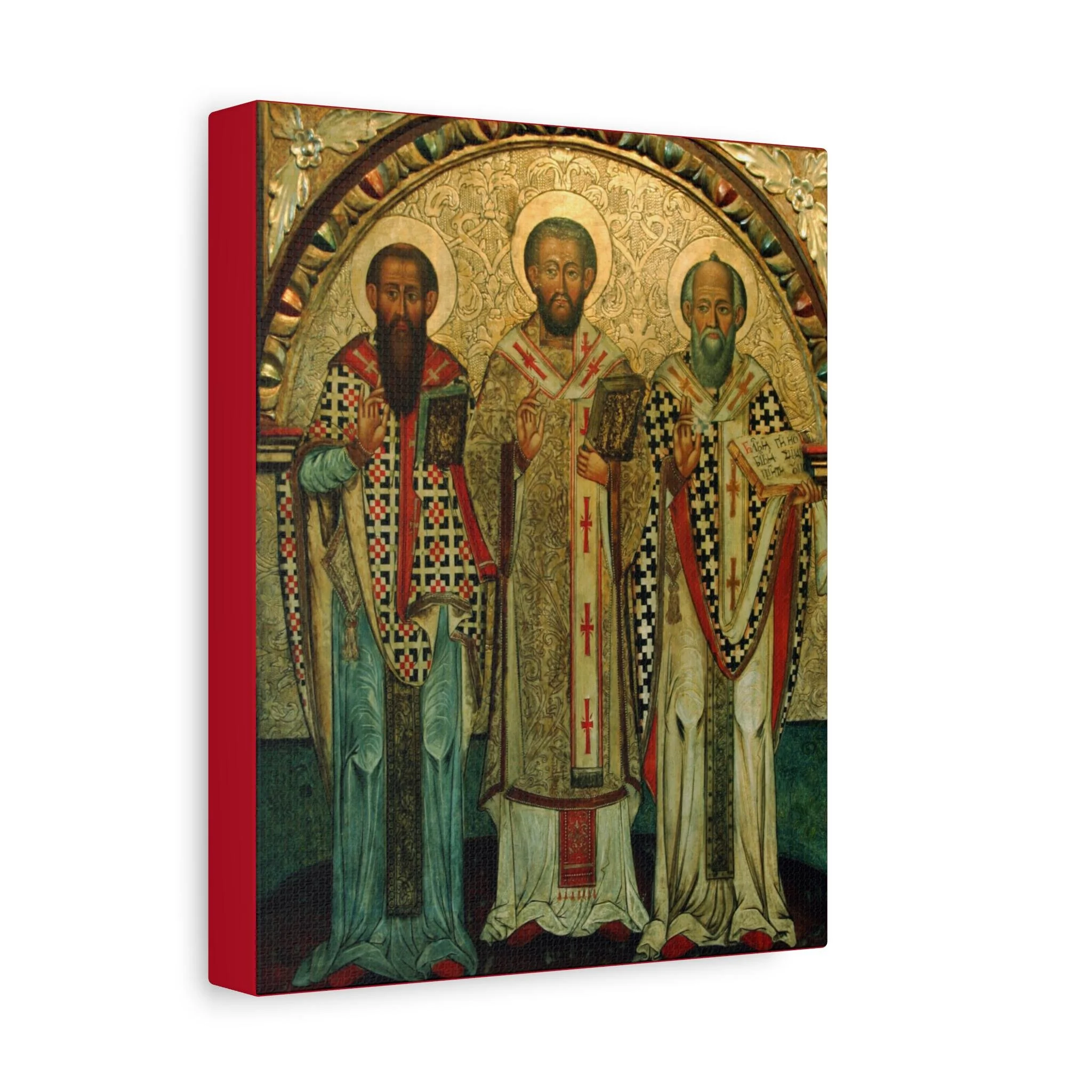
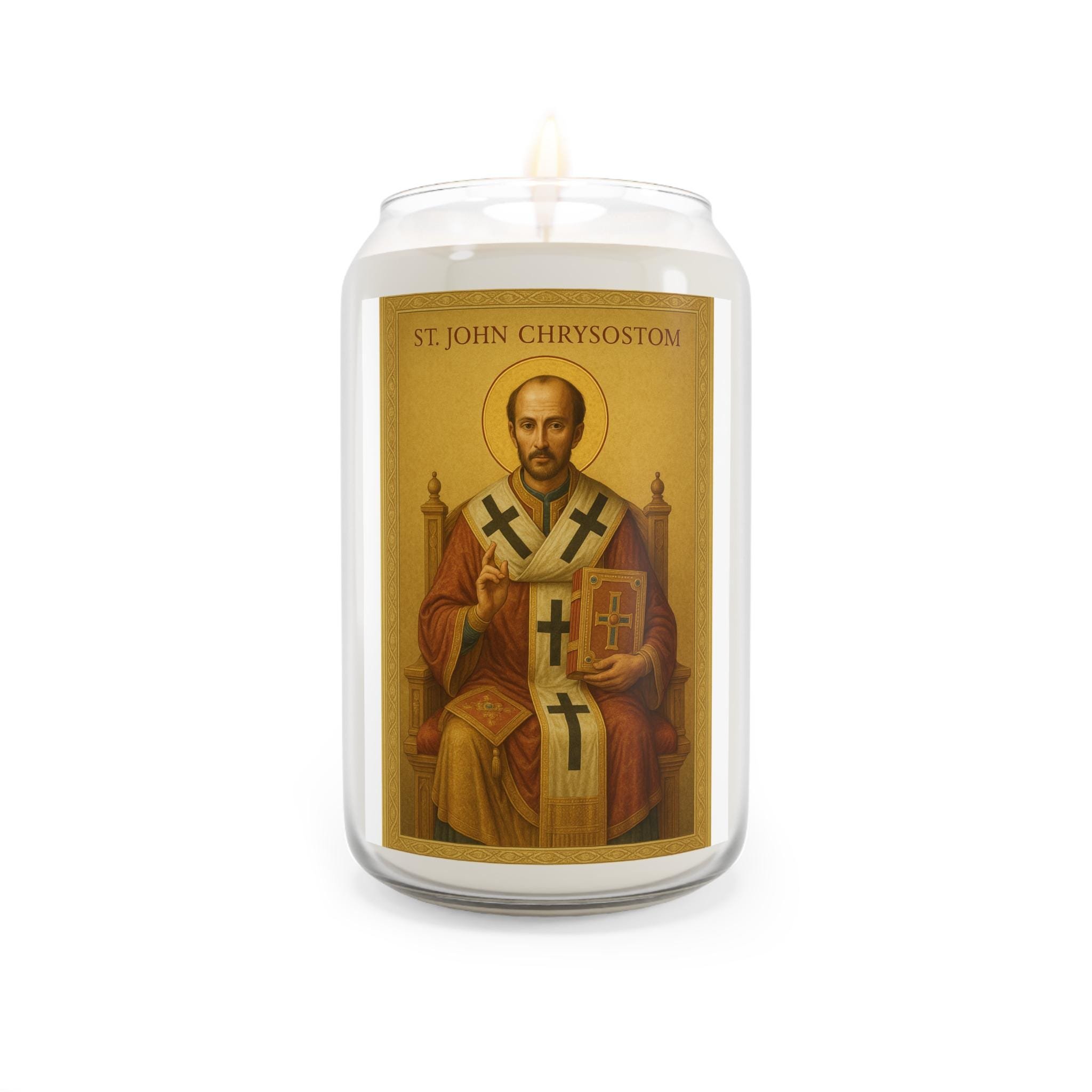
FAQ
Frequently Asked Questions About Saint John Chrysostom
The Mouth That Never Learned to Flatter an Empress.
Saint John Chrysostom could have had an easy episcopate. He had the eloquence, the classical training, and the imperial favor to build the kind of comfortable, undisturbed career that most bishops of his era settled for. Instead he sold off the luxuries of his own household to build a hospital, told wealthy women exactly what he thought of their vanity, sheltered a disgraced minister everyone else had abandoned, and told an empress the truth about a stolen vineyard when flattery would have cost him nothing. Every one of those choices built the case against him, piece by piece, until two exiles and a forced march through the mountains of Armenia finally finished what his enemies had started years earlier.
Ask his intercession. Say his prayer. Remember a preacher who left behind more words than almost any other man in the ancient Church, and who backed every one of them with a life that matched what he said from the pulpit.
Get the Saint John Chrysostom Prayer Card →