Make Your Home a Church: John Chrysostom on the Domestic Church
John Chrysostom • Marriage Theology • The Domestic Church • Eastern Christian Home
“Make Your Home a Church”: John Chrysostom’s Vision for Marriage, Prayer, and the Sacred Household
The Golden-Mouthed preacher of Antioch and Constantinople said it plainly in the fourth century: your home is not a place you go to rest from church. It is itself a church. Here is what he meant, why it matters, and exactly how he said to do it.
“Make your home a church. Where prayer is, and reading of divine Scripture, and psalmody, and thanksgiving, and pious conversations — there is nothing to prevent Christ from being present.”— Saint John Chrysostom, Homily XX on Ephesians, 4th century
This Article at a Glance
- The Quote
- From Chrysostom’s Homily XX on Ephesians — what he actually said, the Greek context, and the full passage most people never read
- The Theology
- Why a household becomes a church, what the phrase “domestic church” meant in the patristic tradition, and how it differs from private devotion
- The Practices
- Chrysostom’s specific instructions: morning and evening prayer, Scripture reading, psalmody, the icon corner, the role of fasting and hospitality
- Marriage Specifically
- What Chrysostom said directly to husbands and wives — his instructions for the wedding night, for daily life, and for building a marriage “stronger than any iron”
- Making It Practical
- How to actually begin — a simple rule for couples and families starting from nothing
- Resources
- Free marriage resources, prayer card, and devotional tools from The Eastern Church
The Full Quote — and What Most People Miss
Every marriage retreat, every Catholic and Orthodox wedding homily, every Christian marriage blog has encountered this line. Fewer have encountered what comes before and after it. The quote almost always travels alone, stripped of the context that makes it not just an inspiring aphorism but a practical theological program. What Chrysostom actually wrote in Homily XX on Ephesians is considerably more demanding — and considerably more beautiful — than the sound bite suggests.
The homily is an exposition of Ephesians 5, the passage about husbands loving their wives as Christ loves the Church. Chrysostom has just finished arguing that this is not a metaphor or a distant ideal but a precise prescription: the husband is to model his entire relationship with his wife on the relationship of Christ to the Body — self-emptying, sacrificial, concerned with her sanctification before her comfort. Then he turns to the household itself:
He continues: “Make your home a church. Where prayer is, and reading of divine Scripture, and psalmody, and thanksgiving, and pious conversations — there is nothing to prevent Christ from being present.” And then, in the same homily, comes the line that most people have never read: “Gather all your household together and make it a church. If the husband and wife are of one mind, their children will be brought up well, and their servants will be orderly, and their neighbors will be edified, and the Church will derive great benefit from them.”
The structure of this passage reveals everything. Chrysostom is not offering a metaphor. He is not saying that a devout home is like a church in the way that a sunset is like a painting. He is making a precise ecclesiological claim: that the Christian household, ordered around prayer and Scripture and mutual love in God, is a genuine expression of the Church — not a copy of it, not a training ground for it, but the thing itself present in domestic form.
The Greek he uses is kat’ oikon ekklesia — the church in the house, or the church according to the household. This is not Chrysostom’s invention. He is drawing on Paul’s own language. Romans 16:5 refers to “the church that is in their house.” Colossians 4:15 greets “the church in her house.” Philemon 1:2 addresses the “church in your home.” Chrysostom is retrieving and amplifying a category that Paul planted, one that had been partially eclipsed by the development of basilica Christianity but that he believed was essential to Christian life and could not be surrendered to institutions.
No pastoral figure in the first millennium of Christianity wrote about marriage and the home with more practical detail than Chrysostom. He was not a monk speculating about family life from a distance. He was a pastor — first in Antioch, then as Archbishop of Constantinople — who preached to thousands of married people every week and watched Christian marriages fail and flourish in real time. His theology of the domestic church is not abstract. It is the distillation of pastoral observation across decades. That is why it has never been superseded.
Part II
What Is the Domestic Church? The Theology Behind the Phrase
The word ekklesia in Greek means “assembly” — a gathering of people called out for a specific purpose. In the New Testament it refers to the Christian community gathered in the name of Christ. What is remarkable about Paul’s several references to the kat’ oikon ekklesia — the church in the house — is that he uses exactly the same word. Not a similar word. Not a diminutive or an analogy. The same word. The assembly in Priscilla and Aquila’s house in Rome (Romans 16:5) is described with the same term as the assembly of all the faithful. Paul did not appear to regard this as a category error.
For the first three centuries of Christianity, before the Edict of Milan and the construction of large public basilicas, most Christian worship took place in precisely these household settings. The kat’ oikon ekklesia was not a theological concept; it was the primary form of Christian assembly. A wealthy convert would open their home. The community would gather. The Eucharist would be celebrated. The Scriptures would be read. The bishop or presbyter would preside when present; the head of the household would lead when not. The home and the Church were, in these early centuries, structurally the same thing.
Chrysostom writes in the late fourth century, after Christianity has become public and basilicas have been built. But he is acutely aware that something has been lost in this transition. Large-scale public worship is glorious, he acknowledges. But it can also produce a passive Christianity — people who consume the liturgy as spectators and then return home to a household ordered by entirely non-ecclesial principles. His domestic church teaching is a deliberate corrective to this tendency. He wants the home to remain what the early church understood it to be: a genuine, active, responsible expression of the Body of Christ, not simply a rest stop between Sundays.
The Eastern Christian Tradition: The Home as Kingdom
In the Eastern Orthodox understanding, the theology of the domestic church is not primarily about religious practice in the home. It is about ontology: what the home actually is. The Orthodox rite of marriage — the crowning service — explicitly crowns the husband and wife as a king and queen entering a new kingdom. The priest places crowns on their heads (in the Greek tradition, crowns of glory; in the Slavic tradition, crowns of martyrdom — a point we will return to). The gospel reading from John 2, the wedding at Cana, signals that the couple’s household will be a place of divine presence and miraculous transformation, as Cana was.
This is not decorative language. The Eastern tradition means it literally: the Christian home is a kingdom, ordered by a covenant between the couple and God, in which the couple are responsible to God for what happens there — the formation of children, the care of the poor, the ordering of daily life around worship. Chrysostom’s domestic church theology is the patristic foundation of this liturgical vision. The wedding service enacts what he prescribed in his homilies.
Vatican II’s Recovery of the Term
In Western Catholic theology, the phrase “domestic church” had largely disappeared from use by the medieval period, replaced by a more institutional understanding of the Church. It was recovered at the Second Vatican Council, which in Lumen Gentium §11 described the family as the ecclesia domestica — the domestic church. The Council was quite deliberate in retrieving this term: the family “should be as it were the first school of social virtues that every society needs,” but more than that, the Christian family is “a church in miniature.” What Vatican II called new language was, in fact, Chrysostom’s language from the fourth century, recovered after fifteen hundred years.
The Eastern churches had never lost it. For Orthodox and Eastern Catholic Christians, the domestic church has always been the foundational unit of ecclesial life — the place where faith is first received, first practiced, and first handed on.
Part III
What John Chrysostom Actually Said About Marriage
John Chrysostom is sometimes misrepresented as hostile to marriage because of passages in his treatise On Virginity where he praises the celibate life. This misreading confuses what he says about the relative merits of two vocations with what he says about the dignity and demands of marriage itself. On marriage specifically, Chrysostom wrote with more pastoral warmth, more practical specificity, and more theological depth than almost any other figure in the patristic tradition. His vision of what a Christian marriage could be is, by any measure, extraordinarily elevated.
His most extended treatment appears in Homily XX on Ephesians — the same homily that contains the domestic church passage. He is commenting on Paul’s instruction that husbands are to love their wives “as Christ loved the Church and gave himself up for her” (Ephesians 5:25). What he draws from this is radical: the Christian husband is not just supposed to feel affection for his wife. He is supposed to pattern his entire relationship with her on the model of the Incarnation — the God who became a servant, who emptied himself, who died so that the one he loved could be transformed and made holy.
This is not gentle advice. Chrysostom is telling husbands that the measure of their love is the cross — that the willingness to sacrifice, to empty oneself, to subordinate personal comfort to the sanctification of the spouse is not an ideal to aspire to but a description of what Christian marriage actually is when it is functioning correctly. He is not naive about how far most marriages fall from this. But he refuses to lower the standard.
What He Said to Wives
Chrysostom addresses wives with equal directness, though from a different angle. His instruction to wives draws on Ephesians 5:22–24 (wives submitting to husbands as to the Lord), but he is careful to contextualize this within the same Christological framework. The wife’s submission, for Chrysostom, is not the submission of a servant to a master. It is the submission of the Church to Christ — which means it is voluntary, loving, oriented toward mutual sanctification, and entirely dependent on the husband first fulfilling his obligation to love as Christ loved.
More strikingly, Chrysostom addresses women directly and tells them that their husbands need their help to become the men that God requires them to be. He advises wives to create an environment of peace and beauty at home, not as an aesthetic preference but as a spiritual strategy — because a husband who comes home to chaos and resentment will become a worse husband and a worse Christian. The wife who manages the home as a place of rest and beauty is not performing a secondary role; she is performing the formative work that enables everything else.
The Most Famous Passage on Choosing a Spouse
In his treatise How to Choose a Wife, Chrysostom makes a claim that was startling in the ancient world and remains counter-cultural today: do not choose a wife for her wealth, her family connections, or her physical appearance. Choose her for her soul. He writes: “Of all those things which I have mentioned, God made none of them; He made only the soul. Let the soul be beautiful, and all those other things will follow in due course. But if the soul be not beautiful, then those other things will not avail at all.”
The practical implication he draws: a husband whose wife has a beautiful soul will find his home transformed into a place of peace, prayer, and genuine joy — which is to say, a domestic church. A husband who chose for wealth or beauty and neglected the soul will find his home a place of constant agitation, regardless of its material comforts. The domestic church begins, for Chrysostom, with the choice of spouse.
Free Marriage Resources from The Eastern Church
We have created free marriage books, devotionals, and workbooks rooted in the Catholic and Orthodox theology of marriage — including Chrysostom’s own vision of the domestic church. Download them free.
Get Free Marriage Resources →Part IV
The Wedding Night Sermon: What Chrysostom Said Should Happen First
Of all the things Chrysostom wrote about marriage, none is more unexpected to modern readers than what he advised should happen on the wedding night itself. Not, he says, what the wedding night typically looks like in his culture — which he describes with some exasperation: drunken parties, lewd songs, immodest dancing. He counsels instead something entirely different for the Christian household.
He advises that when the guests have gone and the husband and wife are alone together for the first time, the husband should take his wife’s hand and lead her in prayer. Together, before anything else, they should kneel and ask God to be the foundation of what they are beginning. Chrysostom even suggests specific language: “I have received this woman not out of lust, but in order that we may live our life in self-restraint and that we may find favor with Thee” — which he acknowledges is not a formula but a pattern, a declaration of intention addressed to God that transforms the beginning of the marriage from a private event into a covenant witnessed by heaven.
The point is not that physical intimacy is shameful or that the wedding night should be ascetic. Chrysostom is entirely positive about marital intimacy throughout his writings. The point is about the order of priority — about what comes first. A marriage that begins with prayer begins with the acknowledgment that what is happening is not merely a private contract between two people but an event that takes place in the presence of God and with God’s participation. That acknowledgment, made at the very beginning, sets the character of the entire marriage that follows.
For the couple to pray together at the beginning of their marriage, and at every new beginning:
“Lord, we come before You together at the beginning of this life. We do not ask You to remove its difficulties or guarantee its comfort. We ask only that You be its foundation — that the love between us find its root in You, grow toward You, and return to You. Make this house a church. Make our life together a prayer. And where we fail, be present in that failure as You were present in the tomb, so that what dies in us may also rise. Amen.”
Part V
The Five Practices Chrysostom Prescribes for the Domestic Church
Chrysostom does not leave the domestic church as an abstract concept. Across his homilies — particularly the Ephesians series, the Colossians series, and his various addresses on marriage and family life — he gives remarkably specific instructions for what the domestic church should look like in practice. Five practices recur with enough consistency to constitute a program.
1. Daily Prayer Together
Morning and evening prayer said together by husband and wife — not privately in separate rooms but as a household act. Chrysostom is specific: “Let there be a set time for prayer, a set time for psalms.” He argues that a couple who pray together daily cannot remain estranged from each other for long, because prayer opens the interior life in a way that ordinary conversation does not.
2. Scripture Reading Aloud
Regular reading of Scripture in the household — ideally from the passage being read at the liturgy that week, so that the home’s reading is in communion with the Church’s reading. Chrysostom addresses this especially to fathers, urging them to read the Scriptures to their children in a way that makes the characters of the Old and New Testament as vivid as contemporaries.
3. Psalmody
Singing psalms together in the household. Chrysostom is enthusiastic on this point: “Nothing so rouses the soul and gives it wings, nothing so takes it away from the earth and frees it from bodily chains as psalmody and sacred songs.” He recommends singing psalms at meals, at the beginning and end of the day, and when the household gathers for any purpose.
4. Hospitality to the Poor
The domestic church is not turned inward. Chrysostom is ferocious on hospitality — particularly the obligation to welcome the poor. “Do you wish to honor the body of Christ? Do not neglect it when it is naked. Do not honor it here in the church with silken garments while outside you leave it naked and numb with cold.” The poor person at the door is, for Chrysostom, Christ arriving at your domestic church for the Eucharist.
5. Spiritual Conversation
Husband and wife should speak to each other regularly about God, about Scripture, about the spiritual life — not only about household logistics and the concerns of work and family. Chrysostom identifies this as the distinguishing mark of a truly Christian marriage: “If you discuss spiritual matters with your wife, your home will be a church.” A home where God is a frequent, ordinary topic of conversation is already ecclesial, regardless of its material circumstances.
+ The Icon Corner
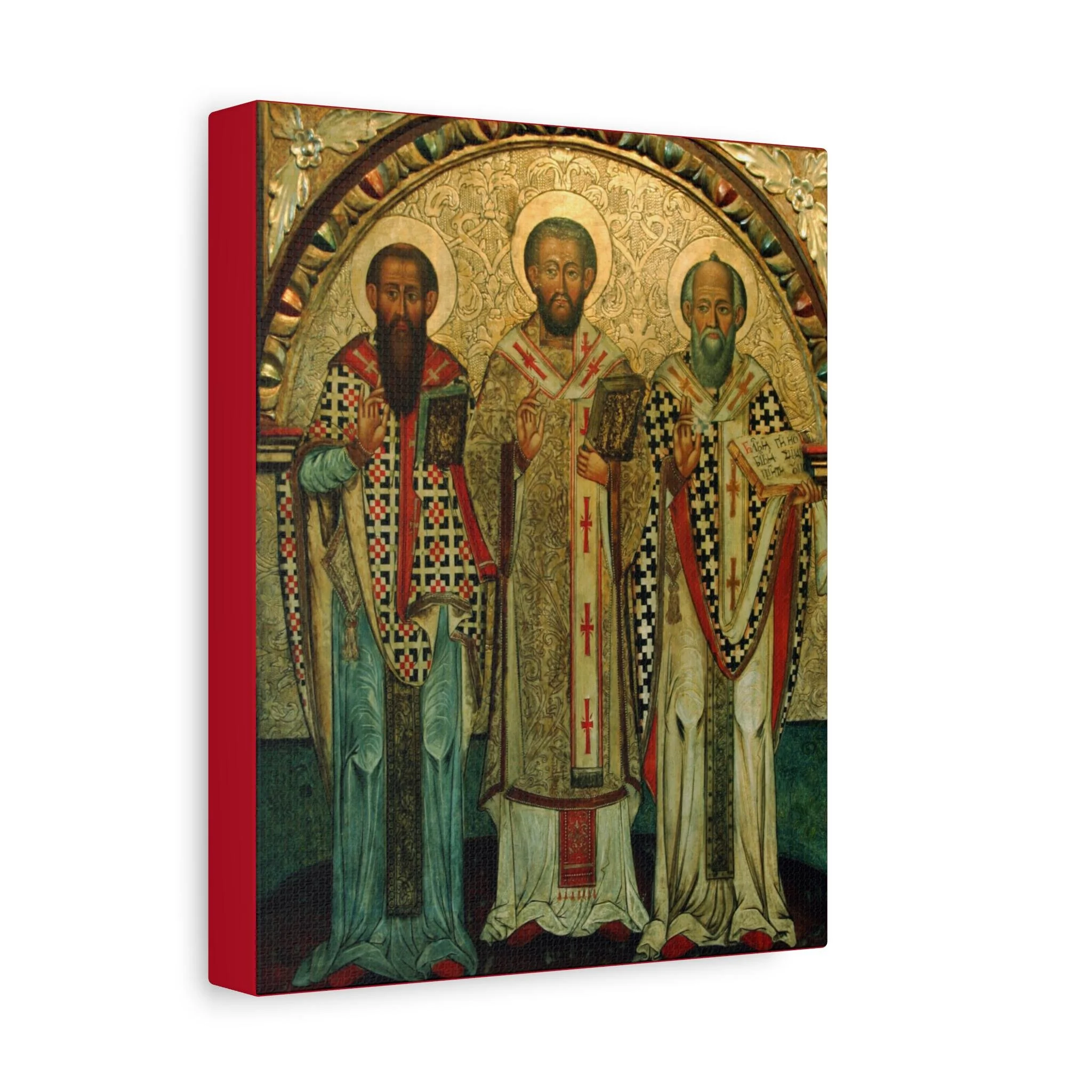
Chrysostom himself strongly recommends a dedicated place of prayer in the home — a physical space marked as sacred. The Eastern tradition developed this into the formal icon corner: a space on the eastern wall of the home where icons are kept, a lamp or candle burns, and the household gathers for prayer. This is the architectural embodiment of Chrysostom’s domestic church theology. (See Part VI for full treatment.)
Why These Five? The Logic of the List
It is worth pausing to notice what Chrysostom does not put on his list. He does not mention attendance at church, though he strongly promotes it elsewhere. He does not mention charitable giving, though he preaches about it constantly. He does not mention fasting, though he recommends it for couples. What he identifies as the constitutive practices of the domestic church are specifically household practices — things that must happen in the home because they cannot happen only in the church building. His point is not that the parish is unimportant. His point is that a Christianity that only expresses itself in the parish and has no domestic liturgical life is an incomplete Christianity — one that has abdicated half its proper territory.
The logic is straightforward: the Church on Sunday forms Christians for an hour. The domestic church forms them for the other 167 hours of the week. A church without a domestic church is a program running in a container that undermines it the moment people go home. Chrysostom wanted Christian households to be, as he puts it, “the school from which children go forth to the Church” — not a place where the formation received in church is undone by a household ordered entirely around non-ecclesial values.
Part VI
The Icon Corner: Sacred Space at the Heart of the Home
Of all the practices that Eastern Christianity developed from Chrysostom’s domestic church theology, none is more visually immediate or more theologically dense than the icon corner. In Russian, it is called the krasny ugol — the beautiful corner, or the red corner, since the word krasny means both beautiful and red in Old Slavonic. In Greek homes it is the proskinitari — the place of veneration. In both traditions the structure is similar: a dedicated space, typically on the eastern wall or in the eastern corner of the main room, where icons are arranged, a lamp or candle burns (the oil lamp in the Orthodox tradition is ideally kept burning continuously or lit during prayer), and the household gathers to pray.
Chrysostom himself does not describe an icon corner in the developed form it later took — that form came after the resolution of the iconoclast controversy in 843 AD. But he is emphatic that the Christian home should have a physical space marked as sacred, a point where the sacred geography of the home is made visible. His language about “making your home a church” is not only about practice; it is about the space itself being ordered to signal divine presence. The icon corner is the architectural enactment of his theology.
What to Put in an Icon Corner
The classical arrangement begins with Christ at the center — typically an icon of the Pantocrator (Christ as ruler of all) or the Theotokos holding the Christ child — flanked by icons of the patron saints of the household members. For a married couple, this means an icon of each spouse’s patron saint, and often an icon of the patron saint of the family (if the couple has chosen one). For families with children, the children’s patron saints are added as each child is named. The corner becomes, over the years, a visible record of the household’s spiritual community — the saints who pray for this specific family, arranged together in perpetual intercession.
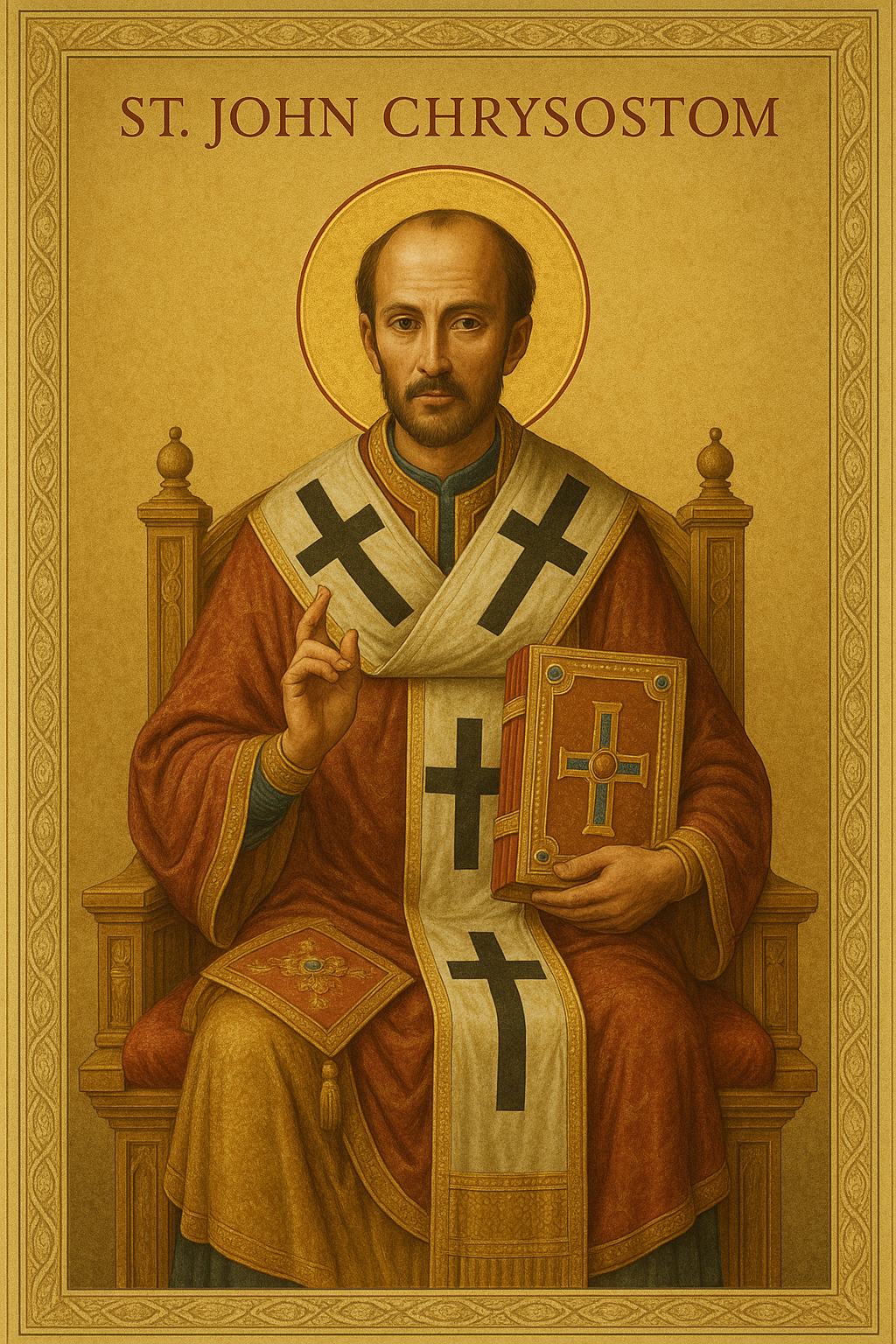
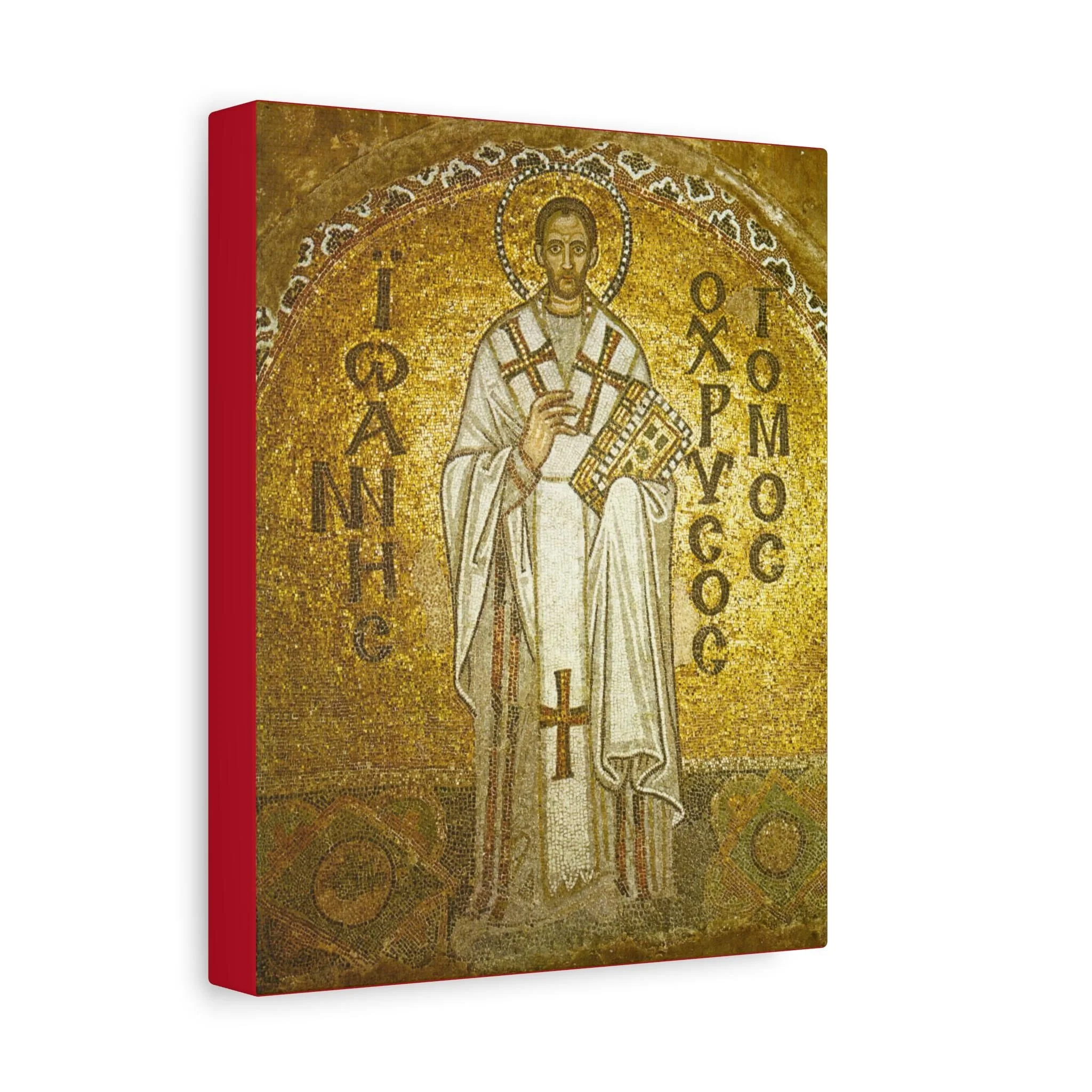
A Chrysostom icon or prayer card has a particular appropriateness in the domestic church corner. He is the saint who articulated this theology most completely and most practically. His presence in the icon corner is a reminder of the program he prescribed and the standard to which he held Christian households accountable.
How to Begin the Icon Corner: A Simple Starting Point
The icon corner does not need to be elaborate to be real. Chrysostom explicitly says that a poor household with a single icon and a shared prayer is already a domestic church. The minimal starting point: one icon of Christ or the Theotokos, placed on a wall in the room where the family spends the most time, with a candle that is lit during prayer. That is enough. The corner grows over time as the family grows, as patron saints are identified, as icons are received as gifts. The point is to begin — to mark the home as a place where God is acknowledged as present, not merely visited on Sundays.

Part VII
The Jesus Prayer and the Domestic Church: Ceaseless Prayer in the Home
Chrysostom recommends in several places that Christians never let the name of Christ be absent from their lips — a practical implementation of Paul’s instruction to “pray without ceasing” (1 Thessalonians 5:17). In the fourth century, when Chrysostom was writing, the specific form of prayer that would become the Jesus Prayer was still developing. But the substance of his recommendation is identical to what the hesychast tradition later formalized: a short prayer, rooted in the invocation of the Holy Name, repeated continuously as the breath of the interior life.
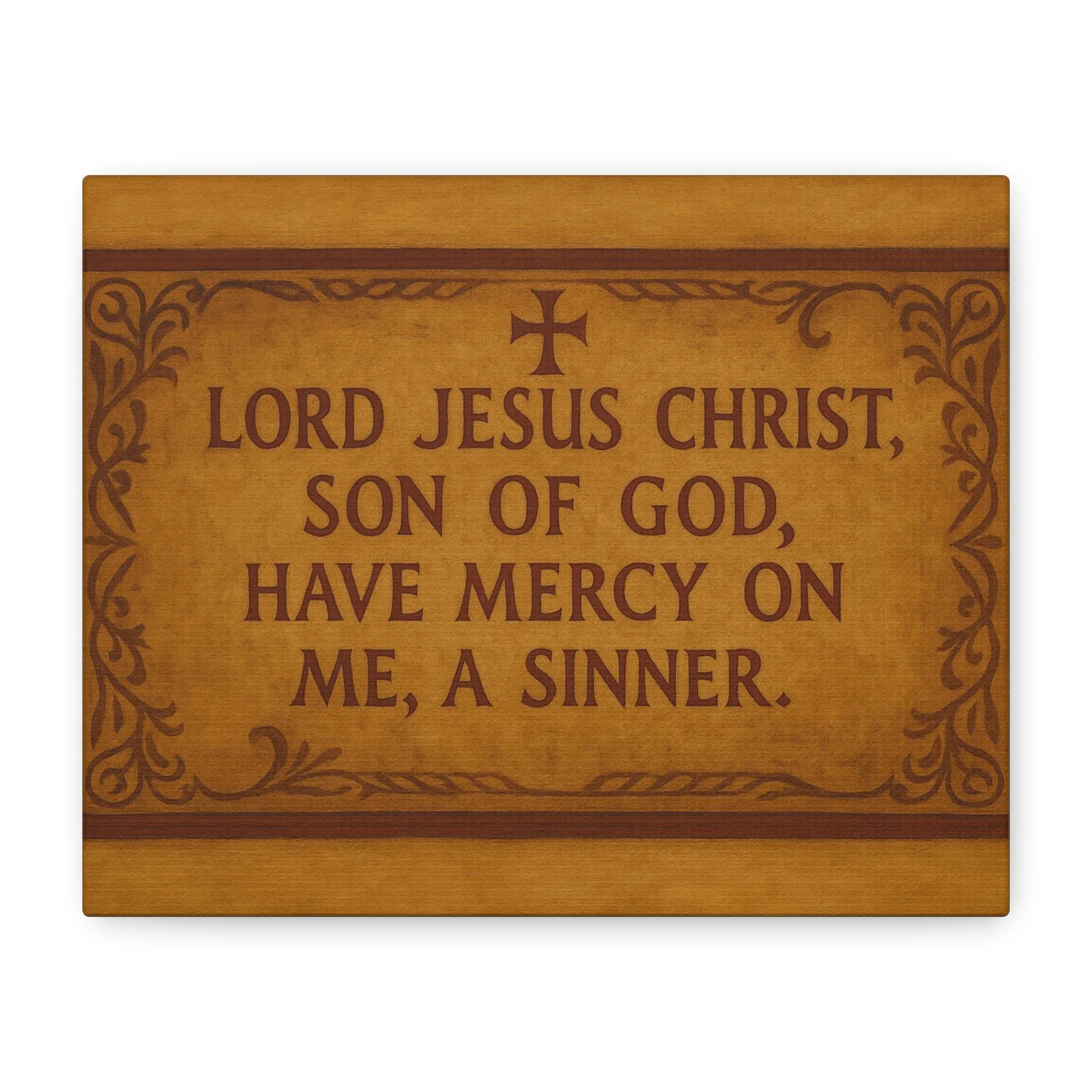
The Jesus Prayer — “Lord Jesus Christ, Son of God, have mercy on me, a sinner” — is the practical instrument by which the domestic church extends beyond the morning and evening prayer rule into the rest of the day. A husband and wife who say the Jesus Prayer individually, who use the prayer rope as a physical aid to continuous prayer, carry the domestic church with them into their workday. The home remains a church even when no one is in it, because the people who made it a church are still praying.
For couples beginning a prayer life together, the Jesus Prayer is often the most accessible entry point precisely because of its brevity. It can be said while making coffee. It can be said during a commute. It can be said in the night during insomnia. It requires no preparation, no private space, no uninterrupted time. It is the prayer that fits inside whatever life you have — which is why the Eastern tradition has always understood it as the prayer for those who want to pray always but cannot always stop to pray formally.
“Lord Jesus Christ, Son of God, have mercy on me, a sinner.”
The prayer of the Eastern Christian tradition • Rooted in Luke 18:13 and the invocation of the Holy Name • The fulfilment of 1 Thessalonians 5:17
Part VIII
Other Church Fathers on the Domestic Church
Chrysostom is the most detailed and the most frequently quoted voice on the domestic church, but he is not alone. The vision he articulates is part of a patristic consensus that spans East and West, Greek and Latin, the second century through the fifth. Several other Fathers deserve mention.
Tertullian (c. 155–220 AD): The Earliest Extended Treatment
Writing around 200 AD, more than a century before Chrysostom, Tertullian in his treatise To His Wife describes the Christian marriage with language that anticipates Chrysostom almost exactly. He describes a couple who pray together, fast together, teach each other Scripture, encourage each other toward holiness, and welcome the poor — and asks, “Where two are gathered together in Christ’s name, there is He in the midst of them, and where He is, there is no evil.” The domestic church is already fully present in Tertullian. Chrysostom is building on a foundation already laid.
Saint Basil the Great (330–379 AD): The Home as School of Virtue
Chrysostom’s great contemporary and fellow Cappadocian, Saint Basil the Great, approaches the domestic church from the direction of virtue formation. In his Longer Rules and in several of his letters, he argues that the household is the primary school of virtue — the place where the virtues of patience, humility, generosity, and temperance are first learned, through the unavoidable friction of life with other people. Marriage is, for Basil, a kind of monasticism for those not called to formal monastic life: a long school of self-transcendence, ordered by love and sanctified by commitment.
Saint Gregory Nazianzen (329–390 AD): The Theologian on Married Holiness
Gregory Nazianzen, the great theologian of the Trinity and Chrysostom’s elder, wrote touchingly about the marriage of his own parents — Gregory the Elder and Nonna — as a model of the domestic church. His mother Nonna was a Christian who married a pagan and, through the holiness of her household, converted both her husband and then her son. Gregory describes her as the “church of the household” in a way that suggests he understood the domestic church as sometimes residing in a single faithful person whose prayer holds the household together until others find their way.
Saint Augustine (354–430 AD): The Western Voice
Augustine’s Confessions is, among other things, a sustained meditation on the domestic church from which he came — and the domestic church that failed to form him. His mother Monica is the saint of his household, whose prayer spans thirty years and finally reaches him in Milan. His account of his own formation is a case study in the domestic church working through a single faithful spouse and parent, against enormous resistance, over an almost impossibly long period. Augustine’s reflection on Monica is the proof that Chrysostom’s program works even in imperfect conditions — that the domestic church can hold even when one member of the household has not yet been reached by it.


Part IX
How to Begin: A Simple Rule for Couples Starting from Nothing
Chrysostom is famously direct about the excuse of complexity. When people in his congregation told him they were too busy, too tired, too undisciplined to maintain a prayer life at home, his response was not sympathy. It was the same response he gave to every objection: begin. Not with the complete rule. Not with the full icon corner. Not with the daily Scripture reading schedule and the fasting calendar. Begin with one thing, and let one thing become two.
For couples starting from nothing, the following sequence builds a genuine domestic church over twelve weeks without requiring dramatic upheaval of existing routines.
Weeks 1–2: One Prayer, Together, Once a Day
Choose morning or evening (not both). Stand or kneel together before whatever icon or cross you have in your home. Say the Our Father together. That is the entire rule for two weeks. The purpose is not to accomplish a spiritual program; it is to establish the habit of standing before God together at least once every day. Nothing else matters yet.
Weeks 3–4: Add a Saint and a Candle
Choose a patron saint for your household — a saint whose life speaks to both of you, or the patron saint of your parish, or the saint whose feast day falls nearest your wedding anniversary. Add their prayer card or icon to the space where you pray. Light a candle when you pray. Now your corner is taking shape. Your prayer becomes: Our Father, then the troparion or short prayer of your patron saint. Five minutes, together, once a day.
Weeks 5–6: Morning and Evening
Add the second prayer time. Morning: upon rising, before anything else, a brief gathering before the icon. Evening: before sleep. These need not be long — three minutes each is sufficient at this stage. The point is the rhythm, the twice-daily acknowledgment that this household begins and ends its day in the presence of God.
Weeks 7–9: Add Scripture
Once the prayer rhythm is stable, add one Scripture reading per week. Sunday evening is the natural time: read the Gospel passage that was proclaimed at that morning’s liturgy. Sit together. Read it aloud. Discuss it for five minutes. This is Chrysostom’s “pious conversation” practice in its simplest form. It takes the word that was planted at church on Sunday and lets it grow through the week at home.
Weeks 10–12: The Jesus Prayer and Fasting
Begin the Jesus Prayer — individually, throughout the day — as the connective tissue between the morning and evening rule. And consider observing one of the Church’s fasting days together: Wednesday or Friday, or both. Chrysostom specifically recommends that married couples fast together occasionally, not as a spiritual competition but as a practice that “tempers the appetite and sharpens the soul.” By the end of twelve weeks, you have a domestic church: a household with a prayer rule, a patron saint, a sacred space, a Scripture practice, ceaseless prayer through the day, and an occasional shared fast. Chrysostom would recognize it immediately.
In the morning, before the day begins:
“O Lord our God, we rise from sleep and come before You — we who are one household, made one by Your grace. This day belongs to You. Bless what we do in it. Protect us from what would harm us. Keep us kind to each other when we are tired, generous when we are depleted, honest when it costs something. And bring us back to this place tonight, together, to give You thanks for the day You gave us. Lord Jesus Christ, Son of God, have mercy on us. Amen.”
Take the Next Step: Free Marriage Resources
We have created free books, devotionals, and couples’ workbooks built on exactly this theology — Chrysostom’s vision of the domestic church in practical form. From marriage prep to the 30-day devotional to the free Catholic marriage workbook for couples, everything we offer is free to download.
Download Free Marriage Resources →Frequently Asked Questions
“Make Your Home a Church” — Questions & Answers
Your Home Is Already a Church. Chrysostom Just Wants You to Know It.
The theology of the domestic church does not ask you to build something that does not yet exist. It asks you to recognize what Christ’s presence has already made of your home — and to live accordingly. The morning prayer, the icon on the wall, the psalm before dinner, the word of Scripture read aloud on Sunday evening: these are not additions to ordinary life. They are ordinary life, lifted into the presence of God where Chrysostom insists it already belongs.
The man who said “make your home a church” was not describing a program. He was describing a reality. A household ordered around prayer and love and the word of God is already the Church in miniature — already the place where Christ is present, already the school where the next generation of Christians is being formed, already the first answer to whatever is wrong with the world. Your home. This one.
Get Free Marriage Resources →