Maximus the Confessor on Marriage & Theosis
Eastern Orthodox • Byzantine • c. 580–662 AD • Feast: January 21 (East) • August 13 (West)
Maximus the Confessor on Marriage, Theosis, and the Bridal Union of the Soul with Christ
He described the soul's union with God in language so intimate it sounds like a wedding night. He used the word "lie" — to lie with the Bridegroom Word, in the chamber of the mysteries. He was the greatest theologian of the Byzantine age, and what he said about love, the body, and the deification of the whole person has been quietly transforming how Eastern Christians understand marriage for fourteen centuries.
At a Glance
- Born
- c. 580 AD, Constantinople (Byzantine Empire)
- Died
- 662 AD, Lazika (modern Georgia), after torture
- Tradition
- Eastern Orthodox; formally canonized; venerated by Eastern Catholics; called "father of Byzantine theology"
- Title "Confessor"
- He suffered for the faith — tongue cut out, right hand amputated — for defending orthodox Christology against the Monothelite heresy
- Major Works
- Ambigua; Questions to Thalassius; Chapters on Love; Mystagogy; Two Hundred Chapters on Theology
- On Marriage
- Valid, holy path to God; not evil; subordinate to celibacy in rank but not in dignity for those called to it
- On Theosis
- The soul's genuine participation in divine life through grace — achieved through love, sacraments, and the whole person's transformation
- Key Bridal Passage
- Two Hundred Chapters on Theology 1.16 — the soul "made worthy to lie with the Bridegroom Word in the chamber of the mysteries"

The Question Marriage Poses to Theology
Every married couple in the Eastern Christian tradition has stood before an altar and received a crown — not a flower crown or a symbolic gesture, but an actual crown, a stephanos, the crown of martyrdom and of royal dignity, placed on their heads by a priest who calls them king and queen of their household, co-heirs of the kingdom, companions in the unending life. The crowning is the central act of the Byzantine marriage liturgy, and it is not metaphorical. The Church means it.
And then the couple goes home. They do dishes. They argue about money. They get sick, they get tired, they get on each other's nerves. They have children who wake them at 2 a.m. and grown children who break their hearts. The royal dignity of the crowning and the daily reality of a shared life occupy such different registers that most couples — even devout, practicing, deeply faithful couples — never quite find the theological bridge between the two. The Church tells them their marriage is sacred. They believe it, mostly. But they lack the vocabulary to articulate what that actually means, and why, and what it demands of them beyond fidelity and kindness.
Maximus the Confessor — the 7th-century Byzantine monk, theologian, and martyr who is widely regarded as the greatest theological mind the Eastern Church produced between Origen and Palamas — offers part of that vocabulary. Not in a treatise on marriage, because he never wrote one. But in the structure of his entire theological vision: his account of what the soul is made for, what God made flesh means for all flesh, what love actually is and does in the person who practices it, and why the soul's deepest union with God is described, in his most intimate language, in bridal terms. To read Maximus on these questions is to find the theological ground beneath the crowning. It is to discover why the Church was not exaggerating.
The Man and His World
Who Is Maximus the Confessor?
Maximus was born in Constantinople around 580 AD, probably into an aristocratic family, and received the thorough education in Greek philosophy and rhetoric available to young men of his class in the late Byzantine world. He served, briefly, as the first secretary to Emperor Heraclius — a position of real political prominence. Then he left the imperial court and entered the Monastery of Chrysopolis, across the Bosporus from Constantinople, as a simple monk.
He spent the following decades in a kind of theological wandering that tracks the crises of his era. The Persian invasion of Palestine in 614 drove him west. He was in Carthage (North Africa) for years, developing his mature theology in conversation with the greatest minds of the African and Eastern church. He spent time at the Monastery of St. Sabbas in Palestine — the same monastery where, two centuries later, the monks would translate Isaac the Syrian from Syriac into Greek. He was never a bishop, never an abbot with administrative authority over a large community. He was, at his core, a theologian and a monk — a man who thought, prayed, and wrote with extraordinary precision and depth.
What made him a "Confessor" — someone who suffered for the faith without martyrdom — was his stand against Monothelitism, the 7th-century imperial heresy that taught Christ had one will rather than two (divine and human). Monothelitism was politically convenient: it was designed to reunite factions of the empire that had split over Christology. Maximus opposed it with everything he had, because he understood that if Christ had only a divine will, then human nature was not truly united to God in the Incarnation — it was overridden, suppressed, evacuated. And if human nature was not truly united to God in Christ, then theosis was impossible. The whole structure of Eastern Christian salvation collapsed.
For this, at the age of approximately 80, he was tried, condemned, mutilated — his tongue was cut out, his right hand was amputated — and exiled to the Caucasus, where he died in 662. He is called Confessor because he suffered everything short of execution in defense of what he believed. The title marks a specific kind of courage: not the heroism of a single moment, but the sustained refusal, across years of pressure and pain, to say something you know is false.
Maximus lost his tongue and his hand rather than concede that Christ had only one will. The reason this matters for a theology of marriage is not incidental. His insistence that Christ possessed a genuine human will — that human nature was not dissolved but perfected in the Incarnation — is the theological ground for everything he says about the body, about flesh, about the sanctification of human life in all its forms.
If Christ's humanity was real — if he really willed as a human, really suffered as a human, really united genuine flesh to genuine divinity — then all human flesh, all human love, all human union is capable of being elevated and sanctified by grace. If his humanity was only apparent, then the body is ultimately irrelevant to salvation, and marriage is simply a concession to weakness.
Maximus paid with his body to establish that the body matters. That is the theological foundation of everything that follows.
The Goal of Christian Life
Theosis: What Eastern Christians Mean by Salvation
The word "theosis" — from the Greek θέωσις, deification or divinization — names what Eastern Christianity understands as the ultimate goal of human existence. It is not primarily about forgiveness, nor about escaping punishment, nor about meeting a legal requirement. It is about becoming, through grace, what God is by nature: fully alive, fully united to the divine life, transformed from the inside out into the likeness of Christ. The formula comes from Athanasius: "God became human so that humans could become god." Maximus inherits this formula and develops it into the most elaborate and rigorous account of theosis in the entire patristic tradition.
What theosis is NOT is equally important. It is not absorption into God — the annihilation of the human person in a divine ocean, as in some Eastern religious philosophies. Maximus is precise: the human being does not become God in essence (which is impossible), but participates genuinely in God's life through grace. The technical language is "perichoresis" — interpenetration — and it draws directly on the theological vocabulary Maximus used to describe the union of two natures in Christ. Just as Christ is fully human and fully divine without confusion and without mixture, so the deified person is fully human and fully united to God, with neither nature dissolved into the other. This matters enormously for a theology of marriage, as we will see.
Theosis, for Maximus, is not a private achievement. It is not the reward of the lone mystic on the mountaintop who has finally gotten away from everyone. This is one of his most insistent emphases in the Chapters on Love: the path to deification runs through love of neighbor, through the community, through the concrete relationships of ordinary life. "He who loves God loves his neighbor as well," Maximus writes. And then, further: a person who has abandoned or neglected the neighbor in pursuit of mystical experience has not advanced toward God but away from God. Theosis happens through love — and love, by definition, requires someone to love.
The stages of theosis in Maximus are usually described as three: praktike (the practical life of virtue, which disciplines the passions and redirects desire toward God), theoria (contemplation, the direct perception of God in created things and ultimately in God himself), and theosis proper (the final union, the entry into divine life that transfigures the whole person). These stages are not sharply sequential — they interpenetrate and loop back on each other — but they provide a useful map of the spiritual landscape.
What is crucially important for the theology of marriage is where Maximus locates the engine of the whole process. It is love. Not just divine love descending on the soul, but human love — properly directed, properly purified — as the active principle of transformation. In the First Century of Various Texts, Maximus writes that humanity was made to be a "partaker of the divine nature" through "deification by grace." The means of that partaking is love. And love is learned, above all, in relationships.
The Central Text
The Bridal Passage: What Maximus Actually Says
There is a passage in Maximus's Two Hundred Chapters on Theology and the Economy of the Incarnation that has been, for fourteen centuries, one of the most quietly arresting sentences in all of Eastern Christian mystical literature. It appears in the sixteenth chapter of the first century, embedded in a chain of spiritual progression:
In an alternate formulation from the same work, Maximus sharpens the language further: the illumined person is "made worthy to lie with the Bridegroom Word in the chamber of the mysteries." The word he uses — the Greek behind "lie with" — carries deliberate intimacy. This is not the language of audience, of approach, of reverent distance. It is the language of union, of shared bed, of the consummation of a marriage. Maximus means it.
To read this passage properly, several things must be understood. First: the "Bridegroom Word" is Christ, the divine Logos, the second Person of the Trinity incarnate. The imagery comes from a long scriptural and patristic tradition rooted in the Song of Songs, in which the relationship between God and the soul, or God and the Church, is described in the language of passionate love between a bridegroom and a bride. Maximus is using this tradition, but with his characteristic technical precision.
Second: the "chamber of mysteries" is the sacramental life of the Church — the liturgy, the Eucharist above all, baptism, the whole economy of the Church's sacred rites. The union with the Bridegroom Word happens not in a private interior experience disconnected from the community, but precisely in and through the Church's liturgical and sacramental life. The Eucharist is, for Maximus, the point of encounter: where the soul receives Christ's body and blood and is genuinely incorporated into his divine life.
Third — and this is the theological precision point that requires honest emphasis — the bridal union Maximus describes here is metaphorical, in the specific sense that it is about the soul's mystical union with Christ. It is not primarily a statement about literal marriage. Maximus's bridal imagery belongs to the tradition of mystical and ascetic writing (rooted in Origen's commentary on the Song of Songs, taken up by Gregory of Nyssa, and developed throughout the Syriac and Greek patristic world) in which the soul itself is the bride, and Christ is always the bridegroom.
The bridal passage is about the soul and Christ — not directly about husband and wife. To say otherwise would misread Maximus. But this is not a retreat from its significance for marriage. It is the opposite.
Maximus is using marital union as the highest possible theological metaphor for the soul's relationship with God. When he wants to describe the deepest, most intimate, most complete form of union between a human person and the divine, the image he reaches for is the marriage bed. He does not reach for a throne room, a battlefield, or even a feast. He reaches for the intimacy of the bridal chamber.
What this implies for actual marriage is profound: if marital union is the closest human analog to the soul's union with God, then marriage is not merely a domestic arrangement blessed by the Church. It is the earthly icon of the soul's ultimate destiny. Every act of faithful, self-giving love between a husband and wife is, in this theological framework, not just good human behavior — it is a participation in the very movement of the soul toward its divine Bridegroom.
The Direct Teaching on Marriage
Marriage in Maximus: The Honest Picture
Maximus's direct statements about literal marriage are more restrained than his bridal imagery might initially suggest, and intellectual honesty requires acknowledging this plainly before drawing theological conclusions. In his most systematic treatments, Maximus places marriage within the postlapsarian economy — the order of human life as it exists after the Fall. In a passage from his Questions and Answers (commenting on Psalm 50:5), he states that God's original intention for humanity did not include "birth through marriage" in the form we know it — that the mode of corruptible generation through pleasure and pain entered human existence with Adam's transgression.
This sounds harsh to modern ears, but it must be understood in the context of his cosmology. Maximus is not saying marriage is sinful or evil. He is saying it belongs to a particular mode of human existence — the tropos, as he calls it (the "how" of our being) — that is different from the original logos (the "what" or essential purpose God intended). The Fall altered the mode of human life; it did not alter its essential goodness or its ultimate vocation. And Christ, by taking on that mode — being born of a woman, entering the economy of bodily human life — has already begun to redeem and transform it from within.
His clearest positive statement about marriage comes in Chapters on Love III.4, where he applies his characteristic ontological grammar: "Not the begetting of children but unchastity is evil." The principle is the same one he applies throughout his ethics: created things are good; their misuse is what becomes sinful. Food is not evil, gluttony is. Money is not evil, avarice is. Procreation is not evil, fornication is. Marriage, as the proper context for sexual union ordered to procreation and mutual love, is not only permitted but defended — emphatically, against any suggestion that the body, generation, or conjugal life is inherently incompatible with holiness.
Maximus ranks celibacy above marriage as a spiritual path — because undivided, unencumbered orientation toward God is, in pure theory, more directly ordered to theosis. This is the consistent Eastern patristic position. But ranking is not the same as dignity. A skilled doctor who serves the sick is ranked differently than a contemplative monk in terms of explicit God-focus, but both vocations have immense dignity, and both can lead to holiness. Maximus's theology of love and incarnation provides deep theological grounds for the dignity of marriage, even as he acknowledges that it is not the "higher" path. The higher path and the holier person are not the same thing.
Both Paths Lead to Tabor
Moses and Elijah: The Transfiguration and Two Ways of Life
One of the most illuminating passages in Maximus for understanding his view of marriage is found in his commentary on the Transfiguration of Christ in the Ambigua (Ambigua ad Iohannem 10). On the mountain, Christ is transfigured and speaks with Moses and Elijah. Two great prophets; two very different life histories. Moses was married — he had a wife, Zipporah, and children. Elijah was celibate, a solitary man who lived in the wilderness. Yet there they stand together, side by side, at the very moment of the revelation of Christ's divine glory.
Maximus does not miss the significance. He writes that the Lord, by revealing both Moses and Elijah to the apostles, was initiating them into "the mysteries of marriage and of celibacy" — showing that both ways of life, properly lived, lead to the same destination: the presence of the transfigured Christ. Moses, he notes with care, "was not prevented by marriage from becoming a lover of divine glory." Marriage was not an obstacle to Moses's encounter with God. It was the context in which Moses, by living faithfully and virtuously, became the kind of person who could stand on the holy mountain and speak with the Lord of glory face to face.
This is not a minor concession. It is a theological affirmation: the married life, governed by reason and unfolding according to divine laws, by virtuous living, is a genuine path to the vision of God. Celibacy is not the only road to Tabor. Both paths are steep; both require virtue, discipline, and the purification of love. But both arrive at the same summit.
"Moses was not prevented by marriage from becoming a lover of divine glory."
— Maximus the Confessor, Ambigua 10"Food is not evil, but gluttony is. Childbearing is not evil, but fornication is. Money is not evil, but avarice is."
— Maximus the Confessor, Chapters on Love III.4"He who is purified is illumined; he who is illumined is made a consort of the divine Bridegroom and Logos in the shrine of the mysteries."
— Two Hundred Chapters on Theology 1.16"Theosis is the fruit of love — and love necessarily precludes neglect of neighbor."
— Chapters on Love, Maximian synthesisGod Took Flesh
The Incarnation and the Sanctification of the Body
The incarnation is not a peripheral doctrine for Maximus — it is the axle on which his entire theology turns. God becoming human in Christ is not a rescue operation performed from a safe distance. It is, in Maximus's reading, a total and irreversible entry of divine life into human flesh — into a genuinely human body, with a genuinely human will, subject to hunger and fear and suffering and death. What God enters, God sanctifies. What God takes up, God transforms. And what God takes up in Christ is everything: not just the soul, not just the spiritual faculty, but the whole human person, body included.
This has radical implications for how Maximus understands theosis. In the West, particularly in some strands of medieval and post-Reformation spirituality, salvation tends to be understood in terms of the soul — its forgiveness, its purification, its journey to God — while the body is often treated as an afterthought, a vehicle that will eventually be left behind. Maximus will have none of this. In his careful reading of the Incarnation, the body is not the problem; the disordered use of the body is the problem. Theosis is not the soul escaping the body but the whole person — soma and psyche together — being transformed and united to God.
He describes the deified state in one of his most striking images: being "united to God made flesh, like the soul united to the body, wholly interpenetrating it in an unconfused union." This is perichoresis — the mutual indwelling of natures without confusion or dissolution — and he uses the soul-body union of the human person as the analogy for the divine-human union in theosis. The two are so bound together, so fully each other's, that they cannot be separated — and yet each remains entirely itself.
Now apply this to marriage. If the soul-body union of the individual person is Maximus's analogy for theosis, then the union of husband and wife — which the New Testament describes using the same language ("the two shall become one flesh") — is itself participating in the very structure of reality that theosis enacts. A married couple's bodily, spiritual, emotional, and practical union is not peripheral to their spiritual life. It is not the "worldly" part of their life that happens before and after the spiritual part. It is, potentially and in God's intention, a form of that perichoretic union — two persons becoming fully each other's while each remaining fully themselves — that reflects and participates in the union of the soul with God.

The Engine of Theosis
Love as the Heart of Theosis — and of Marriage
The Chapters on Love — the Four Centuries on Charity that Maximus wrote as his most practically oriented work — opens with a definition: "Love is a holy state of the soul disposing it to value knowledge of God above all created things." This sounds, at first reading, like a somewhat cold and intellectual account of love. It is not. What Maximus means is that love, properly understood, is not primarily a feeling — a warm emotion that comes and goes — but an orientation of the entire person toward God as the ground and source of all reality. It is what happens when desire, which is natural to the human person, gets directed toward its proper object instead of toward substitutes and distractions.
This is where Maximus is most insightful and most demanding. He does not condemn desire — he would never do that, given his robust defense of the goodness of created nature. What he teaches is that human desire — including erotic desire, including the longing for intimacy and union that marriage exists to satisfy — is, in its deepest structure, a desire for God. The soul that loves a spouse with genuine, self-giving, faithful love is, without necessarily being aware of it, participating in the movement of all love back toward its source. The eros of the marriage bed and the eros of the soul yearning for its divine Bridegroom are not two utterly different things. They are the same energy — the same fundamental human longing for union — encountered at different levels of depth.
This does not mean that sexual love and mystical love are identical. It means that the same person who learns to love faithfully, sacrificially, and with genuine concern for the other's flourishing in a marriage is forming the very capacities — of self-giving, of attention to the other, of endurance through suffering, of joy in another's presence — that will characterize the soul's love for God. Marriage is a school of love. Not in the sentimental sense that it teaches us to be nice, but in the theologically serious sense that it is the primary classroom in which most human beings learn what love actually costs and what it actually is.
In one of the Two Hundred Texts, Maximus writes: "If God suffers in the flesh when He is made man, should we not rejoice when we suffer, for we have God to share our sufferings? This shared suffering confers the kingdom on us." Applied to marriage: when spouses share suffering — the grief of loss, the exhaustion of illness, the pain of misunderstanding, the weight of years — they are not merely enduring hardship together. They are, in Maximus's theological framework, participating in the very form of Christ's incarnate love: a love that chose to enter suffering rather than observe it from a distance, and in entering it, transformed it into the pathway of the Kingdom.
One of Maximus's most important teachings in the Chapters on Love is that theosis is impossible in isolation. Love, by definition, requires an other — and the deification of the soul happens precisely through the love it gives and receives in relationship. "He who truly loves God," Maximus writes, "certainly loves his neighbor as well." This is not simply a moral requirement added on top of the spiritual journey. It is the structure of the spiritual journey itself. The movement toward God and the movement toward neighbor are not two separate movements that happen to coincide. They are one movement, which is love, and it cannot be partial. You cannot love God while despising or neglecting the one who stands next to you.
For a married person, the neighbor is, first of all, the spouse. The daily, patient, sacrificial work of caring for the other person — in their ordinariness, their irritating habits, their specific and demanding needs, their irreducible otherness — is not a distraction from the spiritual life. It is the spiritual life, in its most concrete and demanding form. Maximus would say: the person who has mastered this love — who has learned to love this particular, specific, sometimes difficult, completely unrepeatable human being with genuine, patient, non-possessive charity — has learned the very thing that theosis requires.
The Chamber of Mysteries
The Sacraments as the Chamber of Mysteries
When Maximus describes the soul as "made worthy to lie with the Bridegroom Word in the chamber of the mysteries," the phrase "chamber of the mysteries" is not vague poetic language. It has a specific referent: the sacramental and liturgical life of the Church, and above all the Eucharist. Maximus's Mystagogy — his great commentary on the meaning of the Divine Liturgy — is essentially an extended meditation on the claim that the liturgy is the place where the soul encounters its divine Bridegroom. Every act of the liturgy, every movement of priest and people, every prayer and response, is for Maximus a movement of union — the Church gathering itself into the body of Christ, Christ giving himself to the Church, the faithful being incorporated into the divine life through the reception of his body and blood.
In the Mystagogy, he describes the Church as "a figure of God, since she effects the same union among the faithful" that characterizes God's own inner life. The Eucharist is where this union happens in its most intense and most real form: "the Holy Church is a figure of God, since she effects the same union among the faithful... even as a husband and wife are no longer two but one flesh, so also the soul and the Word are made one spirit through the grace of theosis." He uses the marriage analogy here — explicitly — to describe what happens in the Eucharist. The Church's union with Christ is like a marital union. And the soul's union with Christ in the Eucharist is the fulfillment of what marriage, at its deepest, is a sign of.
For married couples in the Eastern tradition, this has immediate practical implications. The couple that receives the Eucharist together is not performing separate, individual spiritual acts in parallel. They are together receiving the Body of the one in whom their own union has its ground and its goal. The marriage covenant that was sealed by the crowning liturgy is renewed and deepened every time the couple approaches the chalice. The chamber of mysteries is not only the bridal chamber of their wedding night. It is the altar table where they return, again and again, to the Bridegroom who is the source of all love.
Three Fathers, Three Visions
Maximus, Chrysostom, and Gregory of Nyssa: Three Church Fathers on Marriage
Eastern Christians who want to think theologically about their marriages stand in a tradition shaped by multiple voices. Three stand out as primary: Gregory of Nyssa in the 4th century, John Chrysostom in the 4th-5th century, and Maximus the Confessor in the 7th. They do not all say the same thing, and their differences are instructive.
| Church Father | View of Marriage | Distinctive Contribution |
|---|---|---|
| Gregory of Nyssa (c. 335–394) | Ambivalent. Virginity is definitively superior; marriage involves grief and loss; love between spouses, though beautiful, is shadowed by mortality and suffering. | The most austere Eastern voice on marriage. His treatise On Virginity is eloquent about why the married life is not the highest — but also witnesses to the genuine beauty and pain of human love. |
| John Chrysostom (c. 349–407) | Warmly positive. Marriage is "a small church." The couple's home is a place of sanctification. Married love is a vocation, not a compromise. | The most pastorally useful voice for married couples. His Homilies on the Ephesians and On Marriage and Family give practical, warm, concrete theological grounding for the dignity of conjugal life. See our full article on Chrysostom and Marriage. |
| Maximus the Confessor (c. 580–662) | Nuanced and theologically deepest. Marriage is postlapsarian but good; not the highest path, but not an obstacle to holiness. The bridal imagery of the soul with Christ elevates human marriage as its earthly icon. | The most theologically rigorous foundation for understanding marriage as participating in the very movement of love that constitutes theosis. His vision of love, incarnation, and sacrament gives marriage the deepest possible metaphysical dignity. |
These three voices are not competing options from which a Christian picks their favorite. They are complementary perspectives that together form a rich tradition. Gregory provides the honest acknowledgment that married life is costly and that its love is shot through with mortality and loss — which is true, and which is not a reason to avoid it but a reason to embrace it with eyes open. Chrysostom provides the warm pastoral affirmation that the home and the bed and the raising of children are not interruptions of the spiritual life but arenas of it. And Maximus provides the deepest theological ground: the soul's ultimate destiny — union with the divine Bridegroom — is described in the language of marriage, which means that marriage, at its most faithful and most self-giving, is already participating in what the soul is ultimately moving toward.
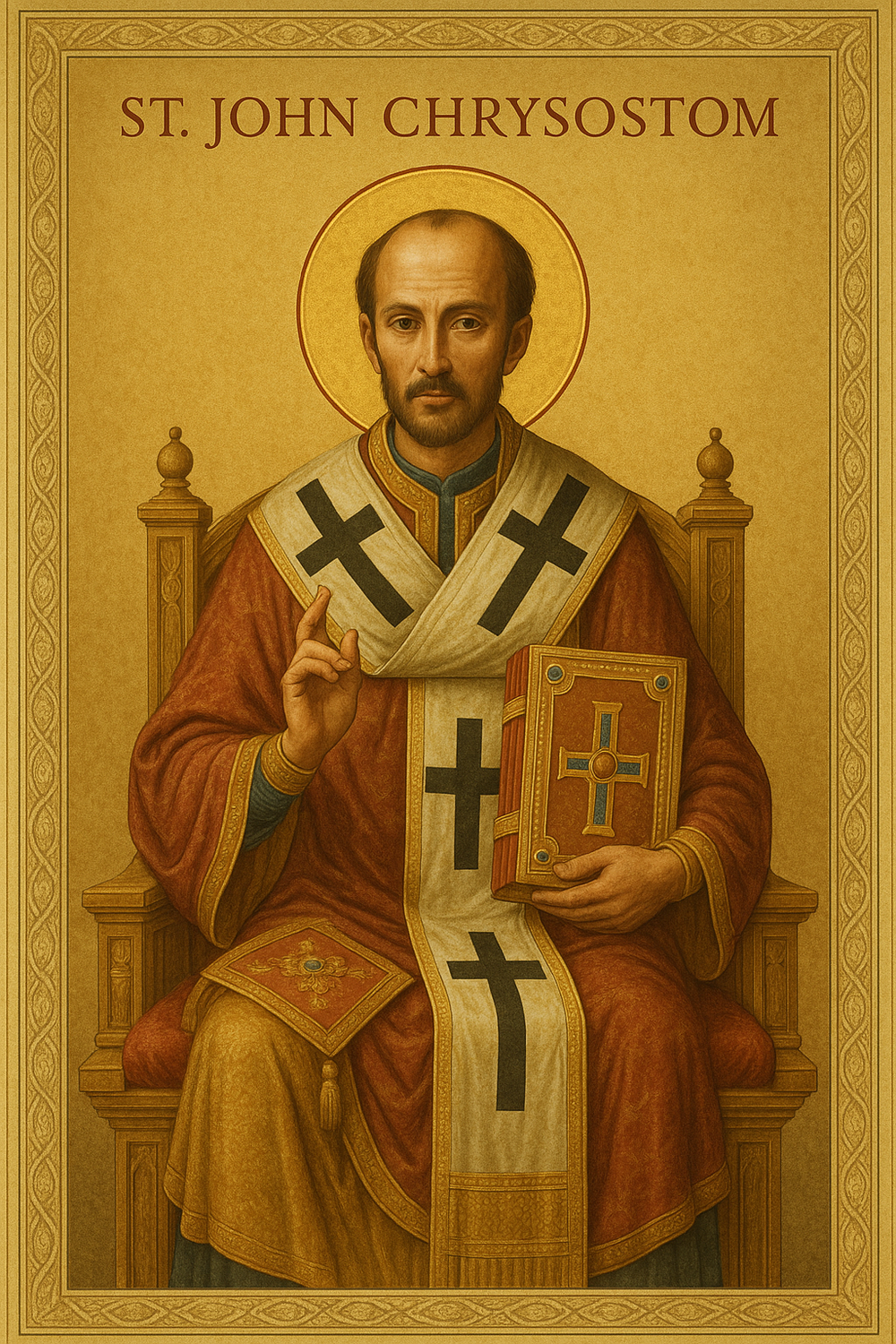
For the prayer card of St. John Chrysostom — a fitting companion to this theological study and a beautiful addition to any marriage-focused prayer corner — visit the St. John Chrysostom Prayer Card in the store.
Living the Theology
What This Means for Married Life Today
Theology that cannot be inhabited is decoration. Maximus's vision of love, incarnation, and the soul's union with its divine Bridegroom is not merely beautiful as an intellectual system. It makes claims on how a married couple actually lives — how they understand their fights and their reconciliations, their shared prayer and their seasons of dryness, their ordinary days and their moments of genuine tenderness. What does it look like to live a marriage with Maximus's theology in view?
The Ascent Toward Bridal Union — And Marriage's Place in It
Maximus's progression in Two Hundred Chapters 1.16 — faith, fear, humility, gentleness, commandment-keeping, purification, illumination, bridal union — is not a sequence that bypasses marriage. It runs directly through it. Consider each step in the context of married life.
- Faith — the couple's shared faith is the foundation. Not just parallel individual faith, but a common orientation of the household toward God that shapes how they parent, how they speak to each other, how they pray, what they prioritize.
- Fear of God — the holy reverence that recognizes one's spouse as a person made in the image of God, not a possession or a projection. The beginning of treating the other with genuine respect.
- Humility — perhaps the single virtue most directly tested by marriage. You cannot be humble in the abstract. You are humble (or you fail to be) in precisely the moment when you are wrong and need to say so, when you are tired and still need to be present, when your needs are legitimate and yet you defer them for the good of the other.
- Gentleness — the deactivation of those "impulses of incensiveness and desire contrary to nature" that Maximus mentions. Marriage is one of the primary arenas in which ungoverned anger (incensiveness) and disordered desire are confronted, challenged, and slowly transformed through the discipline of relationship.
- Keeping the commandments — fidelity, in its full sense: not only sexual fidelity, but the daily faithfulness to the promises made at the crowning, the ongoing choice to choose this person, this life, this love.
- Purification and illumination — the fruits, in time, of virtue lived in relationship: a gradual clarification of vision, a growing capacity to see the other as God sees them, a deepening freedom from the ego's agenda.
- Bridal union with the Logos — the endpoint that does not bypass married love but is informed and prepared by it: the soul that has learned to love faithfully, generously, and without self-seeking in the school of marriage has been forming the very dispositions of love that the divine union requires.
None of this makes marriage easy. Maximus would be the last theologian to claim it does. But it makes marriage serious — in the best and most demanding sense: a form of life that takes the human person seriously enough to believe that the love formed in it is not trivial, not peripheral, not a concession to weakness, but genuine preparation for the only thing the soul is ultimately made for.
Shared Sacramental Life as the Renewal of Union
For Maximus, the sacramental life is not optional supplementation to a basically secular existence — it is the primary site of transformation. For married couples, this means the Eucharist is not merely a practice each spouse maintains independently. It is the renewal, together and in the same act, of their union with the Bridegroom in whom their own union has its meaning. Couples who receive Communion together, who fast together, who observe the liturgical calendar together — fasting seasons, feast days, the rhythm of the Church year — are doing something Maximus would recognize as the concrete enactment of their vocation: bringing their shared life into regular, deliberate contact with the source of all love.
Confession, too, is part of this. Not as a private transaction between each spouse and God in which the other is irrelevant, but as a shared discipline of honesty, accountability, and the ongoing refusal to let sin accumulate unchallenged in the household. The couple who confesses regularly — who does not allow distance from God to become normalized — is maintaining the conditions in which love can deepen rather than calcify.

Frequently Asked Questions
Questions About Maximus the Confessor, Marriage, and Theosis
The Bridegroom Who Makes Marriage Sacred
Maximus the Confessor lost his tongue and his hand rather than deny that Christ was fully human. He did it because he understood that if God did not truly take on human flesh, then flesh cannot be sanctified — and if flesh cannot be sanctified, then marriage, the most bodily of all human relationships, is ultimately beside the point theologically. His suffering is the guarantee of his theology's stakes.
But Maximus also wrote, in the most intimate language he knew, about the soul lying with its divine Bridegroom in the chamber of mysteries. He chose the marriage bed as his highest metaphor for the soul's union with God. He was not being careless. He was saying, with full theological intent: the love you practice in a faithful, self-giving marriage is the same love — at a different depth and in a different mode — as the love that deifies the soul. They share the same source. They move in the same direction. They arrive, ultimately, at the same Bridegroom.
The crowning at the wedding liturgy is not an exaggeration. It is a statement about what is really happening.
Free Eastern Christian Marriage Resources →