Saint Isaac the Syrian: The Complete Biography — Desert Hermit & Master of Inner Peace
Church of the East • Eastern Orthodox • Syriac • Catholic • c. 613–700 AD • Feast: January 28
Saint Isaac the Syrian: The Most Complete Biography — Desert Hermit, Master of Inner Peace, and the Teacher No Tradition Could Keep to Itself
He was born in what is now Qatar. He resigned a bishopric after five months because a creditor told him to leave his Gospel out of it. He ate three loaves a week and went nearly blind reading. His most important writings sat in Oxford for eighty-five years before anyone realized what they were. Every Christian tradition — Orthodox, Catholic, Syriac, and the church he actually belonged to — claimed him as their own. Sufi mystics may have read him in secret. Dostoevsky put his words in the mouth of Elder Zosima. And his teaching on anxiety, inner silence, and the gift of tears is the most practical body of wisdom in the Christian East for the kind of suffering most people carry most of the time.
At a Glance
- Born
- c. 613 AD, Beth Qatraye — the region of the western Persian Gulf, in what is now modern Qatar
- Died
- c. 700 AD, Monastery of Rabban Shabur, Beth Huzaye (modern southwestern Iran)
- Tradition
- Church of the East (historically called "Nestorian," though the church rejects that name); canonized also by Eastern Orthodox, Syriac Orthodox, and (2024) Roman Catholic Church
- Rank
- Bishop of Nineveh — for exactly five months; then hermit for the rest of his life
- Language
- Syriac (Aramaic dialect); writings translated into Greek, Arabic, Georgian, Slavonic, Latin
- Major Works
- First Part (Ascetical Homilies); Second Part (discovered 1983, Oxford); Third Part (discovered 1990s)
- Key Teaching
- Stillness (hesychia) as the path to God; the gift of tears; the compassionate heart; divine mercy as the foundation of all creation
- Hidden Fact
- His Second Part sat in a parchment manuscript at the Bodleian Library, Oxford for 85 years before Sebastian Brock identified it in April 1983
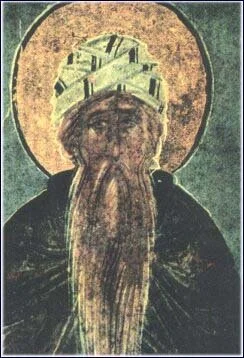
The Hidden Giant of Eastern Christian Spirituality
In the libraries of Eastern Orthodox monasteries — on Mount Athos, in the Egyptian desert, at the Optina Pustyn in Russia, at Mar Saba in Palestine — there is a book that occupies a position second only to the Bible and the Psalter as the constant companion of serious monastic life. It is not the Philokalia, though the Philokalia is near it. It is the Ascetical Homilies of Saint Isaac the Syrian. Monks have been reading it for thirteen centuries. Bishops have cited it in councils. It was translated into Greek, Arabic, Georgian, Slavonic, and Latin by communities that often could not agree on anything else. And yet in the West — outside specialist academic circles and the most serious pockets of Eastern Christian devotion — Isaac of Nineveh is nearly unknown.
This article is an attempt to change that. Not to be comprehensive in the academic sense — there are entire doctoral programs devoted to Isaac's theology — but to give the person who has heard the name, or the person who is struggling with anxiety or spiritual dryness or the feeling that prayer has gone dry and God has gone quiet, a complete, honest account of who this man was, why he wrote what he wrote, and why his specific voice — more than almost any other in the Christian tradition — speaks directly into the kind of interior suffering that modern people most commonly carry.
The short version: Isaac was a 7th-century hermit, born in what is now Qatar, briefly made bishop of a city he immediately left, who spent the rest of his life eating almost nothing, reading himself nearly blind, and writing about the interior life of the soul in language so precise and so compassionate that Christians who disagreed with him theologically on fundamental points kept quoting him anyway. He was, by any measure, the most ecumenical saint in the history of Christianity — owned by every tradition, captured by none, and understood most deeply by those who have actually tried to pray in the way he describes.
His Origins
Born in Qatar: The World That Made Isaac
Saint Isaac was born in the region of Beth Qatraye — a Syriac name meaning "the region of the Qataris" — which encompassed the western shore of the Persian Gulf and the northeastern Arabian Peninsula: the area that is today Qatar, Bahrain, and parts of eastern Saudi Arabia and the United Arab Emirates. This is not a detail most people know, because it is not the Arabia of desert fathers' legends or the Arabia of Islamic history — it is a specific, densely networked region of late antique Persian Gulf Christianity that has been largely invisible to Western church history.
Beth Qatraye in the 6th and 7th centuries was home to flourishing Syriac Christian monastic communities, governed by the Church of the East (the "Persian Church," sometimes called Nestorian), and connected by Persian Gulf trade routes to Christian communities in what is now Iraq, Iran, India, and Ethiopia. The Christianity of this region was not isolated or provincial — it was part of the same Syriac-language theological tradition that produced Ephrem the Syrian, Theodore of Mopsuestia, and the great theological schools of Nisibis and Edessa. It was a Christianity that had been under Persian, not Roman, imperial rule for most of its existence — which meant it had developed its own theological idiom, its own liturgical practice, and its own monastic tradition without the defining influence of the Greek-speaking Roman imperial church.
This origins matter for understanding Isaac's writing. He did not inherit the Greek philosophical framework that shapes so much of Western and Byzantine theology. His primary influences were Syriac: Ephrem the Syrian (whose feast day he shares, January 28), the Syriac desert fathers, and a tradition of mystical writing that handled theological topics in poetry, paradox, and prayer rather than in Aristotelian categories. When he writes about the soul's experience of God, he writes experientially, phenomenologically — as someone describing what actually happens in prayer rather than constructing a theological system about what should happen. This is why monks who disagreed with his Christology kept reading him. The experience he describes is recognizable to anyone who has tried seriously to pray.

The Formation
The Monastery Years: How a Desert Becomes a School
Isaac and his brother entered the monastery together — the most common origin story for Eastern monks of this period, where conversion to monasticism was often a family affair, and where the monastery was the primary institution of advanced education, spiritual formation, and theological learning in the Syriac world. The monastery they entered is identified in some accounts as the Monastery of Mar Matthew near Nineveh — one of the great monasteries of the Church of the East, founded according to tradition in the 4th century, still standing today in what is now northern Iraq near Mosul, and still functioning as a Christian monastery despite centuries of pressure and persecution.
What the accounts say about Isaac's early monastic years is almost exclusively about his reputation for learning and holiness — which drew attention he did not want. He preferred solitude. He wanted to pray, to read, to practice the ascetic disciplines in quiet. The monastery proposed that he head it. He refused and left to live alone in the desert. His brother kept urging him to return. He would not. The pattern established in his earliest years — deep reluctance toward visibility, genuine hunger for solitude, inability to stop people from finding him anyway — would repeat itself throughout his life. He went to the desert to be alone. The desert produced a man whose words have been read for 1,300 years.
The monastery where Isaac was formed, and the broader monastic network of the Church of the East, emphasized what the Syriac tradition called ihidayutha — singleness, or celibate monastic life — and the practice of shlama, peace-stillness, as the orientation of the whole person toward God. These concepts are Isaac's foundational vocabulary. They predate hesychia in the Greek tradition, though they point to the same reality. And they shaped everything he would later write about silence, prayer, and the healing of the anxious mind.
The Five Months
Bishop of Nineveh: Five Months and One Conversation That Changed Everything
In 676 AD, the Catholicos (Patriarch) Giwargis I of the Church of the East came to Beth Qatraye to attend a synod and, having heard of Isaac's holiness, ordained him bishop of Nineveh. This was a significant appointment. Nineveh — ancient Ninua, the city to which the prophet Jonah had been sent, capital of the Assyrian Empire, city of the biblical mass repentance — was a major see in the Church of the East's heartland. To be appointed bishop there was a position of real ecclesiastical and pastoral authority.
Isaac held it for five months.
The reason his ancient biographer Isho'dnah gives is: "by reasons known to God." This is one of the most honest statements in hagiographic literature — the biographer did not know, and said so. One tradition, preserved in the Orthodox account of his life, gives the specific story of why he left. Two Christians came before him to settle a dispute: one man acknowledged a debt but asked for a short extension. The creditor refused mercy and threatened court. Isaac cited the Gospel and asked him to be patient. The creditor replied: "Leave your Gospel out of this!" Isaac's answer has become one of the most quotable lines in Eastern Christian history: "If you will not submit to the Lord's commandments in the Gospel, then what remains for me to do here?" He resigned that day.
Whether or not that specific exchange is historical, it is theologically true to Isaac. His entire theological life was a meditation on the claim that God's mercy is not a religious sentiment separate from practical life — it is the organizing principle of all reality. A church whose leadership would tell the bishop to leave his Gospel out of a dispute over money was a church that had confused its administrative function for its spiritual one. Isaac chose the spiritual one.
Scholars have offered additional explanations: his physical constitution (his eyesight was already weakening); theological disagreements with the direction of the Church of the East; and the fundamental incompatibility between episcopal administration and the contemplative vocation that was his entire purpose. All of these may be true. The honest answer remains what Isho'dnah said: only God knows. What we know is what came after.
Isaac's five-month episcopate is not a minor biographical footnote. It is the hinge on which his entire spiritual teaching turns. He was made bishop of a major city, given authority, given position, given the power to administer and judge — and he walked away from all of it to become a hermit eating three loaves a week. Every word he later wrote about detachment from the world, about the irrelevance of social position to spiritual progress, about the soul's ultimate poverty before God — he wrote as someone who had held significant power and deliberately chosen something else. His teaching on humility is not theoretical. It is the autobiography of a decision.
The Desert Life
Three Loaves a Week: The Hermit Life at Rabban Shabur
After resigning the bishopric, Isaac withdrew first to Mount Matuot in the province of Beth Huzaye (ancient Khuzestan, in what is now southwestern Iran), a wilderness region used by anchorites — hermits who lived in radical solitude. From there he moved to the Monastery of Rabban Shabur, located near the modern city of Shushtar in Iran's Khuzestan province. He would spend the remainder of his life there, living as a hermit attached to the monastery — the standard form of semi-eremitic life in the Church of the East, where a monk would live in solitude throughout the week but join the community for the Saturday vigil and Sunday liturgy.
The physical details of his desert life are sparse but consistent across sources. He ate approximately three loaves a week with some uncooked vegetables. He prayed continuously. He read voraciously — the Scriptures, the desert fathers, the theological writers of the Syriac tradition — and he wrote. The reading eventually destroyed his eyesight; in old age he became nearly blind through the combination of intensive study and the physical conditions of desert asceticism. His anonymous biographer, noting this parallel to a famous predecessor, called him "the second Didymos" — a reference to Didymos the Blind of Alexandria, the 4th-century theologian who lost his sight and yet became one of the most prolific writers of his era. Both men who could no longer read still wrote. Both men's writing improved.
The Monastery of Rabban Shabur was not a backwater. It was one of the great monasteries of the Church of the East, with a distinguished history, a serious library, and a tradition of producing both holy monks and important theological writers. Isaac was known within the community; people came to consult him. He accepted some visitors, sent others away. He was not a hermit in the modern romantic sense of a man of perfect silence — he was a hermit in the ancient Eastern sense: a man who had simplified his life to the point where everything that remained was prayer and writing, and who accepted human contact only when it served those ends.
He died at Rabban Shabur around 700 AD, at an advanced age — probably in his eighties — and was buried there. His grave was venerated locally. His writings outlived him by thirteen centuries and counting.
The Manuscripts
The Writings: Three Parts, Seven Volumes, and a 1983 Discovery in Oxford
The 14th-century Syriac theologian Abdisho bar Brikha records that Isaac wrote seven volumes — seven substantial bodies of work in Syriac covering ascetical theology, mystical theology, prayer, and the inner life of the soul. Of those seven volumes, scholars have so far identified three distinct "Parts" and fragments of a possible fifth.
The First Part — the Ascetical Homilies — is the text that made Isaac famous. It was translated from Syriac into Greek in the late 8th or early 9th century at the Lavra of St. Sabbas in Palestine (the same monastery where St. John of Damascus had lived and written a century earlier), and from Greek it passed into Georgian (10th century), Old Slavonic (14th century), and Latin (15th century). It is from this Greek-derived chain of translations that Isaac entered Orthodox, Slavic, and eventually Western monastic literature. The Greek translation is not complete — the translators selected and adapted — but it preserved enough that the Eastern Orthodox world received a substantial and spiritually authentic version of Isaac's thought.
The Second Part is where the story becomes remarkable. This body of work — containing Isaac's most developed theology of divine mercy, his meditation on Gehenna, and some of his most explicit writing on universal hope — was simply unknown to Western scholarship. It was known to some Syriac-reading communities, but it had never been translated into Greek and therefore never entered the mainstream Orthodox tradition. It was sitting in a parchment manuscript at the Bodleian Library in Oxford — donated in 1898 by an Assyrian priest named Yaroo Michael Neesan — and no Western scholar had recognized what it was.
In April 1983, the Oxford Syriac scholar Sebastian Brock opened MS syr. e. 7 and realized he was reading writings of Isaac the Syrian that the Western academic world had never seen. The manuscript had been in the library for eighty-five years. It had been catalogued. It had sat on a shelf. The parchment itself, in small East Syrian Estrangela script, 190 folios, 26 lines per page, had been waiting in an Oxford library for the right person with the right languages. Brock published the critical edition and translation in 1995. It changed the scholarly understanding of Isaac's theology in ways that are still being worked out.
The Third Part was identified in the 1990s. It is less well known and still being studied. Sebastian Brock's 2024 summary of all editions and translations of the three known Parts represents the current state of the scholarship — and the field is still open. Isaac wrote seven volumes. We may have found only three.
Before 1983, most Orthodox readers knew Isaac primarily through the Greek translation of the First Part — which emphasized the practical ascetic life: stillness, tears, repentance, the stages of prayer. These are genuine and central to Isaac, but they represent one dimension of a much larger theology.
The Second Part revealed the full structure of Isaac's thought: his systematic theology of divine love as the ground of all creation; his explicit meditation on the "difficult matter of Gehenna"; his hope that divine love ultimately has a purpose that cannot be defeated; and his vision of the compassionate heart as the telos of the entire ascetic journey — the point at which prayer for one's own soul becomes prayer for all souls, for all creation, for the demons themselves.
The result of the discovery was to shift scholarly understanding of Isaac from a practical ascetic writer to something much larger: a systematic theologian of mercy whose entire ascetic system is in the service of a vision of God as love — not merely loving, but constitutively, ontologically love — from which no creature is ultimately excluded. This is the Isaac who influenced Dostoevsky. It is also the Isaac who was added to the Roman Martyrology in 2024.
The Ecclesial Mystery
The Nestorian Question: Why Every Church Claimed a Saint Not Their Own
Isaac the Syrian presents a problem for any ecclesiology that requires saints to belong to a specific, doctrinally orthodox tradition. He was a bishop in the Church of the East — the tradition that rejected the Council of Ephesus (431) and the Council of Chalcedon (451), and was considered heretical by both the Eastern Orthodox and Roman Catholic churches for those rejections. He was consecrated bishop by a Catholicos the Orthodox would not have recognized. He died in a monastery belonging to a church his canonizers would have classified as schismatic at best, heretical at worst.
And yet the Eastern Orthodox Church canonized him. The Syriac Orthodox Church (which accepted Chalcedon's rival, Ephesus) canonized him. The Roman Catholic Church added him to the Roman Martyrology in 2024. The Church of the East — now the Assyrian Church of the East — has always venerated him. He is the only figure in Christian history to be formally recognized as a saint by traditions that disagree on the Christological councils that define the fundamental boundaries of Eastern Christian ecclesiology.
How did this happen? The translation. When the monks of the Lavra of St. Sabbas in Palestine translated Isaac's First Part into Greek in the late 8th or early 9th century, they did not advertise the fact that they were translating a Nestorian bishop. They presented the text as the work of "Abba Isaac the Syrian" — a desert father from the Syrian tradition, which was respectable — and the text itself contains almost no explicit Christological statements of the kind that would have triggered theological alarm. Isaac was writing about prayer, tears, silence, compunction, and divine mercy. He was not writing about the two natures of Christ in the technical language that divided the churches. The Byzantine monks who received the Greek translation read it as the work of a great ascetic father and embraced it. By the time anyone examined the question of which church Isaac actually belonged to, his holiness was already established in the Orthodox world by 400 years of continuous reading and citation.
The broader lesson is important: Isaac was canonized because of what he knew, not because of what council he attended. The tradition recognized in him, empirically, the marks of genuine holiness and genuine spiritual wisdom — and it held onto those, even when the ecclesiological category didn't fit neatly. His case is the strongest argument in Christian history that holiness is not the possession of any single tradition.
See also: Saint Ephrem the Syrian — the 4th-century Syriac poet and theologian whose feast day Isaac shares (January 28) and whose tradition shaped Isaac's theological vocabulary.

The Spiritual System
Core Teachings: Stillness, Compunction, and the Gift of Tears
Isaac's spiritual teaching is systematic without being scholastic — it has a shape, a logic, a beginning and an end, but it is organized around experience rather than proposition. The shape is this: the soul begins in distraction and fragmentation; through the practice of silence and ascetic discipline it achieves stillness (hesychia); in stillness it encounters compunction (penthos) — a deep, loving grief for its own sin and for the suffering of the world; compunction produces tears; tears open the soul to a direct experience of divine mercy; and the endpoint is what Isaac calls "the compassionate heart" — a state in which the person prays for all creation with the same love with which God regards all creation.
Each step is precise. Stillness (hesychia) does not mean absence of thought. It means the cessation of the ego's frantic management of its own experience — the end of the soul's project of defending, justifying, planning, and evaluating itself. Isaac teaches stillness as the precondition of prayer, not as an achievement of prayer. You cannot pray your way into stillness; you have to get still in order to pray. The practice that produces stillness is small, persistent, humble — reading, physical work, limited speech, regular fasting, the fixed rhythm of prayer. "A small but always persistent discipline is a great force," he writes, "for a soft drop falling persistently, hollows out hard rock." The rock is the hardened soul. The drop is the daily practice.
Compunction (penthos) is the next stage, and it is the one most misunderstood in modern readings of Isaac. Western Christianity has often associated compunction with guilt — the painful awareness of specific sins — and has treated it as a problem to be solved by confession and absolution. For Isaac, compunction is something larger and more positive. It is a faculty, not just a feeling. It is the soul's capacity to be moved — by the beauty of God, by its own unworthiness, by the suffering of other creatures, by the distance between what creation is and what God intends it to be. Compunction is the heart becoming soft enough to feel what is actually true about reality. It is, for Isaac, the threshold of real prayer.
The gift of tears is the physical expression of compunction and one of Isaac's most specific teachings. He writes: "Tears are the boundary between the bodily and spiritual states." Tears of prayer are not emotional breakdown or religious enthusiasm. They are, in Isaac's phenomenology, the point at which the prayer of the mind becomes the prayer of the whole person — the body participating in what the soul has understood. The tradition he is drawing on, traceable through the Egyptian desert fathers to Evagrius and beyond, treats tears as a sign of genuine prayer rather than performed piety: you cannot manufacture them, only prepare conditions in which they may arise. When they arise, they indicate that something real is happening.
"A small but always persistent discipline is a great force; for a soft drop falling persistently, hollows out hard rock."
— Isaac the Syrian, Ascetical Homilies"Tears are the boundary between the bodily and spiritual states — between the state of passions and that of purity."
— Isaac the Syrian, Ascetical Homilies"Be persecuted, rather than be a persecutor. Be crucified, rather than be a crucifier. Be treated unjustly, rather than treat anyone unjustly."
— Isaac the Syrian, Ascetical Homilies"The Lord's Day is a mystery of the knowledge of the truth that is not received by flesh and blood, and it transcends speculations."
— Isaac the Syrian, Ascetical Homilies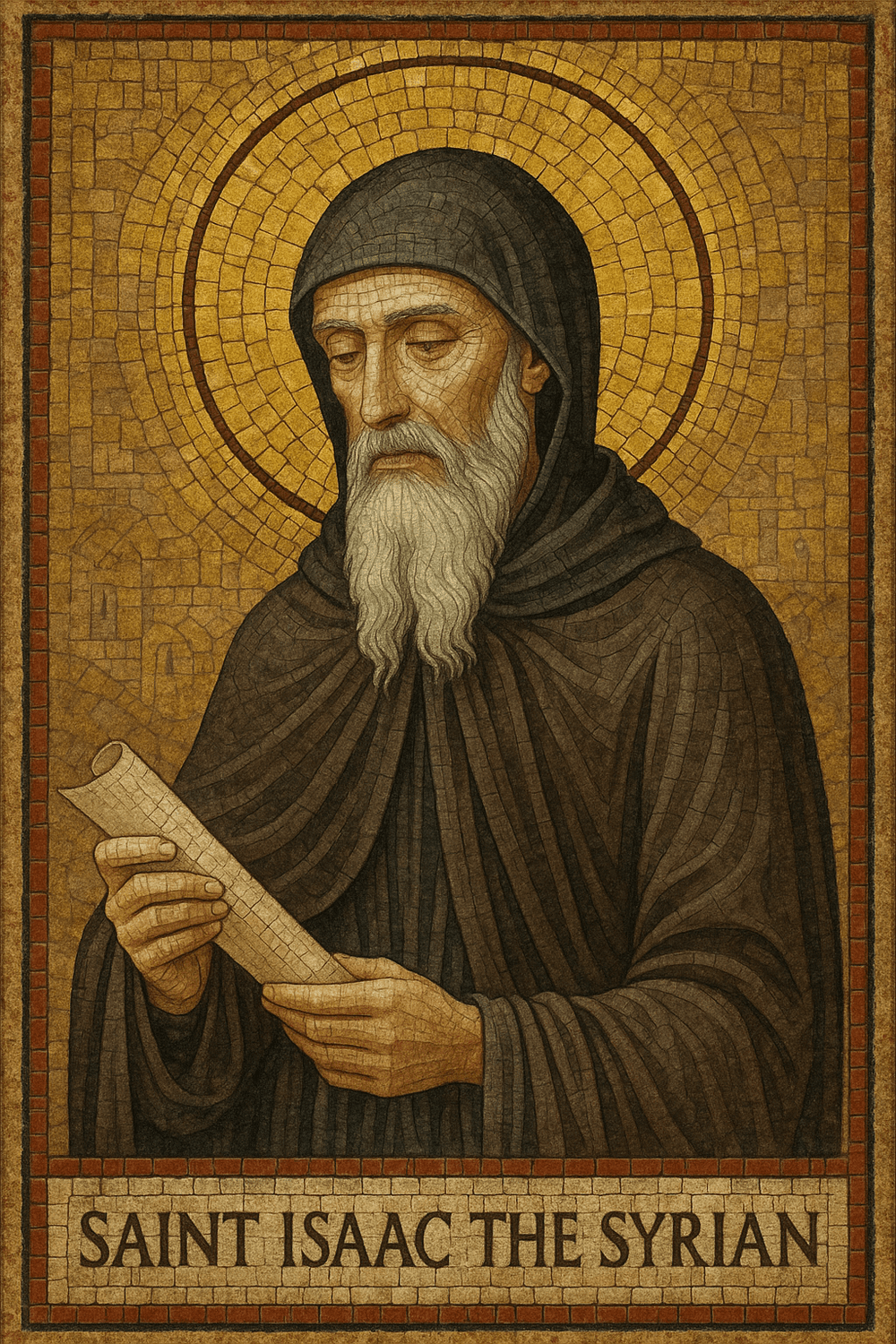
His Most Original Teaching
The Compassionate Heart — The Endpoint of All Prayer
The most radical and most beautiful passage in all of Isaac's writing is a single extended definition — his answer to the question of what the "compassionate heart" actually is. It is one of the most cited passages in all of Eastern Christian mystical literature, and it is worth presenting carefully, because what it describes is not a spiritual achievement in the competitive sense but a transformation of perception: a change in what the person sees when they look at reality.
Isaac writes: "What is a compassionate heart? It is the heart's burning for the sake of the entire creation — for human beings and birds and animals and demons and for all created things. At the remembrance of them and at the sight of them, the eyes of a merciful person pour forth tears. From the strong and vehement mercy that grips his heart and from his great compassion, his heart is humbled and he cannot bear to hear or to see any injury or slight sorrow in any in creation."
The phrase "for the demons" is not a mistake or a rhetorical excess. For Isaac, it is the theological precision point of the entire passage. If the compassionate heart is real — if it is genuinely the overflow of divine love through a transformed human person — then it cannot exclude any creature from its scope, because God's love excludes no creature from its scope. The saint who has arrived at the compassionate heart prays for the demons not because the demons are good but because God loves them still, as creatures, and the saint has become a person through whom that love moves without restriction.
This is the passage that Dostoevsky's Elder Zosima paraphrases in The Brothers Karamazov when he instructs Alyosha to love everything — "every blade of grass, every tiny bird." It is the passage that shaped the specific flavor of Russian Orthodox spirituality that makes it different from Greek Orthodox spirituality: warmer, more expansive, more inclined toward cosmic mercy. It entered Russian monasticism through Isaac, and from Russian monasticism into Russian literature, and from Russian literature into the modern world's sense of what the best of Christianity looks and sounds like.
The Theological Controversy
Isaac on Hell as Divine Mercy Burning — The Most Controversial Passages
The Second Part of Isaac's writings — discovered in 1983 — contains his most direct engagement with the "difficult matter of Gehenna," and it is here that Isaac comes closest to a theological position that has been called, depending on who is reading him, either "universalism," "apokatastasis," or "the hope of universal salvation." It is important to distinguish these carefully, because Isaac himself is careful in a way that his readers sometimes are not.
Isaac does not say that hell does not exist. He does not say that sin has no consequences. He does not say that repentance is unnecessary. What he says is this: the love of God, which is universal and unchanging, which makes no distinction between creatures in its essential care for them, must have a purpose — and the purpose of creation was not to be defeated. He writes: "It is not the way of the compassionate Maker to create rational beings in order to deliver them over mercilessly to unending affliction." He describes the fire of Gehenna not as a different kind of divine action from heaven but as the same divine love — the same fire — experienced differently by those who have been transformed by it (as warmth and light) and those who have not (as burning). The love of God is not conditional. The experience of it is.
Sebastian Brock, the leading Western scholar of Syriac Christianity and the person who discovered the Second Part, situates Isaac in a tradition that includes Gregory of Nyssa and Julian of Norwich — theologians who, from within orthodox Christianity, have meditated seriously on the possibility that divine love ultimately prevails over all estrangement. This is not the universalism of Origen (which was condemned), because Isaac is not interested in the protological theories — the pre-existence of souls, the cyclical cosmology — that got Origen into trouble. Isaac is interested in the nature of God's love in the present and ultimate moment, and he finds in it a hope that he is unwilling to limit.
What the Orthodox tradition has done with this, broadly, is receive it as a legitimate expression of Christian hope — not a doctrine to be taught dogmatically, but a meditation that is allowed and even spiritually valuable — while being careful not to use it as an excuse to avoid repentance. The two are not contradictory: precisely because God's mercy is immense, our repentance should be deep. Isaac never suggests otherwise.

The Long Reception
Dostoevsky, the Philokalia, and the Russian Reception
The path from a 7th-century desert hermit in Iran to the most celebrated Russian novel of the 19th century runs through a specific chain of textual transmission that is worth tracing. The Greek translation of Isaac's First Part, made at the Lavra of St. Sabbas in the 9th century, passed into Slavonic in the 14th century and entered Russian Orthodox monastic literature. By the 19th century, Isaac's Ascetical Homilies were a central text at the Optina Pustyn monastery — the famous monastery in central Russia that became the spiritual center of the Russian intelligentsia's rediscovery of Orthodox tradition, and which Dostoevsky visited on multiple occasions.
Bishop Theophan the Recluse (1815–1894), one of the great figures of 19th-century Russian Orthodox spirituality and the translator of the Philokalia into Russian, produced an important Russian edition of Isaac's writings that brought him into wide circulation in the Russian church. Theophan treated Isaac as a primary authority alongside the Philokalia — which itself did not include Isaac — and his translations made Isaac accessible to the educated Russian reading public at exactly the moment Dostoevsky was writing The Brothers Karamazov.
The evidence of Isaac's influence on Dostoevsky's Elder Zosima is not merely circumstantial. The specific teaching Zosima articulates — that we are all responsible for everyone and for everything, that love should extend to all creatures and to the whole of creation, that the mark of genuine spiritual progress is weeping for everything — is the language of Isaac's compassionate heart. The passage where Zosima instructs Alyosha to love every blade of grass and every creature mirrors Isaac's definition so closely that literary scholars have identified it as one of the closest textual parallels between the novel and any patristic source. Dostoevsky had read Isaac. The greatest Russian novel carries Isaac's theology at its spiritual center.
Isaac is not included in the Philokalia, but he is its close companion in Orthodox monastic practice. For those exploring the Philokalia tradition, see The Complete Guide to the Philokalia, Lessons from the Philokalia, and What the Philokalia Teaches About Anxiety — all on this site.
The Cross-Religious Dimension
The Sufi Question: Did Isaac Shape Islamic Mysticism?
Among the more intriguing questions in the scholarship on Isaac the Syrian is whether his writings — or the tradition they represent — exercised influence on early Islamic mysticism, particularly Sufism. The question cannot be answered definitively, but the circumstantial case is genuinely strong, and the cultural geography makes it plausible in ways that most Western readers have never considered.
Isaac was born and raised in Beth Qatraye, the Persian Gulf coast of Arabia, in the early 7th century — within decades of the emergence of Islam. The Syriac Christian monastic tradition of this region was exactly contemporaneous with, and geographically adjacent to, the earliest communities of Islamic practice. Syriac-speaking Christians and early Muslims shared the same trade routes, the same urban centers in Mesopotamia, and in many cases the same families during a period of religious transition. The vocabulary of Syriac Christian mysticism — stillness, poverty of spirit, the purification of the heart, the remembrance of God, the dissolution of the self in divine love — overlaps in striking ways with the vocabulary of early Sufi practice.
Some scholars, including A. J. Wensinck, who translated Isaac's Syriac homilies in 1923, suggested that Isaac's influence on Sufi thought was significant and traceable. Others are more cautious, noting that parallel development is possible without direct transmission. What is documented is this: Isaac's writings were translated into Arabic relatively early, and they circulated in Arabic-reading communities that included Muslims. The Arabic translation of his corpus is described as "much fuller than the Greek" — meaning the Arabic world had access to more of Isaac than the Byzantine Greek world did. In the Persian Gulf, Levantine, and Iranian zones where Sufism developed most richly, a rich tradition of Syriac Christian mysticism was already present and was not invisible to Muslim intellectuals.
The point is not to claim Isaac for Islam or to reduce Sufism to Christian influence. It is to note that the spiritual geography of the 7th-century Persian Gulf was far more porous than modern denominational categories suggest — and that the man from Beth Qatraye, writing in Syriac in a monastery in southwestern Iran, may have been more widely read and more widely influential than even the Eastern Orthodox tradition knows.
November 2024
Pope Francis and the Roman Martyrology: November 2024
In November 2024, Pope Francis announced the inclusion of Isaac of Nineveh in the Roman Martyrology — the official liturgical list of saints venerated by the Latin Church. The addition was made following discussions with ecclesiastical leaders of the Assyrian Church of the East, and it was explained as a recognition of Isaac's "enduring spiritual legacy and of holiness extending beyond historical ecclesial divisions."
This is an extraordinary event in Christian history, though it received relatively little attention in Western media. The Roman Martyrology is not a casual document — it is the Catholic Church's official declaration of which persons are to be venerated as saints. Adding to it requires a judgment that the person in question was genuinely holy, that their life and teaching are consistent with Christian faith, and that their veneration is beneficial to the Church. The fact that the Catholic Church made this judgment about a 7th-century bishop who belonged to a tradition the Catholic Church has historically considered heretical — and who died 1,300 years ago without any formal Catholic canonization process — represents exactly the kind of move Isaac's entire theological career embodied: holiness recognized across divisions that institutions maintain but that the Spirit apparently does not.
Isaac is now formally venerated by the Church of the East (Assyrian Church), the Eastern Orthodox Church, the Syriac Orthodox Church, and the Roman Catholic Church. He is the most ecumenically claimed saint in the history of Christianity. And he spent his life eating three loaves a week in a desert in Iran, writing about how to be still enough to hear God.
For Eastern Catholic Christians — Maronite, Melkite, Syriac Catholic, Chaldean, and all other Eastern Catholic churches — the November 2024 addition of Isaac to the Roman Martyrology represents formal Roman Catholic acknowledgment of a saint whose spiritual tradition is native to their own liturgical heritage. The Syriac Catholic Church and the Chaldean Catholic Church, which both use the Syriac liturgical tradition inherited from the Church of the East, now have Isaac formally recognized by both their own tradition and by the Rome with which they are in communion. This is a quiet but significant moment in the ongoing reception of Eastern Christian heritage by the universal Church.
His Most Practical Teaching
Isaac and Anxiety: What He Actually Said About the Troubled Mind
In an era of unprecedented anxiety, spiritual burnout, and what the secular world calls "mental health crisis" and the Eastern tradition calls akedia — the desert name for the condition of spiritual listlessness, restlessness, and inability to pray — Isaac the Syrian offers something that almost no other writer in the Christian tradition offers with the same precision: a phenomenology of the troubled inner life that is simultaneously compassionate, honest, and practically useful.
He does not diagnose. He describes. He does not moralize. He observes. And what he observes, from decades of personal experience in one of the most demanding spiritual environments in human history, is that the troubled inner life is not a failure of faith. It is a condition that has stages, causes, and remedies — none of which require the person to have already solved the problem before they can begin.
On the Racing Mind
Isaac describes what the desert tradition calls logismoi — the racing, scattering movement of thoughts that prevents stillness and makes prayer feel impossible. His diagnosis is precise: the racing mind is not primarily a spiritual problem but a practical one. It arises from the absence of structure, from excessive engagement with the world, from the failure to establish what he calls "rule" — the regular rhythm of prayer, reading, physical work, and silence that trains the mind over time to be capable of stillness. His prescription: small, persistent discipline. Not heroic effort. Not emergency measures. The drop that hollows the rock. You cannot force the mind to be still. You can create the conditions under which stillness becomes possible over time.
On Spiritual Dryness
Isaac normalizes spiritual dryness in a way that is countercultural in both ancient and modern contexts. Against any spirituality that treats constant consolation as the sign of a healthy spiritual life, Isaac teaches that seasons of dryness — the absence of felt devotion, the silence of God, the inability to pray with any sense of being heard — are not signs of failure or divine abandonment. They are pedagogical. They teach the soul to distinguish between seeking God and seeking consolations from God. The soul that prays only when it feels something is a soul that has confused the gift for the giver. The soul that continues to pray in dryness is learning to seek God rather than God's felt presence — which is, for Isaac, a much deeper form of prayer.
For more on this from the wider Eastern tradition, see our guide to Spiritual Dryness and the Dark Night of the Soul in Eastern Christian perspective.
On Repentance Without Feeling
One of Isaac's most pastorally important teachings is his distinction between the act of repentance and the feeling of contrition. Many people, he observes, give up repentance because they no longer feel sorry — because the emotional component of compunction has dried up, and they mistake the absence of feeling for the absence of grace. Isaac's response: the act of turning toward God, the decision to face God rather than face away, is itself repentance — regardless of whether it is accompanied by tears or warmth or felt sorrow. The feelings are not the substance of repentance; they are its fruit, which may or may not be present at any given time. Keep the act. The fruit will return when it returns. The discipline outlasts the feeling.

How to Pray With Him
How to Pray With Saint Isaac the Syrian
Saint Isaac's feast day is January 28, shared with Saint Ephrem the Syrian in the Eastern Orthodox, Byzantine Catholic, and Syriac Orthodox calendars. In the Syriac Orthodox Church his feast is on May 14. In the Roman Catholic Church, since his addition to the Roman Martyrology in November 2024, he is formally commemorated as well.
His intercession is traditionally invoked for: inner peace and the healing of anxiety; perseverance through spiritual dryness and desolation; the gift of compunction and tears in prayer; healing of spiritual burnout; the recovery of stillness in a distracted mind; deepening of repentance; and the development of compassion for all people and creatures. He is also invoked by those who feel they are "bad at prayer" — because his entire teaching is addressed to people who find prayer difficult, who feel nothing, who keep showing up anyway, and who need to know that this is exactly where the tradition says you should be.
A prayer from the Second Part of his writings, in Sebastian Brock's translation, gives the flavor of his own voice in prayer: "I beseech you, O God, send me help from your highest heavens so that I may keep far from my heart every evil intention and every carnal wish. Do not cast me, Lord, from your protection lest my adversary find me and trample upon me just as he desires, destroying me utterly. It is you who grant repentance and a sorrowful heart to the sinner who repents; in this way you ease his heart from the weight of sin that is laid upon it, thanks to the comfort which comes from mourning and from the gift of tears."
Those who want to build a prayer rule around Isaac's teaching should read: The Orthodox Prayer Rule for Beginners; The Jesus Prayer; and The Prayer of the Heart — all closely related to Isaac's teaching on prayer.
And if you are in the particular spiritual condition Isaac most consistently addresses — anxious, dry, burned out, unable to feel what you believe — see Orthodox Christian Prayers for Anxiety and our Orthodox Saints for Mental Health list. Isaac is on it. He was put there for a reason.
Questions About Saint Isaac the Syrian
The Man Who Chose the Desert Over Everything
He was offered a bishopric and left it after five months because a creditor told him to leave his Gospel out of it. He ate almost nothing. He read himself blind. He wrote seven volumes of spiritual theology in a desert in Iran. His most important writings sat in an Oxford library for eighty-five years. And when they were finally read, they changed the scholarly understanding of what the Christian tradition has always believed about the mercy of God.
Isaac the Syrian is the saint for the person who is struggling to pray and doesn't know why. For the person who has tried and feels nothing. For the person who has been told that the right spiritual life should feel a certain way, and whose life doesn't feel that way at all. He wrote for you. He wrote from inside the difficulty you are in. And what he wrote — thirteen centuries ago, in a desert in Iran, eating three loaves a week and slowly going blind — has never been more needed.
Browse All Orthodox & Catholic Prayer Cards →