Saint Ephrem the Syrian: The Complete Biography of the Harp of the Holy Spirit
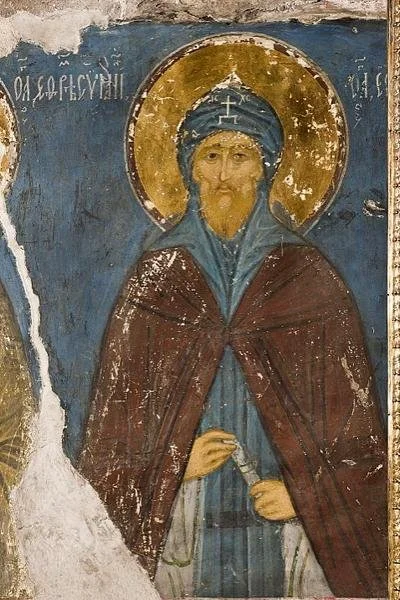
Saint Ephrem the Syrian
The Harp of the Holy Spirit — the only Syriac Christian Doctor of the Church, and the greatest hymnographer the Church has ever produced
Saint Ephrem the Syrian
Each prayer card is made by hand in Austin, Texas — printed on museum-quality paper, assembled in prayer, with intercessions offered to Saint Ephrem for the person who will receive it.
Get the Prayer Card →His Titles: What the Church Called Him
No single saint in the history of the Church has accumulated as many honorific titles as Ephrem the Syrian. Each one points to a different dimension of the same extraordinary life.
Pope Benedict XVI described him as "Christianity's most important Syriac-speaking representative" — someone who "uniquely succeeded in reconciling the vocations of theologian and poet." Saint Jerome, writing twenty years after Ephrem's death, said his works had become so influential that they were being read publicly in some churches after the Sacred Scriptures themselves. Gregory of Nyssa called him: "The splendor of his doctrine and life illumined all the earth, for he is known in almost every place where the sun shines."
The World That Formed Him: Nisibis
Ephrem was born around 306 AD in Nisibis — a frontier city in Roman Mesopotamia, on the edge of the Persian empire, in a region where Aramaic-speaking Syriac Christians formed a distinct community alongside Jews, pagans, Zoroastrians, and every variety of early Christian sect. It was not a quiet place to grow up in the faith. It was a contested border zone, a city that changed hands repeatedly between the Roman and Persian empires, repeatedly besieged, and home to religious competition of a kind rarely seen even in that era of religious ferment.
Later hagiographers wrote that Ephrem's father was a pagan priest of the goddess Abnil. Internal evidence from Ephrem's own hymns suggests his parents were probably both Christians — part of the growing Syriac Christian community shaped by a tradition that traced itself back through Edessa to the apostles. The distinction matters because Ephrem's entire theological vision was formed from inside a living, Syriac-speaking Christian community, not from conversion from paganism. He was a creature of his tradition from the beginning.
He grew up under Bishop Jacob of Nisibis — one of the most remarkable bishops of the early Church and a man who would shape Ephrem's entire life. Jacob appointed him as a teacher (malpānâ in Syriac, a title still honored among Syriac Christians today) after his baptism as a youth. Ephrem would spend the next several decades as Jacob's student, colleague, and eventually the intellectual engine of the Nisibene church.
The Council of Nicea and the Siege of Nisibis
In 325 AD, Bishop Jacob of Nisibis traveled to the First Council of Nicea — the Church's first great council, convened by Constantine I to settle the Arian controversy and define the faith in precise terms. Jacob was a signatory. According to tradition, the young Ephrem accompanied him. Whether or not the tradition is fully accurate in its details, what is historically certain is that Ephrem was formed in the Nicene faith from the very moment it was articulated, and that fighting for Nicene orthodoxy would be one of the defining projects of his entire life.
The political situation around Nisibis was deteriorating steadily. When Constantine I died in 337, the Persian Emperor Shapur II seized the opportunity and began a series of attacks into Roman North Mesopotamia. Nisibis was besieged three times: in 338, 346, and 350. During the first siege, Ephrem credited Bishop Jacob with defending the city through prayer. After Jacob died, Ephrem witnessed the next two sieges and lived through them.
The third siege, in 350, was the most dramatic. Shapur rerouted the River Mygdonius to undermine the city's walls. The citizens frantically repaired the breach while the Persian elephant cavalry became mired in the waterlogged ground and withdrew. Ephrem saw this as miraculous — the city saved by Providence as Noah's Ark had been saved on the flood — and composed a famous hymn celebrating the deliverance. Those hymns, the Carmina Nisibena, are among the earliest surviving Christian poetry of any kind.
The physical link most directly connected to Ephrem's lifetime is the baptistery of Nisibis, constructed in 359 AD under Bishop Vologeses. It stands to this day in the city now called Nusaybin, on the Turkish-Syrian border. Its inscription records the year it was built — the same year Shapur attacked again and began destroying the cities around Nisibis one by one. Ephrem was living through all of it.
The Exile: From Nisibis to Edessa, 363 AD
The campaign of Julian the Apostate ended in his death in battle in 363. His successor Jovian, desperate to rescue his army from a dangerous position, negotiated an ignominious peace with Shapur: the Romans would surrender Nisibis and several other eastern territories to Persia. Every Christian in the city was given a short window to leave.
Ephrem was in his mid-fifties. He had lived his entire life in Nisibis. He left with the others — a refugee, joining thousands of displaced Syriac Christians who streamed westward. He went first to Amida (modern Diyarbakir), then settled permanently in Edessa (modern Şanlıurfa), the ancient city at the heart of Syriac civilization that called itself the City of Christ and claimed to have received a letter from Jesus Himself addressed to its king.
He would live the remaining ten years of his life there. He was already the most important theological voice in the Syriac world. In Edessa, he became something more.
Edessa: The Cave Above the City
Ephrem lived simply in Edessa — in a small cave or cell above the city, overlooking it as a shepherd oversees a flock. He ate sparingly, slept on the ground, and gave himself over almost entirely to prayer and to writing. This life of hidden simplicity was not self-conscious asceticism for its own sake. It was the Syriac form of what the Desert Fathers of Egypt were practicing simultaneously — an entire existence oriented toward God alone, without the buffer of comfort or possession.
But unlike the Egyptian hermits who withdrew into silence, Ephrem remained intensely engaged with his community. He taught. He preached. He organized. And Edessa in the 360s was a city that desperately needed all three.
Edessa was a theological battlefield. At least ten significant heretical sects were active in the city when Ephrem arrived. Arians denied the full divinity of Christ. Marcionites rejected the Old Testament. Manichees preached a cosmic dualism of light and darkness. Bardesanites — followers of the brilliant poet-philosopher Bardesanes — offered an intellectually sophisticated alternative to Nicene Christianity. Each of these movements had its advocates, its arguments, and — critically — its music.
The Hymns: Taking the Enemy's Weapons
What Ephrem did in Edessa was one of the most creative acts of Christian pastoral strategy in the history of the Church.
He noticed that the heretical sects were spreading their theology through songs — through popular melodies that ordinary people, including illiterate Christians, could easily memorize and carry through their daily lives. Bardesanites had produced a particularly extensive body of hymns. The music was beloved. The theology embedded in it was, in Ephrem's view, poison.
His response was to take those same melodies — the ones Edessa was already humming — and compose entirely new lyrics filled with orthodox Nicene doctrine. He wrote teaching hymns (madrāšê in Syriac), setting rich theological content to the tunes people already knew and loved. He then organized and rehearsed all-female choirs to sing these hymns publicly in the forum of Edessa, giving the city both a liturgical experience and a theological education at the same time.
This was not merely clever. It was a form of catechesis that no treatise or sermon could replicate. Doctrine set to music that people loved became doctrine that people carried, remembered, and passed to their children. Sozomen, the church historian, credited Ephrem with composing three million lines. Even if that number is exaggerated, his surviving 400-plus hymns represent only what was preserved — a fraction of an output described by contemporaries as almost incomprehensibly vast.
An ancient writer recorded that a holy elder once had a dream of Ephrem. "When the father arose in the morning, he heard people saying: 'Ephrem teaches as if a fountain were flowing from his mouth.' Then the elder who had seen the dream recognized that what issued from his lips was from the Holy Spirit."
This is not hagiographic embellishment. It is the memory of a community that experienced something in Ephrem's teaching that they had no other category for than to call it the Spirit's voice.


His Theology: Symbols and the Incarnate God
To understand Ephrem, you need to understand his governing theological vision — because it is unlike anything in the Latin or Greek traditions, and it is both more ancient and in some ways more sophisticated than the philosophical frameworks that would dominate Western theology for centuries.
Ephrem's central conviction was that creation is saturated with symbols (rāzê in Syriac) — pointers, resonances, and reflections of the divine reality that made everything. This was not allegory in the Greek sense, where physical things are mere illustrations of abstract principles. For Ephrem, the symbol participates in the reality it points toward. When he looked at fire, or water, or a pearl, or a vine, or light, or a womb, he saw these things as genuinely bearing within themselves the presence and meaning of the God who made them.
The source and summit of all this symbolism was the Incarnation. Jesus Christ — the Word made flesh — was for Ephrem the key that unlocked the symbolic depth of all creation. Every image in Scripture, every image in nature, pointed ultimately toward the One who had taken flesh in a stable in Bethlehem. Ephrem's famous exclamation captures it: "This Jesus created so many symbols that I have fallen into them as into the sea!"
This is theology done not through argumentation but through vision — through the capacity to see what is actually there. Pope Benedict XVI identified this as one of Ephrem's defining contributions: he showed that poetry is not merely a pleasant decoration for theology, but in many ways its most adequate expression.
The Theology of the Incarnation
Ephrem's hymns on the Nativity are among the most theologically dense and poetically beautiful texts in Christian literature. On Christ taking flesh in the Virgin's womb, he wrote:
On the paradox of the Incarnation more broadly:
This is not ornamental writing. Every image carries precise theological content. Christ is Shepherd who becomes Lamb — the divine Author of creation entering the created order as its most vulnerable creature. He is Word who becomes silent — the ground of all speech choosing the wordlessness of infancy. He is thunder who stills His voice — the omnipotent God accepting limitation and dependence. Ephrem's method is to hold these paradoxes in tension through image rather than resolving them through philosophical category, and the result is theology that both instructs the mind and moves the heart.
Mary and the Immaculate Conception
Ephrem's writings on the Virgin Mary are among the earliest in the Christian tradition to develop what would become the doctrine of the Immaculate Conception. He wrote of Mary's unique purity and sinlessness with a clarity and devotion that marked him as one of the founders of Marian theology in both East and West. The Syriac tradition's deep veneration of the Theotokos — the Mother of God — is inseparable from the hymnography Ephrem created.
The Humble Deacon: Refusing the Priesthood
One of the most remarkable facts about Ephrem is that he was never a priest. He spent his entire active life as a deacon — an order below the priesthood — and he refused every effort to elevate him further.
According to the accounts preserved by Sozomen and others, when Saint Basil the Great heard of Ephrem's extraordinary reputation, he sent delegates to Edessa specifically to offer him consecration as bishop. Ephrem refused. According to tradition, he feigned madness so convincingly that the delegates returned to Basil satisfied that the famous Ephrem was mentally unfit for episcopate. Only afterward, when they encountered him teaching and preaching with his usual power, did they understand what had happened.
He may also have visited Basil personally in Caesarea around 370 — a legendary meeting that would have joined the two greatest theological minds of the Greek and Syriac traditions — and even there, when Basil offered him the diaconate or possibly further orders, Ephrem accepted nothing beyond what he already held.
This persistent refusal of honor was not a performance. It was of a piece with his entire spiritual orientation. His most famous prayer — recited to this day at every Great Lent service in Eastern Christianity — begins by asking God to take away the spirit of lust of power. He composed those words out of his own deepest conviction. He meant them.
The Final Years: Famine, Plague, and Death
In 373, Edessa was struck first by famine, then by plague. Ephrem was nearly seventy years old. He came down from his cave.
He organized the famine relief personally — gathering provisions, arranging beds for the starving, mobilizing the city's resources in a way that the civic authorities had failed to do. He was not a man who had spent his life in contemplation and emerged helpless in a practical crisis. He was the son of a city that had survived three Persian sieges. He knew how to organize.
When the plague followed the famine, he stayed. He cared for the sick. He tended to the dying. He contracted the disease himself in the course of this ministry and died on June 9, 373 — ten years after arriving in Edessa as a refugee, at the end of a life that had always chosen service over safety.
He left a testament. It was characteristically Ephrem — humble to the last word. He asked the Edessans not to bury him under the altar of a church or in any sacred space, saying it was not fitting for a worm like him to be interred in the sanctuary of God. He asked to be laid out in his daily tunic and mantle, accompanied by psalms and prayers. He said he had owned nothing — no pouch, no staff, no silver or gold. He asked the city's blessing and departed.
"I, Ephrem, am dying. With fear, but also with reverence, I entreat you, citizens of Edessa, not to bury me under the altar or elsewhere in the house of God. It is not fitting that a worm teeming with corruption be buried in the temple and sanctuary of God. But lay me out in the tunic and mantle which I used and wore daily. Accompany me with psalms and prayers. I had neither pouch nor staff, neither wallet nor silver and gold; nor did I ever acquire or possess anything else earthly… And may your city be blessed; for Edessa is the city and mother of the wise."
Doctor of the Church: October 5, 1920
Ephrem was venerated as a saint immediately after his death — canonized, as was the ancient practice, by the acclaim of the faithful before formal canonization processes existed. His cult spread rapidly from Edessa to all of Syriac Christianity, then to the Greek Church, the Armenian Church, the Coptic Church, and eventually the Latin West.
But it was not until 1920 that the Catholic Church gave him the highest theological honor within its gift. On October 5, 1920, Pope Benedict XV proclaimed Ephrem a Doctor of the Church under the title Doctor Syrus — Doctor of the Syrians. He was the thirty-third Doctor of the Church. He remains the only Syriac-speaking representative among them.
The encyclical in which Benedict XV made the proclamation is worth reading in full for its portrait of what Ephrem actually accomplished. The Pope quoted the ancient witnesses — Jerome, Gregory of Nyssa, Theodoret — who described his influence across every branch of Christianity, and then added the judgment that frames Ephrem's significance most precisely: that God had given him to the Church as "a doctor of heavenly wisdom and an example of the choicest virtues."
Exactly one hundred years later, in 2020, Pope Francis echoed Benedict XVI's assessment by calling Ephrem the figure who most fully demonstrated that poetry and theology are not opposed — that the most complete expression of Christian truth may require beauty as much as argument.
The Prayer of Saint Ephrem
Of everything Ephrem wrote — the 400 surviving hymns, the biblical commentaries, the theological treatises — one short prayer has spread further than any of it. It is prayed at every service during Great Lent throughout Eastern Christianity, from Maronite to Greek Orthodox to Syriac to Coptic to Byzantine. It is perhaps the most universally used prayer in the Eastern Christian world, prayed by more people more frequently than any other text outside the Lord's Prayer.
O Lord and Master of my life,
take from me the spirit of sloth, despair, lust of power, and idle talk.
But give rather the spirit of chastity, humility, patience, and love to Thy servant.
Yea, O Lord and King,
grant me to see my own sins
and not to judge my brother;
for blessed art Thou, unto ages of ages.
Amen.
It asks for almost nothing external. No protection from enemies, no relief from difficulty, no material blessing. It asks only for interior transformation: that four vices be taken away (sloth, despair, lust of power, idle talk) and four virtues given in their place (chastity, humility, patience, love). And then it adds the final petition that defines Ephrem's entire spiritual orientation: grant me to see my own sins — not my brother's, my own. This is the prayer of a man who never, in his entire life, appointed himself the judge of anyone else.
Ephrem on Marriage: The Flesh That God Honored
Ephrem's theology of the Incarnation — God taking human flesh, making the body sacred, entering human limitation out of love — gives marriage a depth that purely legal or contractual understandings cannot reach. If you are seeking resources to bring that depth into your own marriage, these books are completely free to read online.
Free Marriage Resources →Timeline of His Life
Where to Venerate His First-Class Relics
A first-class relic is a part of the saint's physical body — bone, flesh, or hair. Given that Ephrem died in 373 and expressly requested to be buried simply in a foreigners' cemetery rather than a place of honor, the history of his relics is appropriately humble. The Armenian monks of the monastery of St. Sergius (Der Serkis) near Edessa claimed his body in antiquity. Over the following sixteen centuries, portions of his remains dispersed through the networks of Syriac and Byzantine Christianity. The following are the verified locations where first-class relics of Saint Ephrem the Syrian are publicly available for veneration.
Holy Monastery of Saint Ephrem the Syrian
Kontariotissa, Katerini, Greece · First-class relics
At the foot of Mount Olympus, this Greek Orthodox women's monastery is dedicated to Saint Ephrem and houses first-class relics of the saint, installed in the monastery's Katholikon in 2006. The relics include a portion described as the right hand of the saint, and are described by pilgrims and sources as grace-filled and fragrant. The monastery was founded in 1983 and established officially under the Holy Metropolis of Kitros and Katerini in 1985. Crowds of pilgrims flock on January 28 (the Eastern feast day) to venerate them. Visitors are welcome throughout the year.
Learn about this monastery →Armenian Monastery of St. Sergius (Der Serkis)
Near Edessa (modern Şanlıurfa, Turkey) · Historical burial claim
This is the place where, according to the Catholic Encyclopedia and EWTN, the Armenian monks historically claimed to possess the body of Saint Ephrem after his burial at the foreigners' cemetery in Edessa. Access to this site is dependent on current conditions in southeastern Turkey. The ancient city of Edessa — modern Şanlıurfa — remains a place of historical pilgrimage for Syriac Christianity, though the physical condition and accessibility of Christian sites there should be verified before any visit.
It is characteristic of Ephrem himself that his relics are not housed in a grand basilica or a famous pilgrimage destination, but in a hillside monastery of nuns near Mount Olympus and in the history of a remote Armenian monastery near his city of exile. He asked to be buried plainly. In the mysterious economy of the Church's care for its saints, what he asked for is roughly what he received.


Feast Days Across All Traditions
Ephrem is the only pre-schism Church Father whose feast day is observed across the full spectrum of apostolic Christianity — Roman Catholic, Eastern Orthodox, Oriental Orthodox, Syriac, Coptic, Anglican, and more. Each tradition honors him on a date that reflects its own calendrical system, but the saint being honored is the same one.
| Tradition | Feast Day | Notes |
|---|---|---|
| Roman Catholic (Ordinary Form) | June 9 | Optional memorial; date of death |
| Roman Catholic (Extraordinary Form) | June 18 | Original date set in 1920 encyclical |
| Eastern Orthodox / Byzantine | January 28 | Also: Saturday of Venerable Fathers (Cheesefare Saturday) |
| Maronite Catholic | June 18 | Original Latin date preserved in Maronite calendar |
| Syriac Orthodox | 7th Saturday before Easter | Traditional Syriac liturgical placement |
| Coptic Orthodox | July 22 | Corresponds to Coptic calendar date |
| Episcopal Church (USA) | June 10 | Commemorated in Anglican liturgical calendar |
| Church of England | June 9 | Lesser commemoration |
His Major Works
Hymns (Madrāšê)
Ephrem's teaching hymns are his most important contribution. His collections include the Hymns on Paradise — a meditation on Eden, the Fall, and the return of humanity to the Tree of Life through Christ — which Sebastian Brock has called one of the great works of Christian mystical literature. The Hymns on the Nativity, Hymns on the Epiphany, Hymns on the Resurrection, Hymns on Faith, Hymns on Virginity, and the Hymns on the Church together constitute the theological backbone of Syriac Christian liturgy. The Carmina Nisibena — songs about the sieges and history of his home city — are among the earliest surviving Christian historical poetry.
Biblical Commentaries
Ephrem wrote a commentary on the Diatessaron — the gospel harmony used by the early Syriac church — the Syriac original of which was recovered only in 1957 from the Chester Beatty Library in Dublin. He also wrote commentaries on Genesis, Exodus, and the Pauline Epistles (preserved in Armenian). His biblical exegesis does not read like Origen's allegory or Augustine's philosophical analysis. It reads like someone who has absorbed Scripture so completely that he thinks in its images and sees the world through its patterns.
Refutations of Heresy
Ephrem wrote systematic refutations of Bardesanes, Mani, Marcion, and others — not dry theological treatises but vigorously argued poetic works that took the heretics' own rhetorical methods and turned them against them. The Catholic Encyclopedia notes that his refutations were considered authoritative by later Eastern theologians precisely because they engaged heresy seriously rather than dismissing it.
The Prayer of Saint Ephrem
His most universal legacy in living liturgy — prayed at every service throughout Great Lent across the entire Eastern Christian world. No other prayer composed by any single Church Father is used more frequently in daily liturgical life.
Patronage
How to Pray to Saint Ephrem
Saint Ephrem, Harp of the Holy Spirit, Sun of the Syrians, Doctor of the Church — pray for me.
You lived in a cave above the city of Edessa and wrote theology that the whole world could sing. You took the enemy's melodies and filled them with the truth. You feigned madness rather than accept honor. You came down from your cave to feed the starving and nurse the dying, and you died doing it.
Teach me the thing you knew most completely: to see my own sins and not my brother's. Teach me to find God's symbols everywhere — in fire, water, light, and word — so that the whole world becomes for me what it was for you: a text in which He is always speaking.
If I am tempted by the spirit of sloth — pray for me. If I am tempted by despair — pray for me. If I am tempted by lust of power or the vanity of idle talk — pray for me. Give me the spirit of chastity, humility, patience, and love.
Harp of the Spirit, play your music in my soul, that I might come to love the God you loved so completely that you wrote three million lines trying to say what He was like — and still found Him inexhaustible.
Amen.
Saint Ephrem the Syrian Prayer Card
Not mass produced. Made one at a time in Austin, Texas — each card created during prayer, with intercessions offered to the Harp of the Holy Spirit for the person who will receive it.
Get the Prayer Card →Frequently Asked Questions
Saint Ephrem the Syrian — Harp of the Holy Spirit, Sun of the Syrians, and Deacon of Edessa — teach us to see our own sins and not our brother's. Pray for us.