Saints Francis, Abdel Moati and Raphael Massabki: The Complete Biography of the Martyrs of Damascus
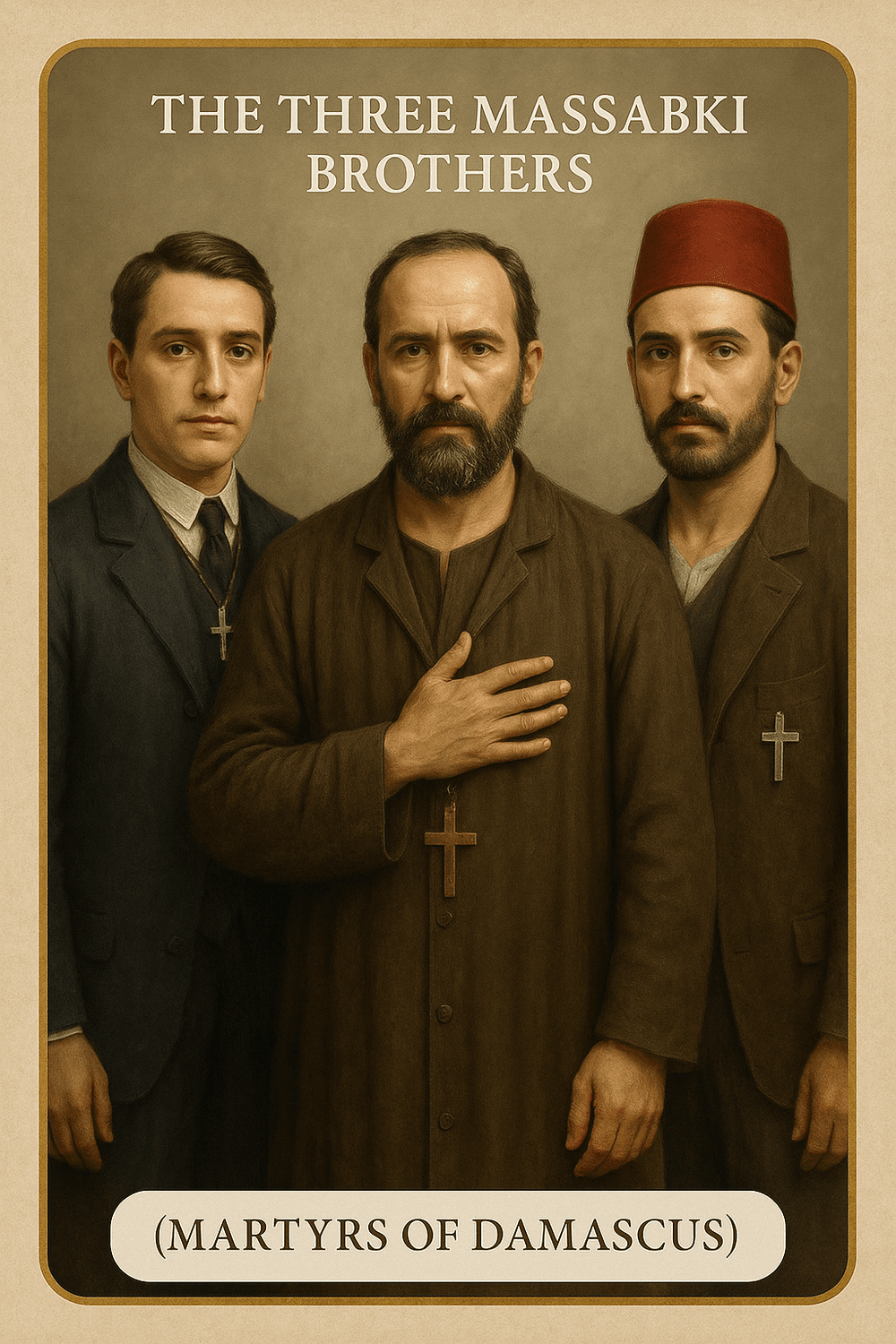
Saints Francis, Abdel Moati & Raphael Massabki
Three brothers, one night, one choice — and the faith of a family that changed history
Saints Francis, Abdel Moati & Raphael Massabki
Each prayer card is made by hand in Austin, Texas — printed on museum-quality paper, assembled in prayer, with intercessions offered to the Massabki Brothers for the person who will receive it.
Get the Prayer Card →Three Brothers You Need to Know
On the night of July 9, 1860, a wealthy Damascus family was praying together in a Franciscan church when armed men broke down the doors. The brothers had taken refuge there as violence swept the Christian quarter of the city. They knew what was coming. They had seen the fires from the windows. They had heard what was happening in the streets.
They had received confession. They had received the Eucharist. They were praying when the men arrived.
Each of the three was given the same choice: renounce Christ and live, or refuse and die. Each refused in his own way — the oldest with a statement that has echoed across 165 years of Christian history, the middle with four words of defiant simplicity, the youngest on his knees. None of them walked out of that church.
Their names were Francis, Abdel Moati, and Raphael Massabki. They were not priests. They were not monks. They were a silk merchant, a schoolteacher, and a younger brother who helped wherever he was needed. They were family men — two of them married, fathers of eight and five children respectively — living ordinary lives of faith in a city that was, on that particular night, trying to kill them for it.
On October 20, 2024, Pope Francis declared them saints of the universal Catholic Church. They are the first Maronite laymen ever to receive that title.
Who They Were: Three Portraits
Francis Massabki
Eldest Brother · Silk Merchant · Father of Eight
The most prominent of the three. A successful silk trader known throughout Damascus and Lebanon. Married with eight children. Generous to the poor. Represented the Maronite Patriarch in Syrian affairs. Deeply devoted to the Rosary. His financial generosity sustained the Franciscan missionaries. The night of his martyrdom, he was praying before the statue of Our Lady of Sorrows.
Abdel Moati Massabki
Middle Brother · Teacher · Father of Five
Lived in the same house as Francis with his wife and five children. Attended daily Mass at the Franciscan church of St. Paul. Taught catechism at the friars' school — his sons Naame and Joseph were pupils there and witnessed his death. Known for fasting, prayer, and genuine respect for all. Hours before his martyrdom, he gathered his students and spoke to them about the grace of martyrdom.
Raphael Massabki
Youngest Brother · Single · Servant of the Church
Unmarried, apparently in poor health, but devoted. Spent long hours in prayer in the church and served as a sacristan and volunteer for the friars. Simple-hearted, with a deep filial love for the Virgin Mary. Gladly helped his family and the Franciscans with whatever was needed. Described by sources as the gentle child of the family — simple in spirit, faithful in heart.
There was a fourth Massabki brother — Abdallah, a priest — who was not present the night of the martyrdom. He survived. The family had given one son to the priesthood and three to martyrdom, and a fourth who carried both the grief and the witness forward.
The World That Formed Them: Damascus in 1860
To understand what happened to the Massabki Brothers, you need to understand what Damascus was, and what 1860 was.
Damascus in the mid-nineteenth century was a city of extraordinary religious complexity — Muslims, Christians, Jews, Druze — living in distinct quarters under Ottoman rule, bound together by commerce and separated by law. Christians lived as dhimmis, protected minorities who paid special taxes, were barred from certain public roles, and existed at the sufferance of the majority. The Massabki family had navigated this world successfully: Francis's silk trade connected them to European markets, gave them standing and financial security, and placed them among the most distinguished families in the Damascus Christian community.
The Sultan's proclamation in 1856, following the Crimean War, had guaranteed formal equality between Christian and Muslim subjects of the empire. This, paradoxically, had inflamed sectarian tensions rather than calming them. Many Muslims experienced the reforms as a disruption of the natural order, a European imposition that elevated dhimmis to a status they had never held. The Christians who prospered under the new arrangements became visible targets of resentment.
Meanwhile, across Mount Lebanon, violence had already been building between Druze and Maronite Christian communities for years. In April 1860, open conflict broke out. The predominantly Christian town of Zahlé fell to Druze militias. More than sixty villages were destroyed. Around 2,600 Christians were slaughtered at Deir El-Qamar. An estimated 12,000 Christians died in Lebanon.
By July, the violence had crossed into Syria. In Damascus, the Christian quarter — Bab Tuma, the gate of Saint Thomas — was targeted. Between 4,000 and 6,000 Christians were killed in the city. Churches, convents, and homes were burned. The Ottoman authorities, who were supposed to protect these communities, were at best ineffective and at worst complicit. The governor later paid for this with his life when French pressure forced the empire to hold its officials accountable.
Into this context — as the fires spread through the Christian quarter of Damascus — Francis, Abdel Moati, and Raphael Massabki made their way to the Franciscan Convent of St. Paul. They were not alone. Many Christians fled there seeking refuge in the church. They came to pray. They received the sacraments. They prepared for whatever was coming.
The Night of July 9–10, 1860
The Franciscan Convent of St. Paul stood in the Bab Tuma quarter of the Old City of Damascus. On the night of July 9, its superior, Father Manuel Ruiz López, was a Spanish Franciscan who had been in the Holy Land for decades. When the sound of the approaching crowd reached the convent, his first action was to go to the church and consume the Eucharistic Species reserved in the tabernacle — to protect the Blessed Sacrament from profanation. He was found there and killed at the foot of the altar.
The seven other Franciscan friars — six priests and two lay brothers, seven Spaniards and one Austrian — were found in the church, on the terrace, and in the street. Each was offered the same choice. Each refused. They were slaughtered with blades. The violence was not quick.
Saint Manuel Ruiz López (Spain) · Saint Carmelo Bolta Bañuls (Spain) · Saint Nicanor Ascanio Soria (Spain) · Saint Nicolás María Alberca Torres (Spain) · Saint Pedro Soler (Spain) · Saint Engelbert Kolland (Austria) · Saint Francisco Pinazo Peñalver (Spain, lay brother) · Saint Juan Santiago Fernández (Spain, lay brother)
All canonized October 20, 2024, alongside the Massabki Brothers. The eleven together are known as the Martyrs of Damascus.
Francis: The Creditor Who Chose Faith Over the Debt
Among the crowd that had taken refuge in the convent was a Muslim notable — Sheikh Abdallah — who owed Francis Massabki an enormous debt: 800,000 pounds, described by contemporary accounts as a vast fortune even by the standards of wealthy merchants. The Sheikh came to Francis in the church with an offer. He would use his influence to spare all three brothers, their families, and everyone who depended on them. The price was simple: they needed only to publicly embrace Islam.
Francis was praying before the statue of Our Lady of Sorrows when they found him. He had been in prayer. He was ready.
He replied: "Sheikh Abdallah can take the money I lent him. He can also take my life. But my faith — no one can make me deny. I am a Maronite Christian and in the faith of Christ I will die. As our Lord Jesus commanded, we do not fear those who can kill the body."
This is a direct reference to Matthew 10:28: Do not be afraid of those who kill the body but cannot kill the soul. Francis had been formed enough in the faith to cite Scripture at the moment of his death. He began to pray. He was killed with swords and daggers.
Abdel Moati: Four Words
Abdel Moati was seized at the door of the chapel. He was told to deny his faith and live. His hours earlier that day had been spent with his students — the boys he taught at the Franciscan school — speaking to them about the grace of martyrdom. He had understood, perhaps, that this moment was coming.
When the demand was made, he said: "I am a Christian. Kill me. I am ready."
Four words. He was killed minutes after his older brother. His sons Naame and Joseph — his students, his children — witnessed it.
Raphael: On His Knees
Raphael was found later. Some accounts suggest he did not immediately understand that his brothers had been killed, or that the situation was fully clear to him before the end — he was the simplest of the three, described as simple-hearted, gentle. When the armed men found him and made the same demand, he fell to his knees in prayer. He testified to Christ. He was cut down where he knelt.
All three were later buried with the Franciscan priests who had also been martyred that night. Their relics were exhumed in October 1861 and placed in reliquaries.

Their Spirituality: Holiness in Ordinary Life
What made the Massabki Brothers remarkable was not that they were unusual people. It was that they were entirely ordinary people who had built, through years of quiet faithfulness, the kind of interior life that held when the worst moment arrived.
Francis attended Mass and prayed the Rosary. He gave generously to the poor from his commercial success. He used his position — as a representative of the Maronite Patriarch, as a man respected by both Christians and Muslims in Damascus — in service of his community rather than for his own advancement.
Abdel Moati taught children the faith. He visited the Blessed Sacrament daily, not because he was a monk or a priest, but because he was a man who believed that God was genuinely present in the tabernacle and that visiting Him was simply what you did. He fasted. He observed penances. And on the last afternoon of his life, knowing what was coming, he gathered his students and told them what mattered most.
Raphael served. He helped. He prayed for long hours without anyone particularly noticing. He had a deep and filial love for the Virgin Mary — the kind that doesn't announce itself but shapes a person slowly over years.
None of this was spectacular. None of it required a monastery or a vocation to religious life. It was what any Christian could do, in any city, in any century. The Massabki Brothers were the Vatican II teaching on the universal call to holiness — Lumen Gentium's insistence that all the baptized are called to sanctity — lived out in Damascus in 1860, four years before the Council was even conceived.
A few hours before his death, knowing the violence was approaching the convent, Abdel Moati gathered his students and explained to them the importance of the grace of martyrdom — urging them to bear witness to their faith without fear of death.
He was teaching until the end. His sons were in the classroom. He died the way he had taught others to live.
Married Men Who Became Saints
Francis was a husband and father of eight. Abdel Moati was a husband and father of five. Their martyrdom proves that the path to holiness runs directly through family life — not around it. If you are married and seeking to understand how marriage becomes a school of sanctity, these books are completely free to read online.
Free Marriage Resources →Blood Ecumenism: Dying Together Across Rites
One of the most striking dimensions of this story is that the eleven martyrs of Damascus came from two entirely different Catholic traditions. The Franciscan friars were of the Latin Church — Spanish and Austrian missionaries who had come to the Holy Land and Syria to serve. The Massabki Brothers were Maronite Catholics — Syriac Eastern Catholics who had been in Damascus for generations. They prayed differently, used different liturgical languages, and observed different traditions.
But they died together. They were offered the same choice. They made the same refusal. And they were buried together, their relics placed together beneath the same altar.
Pope Francis called this "blood ecumenism" — the unity achieved not through theological agreement but through shared martyrdom. Where centuries of ecumenical dialogue had produced partial steps toward unity, one night in Damascus produced something the dialogue could not: eleven people from two different Catholic traditions who died side by side for the same Lord.
The icon created for their canonization — displayed in St. Peter's Square on October 20, 2024 — captured this. At the center: Father Manuel Ruiz, the Franciscan superior, holding the Blessed Sacrament he had consumed before his death to prevent its profanation. Around him: the other Franciscan martyrs. And among them: Francis Massabki holding the insignia of the Maronite Patriarch, Abdel Moati carrying a palm branch of martyrdom, and Raphael with his hands folded in prayer. Eleven martyrs. Two traditions. One witness.
The Road to Canonization


Their Legacy: What They Mean Today
The Massabki Brothers were canonized in October 2024, when Lebanon was still in the grip of the military conflict that had followed the Gaza war, when the Christian communities of Syria had been decimated by over a decade of civil war, and when Maronite Catholics across the Middle East were asking the same question that Christians in Damascus asked in 1860: will we survive here?
In that context, the canonization carried weight that statistics cannot measure. Pope Francis said at the Mass: "These new saints lived Jesus' way: service. They made themselves servants of their brothers and sisters, creative in doing good, steadfast in difficulties, and generous to the end."
But the legacy of the Massabki Brothers extends beyond the geopolitical moment. They are the first Maronite laymen ever declared saints. That is a theological statement as much as a historical one. It says that the path to holiness that Francis walked — the path of a successful merchant who prayed the Rosary and represented his patriarch and gave to the poor and was killed for his faith — is a path the Church formally recognizes as arriving at its destination.
A descendant of the brothers, describing the family's experience of the canonization, said what Francis had told the sheikh was the key: not the dramatic death, but the lifetime of choices that made the dramatic death possible. When you have spent a lifetime placing nothing above Christ — not money, not safety, not reputation — then the moment that asks you to place something above Christ has a clear answer.
The debt the sheikh offered to forgive was 800,000 pounds. Francis told him to keep it. He was praying when they killed him.
Patronage: For Whom They Intercede
How to Pray to the Massabki Brothers
Saints Francis, Abdel Moati, and Raphael Massabki, martyrs of Damascus and witnesses of the faith, pray for us.
You chose Christ when the cost of that choice was everything. You refused to deny the faith in which you had lived and in which you chose to die. Intercede for the persecuted, the pressured, and the afraid — and for all of us who are called to witness to Christ in the ordinary moments, before the extraordinary ones arrive.
Amen.
Saints Francis, Abdel Moati, and Raphael — three brothers who taught me that holiness is available to all of us, in every state of life — pray for me.
Francis, you were a husband, a father of eight, a businessman. You gave your surplus to the poor. You represented your Church. You prayed the Rosary. And when the moment came, you told the sheikh he could keep the money and take your life, but your faith was not for sale. Pray for me, that my own faith is not for sale in the smaller moments that come before the larger ones.
Abdel Moati, you taught children and visited the Blessed Sacrament daily and gathered your students on your last afternoon to tell them what mattered most. Pray for me, that whatever I do in my ordinary life — my work, my teaching, my daily prayer — shapes me toward the person who holds firm when it counts.
Raphael, you were simple, gentle, devoted, and faithful. You fell to your knees when they came for you. Pray for me, that my simplicity and my love of the Virgin Mary grows until it is the kind that kneels when the moment demands it.
I bring you what I am facing today. [Name your need here.] Give me the grace that you had — forged not in a single moment, but in a lifetime of ordinary prayer, ordinary generosity, ordinary faithfulness.
Amen.
Saints Francis, Abdel Moati & Raphael Massabki Prayer Card
Each card is made by hand in Austin, Texas — assembled in prayer, with intercessions offered to the Massabki Brothers for the person who will receive it. Not manufactured. Not mass produced. One at a time.
Get the Prayer Card →


Frequently Asked Questions
Saints Francis, Abdel Moati, and Raphael Massabki — who told the sheikh he could keep the money — pray for us, that we too may hold nothing above the faith we were baptized into.