Saint George: The Most Complete Biography — Soldier, Martyr, Dragon Slayer, and the Patron of Nations
Eastern Orthodox • Catholic • Coptic • Syriac • Martyr of Christ • d. April 23, 303 AD
Saint George: The Most Complete Biography — Soldier, Martyr, Dragon Slayer, and the Patron of Nations
He was a member of the emperor's personal bodyguard. He died three times and was resurrected twice. His name means "farmer." A country may bear his name. The dragon came seven centuries after his death. And the oldest written account of his life was buried under a column in Nubia until 1964.
At a Glance
- Born
- c. 270–280 AD, Cappadocia (modern Turkey); mother from Lydda (Lod), Palestine
- Martyred
- April 23, 303 AD, Nicomedia (traditional) or Lydda (earliest accounts)
- Rank
- Tribunus; member of the Praetorian Guard (emperor's personal bodyguard)
- Names
- Greek: Georgios ("farmer"); Syriac: Mor/Mar Girgis; Arabic: Jurjis; Armenian: Gevorg
- Patron of
- England, Georgia, Ethiopia, Portugal, Catalonia, Aragon, Bulgaria, Palestine, Moscow, Beirut, Boy Scouts, soldiers, farmers, and more
- Title
- Great Martyr and Trophy-Bearer (Orthodox); Prince of Martyrs (Coptic); one of the Fourteen Holy Helpers (Catholic)
- Dragon Legend
- First depicted in Cappadocia, 11th century; popularized in the West by the Legenda Aurea, c. 1260
- Hidden Fact
- His head is kept at S. Giorgio in Velabro in Rome; brought by Pope Zachary in the 8th century
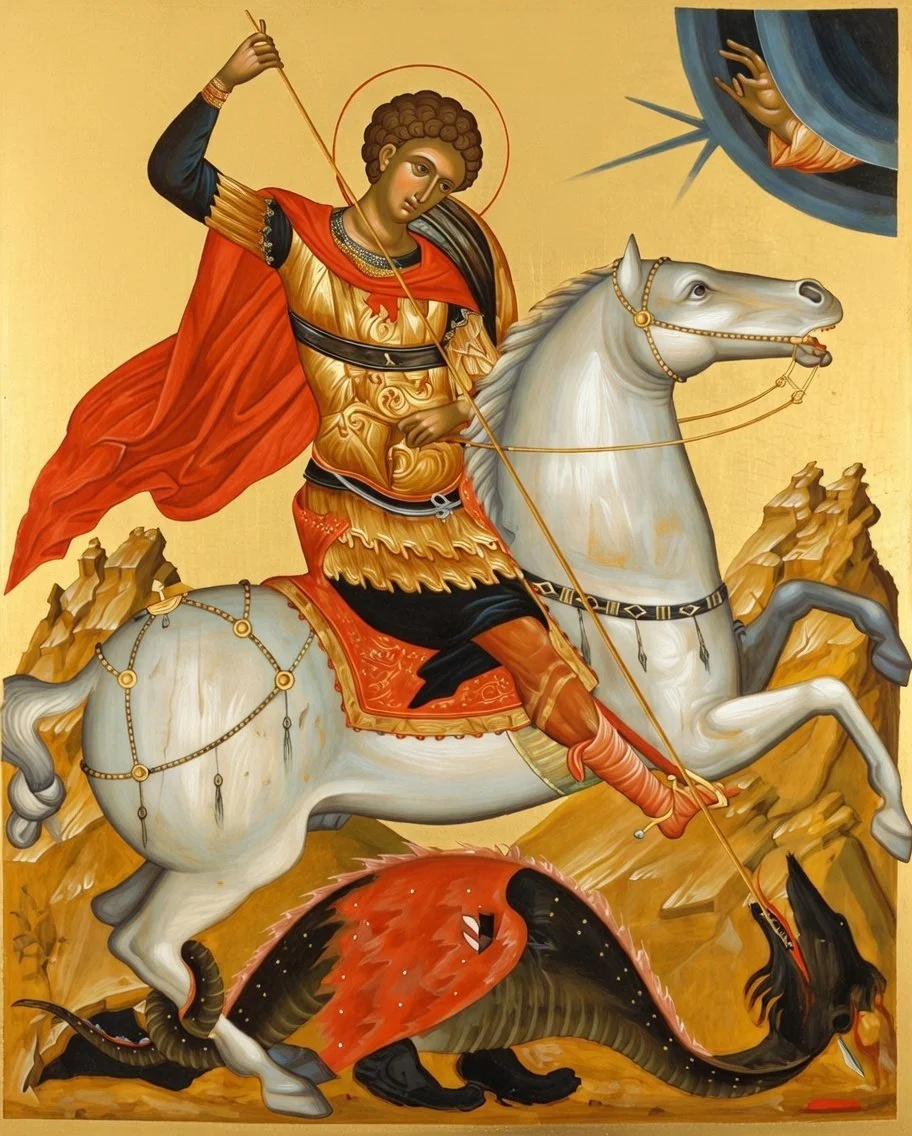
The Sources: What We Actually Know About Saint George
Saint George is one of the most venerated saints in the history of Christianity — patron of England, Georgia, Ethiopia, Portugal, and a dozen other nations, depicted in the art of every Christian tradition from Nubia to Norway, his name carried by millions of people across twenty languages — and yet the historical evidence for his life is genuinely thin. This is not a reason to doubt him. It is a reason to understand precisely what we are working with, because what we are working with is more solid than most popular accounts acknowledge — and more limited than the hagiographic tradition sometimes implies.
The most important document is the one almost no one has heard of: a Coptic manuscript discovered in 1964 under a column in the ruins of the cathedral of Qasr Ibrim in Nubia — before the Aswan High Dam flooded the region — dated by scholars between 350 and 500 AD. This is the oldest known written narrative about Saint George. It was sitting under a column in an African cathedral for over a thousand years until a 20th-century archaeological excavation found it. It predates all other surviving narrative texts about him and establishes the core biographical tradition: his father Gerontius from Cappadocia, his mother Polychronia a Christian, his birth during the reign of Aurelian (270–275), his secret baptism, and his martyrdom under Roman persecution.
Beyond this Nubian manuscript, the historical evidence includes a Greek epigraph from 368 AD discovered in Heraclea of Bethany, which references a "house or church of the saints and triumphant martyrs George and companions" — placing veneration of George within sixty-five years of his death. Eusebius of Caesarea's church history, written during the reign of Constantine I, describes a church built in Lydda dedicated to "a man of the highest distinction" — naming no patron, but later tradition identified him as George. By 494, Pope Gelasius I canonized George among saints "whose names are justly reverenced among men, but whose acts are known only to God" — an honest Roman episcopal acknowledgment of both his authentic veneration and the gaps in the record. That same year, Gelasius classified the dramatic hagiographic account of George's torture and death among apocryphal texts — while simultaneously canonizing the saint himself. The Church held both things at once: this man was real and holy; not everything written about him is verifiable.
What is established: George was a Christian martyr of the late 3rd or early 4th century, probably of Cappadocian origin with Palestinian family connections, who died during the Diocletianic persecution. His relics were venerated in Lydda from at least the 4th century. A basilica was built over his grave during the reign of Constantine. His cult spread through the Eastern Roman Empire within a generation of his death. The rest — the seven years of torture, the three deaths and two resurrections, the empress, the magician, the dragon — belongs to the hagiographic tradition that grew up around that real core. Both the core and the tradition matter. This article covers both, clearly distinguished.
In 494 AD, Pope Gelasius I did two things simultaneously: he declared the written Passio of Saint George apocryphal (not to be read as scripture), and he canonized George as a saint in the same decree — placing him among those whose holiness is real but "whose acts are known only to God." This is theologically careful and historically honest. The Church was saying: the martyr is genuine; some of the stories about him may be embellished. That distinction has been observed by serious Eastern and Western scholars ever since, and it should frame how anyone reads the hagiographic material in this article.
The Meaning Behind the Saint
What His Name Really Means — And Why It Matters
The name George comes directly from the Greek Georgios (Γεώργιος), built from two roots: geo (earth) and ergon (work). It means, simply, "farmer" or "tiller of the earth." This is the same root that gives English "agriculture" and "geology." His Syriac name, Mor Girgis — or Mar Girgis in other dialects — carries the same agricultural meaning. In Armenian he is Gevorg; in Arabic, Jurjis or Jiryis; in Ethiopian Ge'ez, Giorgis. Every form of the name carries the same meaning: worker of the earth.
The theological irony of a warrior saint whose name means "farmer" has not been lost on Eastern Christian writers. In the Greek tradition, where he is a patron of farmers and shepherds as well as soldiers, his name is read as a symbol of his spiritual work: the one who cultivates the soil of souls, who plants the seed of faith in hard ground, who harvests courage where there was only fear. Cappadocia itself, where he was born, was famous as agricultural country — a high Anatolian plateau where farming families of Greek descent had lived for centuries alongside more nomadic populations. His name ties him to that land, to ordinary life, to the specific kind of people who produced many of the early Church's martyrs: not the wealthy aristocracy but working families of provincial origin who had converted to Christianity and held their faith with the tenacity of people who have little else.
In the Coptic tradition he carries the title Ra'is al-Shuhada — Prince of Martyrs. In the Eastern Orthodox tradition he is called Megalomartyr (Great Martyr) and Tropaiophoros (Trophy-Bearer or Victory-Bearer). In the Syriac Christian world he is called simply Mor Girgis — "my Lord George." Each title reflects a different facet of a saint so widely venerated that he has accumulated names and epithets like a river accumulates tributaries over centuries.
His Family and the Secret Baptism
Origins: Cappadocia, Palestine, and the Hidden Faith
The oldest surviving account of George's life — the Coptic Nubian manuscript — gives us the most specific account of his family background, and it is more nuanced than later versions. His father, Gerontius, was a Cappadocian Greek serving the Roman Empire in the region of Nobatia in what is now northern Sudan — a soldier-bureaucrat in the imperial administration of a remote province. Gerontius was a pagan who disapproved of Christianity. His wife Polychronia was a Christian, originally from Lydda in Palestine (called Diospolis in Greek, meaning "City of God"), and she had George secretly baptized — without his father's knowledge or consent.
This detail of the secret baptism, attested in the oldest source, is rarely mentioned in popular accounts of George but is theologically significant. It means George was raised as a baptized Christian in a household divided between a pagan father's public religion and a Christian mother's hidden faith — a situation that was common in late Roman families during the 3rd century, when Christianity was illegal and Christianity-sympathizing women often converted and had their children baptized before their husbands knew. George grew up knowing that his mother's faith was something dangerous, something to be concealed from authority, something that could cost a person their life. He grew up watching her keep faith under conditions of real risk. When he later stood before Diocletian and publicly declared himself a Christian, he was not acting impulsively. He was making explicit what he had learned from his mother to hold privately — that Christ was worth the cost, whatever the cost turned out to be.
After his father's death, Polychronia took George back to her homeland of Lydda in Palestine. He joined the Roman army, likely following his father's military career, and rose rapidly through the ranks by a combination of physical ability, family connections to the officer class, and whatever qualities made Roman commanders notice a young soldier. At some point — probably in his late teens or early twenties — he was appointed to the Praetorian Guard. He was, by all accounts, somewhere between twenty and thirty years old when Diocletian issued the edict of persecution in 303 and everything changed.

The Military Context
The Praetorian Guard: What That Rank Actually Meant
To understand why George's defiance of Diocletian was so dramatic — and why it produced the intensity of response it did — you need to understand what the Praetorian Guard was and what it meant to serve in it.
The Praetorian Guard was the most elite military unit in the Roman Empire: the emperor's personal bodyguard, established by Augustus and maintained by every emperor thereafter. Its members were selected from the best soldiers in the legions — proven veterans with exemplary records, physical excellence, and demonstrated loyalty. They were stationed in Rome and at whatever location the emperor occupied, and they served in direct personal proximity to the most powerful man in the world. They were paid substantially more than regular legionary soldiers, enjoyed significant social prestige, and held the kind of access to imperial power that made them politically valuable and occasionally dangerous — several Praetorian Guard coups had resulted in the installation or removal of emperors over the centuries.
When George stood before Diocletian and publicly declared himself a Christian, he was not a distant provincial soldier disobeying an edict from afar. He was a member of the emperor's household guard, doing it directly in front of the man he served, in front of the assembled court of Nicomedia. The accounts say he tore the imperial edict of persecution and threw it at Diocletian's feet. Whether or not that specific detail is historical, the gesture it represents is precise: a man in a position of maximum personal trust to the emperor publicly repudiating the emperor's authority in the most intimate possible setting. This was not just religious defiance. It was what the Romans would have called proditio — betrayal — from the most trusted quarter. Diocletian's rage, in the accounts, is that of a man personally betrayed, not merely an administrator enforcing policy against a distant rebel.
George distributed all his wealth to the poor before appearing before Diocletian — according to both the Greek and Coptic traditions. This is not a minor detail. It was an act of final preparation, the gesture of someone who has no intention of surviving and who intends to die with no earthly attachments. He divested himself before standing before the emperor, arriving stripped of everything except his faith.
He was not acting alone. The accounts say his witness resulted in thousands of conversions — including the Empress Alexandra and the magician Athanasius — during his years of torture. His martyrdom was not a private act of conscience. It was a public theological argument, conducted through his body under torture, for the reality and sufficiency of Christ.
The scale of the torture in the hagiographic accounts — seven years, three deaths, two resurrections — is almost certainly symbolic rather than chronological. The tradition is making a theological point: the empire's full force, applied with maximum cruelty over maximum time, could not break this man. The martyrdom is the point, not the duration.
The Historical Core
The Confrontation with Diocletian
In February 303 AD, Diocletian issued the first of what became a series of edicts against Christians — the beginning of what historians call the Great Persecution, the most systematic and sustained attempt to eliminate Christianity in Roman history. The edicts required the destruction of Christian scriptures and churches, the removal of Christians from civil and military positions, and eventually demanded that all citizens sacrifice to the Roman gods under penalty of death.
George, according to the hagiographic tradition, responded to the edict with a public act of refusal that was all the more dramatic for its setting. He appeared before Diocletian — in the city of Nicomedia in the later version, or possibly at Lydda in the earliest accounts — and openly declared himself a Christian. In the tradition that has been consistent across languages and centuries, he called himself a "soldier of Jesus Christ the King of heaven" — a deliberate inversion of the military title by which Diocletian would have identified him. He was a soldier. He chose which emperor he served, and it was not the one in Nicomedia.
The Latin Passio Sancti Georgii, the 6th-century account that Gelasius had classified as apocryphal but which circulated throughout Western Christendom, gives the persecutor the name Dacian (emperor of the Persians in this version, a clear legendary elaboration). The oldest Greek tradition names him Dadianus, later rationalized to Diocletian. The Coptic tradition in some versions places the confrontation in different locations entirely. What is consistent across all versions is the core act: a young soldier who should have been the last person in the empire to defy the imperial will, choosing exactly that defiance, publicly, irreversibly, with full knowledge of what would follow.
What followed was among the most violent martyrdoms recorded in the early Church's hagiographic tradition — and one of the most extraordinary in its theological claims.
The Hagiographic Extremes
Seven Years of Torture: Three Deaths, Two Resurrections
The hagiographic accounts of George's martyrdom are, by design, excessive. They were never intended to be read as a medical report. They were written for the same purpose that every martyrology was written: to make the audience feel, viscerally, the weight of what a person endured for the faith, and to demonstrate that what sustained them was not human courage alone but a power operating through the body from beyond it. The tradition is making a theological argument through narrative form: no human being could survive what George survived, therefore what kept him alive was not human.
With that understood, the accounts record the following: George was lacerated on a wheel studded with iron spikes. He was buried alive. He was boiled in a cauldron of molten lead. He had burning torches applied to his body. He was given poison to drink by the magician Athanasius — twice — with no effect. He was beheaded on April 23, 303, and according to the tradition died three separate times over the course of his ordeal, being restored to life twice before the final martyrdom. The Latin Passio extends this to more than twenty separate tortures over seven years. The tradition across languages is remarkably consistent on the core elements even when the details vary: the wheel, the lead, the poison, the three deaths, and the final beheading.
The Coptic tradition states that during these years, 40,900 pagans were converted to Christianity by witnessing his sufferings — including two figures whose own martyrdom is part of the story, discussed below. The Latin Passio says that when George was finally executed, the wicked emperor was carried away in a whirlwind of fire. Whether historical or legendary, these details encode a theological claim: the empire that tried to kill Christianity was destroying itself in the attempt, while the man it was trying to kill kept returning.
What makes the torture narrative theologically interesting is its structure. George is not simply enduring pain with stoic indifference. In the accounts, he is an active theological presence during his torture — praying, performing miracles, converting bystanders, demonstrating that the power operating through him is greater than the power being applied against him. The torture is not something happening to a passive victim. It is a public theological demonstration that George is participating in, along with whatever is sustaining him.

The Conversions Within the Persecution
The Empress Alexandra and Athanasius the Magician
Among the lesser-discussed elements of the Saint George tradition is the account of the two people who converted and were martyred because of what they witnessed during his ordeal. These two figures — the Empress Alexandra and a pagan magician named Athanasius — are integral to the hagiographic tradition across both the Eastern and Western accounts, and they represent one of its most striking claims: that the spectacle of George's martyrdom was itself a form of evangelism so powerful that it converted his persecutor's own wife and the professional he brought in to defeat him.
Athanasius was a magician — likely a priest of the Roman state religion — summoned by the persecutor to counter what was being interpreted as George's use of sorcery to survive his tortures. He carried two vials: one to drive the saint mad, the other to kill him. George prayed, drank the first vial, and was unaffected. He drank the second. Still nothing. In the tradition, Athanasius — whose entire professional identity rested on the power of the old gods to protect their servants and destroy their enemies — recognized in this moment that what was operating through George was more powerful than anything he had access to, and converted on the spot. Diocletian had him executed immediately.
The more dramatic conversion is that of the Empress Alexandra — described in most accounts as Diocletian's wife, though some scholars have proposed she may have been a court official or noblewoman of high rank. According to the hagiographic tradition, she witnessed the spectacle of George's endurance and miracles, could not remain silent about what she saw, and publicly confessed Christ. She was imprisoned by Diocletian and eventually martyred. She is venerated as a saint in her own right in the Eastern Orthodox and Coptic traditions — Saint Alexandra the Empress, whose feast day is April 23, the same day as George's. Both were martyred on the same day. In the iconographic tradition they are sometimes depicted together.
The End and the Beginning
Death, Burial, and the Early Cult at Lydda
George was beheaded on April 23, 303 AD — the date that every tradition has held consistently across seventeen centuries. His servant collected his remains and brought them to Lydda (Diospolis) in Palestine, his mother's homeland, where they were buried. The first church over his tomb is mentioned in the history of Eusebius of Caesarea as built during the reign of Constantine I (306–337) and dedicated to "a man of the highest distinction" — a formulation that, while not naming George by name, was later understood by the tradition to refer to him. A church of that vintage standing over a martyr's tomb in Lydda, dedicated during the first Christian emperor's reign, represents a physical continuation of veneration that is among the earliest documented for any early martyr.
What happened to that church afterward is a story of persistence through destruction. It was destroyed in 1010. The Crusaders rebuilt and rededicated it. In 1191, during the Third Crusade, Saladin's forces destroyed it again. It was rebuilt a third time, and the current Church of Saint George in Lod, Israel — the city that was ancient Lydda — was erected in 1872 and still stands. The sarcophagus traditionally believed to contain George's relics is within the church. The feast of the translation of the relics of Saint George to that location is celebrated on November 3 each year.
The veneration spread with extraordinary speed. By the end of the 4th century it had reached Georgia in the Caucasus — 4th-century devotions there are documented, making the Georgian cult one of the oldest in existence. By the 5th century it had reached the Western Roman Empire. By the 7th century, churches dedicated to George were documented across the British Isles, Nubia, Armenia, Syria, and throughout the Eastern Mediterranean. The Greek epigraph from 368 AD in Heraclea of Bethany — less than 70 years after his death — shows that his veneration as a martyr was established within living memory of those who might have known someone who knew him.

The Legend's True Origin
The Dragon: Where the Story Actually Comes From
The most famous thing about Saint George is the one thing that came last, and came from somewhere unexpected. The dragon legend is not part of the historical account of his martyrdom. It is not in the oldest manuscripts. It does not appear in any surviving source before the 11th century — roughly 700 years after his death. Understanding where it came from is essential to understanding what it means.
The earliest known visual depiction of George killing a dragon comes from cave church frescoes in Cappadocia — his birthplace — and dates to the 11th century. The earliest surviving narrative text featuring the dragon is an 11th-century Georgian source. The story was brought to Latin Europe by Crusaders who encountered it in the Eastern Christian world and found it a perfect expression of what they believed themselves to be doing: fighting evil in the name of Christ, protecting the innocent, restoring order to a world threatened by darkness. The story crossed from East to West through Crusader communities in the 12th century.
The version most Westerners know today — the city of Cyrene or Sylene, the lake, the dragon demanding livestock and then human sacrifice by lot, the princess chosen, Saint George arriving on horseback, the princess's belt around the dragon's neck, the city's conversion — was compiled and given its definitive form by Jacobus de Voragine, Archbishop of Genoa, in his Legenda Aurea (Golden Legend) around 1260. De Voragine's collection became the most widely read book in medieval Europe after the Bible, and his version of the dragon story became the standard.

Saint George the Dragon Slayer — bronze statue available from our affiliate partners. The iconography of George slaying the dragon has been consistent since its 11th-century origin in Cappadocia.
What the Dragon Actually Represents
The Coptic tradition offers the most theologically developed interpretation of the dragon, and it predates the Western narrative dragon entirely. In the Coptic version of the Saint George legend, edited by E. A. Wallis Budge in 1888, the persecutor "Dadianus" is explicitly identified with "the dragon of the abyss" — the adversary from the Book of Revelation, the ancient serpent, the power of death that Christ came to destroy. In this reading, the "dragon" George fights is not a creature from a lake in Libya. It is the same power that was torturing him in the name of Rome — death, empire, and the demand that a human being abandon the living God for a dead idol.
Scholars also note that the geographical setting of the Western dragon story — a city at a lake near Lydda — connects to the legend of Perseus rescuing Andromeda from a sea monster, which ancient sources place near Lydda, the very city where George's mother was from and where he was buried. The oldest Christian writers in the tradition of Lydda would have known the Perseus legend from that landscape. The saint who defeated the tyrant, who was raised from death, who liberated the captive — George maps onto Perseus as Christianity mapped onto and transformed the Greek world.
Get the Dragon Slayer Bronze Statue →The Physical Legacy
His Head in Rome, His Body in Lydda
One of the most specific and least-known facts about Saint George's physical legacy is the location of his head. It is in Rome — at the church of S. Giorgio in Velabro, a 7th-century basilica in the ancient Forum Boarium near the Arch of Janus. Pope Zachary brought the head to Rome in the early 8th century, making it one of the most significant Eastern relic translations to the West in the early medieval period. The church of S. Giorgio in Velabro was badly damaged in a bomb blast in 1993 and has since been partially restored; the relic is still there.
The main portion of his relics — the body — has been associated with Lydda (modern Lod, Israel) since the earliest centuries. The sarcophagus in the Church of Saint George in Lod is traditionally identified as containing his remains, and the feast of the translation of his relics is celebrated there on November 3 each year. Additional relics are documented in a number of Eastern Christian communities: a monastery in Mughni, Armenia, is said to contain relics of the saint and has been mentioned since the 13th century. The monastery at Mit Damsis in Egypt's Dakahlia governorate claims to hold part of the arm of Saint George, reportedly brought there by a wealthy Egyptian who had traveled to Palestine. Gregory of Tours, the 6th-century Frankish historian, mentions relics of George in his region of France and records dedicating a church to him — one of the earliest Western references to the saint outside of Italy.
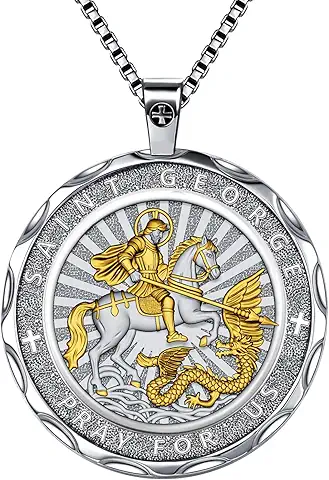
The Most Global Saint
The Global Saint: Every Nation and Tradition He Protects
No saint in Christian history is the patron of more nations, cities, and peoples than Saint George. The list is not simply impressive — it is geographically improbable, spanning from the British Isles to the Horn of Africa to the Caucasus to the Brazilian Amazon, encompassing Catholic, Orthodox, Coptic, Druze, and Muslim communities that have nothing else in common except their devotion to him. Each adoption has its own story.
🏴 England
Patron saint since the reign of Edward III (1348), who founded the Order of the Garter under his protection. His Cross became the flag of England. He never visited England.
🇬🇪 Georgia
Devotion since the 4th century. Exactly 365 Orthodox churches named after him — one per day of the year. The country's English name is a back-derivation from Saint George.
🇪🇹 Ethiopia
Patron of the Ethiopian Orthodox Church. His icon appears on churches, coins, and national emblems. Emperor Menelik invoked him before the Battle of Adwa (1896).
🇵🇹 Portugal
Devotion since the 12th century. King John I (1357–1433) made him patron; the king's image on horseback carried in Corpus Christi processions. The Portuguese Army motto invokes him.
🇪🇸 Catalonia & Aragon
Patron since King Peter I won the Battle of Alcoraz (1096) under his protection. Sant Jordi Day (April 23) is a cultural holiday in Barcelona: lovers exchange roses and books.
🇧🇬 Bulgaria
Praised as "liberator of captives, defender of the poor, physician of the sick." St. George's Day (Gergyovden, May 6) is a public holiday; a whole lamb is traditionally prepared.
🇷🇺 Russia & Moscow
George appears on the coat of arms of Moscow, depicted slaying the dragon. He is one of the most venerated military saints in Russian Orthodoxy.
🇱🇧 Beirut & Lebanon
Patron saint of Beirut and of Lebanese Christians. Venerated across Maronite, Greek Orthodox, and Greek Catholic communities throughout the Levant.
🇲🇹 Malta & Gozo
Patron of the island of Gozo; a horse race is held in his honor. According to local tradition, he appeared to assist the Maltese in battle against the Moors.
🇧🇷 Brazil & Rio de Janeiro
April 23 sees 5 AM masses, fireworks, and citywide celebrations in Rio. He is identified with the Yoruba warrior deity Ogum in Afro-Brazilian Candomblé and Umbanda traditions.
🇦🇲 Armenia
The monastery of Mughni (first mentioned 1278) holds his relics. In Georgian hagiography, Saint Nino — who Christianized Georgia — is described as his relative and is from the same Cappadocian region.
🌍 Patron of Soldiers & Boy Scouts
The worldwide patron of soldiers and of the Boy Scout Movement, which has held Saint George's Day parades since its founding years. The National Catholic Committee on Scouting uses him for awards and activities.
A Country and His Name
Georgia: The Country That May Bear His Name, and 365 Churches
The connection between Saint George and the country of Georgia in the Caucasus is one of the most remarkable instances of a saint's influence on world geography — and it is considerably more nuanced than the simple claim that "Georgia is named after Saint George."
The Georgian name for the country is Sakartvelo — which has nothing to do with George. The English name "Georgia" is what linguists call a back-formation: medieval Western European travelers, encountering a people whose most distinctive religious feature was their intense devotion to Saint George, began calling them "Georgians" — and that exonym, the Latinized form of the saint's name, eventually displaced the older Western terms for the country (Iberia, Colchis). The French chronicler Jacques de Vitry and the English traveler Sir John Mandeville both wrote explicitly that these people were called "Georgian" because they especially revere Saint George. The country did not receive its name from the saint; the saint's name was applied to the country by outsiders who identified the country's people primarily through their devotion to him.
The Georgian Orthodox Church commemorates Saint George twice a year: on May 6 (Julian Calendar April 23) and on November 23. The November feast is unique to Georgia — it was instituted by Saint Nino of Cappadocia, who brought Christianity to Georgia in the 4th century and who, in Georgian hagiography, is described as George's relative. Both saints are from Cappadocia. Both are foundational to Georgian Christianity. Saint Nino's Cross — two grapevines bound together — is the symbol of Georgian Orthodoxy.
An 18th-century Georgian geographer and historian, Vakhushti Bagrationi, wrote that there are exactly 365 Orthodox churches in Georgia named after Saint George — one for each day of the year. This figure is sometimes read as legendary, but the density of George-dedicated churches in Georgia is genuinely extraordinary and reflects a devotion that is organic to the culture rather than imposed. The 11th-century Cathedral of Saint George at the Alaverdi Monastery in Kakheti is one of the largest medieval churches in the Caucasus — a massive structure built in a country that was perpetually under military pressure from Persian, Arab, and later Mongol forces, and that consistently placed itself under the protection of the soldier-martyr from Cappadocia.
The Eastern Traditions
Mor Girgis: The Coptic and Syriac Traditions
In the Coptic Orthodox Church of Egypt, Saint George occupies a position unlike any other non-biblical figure in the calendar. He is Ra'is al-Shuhada — the Prince of Martyrs — a title that reflects both the extraordinary nature of his hagiographic tradition and the depth of popular devotion that has been continuous in Egypt since the 4th century. The Coptic version of his legend, based on a manuscript estimated to be from the 5th or 6th century and edited by the Egyptologist E. A. Wallis Budge in 1888, is among the oldest surviving written narratives about the saint and is the source of the seven-years, three-deaths, two-resurrections account that became standard across Eastern traditions.
In the Egyptian countryside, he is often called by a popular title that says everything about how his intercession is experienced: Sarie Al-Nadha — the "Quick to Answer." This is devotional testimony of the most practical kind: centuries of petitions offered and answered quickly enough that an entire regional epithet crystallized around the speed of his response. In the Syrian countryside, some communities call him Al-Khedr — a name shared with the mysterious figure in Islamic tradition associated with immortality and divine guidance, about whom more below. A church built in his honor in Sahwet Al-Khedr in Syria preserves this ancient naming.
The Syriac Christian tradition — the oldest Aramaic-language Christian communities of the Middle East, including the Maronites, the Syrian Orthodox, and the Syriac Catholics — has venerated Mor Girgis since the earliest centuries, as evidenced by the Syriac language itself giving the world the name by which Eastern Christians most commonly know him. The 6th-century Latin Passio was translated from a Greek text that was itself translated from a Syriac source around 600 AD — the Syriac tradition is therefore primary, not secondary, in the documentary record.
For those interested in the Maronite, Melkite, or Syriac Catholic traditions that have maintained this devotion continuously in the Middle East, see our overviews of the Melkite Greek Catholic Church and the Martyrs of Damascus, who died in the same land where George was venerated from the beginning.
The African Dimension
Ethiopia, the Battle of Adwa, and the Icon That Won a War
In Ethiopia, Saint George — Giorgis in Ge'ez — holds a place in national identity that goes well beyond religious devotion. He is the patron of the Ethiopian Orthodox Tewahedo Church, and his icon appears on churches, national emblems, coins, and public art throughout the country. The dragon-slaying motif is one of the most frequently used subjects in Ethiopian iconography — but in Ethiopia, the dragon beneath the saint's horse often carries a specifically national and historical weight that Western viewers may not immediately recognize.
The most resonant historical moment connecting Saint George to Ethiopia is the Battle of Adwa on March 1, 1896. Emperor Menelik II, facing an Italian colonial invasion that threatened to eliminate Ethiopia's independence, reportedly invoked the help of Saint George before leading his forces into battle. The Ethiopian army, vastly outnumbered in terms of modern weaponry, defeated the Italian force decisively — a victory so complete and so unexpected that it became the most celebrated event in modern African history, the first decisive defeat of a European colonial army by an African nation. Emperor Menelik attributed the victory to divine intervention, with Saint George specifically credited in popular tradition as having appeared on horseback on the battlefield to guide the Ethiopian troops. Ethiopian paintings depicting the Battle of Adwa frequently include Saint George as a supernatural participant in the fighting.
The Ethiopian connection to the oldest written traditions about Saint George is not accidental. The Nubian manuscript discovered at Qasr Ibrim — the oldest written narrative about George — was found in what was then the Christian kingdom of Nubia, directly connected to the Ethiopian world. The devotion was present in the African Christian sphere before it was fully developed anywhere in the West. For more on the Ethiopian biblical tradition, see The Ethiopian Bible vs. the Catholic Bible and the question of which is older.
The Interfaith Dimension
The Druze, the Muslims, and Al-Khidr: A Saint Across Religions
Saint George holds a distinction that almost no other Christian saint shares: he is actively venerated by communities that are not Christian. In the Levant — the region that includes modern Lebanon, Syria, Israel, Palestine, and Jordan — he has been venerated by Druze, Muslim, and Christian communities side by side, sometimes in the same shrines, for many centuries. This cross-religious veneration is not a modern ecumenical courtesy. It is an ancient pattern rooted in the specific religious geography of the Eastern Mediterranean.
In Islamic tradition, a figure called Al-Khidr (the Green One) appears in the Quran obliquely and more extensively in hadith and Sufi tradition — a mysterious, immortal figure associated with divine guidance, the source of living water, and the ability to appear suddenly where he is needed. Al-Khidr is not identified as Saint George in official Islamic theology, but in the popular religious traditions of the Levant, Anatolia, and parts of Central Asia, the two figures have been extensively conflated. Shrines dedicated to "Al-Khidr" in Syrian villages sometimes sit alongside or directly over older Christian shrines to George. The town of Sahwet Al-Khedr in Syria is named after the church built for Saint George there. Evliya Çelebi, the great 17th-century Ottoman traveler, records visiting what he describes as the tomb of "prophet George" in Diyarbakır, Turkey — treating him as a prophetic figure within an Islamic interpretive frame.
Among the Druze — the esoteric monotheistic tradition that emerged from Ismaili Islam in 11th-century Egypt and is now centered in Lebanon, Syria, and Israel — Saint George holds a particularly defined place. He is revered as a figure of divine protection and justice, and the reverence for him in Druze culture is described by scholars as "deeply integrated" rather than superficial borrowing. Wall paintings from the cave church complex of Kırk Dam Altı Kilise at Belisırma in Cappadocia, dated 1282–1304, depict George appearing between donors that include both a Georgian Christian noblewoman named Thamar and a Seljuk Turkish Muslim emir — with the Seljuk Sultan Mesud II and the Byzantine Emperor Andronicus II both named in the inscriptions. The same saint, honored by the Byzantine emperor and the Seljuk sultan, in the same painting, in George's own homeland.
The pattern this documents is not religious confusion. It is the recognition, across communities that disagree about nearly everything, that something in George's story — the refusal of power, the endurance under cruelty, the protection of the vulnerable, the victory over death — speaks to something universal in human religious experience that is not bounded by the doctrinal categories that divide the Abrahamic traditions.
Across World Cultures
Barcelona's Roses, Brazil's Ogum, and the Boy Scouts
The global reach of Saint George's presence in secular culture is unlike any other martyr in Christian history — a testament to how a figure absorbed into so many national identities eventually becomes a cultural as well as a religious possession.
Barcelona: Roses and Books on April 23
In Catalonia, Spain, Sant Jordi Day (April 23) is a major cultural holiday in which lovers exchange gifts of red roses — connected to the George legend, in which roses sprang from the dragon's blood — and books. The books are explained by an astronomical coincidence: April 23 is the date both Miguel de Cervantes and William Shakespeare died (in 1616), making it a day UNESCO has designated World Book Day. Barcelona closes its major streets to cars; booksellers and rose vendors fill the Ramblas; the day is described by Catalans as their Valentine's Day, though with considerably more literary ambition. It is one of the most charming secular evolutions of a saint's feast day anywhere in the world.
Brazil: Ogum and São Jorge in Candomblé and Umbanda
In Brazil — the country with the world's largest Catholic population — Saint George is extraordinarily popular, especially in Rio de Janeiro. April 23 is a local holiday in Rio, with 5 AM masses, fireworks, and citywide celebrations. But the most remarkable dimension of his Brazilian presence is his identification, in the Afro-Brazilian religious traditions of Candomblé and Umbanda, with Ogum — the Yoruba warrior deity, the orisha of iron, warfare, and protection, brought to Brazil by enslaved Africans. In these traditions, which blend African religious practice with Catholic devotion, the image of São Jorge on horseback with his sword and lance is used for prayers directed to Ogum. The soldier-saint of Cappadocia and the warrior deity of the Yoruba, recognized as one in the spiritual imagination of millions of Brazilians — a convergence that no one planned and no theologian endorsed, but which has been spiritually functional in Brazilian culture for centuries.
The Order of the Garter and the Boy Scouts
The Order of the Garter — founded by Edward III of England in 1348, still in existence, still limited to 24 knights plus the sovereign — is the oldest and most prestigious chivalric order in the world, and it has been under the patronage of Saint George from its founding. The motto of the Order, Honi soit qui mal y pense ("Shame on him who thinks evil of it"), and its emblem, the Cross of Saint George, have been the symbolic foundation of the English establishment's highest honor for nearly 700 years. The Garter service at Windsor Castle on the Monday of Royal Ascot week remains one of the most elaborate ceremonial occasions in the British calendar. And when the Boy Scout Movement was founded by Robert Baden-Powell in 1908 — specifically to produce courageous, morally upright young men — Saint George was chosen as its patron from the beginning. The worldwide Scout movement has held Saint George's Day parades since its first years.
Prayer and Practice
Patronage, Prayer, and How to Invoke Saint George
Saint George is invoked across traditions for a consistent cluster of needs: spiritual protection (especially against demonic influence), physical courage in the face of danger, strength under suffering, and protection in battle — understood both literally for soldiers and figuratively for anyone in a season of spiritual warfare. The Eastern tradition adds his protection against skin diseases and fevers, reflecting his centuries-long veneration in the hot climates where his cult was most intense.
In the Eastern Orthodox Church, he is celebrated on April 23 (Old Style; May 6 on the Gregorian Calendar), with the Georgian Orthodox Church adding a second feast on November 23. He is commemorated in the general calendar as a Great Martyr and Trophy-Bearer. In the Roman Catholic Church, he was on the Universal Calendar until the reforms following the Second Vatican Council removed him; Pope John Paul II restored him to the Universal Calendar in 2000, where he now appears as a memorial. The Coptic Orthodox Church celebrates his martyrdom on Miyazya 23 (May 1) and the consecration of his first church on Hidar 7 (November 16). George is also one of the Fourteen Holy Helpers in Catholic tradition — the group of saints specifically invoked against diseases, in emergencies, and at the hour of death.
Questions About Saint George
The Saint Who Belongs to Everyone
Seventeen centuries after his beheading in Palestine, Saint George is venerated in more countries, by more communities, across more religious and cultural lines than any other figure in Christian history who was not the founder of the faith itself. The man who stood before the most powerful emperor in the world and quietly said "I am a soldier of Jesus Christ" has been claimed by English kings, Ethiopian emperors, Syriac monks, Georgian mountain peoples, Brazilian favela communities, and Boy Scouts on six continents. He has been painted in Cappadocian caves, carved on the walls of Lalibela, and set in gold on the breast of every knight of the Order of the Garter. His head is in Rome. His body is in Lydda. His intercession is everywhere.
What explains this reach is not the dragon. The dragon came late. What explains it is the core act: a young man with everything to lose, standing before everything that wanted him to be quiet, refusing. That is a story that belongs to every tradition, every century, and every person who has ever had to decide whether the faith is worth the cost. His answer, for seventeen centuries, has been: yes. Every time. Without exception.
Browse All Orthodox & Catholic Prayer Cards →