Saint Mary of Egypt: The Complete Biography
Eastern Orthodox • Catholic • Coptic • 5th–6th Century • Desert Ascetic
Saint Mary of Egypt: The Most Complete Biography — Hidden History, Miracles, and the Full Tradition
She walked on water. She levitated in prayer. She was illiterate — yet quoted Scripture from memory. She was baptized as a child but spent seventeen years in deliberate sin before a moment at a locked door changed everything. This is the story most accounts don't fully tell.
At a Glance
- Born
- c. 344 AD (Catholic tradition) or c. 460 AD (Orthodox tradition), Province of Egypt
- Feast Days
- April 1 (repose); Fifth Sunday of Great Lent; Holy Thursday (Great Canon)
- Tradition
- Eastern Orthodox, Byzantine Catholic, Roman Catholic, Coptic Orthodox
- Key Miracles
- Levitation, walking on water, clairvoyance, miraculous transport of body after death
- Patron
- Converts, chastity, those struggling with sexual sin, against skin diseases
- Lesser-Known Fact
- St. John of Damascus cited the specific icon she prayed before in his formal defense of holy icons
- In Secular Culture
- One of three penitent saints in Goethe's Faust; set by Mahler in his 8th Symphony
- Primary Source
- St. Sophronius of Jerusalem, c. 634 AD, from testimony of monk in Zosimas's monastery
Who Was She, Really? The Problem of the Sources
Most accounts of Saint Mary of Egypt begin with her birth in Egypt and her flight to Alexandria at age twelve. This article begins somewhere more honest: with the problem of knowing who she was at all, because the historical layers beneath the famous story are more interesting — and more theologically significant — than the polished surface most retellings present.
The primary source is the Life of Our Holy Mother Mary of Egypt, attributed to St. Sophronius of Jerusalem, who served as Patriarch from 634 to 638 AD. Sophronius himself states explicitly that he heard the account from a monk at the monastery where Zosimas had lived, and that this account had never been previously set down in writing. He vouches for it personally. The document was significant enough to be read into the official record at the Second Council of Nicaea in 787 — an ecumenical council of the whole Church — which means it was accepted as credible witness before an assembled hierarchy of bishops. The earliest physical manuscript we possess dates to the 9th century, but by then the text was already old enough to have been translated into Latin by Paul the Deacon in the 8th century. The National Library of Athens alone preserves 27 manuscripts; the Bibliothèque Nationale in Paris holds 37; and numerous others are scattered across the libraries of Mount Athos, Mount Sinai, the Vatican, Oxford, and Cambridge. The sheer number signals a popularity almost unmatched in the hagiographic tradition.
But there is an earlier thread. Cyril of Scythopolis, writing before Sophronius, records in the Life of St. Cyriakus an encounter with a woman named Mary living as a hermitess in the Judean desert, who told Cyriakus she had been a famous singer and actress who had sinned and was doing penance. When Cyriakus returned to find her, she was dead. This earlier account has the same broad contours — a woman named Mary, an ascetic life in the Judean desert, a penitent past in public entertainment — but different specific details. Sophronius goes out of his way to address skeptics who might see his account as dependent on these earlier traditions, insisting that what he recorded had never been set down before and that he would never fabricate a holy tale at the risk of his own soul. Catholic scholars, including the Bollandists, have placed the two accounts as representing different women or different stages of a growing tradition.
The dating presents its own complexity. The Bollandists proposed a death date of April 1, 421 AD — placing Mary in the early 5th century. The Orthodox tradition, drawing on internal evidence from the Synaxarion's reference to Zosimas living during the reign of Emperor Theodosius II (408–450), accepts roughly the same era. But the OrthodoxWiki tradition and other Eastern sources date her death to 522 AD, placing her life in the late 5th and early 6th century. The mathematical analysis of her death date, described later in this article, narrows the field considerably and suggests a date between 527 and 549 AD at the earliest given the calendar evidence. What is not in dispute: she existed, her Life was historically treated as credible witness, and the specific physical objects associated with her story — the icon she prayed before, the church where she received communion — were documented independently by contemporary pilgrims.
Most online retellings of Mary of Egypt spend more time on the lurid details of her early life than on the forty-seven years that followed — which is the inverse of what the text itself does. The Life treats her past briefly and her transformation at length. This article follows the text's own priorities: the sin is the context, not the subject. The subject is what God did with a soul that had gone as far from Him as it is possible to go.
The Historical Context
Alexandria: What That Life Actually Meant
Mary ran away from her family in Egypt at the age of twelve and went to Alexandria. To understand what that meant, you need to understand what Alexandria was in the 5th or 6th century: one of the greatest cities in the world, the intellectual capital of late antiquity, home to one of the seven wonders of the ancient world, seat of a Patriarch, and a city of staggering contrasts — Christian monasteries and pagan philosophical schools existing in the same streets, wealth and squalor within walking distance of each other, and a port through which the commerce of the Mediterranean flowed.
It was also a city in which a twelve-year-old girl who had run away from home had few options. The text is careful about what it says here. It says that Mary "led a life of public prostitution." But it then adds a detail that most retellings either omit or gloss over: she never accepted payment. The Life of Mary of Egypt states explicitly that she survived not by receiving money for sex but by begging and by spinning coarse flax fibers. What the text describes is not prostitution in the economic sense — a woman trading her body for survival — but something the hagiographer characterizes as pure appetite, the complete domination of a person by their own desires. "Not for payment," the text says. "For the love of it." This distinction matters for understanding the theological point the text is making: this was not desperation or coercion but a complete surrender to passion as an organizing principle of life.
She lived this way for seventeen years — from age twelve to age twenty-nine. This is the number the text establishes, and it is one of several significant numerological parallels the story contains: seventeen years in sin, and then seventeen years of agonizing spiritual battle in the desert before peace was found. The symmetry is almost certainly intentional, a feature of the theological architecture of the Life rather than a coincidence.
One almost universally overlooked fact: Mary was almost certainly baptized as an infant or child in Egypt, long before her flight to Alexandria. When she recounts her life to Zosimas, she says "I am protected by Holy Baptism" — and uses the tense and framing of something received earlier, not something she received at conversion. This means she was a baptized Christian throughout her seventeen years in Alexandria. The faith she had received in childhood remained with her somewhere beneath the surface, unacted upon, until a locked church door in Jerusalem broke through it entirely. Her first prayer of repentance, in the porch of the Church of the Holy Sepulchre, was addressed directly to the Virgin Mary — the instinct of someone with a remembered faith, not a person encountering Christianity for the first time.
The Turning Point
The Conversion: What the Sources Actually Say
At twenty-nine years old, Mary of Egypt encountered a group of young men at the port of Alexandria preparing to sail to Jerusalem. The occasion was the Feast of the Exaltation of the Holy Cross — September 14th. She joined the voyage not out of religious feeling but for the same reason she did everything: to find more men. The Life records that she spent the sea voyage seducing the other passengers, repeatedly and shamelessly. When the ship arrived in the Holy Land, she followed the crowd of pilgrims toward the Church of the Holy Sepulchre.
What happened next is the theological center of the entire story. At the door of the church — the specific entrance to the section housing the relic of the True Cross — Mary found that she could not enter. Not because a guard stopped her. Not because of any human obstacle. An invisible force pushed her back, three times, then a fourth. The people around her walked in with no difficulty. Something barred the entrance specifically to her.
In the outer porch of the church, she stood and wept — and then noticed an icon of the Virgin Mary hanging "on a raised place" in the courtyard before the Church of Constantine. She prayed to it. The text records her prayer in detail: she begged the Mother of God to intercede for her, to allow her to enter and venerate the Cross, acknowledging that she was unworthy and that her impurity was the barrier. She promised that if she were granted entrance, she would renounce the world and go wherever the Theotokos directed her. Then she tried the door again — and walked straight in, with no difficulty at all.
She venerated the Cross. She returned to the icon. And she heard a voice: "If you cross the Jordan, you will find rest."
That same evening she reached the Jordan River. On the way, a stranger gave her three coins, with which she bought three small loaves of bread — the only food she would bring into the desert. She arrived at a church on the riverbank dedicated to St. John the Baptist, where she washed herself in the Jordan and received Holy Communion. This church, built by Emperor Anastasios I between 491 and 518 AD, stood approximately eight kilometers north of the Dead Sea at the traditional site of Christ's baptism by John. That she received Communion here — at the very place where the Jordan's salvific significance was first established in the New Testament — is a detail the tradition does not leave unremarked.
The next morning she crossed the Jordan and walked into the desert. She was twenty-nine years old. She would not see another human being for forty-seven years.
The Historical Anchor
The Icon She Prayed Before: The Detail That Changes Everything
One of the most historically significant and almost entirely overlooked aspects of the Mary of Egypt story is the specific, physically documented icon before which she prayed in Jerusalem. This is not a detail invented by Sophronius. It is a detail independently confirmed by multiple sources — and it was cited by one of the greatest theologians in Christian history in the middle of one of the most consequential theological controversies of the early Church.
The icon was displayed "on a raised place" in the courtyard before the Church of Constantine at the Church of the Holy Sepulchre complex. The Piacenza Pilgrim — a Western traveler who visited Jerusalem around 570 AD, well before Sophronius wrote the Life — mentions this icon in his travel account. Epiphanios the Monk, writing in the 8th century, was even more specific: he records having personally seen, on the left side of the Church of Saint Constantine, "the icon of the Most-holy Theotokos, who forbade Saint Mary to enter the church on the day of the Exaltation." This eyewitness pilgrimage testimony confirms the icon was a real, known, physically present object that was already being identified with the Mary of Egypt story by at least the 8th century.
But the most theologically significant reference comes from St. John of Damascus himself — the great 8th-century Doctor of the Church and systematic theologian of the East. In his formal theological defense of holy icons, written during the Iconoclast controversy when the very use of images in worship was being debated at the highest levels of the Church, John of Damascus cited this specific icon — the icon before which Mary of Egypt prayed — as an example of the legitimate veneration of icons and their spiritual efficacy. He was making a doctrinal argument using this icon as evidence.
This citation by John of Damascus has a remarkable implication that is almost never pointed out: it means that at the precise moment when the Church was defending the theological legitimacy of icons, the story of Mary of Egypt — and specifically the moment of her conversion, mediated through her prayer before an icon of the Theotokos — was being used as a concrete example of why icons matter. The locked door, the weeping, the prayer to the icon, the opened door: this was not treated as hagiographic embellishment but as a real-world demonstration of the spiritual reality at the center of the iconoclast debate. Mary of Egypt's conversion was, in effect, icon theology in practice.
The icon is documented before Sophronius wrote the Life. The Piacenza Pilgrim visited Jerusalem around 570 AD and mentions the icon in the courtyard. Sophronius composed the Life around 634 AD. This means the icon's identification with the Mary of Egypt story predates the standard written text by at least sixty years.
St. John of Damascus cited it in a formal theological argument. He was not retelling hagiography. He was making a doctrinal case in the middle of a major ecclesiastical controversy. The use of the icon in that context presupposes that his audience would recognize and accept its story as credible.
The Life was read at the Second Council of Nicaea (787). An ecumenical council read this text into its formal proceedings. Whatever questions scholars have raised about the literary genre of hagiography, the bishops assembled at Nicaea treated this account as legitimate testimony.
Part I
Forty-Seven Years in the Desert: What the Life Actually Records
Mary crossed the Jordan at age twenty-nine with three small loaves of bread and no other provision. The Life records that the bread lasted for approximately seventeen years — a claim that is not presented as a supernatural extension but simply as a fact of her extremely sparse diet. After the bread was gone, she ate whatever herbs and plants she could find in the desert. She drank from whatever water sources she encountered. She had no shelter, no clothing, no community, and no human contact for the entire forty-seven years she spent on the far side of the Jordan.
The desert did terrible things to her body. The intense sun blackened her skin. The extremes of temperature stripped her hair to a white that Zosimas initially mistook, at a distance, for bleached wool. Her body became emaciated to the point that her age was unguessable — he saw her at seventy-six but could not have estimated it. Her skin burned and cracked. The physical description in the Life is of a person who had willingly accepted total material destitution as a form of penance, and whose body showed every year of it.
But what the desert also did to her interior life is the point the text insists on at length. For the first seventeen years — again, the mirror image of her seventeen years in Alexandria — she was tormented by desires. The Life records her own account of this in words that have the ring of genuine spiritual autobiography: "For the first seventeen years in this wilderness, I struggled with my deranged lusts as though with fierce beasts. I desired to eat meat and fish, which I had in abundance in Egypt. I also desired to drink wine, and here I did not have even water to drink. I desired to hear lustful songs. I cried and beat my breast." The temptations were not vague spiritual discomforts. They were specific, sensory, and relentless — the memories of her former life pressing back against the desert silence with physical force.
Her resource against these temptations, she told Zosimas, was prayer to the Mother of God. "When I had sufficiently wept and beat my breast, it was then that I saw a light encompassing me on all sides, and a certain miraculous peace filled me." After seventeen years, the passions subsided. What remained was a different kind of person — one who, by the time Zosimas encountered her, quoted scripture with a depth and fluency that astonished a priest-monk who had been in a monastery since infancy, and who possessed gifts of spiritual perception that no amount of formal religious training produces.
The Transformation of the Body: What Physical Asceticism Produced
The Eastern Christian tradition has always insisted that the body participates in salvation — that ascetic practice is not a rejection of the physical but a reorientation of it. The transformation of Mary of Egypt's body over forty-seven years in the desert is one of the tradition's most vivid examples of this principle. The body that had once been entirely subordinated to appetite became, over decades, entirely subordinated to prayer. The same physicality that had driven her through Alexandria's streets eventually levitated above the desert floor during prayer.
Her body's transformation was visible to Zosimas in ways that went beyond simple aging. He observed a woman whose physical condition was extreme — dark, gaunt, nearly skeletal — but who moved with an authority and calm that had nothing to do with physical comfort. When she prayed, she rose from the ground. Her face, by his account, radiated something. She was naked but not ashamed; not because shame had become irrelevant but because the categories that had once organized her identity around her body had been entirely replaced.
The tradition also notes that she had learned scripture without having ever been taught it. She was illiterate — this is explicit in the Life — yet she spoke at length about the Psalms, the Pentateuch, the words of the prophets, as if she had studied them her whole life. When Zosimas asked where she had learned these things, she replied that she had been taught not by books but by "the living Word." Whatever one makes of this as a supernatural claim, the text presents it as one of the most clear markers of her transformation: the woman who had learned everything through her body had been given, through the body's purgation, access to a form of knowledge that transcended what the body can acquire.
The Encounter
The Encounter with Zosimas: What the Monk Found in the Desert
To understand the encounter with Zosimas, you need to understand the monastic tradition he came from. There was a custom, established by St. Euthymios the Great in the early 5th century and later moved to Lent by St. Savvas the Sanctified, in which the monks of certain Palestinian monasteries would spend the whole of Great Lent in the innermost desert, departing after the feast of the Theophany and returning only for Holy Week. They went alone, with minimal food and water, in imitation of Christ's forty days in the wilderness. This custom was specifically associated with the monasteries near the Jordan River.
Zosimas was a monk of one of these monasteries, and by the time the encounter with Mary occurred, he was a man approaching a spiritual crisis of a particular kind: he had been a monk since infancy, was widely respected, had practiced every form of asceticism known to the tradition — and had begun to wonder whether there was anyone left who could teach him anything. This is not a small temptation in the spiritual life, and the text is quite explicit that it was Zosimas's most dangerous hour. An angel directed him to the monastery on the Jordan River, where this custom of desert solitude was practiced, as the specific cure for his spiritual complacency.
About twenty days into his Lenten desert retreat, at his customary hour of prayer, Zosimas saw a figure at the edge of his vision — a form he initially thought might be a demon or a ghost. It was a human body, but barely recognizable as one: black-skinned from decades of sun, white-haired, and completely naked. It fled. He ran after it, calling out. It stopped, hid in a gully, and said in a voice: "Forgive me, Abba Zosimas — I am a woman and I am naked. Throw me your garment so I can cover myself and you can give me your blessing."
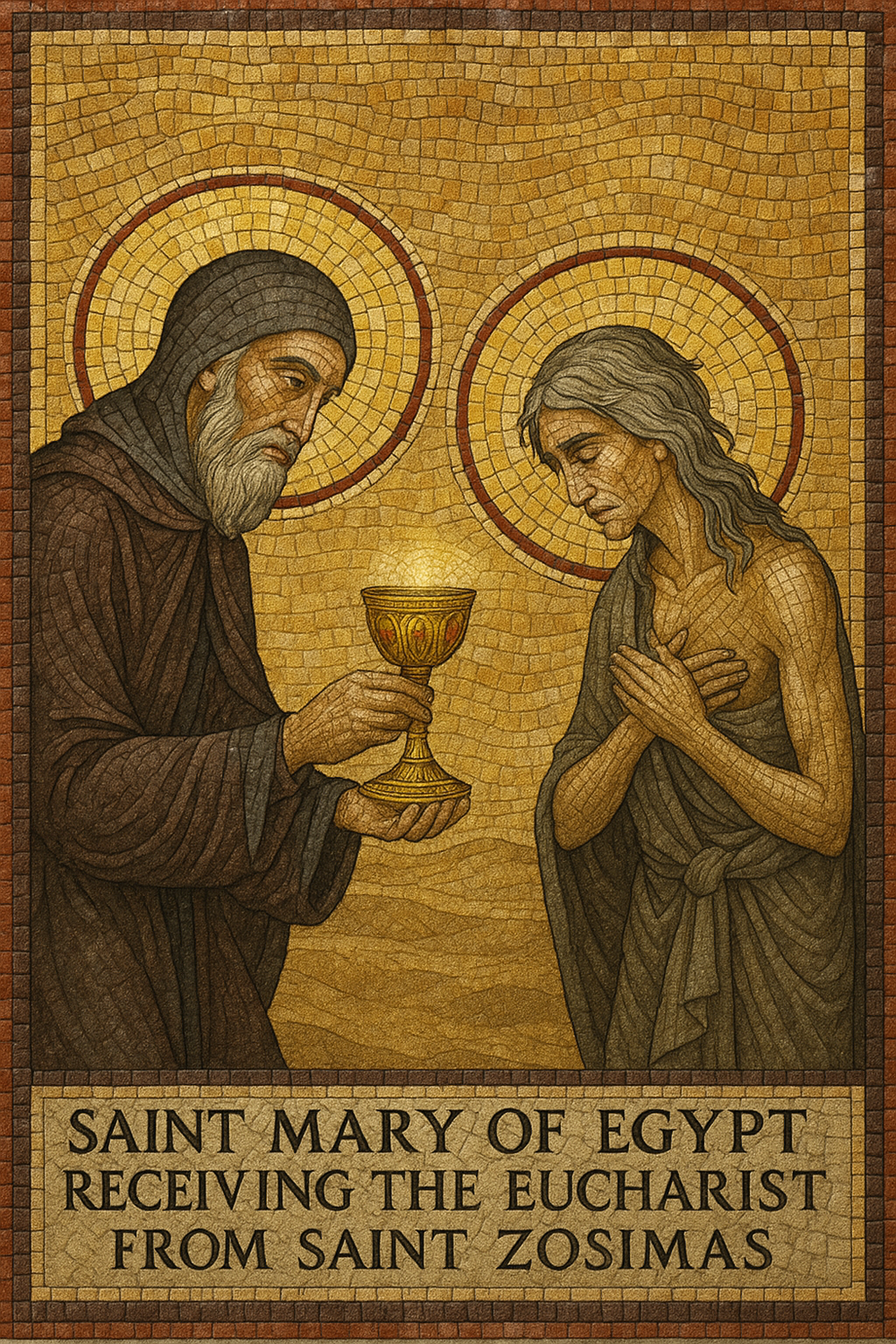
The detail that she called him by name is noted explicitly in the text and is one of the documented miracles. He had never seen her before. She had never seen him. She knew not only his name but that he was a priest, and she rebuked him gently when he tried to bow to her — "You are carrying the Holy Mysteries," she said. "A priest should not bow to me."
What followed was a confession of extraordinary length and intimacy. Mary recounted her entire life in the desert to Zosimas, weeping as she did — her years in Alexandria, her shameless sea voyage, the locked door, the icon, the voice, the crossing. She asked him to return the following year, on Holy Thursday, to the bank of the Jordan with the Holy Eucharist. She needed Communion. Everything she had done for forty-seven years had been moving toward that moment, and she could feel that her remaining time was short.
The Supernatural Record
Miracles, Gifts, and the Unknown Gifts
The Life of Mary of Egypt records a cluster of supernatural gifts and events that are individually documented and collectively remarkable. They are not scattered throughout a long hagiographic narrative for dramatic effect; they are concentrated around the two encounters with Zosimas, and each one is presented as something Zosimas witnessed directly and later reported.
Levitation During Prayer
When Mary finished recounting her story to Zosimas and rose to pray, Zosimas saw her rise from the ground — hovering about a forearm's length above the earth, her hands extended in the orante position. He fell to his face, crying "Lord, have mercy." The text presents this levitation not as a stunt or a display but as the overflow of what her prayer life had become after forty-seven years: the body following the soul in its orientation toward God. Eastern hagiography from this period and later documents this phenomenon in several desert ascetics — St. Mary of Egypt is among the most clearly attested cases. It was precisely the kind of phenomenon that Zosimas found most difficult to process, because it was not something he had seen despite a lifetime in monasteries. The woman who had spent seventeen years in sin had, by sheer persistence in prayer and fasting, arrived at a place of interior life that had eluded him completely.
The Second Gift — Walking on the Waters of the Jordan
Walking on the Jordan River
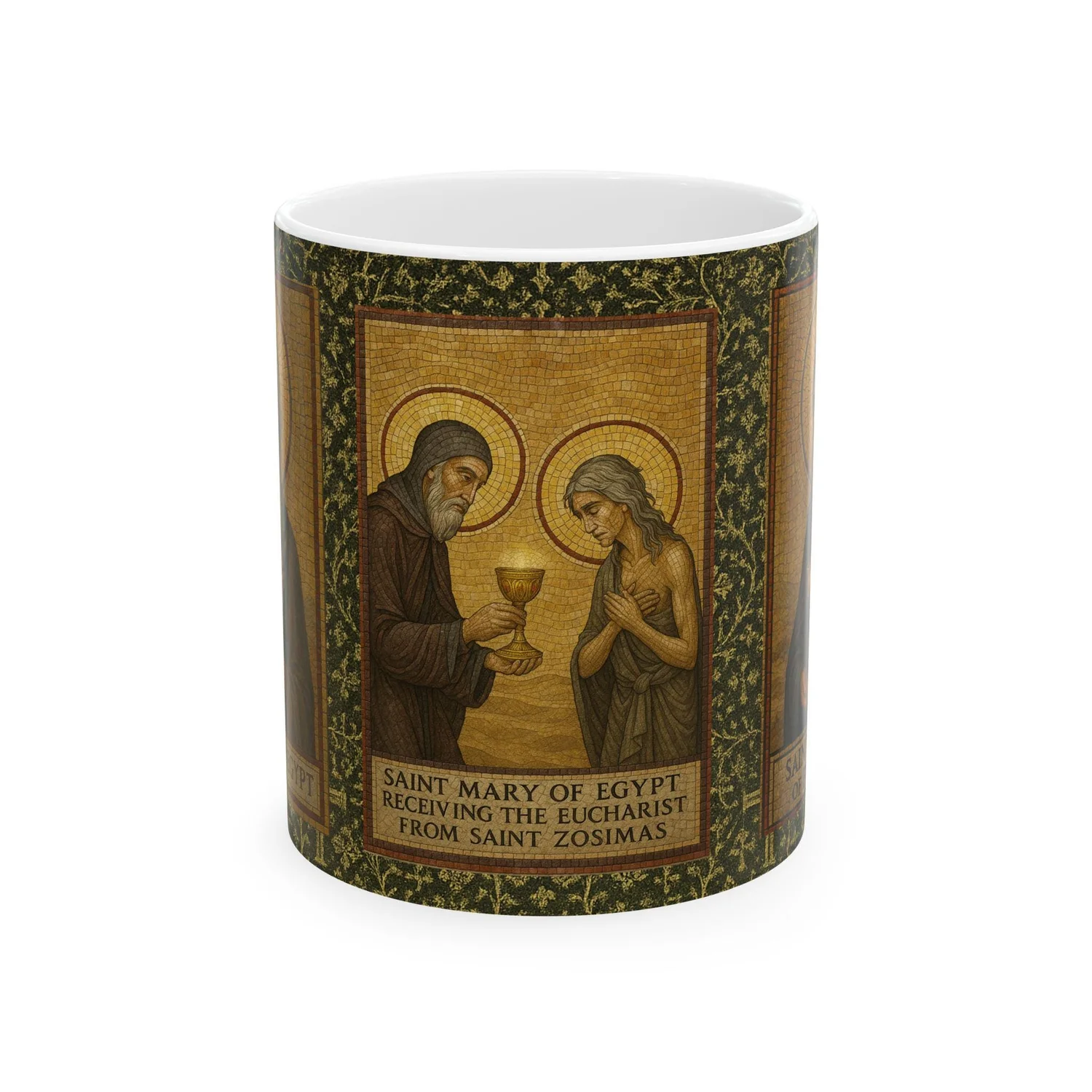
At the second meeting the following Holy Thursday, Zosimas stood on the western bank of the Jordan with the Holy Eucharist as requested, and watched in the light of the moon as Mary appeared on the far eastern bank. He had been wondering how she would cross — the river was not shallow. He watched her make the sign of the Cross over the water, step onto its surface, and walk across as if on dry land. She received Communion from him, said the Prayer of Simeon ("Lord, now lettest Thou thy servant depart in peace"), and walked back across the Jordan the same way. Zosimas did not move for a long time after. The text records him "filled with joy and terror" — a phrase that in Eastern spiritual writing is essentially the definition of encountering the holy. He had just administered the Body and Blood of Christ to a woman who had walked across a river to receive it.
What makes this episode particularly striking in the context of the whole story is the role of the Jordan River in Jewish and Christian sacred geography. The Israelites crossed the Jordan to enter the Promised Land. Jesus was baptized in the Jordan. John the Baptist preached on its banks. Mary had originally crossed the Jordan on foot on dry land after her conversion — walking from the western, human world into the eastern, desert wilderness. Now she crossed it on the water to return briefly to the sacramental life of the Church, and then walked back into the desert to die. The Jordan marks every transition in her sacred biography.
The Third Gift — Knowing Without Learning
Clairvoyance and Knowledge of Scripture Without Study
Zosimas was a priest-monk who had spent his entire life — from infancy — in monasteries, studying the scriptures and the Fathers. He was himself a respected spiritual guide to whom others came for counsel. When Mary began to speak, she quoted the Psalms, the prophetic books, and other scriptures with a fluency and depth that stopped him. He asked her directly: where had she learned these things? She answered that she had learned them not from books — she could not read — but that "the living Word" had taught her. This is the kind of answer that is easy to dismiss and impossible to explain away within the logic of the story. An illiterate woman who had spent seventeen years in Alexandria doing nothing remotely connected to religious education was displaying a knowledge of scripture that surpassed that of a trained monk. Whatever the source, Zosimas accepted it as genuine without requiring further explanation.
Her clairvoyance was specific and verifiable. She called him by his name at their first meeting. She described the condition and customs of his monastery accurately without having been told anything about it. She told him that the following Lent he would be unable to come to the desert because of illness — and when the following Lent came, Zosimas was indeed laid up sick, unable to leave the monastery. Each of these details, attested by Zosimas himself and transmitted through the monks of his community, was specific enough to be confirmed or disconfirmed by the people who knew him.
The End of the Story
Death, the Lion, and the Miraculous Burial
After receiving Communion on Holy Thursday — reciting the Prayer of Simeon ("Lord, now lettest Thou thy servant depart in peace, according to Thy word, for mine eyes have seen Thy salvation") — Mary walked back across the Jordan and returned to the far side of the desert. Zosimas did not see her again until the following year, when he returned to the spot of their first encounter as she had instructed. He found her body lying there, her hands crossed over her chest, her face turned toward the East. She was dead.
Beside her head, written in the earth, was an inscription: "Abba Zosimas, bury here the body of the humble Mary. Render to dust what is dust. And pray to the Lord for me who departed from the world in the month of Pharmuthi according to Egyptian reckoning, on the first day, in the very night of the saving Passion of Christ, after having partaken of the Divine Mysteries."
The inscription established that she had died on the night of Holy Thursday — the very night she received Communion from Zosimas. Her body had been miraculously transported, in the months between her death and Zosimas's arrival, a distance of approximately twenty days' journey from the place where she had received Communion on the Jordan's western bank to the place where she and Zosimas had first met — deep in the eastern desert. The body was incorrupt.
The inscription also told Zosimas her name for the first time. Throughout the entire encounter the previous year, she had never told him what she was called. He learned her name only from the message written in the sand after her death. That she, an illiterate woman, left a legible inscription is noted explicitly in the tradition as one of the miracles associated with her death.
Zosimas began to dig her grave — and found the ground too hard for his old hands. Then a lion appeared from the desert. This detail — a wild animal emerging to assist with a desert saint's burial — is not unique to the Mary of Egypt tradition. The same motif appears in the Life of St. Paul of Thebes (where Antony the Great was assisted by two lions in burying Paul) and in other desert hagiography. The tradition reads these episodes not as isolated miracles but as theological statements: the desert, in the tradition of the Desert Fathers, is a place where the original ordering of creation can briefly reassert itself, where the fear that entered human-animal relations after the Fall can be suspended. The lion that helped bury Mary is the same lion that lies down with the lamb in Isaiah's vision. It is not a miraculous exception to the natural order. It is a glimpse of the restored one.
The inscription stated she died on April 1, which was a Holy Thursday. Easter that year therefore fell on April 4. Using the Julian Calendar, a perpetual calendar search identifies the years where April 1 falls on a Thursday and Easter falls on April 4 as: 443, 454, 527, 538, and 549 AD.
Cross-referencing with her chronology: If she was born around 344 and entered the desert at 29 (around 373), died after 47 years (around 421), the Bollandists' date of April 1, 421 is not among the perpetual calendar matches — suggesting either the age calculations contain some error or that the Orthodox tradition's later dating (5th–6th century) is more accurate.
The strongest candidates from the combined evidence are 527 or 538 AD — consistent with the Orthodox dating, placing her death in the reign of Justinian I, with her conversion occurring around 480–490 AD.
The Textual Record
The Manuscript Tradition: What Scholars Found in the Archives
The literary afterlife of the Life of Mary of Egypt is itself a remarkable document of the story's hold on Christian imagination across cultures and centuries. Its survival is not passive — it was actively copied, translated, read aloud, set to music, painted, carved in stone, and woven into the central liturgical structures of both Eastern and Western Christianity with a thoroughness that few hagiographic texts can match.
Paul the Deacon — the 8th-century Lombard scholar who is better known for his Historia Langobardorum and for his role in the Carolingian court — translated the Life into Latin, bringing it to Western European audiences who would otherwise have had no access to a Greek text. This translation was the bridge through which the Mary of Egypt story reached the medieval West and eventually produced the visual culture described in the next section. The Latin translation entered the liturgical reading cycles of Western monasteries and circulated through the same channels as the Lives of the Desert Fathers — a tradition that Western monks saw as directly relevant to their own vocation.
The Greek manuscript tradition is extraordinary in its breadth. The National Library of Athens preserves 27 manuscripts of the Life. The Bibliothèque Nationale in Paris holds 37. Significant collections exist at the monasteries of Mount Athos and Mount Sinai, the Vatican Library, the Bodleian Library at Oxford, and Cambridge University Library. The earliest surviving manuscript dates to the 9th century. The sheer number — conservatively over 100 known manuscripts — places the Life of Mary of Egypt among the most widely copied texts in the entire Byzantine hagiographic tradition, comparable in manuscript density to some of the most popular theological and liturgical texts of the era.
The Council of Nicaea read-in is a particular form of attestation. The Second Council of Nicaea in 787, convened to resolve the Iconoclast controversy and restore the veneration of holy icons, formally incorporated the reading of the Life of Mary of Egypt into its proceedings at the Fourth Session. This was not liturgical ceremony. It was the assembled bishops of the Church accepting the account as credible testimony relevant to their theological deliberations — specifically, as we noted above, because of the role of the icon in Mary's conversion. A text read into an ecumenical council's official record carries a form of ecclesiastical weight that no popular circulation can replicate.
Mary in the Western Tradition
Mary of Egypt in Western Art, Goethe, and Mahler
The Western reception of Mary of Egypt is a fascinatingly different story from the Eastern one — shaped by translation, by popular appeal, and by the persistent tendency of medieval Western artists to conflate her with Mary Magdalene. Understanding this conflation explains why so many Western images of Mary of Egypt look startlingly different from Eastern icons, and why the two visual traditions are almost irreconcilable.
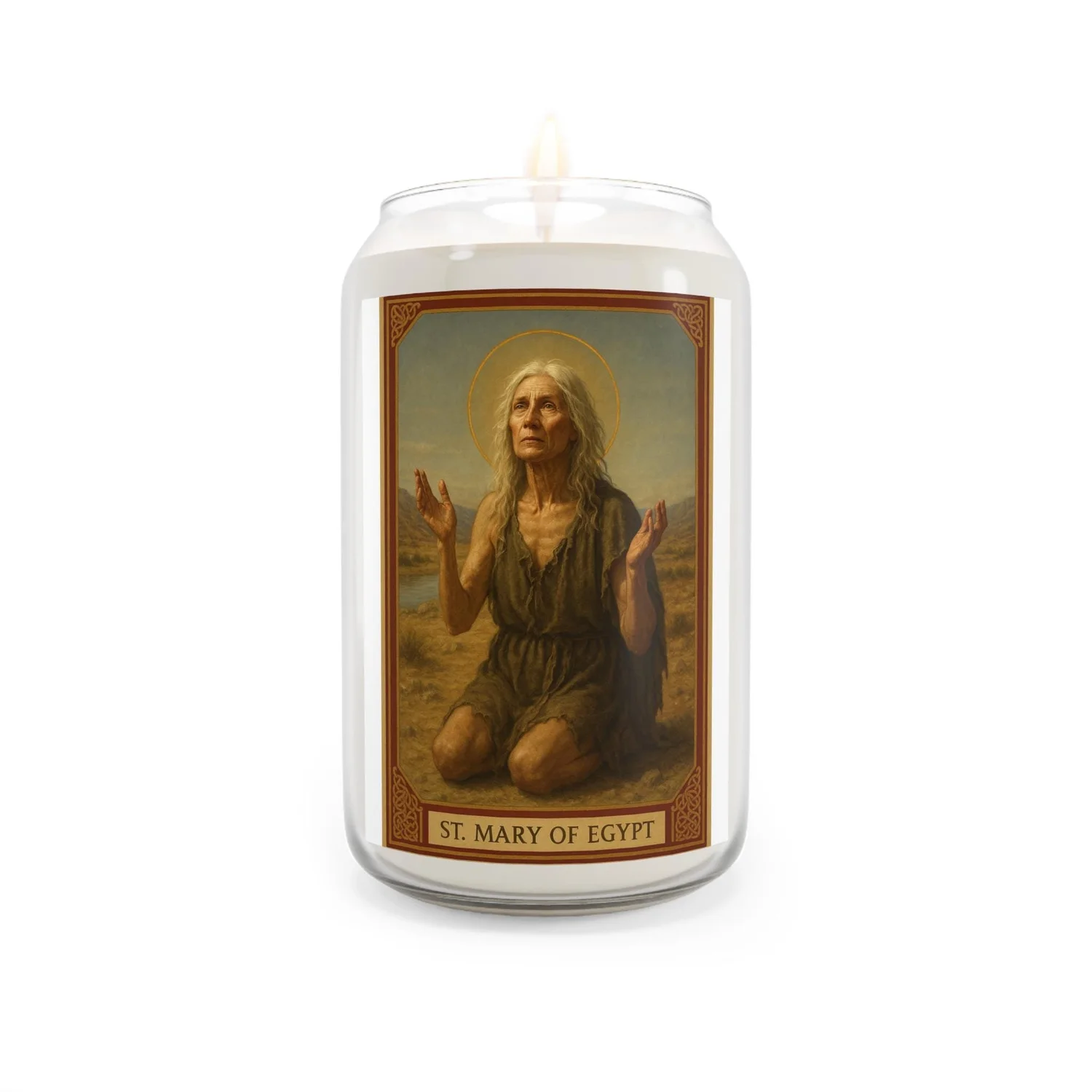
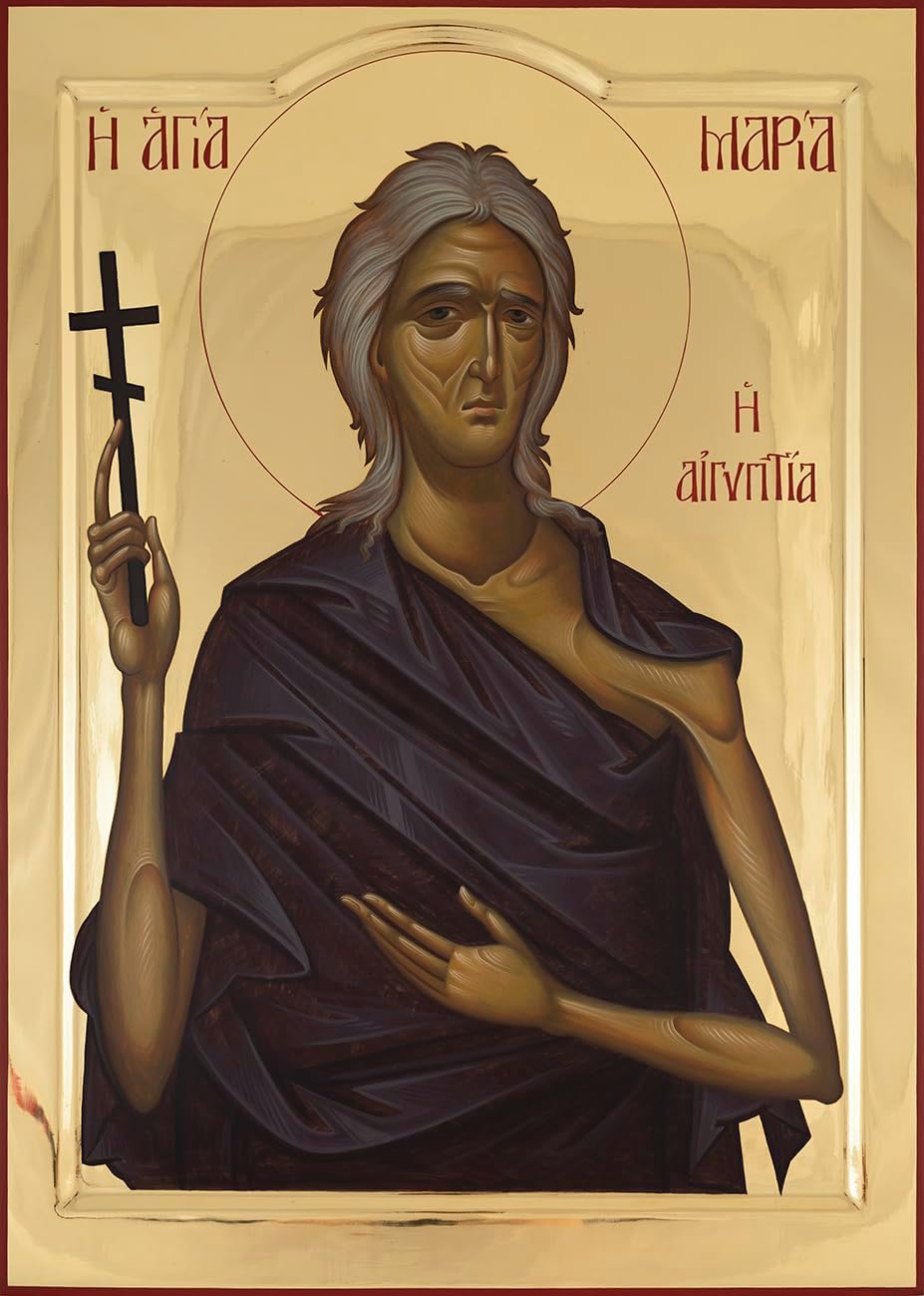
In Eastern iconography — Orthodox, Coptic, and Byzantine Catholic — Mary is depicted consistently as she was described in the Life: emaciated, elderly, dark-skinned from decades of desert sun, with white hair, usually wrapped in the garment Zosimas gave her or covered by her own flowing white hair, with three loaves of bread sometimes depicted at her feet. The image is unflattering in every conventional sense and deliberately so. The tradition is trying to show you what forty-seven years of radical penance actually produces in a body, not to aestheticize it.
In Western medieval and Renaissance art, something different happened. Artists of the period regularly conflated Mary of Egypt with Mary Magdalene — another woman with a licentious past who became a devoted follower of Christ. Both are sometimes depicted together as companion figures, sometimes their stories are merged, sometimes details from one are attributed to the other. The conflation was aided by similar narratives (sexual sin, repentance, proximity to Christ), similar appellations ("Mary"), and by the simple fact that in Western popular piety, the "reformed prostitute saint" archetype was collapsed into a single figure regardless of which saint's name was technically attached to it.
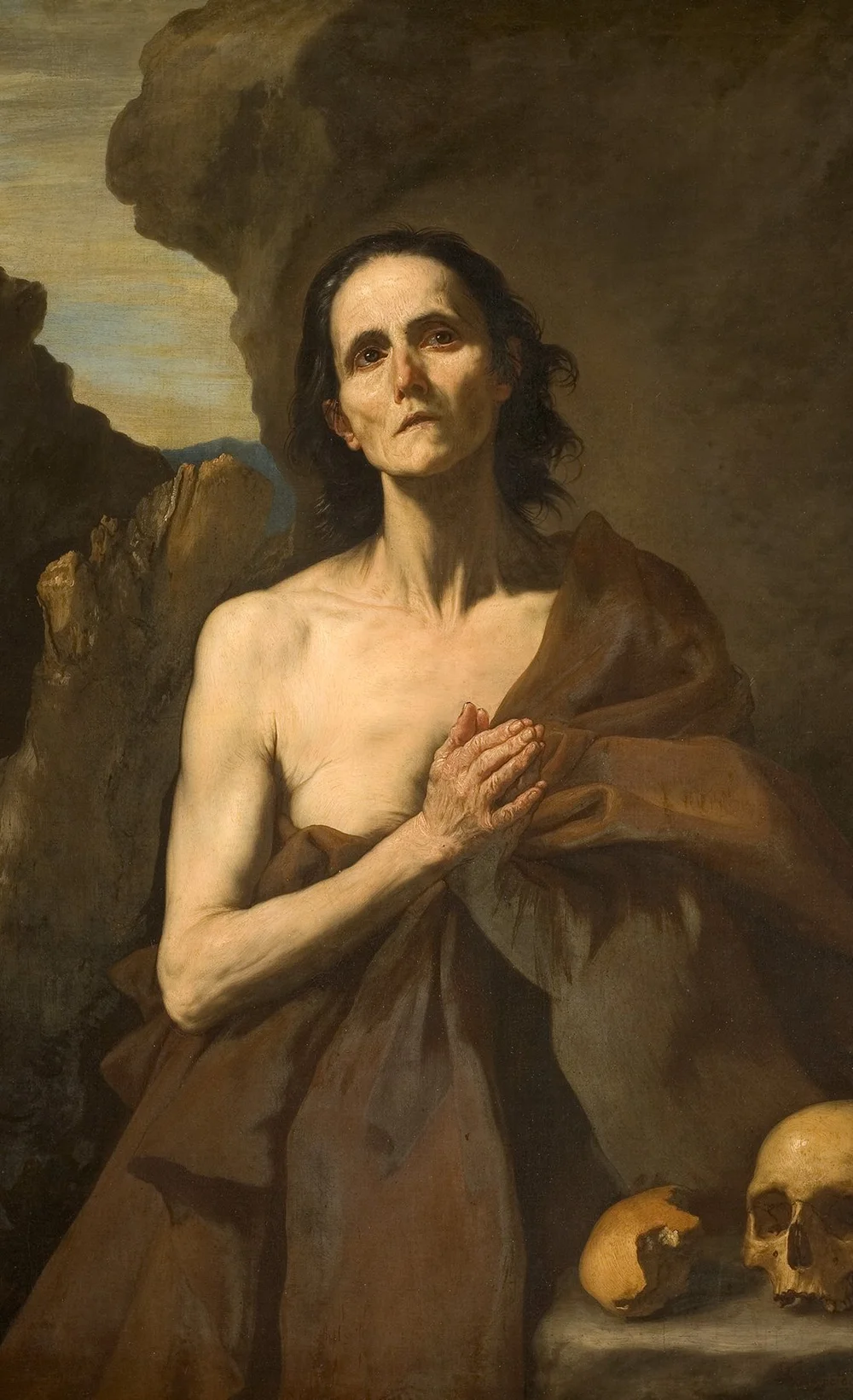
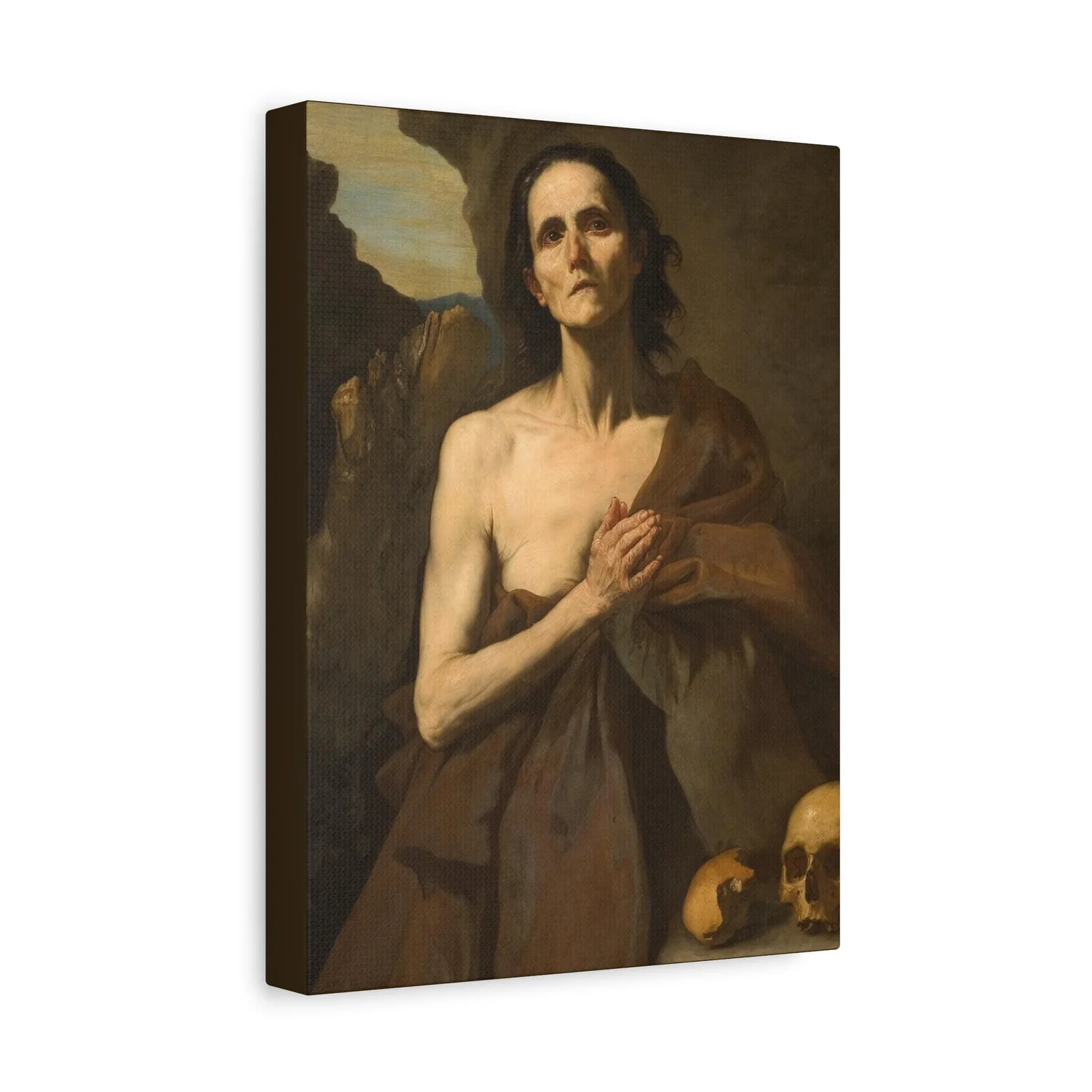
The results range from theologically interesting to visually striking. Hans Memling's detail from the Adriaan Reins Altarpiece (1480) depicts a nude Mary of Egypt with her three loaves — following the text more carefully than many Western treatments. Tintoretto painted both saints together as a diptych (Saint Mary Magdalene and Saint Mary of Egypt, 1582–1587). Jusepe de Ribera's 1651 painting is one of the most powerful Western treatments: an old woman in rags, the desert visible behind her, her face weathered and serene.
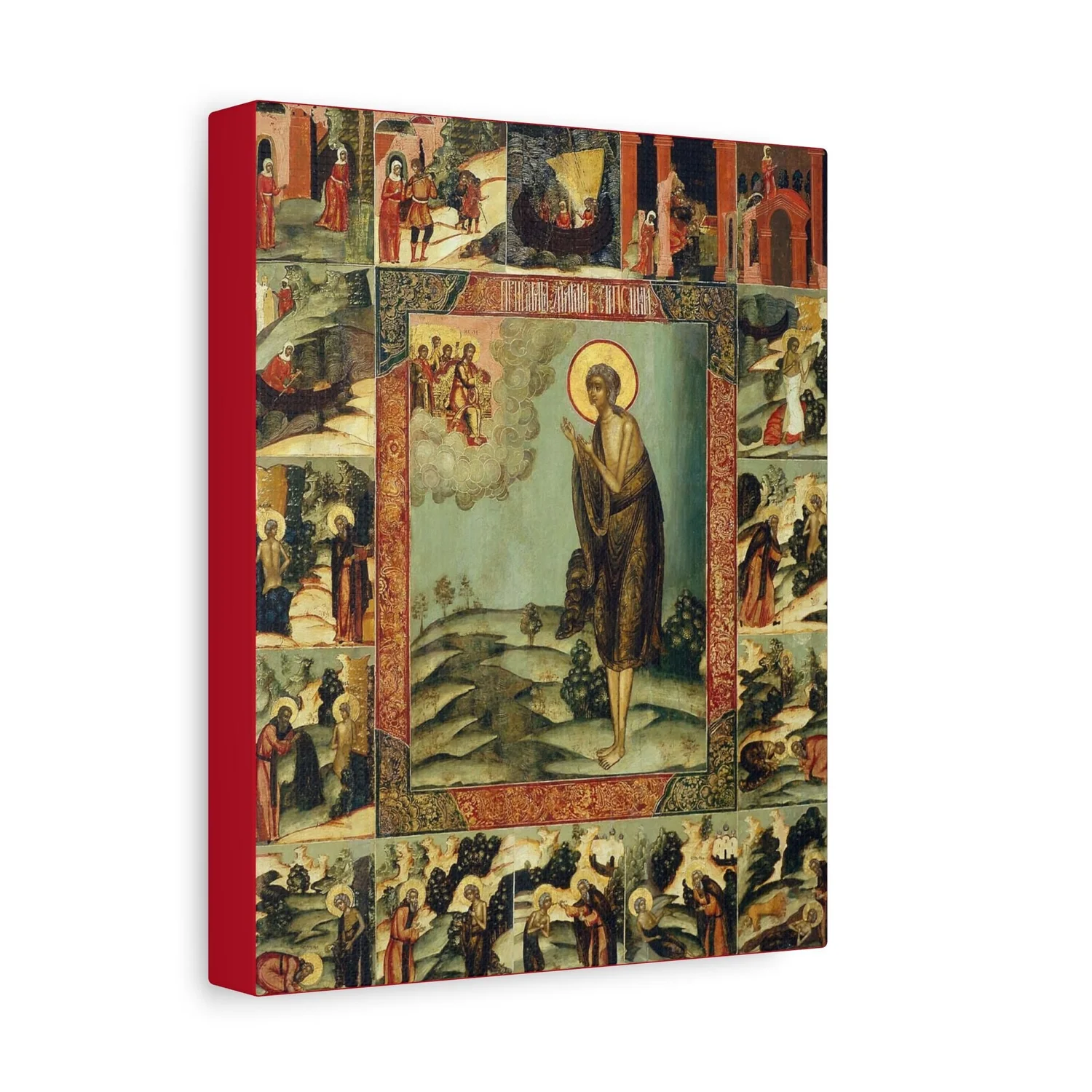
Saint Mary of Egypt Icon Canvas Print — available from The Eastern Church store. The Eastern iconographic tradition has maintained a consistent image of the saint for over 1,500 years.
The Temple of Portunus in Rome — Rededicated to Saint Mary of Egypt in 872
One of the most remarkable and almost entirely unknown facts about Saint Mary of Egypt's legacy in the West is what happened to a pagan temple in Rome in the year 872. The Temple of Portunus — a well-preserved Roman temple near the Forum Boarium, the ancient cattle market by the Tiber River — was rededicated to Saint Mary of Egypt in 872 AD by Pope Adrian II. This act of Christianization preserved the structure through the medieval period; it remained under her patronage for centuries. The temple, which dates to the 1st century BC and is one of the best-preserved Roman temples in existence, stands today in Rome near the Arch of Janus. Its survival is in no small part due to its centuries-long dedication to the Egyptian desert saint who walked across the Jordan.
The choice of Mary of Egypt for this dedication is not accidental. The Temple of Portunus was the temple of the god of ports, gates, and transitions. Mary of Egypt's story is, among other things, a story about thresholds — the church door that would not open, the Jordan she crossed on her way in and on her way back, the desert edge she never recrossed until she died. The early medieval mind that dedicated a temple of gates and passages to a woman whose story turned entirely on a forbidden and then opened door was making a theological observation in architectural form.
Get the Orthodox Desert Mother Canvas Print →In High Culture
Goethe's Faust, Mahler's Eighth, and Dostoevsky's Elder Zosima
The reach of the Mary of Egypt tradition into secular high culture is almost as surprising as any detail in her hagiography. Three of the most celebrated works in Western literary and musical history contain her influence in forms that are rarely recognized by audiences who encounter them.
Goethe and the Symphony of a Thousand
In the final scene of Goethe's Faust II — the conclusion of the entire work — the soul of Faust is brought before the Mater Gloriosa (the Virgin Mary enthroned in heaven) and three penitent women intercede on his behalf. They are identified as the woman who was a sinner in the New Testament (associated with Mary Magdalene), the woman of Samaria (the woman at the well from John 4), and the third — named explicitly as "Magna Peccatrix" in some versions, but identified in the dramatic context as Mary of Egypt. The three together plead with the Virgin for Faust's salvation. This is one of the most famous closing scenes in Western literature. It positions Mary of Egypt alongside scripture's own figures of repentance as intercessors in the drama of the human soul's redemption. Goethe was not a practicing Christian, but his dramatic instinct recognized the theological weight of the tradition he was drawing from.
Gustav Mahler set this scene — including the speech of the figure identified as Mary of Egypt — in his 8th Symphony, premiered in Munich in 1910 with an orchestra and chorus of over a thousand performers (hence its popular name, the "Symphony of a Thousand"). Mahler set the saint's appeal to the Mater Gloriosa as one of the most emotionally intense passages in the work. For anyone who has heard the Eighth Symphony, the voice of Mary of Egypt is among its most memorable moments — a fact that becomes more vivid once you know whose voice it is.
Dostoevsky's Elder Zosima in The Brothers Karamazov
The name "Zosima" is not a common name in Russian literary tradition. When Dostoevsky chose it for the elder who is the spiritual heart of The Brothers Karamazov — arguably the greatest novel in Russian literature and one of the greatest in any language — he was not choosing arbitrarily. Elder Zosima in the novel is the embodiment of active, humble, compassionate spirituality, and his teaching about universal love and the interconnectedness of all things is among the most discussed passages in the Russian literary canon. The name connects him to the Zosimas of the Mary of Egypt tradition: the priest-monk who was cured of spiritual complacency by an encounter with holiness so far beyond his own that it transformed him entirely. Dostoevsky's Elder Zosima undergoes a parallel transformation in the novel, and the echo of the name is almost certainly intentional. Dostoevsky knew the Orthodox liturgical tradition deeply, and the Life of Mary of Egypt is read aloud in Orthodox churches every Lent.
Prayer and Practice
Patronage, Invocation, and How to Pray with Her
Saint Mary of Egypt holds a specific and defined place in the Eastern Christian liturgical year that makes her patronage unusually embedded in the rhythms of ordinary Christian life. She is not a saint whose feast arrives once a year and then recedes. She appears three times during Great Lent, which is the most significant penitential season in the Eastern calendar.
On the Thursday before the Fifth Sunday of Lent, her Life is read aloud in its entirety during the service of the Great Canon of St. Andrew of Crete — a several-hour penitential service in which the entire canonical tradition of repentance is reviewed. A canon (a specific liturgical form) in Mary's honor is sung at the conclusion of each Ode of the Great Canon. In parish practice, this service is typically celebrated on Wednesday evening. Then on the Fifth Sunday of Lent itself — the Sunday of Saint Mary of Egypt — her story forms the theological center of the liturgical day, with the Divine Liturgy of St. Basil the Great and a complete Great Vespers on Saturday evening. And her feast day, April 1, marks the day of her repose with a separate commemoration.
What this liturgical density reflects is the Church's pastoral conviction that the story of Mary of Egypt is specifically useful at the most demanding point of the Lenten journey — when fatigue sets in, when past failures feel defining rather than provisional, and when the distance between where a person is and where they want to be spiritually seems too large to cross. The Church places Mary before the faithful at that moment as an answer to the despair the moment can produce. She is the patron of converts in particular because her story is structurally a conversion story — not from paganism to Christianity, but from a baptized Christian life utterly abandoned to passion to a baptized Christian life completely surrendered to God. That is a form of conversion that many people in the Church need as much as any initial conversion does.

In America
American Churches and Monasteries Dedicated to Saint Mary of Egypt
The devotion to Saint Mary of Egypt has produced a notable cluster of churches and communities bearing her name across the United States — spanning Orthodox, Byzantine, and Coptic traditions. Here are the known communities dedicated to her.
St. Mary of Egypt Orthodox Church — Norcross (Gwinnett County), Georgia
Orthodox Church in America (OCA), Diocese of the South. One of the oldest parishes dedicated to her in the country, founded in 1976 by Fr. John Townsend. Services began in his apartment; the community worships in a redwood temple dedicated in 1980 by Archbishop Dmitri. A diverse convert parish drawing from multiple ethnic Orthodox backgrounds.
stmaryofegypt.comSt. Mary of Egypt Orthodox Church — Kansas City, Missouri
An active Orthodox parish in Kansas City bearing her name. Celebrates the full Eastern Orthodox liturgical cycle including the complete Lenten services in which her Life is read.
stmaryofegypt.netSt. Mary of Egypt Orthodox Church — Greenwood/Indianapolis, Indiana
Antiochian Orthodox Christian Archdiocese. Founded in 2007 by Fr. Peter and Khouria Loretta Wilson. A convert-friendly mission parish serving the Indianapolis metropolitan area, currently building a new home on 14 acres.
stmaryegypt.orgMonastery of Saint Mary of Egypt — Diocese of the West (OCA)
A monastic community dedicated to Saint Mary of Egypt within the OCA's Diocese of the West in the Pacific Southwest Deanery. The monastic life she exemplified — solitary, penitential, wholly given to God — continues in her name on American soil.
OCA Parish DirectorySt. Mary of Egypt Orthodox Church — Roswell, Georgia
Russian Orthodox Church Outside Russia (ROCOR). A distinct community from the OCA parish in nearby Norcross, reflecting the presence of the Russian Orthodox tradition in the Atlanta area.
stmaryofegypt.orgSaint Mary of Egypt Coptic Orthodox Church — Santa Clarita, California
Coptic Orthodox Church in the Los Angeles area. The Coptic tradition has its own deep connection to this saint — she was Egyptian, and the Coptic Church celebrates her feast on April 1 as it does in the Eastern Orthodox tradition. Celebrates the Divine Liturgy and the full Coptic festal cycle.
saintmaryofegypt.comSt. Mary of Egypt and St. Pope Kyrillos VI Church — Redwood City, California
Coptic Orthodox Archdiocese of Northern California and the Western United States, located in the San Francisco Bay Peninsula. Celebrates the Divine Liturgy every Sunday starting at 8:30 AM.
smpk.churchSt. Mary Orthodox Church — Cambridge, Massachusetts
An Orthodox community in Central Square, Cambridge, specifically devoted to the Life and tradition of St. Mary of Egypt. The parish has been a center for serious engagement with Eastern Orthodox theology and the Desert Mother tradition in New England.
stmaryorthodoxchurch.orgThere is also a chapel dedicated to Saint Mary of Egypt within the Church of the Holy Sepulchre in Jerusalem itself — commemorating the precise location of her conversion. The specific courtyard icon before which she prayed is documented by multiple pilgrims from the 6th and 8th centuries. This chapel remains one of the most historically specific physical sites associated with any saint's conversion story in all of Christian hagiography. If you visit Jerusalem, ask to see it.
Frequently Asked Questions
Questions About Saint Mary of Egypt
What Mary of Egypt Teaches That Nothing Else Can
The Church does not give Mary of Egypt her own Sunday in Lent because her past was spectacular, or because her miracles were dramatic, or even because her repentance was extreme. It gives her that Sunday because her story answers the specific question that Lent makes unavoidable: is there a point of no return? She answers it definitively, in the only way that actually helps: not with a theological argument but with a life. A life that began as far from God as any recorded life in the tradition, and ended floating above the desert floor in prayer, known by name to God and to the angels before she was known by name to a single human being she had spoken to in forty-seven years.
Her intercession is specific, earned, and generous. She knows what it is to be too far gone to come back. She came back anyway. Whatever you are carrying into this season, she has carried something heavier — and she is praying for you from a place where that weight no longer exists.
Browse All Orthodox & Catholic Prayer Cards →