What the Saints Said About Aliens and UFOs: Every Reference from the Early Church to Today
Catholic • Eastern Orthodox • Church Fathers • Early Church Through Today
What the Saints Said About Aliens and UFOs: Every Reference from the Early Church to Today
A complete, sourced collection — from the Church Fathers who debated "other worlds" to the modern elders who warned that what we call aliens, the Desert Fathers called demons. Every direct reference. No filler. Honest about what is confirmed and what is uncertain.
At a Glance
- Scope
- Early Church through 21st century — Catholic and Eastern Orthodox traditions
- Most Direct Quote
- Padre Pio (d. 1968): "On other planets other beings exist who did not sin and fall as we did"
- Strongest Orthodox Warning
- St. Paisios of Mt. Athos: UFO sightings are demonic manifestations to draw people from Christ
- Medieval Debate
- The "Plurality of Worlds" — Aquinas vs. Cusa vs. Albert the Great
- The Painting
- Madonna with Saint Giovannino — a 15th-c. Florentine work depicting a disc-shaped object in the sky
- Honest Assessment
- The corpus is smaller than the internet claims. This article documents what is actually sourced.
Why People Are Asking This Now
Something unusual has happened in the last few years. Government hearings on unidentified aerial phenomena — what the military calls UAPs — have moved from the fringe to C-SPAN. Credible former military and intelligence officials have testified under oath about craft that defy known physics. At the same time, interest in the Book of Enoch has surged — the ancient text about angelic beings who descended to Earth, fell into sin, and produced the Nephilim is being read by people who wonder whether the "Watchers" were extraterrestrials and whether the Church has been sitting on something for two thousand years.
This convergence has produced a specific, urgent question that is being typed into search engines at scale right now: What have the saints said about this?
This article is a direct answer to that question — and an honest one. The internet is full of articles that inflate the evidence, attribute quotes to saints that are paraphrased or posthumously reported, and blur the line between what a saint actually said and what a blogger summarized from something they read. This article documents what is actually there. When a source is reliably attested, it says so clearly. When an attribution is uncertain or from a posthumous memoir, it says that too. No filler. No inflation. Every saint referenced here actually said something directly relevant.
What the evidence shows, taken together, is surprising: the question of beings beyond the Earth has genuinely occupied Christian thinkers from the third century to the twentieth. The Church Fathers argued about it. The medieval Doctors debated it formally and the Bishop of Paris issued a condemnation making it heresy to claim God could not create other worlds. Two of the most beloved modern Orthodox saints warned explicitly that what the modern world calls "aliens" is what their tradition has always called demons. And at least one canonized Catholic saint — Padre Pio — appears to have believed firmly that other beings exist, unfallen, in the cosmos God made.
Several widely-circulated "saint quotes" about aliens are paraphrases, posthumous recollections, or misreadings of passages that say something more nuanced. Where this article uses direct quotation marks, the source is specified. Where the evidence is indirect or strongly attributed but not textually certain, that is noted. The most rigorous preresearch available to the author flagged the Padre Pio attribution as coming from a 1974 posthumous memoir with textual variants — which is the truth. You deserve to know that when you cite it.

The Madonna with Saint Giovannino
Before the saints said anything with words, Christian art may have recorded something strange. The painting known as the Madonna with Saint Giovannino — produced in the late 15th century and attributed to the Florentine school, possibly associated with the workshop of Sebastiano Mainardi or Domenico Ghirlandaio — contains something that has drawn sustained attention from art historians, theologians, and UAP researchers alike.
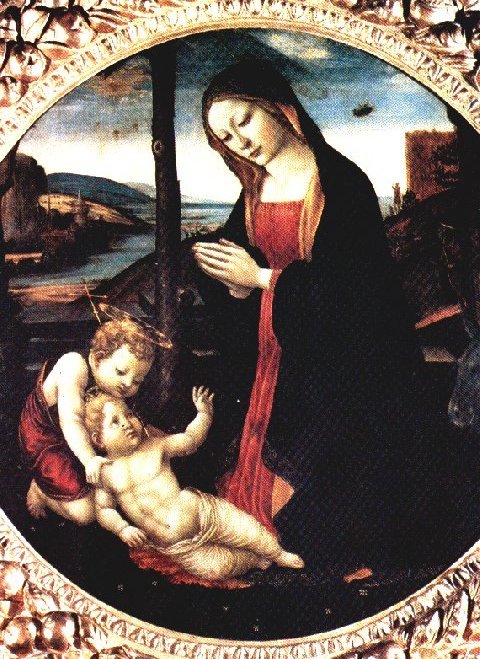
Madonna with Saint Giovannino, Florentine School, c. 1449–1499. The object in the upper right has drawn attention from art historians and UAP researchers for five centuries.
What the Painting Actually Shows
In the upper right of the composition, above and behind the figure of the Virgin Mary, there is a disc-shaped object emitting what appears to be rays of light. Below it, in the lower right, a man is depicted with his hand raised to shield his eyes, as if looking directly at the object — an unusual compositional choice in a nativity-adjacent scene. In the upper left of the painting, there are additional luminous forms with a quality that modern viewers have compared to recently documented "jellyfish" UAPs.
This is not a fringe observation. The object is plainly visible in the original. The man shielding his eyes is plainly there. The question is what a 15th-century Florentine painter was depicting — and what his patrons and viewers would have understood it to mean.
The most likely interpretive frameworks for a 15th-century Catholic viewer are these: the object could represent the Star of Bethlehem, rendered as a luminous disc rather than a star point; it could represent the divine glory (the Hebrew kavod, the radiant presence of God) breaking into the earthly scene; or it could be a representation of an angelic presence, depicted in a form that carried meaning for the original patrons. What it almost certainly was not (or maybe it was), in the mind of the painter, was a spacecraft from another planet in the modern sense.
The significance for our topic is this: the visual vocabulary of 15th-century Christian art included disc-shaped luminous objects associated with divine or angelic presence in the sky. Whatever the painter intended, he painted something that a 21st-century viewer immediately recognizes as matching the shape of contemporary UAP reports. Whether that convergence is meaningful — or simply reflects the limits of how human perception renders any bright, disc-shaped object in the sky — is a question this article cannot answer definitively. But the painting exists, it is genuinely unusual, and it belongs in any honest collection of "what the Christian tradition recorded about objects in the sky."
The Book of Enoch and the Watchers
No conversation about saints and aliens gets far without the Book of Enoch, and that is partly because the Book of Enoch is one of the genuinely strange documents in the ancient Christian literary world — and partly because modern culture has latched onto it as evidence for the "ancient astronaut" theory in ways the patristic tradition would have found entirely foreign.
The First Book of Enoch describes a group of angelic beings called the Watchers (the Ir in Aramaic, meaning "those who are awake" or "those who watch") who descended from heaven to Earth, were attracted to human women, and produced the Nephilim — giants whose violence filled the antediluvian world and whose corruption contributed to the conditions of the Flood. The text is vivid, cosmological, and at times genuinely unsettling. It describes the heavens in elaborate architectural detail. It records Enoch being taken on cosmic tours of the created order. It depicts spiritual beings interacting with the physical world in ways that feel different from most biblical narrative.
The modern "ancient astronaut" reading takes these Watchers and translates them: instead of fallen angels, they become extraterrestrials from another world who visited Earth, interacted with humans, and left a biological legacy in the Nephilim. This reading is interesting but has no support in the patristic tradition. Every Church Father who commented on the Book of Enoch — Origen, Tertullian, Clement of Alexandria, Justin Martyr — treated the Watchers as fallen spiritual beings, not as visitors from other planets. The categories simply did not overlap in their minds.
What makes this historically significant is that the Church Fathers read the Book of Enoch at all — and many of them took it seriously. Tertullian (c. 160–220) cited it as authentic Scripture. Origen (c. 184–253) discussed it extensively. The Ethiopian Orthodox Tewahedo Church has included it in its biblical canon continuously from the earliest centuries and continues to do so today, which is part of why the Ethiopian Bible contains 81 books rather than the Catholic 73 or Protestant 66. The early Church's complicated relationship with Enoch — accepting its content in some quarters, rejecting its canonical status in others — is the theological backstory to the modern alien question.
The Book of Enoch (1 Enoch 6–8) describes the Watchers as beings from heaven who "saw that the daughters of men were beautiful, and they took wives for themselves from all the daughters of men." Their leader, Shemihazah, leads 200 of them in a descent. They teach humanity forbidden knowledge — metalworking, sorcery, the cutting of roots. Their offspring, the Nephilim, fill the earth with violence.
The Church Fathers read this as a spiritual fall, not a space expedition. The Watchers are angels who chose to sin — beings with free will who misused it. Their "descent" is moral and ontological, not geographical. The phrase "came down from heaven" in the patristic reading means abandonment of their spiritual station, not re-entry from orbit.
Fr. Seraphim Rose's argument — which represents the most developed modern Orthodox engagement with this material — is that modern "aliens" are simply the same entities with a new narrative: the Powers of the Air that the Fathers warned against now presenting themselves in the technological costume the 21st century expects. The content is identical; only the framing has changed.


For a deeper look at what the Church Fathers specifically thought of the Book of Enoch, see What the Church Fathers Thought About the Book of Enoch and the Complete Book of Enoch resource here on the site.
Section I
The Early Church Fathers (1st–8th Century)
The Early Church Fathers did not discuss aliens — the concept did not exist. What they discussed was the Greek philosophical question of "polykosmia," or the plurality of worlds: could God have made, or did God make, more than one inhabited world? Their answers set the stage for every Christian engagement with the question that followed.
St. Clement of Rome — d. c. 99 AD
In one of the earliest post-apostolic texts we possess, Clement writes about the orderliness of God's creation and mentions "the ocean, impassable for men, and the worlds which are beyond it." Origen, writing in the third century, interpreted this as potentially referring to other planetary bodies — other literal "worlds." Modern scholars generally read it as referring to the unknown continents on the other side of the Atlantic, in the same way that ancient writers spoke of lands "beyond the pillars of Hercules." The passage is genuinely ambiguous, and its citation in discussions of saints and extraterrestrial life is the most honest example of an early Church reference — because it is honest about the ambiguity rather than claiming more than the text says.
Negative — "A Vain Imagination"
St. Basil the Great — d. 379 AD
When Basil preached through the six days of creation, he directly engaged the ancient Greek philosophers — particularly the Epicureans — who proposed an infinity of worlds existing in boundless space. His dismissal was pointed: he called the idea of other worlds a "vain imagination" born of philosophical speculation rather than divine revelation. His argument was theological, not empirical: since God is one and creation is an ordered act of one Creator, the "cosmos" (the ordered world) is one. Multiplying worlds would require multiplying the source of order, which Basil found theologically incoherent. This text is solidly in the record and frequently cited, and it represents the dominant early Eastern position on the question.
Negative — Rejected Inhabited "Antipodes"
St. Augustine of Hippo — d. 430 AD
Augustine's rejection of "antipodean men" — people living on the opposite side of a spherical Earth — is the most frequently cited early Church negative on other inhabited worlds, and it deserves careful reading. Augustine's actual argument is more specific than it is usually presented: he was not arguing that the Earth is flat (he was familiar with the spherical model), but that there cannot be rational human beings in places unreachable from Adam and Eve, because all human beings share in original sin through common descent, and the Gospel has to be preachable to all of them. His concern was soteriological, not cosmological. He wrote in Latin that the claim of "antipodes" — men on the other side of the Earth — "is on no ground credible," but his grounds were theological, not astronomical.
The nuance scholars emphasize is this: Augustine left open the possibility that God could create other worlds, being omnipotent. He believed God chose not to. He also wrote that if strange "monstrous races" (one-eyed beings, pygmies, others mentioned in secular histories) genuinely exist and are rational and mortal, they descend from Adam and are fully human. This principle is the oldest Catholic theological bridge toward the question of what rational beings on other planets would mean for the faith — though Augustine himself was not applying it to that question.
Negative — "Holy Scripture Teaches There Is One"
St. John of Damascus — d. c. 749 AD
John of Damascus, the great systematizer of patristic theology, addressed the plurality of worlds directly in his comprehensive summary of Orthodox teaching. He noted that "some, indeed, have imagined that there are infinite worlds" — acknowledging the philosophical tradition — and then stated plainly that "Holy Scripture teaches that there is one." This is not a developed cosmological argument but a dogmatic statement of the position he believed the tradition had settled: the biblical narrative concerns one creation, one humanity, one history of salvation, and Scripture does not envision anything beyond it.
John of Damascus serves as the official Eastern "closure" to the early Church debate — the point at which the tradition, in its systematic Eastern form, recorded its answer. It is significant that this answer is not a philosophical deduction but a simple appeal to the sufficiency of Scripture on the question. For subsequent Eastern Orthodox thinkers, this text is the baseline — which makes the modern Orthodox saints who discussed alien phenomena notably aware that they were departing from the tradition's settled opinion, at least on the cosmological dimension.
The Desert Fathers and Demonic Apparitions
The Desert Fathers left no writings about beings from other planets — the concept was not available to them. What they left was something that modern Orthodox writers consider directly relevant: an extensive documented tradition of encounters with entities that appeared in the sky, in the desert, in unusual forms, and presented themselves as beneficial or instructive.
St. Athanasius of Alexandria, in his Life of Antony the Great, describes Antony encountering a creature in the desert that was human to the waist and donkey-like below — an onocentaur — which Antony confronted with the words "I am a servant of Christ." The creature fled. Jerome, in his Life of Paul of Thebes, describes Antony encountering both a centaur-like creature and a satyr who claimed his tribe knew of Christ's coming to save the world. Modern scholars read these episodes as hagiographic literary conventions and demonological theology in narrative form, not zoological reports. But they are the texts that Fr. Seraphim Rose and other modern Orthodox writers point to when they say the Church has always known about encounters with non-human intelligent entities — and that the Church's consistent response has been spiritual discernment, not fascinated investigation.
The Desert Fathers' tradition is the root of the Orthodox position on UAPs: not "are they real?" but "what are they spiritually, and what is the correct response?" The answer the tradition gives to the latter question is prayer, discernment, and the invocation of Christ — because anything real is either from God or from the enemy, and anything from the enemy flees the name of Jesus.
Section II
The Medieval Period (9th–15th Century)
The medieval period did something remarkable with the alien question: it formalized it. The recovery of Aristotelian philosophy through Arab translators, the expansion of the universities, and the willingness of the Scholastic theologians to engage ancient philosophical questions on their own terms produced the most developed pre-modern Christian engagement with "other worlds" — and eventually a formal ecclesiastical ruling on what a Catholic was permitted to believe about them.
St. Albert the Great — d. 1280
Albert the Great — the Dominican polymath who was Thomas Aquinas's teacher and one of the most encyclopedic minds of the 13th century — is documented as treating the plurality of worlds as a serious and open philosophical question, not a settled matter. The paraphrase most commonly attributed to him: that the question of whether there is one world or many is "one of the most wondrous and noble questions in Nature" and that it seems "desirable to inquire into it." He did not conclude that other worlds exist. He concluded that the question was legitimate, which in the intellectual climate of his era was itself a significant position. His openness reflected his broader commitment to natural philosophy as a legitimate complement to theology — a methodological stance that made him more comfortable with open questions than many of his contemporaries.
Negative — With the Critical "Loophole"
St. Thomas Aquinas — d. 1274
Aquinas argued against a plurality of worlds in the Aristotelian sense — his reasoning was that the perfection of creation implies a unified order, and multiple separate worlds would each be incomplete without reference to the others. The "very order of things," he wrote, "shows the unity of the world." On this point he sided with Aristotle and with the dominant patristic tradition.
But the Thomistic "loophole" is equally important and is genuinely in the text: Aquinas was clear that God has the power to create multiple worlds. His claim was that God chose not to — not that God could not. This distinction was enormously consequential for later theology, because it meant the Church could not dogmatically bind itself to the claim that God made only one inhabited world. The distinction between what God can do and what God chose to do kept the question permanently open. Three years after Aquinas died, that distinction became the center of a major ecclesiastical controversy.
In 1277, Etienne Tempier, Bishop of Paris, issued a sweeping condemnation of 219 propositions that he considered philosophical errors dangerous to the faith. Among them was the proposition that God could not create more than one world.
Tempier's ruling effectively declared it a philosophical error — bordering on heresy — to assert that God's creative power was limited to a single world. The intention was to protect divine omnipotence from Aristotelian constraints. The effect was to permanently open the "plurality of worlds" question for Catholic theology. After 1277, any Catholic thinker could speculate about other inhabited worlds without being accused of contradicting the faith. Many of them did.
This is why the 15th century produced the most remarkable Christian speculation about extraterrestrial life before the 20th century.
Open — "God's Power Is Not Exhausted"
St. Bonaventure — d. 1274
Bonaventure — a contemporary of Aquinas and the other great Franciscan scholastic Doctor — argued that while he did not believe other worlds actually exist, it was essential to insist that God could have made them. To claim that God could not was to limit divine omnipotence in ways the faith did not permit. The multiplication of God's ideas could manifest in infinite ways beyond what we observe. This was a more cautious position than Albert's openness, but it was theologically decisive in the same direction: the question was kept open by insisting on what God's power allows, not by speculating about what God actually did.
The Most Explicit Medieval Speculation — But Not a Canonized Saint
Nicholas of Cusa — d. 1464 — Cardinal, Not Canonized
Nicholas of Cusa is not a canonized saint, but he is impossible to omit from an honest account of Christian engagement with this question. Writing in the middle of the 15th century, he argued that the universe has no center (anticipating Copernicus by nearly a century), that the stars are not fundamentally different from the sun, and that other regions of the universe are inhabited by beings suited to their environments. His most striking line: "We suppose that in every region there are inhabitants, differing in nature by rank and all owing their origin to God." He also specifically discussed what the inhabitants of the sun and moon might be like — more "solar" or "lunar" in nature, more spiritual, more refined than earthly creatures. His views were not condemned. They were widely read. And they represent the high-water mark of late medieval Christian openness to other intelligent life in the cosmos.
Section III
Saints Who Believed Other Life May Exist
By the 19th and 20th centuries, the expansion of astronomical knowledge had changed the terms of the debate. Telescopes had revealed a universe of almost incomprehensible scale. The question of whether God populated other worlds was no longer abstract. Two reliable sources and one strongly attested tradition make up the canonical "pro" camp among canonized saints.
St. Theophan the Recluse — d. 1894
Theophan the Recluse — the great 19th-century Russian spiritual director and translator of the Philokalia into Russian — wrote a pastoral letter addressing exactly the kind of question that must have been posed to him by a correspondent troubled by the expanding knowledge of the cosmos: what would the inhabitants of other planets mean for the Christian faith? His answer is the most careful, theologically grounded, and reliably attested saint-authored speculation on the topic in the entire corpus. He wrote that the existence of such beings is "only probable, not certain," and that if they exist, several scenarios are possible: they could have remained in original righteousness and never fallen; they could have fallen as humanity did and received their own economy of salvation; or other planets might one day be populated by human souls who have passed through this life. He treated all of this explicitly as supposition, and he was careful to note that none of it threatened the core of the faith. What is most significant about Theophan's letter is its tone: a senior Orthodox spiritual director in the 19th century, addressing the question matter-of-factly as a legitimate pastoral concern, without alarm or dismissal.
Most Famous — Attribution Requires Honest Caveat
St. Padre Pio — d. 1968
Padre Pio is the most frequently cited saint in discussions of extraterrestrial life, and his attributed statement is the most direct affirmation of other intelligent beings by a canonized saint in the Catholic tradition. The most complete version, as published in the 1974 posthumous memoir by Don Nello Castello, has Padre Pio being asked whether beings on other planets exist and responding: "What else? Do you think there are no other beings? The Lord certainly did not limit His glory to this small Earth. On other planets other beings exist who did not sin and fall as we did."
The most thorough scholarly preresearch available to the author of this article — including a rigorous independent AI research effort that checked primary sources — flagged this attribution as "low to medium-low" in textual reliability. The quote is from a posthumous memoir published six years after Padre Pio's death. The wording varies across different published versions. It has not been cross-verified against a critical first edition or an independent contemporary witness. This does not mean Padre Pio didn't say something like this. It means the exact wording should be treated as a strongly attested tradition — the kind of saying that circulated in the communities around him — rather than a verified verbatim transcript.
The theological content of the attributed saying is coherent with Padre Pio's known spirituality and with the Thomistic tradition: God's creative glory is not limited; other beings could exist who, unlike humanity, remained in their original relationship with God and did not need the specific redemptive act accomplished in the Incarnation. This view has a legitimate place in Catholic theology and was expressed by several non-saintly Vatican figures in the 20th century. Whether Padre Pio said these precise words, the theology they express is Catholic and serious.
Because it is the most-searched saint quote on this topic and excluding it would be dishonest in a different direction. This article includes it with its caveats because that is what intellectual honesty requires: present the evidence, note its limitations, let the reader decide. The saying is in wide circulation, it has been in print since 1974, and it accurately represents a theologically legitimate Catholic position. Flag the uncertainty; include the data.
Probable Paraphrase — Widely Cited, Source Uncertain
St. John of Kronstadt — d. 1908
A statement attributed to St. John of Kronstadt — "The Lord is like a sun that shines on everyone and everything. There are many worlds, and the Lord is present in all of them" — circulates widely in discussions of Orthodox saints and extraterrestrial life. The citation is consistently vague: attributed to My Life in Christ without a specific volume, edition, or page number. Multiple research attempts failed to locate the specific passage in verified editions of the text. It is included here for completeness, with the clear note that it should not be cited as a confirmed direct quote until someone can produce the primary source location. The theology is consistent with John of Kronstadt's known spirituality — he wrote extensively about God's universal presence and the vastness of the creation — but the specific cosmological claim cannot be confirmed at this time.
Section IV
Saints Who Warned: Aliens Are Demonic Deception
This section contains the most substantive and clearly attested saint-authored material on the alien question in the entire article. Three canonized modern Orthodox saints — and one highly influential Orthodox writer whose canonization is local and incomplete but whose influence is enormous — addressed the UFO and alien question directly, explicitly, and with the authority of their spiritual lives behind their answers. All of them said essentially the same thing.
St. Paisios of Mount Athos — d. 1994
St. Paisios of Mount Athos — canonized in 2015 and one of the most beloved and widely read Orthodox spiritual fathers of the 20th century — addressed the alien question with the directness that characterized all his spiritual counsel. He stated that there is no biological intelligent life on other planets. He stated that the modern UFO phenomenon consists of demonic manifestations — appearances orchestrated by the enemy to draw people away from Christ and toward a "New Age" religious framework that would prepare them for the Antichrist. His reasoning was not primarily cosmological but spiritual: he was not making a claim about astronomy. He was applying the Desert Fathers' tradition of discernment to a modern phenomenon and arriving at the same conclusion the Fathers arrived at with the demonic apparitions of their era: this is the enemy, working in a form suited to the credulity of the age.
Paisios was not dismissive of the reality of what people were experiencing. He acknowledged that people genuinely see and encounter things. His point was about the source and the intent. Something real is happening; but "real" does not mean "extraterrestrial biological life from another planet." In the Paisian framework, the correct question is never "what is this physically?" but "what is this spiritually, and what does it want from the people who encounter it?" See his full biography at Saint Paisios the Athonite.
Explicit — "Barren" Cosmos; Aliens as Demonic Visions
St. Porphyrios of Kavsokalyvia — d. 1991
St. Porphyrios of Kavsokalyvia was known throughout his life for a clairvoyant spiritual perception that allowed him to "see" in ways that went beyond normal human awareness. He spoke about the cosmos from within that experience. His reported statement to his disciples was direct: that in his spiritual perception of the universe, the rest of the cosmos is "barren" of intelligent biological life, and that what people encounter as "aliens" are "products of imagination or even demonic visions." Like Paisios, he was not denying that something real is happening in UAP encounters. He was identifying the source. Read the full life of Saint Porphyrios of Kavsokalyvia here.
The convergence of Paisios and Porphyrios — two canonized Athonite elders of the same generation, both highly revered and both clearly attested on this question — is theologically significant. These are not fringe opinions. They are the stated positions of two saints of the Ecumenical Patriarchate on a question they were directly asked, drawing on the full weight of the hesychast tradition behind them.
St. Gabriel Urgebadze — d. 1995
St. Gabriel Urgebadze — the beloved Georgian wonder-worker and fool for Christ, canonized in 2012 — is attributed with a warning that has circulated widely in Orthodox discussions of UAP disclosure: "Humanity will seek help from the aliens, not knowing that they are actually demons." The attribution is consistent with his known spiritual vision and eschatological concerns, and it aligns precisely with the positions of Paisios and Porphyrios. As with several quotes in this article, the challenge is tracing it to a specific primary source document. It circulates with confident attribution in multiple Orthodox sources. The caveat is the same as for other attributed modern saint quotes: treat it as a strongly attested tradition while acknowledging that the primary text documentation is incomplete in available sources.
The Most Developed Modern Orthodox Argument — Not Formally Canonized
Fr. Seraphim Rose — d. 1982
Fr. Seraphim Rose is not a canonized saint in the universal sense, but his work is so widely cited in Orthodox discussions of this topic — and his argument is so careful and so directly relevant — that omitting him would leave a significant gap. His book Orthodoxy and the Religion of the Future contains the most developed Orthodox theological analysis of the UFO phenomenon available from an author formed in the patristic tradition, and it makes the argument that has become the baseline for the Paisios-Porphyrios-Gabriel position.
Seraphim Rose's core argument: what modern culture calls "aliens" are the same entities that the Desert Fathers called "aerial spirits" and "fallen angels of the air" — spiritual beings who exist in the atmosphere of the Earth, have been active in human history since before the Fall, and are able to manipulate human perception and create physical phenomena. They are not biological creatures from other planets. They are demonic intelligences who have updated their presentation for the technological age — presenting themselves as "extraterrestrials" because that is the category that the modern mind is prepared to accept as plausible, in the same way that in earlier eras they appeared as fairies, forest spirits, or the demonic apparitions that the Desert Fathers documented in the lives of the saints. The "UFO abduction" phenomenon, in Seraphim Rose's analysis, mirrors the "demonic assault" traditions of the hesychast literature point for point — the paralysis, the perceived travel, the beings who claim superior knowledge and demand cooperation — right down to the spiritual aftermath in the lives of people who have experienced them.
The Orthodox saints who warned about demonic deception in alien encounters were not being anti-scientific. They were applying a two-thousand-year tradition of documented experience with non-human intelligence to a new set of reported phenomena. Their argument is: we have been here before. We know what these entities do. We know how they present themselves. We know what spiritual discernment looks like when they are involved. And the correct response has never changed: the name of Jesus, the sign of the cross, and the refusal to engage on their terms.
Section V
The Philokalia and the Powers of the Air
The Philokalia — the five-volume collection of hesychast spiritual texts from the 4th through 15th centuries — does not discuss aliens or extraterrestrial life. This is not an oversight. The Philokalia's subject is the inner ascent of the human soul toward union with God through ceaseless prayer and watchfulness. It is not a cosmological text and was never intended to be one.
What it does contain is directly relevant to the modern question, because it provides the theological and experiential framework that the modern Orthodox saints drew on when they addressed UFOs and alien phenomena. Specifically: an extensive, sober, and practically detailed body of teaching on the nature, tactics, and spiritual discernment of non-human intelligent entities.
St. Maximus the Confessor and the Logoi of Creation
St. Maximus the Confessor — the 7th-century theologian whose work occupies the fourth volume of the Philokalia and who represents the most cosmologically developed of the Philokalic authors — provides the theological framework for understanding where extraterrestrial beings would fit within Christian ontology, if they exist. His concept of the Logoi — the individual reasons or blueprints of all created things, existing eternally within the Divine Word (Logos) — implies that any created being has its principle in God. If beings on other worlds exist, they have their Logoi in Christ; they are created by and for the same Word who became incarnate in Jesus. There is no created being, anywhere in the universe, that would fall outside the creative and sustaining activity of the Logos. This is not a statement about whether such beings exist; it is a statement about what existence means within a Christological ontology. Nothing that exists is an ontological orphan.
The "Powers of the Air" — What the Philokalia Actually Addresses
The Philokalia's most directly relevant content for the alien question is its extensive teaching on the "aerial spirits" and "Powers of the Air" — spiritual entities that operate in the atmospheric realm between earth and the higher heavens, and that engage actively with human spiritual life, particularly with those who pursue the interior life of prayer. The texts document how these entities present themselves to those in prayer: sometimes as radiant figures, sometimes as voices, sometimes as apparently beneficial presences, and sometimes in forms that are genuinely disorienting and strange. The consistent teaching is threefold: do not assume that any vision or presence is from God; test everything by the fruits and by the name of Jesus; and do not engage in extended interaction with anything you have not clearly discerned to be from God.
One specific warning in the Philokalic tradition is directly relevant to the modern discussion: "If light or some fiery form should be seen by one pursuing the spiritual way, he should not on any account accept such a vision: it is an obvious deceit of the enemy." This is the tradition Seraphim Rose, Paisios, and Porphyrios are drawing on when they address UFO phenomena. The luminous disc, the radiant aerial form, the paralysis and examination, the sense of being transported — these phenomenological details are not new to the hesychast tradition. They are documented in it, as enemy activity, going back to the Desert Fathers in the 4th century.
Read more on the lessons of the Philokalia and the hesychast tradition as context for everything the modern Orthodox saints said about spiritual deception.

The Composite View
What the Saints Collectively Said: A Summary and Average
Taking the entire corpus together — from the ambiguous mention by Clement of Rome in the first century to the explicit demonic deception warnings of Paisios and Porphyrios in the twentieth — what emerges is not a unified Christian position on aliens. What emerges are three distinct camps, with markedly unequal numbers in each.
Other Life May Exist
Theophan the Recluse (speculative pastoral letter), Padre Pio (posthumous attribution), possibly John of Kronstadt (unverified). Also: Albert the Great (open question), Bonaventure (God's power allows it), and Nicholas of Cusa (they probably exist — but Cusa is not canonized). This camp is smaller and more recent.
Aliens = Demonic Deception
St. Paisios (canonized 2015), St. Porphyrios (canonized 2013), St. Gabriel Urgebadze (canonized 2012), Fr. Seraphim Rose. All explicitly addressed the modern UFO/alien question. All reached the same conclusion. This camp is the most clearly attested with direct modern quotes.
Silence or Rejection
St. Basil (dismissed other worlds), St. Augustine (rejected inhabited antipodes), St. John of Damascus (Scripture teaches one world), St. Thomas Aquinas (argued against plurality). The majority of the classical tradition. They did not address UFOs because UFOs had not been framed yet — but their cosmological positions provided no space for extraterrestrial biological life.
The Averaged Position of the Tradition
If you average the views of all the saints and theologians in this article, weighted by the clarity of their attestation and the authority of their canonical status, what you get is something like this:
On whether biological extraterrestrial life exists: The traditional position, held by the majority of classical and medieval saints, is that it probably does not. The most reliable modern Catholic saint-level source (Theophan) treats it as speculative but possible. The most famous modern Catholic attribution (Padre Pio) affirms it but with textual uncertainty. The weight of the tradition leans toward "we have no reason to believe it and some theological reasons to doubt it."
On what modern UFO and alien phenomena represent: The most clearly attested modern saint positions — three canonized saints addressing this directly — agree that whatever is happening, the spiritual source is demonic, not extraterrestrial. The hesychast tradition supports this position from sixteen centuries of documented experience with aerial spiritual entities. This is not the majority position of the entire tradition because the earlier tradition did not address this specific question. But it is the position of the tradition's most recent and most explicitly relevant voices.
On what God could have done: All sides agree — from Bonaventure to Aquinas to the 1277 Condemnations — that God could have created intelligent life elsewhere. The question of what God actually did is treated as theologically open and non-binding on the faith.
What the tradition would say to someone watching UAP disclosure hearings right now: The saints would likely not be fascinated by the cosmological question. They would be asking the spiritual discernment questions. Where is this going? What is being produced in people's interior lives by engagement with this narrative? Is it moving them toward Christ, toward prayer, toward humility? Or toward something else? Those are the questions the tradition is equipped to answer, and the answers of the most recent saints are not ambiguous.
Complete Reference Table
| Saint / Figure | Era | Position | Key Basis | Reliability |
|---|---|---|---|---|
| St. Clement of Rome | d. c. 99 | Ambiguous | "Worlds beyond the ocean" — likely other continents | High (text); Low (alien interpretation) |
| St. Basil the Great | d. 379 | Negative | Other worlds are "vain imagination" of Greek philosophy | High |
| St. Augustine | d. 430 | Negative | No inhabited antipodes; all rational beings descend from Adam | High |
| St. John of Damascus | d. c. 749 | Negative | "Holy Scripture teaches there is one world" | High |
| St. Albert the Great | d. 1280 | Open | Legitimate philosophical question within the faith | High (position); medium (exact quote) |
| St. Thomas Aquinas | d. 1274 | Negative (with loophole) | God could but didn't; unity of order implies one world | High |
| St. Bonaventure | d. 1274 | God's power not limited | Asserting God couldn't make other worlds approaches heresy | High (position); medium (exact quote) |
| Nicholas of Cusa | d. 1464 | Positive (not canonized) | All celestial regions likely inhabited; God wouldn't leave universe empty | High |
| St. Theophan the Recluse | d. 1894 | Speculative / Open | Inhabitants of other planets are possible; faith stands regardless | High |
| St. Padre Pio | d. 1968 | Positive (attributed) | "Other beings exist who did not sin and fall as we did" | Medium-low (posthumous memoir) |
| St. John of Kronstadt | d. 1908 | Positive (attributed) | "Many worlds, and the Lord is present in all of them" | Low (unverified primary source) |
| St. Paisios of Mt. Athos | d. 1994 | Negative / Demonic warning | No life on other planets; UFOs are demonic manifestations | High |
| St. Porphyrios of Kavsokalyvia | d. 1991 | Negative / Demonic warning | Cosmos is "barren"; aliens are imagination or demonic visions | High |
| St. Gabriel Urgebadze | d. 1995 | Demonic warning | "Humanity will seek help from aliens, not knowing they are demons" | Medium (circulated attribution) |
| Fr. Seraphim Rose | d. 1982 | Demonic — fully developed argument | UFOs = fallen angels in technological costume; mirrors Desert Father accounts | High (published book) |
Frequently Asked Questions
Questions About Saints and Aliens
What the Saints Knew That We Are Still Learning
The saints who addressed this question — whether they concluded that other worlds exist, or that what appears as "aliens" is the ancient enemy in new costume — were not confused about where to look for answers. They did not look to government hearings. They did not look to UAP testimony or ancient astronaut theories. They looked inward, and upward, and they trusted the tradition they had received from those who had gone before them in the life of prayer. That tradition has an answer to the modern confusion. It is not primarily an answer about cosmology. It is an answer about discernment: know what things are spiritually before you decide what they are physically, because the spiritual question is the one that actually affects your soul.
The saints looked at the sky and saw what belonged to God. Whatever else is up there — biological, spiritual, or something that exceeds our current categories — so does it.
Read Aliens and Demons: Discerning the Great Deception →Browse Orthodox & Catholic Prayer Cards →