Catholic Warrior Saints: Joan of Arc, Ignatius & Military Patrons
Roman Catholic • Pre-Schism Martyrs • Patron Saints for Soldiers • Spiritual Warfare
Catholic Warrior Saints: Joan of Arc, Ignatius & the Military Patrons of the Church
From the archangel who drives demons from heaven to the teenage girl who drove the English from Orléans — a complete guide to every warrior saint the Catholic Church has claimed as its own, covering their lives, their patronage, and why soldiers and spiritual warriors have invoked them for two thousand years.
At a Glance
- Saints Covered
- 8 warrior saints — universal Catholic, pre-schism Roman martyrs, and post-schism Catholic canonizations
- The Universal Champions
- St. Michael the Archangel (Leo XIII prayer); St. George (patron of England and Catholic nations)
- The Roman Military Martyrs
- St. Sebastian, St. Martin of Tours, St. Maurice & the Theban Legion
- The Soldier-Pilgrim
- St. Rasso of Andechs — Bavarian knight turned Benedictine
- The Post-Schism Saints
- St. Joan of Arc (canonized 1920); St. Ignatius of Loyola (canonized 1622)
- The Catholic Distinctive
- The Rosary as spiritual warfare; the Spiritual Exercises; the Prayer of Pope Leo XIII
The Catholic Theology of the Holy Warrior
The Catholic understanding of warfare — physical and spiritual — runs deeper than a list of patron saints. It is a theology, and it has two dimensions that belong together. The first is the tradition of just war, developed by St. Augustine and systematized by St. Thomas Aquinas: the conviction that there are conditions under which fighting is not only permitted but required, and that the soldier who fights within those conditions is not doing something spiritually neutral but something potentially holy. The second is the Pauline theology of spiritual warfare — Ephesians 6:10-18, the full armor of God — which the Catholic tradition has never read as metaphor alone. The belt of truth, the breastplate of righteousness, the shield of faith, the helmet of salvation, and the sword of the Spirit describe a real battle against real enemies that every Catholic faces whether or not they have ever held a physical weapon.
The warrior saints stand at the intersection of these two dimensions. Some of them — Sebastian, Maurice, Martin — were literal soldiers who became saints. Some — Joan of Arc — were saints who became literal soldiers. Some — Ignatius — were soldiers transformed by grace into warriors of the interior life. And one — Michael the Archangel — has been fighting the battle at its ultimate spiritual source since before human history began. Together they constitute the Catholic Church's complete answer to the question of what holy warfare looks like across every form it can take.
The Rosary and Lepanto: Catholic Spiritual Warfare in History
The most vivid historical demonstration of Catholic spiritual warfare theology is the Battle of Lepanto, October 7, 1571. Pope Pius V, facing an Ottoman fleet advancing toward the western Mediterranean that vastly outmatched the resources of the Holy League, had one strategic resource the Ottomans lacked: he asked every Catholic in Europe to pray the Rosary. The fleet engaged the Ottomans at the Gulf of Corinth. The Holy League won decisively. Pius V attributed the victory directly to Our Lady of the Rosary and instituted the feast that is still celebrated on October 7. The battle's significance for Catholic warrior-saint theology is this: the Church's supreme military act in 1571 was prayer. The weapons of the visible battle were coordinated with the weapons of the invisible one. That coordination — the simultaneous deployment of human courage and divine intercession — is the Catholic theology of holy warfare in a single historical event.
"Put on the full armor of God" — belt of truth, breastplate of righteousness, shoes of the gospel of peace, shield of faith, helmet of salvation, sword of the Spirit.
The Catholic tradition has always read this passage as describing a real battle requiring real equipment. The warrior saints of the Church are the ones who wore this armor under conditions that made its weight visible — who demonstrated, in historical flesh, that faith is a shield that deflects actual blows, that truth is a belt that holds the whole kit together, and that the sword of the Spirit cuts through the same darkness in the third century and the twenty-first.
Catholic Warrior Saint Prayer Cards
Handcrafted prayer cards for soldiers, veterans, first responders, and anyone engaged in the battles of faith. Every saint in this guide has a prayer card — for personal devotion, gifts, and parish distribution.
Browse All Prayer Cards →The Universal Champions
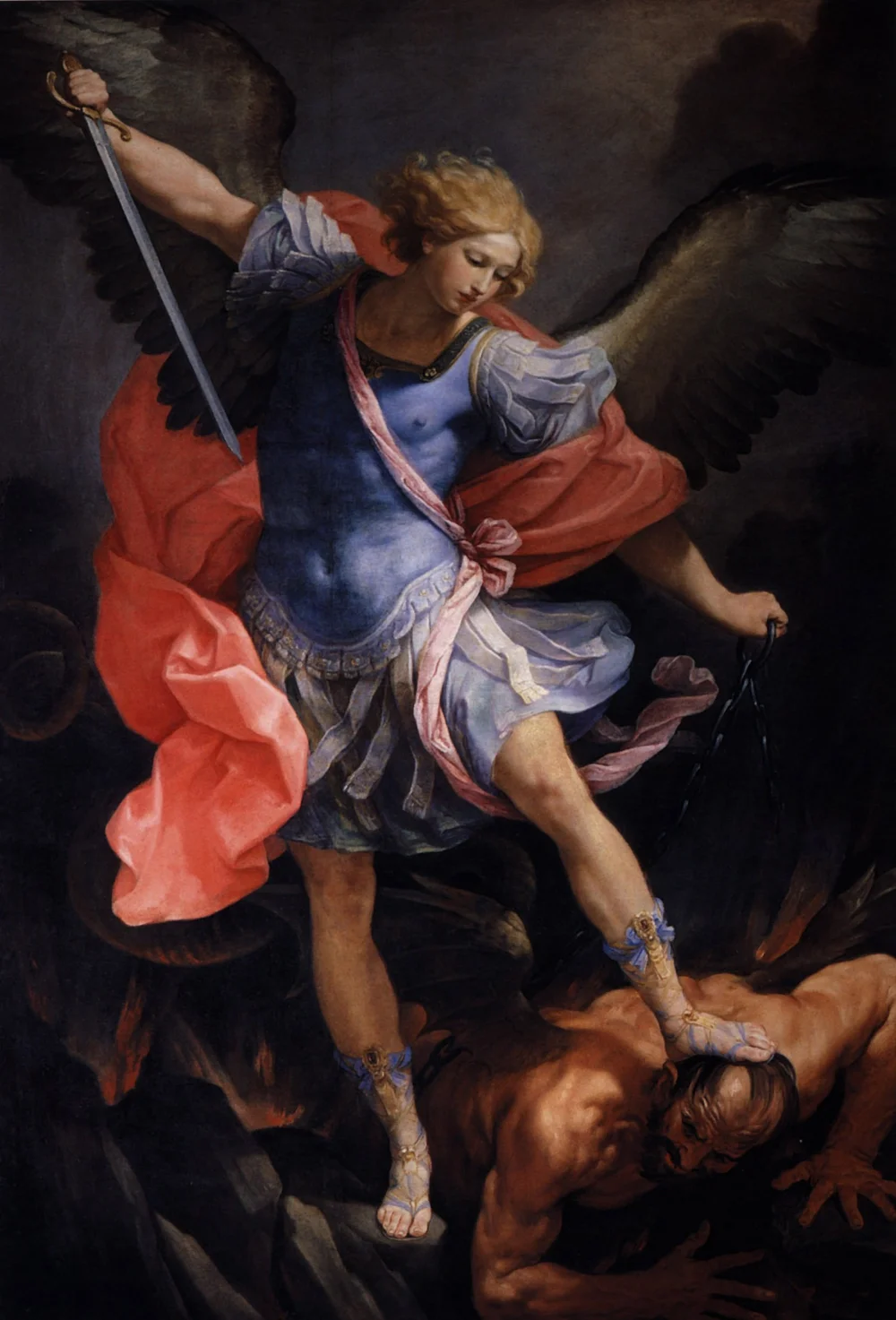
These two saints belong to the undivided pre-schism Church — venerated by Orthodox and Catholic alike. But the Catholic tradition has built specific, deeply layered devotional structures around both of them that give them a distinct Catholic character alongside their universal one. Michael is the subject of the most famous papal prayer in modern Catholic history. George is the patron of England, of the Crusades, and of Catholic nations on three continents. They are not merely shared saints. They are specifically Catholic ones as well.
St. Michael the Archangel — Universal, Central to Catholic Devotion
St. Michael is the only archangel with a shrine in the Western Catholic tradition that shaped the entire landscape of a nation. Mont-Saint-Michel, the tidal island monastery off the coast of Normandy, was built in the eighth century after Michael appeared to the Bishop of Avranches and commanded a church to be built on the rock — and the resulting abbey became one of the great pilgrimage destinations of medieval Europe, drawing kings and peasants alike across the tidal flats to invoke the warrior-archangel who guards the approaches to heaven. The physical architecture of Mont-Saint-Michel — impregnable, vertical, its spire crowned with Michael's gilded statue — is the Catholic imagination of Michael made stone: something unmovable, something that rises above everything around it, with a warrior at the top.
The specific event that most shaped Catholic devotion to Michael in the modern era was a private one: in 1886, Pope Leo XIII reportedly experienced a vision or locution — the accounts vary — in which he perceived a conversation between God and Satan, in which Satan was granted increased power to assault the Church for a period of time. Leo XIII left his private chapel, wrote the Prayer to St. Michael at his desk, and within days had mandated its recitation at the end of Low Mass throughout the Catholic world. The prayer — "St. Michael the Archangel, defend us in battle; be our protection against the wickedness and snares of the devil; may God rebuke him, we humbly pray; and do thou, O Prince of the Heavenly Host, by the power of God, thrust into hell Satan and all evil spirits who wander through the world seeking the ruin of souls" — became one of the most widely prayed Catholic devotional texts in history. It was said at the end of Mass in the Roman Rite until the liturgical reforms of the 1960s, and its recitation has been restored in countless parishes and communities since.
Michael is the patron of the United States Army's 82nd and 101st Airborne Divisions, of police departments across the world, of paratroopers and of the dying. In the Catholic theology of death, Michael accompanies the soul at the moment of departure and carries it to its particular judgment — making him the warrior present at both the beginning and the end of every human battle, the one who fights for the soul while it lives and escorts it when it is finished fighting.
The Prayer of Pope Leo XIII is most powerful when prayed daily — at the end of Morning Prayer, after the Rosary, or after Mass. Many Catholic families also pray it during times of unusual spiritual pressure, difficulty, or oppression. It requires no special preparation: say it slowly, mean it, and remember that you are not composing a polite request. You are calling on a commander who is already in the field.
Patron of England and the Catholic Nations
St. George — Universal, Patron of Catholic Nations
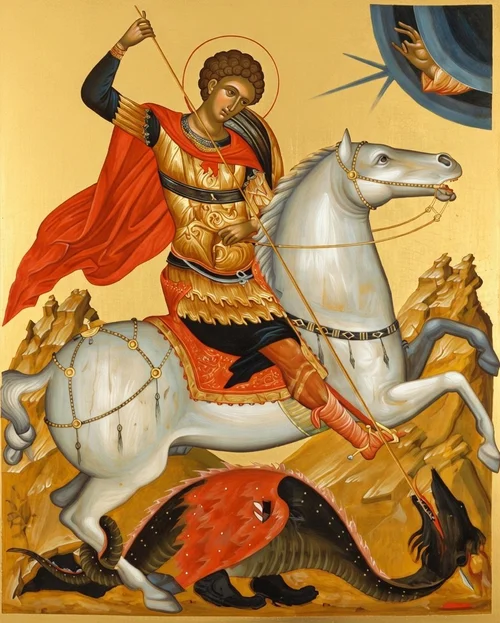
George became specifically and deeply Catholic in a way that goes beyond the pre-schism martyrdom he shares with the Orthodox world. In the Catholic West, his cult was carried by the Crusades — the crusading armies adopted George as their patron, and his red cross on a white field became the banner of English Christianity, eventually of England itself. Pope Gelasius I in 494 AD included George among the saints "whose names are justly reverenced among men but whose actions are known only to God" — a canonical acknowledgment that the historical details are uncertain but the witness is genuine. By the time of the Crusades, that witness had become one of the organizing symbols of Catholic militant Christianity: the soldier-martyr who chose death over apostasy, whose dragon-slaying image encoded the entire theology of faith's triumph over evil, and whose red cross on white was carried into every major engagement of the medieval Catholic military tradition.
The canonization of George as patron of England under Edward III in the fourteenth century cemented his specifically Catholic national identity in the English-speaking world. The Order of the Garter — the highest order of chivalry in England — is under his patronage. St. George's Chapel at Windsor Castle is one of the great Catholic ecclesiastical buildings of medieval England, still active. When Henry V invoked St. George at Agincourt ("God for Harry, England, and Saint George"), he was invoking a saint whose patronage of the English military tradition was four centuries old and counting. The fact that this same saint is the Megalomartyr of the Orthodox East and the Mor Girgis of the Coptic Church is a reminder that George belongs to everyone — but England, and the Catholic nations of Europe, made a very specific claim on him, and that claim shaped the devotional vocabulary of Catholic military culture for seven hundred years.
George is also one of the Fourteen Holy Helpers — a group of saints whose intercession was considered especially powerful against specific afflictions, particularly during the plague era. His patronage of soldiers, cavalry, archers, and those facing overwhelming force makes him the natural choice for any Catholic in military service seeking a patron, and his April 23 feast is celebrated with particular solemnity in England, Portugal, Catalonia, and Georgia — nations whose Catholic identity was formed in part by their relationship with the dragon-slayer.
Section II
The Roman Military Martyrs
The three saints in this section were all soldiers of the Roman imperial army who chose Christianity over the demands of the empire — at different times, in different ways, and at different personal costs. Sebastian survived his first execution and chose re-engagement over escape. Martin of Tours refused to fight and became a bishop whose relic shaped the language of chapels and chaplains. Maurice commanded six thousand men through two rounds of decimation without yielding a single one. Together they represent the range of moral courage available to a Christian in uniform, and between them they cover nearly every situation a Catholic soldier might face.
St. Sebastian — Pre-Schism, Roman Catholic Primary
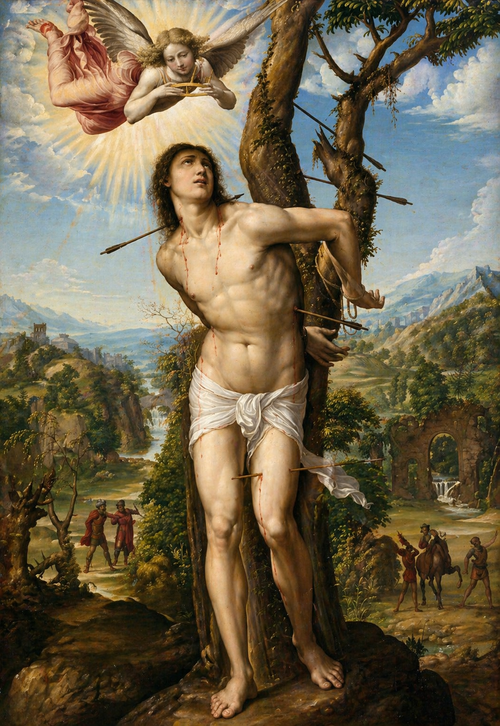
Sebastian was a captain in the Praetorian Guard — the most elite unit in the Roman military, responsible for the emperor's personal protection — who had concealed his Christianity from his commanders for years and used his position to protect, encourage, and occasionally secure the release of imprisoned Christians. When his faith was discovered and reported to Diocletian around 288 AD, the emperor had him taken to the Campus Martius — the ancient Roman military training ground — tied to a stake, and shot with arrows by archers of his own unit until he was left for dead. A Christian widow named Irene found him that night, still breathing, and nursed him back to health. His recovery was so complete that when he stood before Diocletian again weeks later — having sought out the emperor rather than fled — Diocletian reportedly had to look twice before recognizing the man he had ordered killed. Sebastian rebuked him for the persecution. This time the emperor ensured the job was completed: Sebastian was beaten to death with clubs, and his body thrown into Rome's great sewer, the Cloaca Maxima. Another Christian woman, Lucina, retrieved it after a vision directed her to the spot, and buried it in the catacombs on the Appian Way — which became the Basilica of San Sebastiano, still a pilgrimage church and one of the Seven Churches of Rome.
Sebastian's specific patronage of those who survive wounds — and his association with plague protection — made him one of the most venerated saints in medieval Catholic Europe. The identification of plague deaths with being shot by arrows (the sudden, piercing mortality of epidemic disease compared to the sudden, piercing impact of an arrow) drove enormous popular devotion to him during the Black Death and subsequent outbreaks. Hundreds of churches across Europe were dedicated or rededicated to him in thanksgiving after plague years. His image became one of the most reproduced in Catholic art — the young Praetorian officer, pierced and bound to the stake, his face lifted with an expression that reads not as agony but as something more like surprise at the inadequacy of what is being done to him to accomplish its intended purpose.
For Catholic soldiers and veterans, Sebastian carries a specific message that the other warrior saints do not: he is the patron of the one who was hit and survived — the soldier who took the wound, was left for dead, recovered, and went back into the fight. His re-engagement with Diocletian after surviving the arrows is not recklessness. In the tradition's understanding, it is the logical completion of his witness: the arrows failed to silence him, and he refused to let them succeed by default through his absence. He is the patron of resilience — of getting back up and going back to where the fight is.
The Soldier Who Stopped
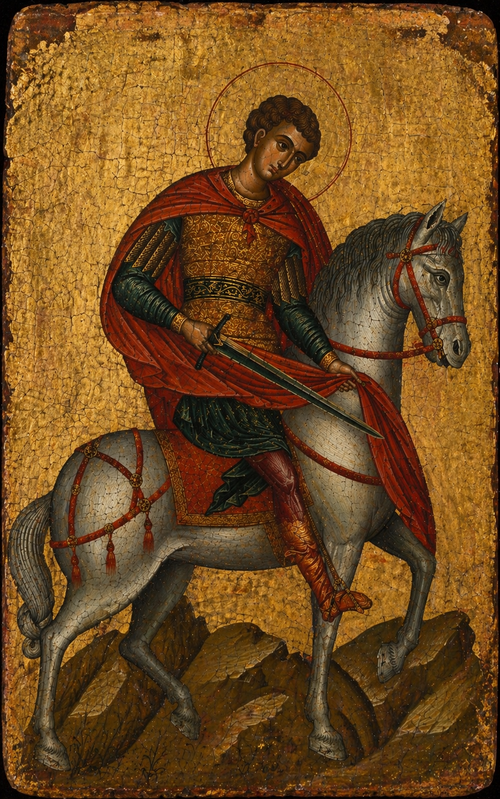
St. Martin of Tours — Pre-Schism, Roman Catholic Primary
The story of Martin of Tours begins with a cloak and ends with the English language carrying its memory without knowing it. Martin was born around 316 AD in Pannonia (modern Hungary) to a Roman military officer, was raised in Pavia in northern Italy, and was conscripted into the imperial cavalry in his teens — the Roman empire required the sons of veterans to serve. He was stationed at Amiens in Gaul in the winter of approximately 334 AD when the event occurred that defined his entire subsequent legacy: at the city gate he encountered a nearly naked beggar freezing in the cold, unsheathed his sword, cut his military cloak in half, and gave half to the man. That night he dreamed of Christ wearing the half-cloak, saying to the angels: "Here is Martin, the Roman soldier who is not baptized; he has clad me." Martin was baptized shortly thereafter.
When the emperor Julian — not yet the Apostate — ordered a military campaign against the Germanic tribes and required the cavalry to take a pre-battle payment, Martin refused both the money and the campaign: "I am a soldier of Christ. It is not lawful for me to fight." Julian accused him of cowardice. Martin offered to stand unarmed between the two armies — an offer that was not taken up because, in an improbable historical coincidence, the Germanic forces sued for peace and the campaign was cancelled before it began. Martin was released, went to find his mentor Hilary of Poitiers, eventually became a monk, founded what is often counted as the first monastery in Gaul, and became Bishop of Tours — one of the most influential sees in the Western Church.
The specific linguistic legacy of Martin of Tours is embedded in the word "chapel." His cloak — the half he kept, which became a relic after his death — was carried by Frankish kings into battle as a sacred protection. The portable shrine that housed the cloak was called a capella (little cloak), and the priests who accompanied it into battle were called capellani — chaplains. Every military chaplain who has ever served in any armed force in the Western tradition carries Martin's name in his title. Every church building called a chapel carries the memory of the cloak. His feast on November 11 — Martinmas — gave its character to the day that the First World War ended, Armistice Day. The saint of soldiers and the patron of the poor and the conscientious objector is woven into the fabric of Western military history at a level most people never notice.
The Legion That Would Not Break
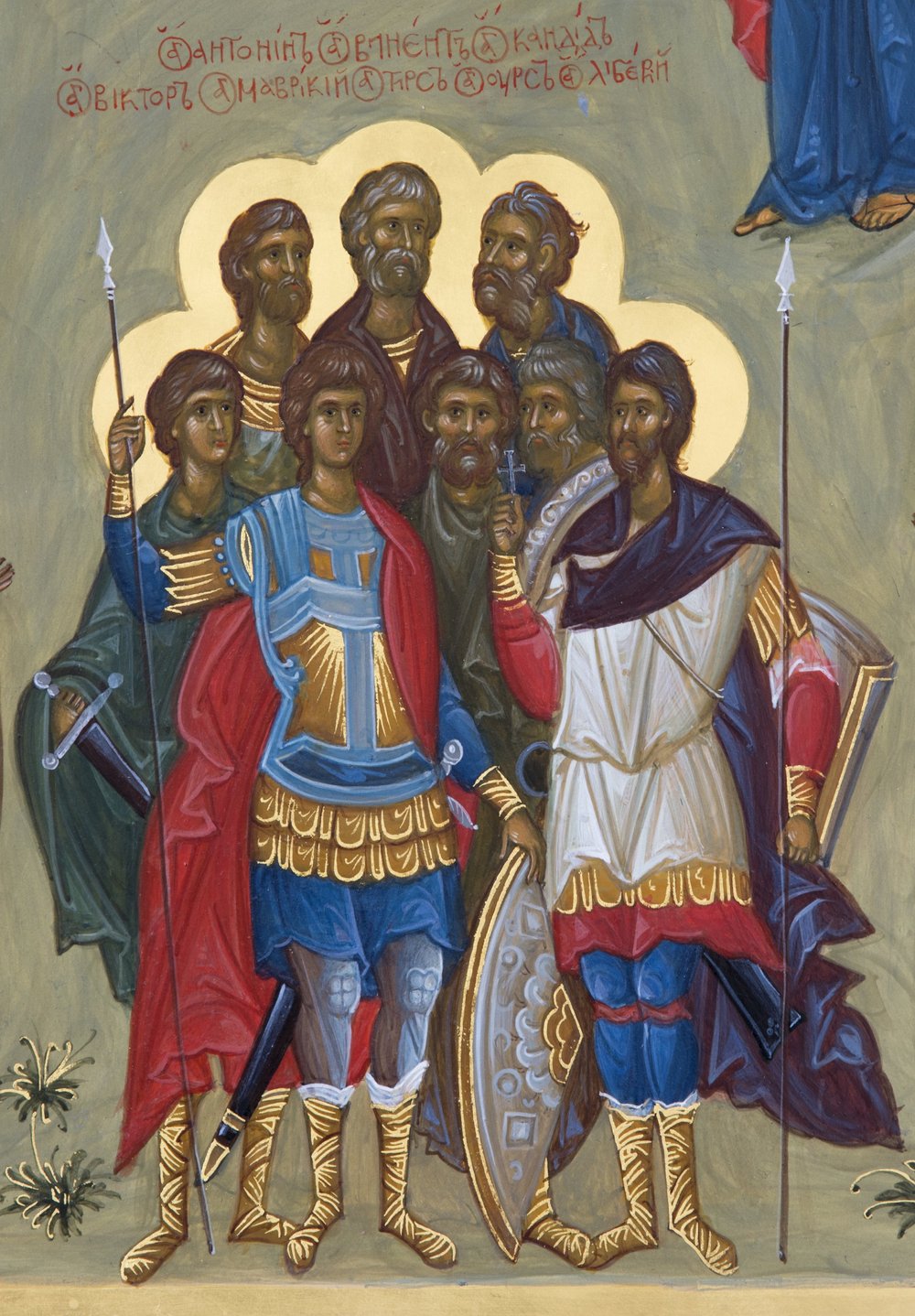
St. Maurice & the Theban Legion — Pre-Schism, Roman Catholic & Coptic
The Theban Legion — recruited from the Thebaid region of Upper Egypt, meaning they were almost certainly Coptic Christians — were stationed in Gaul under the emperor Maximian when, around 286 AD, the order came to slaughter the local Christian population and participate in pagan sacrifice before battle. Their commander, Maurice, refused. Maximian ordered a decimation: one soldier in ten was executed. The surviving nine in ten refused again. A second decimation was ordered. They still refused. The entire legion — approximately six thousand men, according to the primary source, the account of Bishop Eucherius of Lyon written in the fifth century — was executed where they stood. Not one man stepped forward to save himself by compliance.
For the medieval Catholic West, the Theban Legion became one of the defining stories of collective Christian witness — and Maurice became specifically the patron of the Holy Roman Empire, his lance and sword preserved as sacred relics carried in the imperial regalia. The Imperial Sword of the Holy Roman Empire, one of the great treasures of European Catholic civilization, is still called the Sword of St. Maurice. The Abbey of Saint-Maurice in Switzerland, built over the site of the martyrdom in the fourth century, was one of the major pilgrimage shrines of early medieval Christendom and is still an active abbey today. Maurice and his legion are depicted in Catholic art of the thirteenth century as Black Africans — a visual acknowledgment of their Egyptian origin — making him one of the earliest unambiguously Black saints in the Western Catholic iconographic tradition.
Maurice represents a specific and demanding form of moral courage that the Catholic just war tradition has always grappled with: the courage not of fighting but of refusing, at maximum personal cost, an order that violates the conscience. The Theban Legion's unanimous refusal — six thousand men, no defections, two rounds of execution — is the historical demonstration that the soldier's ultimate loyalty is not to the emperor but to God. The Catholic tradition has honored this witness for seventeen centuries and continues to: Maurice is invoked wherever Catholics in military service face the question of what an order is worth and what a conscience is worth more.
Section III
The Soldier-Pilgrim
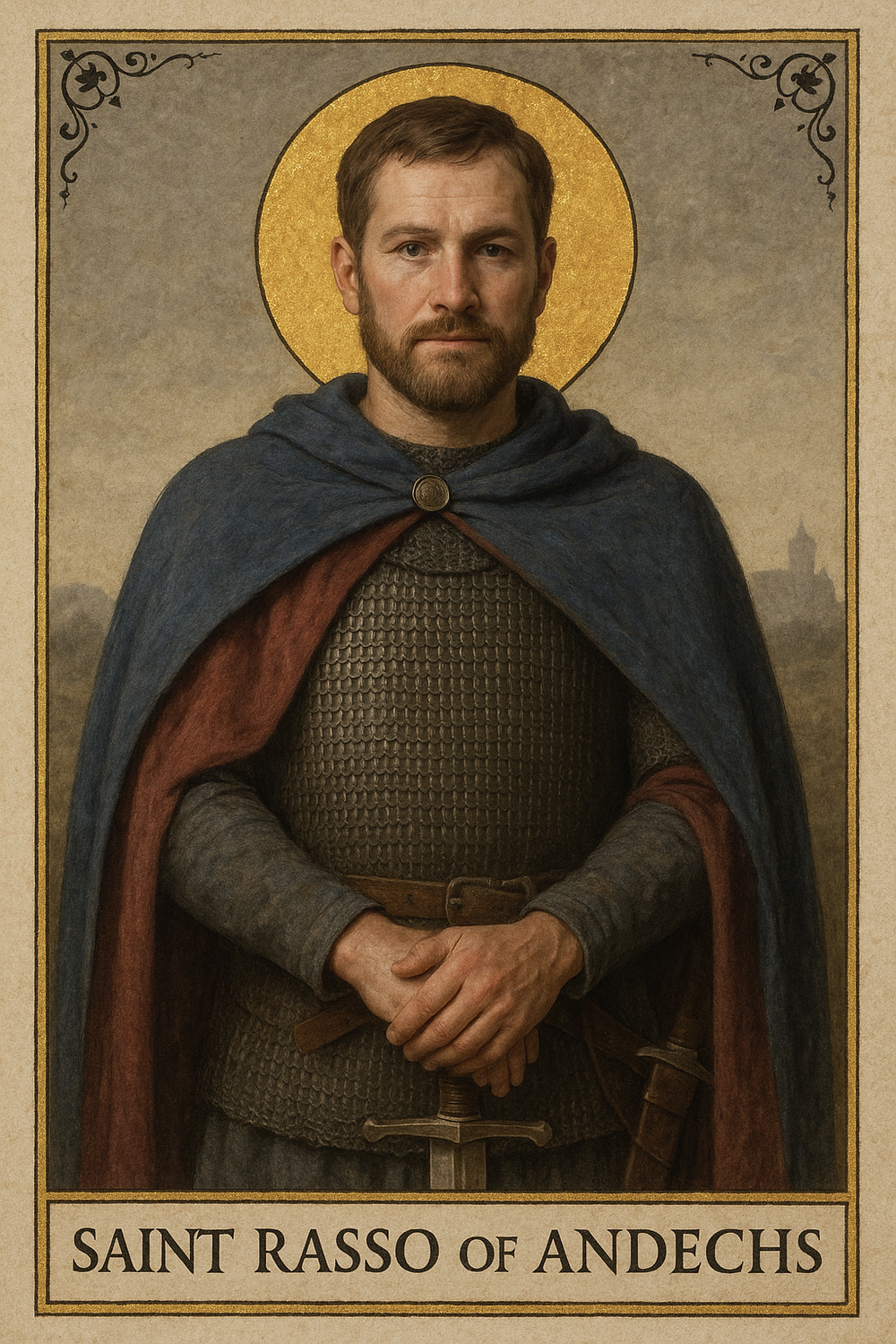
St. Rasso of Andechs — Pre-Schism, Roman Catholic (Bavarian)
Rasso of Andechs belongs to a category of Catholic warrior saint that is rare and undervalued: the veteran who survived his wars, came home, and went deeper into faith rather than settling into the comfort that survival had purchased. He was a Bavarian count of the noble house of Andechs who fought in the campaigns against the Magyar invasions of the early tenth century — the violent raids that struck deep into the heart of Christian Bavaria and the Frankish lands, burning churches and monasteries, forcing the Christian communities of the German lands into a defensive posture for decades. Rasso was among the commanders who resisted, and by the time the Magyar threat had been contained, he had the battlefield experience of a man who had spent his military career defending Christian civilization against forces that wanted to end it.
What Rasso did next is what makes him a saint rather than merely a successful soldier. He undertook a pilgrimage to Jerusalem and Constantinople — a journey of enormous physical difficulty and danger in the tenth century — and returned with a remarkable collection of sacred relics said to number in the hundreds, which he installed in the church at Andechs on the hill above his ancestral seat. He then withdrew from secular life, took Benedictine vows, and died a monk. The Andechs Abbey — one of the great pilgrimage sites of Bavaria, still active, still drawing pilgrims to the hill where Rasso's relics rest — was the fruit of that pilgrimage and that withdrawal. It sits on the hill above the Bavarian lake country, its white towers visible for miles, a monument to the conviction that surviving your wars is not the end of the story but the beginning of a different and more demanding chapter.
Rasso speaks specifically to the veteran experience in a way that few warrior saints can: he is the patron of the soldier who made it home and is wrestling with what to do with the life that was given back. His transition from count to monk was not a rejection of his military identity but its completion — the recognition that the courage required to defend Bavaria and the courage required to pray in a monastery belong to the same tradition of costly fidelity, and that a man who has spent his courage on the first has more than enough for the second. He is the Catholic patron of veterans navigating the return.
Section IV
The Post-Schism Catholic Warrior Saints
Joan and Ignatius are the two warrior saints who are exclusively Catholic — canonized after the Great Schism, belonging to no other tradition. They are also the two who most clearly represent the twin poles of the Catholic warrior vocation: the external warrior who hears God's voice and leads armies in His name, and the interior warrior who transforms military discipline into the most rigorous program of spiritual combat in the Western tradition. Between them, they have defined what Catholic warrior-sainthood looks like in the post-medieval world — and they could not be more different from each other, or more complementary.
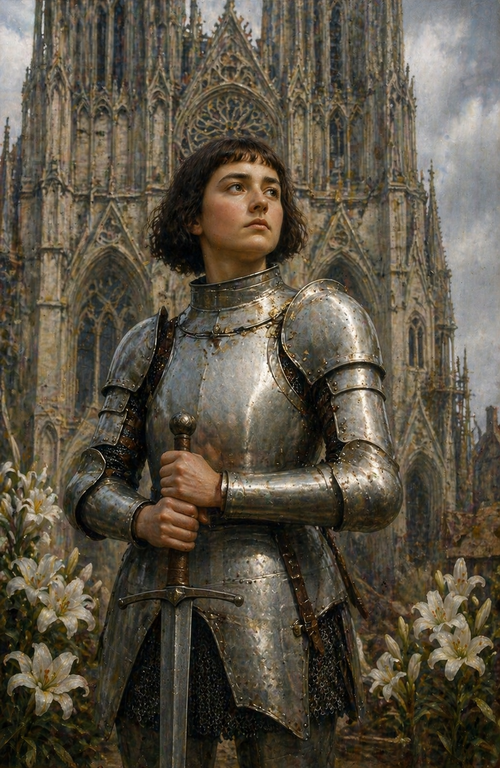
St. Joan of Arc — Post-Schism, Roman Catholic — Canonized 1920
Joan of Arc is the most famous warrior saint in the Western world and one of the most extraordinary individuals in the entire history of the Catholic Church. What she accomplished between the ages of seventeen and nineteen — uneducated, without military training, without political connections, in the middle of a war the professional French military had been losing for nearly a century — cannot be explained within the range of ordinary human capability. Which is, of course, the point. The Catholic Church canonized her in 1920 not because she was a great military commander (she was, but that was not why) but because she was a saint: a human being through whom the power of God was demonstrably operating in ways that exceeded the human resources available.
She began hearing voices at approximately age thirteen — identifying them over time as St. Michael the Archangel, St. Catherine of Alexandria, and St. Margaret of Antioch. The voices told her that she had been given a mission: to drive the English out of France and to have the Dauphin Charles VII crowned King of France at Reims. This mission required her to travel to Chinon, gain an audience with the Dauphin she had never met, persuade him of her calling through a private conversation whose content he never disclosed, receive command of an army, and ride to the besieged city of Orléans in armor. She accomplished all of this in under a year. The siege of Orléans had lasted months before her arrival; she lifted it in nine days. The coronation at Reims followed in July 1429. She had done what she said she would do.
Her capture by the Burgundians in May 1430, sale to the English, and subsequent trial at Rouen in 1431 constitute one of the most documented ecclesiastical injustices in the Catholic historical record. She was nineteen years old. She was questioned by some of the most learned ecclesiastical lawyers in France, who had been specifically tasked with finding grounds for her conviction, and she answered with a theological precision and a personal authority that repeatedly left her questioners at a loss. The question at the heart of the trial — whether her voices were from God or from the devil — was one that her accusers had already decided before they asked it. She maintained their divine origin under prolonged examination, under psychological pressure, and in the face of the certain knowledge that her conviction had been decided in advance. She was burned at the stake on May 30, 1431. Her last word, repeated, was "Jesus."
The rehabilitation trial of 1456, ordered by Pope Callixtus III, found the original proceedings fraudulent in virtually every procedural and substantive respect and annulled the conviction. Joan was beatified in 1909 and canonized in 1920. She is the patron of France and of French Catholics, of soldiers, of women in military service, of prisoners and captives, and of anyone who has ever faced institutional religious authority in a situation where conscience and authority pointed in different directions. She did not survive her encounter with the institutional Church in its corrupted form. But she was right, and it was wrong, and the historical and canonical record shows it — which is why the Church eventually recognized her, and why her witness is among the most durable and powerful in the entire Catholic tradition.
Joan's experience of locution — interior voices she identified as saints — is not theologically unusual in the Catholic tradition, though the consequences of her specific case were unusually public. The Church's process of discernment for such experiences is thorough, and Joan's canonization represents the Church's definitive judgment, after centuries of examination, that her voices were genuine. Catholics who struggle with the idea of a teenager being given a military mission by divine command are in good company: most of Joan's contemporaries also found it improbable. She did it anyway, and the results were what she said they would be.
The Soldier Who Found the Real War
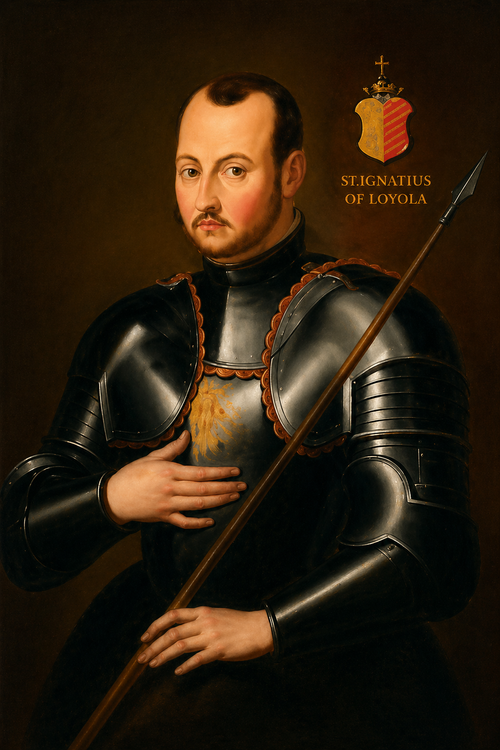
St. Ignatius of Loyola — Post-Schism, Roman Catholic — Canonized 1622
Ignatius of Loyola did not become a saint despite his military past. He became a saint because of what his military past gave him — the specific combination of discipline, tactical thinking, obedience, and willingness to endure pain in service of a mission — and because he had the intelligence and the grace to recognize, after a cannonball broke his leg at Pamplona in 1521, that these capacities had been given to him for a different war than the one he had been fighting.
He was born Iñigo López de Loyola in 1491 into a Basque noble family with a strong military tradition. He was trained as a soldier, served as a page and then a soldier in various campaigns, and by his late twenties was an experienced officer with a taste for glory and the kind of self-regard that military culture produces in men who are good at it. At the Battle of Pamplona in May 1521, a French cannonball passed between his legs and shattered his right shin, wounding the left as well. The fortress fell. Ignatius was carried back to the family castle at Loyola in considerable pain, where he underwent multiple agonizing surgeries — including having a protruding bone sawn off without anesthetic because he was unwilling to accept a limp that would prevent him wearing the tight courtier's hose fashionable at the time. The combination of physical suffering and enforced inactivity produced the conditions for a conversion he had not been looking for.
The conversion mechanism was simple: he noticed a difference. When he read the chivalric romances he had always enjoyed, he felt pleasure that faded into emptiness when he put the book down. When he read the life of Christ and the lives of the saints that were the only books available in his convalescence, he felt a different kind of feeling — one that, when he turned away from it, left him not empty but fuller and wanting more. He was a soldier. He recognized the tactical difference between approaches that worked and those that didn't. He spent months observing this pattern before he drew the only logical conclusion: the pleasures of the courtly life left him empty; the pursuit of God left him full. The rest of his life was the disciplined application of that observation.
The Spiritual Exercises he eventually developed — after years of prayer, pilgrimage to Jerusalem, study at Paris, and mystical experience at Manresa — are built explicitly and consciously on military structure. The retreatant is a soldier being trained for a specific mission. The director is the commanding officer. The enemy is identified, his tactics studied, his vulnerabilities noted. The exercitant practices discernment — the spiritual equivalent of tactical intelligence — learning to distinguish the movements of the good spirit from those of the enemy, to recognize consolation from desolation, to make decisions under pressure with the information available rather than waiting for perfect clarity that never comes. The Jesuits he founded were organized on military lines: total obedience to a superior, deployment wherever the mission required, no permanent establishment that could not be abandoned when necessity demanded it. By the time of his death in 1556, the Society of Jesus had nearly a thousand members active across Europe, India, Brazil, and Japan. The soldier's discipline had built one of the most effective missionary organizations in the history of the Church.
The Spiritual Exercises are structured as a thirty-day silent retreat, though Ignatius developed an "annotation 19" version that can be made in daily life over several months. They are available at Jesuit retreat houses worldwide and are increasingly offered specifically for veterans. The specific combination of rigorous structure, clear mission orientation, systematic discernment training, and willingness to confront the darkest material of one's own interior life makes them — as Ignatius designed them to be — exactly what military training prepares a person for. Many veterans who make the Exercises report that it is the first spiritual practice that has felt familiar.
Finding Your Patron
Finding Your Catholic Warrior Patron
The Catholic tradition has always understood that patron saints are not generic protections — they are specific relationships between a specific person and a specific saint whose life touches theirs at some point of genuine contact. The most effective patron is rarely the most famous one; it is the one whose story speaks directly to your situation. Here is a practical guide to matching your situation with your patron.
| Your Situation | Primary Catholic Patron | Also Consider |
|---|---|---|
| Active military service — any branch | St. Michael or St. George | St. Sebastian, St. Martin of Tours |
| Infantry soldier | St. Martin of Tours | St. Maurice, St. Sebastian |
| Military officer / command responsibility | St. Maurice | St. George, St. Michael |
| Military chaplain | St. Martin of Tours | St. Ignatius of Loyola |
| Police / first responder | St. Michael the Archangel | St. Sebastian |
| Wounded — recovering from combat injury | St. Sebastian | St. Ignatius of Loyola |
| Veteran — navigating the return | St. Ignatius of Loyola | St. Rasso of Andechs, St. Martin of Tours |
| Spiritual warfare / interior battle | St. Michael the Archangel | St. Ignatius of Loyola |
| Woman in military / facing impossible odds | St. Joan of Arc | St. Michael (her primary patron) |
| Facing unjust institutional authority | St. Joan of Arc | St. Sebastian, St. Maurice |
| French Catholic heritage | St. Joan of Arc or St. Martin of Tours | Both — they are the French warrior saints |
| Conscientious objector / moral refusal | St. Martin of Tours | St. Maurice and the Theban Legion |
| English Catholic heritage | St. George | St. Sebastian (honored widely in English Catholic art) |
| Bavarian / German Catholic heritage | St. Rasso of Andechs | St. Michael (patron of the Holy Roman Empire) |
Bring Your Patron Home
Every Catholic warrior saint in this guide has a handcrafted prayer card available from The Eastern Church — for personal devotion, for gifts to soldiers and veterans, and for bulk parish distribution. There is no better gift for a Catholic in uniform than a prayer card of their patron saint.
Browse All Warrior Saint Prayer Cards →Questions About the Catholic Warrior Saints
Put On the Full Armor
The Catholic warrior saints are not a museum exhibit. They are the Church's living answer to the question that every soldier, every veteran, every person waging the interior battle of the Christian life eventually asks: has anyone been here before? The answer is yes — in the second century and the fifth and the fifteenth and every century since. They faced what you are facing. They won. Not always by surviving, but by refusing to let what was done to them be the final word. The prayer cards in this collection are the practical first step: bring your patron home, learn their story, and invoke them by name. The full armor of God is available. Put it on.
Browse All Catholic Warrior Saint Prayer Cards →