Orthodox Warrior Saints: A Complete Guide
Eastern Orthodox • Oriental Orthodox • Byzantine • Coptic • Armenian • Slavic
Orthodox Warrior Saints: A Complete Guide to the Holy Military Martyrs
The Orthodox tradition produced the richest warrior-saint theology in all of Christianity — from the armored Megalomartyr icons of Byzantium to the Coptic soldiers of the Egyptian desert to the Armenian generals who died at Avarayr. This is the complete guide to every warrior saint the Orthodox world calls its own.
At a Glance
- Saints Covered
- 12 warrior saints across Eastern Orthodox, Oriental Orthodox, Coptic, Armenian, and Slavic traditions
- The Category
- Holy Military Martyrs (Megalomartyr-Soldiers) — the most developed warrior-saint theology in Christianity
- The Byzantine Core
- St. George, St. Demetrios, St. Theodore Stratelates, St. Theodore Tyron — the armored saints of the icon tradition
- The Coptic Warriors
- St. Mercurius (Abu Sefein), St. Menas (Mar Mina), St. Maurice & the Theban Legion
- The Armenian Martyrs
- St. Sarkis the Warrior, St. Vartan Mamikonian — the founding witnesses of Armenian Christianity
- The Slavic Saints
- St. Olga of Kyiv, St. Alexander Nevsky — warrior saints of the Russian and Ukrainian Orthodox world
The Orthodox Theology of the Holy Warrior
No Christian tradition has developed the theology and iconography of the holy warrior as deeply as the Orthodox. This is not incidental. The Eastern Church emerged from the Roman Empire, spread through the Byzantine civilization, and endured centuries of siege — by Persians, by Arabs, by Mongols, by Ottomans — in ways that made the question of how a Christian faces lethal external power not a theoretical question but a lived one, pressing on every generation. The warrior saints are not decorations on the walls of Orthodox churches. They are the tradition's accumulated answer to that question, encoded in gold and lacquer and hammered into icons that have outlasted every empire that tried to destroy them.
The Megalomartyr Category
The Orthodox hagiographical tradition has a specific rank — Megalomartyr, Great Martyr — reserved for saints whose martyrdom was of exceptional scope, duration, or theological significance. Among the warrior saints, George, Demetrios, Theodore Stratelates, Theodore Tyron, and Mercurius all hold this title. It is not merely honorific. It marks a saint whose witness became the theological and spiritual foundation of an entire community — whose death was so total, so unequivocal, so clearly won through grace rather than human endurance, that the Church understood it as something more than exemplary courage. The Megalomartyr's death is an act of the divine life moving through a human person who has surrendered entirely to it.
The Icon of the Armored Saint
The Byzantine iconographic convention of depicting warrior saints in full Roman military armor — mounted, armed, often in the act of spearing a fallen enemy — is a specific theological claim. The armor is not historical costume. It declares that the saint is still fighting. In Orthodox theology, the saints are alive in God and their intercession is active, continuous, and powerful. When an Orthodox Christian stands before an icon of St. George or St. Demetrios, they are not looking at a historical picture. They are encountering a living person — one who holds, from within the divine life, the office the icon depicts. The soldier's armor is the eternal form of what this person is and does. It is a permanent vocation, not a biographical detail.
This is why Orthodox churches going into conflict have carried icons of George and Demetrios, why Byzantine emperors invoked Demetrios before battles for Thessaloniki, why the Theban Legion's Coptic heritage is claimed by the Egyptian Church as a living protection rather than a historical memory. The warrior saints of Orthodoxy are not past. They are present — and they are armed.
Eastern Orthodox: Greek, Russian, Serbian, Antiochian, Romanian, Bulgarian, and all other autocephalous Orthodox churches sharing the Byzantine liturgical tradition.
Oriental Orthodox: Coptic Orthodox (Egypt), Armenian Apostolic, Ethiopian Orthodox, Eritrean Orthodox — the non-Chalcedonian tradition that parted from the Byzantine Church in 451 AD but shares the pre-schism warrior-saint heritage entirely.
Eastern Catholic (sharing this tradition): All Byzantine-rite Eastern Catholic churches — Greek Catholic, Melkite, Ukrainian Catholic, Ruthenian, Romanian, and others — share the Eastern Orthodox warrior-saint tradition in its liturgical and theological forms. This guide belongs to them equally.
Orthodox Warrior Saint Prayer Cards
Handcrafted prayer cards in the Eastern Christian tradition — for icon corners, gifts to soldiers and veterans, and bulk parish orders. Every saint in this guide has a prayer card.
Browse All Prayer Cards →The Universal Orthodox Champions
These two saints — one an archangel who transcends history, one a Roman officer who entered it at full speed and refused to flinch — are the foundation of Orthodox warrior devotion. They appear in every Orthodox church on earth, in every Orthodox tradition from the Nile Delta to the Arctic Circle. Any account of Orthodox warrior saints that doesn't begin here has begun in the wrong place.
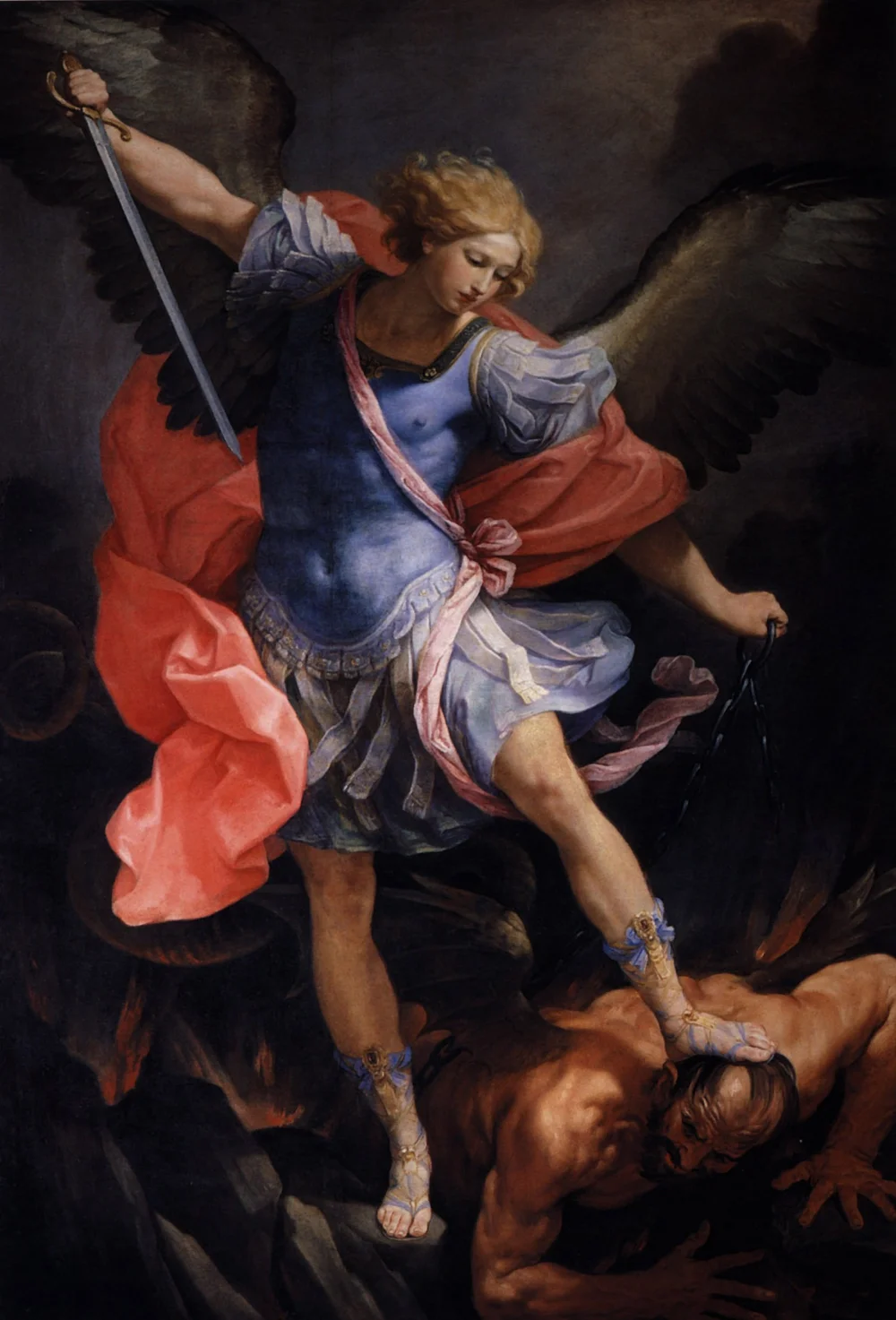
St. Michael the Archangel — Universal Orthodox
The Eastern Orthodox tradition calls Michael the Archistrategos — the Supreme Commander — and the title is precise: he commands the entire army of heaven, all the bodiless powers, every rank of angel and archangel, in the ongoing war against the fallen spirits who assault the Church and the souls within her. His authority is not derived. It is delegated directly by God, which means that when an Orthodox Christian invokes Michael, they are not asking a human saint who achieved holiness through struggle. They are asking the officer God Himself appointed to lead the defense of the created order against its enemies.
The Byzantine liturgical calendar honors Michael with unusual frequency. The November 8 Synaxis of the Archangels is the principal Byzantine feast, celebrating the entire heavenly host — a major liturgical event in every Greek, Russian, Serbian, and Eastern Catholic church. The September 6 feast commemorates the Miracle at Chonae (Colossae), where Michael struck the ground to divert a stream that pagans had engineered to destroy a Christian shrine: an image of divine power intervening precisely in the physical, material world on behalf of His people. The Coptic tradition goes further still, celebrating Michael on the twelfth of every month — twelve separate feasts, each with its own liturgical observance — making him perhaps the most frequently celebrated saint in any Christian calendar in the world. In the Coptic theology, Michael is the weigher of souls, the messenger between heaven and earth, and the protector of the Nile itself.
The most important Orthodox prayer associated with Michael is the ancient Troparion of the Archangel Michael, sung at every Divine Liturgy that commemorates him: "Supreme Commander of the heavenly hosts, we who are unworthy beseech you, by your prayers encompass us beneath the wings of your immaterial glory, and guard us who fall down before you and cry out: Deliver us from all harm, for you are the Commander of the powers on high." This is not poetry. It is the Church's active deployment of its supreme military resource — the saint who answers the question that defines all of holy warfare: who is like God? — with the only response the universe can give: no one.
The Trophy-Bearer
St. George the Trophy-Bearer — Universal Orthodox — Megalomartyr
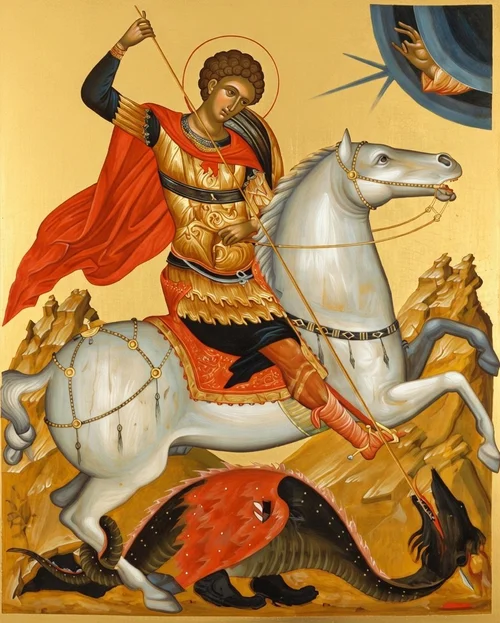
George is the Megalomartyr above all others — the Great Martyr whose witness spread to every corner of the Christian world and took root in every tradition that encountered it. He was a Roman officer of Cappadocian origin, a tribune in Diocletian's Praetorian Guard, who publicly declared his faith at the beginning of the Great Persecution around 303 AD, distributed his wealth to the poor, refused every offer of mercy and advancement, and endured days of torture before his beheading at Nicomedia. The tradition calls him Tropaiophor — Trophy-Bearer — because his death was understood not as a defeat but as the definitive capture of a prize. The trophy is not his, but the one he won for Christ by his witness.
In the Byzantine iconographic tradition, George is typically depicted on horseback in full military armor, his lance driving through a dragon or serpent beneath his horse's hooves. The dragon is the iconographic shorthand for the entire complex of what opposes God: the persecuting Roman state, the demonic powers behind it, and the primordial enemy of the human soul. George's mounted image became one of the most widely reproduced images in Christian art — it appears on the coins of medieval kingdoms, on the shields of crusading armies, on the walls of Coptic monasteries in Egypt, on the flags of nations from England to Georgia, on the icons of every Orthodox tradition from the Nile to the Neva. There is no single saint — not even Michael — whose physical image has been reproduced more widely across the Christian world.
The Coptic Orthodox tradition venerates him as Mor Girgis with an intensity that approaches the national. Major Coptic churches across Egypt bear his name. The Syriac tradition carries him under the same Aramaic form. The Armenian Apostolic Church includes him in its calendar. The Ethiopian Church counts him among the most beloved intercessors. In every Orthodox family tree — Eastern, Oriental, Chalcedonian or not — George is the warrior whose story needed no translation because courage and fidelity speak every language simultaneously.
Section II
The Byzantine Holy Military Martyrs
If George is the universal Orthodox warrior, these three saints are the specifically Byzantine ones — the soldier-martyrs whose stories, relics, and icons are woven into the liturgical and devotional life of every Greek, Slavic, Romanian, Melkite, and Eastern Catholic tradition that traces its roots to Constantinople. They are frequently depicted together in icons: Demetrios and George mounted on horseback with the same regal bearing, the two Theodores standing side by side in full armor. In Byzantine iconography, their pairing is a theological statement: the Church is defended by soldiers who stand together, who reinforce each other, whose witness is collective as well as individual. No Byzantine tradition has ever had just one military saint. It has always had a company.
St. Demetrios of Thessaloniki — Byzantine Orthodox — Megalomartyr
Demetrios and George are the two pillars of Byzantine warrior devotion — depicted together in countless icons, invoked together in the litanies of countless Divine Liturgies — but they are not interchangeable. Where George's witness traveled the world and became universal, Demetrios's roots went straight down into one city and stayed there. He is the patron of Thessaloniki, the second city of the Byzantine Empire, in a way that George is the patron of no single place. The relationship between Demetrios and his city is one of the deepest and most enduring patron-saint bonds in the history of Christianity.
He was a Roman proconsul in Thessaloniki around 306 AD — a position of both military and civic authority — when his Christianity was discovered under the persecution of Maximian. While imprisoned in the city's baths, he blessed and encouraged the young Christian Nestor before the boy's fatal gladiatorial contest against the emperor's champion Lyaios. Maximian had him run through with spears on the spot. His body was buried at the site of his martyrdom, and from nearly the first moment, miracles followed. The church built over his tomb became one of the most visited shrines in the entire Byzantine world. And when the barbarian sieges came — Avars, Slavs, Bulgars, Arabs, Normans, cycling through the centuries — the tradition recorded again and again that a soldier in shining armor had been seen defending the walls. The city kept surviving. Thessaloniki attributed it to Demetrios.
The myrrh-streaming of his relics is central to the Demetrios cult in the Orthodox tradition. When his tomb was opened, the relics were found to be exuding fragrant oil — myrrh — the sign the Eastern tradition associates with a saint's ongoing life and presence. The myrrh was collected in ampullae and distributed across the Byzantine world as a healing oil. Pilgrims came from across the empire. The feast of Demetrios on October 26 remains one of the great celebrations of the Byzantine year, observed with particular solemnity in Thessaloniki itself, where the Hagios Demetrios basilica stands on the original site of the martyrdom and has stood there, through every catastrophe the city has endured, for seventeen hundred years.
The General
St. Theodore Stratelates — Byzantine Orthodox — Great Martyr
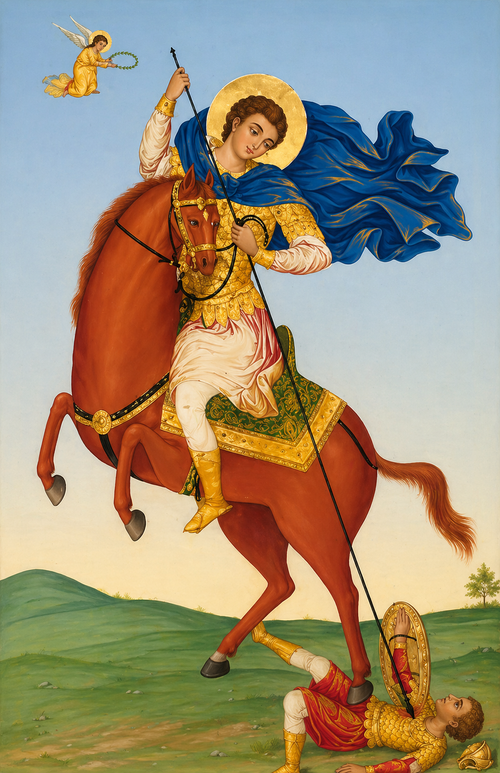
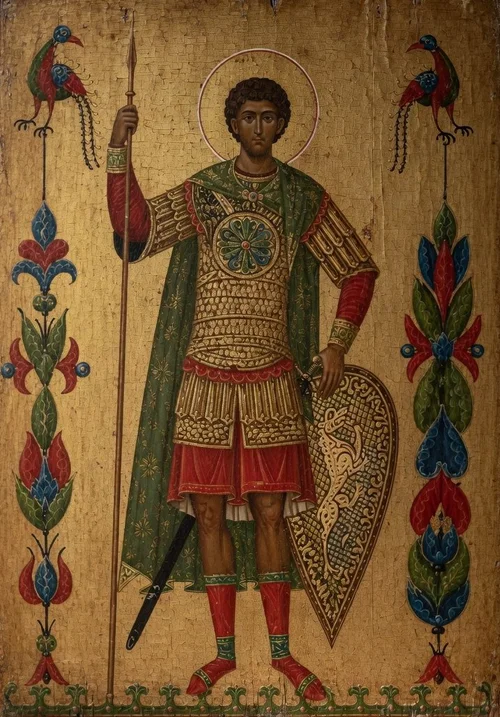
Theodore Stratelates — Theodore the General — holds a specific rank among the Byzantine military saints that his title alone announces: he was not a recruit, not a junior officer, but a commanding general. His office in the army of the Roman emperor was one of the highest military positions available, and it was precisely this authority that made his martyrdom so significant. He had everything the empire could offer a soldier — rank, honor, the emperor's trust — and he destroyed it all in a single night, not impulsively but with deliberate calculation, when he reduced the temples of Heraclea to rubble and distributed the idols' gold and silver to the poor the night before his court-mandated act of sacrifice.
The Orthodox tradition reads this act as strategic rather than reckless. Theodore was a general. Generals do not make suicidal gestures. They choose the moment and the manner of their decisive engagement, and Theodore chose his: he forced the confrontation on his own terms, at a time and in a way that made his witness unmistakable. His subsequent torture under Licinius lasted for days and included every cruelty the imperial executioners knew. The hagiographical tradition records visions of Christ and the angels attending him throughout — the commander of heaven's armies honoring the loyalty of one of his earthly officers. He was crucified, then beheaded. His servant Ouaros carried his body to his native Euchaita for burial, from which his relics were later translated with great ceremony.
Theodore Stratelates is the patron invoked by military officers and commanders in the Orthodox tradition — those who carry authority over others and must exercise it with the justice and courage that such authority demands. His feast on June 8 (the translation of relics) is the major commemoration in the Byzantine calendar. He is depicted in icons alongside Theodore Tyron, the two Theodores forming a matched pair in Orthodox iconography — the General and the Recruit standing together as a statement that the warrior-witness of the Church requires both command and obedience, both the authority of the officer and the courage of the new soldier.
The Recruit
St. Theodore of Amasea (Theodore Tyron) — Byzantine Orthodox — Great Martyr
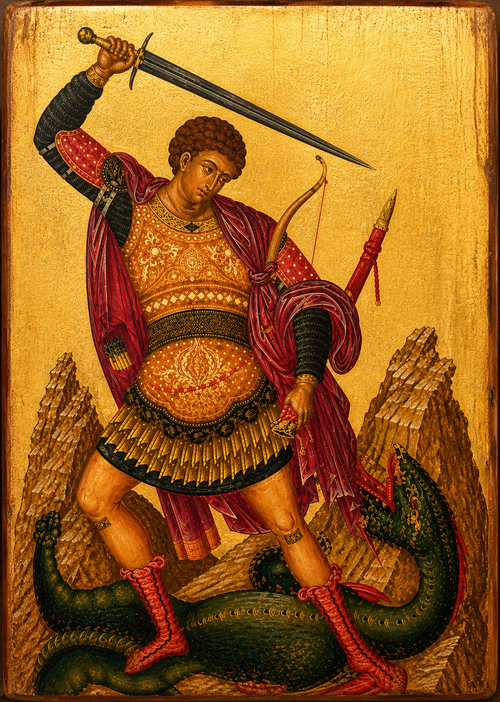
Theodore Tyron — Theodore the Recruit — is the earlier and, in the daily life of the Orthodox Church, arguably the more present of the two Theodores. Where Stratelates is the patron invoked for authority and command, Tyron is the one associated with new beginnings, with the courage of those who are just starting, with the specific witness of a person who has not yet accumulated rank or reputation but who acts from pure conviction. He was a new soldier, stationed at Amasea in Pontus around 306 AD, when the order came to participate in pagan sacrifice. He refused, burned the temple of Cybele to the ground, and was arrested. Brought before the magistrate Publius and tortured, he reportedly endured the entire ordeal in a state of such visible joy and composure that his torturers were disturbed. He was executed by fire — thrown alive into a furnace, from which tradition says he emerged unharmed before being beheaded.
The Kollyva miracle — the defining story of Theodore Tyron's ongoing protection of the Church — belongs to approximately 362 AD, more than fifty years after his death. The emperor Julian the Apostate, unwilling to create martyrs but determined to undermine Orthodox practice, ordered the Constantinople market food supply to be secretly contaminated with blood from pagan sacrifices during the first week of Great Lent, so that fasting Christians would unknowingly violate their fast. Theodore appeared that night in a vision to Archbishop Eudoxius of Constantinople, warned him of the plot in specific detail, and instructed him to have the faithful eat boiled wheat — kollyva — for the week instead of market food. The archbishop complied, the emperor's plan failed, and the Orthodox Church has observed the First Saturday of Great Lent as the Saturday of St. Theodore ever since, blessing and distributing kollyva in every Byzantine-tradition church in the world, every year, without interruption for over sixteen hundred years.
This is what makes Theodore Tyron unusual among warrior saints: his ongoing witness in the life of the Church is not primarily military but liturgical. He is the warrior saint of Lenten fasting, of the Church's ability to maintain its practices against those who would corrupt them from within. In Orthodox theology, the First Saturday of Lent is not a historical memorial. It is the Church's active, annual invocation of its Recruit — the young soldier who has been guarding the fast since 362 AD and is still on duty.
Section III
The Coptic Orthodox Warrior Saints
The Coptic Orthodox Church of Egypt is one of the oldest Christian communities on earth — tracing its founding to St. Mark the Evangelist in Alexandria in the first century — and it produced three of the most extraordinary warrior saints in the entire Christian tradition. Two of them — Mercurius and Menas — are virtually unknown in the Western world, which says more about the West's incomplete knowledge of Christian history than it does about the significance of these saints. The third — Maurice and the Theban Legion — is known in the West, but rarely with full awareness of his Coptic Egyptian origins. Together these three represent a warrior-saint tradition of stunning depth, rooted in the Egyptian desert and the Roman legions simultaneously, and constituting one of the most powerful devotional inheritances any Christian tradition carries.
St. Philopater Mercurius (Abu Sefein) — Coptic Orthodox — Great Martyr
The story of Mercurius is two stories, separated by a century, and the second is more extraordinary than the first. The first story: Mercurius was a distinguished Roman officer — decorated, trusted, the kind of soldier who rises through merit — who served under the emperor Decius in the mid-third century. When Decius turned to systematic persecution of Christians, Mercurius refused the mandatory pagan sacrifice, was arrested, and endured a martyrdom of unusual brutality. During his imprisonment, tradition holds that the Archangel Michael appeared to him and gave him a second sword — which is the origin of the name by which all of Coptic Egypt knows him: Abu Sefein, the Father of Two Swords. The icon of Mercurius always depicts him with two swords: the one he earned as a soldier, and the one the Archangel gave him as a saint.
The second story belongs to approximately 362 AD, during the reign of Julian the Apostate. St. Basil the Great, bishop of Caesarea where Mercurius was buried, was at prayer when he received a vision: the Theotokos appeared to him, instructing the martyr Mercurius — whose tomb was in Basil's cathedral — to deal with the apostate emperor who was about to march against Persia. Basil went to the tomb. The arms displayed there — lance and armor preserved as relics — were gone. Some time later they were back, bloodied. Julian the Apostate died during the Persian campaign from a wound inflicted by an unidentified soldier. The accounts of his death preserved by multiple historians include the detail that no Roman soldier claimed responsibility for the fatal blow. The Coptic tradition, the Syriac tradition, and Basil's own account all attribute the death to Mercurius, acting from beyond death by divine commission.
For the Coptic Church, Mercurius is in a category almost by himself. His icon appears in virtually every Coptic church. His name is among the most common given to Coptic boys at baptism. His feast on Hatour 25 is a major liturgical celebration. Churches dedicated to Abu Sefein exist across Egypt and in the Coptic diaspora worldwide. He is the warrior who received an angel's weapon and used it — the soldier whose martyrdom was not an ending but the beginning of a more powerful service.
The Egyptian Soldier
St. Menas (Mar Mina) — Coptic Orthodox — Great Martyr
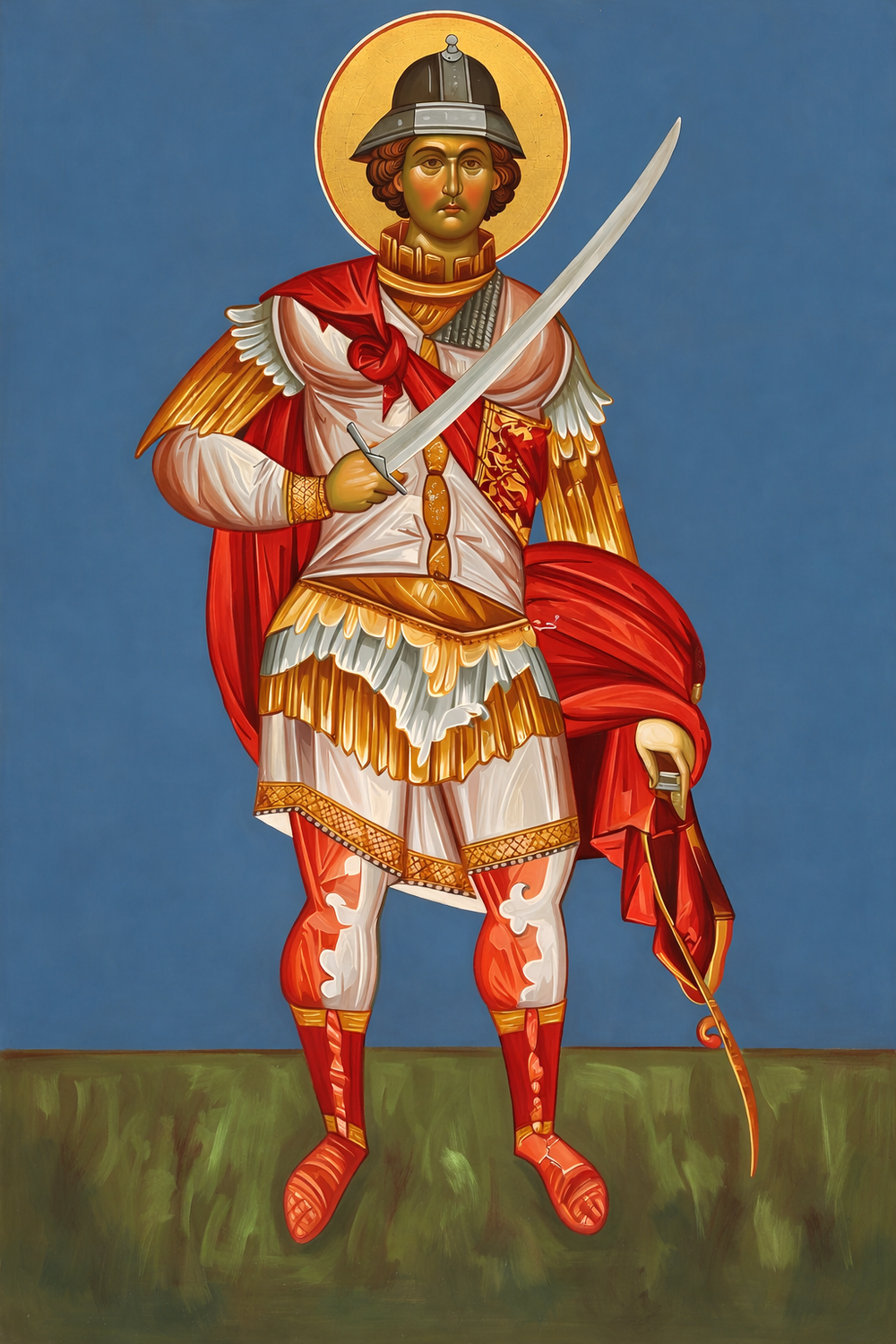
Menas was an Egyptian Christian soldier serving in a Roman unit in Phrygia (modern central Turkey) who left the army when the persecutions began, withdrew to the Egyptian desert to pray and fast, and then returned to a pagan festival to declare himself publicly before the crowd. He was beheaded around 309 AD. His body was carried back to Egypt on the back of a camel that, according to tradition, refused to move from the spot in the desert southwest of Alexandria where Menas was to be buried — and that is where he stayed, and where the ancient world built one of the most magnificent shrine complexes in all of Christianity.
The site of Abu Mena, at its fifth-century peak, was one of the most important pilgrimage destinations in the entire Roman and Byzantine world. The great basilica over Menas's tomb drew hundreds of thousands of pilgrims annually from across the Mediterranean. The distinctive pilgrim flasks — ampullae stamped with the image of Menas standing between two kneeling camels — have been found at archaeological sites stretching from Britain to Syria, carried home by pilgrims who had made the journey to the Egyptian desert and brought back the blessed oil or water of his shrine. The image of Menas on the camel became one of the most widely distributed Christian images of late antiquity.
For the Coptic Church, Menas is a national possession in the deepest sense. He is an Egyptian — born in Egypt, returned to Egypt, buried in Egyptian soil — who chose the desert rather than the army when the army required apostasy, and whose desert became a shrine city. He is the patron of those who step back from worldly advancement, who refuse to let empire define their identity, and who trust that the withdrawal into faith will eventually prove more powerful than the power structure they left. His feast on Hator 15 is one of the great celebrations of the Coptic year.
The Theban Legion
St. Maurice & the Theban Legion — Coptic & Oriental Orthodox
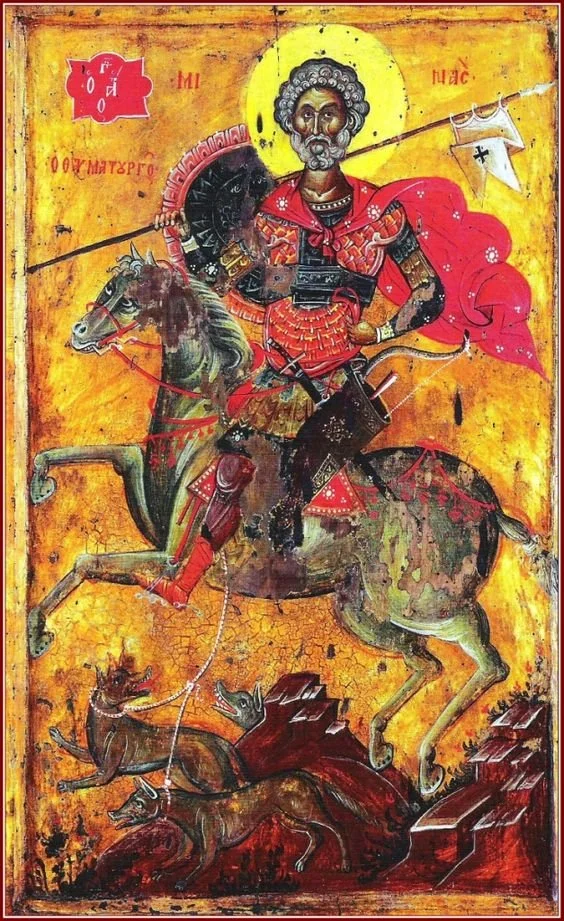
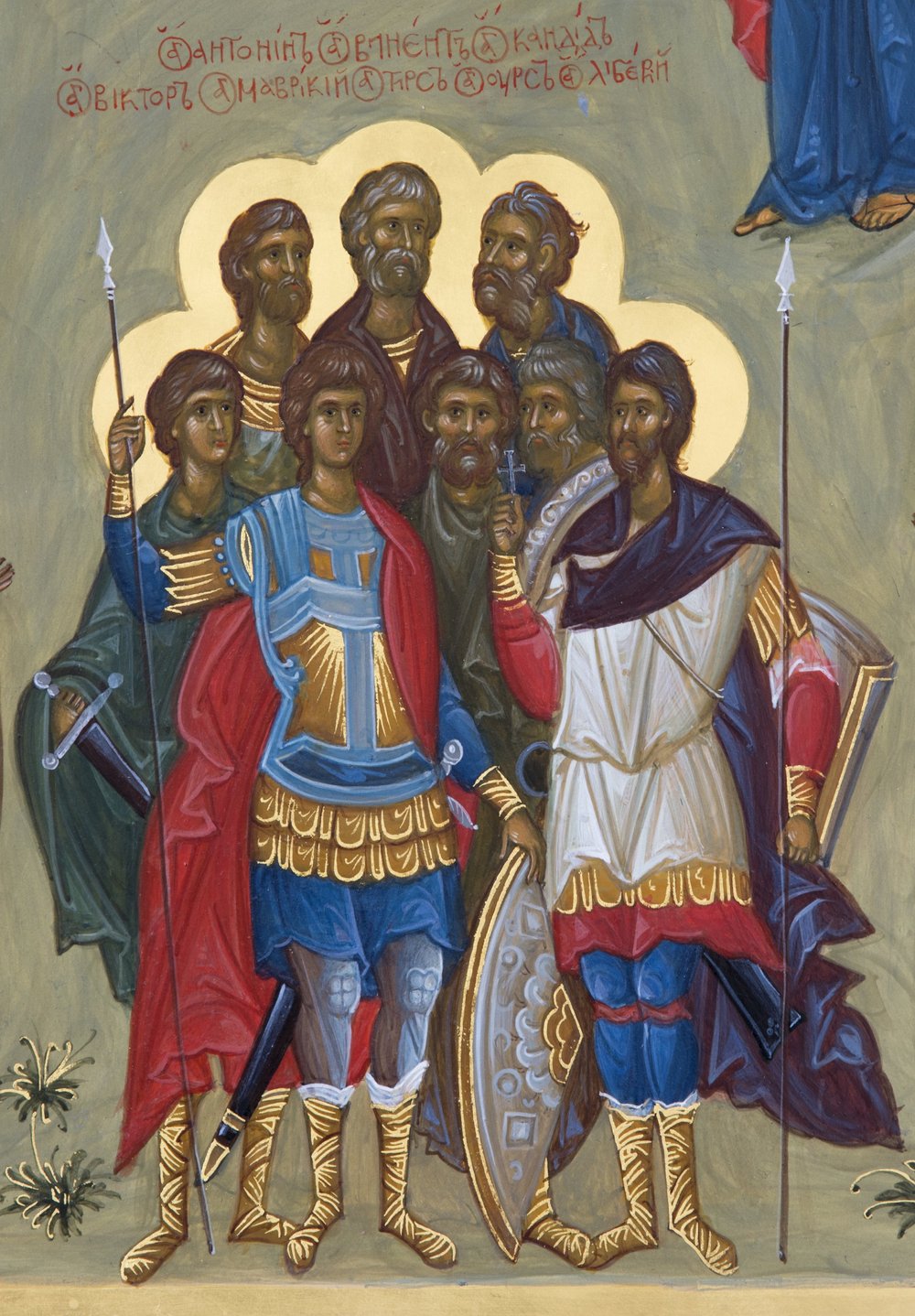
The Theban Legion were Coptic Egyptian Christians — recruited from the Thebaid, the ancient Christian heartland of Upper Egypt — serving in the Roman army in Gaul when, around 286 AD, the emperor Maximian ordered them to participate in the massacre of local Christians and in pagan sacrifices before battle. Their commander, Maurice, refused. Maximian ordered a decimation — one soldier in ten executed. The surviving nine in ten still refused. A second decimation was ordered. They still refused. The entire legion, approximately six thousand men, was executed where they stood. Not one soldier stepped forward to save himself by compliance.
For the Coptic and Ethiopian traditions, the Theban Legion is a specifically African martyrdom — Egyptian Christians whose witness took place on Swiss soil, far from the Nile, but whose identity was formed by the faith of the Egyptian Church. The martyrdom at Agaunum is claimed by the Coptic tradition as one of its own: these were sons of Egypt who carried their faith into the Roman legions and maintained it under conditions that destroyed every other calculation except the final one. The Abbey of Saint-Maurice in Switzerland, built over the site of the martyrdom, became one of the great pilgrimage shrines of early medieval Europe and still stands today.
Maurice himself — the commander who refused the first order, led his men through the first decimation and the second without yielding, and died with them — represents a specific and demanding form of moral courage: the courage not of individual witness but of maintaining a community's integrity under progressive pressure. He did not merely refuse. He held his men together through conditions that broke most units, and he held them until the last soldier's last refusal. For the Orthodox tradition, this collective martyrdom — unanimous, total, without a single defection recorded — is among the most powerful witnesses to the Holy Spirit's presence in the Church that the ancient sources preserve.
Section IV
The Armenian Orthodox Warrior Saints
The Armenian Apostolic Church — the world's oldest national Christian church, founded in 301 AD — has produced two warrior saints who together constitute the theological and historical foundation of Armenian Christian identity. They are not merely venerated; they are load-bearing. The Armenian Church's understanding of what it means to be Armenian and Christian simultaneously is built, in large part, on what Sarkis and Vartan did, and what they refused to do. Every Armenian who has ever faced pressure to abandon their faith or their identity draws on their witness, usually without naming it, because the witness has been in the blood of the people for fifteen hundred years.
St. Sarkis the Warrior — Armenian Apostolic (Oriental Orthodox) & Armenian Catholic
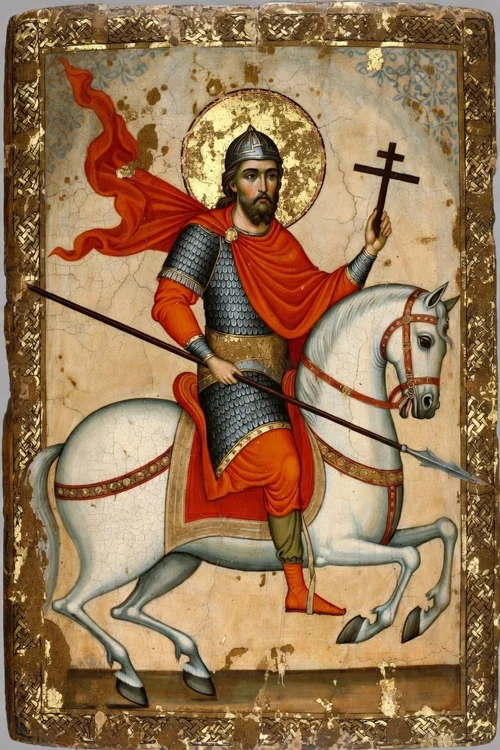
Sarkis — Sergius in the Latin tradition — was a high-ranking Roman general who had served with distinction before the situation in the empire turned against Christians during Julian the Apostate's reign around 360–362 AD. He and his son Martiros fled to Armenia rather than apostatize, and it was in Armenia that Julian's agents eventually caught up with them. Both were executed for refusing apostasy — Martiros first, then Sarkis — around 362 AD. The Armenian tradition places their martyrdom on the Ararat plain, the sacred heartland of Armenian geography, and the site became a pilgrimage shrine. Their relics are venerated at the Cathedral of Vagharshapat (Etchmiadzin).
What makes the feast of Sarkis one of the strangest and most beloved in the Armenian calendar is what it has accumulated around itself over the centuries. Sixty-three days before Easter, in the heart of the Armenian winter, the feast has developed a popular dimension found nowhere else in Christian hagiography: it has become associated with young love and spring's approaching renewal. The specific connection involves a legend about Sarkis's swift horse — whose hoofprints in the overnight snow, left near a girl's doorstep, were read as a sign of blessing for the coming year. The feast thus holds a unique position: it is simultaneously a commemoration of martyrdom and an anticipation of life, in precisely the way that the Christian mystery of holy death always produces unexpected fruit.
For Armenian communities worldwide — both Armenian Apostolic and Armenian Catholic — the feast of Sarkis is a community event, not merely a liturgical one. It anchors the winter calendar, it marks the point at which Lent's approach becomes real, and it connects the warrior-martyr tradition directly to the renewal of life that follows faithful death. Sarkis is the Armenian Church's warrior who proved that dying on Armenian soil, in defense of Armenian Christianity, plants something that does not die.
The Defender of Avarayr
St. Vartan Mamikonian — Armenian Apostolic (Oriental Orthodox) & Armenian Catholic
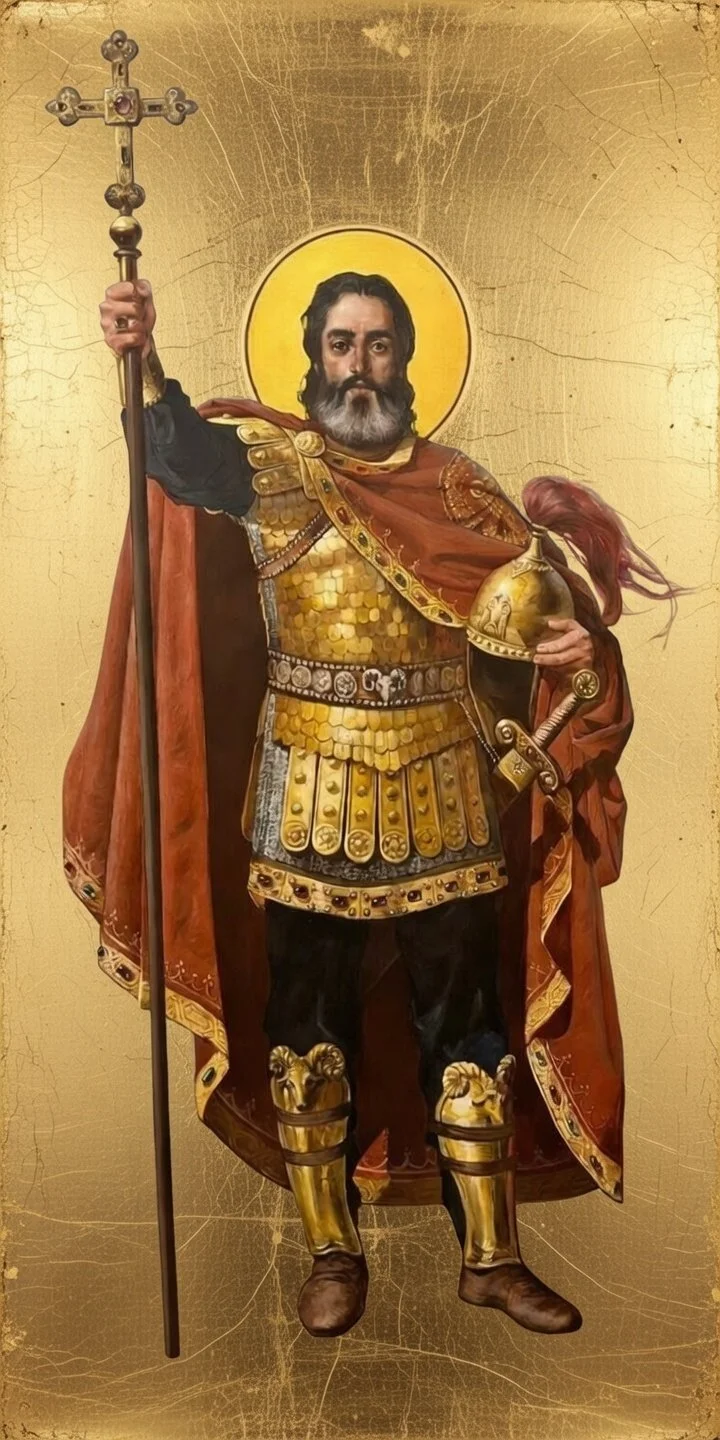
On June 2, 451 AD, on the Avarayr plain in what is now northwestern Iran, the Armenian army under Vartan Mamikonian met the Sassanid Persian forces in battle. The Persians had demanded that Armenia convert to Zoroastrianism and abandon Christianity. Vartan, the sparapet — commander-in-chief — of Armenia's military forces, refused and called his men to battle. The Armenian forces were vastly outnumbered. Vartan was killed. Approximately one thousand of his soldiers died with him. By every conventional military measure, Avarayr was a defeat. But the resistance so exhausted and alarmed the Sassanid empire that thirty-three years later, in 484 AD, Persia signed the Nvarsak Treaty granting Armenia religious freedom. The battle Vartan lost purchased a peace his death made possible.
The speech attributed to Vartan before the battle — preserved in the fifth-century history of Eghishe — is one of the foundational documents of Armenian Christianity and one of the great testimonies of Orthodox martyrdom theology anywhere in the tradition: "What we have taken on ourselves, let us not give back. We have given our lives to God; God has taken us for Himself. What thanks will we have if, in the time of peace, we profess faith, but in the time of difficulty, we renounce it? What does a man gain if he gains the whole world but loses his soul?" He knew the odds. He knew the likely outcome. He went anyway, because there are situations in which the question of what you will die for is more important than the question of whether you will survive.
Vartanants Day — the Armenian feast of Vartan — is observed as a day of national prayer and fasting throughout the Armenian Church. It is one of the distinctively Armenian liturgical observances, with no equivalent in any other Orthodox calendar, and it functions as the annual renewal of the commitment Vartan made at Avarayr: that Armenian Christianity is not negotiable, regardless of the cost. For a people whose twentieth century included genocide, the feast of Vartan carries a weight that goes beyond hagiography. He is the answer to the question "has this happened before?" — and the promise that what happened before did not, in the end, extinguish what it tried to destroy.
Section V
The Slavic Orthodox Warrior Saints
The Christianization of the Slavic world produced its own warrior saints — figures who stood at the hinge points of Russian and Ukrainian Christian history and whose stories are inseparable from the founding of the Orthodox civilization of Rus. Olga and Alexander Nevsky represent the two poles of this tradition: one a princess whose violence was converted into apostolic mission, the other a prince whose military genius was completed by monastic vows. Between them, they bracket the entire arc of the Slavic Orthodox warrior-saint: from the raw, pre-Christian courage that God converts into something holy, to the mature Christian statesman who understands that the interior battle and the exterior battle are the same war.
St. Olga of Kyiv — Eastern Orthodox, Ukrainian & Slavic
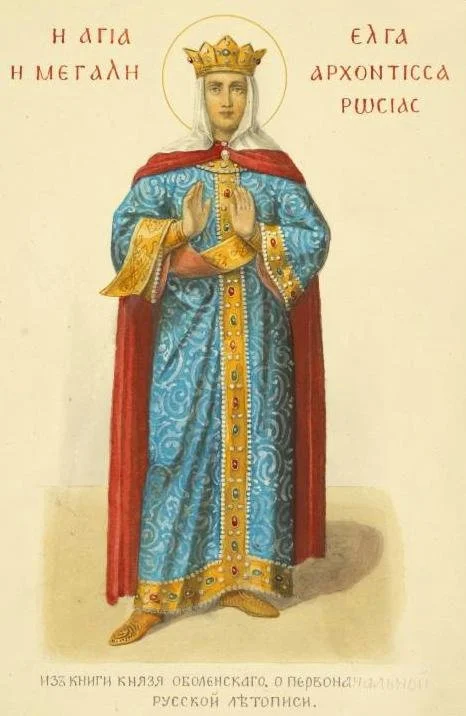
Olga of Kyiv is the only female saint in the Orthodox warrior tradition before the modern era, and she belongs here not metaphorically but biographically — her early career involved a campaign of vengeance against the Drevlian tribe who murdered her husband Igor that was, by any historical measure, militarily brilliant, psychologically calculated, and utterly without mercy. The Drevlians who came proposing she marry their prince were buried alive in their own boat. A second delegation was burned in a bathhouse. A third was massacred at the funeral feast. The Drevlian capital, Iskorosten, was burned — tradition says she used birds as fire-carriers, tying burning rags to their feet and releasing them to return to their nests in the city's thatched roofs. The city burned. Olga had demonstrated, in the clearest possible terms, that the regency of Kyiv was not available for conquest.
What makes Olga a saint is not the vengeance but what followed it. Around 957 AD, she traveled to Constantinople and received Christian baptism — in accounts that suggest a ceremony of considerable imperial significance, attended personally by the Emperor Constantine VII. She took the name Helena and returned to Kyiv with a vision of what the land of Rus could become. Her son Sviatoslav remained militantly pagan and refused her encouragement, but she worked quietly and persistently — building churches, protecting Christians, nurturing the faith in the spaces available to her — and she lived long enough to watch her grandchildren's generation begin to turn. Her grandson Vladimir baptized Kyiv in 988 and made Christianity the faith of the Slavic world. The Orthodox tradition holds Olga as the foundation of that event, and honors her with the title Equal to the Apostles.
For the Ukrainian tradition — Eastern Orthodox and Eastern Catholic alike — Olga is the mother of the Ukrainian Church in the most literal sense. The Christianization of the Slavic world began in her decision, in Constantinople, to be baptized. Her warrior past is not erased by the tradition but converted — understood as the raw material of a will and a courage that, once directed by grace, became one of the most consequential acts of Christian mission in history. She is the patron of rulers, widows, and converts; and she is the specific witness that God is not deterred by the character of His instruments before He gets hold of them.
The Prince and the Monk
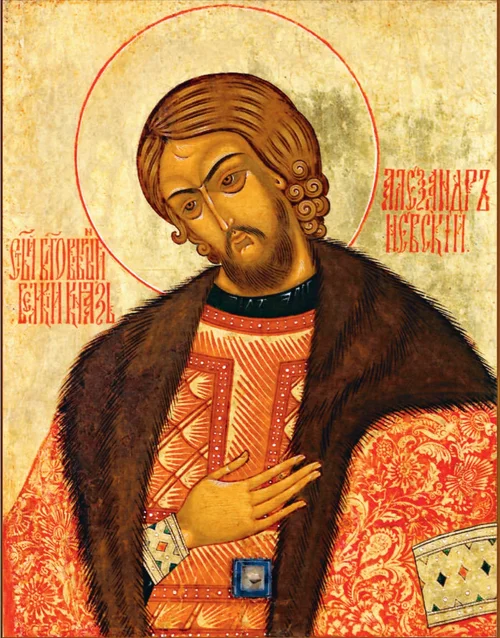
St. Alexander Nevsky — Eastern Orthodox — Russian & Slavic
Alexander Nevsky faced a geopolitical situation in the 1240s that would have broken most men: the Mongol Golden Horde occupied the eastern steppes and held effective suzerainty over most of the Russian principalities, while the western frontier faced simultaneous military pressure from Swedish expansion in the north and the Teutonic Knights advancing from the west, both framed as crusading enterprises aimed in part at Latinizing the Russian Church. He was Prince of Novgorod at the time of the first crisis — approximately nineteen years old when the Swedish advance began in 1240 — and he met each challenge with a different weapon.
Against the Swedes on the Neva River (1240), he moved at extraordinary speed, attacking before the Swedish forces could establish a position, and won a decisive engagement that earned him the surname Nevsky. Against the Teutonic Knights on frozen Lake Peipus (1242), he drew them onto the ice and used the terrain to collapse their armored formation — the Battle on the Ice ended the Knights' advance and secured the Orthodox liturgical tradition of Novgorod against forced Latinization for the foreseeable future. These are the victories the Eisenstein film immortalized. But Alexander's most significant strategic decision was the one that looked, to his contemporaries, like cowardice: his decision not to fight the Mongols.
Facing east, Alexander calculated — correctly — that the Mongol force could not be defeated militarily by the available Russian resources, and that the cost of attempting it would be the annihilation of the Russian people and the Russian Church. He chose instead to submit, to pay tribute, to travel repeatedly and with personal risk to the court of the Golden Horde, to use every diplomatic tool available to keep the Mongol yoke as light as possible while the Russian people recovered their strength. He negotiated exemptions for the Orthodox clergy from Mongol taxation. He managed relations between Russian princes and the Horde with a skill that preserved more of the Christian civilization of Rus than any purely military strategy could have. He died returning from one such diplomatic mission, took monastic vows on his deathbed under the name Alexiy, and was buried at Vladimir. Peter the Great had his relics transferred to St. Petersburg in 1724, where they remain in the Alexander Nevsky Lavra — one of the spiritual centers of Russian Orthodoxy.
Alexander Nevsky is the Orthodox saint of the impossible strategic choice — of the situation where every option involves loss, and wisdom consists in choosing which loss to accept. His specific combination of military brilliance on the battlefield and diplomatic realism in statecraft, held together by genuine Orthodox faith that expressed itself finally in monastic vows, makes him the most complete model in the Slavic tradition of what an Orthodox Christian ruler can be when the pressure on him is total and the options are all bad.
Frequently Asked Questions
Questions About the Orthodox Warrior Saints
Still Armed. Still Fighting.
The warrior saints of the Orthodox tradition are not figures from the past who happened to be courageous. They are the Church's permanently deployed defenders — given their offices by God, confirmed in them by martyrdom, and active in their intercession for anyone who calls on them. The Byzantine tradition put their armor in gold on icon boards because gold does not corrode: the witness they bear is as incorruptible as the material chosen to honor it.
Whether your battle is physical, spiritual, interior, or the kind that requires diplomatic endurance of humiliation while you wait for the moment when resistance becomes possible — one of these saints has fought exactly that battle, from exactly that position, and won it in a way that death could not undo. Their prayer cards are in the collection. Your icon corner is waiting. The saints are still armed, and they are still in the fight.
Browse All Orthodox Warrior Saint Prayer Cards →