Warrior Saints: A Complete Guide to Catholic & Orthodox Patrons
Catholic • Orthodox • Eastern Christian • Patron Saints
Warrior Saints: A Complete Guide to Catholic & Orthodox Patrons of Soldiers and Spiritual Battle
From the archangel who cast Satan out of heaven to the French peasant girl who led an army — a deep dive into all 17 warrior saints venerated in Catholic and Orthodox Christianity, covering their lives, their patronage, their traditions, and why soldiers and spiritual warriors have invoked them for two thousand years.
At a Glance
- Saints Covered
- 17 warrior saints — pre-schism universal, Catholic, and Orthodox
- Traditions Covered
- Roman Catholic, Eastern Orthodox, Byzantine Catholic, Coptic, Armenian, Syriac, Maronite, and more
- Pre-Schism Saints
- 14 saints venerated before the Great Schism (1054 AD) — technically shared by all
- Post-Schism Catholic
- St. Joan of Arc (d. 1431) and St. Ignatius of Loyola (d. 1556)
- Post-Schism Orthodox
- St. Alexander Nevsky (d. 1263)
- Supreme Patron
- St. Michael the Archangel — the universal warrior-protector of the entire Church
What Is a Warrior Saint?
Two kinds of people tend to find this article. The first are soldiers, first responders, and veterans — people who face real physical danger or who live with the aftermath of it, and who are looking for a patron saint who understands what that life costs. The second are ordinary Christians who have begun to take seriously the reality of spiritual warfare — the interior battles, the forces of darkness that the New Testament describes plainly and that every major saint in every major tradition treats as an unremarkable fact of the Christian life. Both groups are asking the same essential question: who in the communion of saints has fought the kind of battle I am fighting, and can intercede for me in it?
The Christian tradition has been answering that question for two thousand years, and the answers are richer — and stranger, and more beautiful — than most people expect. The warrior saints are not a collection of violent men who were good fighters. They are a collection of people who faced power, looked it in the eye, and chose God over it. Some of them were Roman soldiers who refused to kill Christians or perform pagan sacrifice and died for it. Some were generals who led armies in defense of their faith and their people. One was a teenage girl who heard the voice of St. Michael the Archangel and led the army of France. One was a Spanish soldier whose leg was shattered by a cannonball, who lay in a hospital bed for months reading the lives of the saints, and who rebuilt his entire life around a different kind of warfare — the interior kind.
This guide covers all seventeen of the major warrior saints venerated across the Catholic and Orthodox world. It is organized in three sections: first the pre-schism saints venerated before the Great Schism of 1054 AD (shared in principle by all traditions, though in practice some are more central to the East and some to the West); then the post-schism Catholic warrior saints; and finally the post-schism Orthodox warrior saints. For each saint you will find a full biographical account, their patronage, which specific Christian traditions feel most deeply that this saint is theirs, and a prayer card so you can bring their intercession into your home and your prayer life.
A note on the prayer cards: every saint in this guide has a handcrafted prayer card available in The Eastern Church's collection. These are not generic devotional objects — they are beautifully designed cards made specifically for the Eastern Christian visual tradition, suitable for icon corners, giving as gifts to soldiers and veterans, and for parish prayer card ministries. If you are looking for a patron saint and want to begin invoking one of these saints today, the prayer card is the first step.
Eastern Christian Warrior Saints Prayer Cards
Handcrafted prayer cards for soldiers, veterans, first responders, and anyone fighting the battles of faith. Every saint in this guide has a prayer card — for icon corners, gifts, and bulk parish orders.
Browse All Prayer Cards →Pre-Schism Warrior Saints
The fourteen saints in this section all lived and died before the Great Schism of 1054 AD — which means they belong, in principle, to the undivided Church and are venerated by both Catholic and Orthodox traditions. In practice, some feel more at home in the Eastern tradition (like the Byzantine military martyrs Demetrios and the two Theodores) and some in the Western (like Martin of Tours). But the point remains: when you invoke any of these saints, you are reaching back across every division in Christian history to the time when the Church was one — and praying with a saint who is claimed by brothers in Christ on both sides of every subsequent split.
St. Michael the Archangel — Pre-Schism, Universal
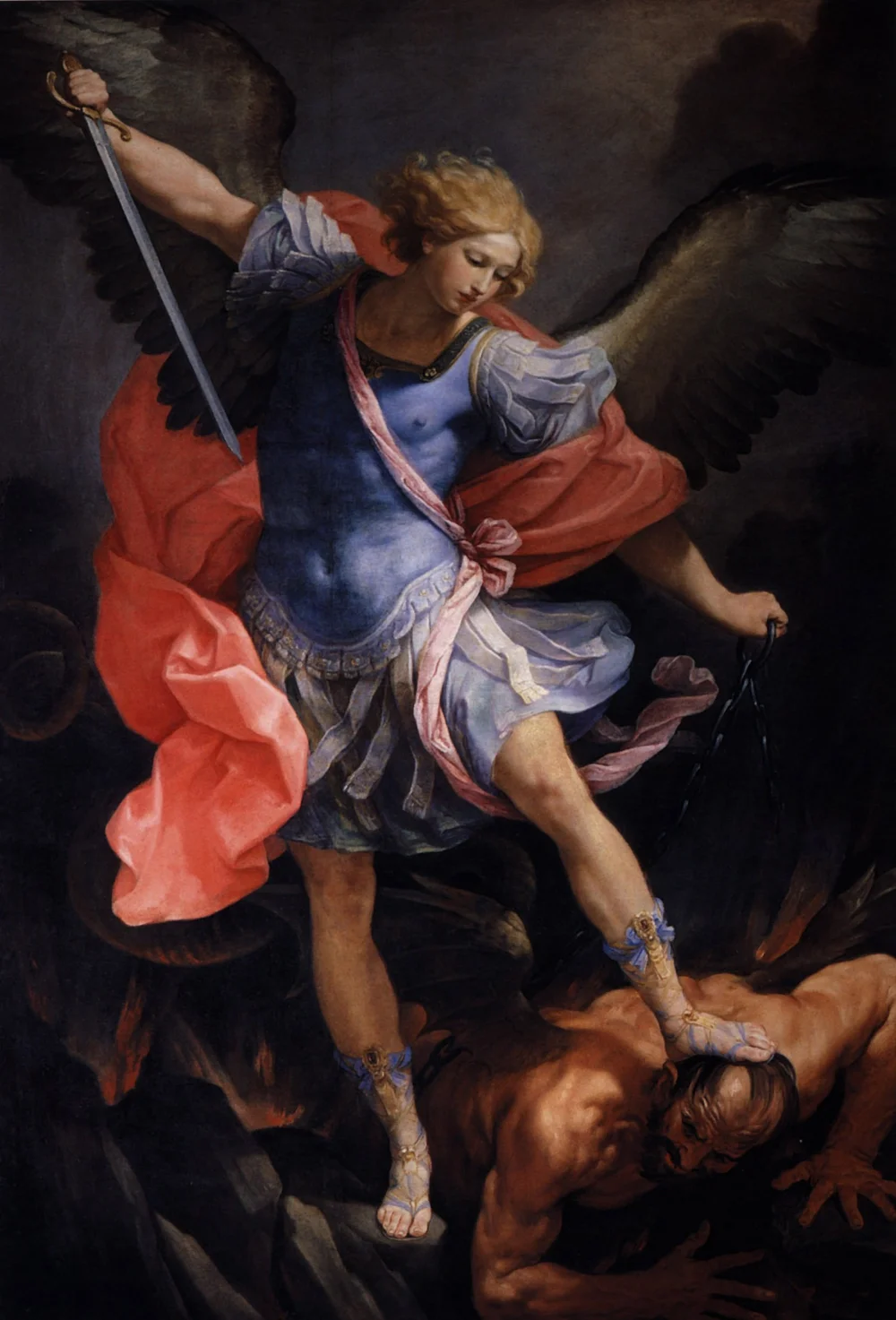
"Who is like God?" — that is what the name Michael means in Hebrew, and it is also the question his entire ministry is putting to the universe at every moment. He is the Archangel, the prince of the heavenly host, the one who in the book of Revelation leads the armies of heaven against Satan and casts the dragon and his rebel angels out of the sky (Revelation 12:7–9). He is named in the book of Daniel as the great protector who stands watch over God's people (Daniel 10:13, 12:1). In the epistle of Jude he disputes with the devil over the body of Moses. He appears to Joshua outside Jericho as "commander of the army of the Lord" (Joshua 5:14). Before the Christian era had even fully begun, Michael was already the warrior-protector of the people of God — and when the Church emerged from Judaism, it inherited this theology entire.
The Eastern Christian tradition venerates Michael with an intensity that can surprise Western Christians. The Coptic Orthodox Church celebrates his feast on the twelfth day of every Coptic month — twelve major liturgical commemorations per year, each with its own readings and devotions. The Byzantine Synaxis of the Archangels on November 8 is one of the best-attended feasts of the Eastern liturgical year. Icons of St. Michael are found in virtually every Orthodox and Eastern Catholic church, typically depicting him in full Roman military armor with a drawn sword or a spear, his foot on the neck of a defeated dragon or demon. The message is not subtle, and it is not meant to be: when the Church gathers, the commander of heaven's armies is in the room.
In the Western Catholic tradition, Michaelmas (September 29) has been observed since the fifth century, and devotion to Michael was renewed dramatically in 1886 when Pope Leo XIII — after reportedly experiencing a vision of demonic activity — composed the Prayer to St. Michael that is still recited in countless Masses and in private devotion across the Catholic world. The United States Army's 82nd and 101st Airborne Divisions both claim Michael as their patron. Police departments across the world are under his protection. The dying are commended to his care as their souls approach the moment of judgment. There is no battle, no danger, no darkness in which Michael is not the right saint to invoke.
St. Michael occupies the summit of this entire guide not because he was a human warrior who can sympathize with human weakness in the way the other saints can — he cannot, because he is not human — but because he is the one who fights at the level of the battle's ultimate source. Every human conflict, every personal struggle, every addiction, every temptation, every assault against a soul or a Church traces back ultimately to the same spiritual enemy. Michael is the one God commissioned to meet that enemy. He is not merely a symbol of strength. He is the actual commander of the actual army that is actually fighting on your behalf.
Everyone — but especially: soldiers facing physical danger, police and first responders, anyone experiencing spiritual oppression or unusual darkness, the sick and the dying, and anyone who takes seriously the reality of spiritual warfare described in Ephesians 6. He is the one saint whose intercession covers every category of battle.
The Megalomartyr
St. George the Trophy-Bearer — Pre-Schism, Universal
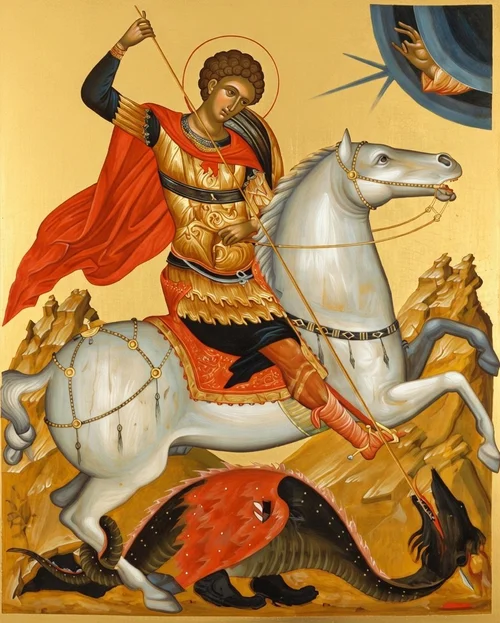
St. George was a Roman officer of Cappadocian Greek origin — likely from the area of what is now central Turkey — who served in the imperial army under Diocletian. He was, by every account, a successful soldier: a tribune in the Praetorian Guard, trusted and decorated. When Diocletian's Great Persecution against Christians began in 303 AD, George did something that cost him everything: he publicly and loudly declared himself a Christian, tore up the imperial edict ordering the persecution, distributed his wealth to the poor, and refused every offer of advancement, bribery, and mercy that the emperor extended. He was tortured for days — the hagiographical tradition catalogues an almost impossible sequence of torments — and finally beheaded at Nicomedia. His relics were carried to Lod (Lydda) in modern Israel, where a great basilica was built in his honor. He was not yet thirty years old.
The famous legend of George and the dragon is medieval allegory grafted onto a real martyr's life, and the allegory is theologically precise: the dragon is the persecuting Roman state, paganism, and ultimately the devil himself; the captive princess is the Church or the soul held prisoner by sin and fear; and George's lance is the Cross of Christ. The story is catechism in narrative form. What it encodes is the actual experience of the early Church: that a soldier can face the most powerful earthly institution in the world, refuse its demands, and win — not by surviving, but by witnessing. The Greek title Tropaiophor — Trophy-Bearer — captures this exactly. George bears the trophy not of military conquest but of martyrdom, which is the only victory the enemies of God cannot ultimately undo.
His veneration is genuinely universal in a way that no other non-biblical saint can claim. He is the patron and national saint of England, Georgia, Ethiopia, Catalonia, and Portugal. He is venerated in the Byzantine tradition as one of the Great Martyrs and appears in countless icons alongside Demetrios, both of them mounted on horseback in imperial armor. In the Coptic tradition he is Mor Girgis, one of the most beloved saints of Egypt, his feast celebrated with enormous popular devotion. In the Syriac tradition his name fills the litanies. Maronite, Armenian, Melkite, Ukrainian, Romanian, Bulgarian — every Eastern Christian community that ever came into contact with the Roman world has George. He crosses every boundary the Church has ever drawn because his witness is the same in every language: choose Christ over Caesar, and Christ will make a trophy out of what it cost you.
The Archer of Faith
St. Sebastian — Pre-Schism, Roman & Universal
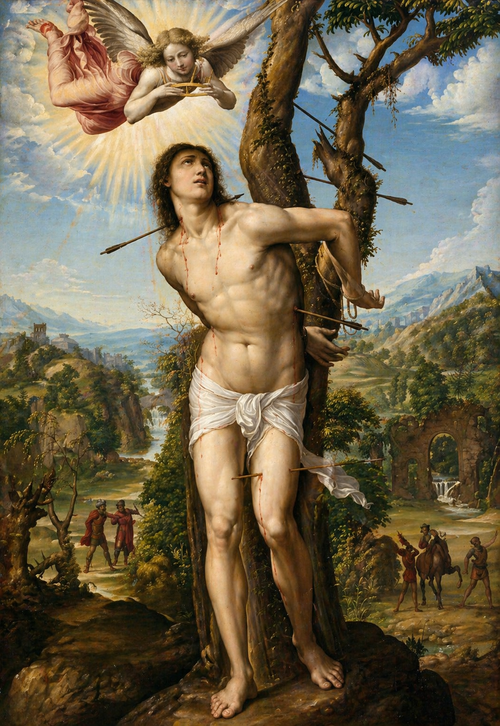
Sebastian was a captain in the Praetorian Guard — the elite unit responsible for the personal protection of the Roman emperor — during the reign of Diocletian, around 283–288 AD. He had managed to conceal his Christianity from his commanders for years, which placed him in a position he used carefully: he visited imprisoned Christians, strengthened those wavering in their faith, worked to secure the release of those he could, and quietly brought others to faith. When his Christianity was finally discovered and reported to Diocletian, the emperor had him taken to a field, tied to a stake, and shot with arrows until he was believed dead.
Sebastian did not die. A Christian widow named Irene found him still breathing, took him home, and nursed him back to health. When he had recovered, Sebastian did something remarkable that the hagiographical tradition has always found slightly baffling from a self-preservation standpoint: he went directly back to Diocletian to confront him about the persecution. This time the emperor took no chances. Sebastian was beaten to death with clubs, and his body was thrown into the Cloaca Maxima — the great sewer of Rome — to prevent his tomb from becoming a site of veneration. A Christian woman named Lucina was told in a dream where to find the body. She retrieved it and buried it in the catacombs on the Appian Way, where a basilica now stands in his honor.
Sebastian's survival of the first execution — arrow after arrow lodged in him, left for dead, and yet living — made him one of the most potent symbols in Christian art and one of the most invoked saints in the tradition of physical protection and resilience. He is the patron of archers and of anyone whose body has been subjected to violence. He was specifically invoked during the great plague epidemics of medieval Europe, partly because the plague's sudden, piercing death was compared to being shot by arrows, and partly because Sebastian's survival of what should have killed him was understood as a sign of extraordinary divine protection. The tradition of invoking him for plague protection contributed enormously to his veneration — his image appears in hundreds of churches that were built or expanded in thanksgiving after plague years.
The Legion of Martyrs
St. Maurice & the Theban Legion — Pre-Schism, Universal
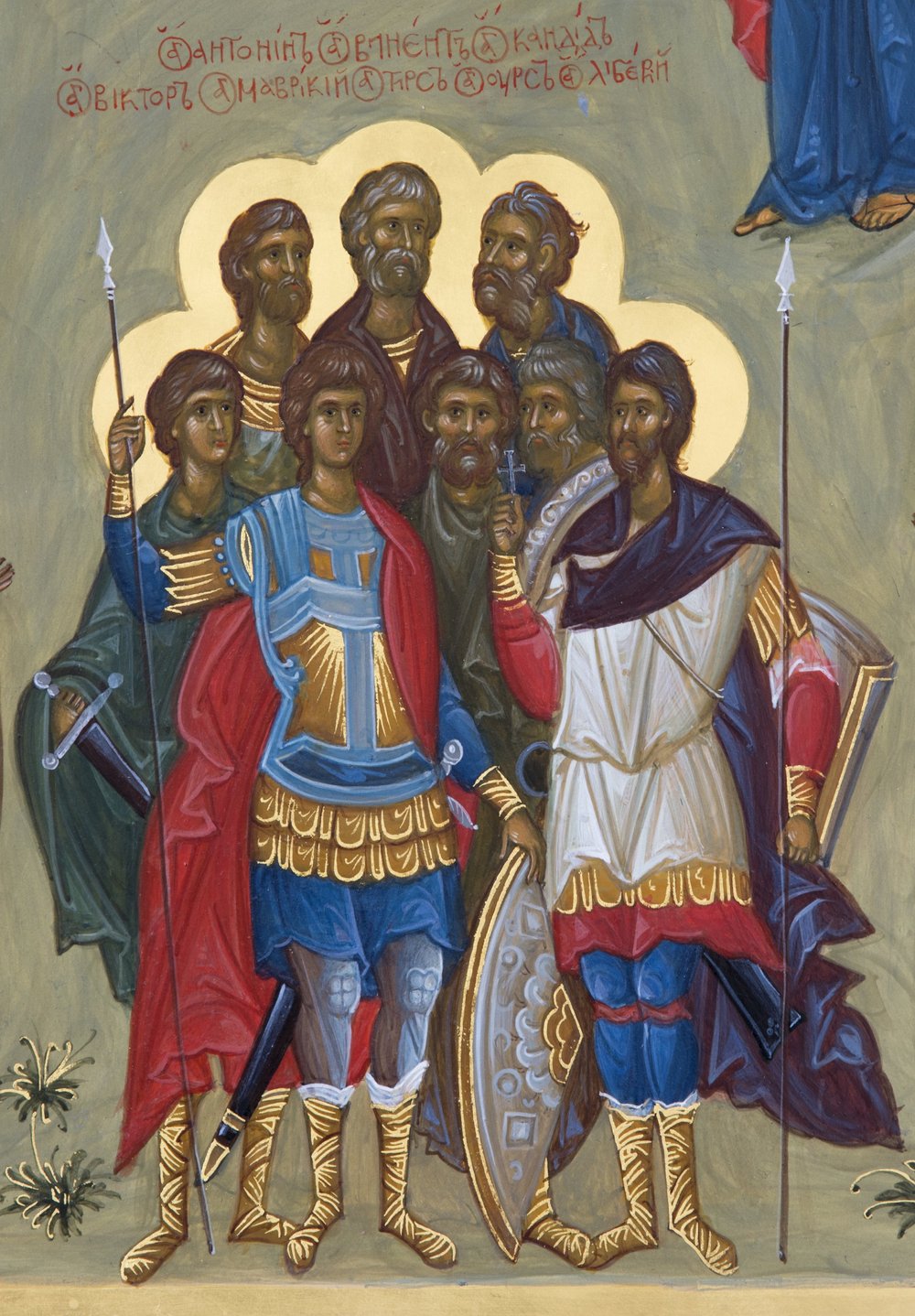
The Theban Legion is one of the most extraordinary stories of collective martyrdom in Christian history. The legion — approximately 6,600 soldiers — had been recruited from the Thebaid region of Egypt, which means they were almost certainly Coptic Christians from the heartland of Egyptian Christianity. They were stationed in Gaul under the emperor Maximian when, around 286 AD, the order came down to slaughter the local Christian population and to participate in pagan sacrifices to secure the army's success. The legion's commander, Maurice, refused. When Maximian responded by decimating the legion — executing one in ten — the survivors still refused. When Maximian ordered a second decimation, they still refused. The entire legion, approximately six thousand men, was executed rather than comply.
The historical details of the Theban Legion have been debated by scholars for centuries — the sheer number of martyrs strains credibility, and some argue the account is partly legendary. What is not in dispute is that a significant martyrdom of Christian soldiers took place at Agaunum (modern Saint-Maurice-en-Valais in Switzerland) in the late third century, that Maurice was revered as their commander, and that the site became one of the major pilgrimage shrines of early medieval Europe. The abbey of Saint-Maurice was founded there in the fourth century and still stands.
Maurice's significance cuts several ways. For the Coptic tradition, he is an Egyptian Christian soldier who chose death over apostasy — a model of the very witness the Coptic Church has maintained through centuries of persecution. For the Western Catholic tradition, he became the patron of the Holy Roman Empire and an emblem of Christian kingship — emperors carried his lance and sword as sacred relics. For soldiers of every tradition, Maurice represents the conviction that there is a point at which an order cannot be obeyed — not from cowardice, not from self-preservation, but because there are commands that exceed any emperor's legitimate authority. Six thousand men agreed with him, to the last man.
The Myrrh-Streamer of Thessaloniki
St. Demetrios of Thessaloniki — Pre-Schism, Byzantine Universal
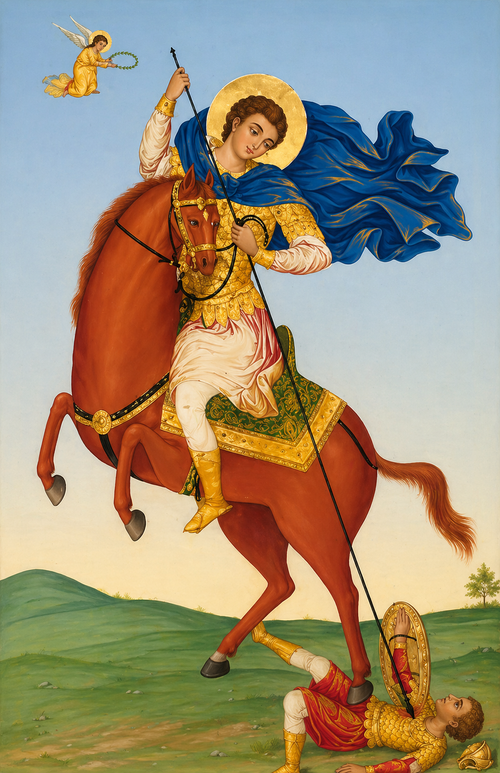
In the Byzantine world, Demetrios and George are the twin pillars of the warrior-saint tradition — often depicted side by side in icons, both mounted, both armored, both bearing the instruments of their witness. If George is the patron whose story transcended the Byzantine world and became universal, Demetrios is the one whose roots went deepest into it: he is the protector of Thessaloniki, the second city of the Byzantine Empire, and one of the most intensely loved saints in the entire Eastern tradition.
Demetrios was a Roman officer stationed in Thessaloniki — the ancient capital of the province of Macedonia — during the reign of Maximian, around 306 AD. He had been appointed proconsul by the emperor, a position of considerable civic authority, when his Christianity was discovered. He was arrested and imprisoned in the baths near the theater. While in prison, he was visited by a young Christian named Nestor who asked for his blessing before entering a gladiatorial contest against the champion fighter Lyaios. Demetrios blessed him, Nestor won, and the furious Maximian had Demetrios run through with spears in his prison cell and Nestor subsequently beheaded. The faithful gathered Demetrios's body and buried it on the spot. Almost immediately, accounts of miracles at his tomb began to accumulate.
The later accounts of Demetrios's miraculous defense of Thessaloniki are among the most dramatic in Byzantine hagiography. During the Avar and Slavic siege of 586 AD, eyewitnesses reported a soldier in shining armor fighting on the city walls who was later identified as Demetrios. The city survived. During the Arab raid of 904 AD, during the Bulgarian sieges, during the Norman attack of 1185 — again and again, Thessaloniki faced assault and survived, and again and again the survivors attributed it to their patron. The city was not always saved — it has fallen more than once in its long history — but the conviction that Demetrios was its supernatural champion persisted through every catastrophe and was renewed every time the city endured. His relics, discovered beneath the great basilica built in his honor, were found to be streaming myrrh — the fragrant oil that, in Eastern theology, is the sign of a saint's ongoing life and power.
The General
St. Theodore Stratelates — Pre-Schism, Byzantine Universal
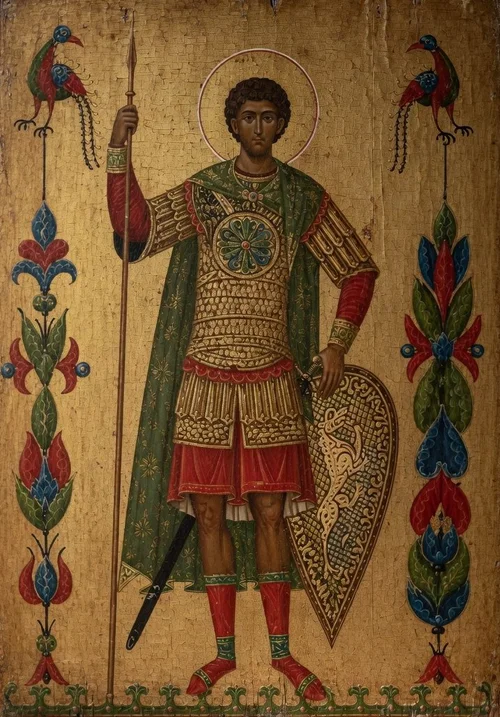
Theodore Stratelates — "Theodore the General" — is the senior of the two soldier-Theodores venerated by the Eastern Church, and his title alone tells his story: stratelates means commander, strategos, the general of an army. He was a high officer under the emperor Licinius, stationed at Heraclea on the Propontis (the Sea of Marmara, near modern Istanbul), around 319 AD. His fame had spread not only for his military skill but for his reputation for justice and his protection of the local Christian population — a dangerous thing in the court of Licinius, who was moving toward direct conflict with the Christian emperor Constantine.
Theodore was summoned to appear before Licinius and asked to lead the imperial army in a series of pagan sacrifices. He agreed — and then, the night before the ceremonies were to begin, destroyed every idol in the temple, reduced the golden and silver statues to fragments, and distributed the pieces to the poor. His arrest and execution followed. He was tortured with particular savagery — the hagiographical accounts describe torments that went on for days — and finally crucified. A vision of angels and of Christ Himself is recorded as appearing to him on the cross. He was taken down still living, beheaded, and his body was carried by his servant Ouaros back to his native city of Euchaita for burial.
Theodore Stratelates occupies a specific and important place in the Eastern theology of holy warfare. He is the model of what the Eastern tradition calls a "soldier-saint" in the fullest sense: not merely a soldier who became a martyr, but a man whose specific military authority, tactical skill, and command presence were themselves sanctified by his faith and put in service of God's people. He is the patron invoked by military officers and commanders — those who carry responsibility not only for their own lives but for the lives of those under their command. His feast on June 8 is the major commemoration, marking the translation of his relics to Euchaita.
The Recruit
St. Theodore of Amasea (Theodore Tyron) — Pre-Schism, Byzantine Universal
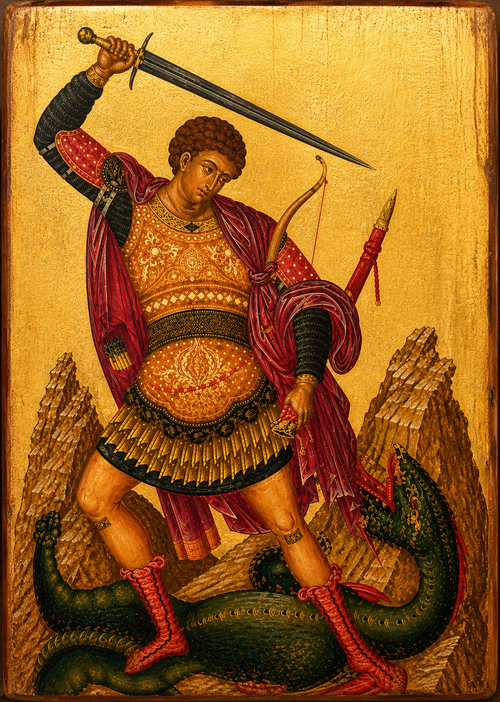
Theodore Tyron — the Recruit — is the earlier and in some ways the more beloved of the two Theodores. Where Stratelates was a general, Tyron was a new soldier, a tiro (recruit) just entering military service, which gives him a particular resonance with the young and with those at the beginning of a difficult path. He was stationed in Amasea in Pontus (northern Turkey) when, around 306 AD, the order came to participate in pagan sacrifices. Theodore refused, and while awaiting punishment took matters dramatically into his own hands: he burned down the pagan temple of the mother goddess Cybele. Arrested and brought before the magistrate Publius, he was tortured and executed — thrown alive into a fire, according to the tradition, from which he emerged unharmed before being beheaded.
The most beloved story associated with Theodore Tyron does not come from his martyrdom but from nearly sixty years later. In 362 AD, the emperor Julian the Apostate — determined to undermine Christian practice without the visible scandal of outright persecution — ordered the city markets of Constantinople to be secretly contaminated with blood from pagan sacrifices, so that Christians who fasted from meat during the first week of Lent would unknowingly eat defiled food. The night before the market opened, Theodore appeared in a vision to the Archbishop of Constantinople, Eudoxius, warned him of the plan, and told him to have the faithful eat boiled wheat (kollyva) instead. The archbishop obeyed, the emperor's plan was foiled, and the Church has commemorated this miracle on the First Saturday of Great Lent ever since — blessing and distributing boiled wheat in every Byzantine church, every year, as a memorial of Theodore's protection of the fasting faithful.
This makes Theodore Tyron unusual among warrior saints: he is invoked not primarily in battle but in the practice of the ordinary Christian life, especially fasting and the Lenten disciplines. He is the saint who guards the integrity of Christian practice against those who would corrupt it from the inside — which, in the Eastern tradition's understanding of spiritual warfare, is exactly the kind of attack that requires a warrior's vigilance.
The Egyptian Soldier
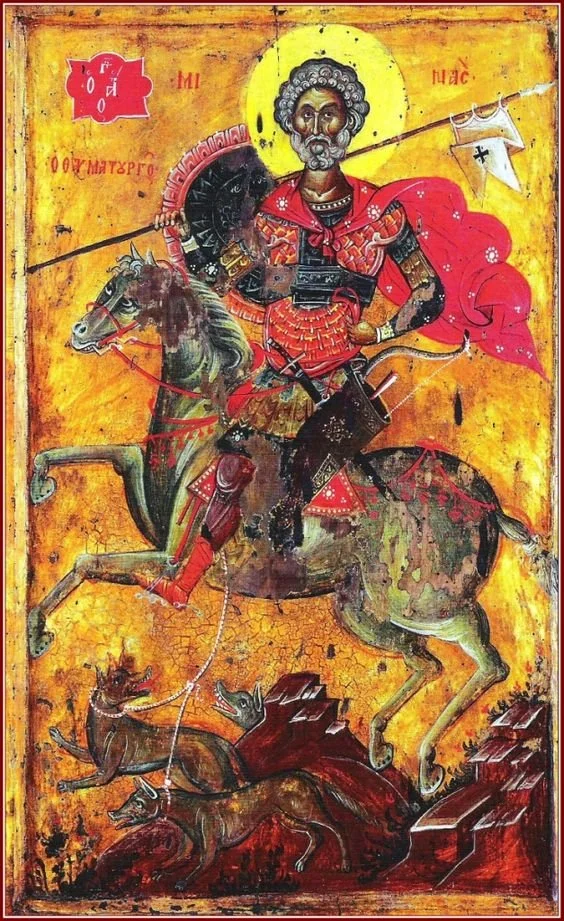
St. Menas (Mar Mina) — Pre-Schism, Coptic & Universal
Menas was an Egyptian Christian soldier serving in the Roman army in Phrygia (modern central Turkey) who left the army when persecution began, withdrew to the desert to pray, and then re-emerged to present himself publicly before a pagan festival, confess his Christianity, and invite the consequences. Around 309 AD, he was beheaded. His body was taken back to Egypt — tradition says on the back of a camel that refused to move from the spot where Menas was eventually buried — and the site became one of the great Christian shrines of the ancient world.
The shrine of Abu Mena, built over his tomb in the desert southwest of Alexandria, became one of the most visited pilgrimage sites in the entire Roman Empire. At its peak in the fifth and sixth centuries, the complex included a great basilica, baths, hostels, and an extensive network of facilities for the enormous numbers of pilgrims who came seeking his intercession. The distinctive ampullae (small flasks) of water and oil blessed at his tomb were exported across the Mediterranean world — dozens have been found in archaeological sites from Britain to Syria. The image stamped on the ampullae — Menas standing between two kneeling camels — became one of the most recognizable icons of early Christianity.
For the Coptic Church, Menas is in some ways what George is for the Byzantine world: an Egyptian soldier-martyr whose witness became a centerpiece of the national Christian identity. His veneration is among the deepest and most consistent in the Coptic tradition, and his name is among the most common given to Coptic boys. He is a specific example of the kind of warrior saint who is claimed most intensely not by the military traditions but by an entire people — whose martyrdom became the foundation of a community's sense of who they are before God.
The Soldier Who Stopped
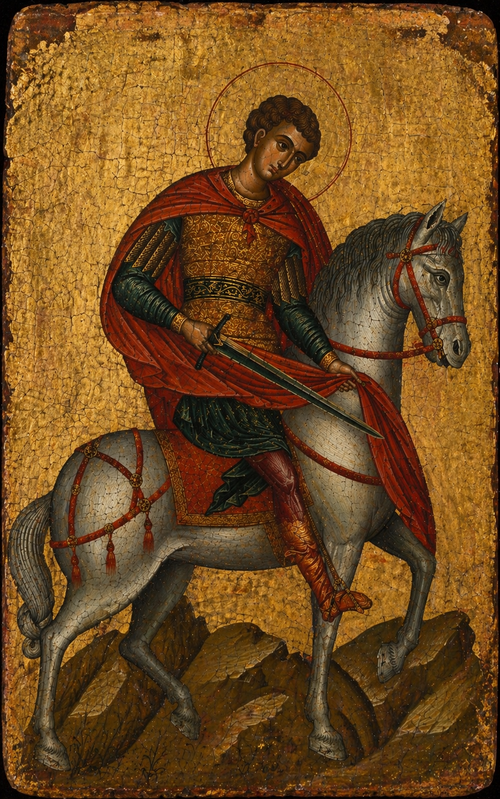
St. Martin of Tours — Pre-Schism, Western & Universal
Martin of Tours occupies a singular position in the history of warrior saints because his most famous story is about refusing to fight. He was born around 316 AD in Pannonia (modern Hungary) to a Roman military officer and was required by law to serve in the imperial cavalry. He served faithfully — and it was while serving that the famous episode at Amiens occurred: Martin encountered a nearly-naked beggar freezing in the winter cold, and cut his military cloak in half to share with him. That night, he dreamed of Christ wearing the half of the cloak and saying to the angels: "Martin, still a catechumen, clothed me with this garment." Martin was baptized shortly after.
When the time came for a campaign against the Germanic tribes, Martin refused to fight — not from cowardice, which he was at pains to demonstrate (he offered to stand unarmed between the opposing armies), but from conscience: he was a soldier of Christ, he said, and it was not lawful for him to continue fighting. His commander, the emperor Julian (before he became the Apostate), accused him of cowardice and had him imprisoned, but the campaign ended before it began through a sudden peace, and Martin was released. He went to find the bishop Hilary of Poitiers, became a monk, founded what is often considered the first monastery in Gaul, and eventually became Bishop of Tours — one of the most influential bishops of the fourth and fifth century Western Church.
Martin's patronage of soldiers comes not from having been a great fighter but from having been a soldier first — from having understood from the inside what military life demands and costs — and from the fact that his cloak became one of the most venerated relics of the medieval West. The military chapel that housed his cloak gave the English language its word "chapel" (from cappa, cloak). Armies carried his cloak into battle as a palladium — a divine protection — for centuries. He is the patron of infantry, cavalry, the poor, and of the strange courage required to say "no, I cannot do this" when the order is one that conscience forbids.
The Father of Two Swords
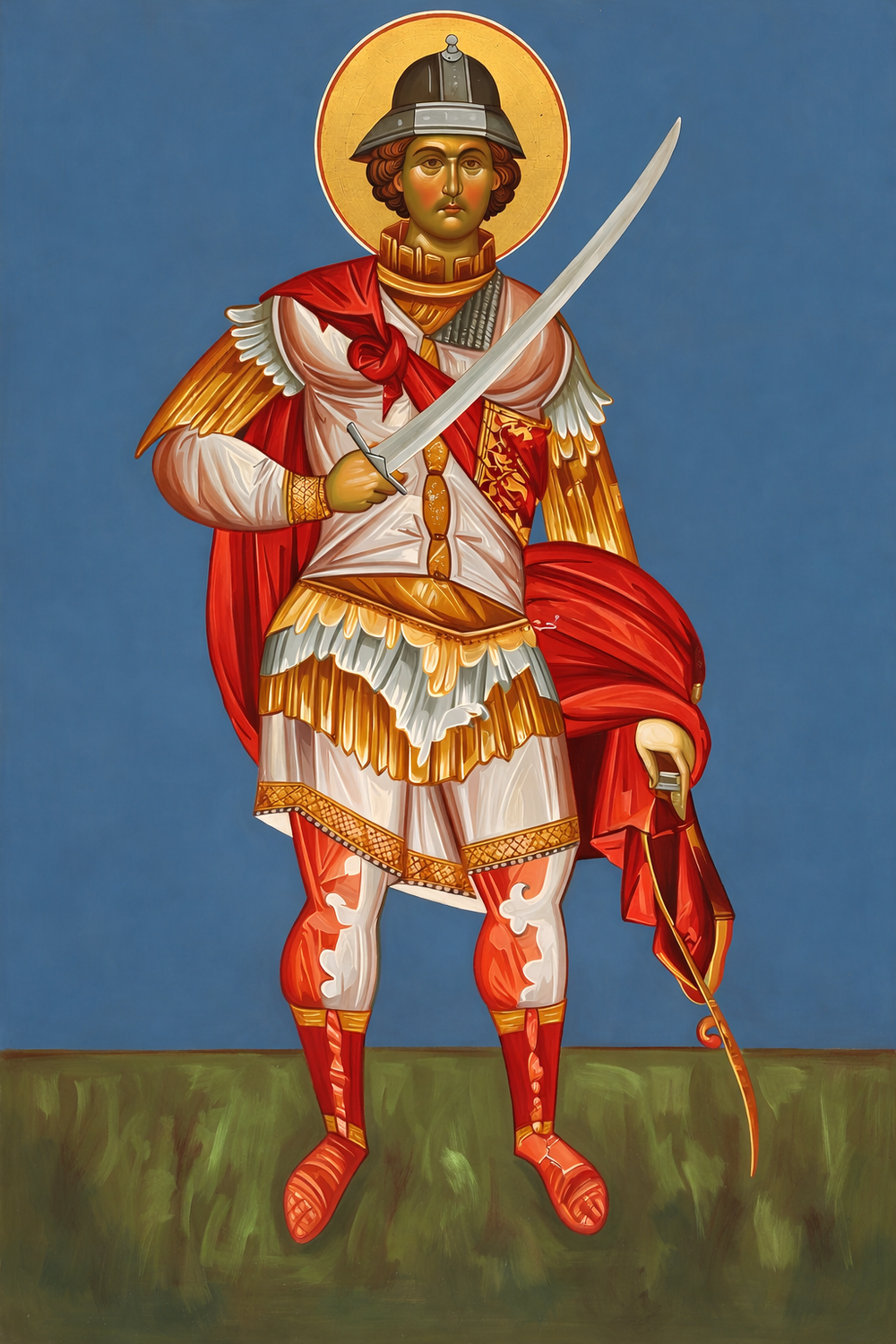
St. Philopater Mercurius (Abu Sefein) — Pre-Schism, Coptic & Oriental
Mercurius is among the oldest of the soldier-martyrs and one of the strangest stories in the entire warrior-saint tradition — and it is a story in two parts, the second of which is more astonishing than the first. He was a Roman officer of Cappadocian or Scythian origin who served under the emperor Decius in the mid-third century. He was, by the accounts, a distinguished soldier — decorated for valor, trusted by the emperor. When Decius turned to systematic persecution of Christians, Mercurius refused to sacrifice to the Roman gods and was arrested, tortured with extraordinary brutality, and beheaded around 250 AD. The Archangel Michael is said to have appeared to him during his imprisonment and given him a second sword — which is the origin of his Coptic Arabic name, Abu Sefein: Father of Two Swords.
The second part of the story comes more than a century later, during the reign of Julian the Apostate. Julian, who had been raised Christian and renounced the faith upon becoming emperor, was preparing a military campaign against Persia around 362–363 AD. St. Basil the Great — bishop of Caesarea, where Mercurius was buried — was in prayer and received a vision: he saw the Virgin Mary instructing the saint Mercurius to deal with the apostate emperor. Julian was killed during the Persian campaign under obscure circumstances — no enemy soldier was ever definitively identified as responsible for the wound that killed him. The tradition, preserved in the Coptic Church, the Syrian tradition, and referenced by Basil himself, holds that Mercurius struck the fatal blow. Julian's last recorded words, in one account, were addressed to Christ.
Mercurius holds an enormous place in Coptic devotion that most Western Christians have never encountered. His icon fills the walls of Coptic churches; his name is among the most common given to Coptic Christians; major churches across Egypt are dedicated to him. He is the warrior-protector of the Coptic people in a role analogous to what George is for the Greeks and what Demetrios is for the Thessalonians — the divine champion who fights for his community from beyond death. For the Coptic tradition, the two swords in his icon are not merely symbols. They are the instruments of a very specific and very documented act of divine warfare against a very specific enemy of the Church.
The Armenian Warrior
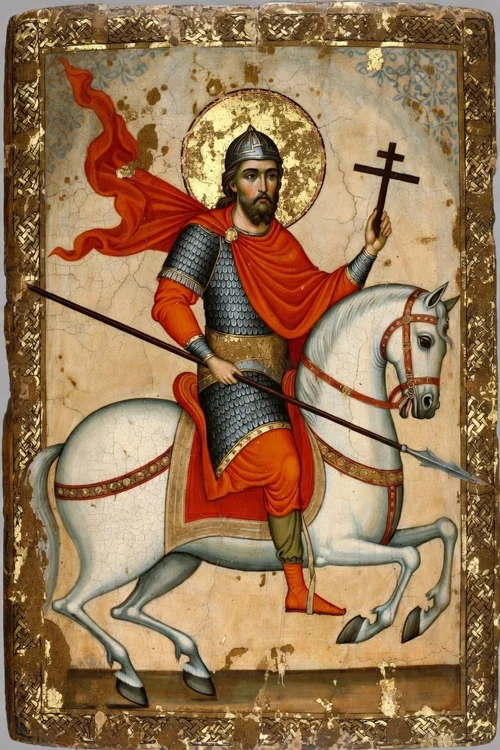
St. Sarkis the Warrior — Pre-Schism, Armenian & Syriac
Sarkis (Sergius in the Latin tradition) was a Roman general and his son Martiros (Martirius) who served during the reign of Constantine and his sons. According to the Armenian tradition, Sarkis and his son were brought to Armenia after fleeing the persecution of Julian the Apostate — the same emperor who is associated with the death of St. Mercurius. When Julian's pagan agents caught up with them in Armenia, Sarkis and Martiros refused apostasy and were executed around 362 AD. The Armenian Church locates the martyrdom in the Ararat plain, and the site became a major pilgrimage center.
What makes Sarkis unusually interesting among the warrior saints is that his feast has acquired a popular dimension that exists nowhere else in the calendar: in the Armenian tradition, the feast of St. Sarkis has become associated with young love and with the beginning of spring. The specific connection is to a legend about Sarkis's swift horse and a snowfall: young Armenian women were said to leave offerings out the night before the feast, and if the snow showed the print of a horse's hoof in the morning it was a sign of blessing on the coming year. The feast thus holds a unique position in Armenian popular culture — simultaneously a commemoration of martyrdom and a celebration of the renewal that follows it, in the way that good deaths do, unexpectedly, produce life.
For the Armenian community — both Armenian Apostolic and Armenian Catholic — Sarkis is deeply their own saint in a way that few others are. He died on Armenian soil, he died defending Armenian Christianity, and his feast is woven into the annual rhythms of Armenian family and community life in ways that translate immediately into cultural belonging. He is the patron who connects military courage, national identity, family life, and seasonal renewal into one figure — which is exactly the kind of saint that can sustain a community through centuries of persecution and diaspora.
The Defender of the Faith
St. Vartan Mamikonian — Pre-Schism, Armenian National Saint
The Battle of Avarayr, fought on June 2, 451 AD, between the Armenian army under Vartan Mamikonian and the Sassanid Persian forces, was a military defeat. The Armenians were vastly outnumbered. Vartan was killed on the field. Approximately one thousand of his soldiers died with him. And yet Avarayr is the foundational event of Armenian Christian identity — the moment that defined what it means to be Armenian in terms that have endured for fifteen centuries. The reason is simple: the battle was not for territory. It was for the right of Armenians to remain Christian rather than convert to Zoroastrianism under Persian mandate. Vartan lost the battle. He won the war. The subsequent Armenian resistance so exhausted the Persians that they eventually signed the Nvarsak Treaty in 484 AD, granting Armenia religious freedom. Vartan's death was the price of that freedom.
Vartan came from the noble Mamikonian family, which had held the military command of Armenia for generations. He was not a simple soldier but a sparapet — the commander-in-chief of the Armenian forces — a man of education, political standing, and deep religious conviction. The speech attributed to him before the battle, preserved in the history of Eghishe, is one of the great documents of early Christian martyrology: "What we have taken on ourselves, let us not give back. We have given our lives to God; God has taken us for Himself. What thanks will we have if, in the time of peace, we profess faith, but in the time of difficulty, we renounce it? What does a man gain if he gains the whole world but loses his soul?" He knew he was outnumbered. He went anyway.
Vartan Mamikonian occupies in the Armenian tradition exactly the space that George occupies in the Greek — and then some. He is not just the patron saint of the nation. He is the embodiment of why the nation exists as a Christian nation. Vartanants Day is a national day of prayer and commemoration in Armenia. Every Armenian of faith knows the name. Every Armenian child learns the story. And every Armenian who has ever faced pressure to abandon their identity — religious, ethnic, cultural — in exchange for safety has drawn on the same courage that Vartan and his men carried onto the field at Avarayr.
The Crusader Count
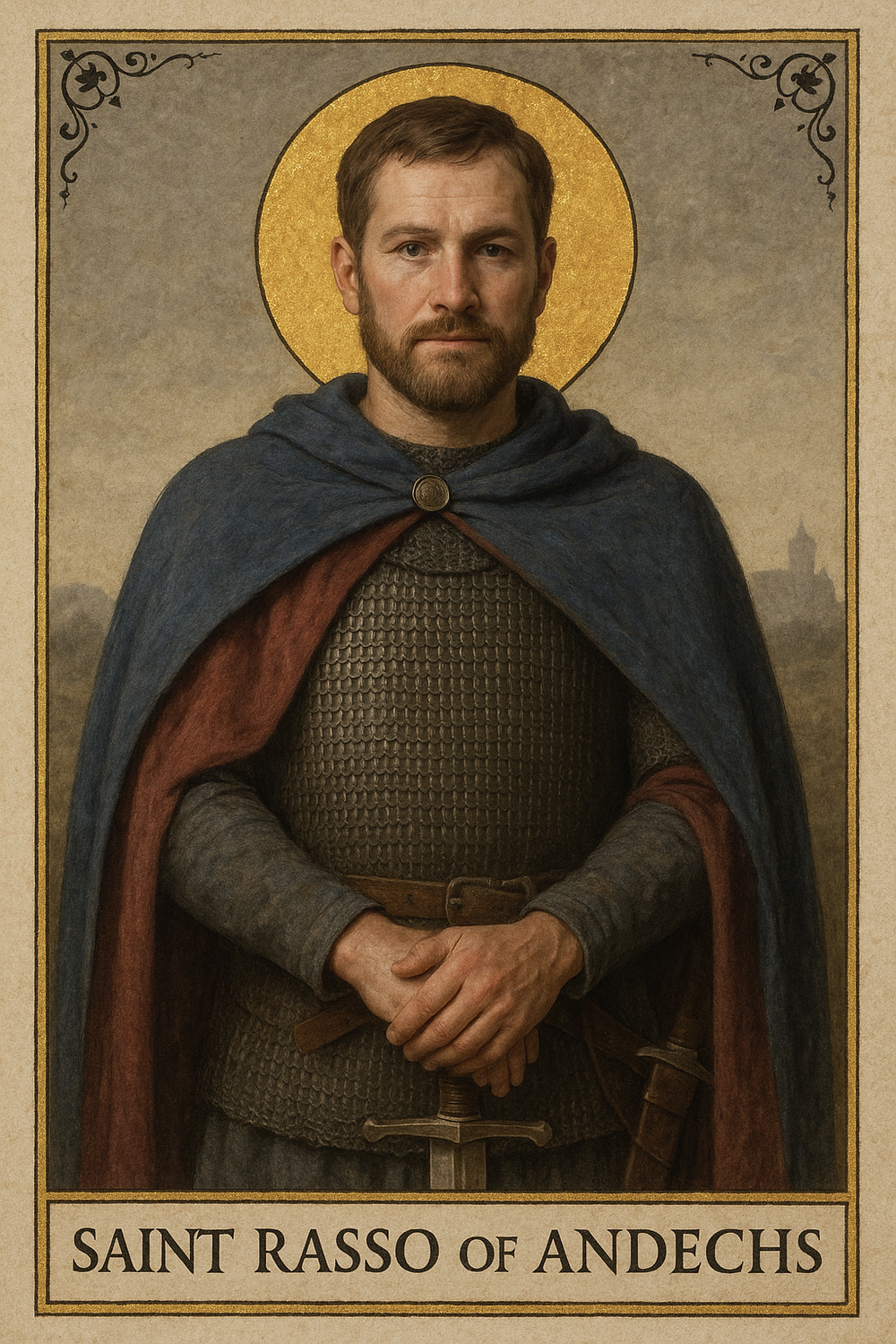
St. Rasso of Andechs — Pre-Schism, Bavarian Catholic
Rasso (also spelled Ratho or Rassus) was a Bavarian count of the noble house of Andechs who fought against the Magyar invasions of the late ninth and early tenth centuries — the violent wave of Hungarian raids that struck deep into the heart of Christian Europe before the Magyar conversion in the late tenth century. He was, by accounts, a formidable military commander who participated in the defense of the German Christian lands during one of the most desperate periods in medieval Bavarian history.
What distinguishes Rasso from being merely a Christian soldier is what he did after the fighting was over. Having survived the Magyar wars, he undertook a pilgrimage to Jerusalem and Constantinople, bringing back a remarkable collection of sacred relics — said to number in the hundreds — which he installed in the church at Andechs. He then withdrew from secular life, became a Benedictine monk, and died in the monastery. The Andechs Abbey, still one of the great Benedictine monasteries of Bavaria, stands on the hill where his relics rest.
Rasso belongs to a specific and underrepresented type of warrior saint: the soldier who fought, who survived, who made it home, and who then spent the rest of his life going deeper into the faith that had sustained him in battle. His transition from count to monk is not a rejection of his warrior past but its completion — the discovery that the courage required to fight for Bavaria and the courage required to pray in a monastery belong to the same tradition of costly fidelity. He is the patron for veterans who have come home and are not sure what to do with who they have become, and for anyone who has survived their wars and is looking for the next battle — which turns out to be the interior one.
The Warrior Princess
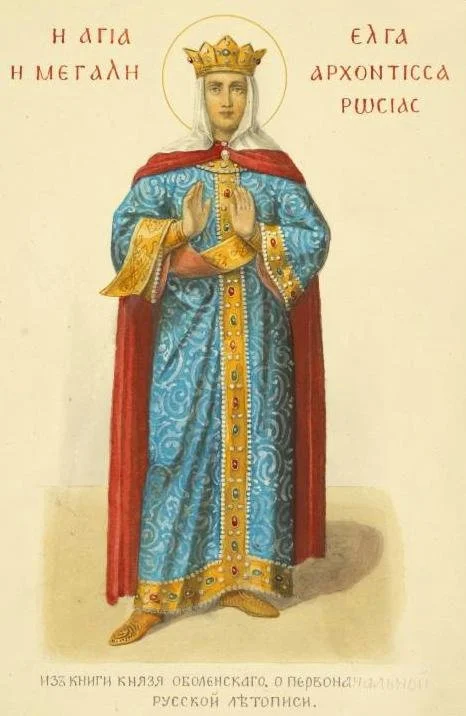
St. Olga of Kyiv — Pre-Schism, Slavic Eastern Christian
Olga of Kyiv is the only female saint in this guide before Joan of Arc, and she belongs in the warrior-saint category not metaphorically but literally — though her warfare was political and strategic rather than military, and her most famous early acts were deeply violent. When her husband, Prince Igor of Kyiv, was murdered around 945 AD by the Drevlian tribe who had revolted against his tax collectors, Olga was left as regent for her young son Sviatoslav. What followed was one of the most calculated campaigns of vengeance in medieval history: the Drevlian ambassadors who came proposing she marry their prince were buried alive in their boat; a second delegation was burned in a bathhouse; a third was massacred at a funeral feast; the Drevlian capital was burned to the ground, partly using birds whose feet had been lit with burning rags. Olga was, by every account, a woman of formidable intelligence, political will, and absolutely no mercy toward those who killed her husband.
What makes Olga a saint is what happened next. Around 957 AD, she traveled to Constantinople and was baptized — the accounts suggest she was personally received by the emperor Constantine VII Porphyrogennetos and the Patriarch Polyeuktos in a ceremonial baptism of considerable significance. She took the Christian name Helena, in honor of the Emperor Constantine's mother. She returned to Kyiv and spent the rest of her life working quietly — her son Sviatoslav remained militantly pagan — to plant the seeds of Christianity in the lands of Rus. She built churches, she encouraged Christian practice among those who would receive it, and she prepared the ground for her grandson Vladimir, who would baptize Kyiv en masse in 988 and make Christianity the faith of the Slavic world. The Eastern Church honors her as Equal to the Apostles for this work.
For the Ukrainian tradition in particular — both Ukrainian Greek Catholic and Ukrainian Orthodox — Olga is the mother of the Ukrainian Church. Her brutal early years are not denied or minimized in the tradition; they are understood as the raw material that God converted into one of the most consequential Christian missions in history. She is the patron of rulers, converts, and widows, and her story is a specific witness to something the tradition believes deeply: that the God who made the universe is not deterred by the character of His instruments before He gets hold of them.
Section II
Catholic Warrior Saints
The two saints in this section were canonized after the Great Schism of 1054 — which means they are not formally part of the Orthodox calendar, though the Orthodox tradition holds them in respect. Joan of Arc and Ignatius of Loyola represent the two faces of Catholic warrior-sainthood: the external warrior who leads armies in God's name, and the interior warrior who transforms the discipline of the soldier into the discipline of the soul. Between them, they cover nearly every dimension of what it means to fight for God in the Catholic tradition.
St. Joan of Arc — Post-Schism, Roman Catholic
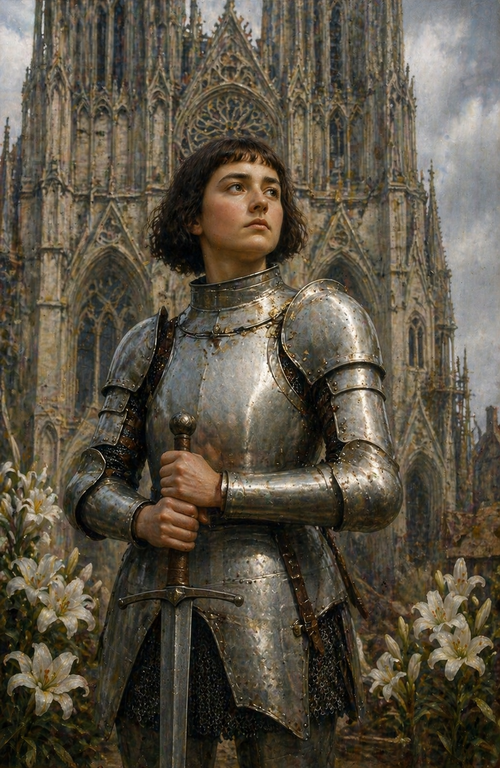
Joan of Arc is the most famous warrior saint in Western Christianity and one of the most extraordinary figures in the entire history of the Church. She was born around 1412 in Domrémy, a village in northeastern France, to peasant parents. France was in the middle of the Hundred Years' War with England — the Dauphin Charles VII had not been crowned, the English and their Burgundian allies controlled much of the country, and the situation appeared militarily hopeless. Joan began hearing voices at around age thirteen: she identified them as St. Michael the Archangel, St. Catherine of Alexandria, and St. Margaret of Antioch. The voices told her that she had been chosen to drive out the English and have the Dauphin crowned king of France.
What followed is almost incomprehensible from any purely human standpoint. A seventeen-year-old peasant girl, with no military training and no political connections, traveled to Chinon, gained an audience with the Dauphin through sheer persistence, persuaded him of her mission through a private conversation whose contents were never disclosed, was given command of a relief army, rode to Orléans in full armor, and within nine days lifted the English siege that had lasted months. The French military campaigns that followed, under her leadership and inspiration, culminated in the coronation of Charles VII at Reims in July 1429 — exactly as she had said they would. She had done in less than a year what the entire professional French military had failed to do in decades.
In 1430, Joan was captured by the Burgundians and sold to the English. Her trial in Rouen in 1431 was a travesty of ecclesiastical procedure — a political execution dressed as a heresy trial. She was accused, among other things, of wearing men's clothing and claiming divine authority without ecclesiastical sanction. She was nineteen years old, defending herself alone against the accumulated legal sophistication of her accusers, and she did so with such precision and theological intelligence that her judges were frequently confounded. On May 30, 1431, she was burned at the stake in the Rouen marketplace. Her last word, repeated multiple times, was "Jesus." Eyewitnesses reported that her heart would not burn. The English soldier assigned to light the fire reportedly told a friend afterward that he had burned a saint.
The posthumous rehabilitation trial of 1456 annulled her condemnation and declared the original trial fraudulent. She was beatified in 1909 and canonized in 1920. She is the patron of France, of soldiers, of women in military service, and of anyone who has faced the institutional Church or institutional power in a situation where conscience pointed one way and authority pointed another. She did not survive her encounter with the institutional Church. But she was right, and it was wrong, and the record shows it — which is precisely why the Church eventually recognized her.
The Soldier Turned Pilgrim
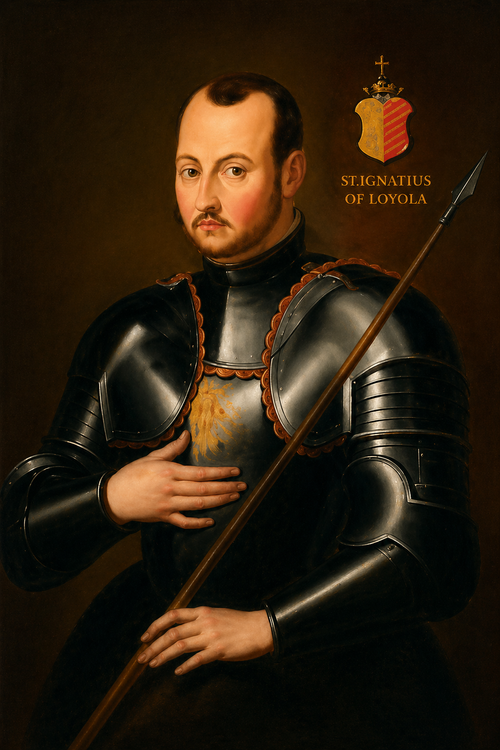
St. Ignatius of Loyola — Post-Schism, Roman Catholic
Ignatius of Loyola is not a warrior saint in the conventional sense — he never died in battle and was never martyred. He belongs in this guide because his entire spiritual system grew directly and consciously out of military experience, and because the path he traveled — from soldier to saint, from military discipline to spiritual discipline, from physical courage to interior courage — is one of the most documented and replicable conversion narratives in Christian history. He is the warrior saint for people who have survived their physical wars and are not sure how to wage the next one.
Iñigo López de Loyola was born in 1491 in the Basque country of northern Spain into a noble family with a strong military tradition. He was trained as a soldier, served in various campaigns, and by his late twenties was a practiced courtier and a moderately successful officer with a taste for adventure and romance. In May 1521, the French besieged the fortress of Pamplona in Navarre. Ignatius — against what appears to have been the better judgment of his commanders — persuaded the garrison to resist rather than surrender. A cannonball passed between his legs, shattered his right leg, and wounded his left. The fortress fell. The French, impressed by his courage, had him carried to his family castle at Loyola to recover.
The recovery took months and involved multiple agonizing surgeries — Ignatius insisted on having a disfiguring bone protrusion sawn off, unwilling to accept a limp that would prevent him from wearing the tight courtier's hose fashionable at the time. During this long convalescence he asked for the romantic novels he enjoyed to pass the time. There were none available. What there was were a life of Christ and a collection of saints' lives. He read them — out of boredom at first, then with increasing interest — and discovered something: when he fantasized about military glory and courtly romance, he felt pleasure that faded into emptiness. When he read about St. Francis, about St. Dominic, about men who had given everything for God, he felt a different kind of feeling — one that, when he turned away from it, left him not empty but wanting more. He was a soldier. He recognized the difference between tactics that worked and tactics that didn't. This one worked.
The Spiritual Exercises that Ignatius subsequently developed — after years of prayer, pilgrimage, mystical experience, and theological study — are built entirely on military metaphors: the exercitant is a soldier being trained, the director is the commander, the enemy is Satan, and the battle is for the soul. The Jesuits, the religious order he founded, were structured with a military command hierarchy, total obedience, and the specific goal of sending highly trained spiritual warriors wherever the Church's needs were greatest. By the time of his death in 1556, the Society of Jesus had approximately one thousand members active across Europe, India, and Brazil. The soldier's cannonball had broken his leg and ended his military career. It had, indirectly, produced one of the most powerful institutions the Catholic Church has ever generated.
Ignatius is the specific patron for the warrior who has come home — or who has survived the external battle and discovered that the real fight is interior. His Spiritual Exercises are the most rigorously developed program of interior spiritual warfare in the Western Catholic tradition. Anyone fighting addiction, besetting sins, habitual patterns of thought and behavior that resist ordinary willpower, will find in Ignatius a commander who has mapped that terrain precisely.
Section III
Orthodox Warrior Saints
Alexander Nevsky is the one post-schism saint in this guide canonized exclusively in the Orthodox tradition. He represents the specifically Orthodox understanding of the warrior-prince: a man of profound personal piety who ruled a kingdom during a period of existential threat from two directions simultaneously, who chose diplomacy in one direction so that he could fight effectively in the other, and who, in the end, took monastic vows before his death because the interior battle was, to him, as serious as the exterior one had ever been.
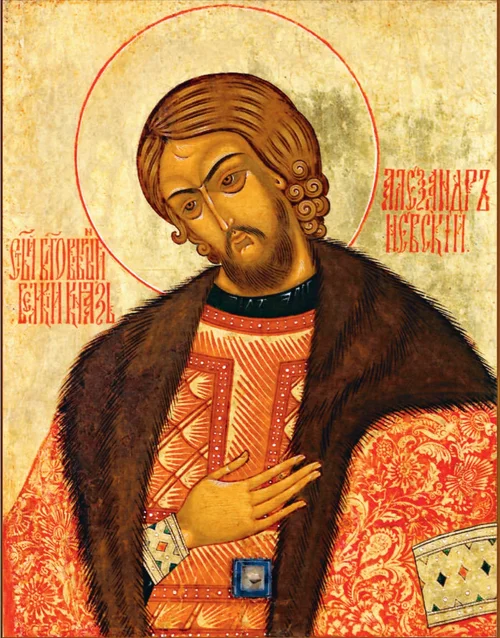
St. Alexander Nevsky — Post-Schism, Eastern Orthodox
Alexander Yaroslavich Nevsky was born around 1221 into the Rurikid dynasty — the ruling house of the Kievan Rus state — and became Prince of Novgorod at approximately sixteen years of age. He ruled during what may have been the most dangerous two decades in the history of Russian Christianity: the Mongol invasion of 1237–1242 had devastated most of the Rus principalities, and while the Mongols occupied the east, the western frontier faced simultaneous threats from the Swedish expansion in the north and the Teutonic Knights advancing from the west. Alexander faced both simultaneously with a force that was dramatically outmatched in both directions.
In 1240, a Swedish force advanced down the Neva River intending to threaten Novgorod. Alexander moved with extraordinary speed — gathering his forces and attacking before the Swedes could establish a beachhead — and defeated the Swedish army in a battle so decisive that he acquired the surname Nevsky (of the Neva). He was twenty years old. Two years later, the Teutonic Knights advanced onto the frozen Lake Peipus in Estonia with a force of armored cavalry considered nearly unstoppable. Alexander positioned his army to exploit the terrain, broke the Knights' charge at the ice, and drove them into the lake. The Battle on the Ice (April 5, 1242) has been called one of the most decisive engagements of medieval European history — it ended the crusading threat to Novgorod and secured the eastern Christian tradition against forced Latinization.
What makes Alexander a saint rather than merely a great general is the eastern side of his policy. Facing the Mongol Golden Horde in the east, Alexander chose not to fight. He accepted the humiliating reality of Mongol suzerainty — paying tribute, traveling repeatedly to the Horde's court, using his diplomatic skill to negotiate the most favorable terms possible for the Russian people and the Russian Church. His contemporaries found this humiliating. Later assessments recognized it as brilliant: by refusing to fight a war he could not win in the east, he preserved enough resources and stability to fight the wars he could win in the west. He protected the Church from the Horde's persecution where he could. He died returning from one such diplomatic mission to the Horde, took monastic vows on his deathbed under the name Alexiy, and was buried at Vladimir. His relics were transferred to St. Petersburg in 1724 on the orders of Peter the Great, who placed them in the monastery built in his honor — the Alexander Nevsky Lavra, still one of the spiritual centers of Russian Orthodoxy.
In 1941, when the German invasion threatened to annihilate the Soviet Union, Stalin — an atheist running an atheist state — authorized the release of the Eisenstein film depicting Alexander Nevsky battling the Teutonic Knights. He also authorized the creation of the Order of Alexander Nevsky, a military decoration for senior commanders. The instinct behind both decisions was sound: Alexander Nevsky is the warrior-saint of Russia, and in moments of existential national threat, Russia remembers him. His particular combination of military genius, diplomatic realism, profound personal faith, and monastic end make him the most complete expression in the Eastern Orthodox tradition of what a Christian ruler facing impossible odds can be.
Finding Your Patron
How to Choose Your Warrior Patron Saint
The question of how to choose a patron saint is one of the most practical questions in the Christian spiritual tradition, and the answer is simultaneously simple and worth taking seriously: you look for the saint whose story speaks to your actual situation — not the saint with the most dramatic story or the most popular devotion, but the one whose particular kind of courage, witness, or patronage intersects with the specific battle you are actually fighting.
The tradition has always understood that patron saints are not arbitrary assignments. There is something in the match between a person and their patron that is itself a form of spiritual guidance — the recognition that this saint has walked the terrain you are entering, has fought the battle you are facing, has something to teach you from the other side that you specifically need. That recognition is not always logical. It is sometimes immediate and intuitive. But for those who want a framework to start from, here is a practical matching guide:
| Your Situation | Primary Patron | Also Consider |
|---|---|---|
| Active military service | St. George or St. Michael | St. Sebastian, St. Demetrios, St. Theodore Stratelates |
| Military command / officer | St. Theodore Stratelates | St. Alexander Nevsky, St. Maurice |
| Police / first responder | St. Michael the Archangel | St. Sebastian, St. George |
| Spiritual warfare / interior battle | St. Michael the Archangel | St. Ignatius of Loyola, St. Theodore Tyron |
| Veteran / post-combat reintegration | St. Ignatius of Loyola | St. Martin of Tours, St. Rasso of Andechs |
| Facing impossible odds | St. Joan of Arc | St. George, St. Vartan Mamikonian |
| Woman in military / leadership | St. Joan of Arc | St. Olga of Kyiv |
| Conscientious objector / moral courage | St. Martin of Tours | St. Maurice, St. Theodore Tyron |
| Defending national / ethnic identity | St. Vartan Mamikonian (Armenian), St. Alexander Nevsky (Russian/Slavic), St. Demetrios (Greek) | St. George (England, Georgia, Ethiopia), St. Olga (Ukrainian) |
| Armenian heritage | St. Sarkis or St. Vartan Mamikonian | Both — they are the Armenian warrior saints |
| Coptic / Egyptian heritage | St. Mercurius (Abu Sefein) or St. Menas | St. Maurice (Theban Legion) |
| Survived something that should have killed you | St. Sebastian | St. Mercurius (Abu Sefein), St. Theodore Tyron |
| Byzantine / Eastern Catholic tradition | St. Demetrios or St. George | Both Theodores, St. Michael |
| Diplomat navigating hostile power | St. Alexander Nevsky | St. Olga of Kyiv |
If you cannot decide, start with St. Michael. He is the universal warrior-patron of the entire Church — the one who fights at the level of the ultimate source of every battle. You cannot go wrong invoking him first, and every other warrior saint is fighting under his command anyway. He is, as the tradition has always said, the one who answers the founding question of all spiritual warfare: "Who is like God?" — with the only possible response to that question, which is: no one. And that is enough.
Bring Your Patron Saint Home
Every warrior saint in this guide has a handcrafted prayer card available through The Eastern Church. Singles for your icon corner, bulk orders for parish distribution, and gifts for soldiers, veterans, and first responders who deserve to carry their patron with them.
Browse All Warrior Saint Prayer Cards →Questions About Warrior Saints
The Saints Are Still Fighting
Two thousand years of Christian history have produced warriors in every century, on every continent, in every tradition — people who looked at the same power that tried to crush the Church in Diocletian's Rome, in Julian's Persia, in the Mongol steppes, and in the killing fields of medieval France, and who answered it the same way: with faith, with courage, and with a willingness to pay whatever the witness cost them. The warrior saints are not history. In the theology of the communion of saints, they are present — fighting still, interceding still, available to anyone who asks them.
The prayer cards in this guide are not decorations. They are invitations: bring this saint into your home, your icon corner, your daily prayer. Put their story in your hands. Learn what they faced and how they faced it. And ask them — directly, with confidence, as the tradition has always done — to intercede for you in the battle you are actually fighting right now. The saints are still in the fight. They are simply fighting from further inside the territory that matters.
Browse All Warrior Saint Prayer Cards →