The Battle of Avarayr (451 AD): Armenia's Greatest Martyrdom
May 26, 451 AD · Avarayr Plain, Vaspurakan · The Complete History
The Battle of Avarayr
The day Armenia chose death over apostasy — and how losing a battle on purpose won the world's first treaty for religious freedom
At a Glance
On the morning of May 26, 451 AD, sixty-six thousand Armenian soldiers walked to the bank of the Tlmut River on the Avarayr Plain in Vaspurakan, knelt in the grass, and took Holy Communion. They knew they were outnumbered three to one. They knew the Persian army had war elephants. They knew many of them would not see the sun set. They took communion anyway — and then they formed their lines and advanced into the largest army they had ever faced, for the right to keep doing exactly what they had just done.
The Battle of Avarayr is one of the most extraordinary events in the history of Christianity — and one of the least known outside the Armenian world. It is the story of a people who were given a simple choice: convert to Zoroastrianism and live, or refuse and face war. They refused. They lost the battle. And in losing it, they won something no army that day could have predicted: the world's first formal treaty guaranteeing the right of religious freedom, signed thirty-three years later by a Persian king who had finally run out of patience for a war he could not win against people who would not stop dying for their faith.
This article is the complete account of what happened at Avarayr — what led to it, who fought it, how it unfolded, who died, who wrote it down, who continued the war afterward, and why a military defeat became the defining spiritual victory of the Armenian nation. It is also the story of a remarkable coincidence that shaped all of Eastern Christian history: the battle was fought on the same day as the opening of the Council of Chalcedon — and Armenia's absence from that council, forced by the war, set the Armenian Church on a theological path it has walked ever since.
The Most Remarkable Coincidence in Christian History
May 26, 451 AD. In the ancient Anatolian city of Chalcedon — across the Bosphorus from Constantinople — the Emperor Marcian opened the Fourth Ecumenical Council of the Christian Church. Six hundred bishops from across the Roman and Byzantine world gathered to settle the greatest theological controversy of the age: the nature of Jesus Christ. Over the following weeks they would produce the Chalcedonian Definition — the declaration that Christ has two natures, divine and human, united in one person — that would become the permanent theological foundation of both Eastern Orthodoxy and Roman Catholicism.
On the same day, May 26, 451 AD, on the Avarayr Plain in Vaspurakan in Persian-controlled Armenia, Vartan Mamikonian led sixty-six thousand Armenian soldiers into battle against the Persian Empire. Most of the Armenian bishops who should have been at Chalcedon were instead in the field or in prison. Armenia could not send delegates to the most important council in a century — because Armenia was fighting for its life.
These two events — the Council of Chalcedon and the Battle of Avarayr — are almost never discussed together in Western Christian history. But they are inseparable. Armenia's forced absence from Chalcedon meant that the Armenians received the council's decrees at second hand, in translation, filtered through a theological tradition that read the two-nature formula as crypto-Nestorianism. The battle that kept Armenia from Chalcedon thus contributed directly to the theological divergence that led to the Second Council of Dvin in 554 — and ultimately to the fifteen-century separation between the Armenian Apostolic Church and the Chalcedonian world. A war fought over Zoroastrianism ended up shaping a Christian theological divide that has never been fully healed.
The double significance of May 26, 451: The day Vartan Mamikonian died defending Armenia's right to be Christian is the same day the Council of Chalcedon opened — the council whose decrees, received without Armenian participation, permanently separated the Armenian Apostolic Church from Eastern Orthodoxy and Roman Catholicism. One date. Two events. Fifteen centuries of consequences.
Armenia Before the Battle: The World That Was at Stake
To understand what the Armenians were fighting for at Avarayr, you must understand what Christian Armenia was in 451 AD — and how fragile that achievement remained after one hundred and fifty years.
In 301 AD, King Tiridates III had declared Armenia the world's first Christian nation. Gregory the Illuminator had organized the Church. The fifth-century Golden Age had produced the Armenian alphabet (405 AD), the first Armenian Bible, and a flowering of Christian literature and theology that ranked Armenia among the most intellectually vibrant Christian cultures of the ancient world. The saints of that golden generation — Mesrop Mashtots, Sahak Partiev, Yeghishe, Vartan himself — were alive, formed, and active.
But Armenia as a political entity had been partitioned in 387 AD, divided between the Byzantine Empire in the west and the Sasanian Persian Empire in the east. The larger eastern portion — the Armenia where Avarayr would be fought — had fallen entirely under Persian control in 428 AD, when the last Armenian king, Artaxias IV, was deposed at the request of Armenian nobles seeking Persian patronage. The Persians appointed a marzpan (governor) to rule Armenia as a province. The Armenians accepted this — as long as they could keep their faith.
For a generation, that bargain held. The Persians were pragmatic administrators. Armenian cavalry was genuinely valuable to the Persian military machine. Many Armenian nobles had served in Persian armies across Asia. Christianity, while suspect in a Zoroastrian empire, was tolerated as long as it did not become politically threatening. The Armenian Church continued to build, baptize, ordain, and pray. The schools founded by Mesrop Mashtots trained a generation of scholars and clergy. Saint Vartan Mamikonian himself — who would die at Avarayr — had served as a general in the Persian army and was respected by Yazdegerd II as the sparapet (supreme commander) of the Armenian military forces.
Then Yazdegerd II decided that tolerance was over.
Yazdegerd II and the Zoroastrian Ultimatum
Yazdegerd II (r. 438–457 AD) was a Sasanian king of strong Zoroastrian conviction and a particular hostility toward Christianity that set him apart from more pragmatic Persian rulers before and after him. He was not simply a political administrator enforcing empire — he was a religious zealot who genuinely believed that the Zoroastrian faith was the true religion of humanity and that the spread of Christianity within his empire was a theological and political threat that had to be stopped.
The Political Calculation
Yazdegerd's anti-Christian policy had a political logic beneath its religious surface. The Armenian Church was not ecclesiastically independent in the way the later Armenian Apostolic Church would become. In 451, the Armenian Catholicos still maintained hierarchical connections to the Greek-speaking Christian Church aligned with Constantinople and, through it, with Rome — the Christian powers of Byzantium, the very empire Persia perpetually competed with for dominance of the ancient world. For Yazdegerd, allowing the Armenian Church to maintain its Byzantine ecclesiastical connections was allowing a Persian province to maintain spiritual loyalty to a rival empire. He wanted the Armenians either to convert to Zoroastrianism entirely or to cut their ties with Constantinople in favor of the Aramaic-speaking Church of the East — the Nestorian church, which operated within Persian territories and had no Byzantine connections.
The Edict and the Pressure at Ctesiphon
In the mid-440s, Yazdegerd began his campaign. He summoned the leading Armenian nobles to his capital at Ctesiphon — a summons that was an order, not an invitation — and pressured them there to renounce their ties with the Byzantine church and to formally apostatize. The nobles, isolated in the Persian capital, under enormous political and physical pressure, temporarily yielded. Some made nominal declarations of Zoroastrian allegiance to satisfy the king and return home alive.
When they returned to Armenia, many immediately repented, declared their apostasy void, and resumed their Christian faith and practice. The pressure at Ctesiphon had produced the appearance of compliance without the reality. The intelligence reaching Yazdegerd was that his great victory over Armenian Christianity had dissolved the moment the nobles crossed back into Armenian territory.
Yazdegerd's minister Mihr-Narseh then took more aggressive steps. Fire-temples were being built in Armenian towns. Zoroastrian magi arrived with Persian military backing to replace Armenian clergy, suppress Christian worship, and begin the systematic conversion of the population. Churches were threatened. Priests were removed. The policy was no longer a pressure campaign — it was an occupation of Armenian religious life.
The Formal Edict of 449
In 449 AD, Yazdegerd issued a formal edict demanding the complete conversion of Armenia to Zoroastrianism. The demand was comprehensive and specific: Armenians were to build fire-altars, adopt Zoroastrian rituals in their homes and public life, send their children to be educated by magi, and sever all remaining connection to the Christian church. This was not a request for religious coexistence. It was an ultimatum.
The Assembly at Artashat: Armenia's Answer
In 449 AD, the political and religious leadership of Armenia convened a general assembly at Artashat — the ancient capital of Armenia — to formulate an official response to Yazdegerd's edict. The assembly brought together the Catholicos, the bishops, the noble princes (nakharars), and the leading figures of Armenian civil and ecclesiastical society. The question before them was existential: obey and survive, or refuse and face destruction.
The assembly was not quick or unanimous. There were voices for pragmatism — the same voices that would later, under the marzpan Vasak Siwni, argue for accommodation with Persia. But the dominant voice — shaped by the theology of the Armenian Golden Age, by the example of the martyrs, and by the pastoral authority of the bishops — was refusal.
The assembly also composed a formal oath — a corporate declaration of faith that soldiers would later repeat on the eve of battle, as recorded by the eyewitness historian Yeghishe:
This was Armenia's answer. Yazdegerd II, upon receiving it, was enraged. He assembled a massive army and marched toward Armenia.
Saint Vartan Mamikonian: The Man Who Led Them
Vartan Mamikonian is the closest thing Armenia has to a patron saint of the nation itself — more immediately present in Armenian consciousness than Gregory the Illuminator, more universally beloved than any of the great theologians, more emotionally potent than any figure in Armenian history. He is saint and hero, general and martyr, the man Armenia calls its own even fifteen centuries after his death. To understand Avarayr is to understand Vartan.
Lineage: The Blood of Saints
Vartan's lineage was almost impossibly distinguished. His grandfather was Saint Sahak Partiev (Isaac the Great), the Catholicos who co-created the Armenian alphabet with Mesrop Mashtots and oversaw the translation of the first Armenian Bible. Sahak Partiev himself descended from the Gregorid line — the family of Saint Gregory the Illuminator, Armenia's founding Catholicos. Vartan Mamikonian was thus the great-great-grandson of Gregory the Illuminator through the female line. The blood of the man who had baptized Armenia ran in the veins of the man who would die defending what that baptism had made possible.
His father Hamazasp had been sparapet — supreme commander — of the Armenian army before him. The Mamikonian family held the hereditary office of sparapet, making them not only the great military commanders of Armenia but a kind of warrior-nobility inseparably bound to Armenia's defense. The family crest was the fighting spirit of the nation itself.
His Formation: Scholar, Soldier, and Faithful
Vartan received his early education under his grandfather Catholicos Sahak — the same man who had shaped a generation of Armenian Christian scholars. Rather than entering the priesthood as others in the Gregorid line had done, Vartan chose the military path. He became a soldier of enormous skill, serving in the Persian army's campaigns against Rome and the nomads of Central Asia, earning the respect of Yazdegerd II himself as one of the finest military commanders in the Persian sphere. The eyewitness historian Yeghishe, who served as Vartan's secretary, describes him as a man for whom faith and soldiering were not in tension but in unity: he believed that one could not serve one's people without serving Christ at the same time.
The Brief Apostasy and Return
Like many other Armenian nobles summoned to Ctesiphon, Vartan had nominally complied with Yazdegerd's demands when under direct pressure in the Persian capital. He had made some kind of formal declaration to satisfy the king. When he returned to Armenia, he immediately repented — publicly, formally, and with the full authority of his position. He rejoined the Church, confessed his apostasy, and became the most determined opponent of Yazdegerd's conversion policy. The brief apostasy under duress had if anything hardened him. He knew exactly what he had been asked to surrender, and he knew he would not surrender it again.
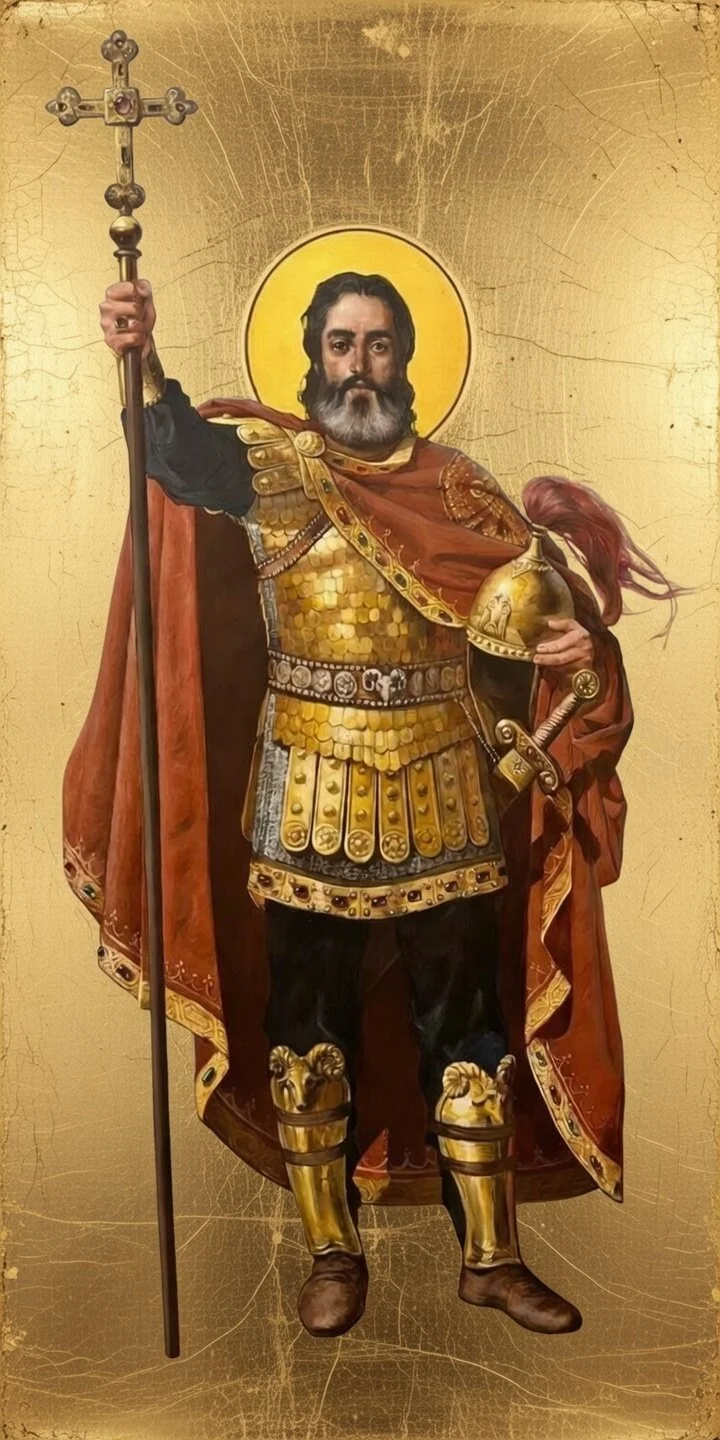
Saint Vartan Mamikonian
The general who died at Avarayr on May 26, 451 AD, defending Armenia's right to practice Christianity. Canonized by the Armenian Apostolic Church. Patron for defending the faith under impossible odds, for courage in impossible battles, and for standing firm under political and state pressure. Feast: Vartanants, Thursday before Great Lent.
Get the Prayer Card →The Traitor: Vasak Siwni and the Question of Survival
No account of Avarayr is honest without confronting the figure of Vasak Siwni — the marzpan (Persian-appointed governor) of Armenia who defected to the Persian side before the battle and fought against his own people. In Armenian memory, Vasak is the archetypal traitor, the man whose name became a byword for betrayal in the Armenian language. But the historical Vasak was more complicated than simple treason — and his choices illuminate the genuine difficulty of the decision every Armenian faced in 451.
Vasak was not a coward. He was a pragmatist who had read the military situation accurately and concluded that the Armenians could not win. The Persians had more soldiers, better logistics, war elephants, and the full resources of an empire. Vasak's argument — preserved in the sources — was essentially this: a negotiated settlement could preserve Christianity in Armenia without the destruction of the Armenian people; a military confrontation would end in defeat, exile, and the total suppression of the Church under Persian military occupation. He was not wrong about the military calculus.
What he missed — and what the battle of Avarayr proved — was the spiritual calculus. The Armenians did not fight Avarayr to win it militarily. They fought it to demonstrate, at the cost of their own blood, that there was no price at which Armenian Christianity could be purchased. A victory bought by Vasak's negotiations would have been a surrender with better terms. The Armenians chose a different kind of victory entirely.
In the battle itself, Vasak's forces fought on the Persian side. Yazdegerd II afterwards dismissed even Vasak, recognizing that his collaboration had produced a pyrrhic victory that served Persian interests poorly. Vasak died in Persian captivity, removed from office, his gamble having failed on both sides: he had lost his people's respect without gaining Persian trust.
The Eve of Battle: Communion, the Maccabees, and the Oath
The night and morning before the Battle of Avarayr are among the most vivid scenes in Armenian Christian literature, preserved in the pages of Yeghishe's History of Vardan and the Armenian War. What happened on the plain before the battle began tells us more about what the Armenians believed than any amount of theological analysis.
The Gathering of the Army
The Armenian force — 66,000 men, cavalry and infantry together, nobles and freemen and common soldiers — converged on the plain of Ardaz from their various positions around Armenia. With them came Catholicos Hovsep I and the priest Ghevond Yeretz (Saint Levond), leading a contingent of clergy and deacons. The presence of the clergy was not incidental. The Catholicos and the priests had chosen to march to battle alongside the soldiers, not because they were warriors but because they understood the battle's nature: it was not a political campaign or a territorial dispute. It was a confession of faith, and clergy belonged in a confession of faith as surely as soldiers did.
Vartan Reads from the Maccabees
According to Yeghishe's account, on the eve of battle Vartan Mamikonian took up the Book of Maccabees and read it aloud to his assembled army — the story of the Jewish brothers who had died rather than renounce their ancestral faith under Antiochus IV Epiphanes in the second century BC. Yeghishe writes that Vartan read with "exuberant words about the proceedings, and how they had fought the king of Antioch for their God-given religion." The parallel was deliberate and exact: as the Maccabees had refused Hellenization under Antiochus, the Armenians refused Zoroastrianization under Yazdegerd. As the Maccabees had fought against impossible odds and some had died, the Armenians prepared to do the same. The precedent from Scripture was their armor as much as any metal they wore.
Holy Communion on the Battlefield
On the morning of May 26, 451 AD, before the armies met, the entire Armenian force — all sixty-six thousand men — received Holy Communion. Saint Ghevond Yeretz administered the Eucharist on the plain of Avarayr. This was not a routine religious observance. It was a deliberate act of theological declaration. To receive the Body and Blood of Christ before a battle you expected to lose was to say: whatever happens today, we belong to this — not to the fire temples, not to the magi, not to the empire of Yazdegerd. We are Christ's, and Christ's we will remain, alive or dead.
The Address Before Battle
When the communion was complete and the lines were forming, Vartan addressed his army. The specific words recorded by Yeghishe have been debated by scholars, but the tradition preserves the essential substance. He reminded his soldiers of the nature of what they were doing — not merely fighting a battle but witnessing to a truth that could not be compelled away. The most famous formulation, preserved in multiple sources, captures the spirit precisely:
Christianity, for Vartan and the men who heard him, was not a cultural garment that could be exchanged for another. It was skin. It was the irreducible substance of what they were. No edict, no army, no war elephant could peel it away.
The Battle Itself: May 26, 451 AD
The Avarayr Plain lies in the principality of Artaz, in the extreme northwest of what is today Iran — along the Tlmut River (a tributary of the Arax), near the modern borders of Iran, Turkey, and the Azerbaijani exclave of Nakhichevan. The plain was open and suited to cavalry — which would prove a critical tactical factor.
The Armies
The Armenian force of approximately 66,000 was not a professional standing army. It was a popular uprising — nobles with their retinues, freemen, and common soldiers, organized under the traditional military structure of the Armenian nakharardom. The Armenian cavalry was, however, a genuinely elite force. Armenian horsemen were among the most prized soldiers in the ancient world, sought by both Persia and Byzantium as tactical allies. Many of these men had fought in Persian campaigns against Rome and the Kidarites in Central Asia. They were experienced, disciplined, and — crucially — they were fighting for something no professional soldier in Yazdegerd's army could equal: the survival of everything they loved.
The Persian army, commanded by Mushkan Niusalavurt, was approximately three times the size of the Armenian force — around 198,000 men by the numbers given in the sources, though the exact figures have been questioned by historians. It included the fearsome Savārān — the Sasanian heavy cavalry, sometimes called the New Immortals — and war elephants, which were the ancient world's equivalent of armored vehicles: massive, terrifying, capable of disrupting cavalry formations and sending untrained troops into panic.
The Course of the Battle
The battle was fierce and long. Initial accounts indicate that Vartan Mamikonian drove his cavalry hard into the Persian lines early in the fighting, winning initial success — cutting through Persian formations, killing significant numbers of the heavier infantry. For a time, the battle seemed genuinely contested. The Armenian cavalry, fighting with the desperate intensity of men protecting their faith and their homeland, inflicted casualties entirely disproportionate to their numbers.
But the Persian numerical advantage, the war elephants, and the defection of Vasak Siwni's forces fighting on the Persian side eventually turned the tide. Vartan Mamikonian himself was killed in the fighting — along with eight of his principal officers and commanders. When their sparapet fell, the Armenian lines could no longer hold. By evening, the Armenian forces had retreated.
The statistics of the battle tell the real story. The Armenians lost 1,036 men — including Vartan and the eight commanders. The Persians lost approximately 3,544. The army that had just defeated the Armenians had suffered three times the casualties of the losing side. The Armenian cavalry — outnumbered, without elephants, fighting as a popular uprising rather than a professional force — had made the Persian victory so costly that Yazdegerd II could not simply shrug and begin another campaign the next season.
The arithmetic of Avarayr: 1,036 Armenians killed. 3,544 Persians killed. The losing army killed three times as many of the winning army as the winning army killed of them. This is not a military defeat in any conventional sense. This is a people that could not be conquered at any price the victor was willing to pay.
The Immediate Aftermath: A Pyrrhic Persian Victory
Yazdegerd II had won the battle. He had not won the war. The distinction between these two facts is the entire meaning of Avarayr.
In the weeks and months following the battle, Yazdegerd did what victorious Persian kings typically did: he exiled the Armenian Catholicos Hovsep I and several of the most defiant priests. He imprisoned a number of noble Armenian families. He appointed a new governor for Armenia and sent Persian administrators to enforce the conversion program. On paper, he had crushed the rebellion. Armenia was under occupation. The institutional structure of the Armenian resistance had been dismembered.
But he did not force the conversion. He did not rebuild the fire temples at Armenian sword-point. He issued no execution orders against the Armenian clergy en masse. The reason was simple: the battle of Avarayr had demonstrated that the cost of actually suppressing Armenian Christianity was not a one-time military expenditure. It was an ongoing war that would drain Persian resources indefinitely. And Persia, already facing threats from the Kidarites on its eastern frontiers, could not afford an indefinite Armenian insurgency in its northwestern provinces.
Yazdegerd II dismissed Vasak Siwni — who had betrayed his own people and still lost the king the decisive victory he needed — and effectively allowed the existing situation to persist: Armenia remained nominally Persian, but Christianity continued to be practiced. The conversion program had failed. The greatest army in the western part of the ancient world had killed 1,036 Armenian soldiers and found itself no closer to an Armenian fire temple than it had been before the battle.
Yeghishe: The Eyewitness Who Wrote It All Down
We know as much as we do about Avarayr because of one man: Yeghishe (Elishe, c. 410–475 AD), the Armenian historian who had been present for the war as Vartan Mamikonian's personal secretary and who later wrote the definitive account — History of Vardan and the Armenian War — that remains the primary source for everything described in this article.
Yeghishe was one of the students trained in the generation of the Armenian Golden Age, educated by Mesrop Mashtots and Sahak Partiev themselves. He had studied in Alexandria and returned to Armenia in 441, entering military service with Vartan. He was there. He heard Vartan read the Maccabees. He received communion on the plain of Avarayr. He survived the battle and its aftermath.
After the defeat, Yeghishe renounced military life and became a hermit in the mountains south of Lake Van. He did not write his history until the 460s, when he was asked by a priest named David Mamikonian to record what had happened. He called the work not a standard history but a Hishatakaran — a Memorial or Recollection. It is deeply theological in its framing: Avarayr is not merely a military engagement in Yeghishe's telling but a sacred event with cosmic significance, an episode in the eternal war between the Church and the powers that wish to extinguish her.
The History of Vardan is one of the great works of early Christian literature. It is the lens through which every subsequent Armenian generation has understood what Avarayr meant. The oath, the communion, the address, the casualty figures, the names of the martyrs — all of it comes from Yeghishe, who was standing close enough to count the dead.
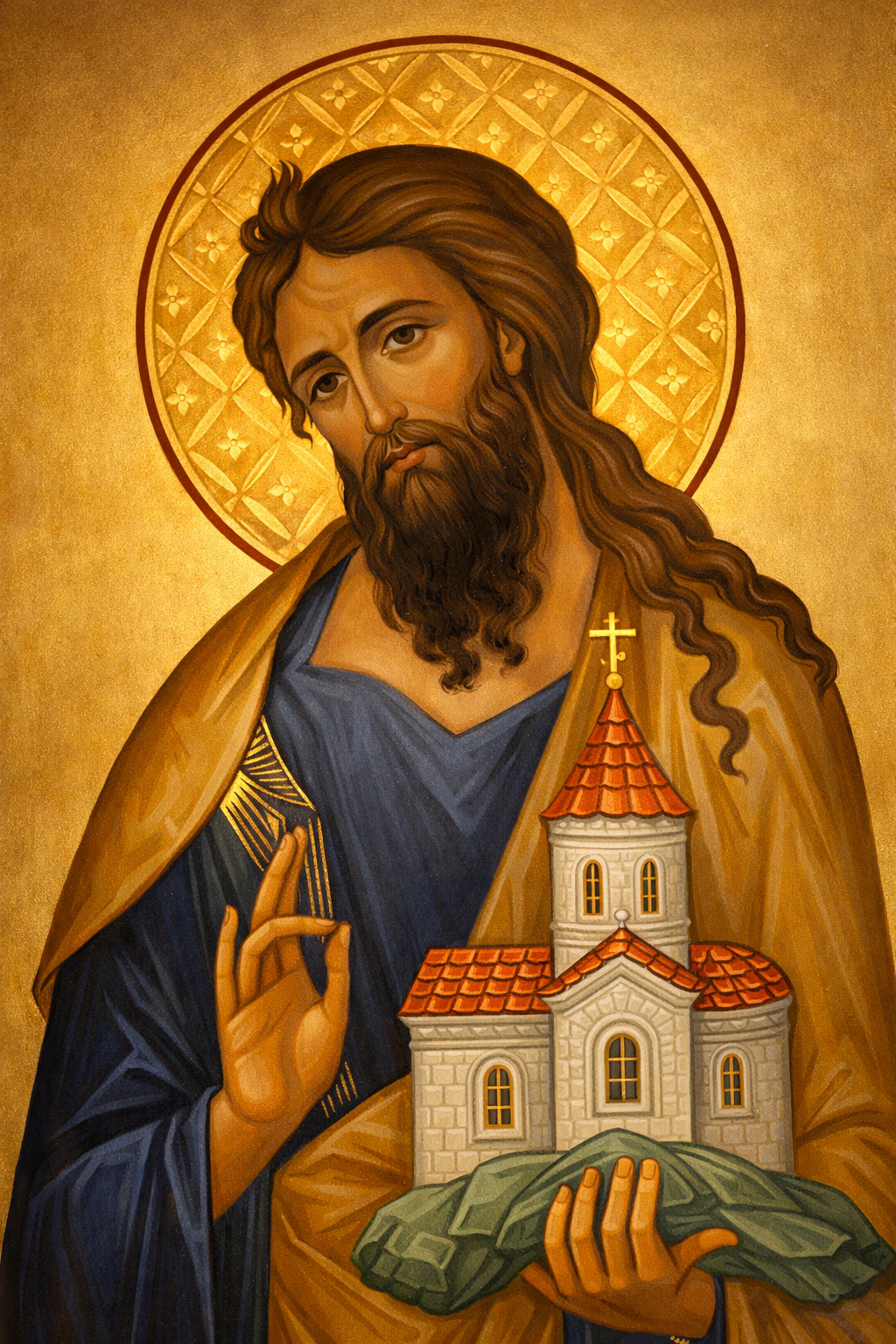
Saint Yeghishe (Elisha)
Vartan's secretary, eyewitness to Avarayr, and author of the History of Vardan and the Armenian War — the text that preserved everything we know about the battle. Without Yeghishe's pen, Avarayr would have been lost. He is venerated as a saint and martyr of the written word. Patron for courage under persecution and faithful witness to the truth.
Get the Prayer Card →Vahan Mamikonian and 33 Years of Guerrilla War
The Battle of Avarayr was not the end of the war. It was the beginning of thirty-three years of sustained Armenian resistance that ultimately compelled Persia to sign a formal treaty of religious freedom.
Vahan Mamikonian — nephew of Vartan, son of his brother Hmayak who had also died at Avarayr — emerged in the years following the battle as the leader of an Armenian resistance movement based in the mountains and the forests of the Armenian highlands. He was a child when Avarayr was fought. He grew up knowing nothing but occupation and insurgency. By the late 460s and 470s, he was coordinating ambushes, raids, and guerrilla operations from mountain strongholds that disrupted Persian supply lines, undermined Persian administrative control, and inflicted steady attrition on Persian forces without ever producing a decisive set-piece battle.
The twenty-five Armenian nobles captured after Avarayr had been sent by Yazdegerd to fight for Persia on the eastern frontier against the Kushans — a characteristic Persian strategy for neutralizing troublesome prisoners by making them fight elsewhere. Eventually these nobles were freed and returned to Armenia, where they rejoined the resistance. The guerrilla war gained momentum through the 470s, drawing in Georgian allies under King Vakhtang and sustaining pressure on the Sasanian administration in Armenia that Persia could not comfortably absorb.
Then, in 484 AD, the Persian Shah Peroz I was killed in battle against the Hephthalites on the eastern frontier — a catastrophic defeat for Persia that created an immediate need to stabilize all remaining frontiers. Peroz's brother and successor, Balash (r. 484–488), faced a weakened empire and an Armenian insurgency that showed no sign of ending. He sent a representative to negotiate with Vahan Mamikonian. Vahan, who had never wanted war for its own sake, accepted the offer of peace.
The Treaty of Nvarsak (484 AD): The First Religious Freedom Treaty
In 484 AD — thirty-three years after the Battle of Avarayr — the Treaty of Nvarsak was signed between Vahan Mamikonian and the representatives of Shah Balash at the settlement of Nvarsak in Persia. It is one of the most remarkable documents in the history of human rights.
| Provision | What It Meant |
|---|---|
| All existing fire-altars in Armenia must be destroyed; no new ones may be built | The physical apparatus of the forced Zoroastrianization is dismantled — permanently |
| Christians in Armenia have freedom of worship; forced conversions to Zoroastrianism must stop | The core demand of the rebellion is met: the right to practice Christianity is formally guaranteed |
| Land may not be allotted to people who convert to Zoroastrianism | Economic incentives for apostasy are removed; the Church's economic base is protected |
| The Sasanian king must personally administer Armenia — not through deputies | Administrative accountability is established; no more marzpans running unchecked conversion programs |
Following the treaty, Vahan Mamikonian was appointed hazarapet (administrator) and later marzpan — governor — of Armenia itself. The nephew of the man who had died at Avarayr was now governing the province in the name of the empire that had killed his uncle, with the formal guarantee of his people's religious freedom secured in writing. The Armenian Church could rebuild, ordain, baptize, and worship freely.
The chain of causation is direct and verifiable. Avarayr produced unsustainable losses for Persia. Avarayr's moral example inspired thirty-three years of guerrilla resistance that Persia could not absorb. The guerrilla resistance, combined with Persia's crisis on the eastern frontier, produced the conditions that made the Treaty of Nvarsak possible. And the treaty enshrined in formal legal language the right to religious freedom that 1,036 Armenians had purchased with their lives on May 26, 451 AD.
Avarayr and Chalcedon: The Coincidence That Shaped Christian History
The theological consequences of Avarayr are as profound as its military consequences — and they have received almost no attention in Western Christian scholarship.
Armenia's absence from the Council of Chalcedon (451 AD) was directly caused by the war. The Armenian bishops were not in Chalcedon because they were in the field, in prison, or in hiding. When the Council's decrees — defining Christ as having two natures in one person — reached Armenia in the aftermath of the war, they arrived without any Armenian voice having shaped them, without any Armenian theologian having argued for or against the formula, without the perspective of a church that had just fought and died for Christianity being present in the room.
The Armenians who studied the Chalcedonian formula — translated into a written language that was less than fifty years old, filtered through the Cyrillian theological tradition they had inherited, received in the aftermath of a traumatic war — read it as tending toward the Nestorianism that the Council of Ephesus (431 AD) had condemned. The same theological intuition that had made the Armenians refuse Yazdegerd — the conviction that Christ is utterly and inseparably one, not a divine principle allied with a human instrument — made them read Chalcedon's two-nature language as dangerous.
The result was the First Council of Dvin (506 AD), then the Second Council of Dvin (554 AD), which permanently and canonically codified the Armenian Church's rejection of Chalcedon. The theological divide that still separates the Armenian Apostolic Church from Eastern Orthodoxy and Roman Catholicism — the divide that has been the subject of intense modern ecumenical dialogue — began, in part, on the plain of Avarayr, on May 26, 451 AD, with Vartan Mamikonian's cavalry charge into an army three times larger than his own.
The 1,036 Martyrs: Armenia's Mass Canonization
Every one of the 1,036 Armenian soldiers killed at Avarayr was canonized as a saint by the Armenian Apostolic Church. This is one of the largest mass canonizations in the history of Christianity — a collective declaration that every man who died that day died as a martyr: not merely a soldier fallen in battle but a witness to the faith who gave his life rather than apostatize.
The canonization reflects the Armenian theological understanding of what Avarayr was. The soldiers did not die incidentally while pursuing military objectives. They died as a direct consequence of refusing to renounce Christianity — which is precisely the definition of martyrdom in the patristic tradition. The sword that killed them was ultimately Yazdegerd's edict. The communion they had taken that morning was the seal of their witness. The battle was, in the deepest sense, a liturgical act.
The nine principal commanders who died with Vartan are especially commemorated: Vartan himself, along with Khoren Khorkhorouni, Artak Paluni, Thamaz Dimaksian, Hmayak Dimaksian, Vahan Khorkhorouni, Arsen Entzeaetsi, Garjak Sruandztian, and Nershapuh Arzruni. These nine, together with Vartan, form the core of the Vartanantz commemoration. But the feast honors all 1,036 equally — common soldiers alongside nobles, freemen alongside cavalry officers — because the martyrdom was collective and the faith was shared.

Saint Sahak Partiev (Isaac the Great)
Vartan's grandfather. The Catholicos who co-created the Armenian alphabet and oversaw the first Bible translation — the intellectual and spiritual formation that made Avarayr possible. Patron for spiritual leadership and preserving faith in crisis.
Get the Prayer Card →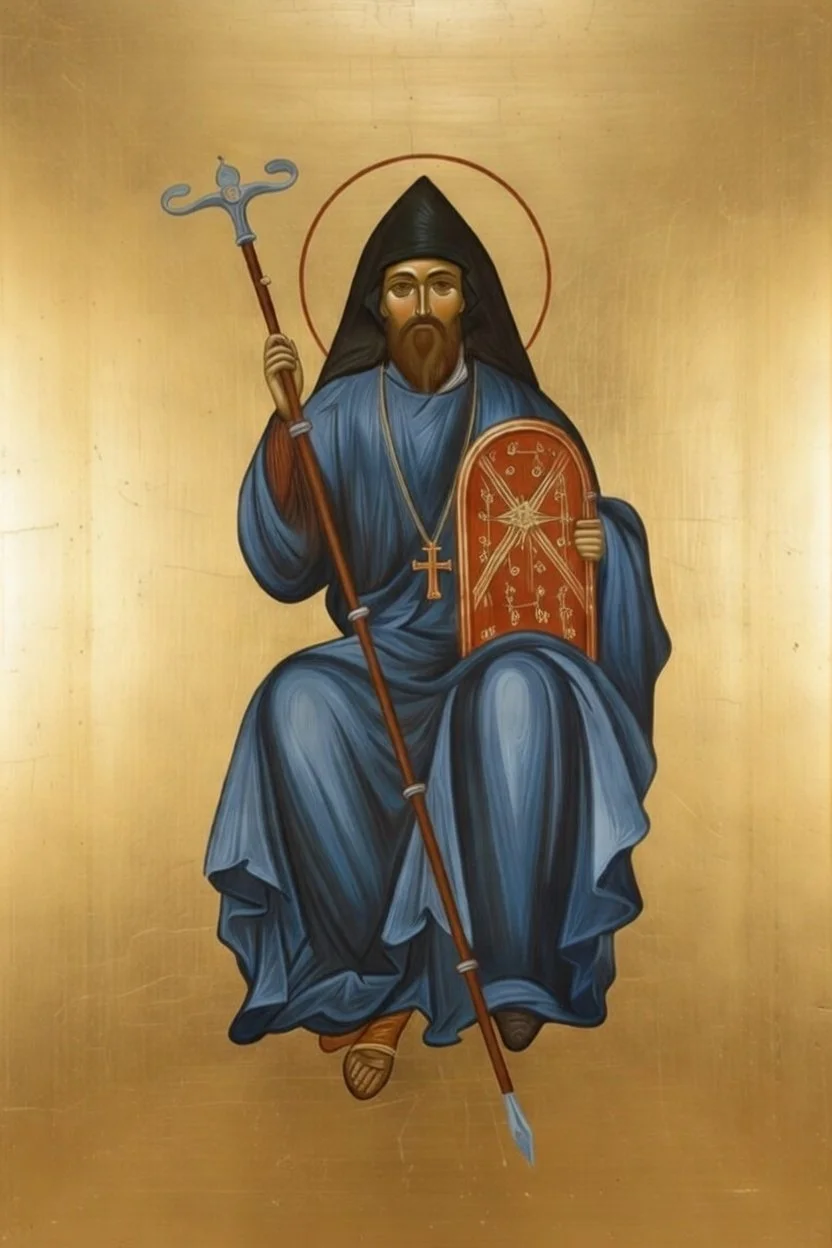
Saint Mesrop Mashtots
Inventor of the Armenian alphabet — and thus the man who made it possible for Armenians to read the Gospel in their own tongue, which is ultimately what Avarayr was fought to protect. Feast: Feb 19 in the Eastern Orthodox Menaion.
Get the Prayer Card →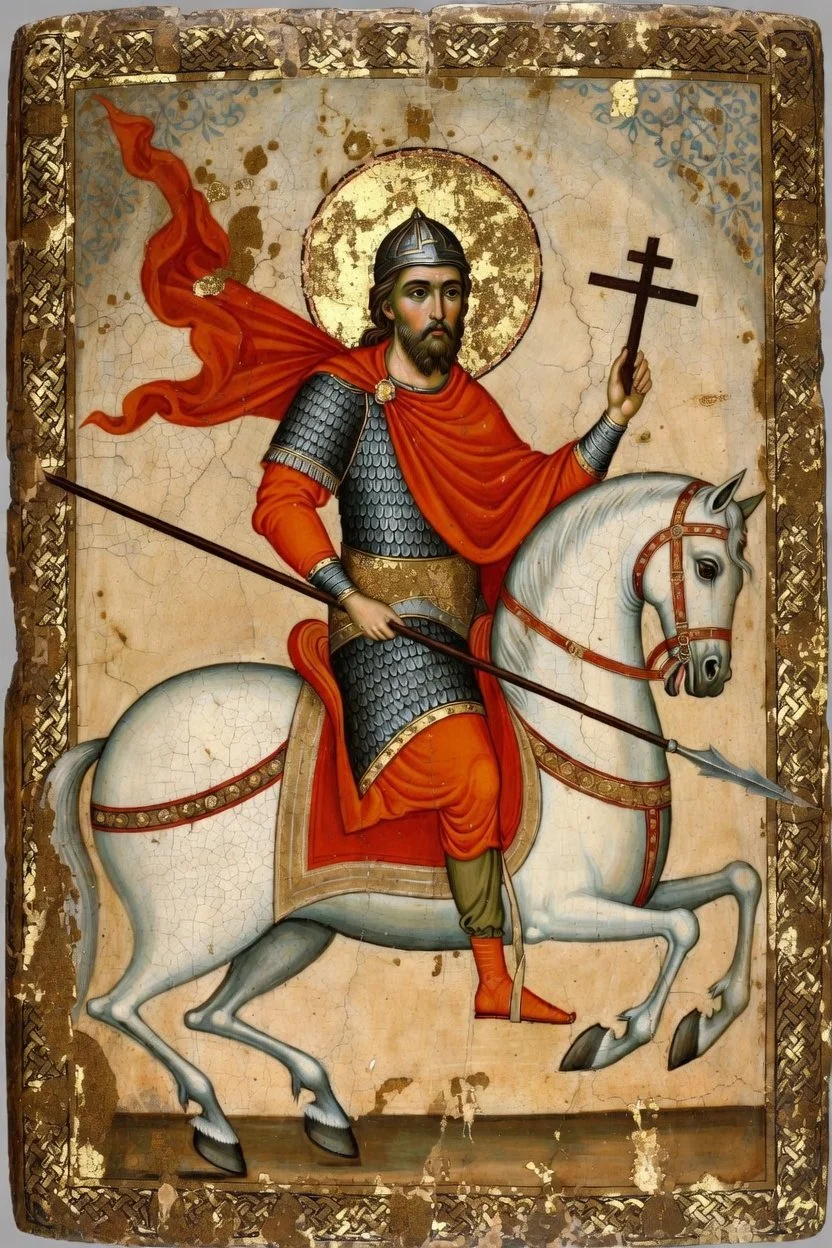
Saint Sarkis the Warrior
A Roman military officer who fled to Armenia and was martyred for refusing to renounce Christianity under Emperor Julian — a century before Avarayr, the same choice, the same answer. The patron of Armenian warriors and the model Vartan's soldiers followed.
Get the Prayer Card →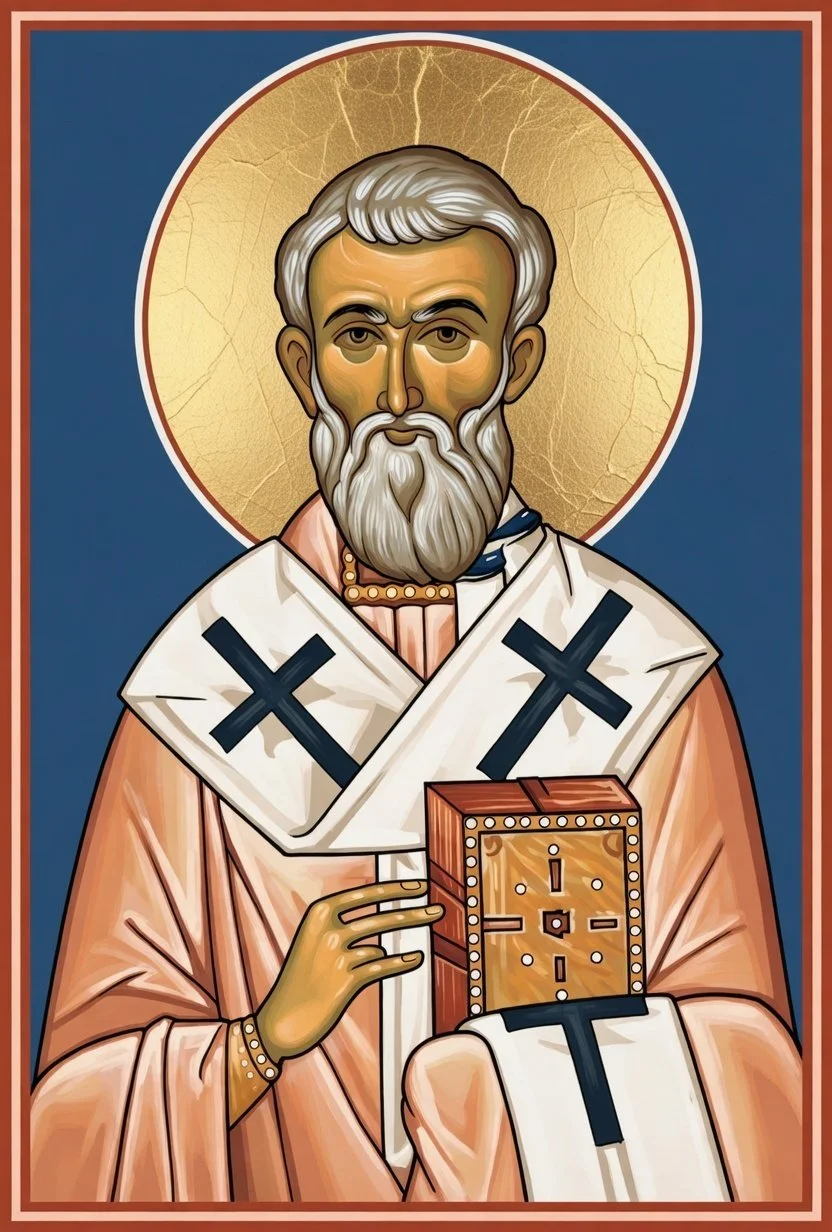
Saint Gregory the Illuminator
Vartan Mamikonian's ultimate ancestor through the female line. The man who baptized Armenia in 301 AD, making Christianity Armenia's state religion — which is what Yazdegerd tried to reverse and what Avarayr was fought to preserve. Patron of Armenia.
Get the Prayer Card →Saint Shushanik: Vartan's Daughter and Her Own Martyrdom
The story of Avarayr does not end with Vartan on the battlefield. It continues in the life and death of his daughter, Saint Shushanik — who carried the legacy of Avarayr into her own, even more personal martyrdom.
Shushanik was the daughter of Vartan Mamikonian. She married a Georgian prince named Varsken. In the years after Avarayr, Varsken made the exact choice Vartan had refused: he converted to Zoroastrianism in exchange for political favor from the Persian court and demanded that Shushanik do the same. The wife of a Georgian prince, daughter of the most famous Christian martyr of her age, was asked to renounce the faith her father had died for.
She refused. As Vartan had chosen death on the battlefield over apostasy, Shushanik chose imprisonment, torture, and death in a Georgian prison over the denial of her faith. Varsken had her imprisoned, beat her, and subjected her to years of deliberate physical abuse. She died from the effects of her mistreatment but never recanted. Her story — told in what is considered the oldest surviving work of Georgian literature — is one of the most harrowing accounts of domestic religious persecution in Christian history.
The parallel is theologically precise: Vartan chose death over apostasy on a battlefield. His daughter chose death over apostasy in a marriage. The principle was identical. The arena was different. The witness was the same. And the Georgian Orthodox Church, which venerates Shushanik on October 17, commemorates her as a daughter who completed what her father began — proving that Avarayr was not a single event but a spirit that moved through the Mamikonian bloodline like fire.
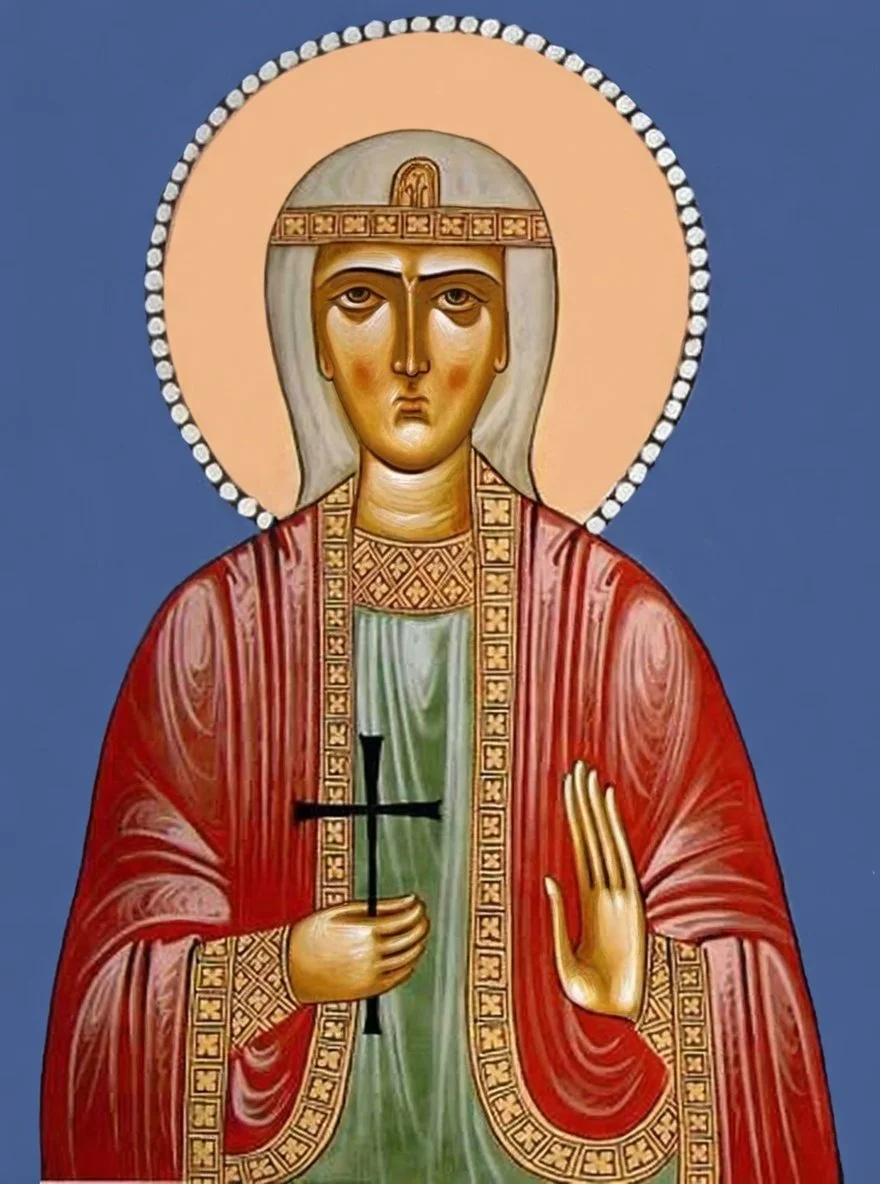
Saint Shushanik
Daughter of Saint Vartan Mamikonian. She refused to apostatize when her Georgian husband converted to Zoroastrianism under Persian pressure — choosing imprisonment, torture, and death over the denial of her faith. Her story is told in the oldest surviving work of Georgian literature. Patron for survivors of domestic abuse, for those forced to choose between faith and family, and for all who suffer in silence. Feast: October 17 (Georgian Orthodox).
Get the Prayer Card →Vartanants: The Living Feast
In the Armenian Church, the Battle of Avarayr does not belong only to the fifth century. It belongs to every year. The Feast of Vartanants — commemorating Saint Vartan the Warrior and all his companions — is observed on the Thursday preceding Great Lent, moving annually with the liturgical calendar. In 2026, it fell on February 12. In every year, it falls in the pre-Lenten period, linking the self-giving of the Avarayr martyrs with the Lenten preparation for the Passion and death of Christ himself.
The feast has two parts in the Armenian calendar. On the Tuesday before Lent, the Armenian Church commemorates the Feast of the Ghevontian Priests — specifically honoring Catholicos Hovsep I and the priest Saint Ghevond Yeretz (Levond) who administered communion before the battle and whose ministry on the battlefield was integral to its spiritual meaning. On the Thursday, the full feast of Vartanants honors Vartan and all 1,036 martyrs. The two-day commemoration captures both the ecclesiastical and the military dimensions of Avarayr — the priests and the soldiers, the chalice and the sword, the liturgy and the battle that was itself an act of worship.
In the diaspora — in Armenian communities in Los Angeles, Boston, Beirut, Paris, Sydney, and Buenos Aires — Vartanants has become not only a religious observance but a cultural one, a day when being Armenian and being Christian are understood as inseparable. The feast is, as one Armenian scholar has observed, the crux of what it means to be Armenian. It is the day when the community remembers that it exists not by accident or by geography but by choice — the same choice Vartan made on the plain of Avarayr when he received communion at dawn and then rode toward the Persian lines.
Legacy: Why Avarayr Still Matters
The Battle of Avarayr is not primarily a military event. It is a theological one — a statement, written in blood, about the nature of faith and the limits of power. Its legacy is felt in several distinct ways that reach from the fifth century to the present.
The Paradigm for Armenian Suffering
The UCLA scholar Peter Cowe, Narekatsi Chair of Armenian Studies, has described the Battle of Avarayr as "the root paradigm for interpreting the Armenian Genocide of 1915 and the widespread representation of its victims as martyrs." This is a precise and important observation. When the Armenian Apostolic Church canonized all the victims of the 1915 Genocide in a mass ceremony at Etchmiadzin on April 23, 2015 — the largest canonization in the history of the Church — it was explicitly interpreting the Genocide through the lens of Avarayr. The Genocide victims, like the Avarayr martyrs, died not as casualties of a conflict but as martyrs who chose death over the denial of their identity and faith. The theological framework for understanding that choice had been established at Avarayr in 451 and refined over fifteen centuries of Armenian Christian experience.
The First Religious Freedom Treaty
The Treaty of Nvarsak (484 AD), which Avarayr's sacrifice made possible, is one of the earliest formal legal guarantees of religious freedom in human history. The principle it established — that a government cannot compel the religious conversion of a subject people — was revolutionary in the ancient world and has direct descendants in modern human rights law. The Armenians did not win this treaty by being powerful. They won it by making the cost of their destruction too high for any power to pay. Avarayr was the price they paid to set that price.
The Theological Independence of the Armenian Church
Avarayr's role in keeping Armenia from Chalcedon is perhaps its most theologically consequential legacy. A church shaped by the experience of dying for its faith rather than surrendering it was not likely to accept doctrinal formulas under imperial pressure. The Armenian Church's Miaphysite Christology — its insistence on the absolute unity of Christ's divine and human nature — is not unconnected to the Avarayr spirit. The same theological intuition that made "we cannot change the color of our skin" the defining statement of Armenian Christian identity made the two-nature formula feel like a crack in the armor that had protected that identity for a century.
The Model for Christian Witness
Beyond Armenian particularity, Avarayr is simply one of the great examples of Christian witness in the history of the Church. Sixty-six thousand people took communion before a battle they knew they would probably lose, because the alternative — living without the right to take communion — was worse than losing. This is not nationalism. This is theology made concrete, in flesh and blood, on a plain by a river in what is now northwestern Iran. It belongs to the whole Church, not only to Armenia. And it asks every Christian the same question it asked the men who lined up on May 26, 451 AD: what are you willing to lose for the right to receive the Body of Christ?
Free Christian Marriage Books That Bring You Closer to God and Each Other
Complete books — no email, no paywall, no missing chapters. Read every book free online right now. Rooted in the ancient Christian tradition, written for couples at every stage of marriage.
Read Free Marriage Books →Frequently Asked Questions
Honor the Martyrs of Avarayr
Saint Vartan, Saint Yeghishe, Saint Shushanik, Saint Sahak Partiev, Saint Gregory the Illuminator — every saint connected to the Avarayr story has a handcrafted prayer card, made one at a time and prayed over in Austin, Texas.
Browse Armenian Prayer Cards →Further Reading & Resources
Go Deeper Into Armenian Christianity