Saint Luke the Surgeon (Valentin Voyno-Yasenetsky): Bishop, Physician, Confessor, and Intercessor for the Sick
Complete Hagiography
Saint Luke the Surgeon (Valentin Voyno-Yasenetsky): Bishop, Physician, Confessor, and Intercessor for the Sick
Archbishop, world-class surgeon, three-time Soviet prisoner, Stalin Prize laureate — the man who prayed over every patient before he cut, whose cassock remained with him until death, and whose incorrupt relics have been the site of hundreds of documented healings
The Saint Luke prayer card page holds visitors for an average of sixteen minutes and twenty seconds. That number is not a vanity metric. It is a window into the state of mind of the people who find it. They are not browsing. They are afraid. Someone they love is about to enter an operating room, or they themselves are waiting for a diagnosis that will determine whether they walk out of a hospital on their own feet. They have come to a 1,000-year-old Christian tradition and looked up the name of the only saint in the entire canon who was simultaneously a bishop in full vestments, a world-class surgeon with a Stalin Prize, and a man who spent eighteen years in Soviet prison camps for refusing to take off his cross. They are reading everything there is to read about him because they need to know: is this real? Can this man’s intercession actually help?
This article is the most complete English-language resource on Saint Luke the Surgeon ever assembled in one place. It covers his full biography from birth to canonization, his specific medical innovations with the surgical literature that documented them, his three distinct periods of Soviet imprisonment and exile, his documented miracles with the names and medical details that make them verifiable, every relic location in the world with links to visit, all of the traditional prayers used before surgery and during illness, the full Troparion and Kontakion in both Church Slavonic and English, and a practical guide to asking for his intercession. If you are going into an operating room tomorrow, or sitting beside someone who is — everything you need is here.
Saint Luke the Surgeon is the patron saint of surgeons, physicians, and all medical personnel. He is the intercessor specifically for those facing operations, for those with chronic infections and difficult diagnoses, for the blind and those with eye conditions, and for the suffering poor who have no other advocate. He was all of these things before he was a saint. He was a man who operated on peasants in Siberian exile camps using metal pliers when proper instruments were unavailable. He was a bishop who hung an icon of the Theotokos above his operating table and prayed before every incision. He told his medical students that the source of surgical skill was ultimately the grace of God working through human hands. He meant it. And the 40,000 people who processed through Simferopol on the day his incorrupt relics were discovered in 1996 meant it too.
Early Life: From Kerch to Kiev (1877–1903)
Valentin Felixovich Voyno-Yasenetsky was born on April 14, 1877 (April 2 in the Old Style Julian calendar) in the city of Kerch in Crimea. His father, Felix Stanislavovich Voyno-Yasenetsky, was of Polish origin and Roman Catholic faith — a man of mild temperament who practiced his Catholicism quietly. His mother, Maria Dmitrievna Kudrina, was Russian Orthodox — described by those who remembered her as devout, warm, and deeply formed in the Eastern Christian tradition. Valentin was the second of five children. This dual religious inheritance — Latin order and Byzantine depth — would mark everything he became.
The family moved frequently through Valentin’s childhood, following his father’s career in the civil service: from Kerch to Zhitomir, then to Kiev, where Valentin completed his education. He was a gifted student — particularly strong in languages, mathematics, and the natural sciences. But it was visual art that captured his deepest early attention. He enrolled at the Kiev Art School after gymnasium, and his work there was taken seriously. He had the talent, the training, and the vision of a painter who might have become significant.
Something interrupted this trajectory. During the years of his artistic formation, Valentin began reading widely — Leo Tolstoy, the Gospels, the Church Fathers. He became increasingly occupied with the question of how a person should live in relation to the suffering around them. He was moved, specifically, by the condition of the Russian peasantry: the vast majority of the population living in poverty, illness, and ignorance, with almost no access to any form of medical care. He later described the decisive shift in his autobiography:
In 1898 he entered the Medical Faculty of Kiev University. He was 21 years old, and he was an outstanding student — praised by his professors for both intellectual acuity and the unusual quality of his attention to patients. He studied anatomy, physiology, internal medicine, surgery. He had an artist’s eye for spatial relationships and a careful, precise hand — both of which would serve him throughout his surgical career. He graduated in 1903 near the top of his class. The peasant doctor he had promised himself to become was ready to go to work.
The Making of a World-Class Surgeon (1903–1917)
The young Dr. Voyno-Yasenetsky began his career exactly as he had intended: not in a prestigious city hospital with a promising academic future, but in the field, serving the most underserved populations he could reach. The Russo-Japanese War (1904–1905) immediately took him to a Red Cross hospital in Chita, in eastern Siberia. It was his first exposure to the scale and brutality of trauma surgery — shrapnel wounds, amputations, infected limbs, chest injuries. He discovered two things simultaneously: that he had an extraordinary natural aptitude for surgery, and that the limitations of current anesthetic techniques were killing patients who otherwise might have lived.
After the war, he took up the career of a zemstvo surgeon — the district physician serving the rural poor across multiple Russian provinces. He worked in Arda (Simbirsk province), Fatezh (Kursk province), and Pereslavl-Zalessky. These appointments were not stepping stones to something better. They were the work itself. In Pereslavl he built one of the finest rural surgical hospitals in Russia, equipping it carefully and training his staff with the same rigor he brought to his own learning.
In the rural hospitals of provincial Russia, Voyno-Yasenetsky encountered every surgical condition that exists: gallbladder disease, hernias, stomach perforations, appendicitis, gynecological emergencies, neurological injuries, bone infections, eye diseases including cataracts and glaucoma that had blinded patients for years. He performed them all, drawing on the current European literature (he read German and French surgical journals systematically) and working out original solutions to problems that the textbooks addressed inadequately. He later said that the most important element of his surgical education was not the university but those years of rural practice, where he was the only physician within a day’s journey and could not refuse a case on grounds of insufficient preparation.
In 1904 he married Anna Vasilyevna Lanskaya, a nurse he had met at the Arda hospital. She is described in every account of his life with the same words: holy, gentle, luminous. She was a woman of deep Orthodox faith whose practice of it was quiet and consistent rather than demonstrative — a quality that impressed him increasingly as his own faith deepened. Her colleagues and patients called her “the holy nurse.” They had four children together. Her death of tuberculosis in 1919, still young, devastated him in a way that permanently altered his relationship to both faith and suffering.
By 1907 he was serving as head of a 100-bed hospital in Pereslavl-Zalessky and performing surgery at a scale and quality that would have been notable in any medical center in Russia. He performed nearly 1,000 operations per year in some years. He trained the local peasants who assisted him in his operating theater. He drove improvements in hospital hygiene and wound management that reduced postoperative infection rates significantly. He was becoming, quietly and methodically, one of the most capable surgeons in the country — not through academic distinction or specialist training but through volume, reflection, and relentless improvement.
The Regional Anesthesia Breakthrough and the Doctoral Thesis (1915–1916)
As Voyno-Yasenetsky accumulated thousands of operative cases across his rural practice, one problem occupied him more than any other: anesthesia. The standard general anesthetics of the early 20th century — chloroform and ether — were dangerous, particularly outside academic centers. They required skilled administration, close monitoring of the patient’s respiratory state, and the ability to respond immediately when things went wrong. In rural Russian hospitals without trained anesthetists, general anesthesia killed patients at rates that were unacceptable and largely unavoidable. Voyno-Yasenetsky watched this happen and resolved to find a better approach.
He began studying regional nerve block techniques systematically: the use of local anesthetic injections at specific nerve points to block sensation in the surgical area without compromising consciousness or vital functions. He drew on the European literature — particularly German work on cocaine and procaine nerve blocks — extended it with his own clinical observations, and developed a series of practical protocols for conducting complex surgery with local anesthesia in under-resourced settings.
His most significant original contribution was the systematic description of ethanol injection into the branches of the trigeminal nerve at the Gasserian ganglion for management of facial pain during surgery. This technique — blocking the primary nerve supplying sensation to the face, jaw, and related structures by injecting alcohol directly at the nerve branch points — allowed surgeons to operate on the face without general anesthesia, with acceptable levels of patient comfort and greatly reduced risk of anesthetic death. This was genuinely novel in the Russian-language surgical literature at the time.
He compiled his findings into the monograph Regional Anesthesia (Regionarnaya anesteziya), published in 1915. On the basis of this work, he submitted a doctoral thesis to Kiev University and received his Doctor of Medical Sciences in 1916. The thesis committee praised the work as a practical contribution of exceptional value to rural surgery. The book was immediately useful to the surgeons who most needed it: practitioners in the provinces and military hospitals who could not maintain specialist anesthesiologists and needed reliable techniques for conducting serious operations safely with local blocks.
Tashkent, the Revolution, and the Decision for Faith (1917–1921)
In 1917, Voyno-Yasenetsky was appointed Professor of Surgery and Head of the Surgical Department at Tashkent Medical College in Central Asia — a significant academic appointment that brought him to a remote but major regional medical center at the precise moment when the Russian Revolution was overturning every institution in the country. Tashkent was becoming a Bolshevik city: the new regime was systematically closing churches, arresting clergy, and replacing religious public life with atheist propaganda. For a man whose faith was deepening, this was an increasingly hostile environment.
And his faith was deepening. Since Anna’s death from tuberculosis in 1919, which left him with four children and a grief he described as permanent, Voyno-Yasenetsky had been attending the Tashkent cathedral regularly — wearing his physician’s coat openly in the congregation, serving on the parish council, giving talks on religious topics at public meetings. These were conspicuous acts in a Bolshevik city, and they attracted both the admiration of the surviving Christian community and the hostile attention of the new authorities.
In October 1919 he was arrested for the first time — on charges that were almost certainly fabricated, in a sweep of “enemies of the Soviet state” that targeted visible Christians among others. At the trial, confronted by the Bolshevik prosecutor Peterss who challenged him to explain what a professor of surgery was doing practicing religion, he gave the response that became the first of his famous retorts to Soviet authority: “I cut people open to save them. In whose name do you operate?” He then added, with surgical precision: “When I opened the skull, I never saw the soul or conscience there — yet I saved the patient nonetheless.” Peterss, reportedly unsettled by the directness of the response, was transferred shortly afterward. Voyno-Yasenetsky was released.
But the arrest clarified something for him. The stakes were real, the threat was real, and his response to both was going to be the same: he was not going to pretend that his faith and his medicine were separate, and he was not going to hide the faith to protect the medicine. He continued attending church, continued wearing his physician’s cross, and continued making his Christian identity as public as his professional one.
Ordination as Priest and the Operating Room with an Icon (1921)
The decisive moment came at a diocesan meeting in Tashkent in 1920. Bishop Innocent of Tashkent, having observed the physician’s conspicuous faith and witnessed both his pastoral engagement with the community and his personal holiness, stopped the meeting and addressed him directly: “Doctor, you must be a priest.” There was a pause. Then Voyno-Yasenetsky replied: “Very well, your Grace. I will be a priest if you wish.”
He was ordained a deacon on February 13, 1921, and a priest on February 15, 1921. From that day forward, he wore his cassock and pectoral cross at all times — in the hospital, in the operating theater, in the lecture hall where he taught surgery to medical students. This was not a gesture of defiance for its own sake. It was a statement about the unity of his vocation: that healing bodies and serving God were not two careers between which he divided his time, but one calling that happened to require two kinds of competence.
His operating theater became a place of prayer. He placed an icon of the Theotokos — the Mother of God — above the surgical table. Before every operation he blessed the patient, made the sign of the cross, and prayed silently or aloud. After every operation he prayed again — for recovery if the patient lived, for repose if the patient died. His students, initially bewildered and sometimes contemptuous, observed that the operations performed in this theater had outcomes as good as or better than those performed anywhere in the region. The surgeon who prayed was also the surgeon who was most careful, most precise, most attentive to the patient as a whole person rather than an anatomical problem to be solved.
Soviet colleagues complained to the authorities about the priest who was also a professor. The authorities summoned Voyno-Yasenetsky for meetings. He went, wearing his cassock and cross, and answered their questions with the same calm that characterized his response to Peterss: he healed the sick, he served God, he harmed no one. The complaints did not stop. Neither did the cassock and cross.
Tonsure and Consecration as Bishop Luke (May 1923)
By 1923 the church situation in Central Asia had become critical. The Bolsheviks had arrested Patriarch Tikhon of Moscow, the head of the Russian Orthodox Church, and were pressing for the appointment of regime-friendly bishops across the country. The Orthodox hierarchy in Tashkent — meeting in conditions of considerable personal risk, aware that the act they were contemplating would attract immediate Soviet attention — elected Father Valentin Voyno-Yasenetsky as bishop. The choice was driven by the same qualities that Bishop Innocent had identified three years earlier: this man’s faith was not performative, his pastoral gifts were genuine, and his courage was tested.
On May 30–31, 1923, in a ceremony held in the Tashkent cathedral with the doors locked and guards posted outside, Voyno-Yasenetsky was tonsured a monk — taking the monastic name Luke, after the Apostle Luke the physician-evangelist, the man who wrote the most beautiful Gospel and who is the patron saint of doctors and artists. Then, at a separate ceremony, he was consecrated bishop of the Russian Orthodox Church in Central Asia.
The choice of the name Luke was extraordinarily fitting. Luke the Apostle was himself a physician — referred to by Paul as “Luke the beloved physician” (Colossians 4:14) — who had combined medical practice with apostolic proclamation. In taking this name, the surgeon-priest was aligning himself with the one figure in the apostolic tradition who most directly embodied the unity of healing and faith. He would carry this name for the rest of his life and into eternity.
One month later, on June 10, 1923, he was arrested by the OGPU (the Soviet secret police) on charges of “supporting counter-revolutionary Patriarch Tikhon.” The pattern that would define the next two decades of his life had begun: consecration and arrest, ministry and exile, healing and imprisonment, each cycle confirming rather than breaking the faith that drove it.
First Exile: Yeniseysk and Turukhansk Above the Arctic Circle (1923–1926)
The first exile dispatched Bishop Luke to the Yeniseysk region of Siberia — a journey of several thousand miles from Tashkent, into territory that the tsarist and Bolshevik regimes alike used as a dumping ground for those they wished to be forgotten. The assumption was that distance, isolation, and physical hardship would accomplish what direct suppression had not: the breaking of a man’s will and the ending of his public Christian witness.
It did not. In Yeniseysk, Bishop Luke found sick people, and he operated on them. The local hospital had no surgeon of any real competence. He stepped in, improvising equipment, adapting the techniques of a lifetime of rural surgery to conditions that were primitive even by rural Russian standards. The people of Yeniseysk received, through their exiled bishop, a quality of surgical care they could not have obtained anywhere else within hundreds of miles.
He was then transferred to Turukhansk, above the Arctic Circle — the same settlement where Stalin himself had been exiled before the Revolution, chosen for its absolute remoteness. Bishop Luke continued to practice medicine, to celebrate the Divine Liturgy in private homes when no church was available, to baptize converts, to hear confessions. He used a towel as a stole when proper vestments were absent. He consecrated the Eucharist over whatever table was available. He administered the sacraments to dying prisoners and sick villagers with equal care.
The most famous incident of this first exile involves a peasant boy brought to Bishop Luke with advanced osteomyelitis of the knee — a severe bone infection that had progressed to the point where the joint was largely destroyed and systemic infection threatened the child’s life. The proper surgical instruments for the operation required were not available. Bishop Luke operated anyway, using metal pliers to remove the necrotic bone — the kind of improvisation that would have been unthinkable in any medical center but that decades of rural surgery had made possible for him. The boy survived. The surgery worked. This incident, attested by multiple witnesses, is among the most frequently cited episodes in his hagiography, both for what it says about his surgical resourcefulness and for what it says about the conditions under which he chose to exercise it.
He returned to Tashkent in 1926 having served his sentence. He briefly resumed his episcopal ministry and his surgical work. Within four years, he was arrested again.


Second Exile: Arkhangelsk and the Masterwork on Purulent Surgery (1930–1934)
The second arrest came in 1930, and the second exile sent Bishop Luke to Arkhangelsk in the far northwest of Russia — a different kind of Siberia, cold and dark and remote in a different direction. He continued his pattern without variation: he found patients, he operated on them, he served the Christian community as best circumstances permitted, and he wrote. The years of exile, rather than silencing him, produced some of his most important work.
He had been working for years on the manuscript that would become his most significant medical contribution: Ocherki gnoynoy khirurgii — Sketches on Purulent Surgery, or as it is sometimes translated, Essays on the Surgery of Pyogenic Infections. The book was a comprehensive, systematic treatment of suppurative infections in all their forms: abscesses at every level and location, empyemas of the pleural cavity, osteomyelitis of every bone, infected wounds in all stages, septic conditions of joints and soft tissues. It addressed not just the surgical management of each condition but the full clinical picture — diagnosis, staging, decision-making, operative technique, postoperative care, complications, failure modes.
What made the book extraordinary was its basis: not theoretical knowledge but thousands of cases from forty years of practice in environments where Bishop Luke had been the only physician for entire regions. He had seen infections that urban hospital surgeons never encountered, in stages of progression that referral systems would have diverted before reaching a surgical team. His staging of osteomyelitis, his description of the progression of deep-space infections, his protocols for managing empyemas without thoracic surgery support — all of these were grounded in clinical experience that was, quite simply, unavailable to anyone who had practiced only in academic centers.
The book was published in 1934, the year he was allowed to return from his second exile. It was immediately recognized as a standard reference — the most comprehensive practical guide to surgical infection management in the Russian language. It would be revised and expanded twice (1944 and 1956) and would remain in use for thirty years. It was this book, along with his wartime monograph on joint resections, for which he received the Stalin Prize in 1946.
He returned from Arkhangelsk in 1934, having served his second sentence. He served in various episcopal positions in central Russia, continuing both his medical and his pastoral work, knowing with some certainty that a third arrest was coming. It came in 1937, in the worst year of the Great Terror.
Third Exile: The Interrogations and “The Cassock Remains Until Death” (1937–1942)
The third arrest, in 1937, came in the context of Stalin’s Great Terror — the systematic purge in which hundreds of thousands of people were executed or sent to labor camps on fabricated charges. For a bishop who had already served two exile terms and refused to recant either his faith or his episcopal office, the third arrest carried a real possibility of execution. The charges were the standard fabrications: espionage, counterrevolutionary activity.
The NKVD interrogations of this period were designed to break subjects through sleep deprivation and physical stress. Officers worked in shifts, waking the prisoner whenever he fell asleep, preventing more than a few minutes of rest at a time for days or weeks. Food was withheld at various points. The accounts from Bishop Luke’s own autobiography, dictated in 1957 when he was totally blind, describe interrogation sessions that continued through the night while he sat alone, exhausted, refusing to give the confession that would have ended the process but required him to renounce his faith or his episcopal office.
The most memorable exchange of his entire confrontation with Soviet power came when an interrogating officer demanded that he remove his bishop’s cassock and cross — the same demand that had been made before. The response that he gave, and that has been transmitted through every account of his life since, was this:
He was not executed. He was sentenced to exile in the Krasnoyarsk Territory of Siberia, where he remained at Bolshaya Murta from 1937 to 1942. Five years, in a small settlement far from any medical center, with no episcopal congregation to serve and no operating theater to work in. He survived it the way he had survived everything: by prayer, by writing, and by serving whatever sick people he could reach.
In June 1941, Germany invaded the Soviet Union. The catastrophic scale of the assault transformed the regime’s calculus. The war created an urgent, massive need for surgical expertise. It also created a political need for national unity that made the systematic persecution of the Russian Orthodox Church temporarily inconvenient. Bishop Luke, still in exile in Bolshaya Murta, sent a telegram to the Soviet government: “I, Bishop Luke, a specialist in purulent surgery, can render immediate assistance to the wounded. I beg you to send me to whichever front I am needed most urgently. After this assignment, I am prepared to continue serving out my sentence.”
The war had made his offer impossible to refuse.
World War II: Archbishop-Surgeon of Krasnoyarsk (1942–1946)
In January 1942, Bishop Luke was recalled from exile and appointed Archbishop of Krasnoyarsk by the Russian Orthodox Church (with Soviet government acquiescence). Simultaneously, he was appointed Consultant Surgeon to the hospital system of the Krasnoyarsk Military Region, directly overseeing surgical treatment of wounded soldiers being evacuated from the western fronts. The regime that had imprisoned him three times for his faith now needed his hands.
What he found in the Krasnoyarsk military hospitals was exactly the situation his entire career had prepared him for: overwhelmed medical facilities, overwhelmed surgical teams, soldiers with severe untreated infections, chronic osteomyelitis from old wounds, and conditions requiring improvised expert surgery in under-resourced environments. He had been practicing this specific kind of surgery for forty years. He operated intensively, developed new protocols for managing infected joint injuries, supervised younger surgeons, and built a system of care that the hospital administration credited with significant improvements in operative outcomes and limb-salvage rates.
His most important wartime surgical innovation was the technique for late resection of infected gunshot wounds of the large joints. The problem it addressed was specific to wartime: soldiers wounded in battle who had received initial field treatment, survived to a rear hospital, but then developed chronic osteomyelitis in large joints — typically the knee, hip, or shoulder — that conventional treatment could not resolve. The standard surgical answer was amputation, which was both physically devastating and militarily wasteful. Archbishop Luke developed a technical protocol for performing joint resection — removing the infected and necrotic bone while preserving the surrounding musculature and vascular supply — at a “late” stage of infection that conventional surgical thinking had considered inadvisable for resection. His results demonstrated that limbs could be saved through this approach that would otherwise have been amputated, with acceptable rates of functional restoration.
He codified this technique in his 1944 monograph Late Resections of Infected Gunshot Wounds of the Joints, which became an essential reference for Soviet military surgeons for the remainder of the war and afterward. Combined with the expanded second edition of Sketches on Purulent Surgery (also published in 1944), this monograph formed the body of work that the Stalin Prize committee evaluated in 1946.
Throughout all of this, Archbishop Luke continued to serve his episcopal function. He celebrated the Divine Liturgy, preached, ordained clergy, and served the Christian population of Krasnoyarsk with the same diligence he brought to his surgical work. The combination was, for the Soviet authorities, deeply uncomfortable: a bishop in full vestments performing surgery that was saving soldiers, and celebrating the liturgy that the Soviet system was trying to suppress, on alternating days of the same week.
The Stalin Prize and the War Orphans (1946)
In February 1946, the Supreme Soviet awarded Archbishop Luke Voyno-Yasenetsky the Stalin Prize of the First Class for his surgical contributions to Soviet science — specifically for the two wartime monographs on purulent surgery and late joint resections. The Stalin Prize was the highest scientific honor in the Soviet Union, with a substantial cash component. It was awarded to him by the same regime that had imprisoned him three times, exiled him for eighteen years, and tortured him through sleep deprivation in NKVD interrogations.
Archbishop Luke accepted the prize in his full episcopal vestments, wearing the bishop’s cross he had refused to remove through every one of those imprisonments. The photograph of this moment — the old archbishop in his vestments, holding the USSR’s highest scientific honor, wearing the cross they had tried to take from him — is one of the most remarkable images in 20th-century Russian Christian history. Two incompatible worldviews were forced, by the war’s requirements and one man’s refusal to separate his identities, into a single moment of involuntary acknowledgment.
Then he donated the entire financial component of the prize — a very large sum by any standard — to the war orphans of the Soviet Union. The gesture was characteristically him: receive what the state offered, and immediately give it to those who needed it most. He kept nothing. The money went to children who had lost their fathers in the same war whose soldiers he had saved.
At the moment of the Stalin Prize award, Archbishop Luke simultaneously held: the USSR’s highest scientific honor and the status of a man who had spent 18 years in Soviet prisons and exile for his faith. He had operated on peasants in Siberia with metal pliers. He had prayed over every patient before cutting. He had donated the prize money to orphans. He wore his bishop’s cross to receive it. No other figure in Soviet history embodied more completely the contradiction the regime could not resolve: the claim to have built a better world for human beings, executed by a system that imprisoned the people who most genuinely served them.
Saint Luke the Surgeon Prayer Card
Our handcrafted Saint Luke prayer card is made one at a time, with the Jesus Prayer prayed over each card before it ships — the way a saint’s intercessory card ought to be made. Carry it in your pocket before surgery, tape it to your hospital room wall, or give it to someone facing a diagnosis who needs a physical reminder that this bishop-surgeon is praying for them.
View Saint Luke Prayer Card →Archbishop of Simferopol: The Blind Bishop Who Served Daily Liturgy (1946–1961)
In May 1946, Archbishop Luke was appointed to his final and most significant episcopal post: Archbishop of Simferopol and Crimea. The diocese he inherited was devastated by the war and the preceding decades of Soviet anti-religious policy. Churches were closed or converted to other uses; clergy were few, demoralized, and undertrained; the faithful were scattered. He threw himself into the work of rebuilding with the same concentrated energy he brought to everything.
He traveled throughout the Crimean peninsula, visiting every surviving parish, ordaining new priests and deacons (sometimes in circumstances that still required considerable discretion), and restoring liturgical life to communities that had survived for years without regular clergy. He preached constantly — his homilies filled the cathedral in Simferopol whenever he served, drawing not only the pious faithful but curious outsiders who came to hear the famous surgeon-bishop. He gave alms generously, opening his modest household resources to the poor who came to him.
His right eye had been severely damaged during the second exile in 1934 (from an infection that went untreated for too long in Arkhangelsk), losing most of its function. By 1955, the other eye had failed completely. He was eighty years old and totally blind. The blindness did not stop him. He had celebrated the Divine Liturgy so many thousands of times across so many decades that he knew every prayer, every gesture, every movement of the service from complete internal memory. He continued to serve daily Liturgy until the end of his life. His deacons guided him to the altar; he conducted the service from there with nothing but memory and faith.
Those who attended his liturgies in the final years describe an atmosphere of extraordinary spiritual intensity. The old blind archbishop in full vestments, celebrating the ancient Byzantine rite without notes, without sight — conducting a service he had first learned sixty years earlier and that had accompanied him through exile camps, interrogation rooms, and operating theaters. The congregation stood in complete silence during the most solemn moments, aware that they were witnessing something irreplaceable.
He continued to write. He revised Sketches on Purulent Surgery for the 1956 edition. He refined Spirit, Soul, and Body, his theological exploration of the interrelationship between the physical and spiritual dimensions of human nature. He dictated the ten volumes of homilies that were preserved and eventually published. He counseled the sick and suffering who came from across Crimea and beyond, never refusing a visitor regardless of his own exhaustion. He accepted the 1958 Khrushchev anti-religious campaign with the same equanimity he had accepted every previous persecution, writing privately that he felt called to “swim against the stormy current of anti-religious propaganda” for whatever years remained to him.
Medical Innovations: What Saint Luke Contributed to Surgery
Saint Luke’s contributions to surgical science were not incidental to his biography — the interesting sideline of a primarily religious figure. They were the contributions of a first-rank 20th-century surgeon whose innovations are documented in the secular scientific literature independently of any hagiographic purpose. The following represents the consensus of medical historians and the surgical literature on his specific contributions.
Regional Anesthesia: The Gasserian Ganglion Block
His 1915 monograph systematized practical nerve block techniques for rural surgeons without specialist anesthesiologists. His original contribution — the use of ethanol injection at the branches of the trigeminal (Gasserian) ganglion for facial surgery — was the first systematic description of this technique in the Russian surgical literature. It enabled surgeons to operate on the face, jaw, and related structures without general anesthesia, with greatly reduced risk of anesthetic death in under-resourced settings. Multiple editions of the book were used to train Soviet surgeons for thirty years.
Purulent Surgery: The Standard Reference
Sketches on Purulent Surgery (1934, revised 1944 and 1956) became and remained the standard Soviet reference on surgical infection management for three decades. Based on an extraordinary volume of personal clinical experience with infections that academic surgeons rarely saw, the book provided a comprehensive practical taxonomy of purulent conditions and systematized the surgical approaches to each. Generations of Soviet surgeons were trained with this book as their primary reference on infection surgery.
Late Joint Resection for Infected Gunshot Wounds
His wartime innovation — the technical protocol for late resection of chronically infected large joints following gunshot wounds — directly saved limbs that conventional surgical practice would have amputated. The innovation was not a single technique but a systematic approach: careful staging of the infection, assessment of remaining viable tissue, timing of the resection to maximize functional outcome, and postoperative management of the resected joint to preserve mobility. His results, documented in the 1944 monograph, demonstrated outcomes that colleagues considered unexpectedly good given the severity of the cases he accepted.
Ophthalmological Surgery
Throughout his rural practice and episcopal years, Archbishop Luke performed cataract extractions, glaucoma treatments, and other eye surgeries on patients who had been blind for years and had no access to specialist ophthalmology. The pattern of patients whose sight he restored — and who then brought other blind people to him — is documented in multiple independent accounts and may explain the specific concentration of eye-related miracles attributed to him after his death.
Scale and Breadth
Beyond specific innovations: 55 scientific papers on surgery and anatomy; general surgery, neurosurgery, orthopedics, ophthalmology, otolaryngology, urology, and gynecology all represented in his operative experience; approximately 1,000 operations per year during his peak wartime period; and practice sustained across five decades in conditions ranging from a city medical college to an Arctic exile settlement. No 20th-century surgeon of comparable technical achievement practiced under conditions of comparable adversity.
| Contribution | Description | Publication |
|---|---|---|
| Trigeminal (Gasserian) ganglion nerve block | First systematic Russian-language description of ethanol injection for facial anesthesia; enabled rural surgeons to perform facial surgery safely without general anesthesia | Regional Anesthesia (1915) |
| Systematic purulent surgery taxonomy | Comprehensive staging and surgical management of all categories of suppurative infection; standard Soviet reference for 30+ years | Sketches on Purulent Surgery (1934, rev. 1944, 1956) |
| Late joint resection for osteomyelitis | Limb-saving technique for chronically infected large joints following gunshot wounds; reduced amputation rate in wartime cases | Late Resections of Infected Joints (1944) |
| Rural regional anesthesia protocols | Practical guide enabling non-specialist surgeons to operate safely with local nerve blocks in under-resourced settings | Regional Anesthesia (1915) |
| 55 scientific papers | Contributions to anatomy, surgical technique, and infectious disease management spanning 1910–1956 | Various Soviet medical journals |
| Ophthalmological practice | Restoration of sight through cataract surgery and glaucoma treatment in patients with no specialist access; documented cases of successful eye surgery in rural settings from 1904–1946 | Documented in clinical records and witness testimony |
His Writings: Medical and Spiritual
Archbishop Luke was prolific across two entirely separate literary traditions. The range of his output — from technical surgical monographs to sermons on the Beatitudes to a philosophical treatise on the soul — is itself evidence of the depth of his formation and the unity of his vision.
Medical Works
Regional Anesthesia (Regionarnaya anesteziya, 1915, multiple later editions). The pioneering monograph on peripheral nerve block techniques for rural surgeons. Basis of his 1916 doctoral thesis. Widely used in Russian surgical training for decades.
Sketches on Purulent Surgery (Ocherki gnoynoy khirurgii, 1934; revised 1944 and 1956). His magnum opus and the principal reason for the Stalin Prize. Comprehensive, systematic, grounded in thousands of cases from forty years of rural and military practice. The standard Soviet reference on surgical infection management for three decades. Cited in the medical literature into the 1970s.
Late Resections of Infected Gunshot Wounds of the Joints (1944). His wartime monograph codifying the limb-saving joint resection technique developed in Krasnoyarsk. Essential reference for Soviet military surgeons for the duration of the war and afterward.
55 Scientific Papers on various aspects of surgery, anatomy, and infectious disease management, published in Soviet medical journals between approximately 1910 and 1956.
Spiritual and Theological Works
Spirit, Soul, and Body (Dukh, dusha i telo, written 1945, published with Patriarchal blessing). His most important theological work — a philosophical and theological exploration of the relationship between the physical body, the soul, and the spirit. Drawing on both the Greek Fathers and his own experience as a surgeon who had spent decades observing the intersection of physical and spiritual health, this work argues for a Christian understanding of human nature that takes the body seriously without reducing the person to it. It was widely circulated in samizdat form during the Soviet period when open publication was impossible, and it remains in print today.
Ten Volumes of Homilies. Archbishop Luke preached regularly throughout his episcopal ministry, and his homilies were collected by devoted listeners and eventually compiled. The ten volumes cover the full Christian year and treat theological, moral, and pastoral subjects with the same clarity and practical directness that characterized his medical writing. Circulated in manuscript during the Soviet period; published after his canonization.
The Way of the Cross (Put’ vsekh zemli, dictated 1957, published posthumously). His autobiography, dictated when he was totally blind in the last years of his life. Remarkably candid, spiritually deep, and historically invaluable as the primary source for many of the biographical details transmitted in his hagiography.
Personal Letters. His extensive correspondence — with his children, with fellow bishops, with pastoral correspondents seeking his counsel — has been partially published and provides an essential window into his inner life. The letters are characterized by the same combination of practical wisdom and spiritual depth that marks everything he wrote.
The Last Days and Repose: June 11, 1961
In his final years, Archbishop Luke lived in a modest two-room apartment attached to the Simferopol cathedral. He was totally blind, increasingly frail, 83 and then 84 years old. He continued to serve daily Liturgy from memory. He continued to receive visitors — the sick who came seeking blessing and prayer, the priests who came for counsel, the laypeople who came simply to be near him. He was known for the quality of his attention to each person, treating each visitor as if their need were the only thing in the world that required his attention at that moment.
On June 11, 1961 — the Sunday of All Saints, one of the most significant feast days in the Orthodox calendar — Archbishop Luke Voyno-Yasenetsky fell asleep in the Lord at his apartment in Simferopol. He was 84 years old. He had been Archbishop for fifteen years, a bishop for 38 years, a priest for 40 years, a physician for 58 years. He had spent 18 of those years in Soviet prisons and Siberian exile. He had saved an uncountable number of lives. He had written some of the most important surgical textbooks in Soviet medical history. He had preached, ordained, counseled, blessed, and prayed without ceasing.
When news of his death spread through Simferopol, the faithful gathered spontaneously at the cathedral. His body was dressed in full episcopal vestments — the sakkos, the omophorion, the mitre, the panagia — and lay in state for three days. The crowds stretched around the block. Many reported an unusual fragrance emanating from the body — described as sweet and indescribable, unlike any natural scent — a phenomenon the Orthodox tradition associates with the bodies of saints. He was buried in the grounds of the cathedral. His cassock had indeed remained with him until death.
Discovery of Incorrupt Relics and Canonization (1995–2000)
The process of Archbishop Luke’s formal glorification began in 1995 when the Diocese of Simferopol and Crimea initiated proceedings for his addition to the local Crimean calendar, assembling documentation of healings at his tomb, accounts of the fragrance at his repose, records of his persecutions, and theological evaluations of his writings.
On March 17, 1996, his tomb in the Holy Trinity Cathedral in Simferopol was opened for the formal discovery of relics. What the clergy found confounded them. The body of Archbishop Luke, buried for 35 years, was found to be incorrupt. The flesh had not decayed in the expected manner. His heart was found to be particularly well-preserved. More significantly — and this was the detail that multiple independent witnesses, including state security observers present at the opening, all reported identically — a fragrance filled the room when the tomb was opened. The same sweet, indescribable scent that had been reported at his repose in 1961. Those present described the experience as overwhelming. Medical personnel who examined the remains could not explain the state of preservation by natural means after 35 years of burial. The formal examination documented the incorruption and the fragrance, and these findings became central elements of the canonization documentation.
On May 25, 1996, Archbishop Luke was glorified by the Russian Orthodox Church as a Confessor of the Faith — formally enrolled in the calendar of saints with the title “Holy Hierarch Luke, Archbishop of Simferopol and Crimea, Confessor.” The glorification ceremony drew an estimated 40,000 people to Simferopol, who gathered in and around the Holy Trinity Cathedral for a procession that lasted for hours. His relics were translated to a new reliquary in the cathedral nave, where they have remained ever since. In 2000, the Jubilee Council of Bishops of the Russian Orthodox Church formally confirmed his glorification in the broader canonization of the New Martyrs and Confessors of Russia. His feast day, June 11, was established as a feast of the entire Russian Orthodox Church.
Where to Venerate His Relics: Complete Guide with Links
The primary relics of Saint Luke the Surgeon are enshrined at Holy Trinity Cathedral in Simferopol, Crimea. Portions of his relics have been distributed to a small number of monasteries and parishes worldwide. The following are the confirmed relic locations with information for visiting faithful.
Documented Miracles and Healings Attributed to Saint Luke
The documentation of miracles attributed to Saint Luke’s intercession is among the most substantial in modern Orthodox hagiography. The canonization commission assembled testimony from hundreds of individuals. The St. Petersburg Society of Orthodox Doctors — the primary medical organization of the Russian Orthodox Church — has maintained an ongoing register of reported healings with medical documentation. The following accounts represent those with the highest levels of corroboration, including cases with named witnesses, medical records, and living testimony.
The foundational miracle of his hagiography. When his tomb was opened on March 17, 1996, the clergy, medical personnel, and state security observers present all reported identically: an inexplicable sweet fragrance filled the area, and the body was found in a state of preservation that the medical personnel present described as inconsistent with normal decomposition after 35 years. The testimony was unanimous across observers of different backgrounds and different relationships to the Church. The formal medical examination documented the incorruption. This event, attested by independent witnesses including secular state officials, was the decisive factor advancing his canonization and remains the foundational miracle of the official hagiography.
One of the pre-canonization miracles with the strongest documentary foundation. A woman from Simferopol had been diagnosed with an inoperable stomach cancer and given a prognosis of weeks to live. Her physicians had declined to offer further surgical treatment. She began visiting Saint Luke’s tomb regularly, praying the Akathist and asking for his intercession. Subsequent medical imaging showed significant reduction in the tumor that her physicians described as inconsistent with the expected disease progression. She recovered and testified before the canonization commission, providing her medical records for examination. This case was formally evaluated by the commission in its assessment of miracles attributed to Archbishop Luke.
A priest in the Crimean diocese developed a severe retinal detachment in one eye. Surgical intervention was attempted but the retina did not reattach successfully, and the ophthalmological team considered the prognosis for vision restoration poor. The priest undertook a novena of prayer before the relics of Saint Luke in Simferopol, asking the healing physician to intercede for the restoration of the vision that had been Saint Luke’s own gift to the blind throughout his life. At his follow-up examination, the retina was found to have reattached spontaneously — described by his ophthalmologist as highly unusual at that stage of detachment. His vision was substantially restored. The case is documented in Simferopol diocesan records and was among the miracles cited in the canonization proceedings.
The St. Petersburg Society of Orthodox Doctors documented the case of a seven-year-old child diagnosed with osteosarcoma (bone cancer) of the femur. The tumor had been assessed as inoperable due to its size and location; amputation was being considered. The parents, Orthodox Christians, began praying through Saint Luke’s intercession and placed his icon in the child’s hospital room. A subsequent scan showed the tumor had significantly reduced in size and changed in character in a way the oncological team described as atypical for this diagnosis. The child underwent surgery with a much more conservative approach than originally planned and recovered. The Society of Orthodox Doctors included this case in their published compendium of miracles attributed to Saint Luke, noting that spontaneous regression of osteosarcoma of this type and magnitude is not a recognized clinical phenomenon.
A man in his sixties suffered an ischemic stroke leaving him with right-side paralysis and significant aphasia. His physicians assessed the extent of neurological damage as consistent with permanent disability. His family began praying before an icon of Saint Luke and made a pilgrimage to a church holding his relics. The stroke survivor reports that during one night of prayer he experienced warmth in his paralyzed limbs. Within the following two weeks he recovered significantly more motor function than his physicians had predicted, and his speech returned substantially. His neurologist, who documented the case, stated that the degree of recovery was unusual for the severity of the original stroke. This case is among those published in the documented miracle accounts of Saint Luke.
Nina Pavlovna, a schoolteacher from Yalta, had been diagnosed with a uterine tumor and was scheduled for major surgery. She visited the newly translated relics of Saint Luke three times in the week before her scheduled operation, praying specifically for his intercession. On her pre-operative examination, her gynecologist found the tumor had reduced substantially in size to a degree that a less extensive procedure was deemed appropriate. The surgery was performed successfully. She gave testimony before the diocesan authorities and has spoken publicly about her healing on multiple occasions. Her account is among those in the official Simferopol diocesan documentation of miracles recorded after the 1996 canonization.
The tradition of miracle healings attributed to Saint Luke begins before his death, in his lifetime practice. The hagiographic record preserves the account of a destitute blind man whose sight was restored by surgery performed by Bishop Luke during his Simferopol years. After his recovery, this man — who had no money to offer — brought five other blind beggars from the city to the Archbishop’s hospital and asked him to operate on them. Bishop Luke operated on all five. All five recovered their sight. The account is preserved in multiple independent records from the Crimean diocesan archives and is consistent with the documented ophthalmological practice that ran throughout his career.
Iconography: How to Recognize Saint Luke in Icons
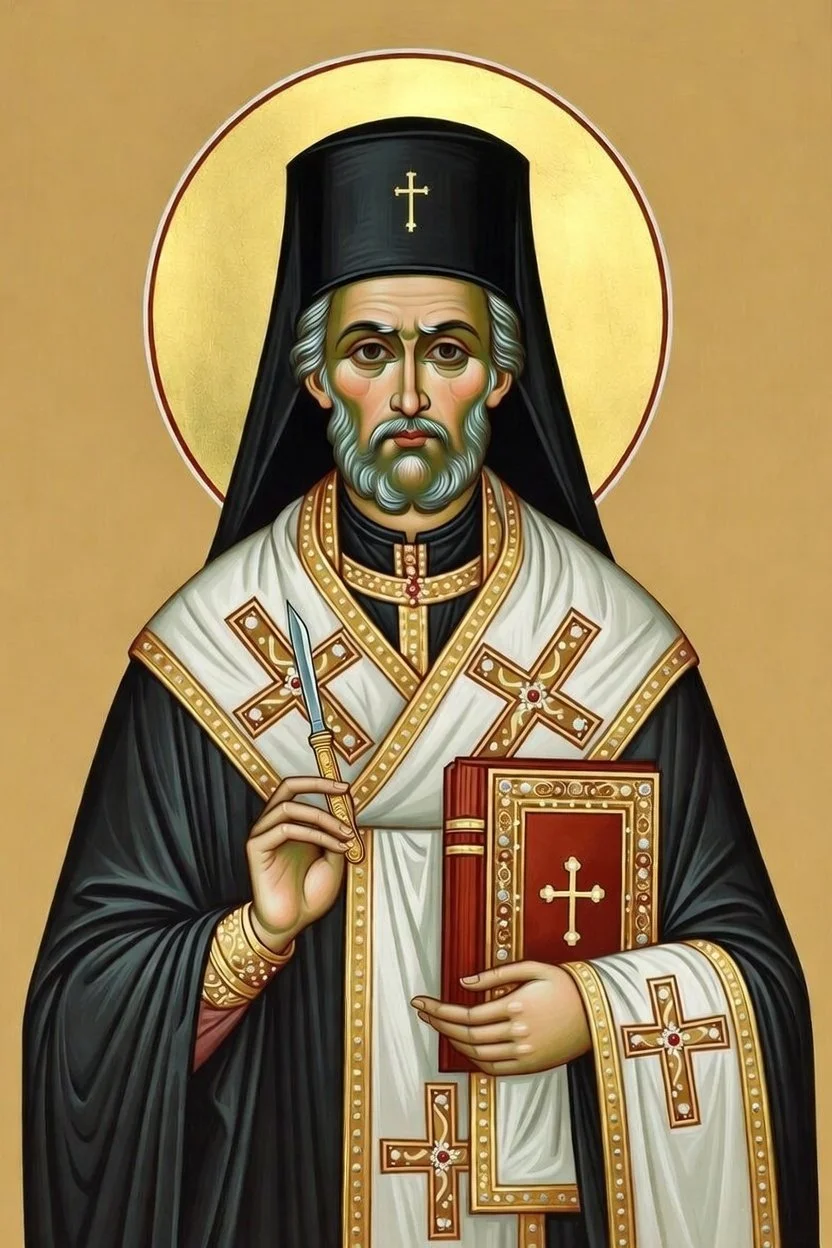
Saint Luke is depicted in Orthodox iconography in several distinct forms. In his most common form as a hierarch-bishop, he appears in full episcopal vestments (sakkos, omophorion, mitre) holding the Gospel and blessing with his right hand. He is immediately distinguished from other bishop-saints by his spectacles — a highly unusual iconographic detail that appears because his historical portraits all show him wearing them, and because icon painters preserved this identifying feature when developing his iconographic tradition after his 1996 canonization.
In the surgeon-bishop iconographic tradition that has developed since his glorification, he is depicted in full episcopal vestments while holding surgical instruments — typically a scalpel, sometimes with a patient at his feet. This unprecedented combination (omophorion plus scalpel) directly expresses the unity of vocation he insisted on throughout his life. A third tradition shows him in the austerity of the confessor-martyr mode, emphasizing the cross he refused to remove.
His icon belongs in the hospital room, the medical practice, the surgery waiting area, and the home prayer corner — wherever people face the fear of illness and the uncertainty of treatment. Orthodox surgeons who are believers often keep a small icon of him in their operating suite, continuing the tradition he began when he first placed an icon of the Theotokos above his own surgical table in Tashkent in 1921.
Traditional Prayers to Saint Luke the Surgeon
The following prayers are in standard use within the Russian Orthodox Church and the Russian Orthodox Church Outside Russia (ROCOR). They are appropriate for personal devotion before surgery, during illness, for chronic conditions, and for intercession on behalf of the sick. Original Church Slavonic is given where the source text is available.
Special Prayer Before Surgery or Medical Procedure
You who spent your life in the healing of bodies and the salvation of souls — who placed an icon above your surgical table and prayed before every incision — who wore your bishop’s cross into the operating room and refused to remove it even in Soviet prisons — hear me now as I come before God through your intercession.
I am afraid. I do not hide this from you, who knew fear in the darkness of Soviet interrogation rooms and offered it to God rather than surrendering to it. You understood what it means to hold a life in your hands, and what it means to commit that life to the One who made it. Now I ask you to stand with me before the throne of the Merciful God and to intercede for my healing.
Pray that the hands of those who will operate upon me may be guided by wisdom and steadied by grace, as your own hands were steadied by forty years of prayer. Pray that the instruments they use may become instruments of healing. Pray that my body — which bears the image and likeness of God, as you knew every body you ever cut — may be restored to health and wholeness. And pray that whatever the outcome, I may accept it in faith, as you accepted every suffering in the confidence that nothing comes to us outside the providence of the One who loves us.
Holy Hierarch Luke, wise physician of souls and bodies, unceasingly pray to Christ our God for us.
Amen.
You spent a lifetime healing bodies in Siberian exile camps with improvised instruments, in wartime hospitals overwhelmed with wounded, in rural clinics where you were the only physician for a hundred miles. You never turned away a patient. You never abandoned a case that others had given up on. Bring before the Great Physician, Christ our Lord, the name and the need of [Name], who is suffering and afraid.
Ask the Lord to grant healing if it be His holy will. Ask that the suffering of [Name] may be sanctified and not wasted. Ask that in illness as in health, [Name] may know the presence of the God who loves them, and come at last to the eternal life that you now enjoy in the company of Christ whom you served.
Holy Luke, the boast and the strength of the Crimean land, pray to Christ our God for us. Amen.
Troparion and Kontakion with Original Slavonic Texts
The Akathist to Saint Luke and How to Pray It
An Akathist hymn to Saint Luke was composed and approved by the Synod of the Russian Orthodox Church Outside Russia (ROCOR) in 2017. The Akathist follows the standard 24-stanza Byzantine hymnic form, alternating Kontakions and Ikoses, with each Ikos ending in a series of salutations (“Rejoice, O Luke, consort of angels”; “Rejoice, healer of bodily ailments”; “Rejoice, pillar of Orthodoxy”; “Rejoice, wise physician”; “Rejoice, confessor of Christ”; “Rejoice, intercessor for those in sickness”).
The Akathist is used at his feast day services (June 11), at Molebens for the sick in Russian Orthodox parishes, and for personal devotional reading — particularly before surgery or during serious illness. It takes approximately 20–30 minutes to pray in full.
The full Church Slavonic text is available at Azbyka.ru (the major Russian Orthodox digital prayer library). An English translation published by ROCOR is available through Saint Tikhon’s Seminary Press and Orthodox bookstores. For those who want a shorter invocation before a medical appointment, the first Kontakion and first Ikos of the Akathist are traditionally used as a brief complete service of intercession.
Carry Saint Luke Into the Hospital With You
Our handcrafted Saint Luke the Surgeon prayer card is prayed over individually before it ships — the Jesus Prayer said over each one, the way this kind of thing ought to be made. Keep it in your hospital gown pocket. Tape it above your hospital bed. Give it to a surgeon you trust and ask them to carry it into the room. This is the card people carry when they are afraid, and the 16-minute average time on this page tells us exactly who those people are.
View Saint Luke Prayer Card →Saint Luke as Patron of Surgeons and Medical Professionals
Within the Eastern Orthodox tradition, Saint Luke occupies the position of patron saint of surgeons, physicians, and medical personnel with a unique credibility: he is not a healer revered primarily for miraculous deeds performed with no natural explanation, but a man whose medical achievements are documented in the secular scientific literature. His patronage carries the authority of someone who actually did what medical professionals are asked to do — diagnose, operate, manage uncertainty, accept loss, try again — and who did it for fifty years across conditions of extraordinary difficulty while maintaining the conviction that the work mattered because the patients mattered, and the patients mattered because they were made in the image of God.
His model for Orthodox medical professionals is not the model of the miraculous healer who transcends medicine but the model of the excellent practitioner who sanctifies it — who brings to the technical demands of his discipline the full weight of his spiritual formation, and who understands the operating room as a place of prayer as much as a place of surgery. He told his students that God’s grace worked through human hands. He did not mean that faith replaced skill; he meant that skill, offered to God, became more than skill alone.
For patients, he is the intercessor who understood from both sides of the surgical drape the fear before an operation, the uncertainty of a diagnosis, the vulnerability of a person who has committed their body to the hands of someone else. His compassion was not theoretical. It was the compassion of a man who had been that vulnerable himself — imprisoned, tortured, exiled, stripped of everything — and who had found in that vulnerability the same God he met in his patients.
Feast Days and Liturgical Commemoration
June 11 — Primary Feast Day. The anniversary of his repose in 1961. Observed throughout the Russian Orthodox Church and ROCOR, and in many OCA and other Orthodox parishes. In Simferopol, June 11 is a major pilgrimage event drawing faithful from across Crimea, Russia, and the diaspora. Major parishes celebrate a Festal Divine Liturgy, a Moleben for the sick, and often a procession with his icon.
January 25 — Synaxis of the New Martyrs and Confessors of Russia. Saint Luke is commemorated collectively with all who suffered for the faith under the Soviet regime. This feast was established to honor the thousands of clergy, monastics, and laypeople imprisoned, tortured, or killed under Communism.
December 15 — Local Feast, Diocese of Simferopol and Crimea. Observed in the Crimean diocese and in parishes with a special connection to Saint Luke.
Second Sunday after Pentecost — Synaxis of All Crimean Saints. Saint Luke is included in the collective commemoration of all Crimean saints.
His Akathist and prayers are in regular use throughout the year in Russian Orthodox, ROCOR, and OCA parishes, particularly at Molebens for the sick. Many Orthodox hospitals observe his primary feast with special liturgical celebrations. He is commemorated by name in many parish hospital ministries worldwide.
Frequently Asked Questions About Saint Luke the Surgeon
The Cassock That Remained Until Death
He was a surgeon who prayed before he cut. A bishop who wore vestments in the operating room. A prisoner who refused to take off his cross. A Stalin Prize laureate who gave the money to orphans. A man who went totally blind and still celebrated the Divine Liturgy from memory every single day until June 11, 1961. When they opened his tomb in 1996, 35 years after he died, they found incorruption and a fragrance that filled the room. The cassock was still with him. It remained with him until death — and then beyond it.
View Saint Luke Prayer Card →Browse All Eastern Prayer Cards →