Orthodox Saints for Mental Health: Who to Pray To, What They Suffered, and the Prayers That Heal
Eastern Orthodox Saints • Mental Health • Anxiety • Depression • Healing
Orthodox Saints for Mental Health: Who to Pray To, What They Suffered, and the Prayers That Heal
Four Eastern Orthodox saints — from Greek, Russian, and Athonite traditions — whose lives passed through the darkest forms of interior suffering, and to whom the Orthodox Church has turned for healing for centuries. Their stories, their prayers, and how to carry them with you.
The Eastern Orthodox tradition has a phrase for a particular kind of spiritual darkness that has no obvious cause, no resolution in sight, and no words that fit it: the abandonment of grace. It is what the Desert Fathers called acedia — the noonday demon. It is what modern clinicians call depression. And the Orthodox saints who are most closely associated with mental health are not saints who avoided this experience. They are saints who went all the way into it, wrote about it with devastating honesty, were transformed inside it, and left a trail that others could follow.
Saint Silouan the Athonite spent fifteen years in what he described as total spiritual darkness before receiving the words — from Christ himself, in a vision — that would become the most quoted Orthodox teaching on surviving depression. Saint Porphyrios of Kavsokalyvia was often physically ill throughout his decades of ministry, yet counseled thousands in psychological distress with a gentleness and precision that astonished those who met him. Saint Tikhon of Zadonsk suffered from what we would today recognize as clinical depression and wrote about it more honestly than almost any bishop in history. Saint Gerasimos of Cephalonia established a tradition of healing at his monastery that has drawn families with mentally ill loved ones from across Greece for five hundred years.
These four saints are drawn from the Greek Orthodox and Russian Orthodox traditions. Their prayer cards are available from The Eastern Church — handcrafted, hand-finished, and prayed over throughout their creation in Austin, Texas. This article covers who they are, why the Orthodox Church has specifically invoked them for mental health, what miracles are on record, and what prayers the tradition offers.
The Orthodox Approach to Mental Suffering — Why It Is Different
Eastern Orthodoxy has a theology of the interior life that is more granular, more diagnostic, and in many ways more psychologically sophisticated than what most Western Christians inherit. The Desert Fathers — the 3rd and 4th-century monastics of Egypt and Palestine who formed the root tradition from which Eastern Christian spirituality grows — developed an entire taxonomy of spiritual and psychological states: logismoi, the invasive thoughts that destabilize the soul; acedia, the spiritual listlessness that is the closest ancient word for depression; apatheia, the hard-won inner stillness that is not coldness but freedom from compulsion. The Orthodox tradition never separated the health of the soul from the health of the mind. They were always understood to be the same thing approached from different directions.
This means that when an Orthodox Christian turns to a saint for mental health, they are not engaging in a category error — as though prayer were a supplement to real medicine. They are engaging with a tradition that has been thinking carefully about interior suffering, its causes, its mechanics, and its remedies, for seventeen hundred years. The saints in this article are not just holy people who happened to suffer. They are physicians of the soul in the technical Orthodox sense: people whose experience of interior suffering, and whose healing, generated knowledge that the Church preserved and transmitted as part of its medical tradition.
The saints in this article come from two major branches of Eastern Orthodoxy: Greek Orthodox (Saints Porphyrios, Gerasimos, and Silouan — the latter is Russian-born but formed in the Greek Athonite tradition) and Russian Orthodox (Saint Tikhon of Zadonsk). All are recognized by the wider Orthodox communion. For Catholics and other Christians who wish to pray to these saints: the saints of the undivided Church and those canonized in the Eastern tradition are prayed to by Eastern Catholics freely. Western Catholics may also pray to them in a spirit of devotion, as many do.
Saint Silouan the Athonite — "Keep Your Mind in Hell, and Do Not Despair"
Simeon Ivanovich Antonov was born in 1866 in the village of Shovsk in the Tambov region of Russia, the son of a peasant farmer. He was a large, strong young man who worked hard and lived roughly before entering the Russian monastery of Saint Panteleimon on Mount Athos in 1892 at the age of twenty-six. What happened to him there — and what he made of it — is one of the most remarkable accounts of interior suffering and its transformation in the history of Christian spirituality.
Shortly after his arrival on Athos, Silouan experienced an intense period of grace — a vivid sense of God's presence that became his reference point for everything that followed. And then it left. For approximately fifteen years, he described living in a state of total spiritual abandonment: prayer felt empty, God felt absent, his thoughts turned dark and despairing. He described this period as living in hell — not metaphorically, but as an experiential reality of interior torment. He did not leave. He stayed, prayed as he was able, and waited.
At some point during this darkness — the accounts differ on the exact circumstances — he received a vision, or an interior word, that he understood as coming from Christ: "Keep your mind in hell, and do not despair." This sentence became the foundation of his entire spiritual teaching, and through the biography written by his disciple Archimandrite Sophrony (Sakharov), it became one of the most widely cited Orthodox teachings on depression and spiritual desolation in the 20th century. The teaching does not offer escape from the darkness. It teaches how to inhabit it without being destroyed by it: to know that you are in hell, to face it without flinching, and to hold the will oriented toward God in the midst of it — not despairing, even when despair is the only feeling available.
Silouan lived on Athos until his death in 1938. He was canonized by the Ecumenical Patriarchate in 1988. His teachings on mental suffering, on weeping for all humanity, on the love of enemies as a spiritual discipline that expands the self outward rather than collapsing it inward — these have found their way into Orthodox spiritual direction, into psychiatric chaplaincy, and into the practices of people who have never heard of Mount Athos but who have been handed his words at the right moment.
"Keep your mind in hell, and do not despair. The soul that has tasted the grace of the Holy Spirit knows what it means to lose it. But the soul must not despair. It must hold on. God has not abandoned you. He is simply letting you discover what you are made of — and what you are made of is capable of bearing this, and more."
Silouan's canonization process included the examination of miracles attributed to his intercession after his death. The most widely documented involve healing — physical and spiritual — reported by those who prayed through his intercession and through contact with his relics preserved at the Saint Panteleimon Monastery on Athos. His disciple Sophrony's biography, first published in English in 1952, brought his teachings to a global audience and itself became an instrument of healing for many readers who recognized their own interior experience in Silouan's account.
The deeper miracle of Silouan's life, in the Orthodox understanding, is the transformation itself: that fifteen years of what felt like spiritual death produced a man whose love for all humanity — including those who had never heard of him and would never know his name — was so complete that Sophrony described it as the fullest expression of Christian love he had ever encountered in a living person. The darkness did not break him. It made him.
O Saint Silouan, monk of the Holy Mountain and physician of the darkened soul — you who spent fifteen years in the hell of spiritual abandonment and came out the other side bearing a love for all humanity that could only have been forged in that darkness — intercede for me now in my own interior night.
I know what you meant when you described the abandonment of grace. I know the feeling of praying into silence, of reaching for God and finding nothing, of wondering whether the light will ever return. You taught us not to despair — that keeping the mind in hell without despairing is not defeat but faithfulness. Help me practice that faithfulness now.
Pray that God, who did not abandon you even when every feeling said He had, would make His presence known to me in the manner He chooses and in His time. And pray that I will hold on until He does.
Amen.
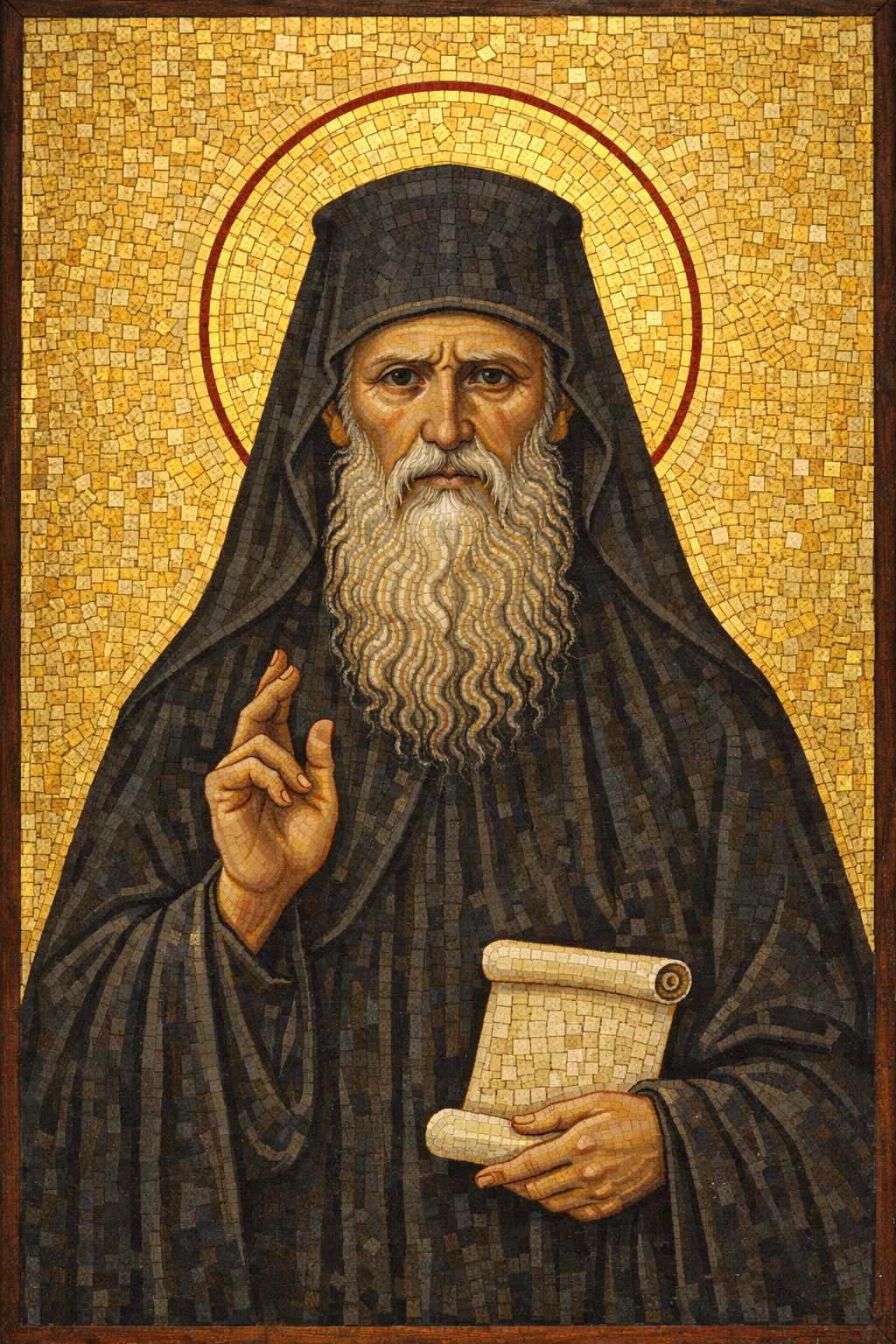
Keep Silouan's card in your wallet or your coat pocket — somewhere it travels with you into the worst moments of the day. When the depression rises before you can think your way out of it, hold the card. Look at his face. Remember that someone walked through fifteen years of what you may be experiencing now and came out bearing a love so vast it astonished everyone who met him. He knows the way through. He is praying with you.
$3.00 — Hand-finished and prayed over in Austin, Texas Get This Prayer Card →Saint Porphyrios of Kavsokalyvia — The Gentle Physician of Anxious Souls
Evangelos Bairaktaris was born in 1906 in the village of Agios Ioannis Karystia on the Greek island of Evia, the son of a poor family. At eleven years old, inspired by reading the life of Saint John the Hut-Burner, he decided he wanted to become a monk. At twelve he ran away and boarded a ship to Mount Athos, the peninsula in northern Greece that has been the center of Eastern Orthodox monasticism for over a thousand years. He was turned away — too young — but made his way back a year later and was accepted as a novice at the Skete of Kavsokalyvia. He took the name Porphyrios and remained on the Holy Mountain for years, receiving spiritual formation under two elderly monks who poured their tradition into him with unusual depth.
He left Athos due to illness — his health was fragile throughout his entire life — and eventually settled in Athens, where for decades he served as a spiritual father to an enormous number of people: priests, monastics, laypeople, physicians, psychiatrists, and those whom the psychiatrists had not been able to help. He became known throughout Greece for his gifts of spiritual discernment and healing, and specifically for his ability to address psychological and spiritual distress with a combination of profound theological understanding and genuine compassion.
What distinguishes Porphyrios in the canon of saints for mental health is the way he thought about anxiety and depression theologically. He consistently taught that approaching God through fear — through a spirituality of terror, guilt, and relentless self-examination — produced illness of the soul. The antidote, in his teaching, was not less effort but a different direction: toward love, toward beauty, toward joy. "Don't fight against darkness," he said. "Light a candle." He did not dismiss the reality of darkness or suffering. He redirected the spiritual energy that anxiety consumes into something that could produce healing. People who came to him unable to pray, unable to feel God's presence, unable to find peace, often left having experienced exactly those things. He was canonized by the Ecumenical Patriarchate in 2013, only twenty-two years after his death — a remarkably short time, reflecting the depth of his ongoing impact.
The accounts of healing associated with Porphyrios during his lifetime are extensive and were gathered through an informal but comprehensive process: the testimonies of those who came to him and experienced relief from physical illness, psychiatric conditions, addiction, and spiritual crisis. Many of those who testified were medical doctors who brought their patients to him when conventional treatment had reached its limits, and who documented what they observed.
The formal canonization miracle examined by the Ecumenical Patriarchate after his death met the standard required by the Orthodox Church for glorification: a healing that could not be explained by natural causes, occurring after prayer invoking his intercession. His relics are kept at the Holy Monastery of the Transfiguration of Christ in Milesi, Attica, which he himself founded and to which pilgrims continue to travel seeking healing.
O Saint Porphyrios, gentle father of anxious souls — you who received the sick and the frightened and the spiritually exhausted and sent them away carrying something they had not brought with them — intercede for me in my anxiety and my restlessness.
You taught that the cure for darkness is not fighting the darkness but turning toward the light. Help me turn. When my thoughts spiral and my chest tightens and the anxiety builds before I can stop it — remind me to turn. Not to white-knuckle my way through but to open toward Christ, however briefly, however imperfectly.
You were ill for most of your long life, and you lived in a nearness to God that illness could not touch. Pray that I would find that same interior ground — a place in me that anxiety cannot reach because Christ is already there. Pray for me, Saint Porphyrios.
Amen.

Porphyrios's card belongs on your car's dashboard or in the pocket of your daily bag — somewhere you will see it before the anxiety of the day gets ahead of you. His face is a reminder of his teaching: light a candle instead of cursing the dark. You do not have to fight the anxiety down. You can turn toward something instead. He is a gentle guide for that turning, and he is still making himself available to those who call on him.
$3.00 — Hand-finished and prayed over Get This Prayer Card →Saint Tikhon of Zadonsk — The Saint Who Wrote About Depression More Honestly Than Any Bishop in History
Timofei Savich Sokolov was born in 1724 in the village of Korotsk in the Novgorod region of Russia, the son of a village clerk who died when Tikhon was a child. His early life was shaped by poverty so severe that his mother nearly gave him away as a serf to survive. He made his way through seminary on talent and determination, eventually rising to become the Bishop of Voronezh — a position he held for less than five years before resigning due to what he described as ill health and what the record makes clear was a combination of physical frailty and severe psychological suffering.
He retired to the Zadonsk Monastery in 1769 at the age of forty-five and spent the remaining fourteen years of his life there, writing, praying, receiving visitors, and struggling — with remarkable honesty in his journals and letters — with what we would today recognize as clinical depression. He describes periods of what he calls "spiritual darkness" in which prayer felt impossible, hope felt inaccessible, and the desire to live diminished to nearly nothing. He does not dress this up. He writes about it with the same precision and candor that he brings to everything else.
What makes Tikhon essential for this list is not just that he suffered, but that he wrote about suffering — in his major work On True Christianity and in his personal correspondence — in a way that became a theological and pastoral resource for those who came after him. He developed an understanding of the spiritual roots of despair, of the difference between ordinary sadness and the deeper collapse of spiritual vitality, and of what the tradition of prayer and sacrament offers those who find themselves in that collapse. He was known during his lifetime for his ministry to those experiencing despair and was sought out for counsel by people who had tried everything else. Dostoevsky, who read him extensively, drew on his portrait for the character of Father Zosima in The Brothers Karamazov — one of literature's most beloved accounts of holy compassion.
"The soul that has fallen from God is like a ship that has lost its anchor. Every wave threatens to dash it on the rocks. But God has not withdrawn the anchor — it is still there, available, waiting to be thrown again. The prayer of the despairing soul is not wasted. God receives it even when the soul does not feel that it is received."
Saint Tikhon was glorified — formally canonized — by the Russian Orthodox Church in 1861, nearly eighty years after his death, following the documentation of healings at his relics and of miracles attributed to his intercession. The most widely recorded healings involved those suffering from psychological and spiritual distress, which was consistent with his known ministry during his lifetime. His relics are kept at the Zadonsk Monastery, which became a pilgrimage destination almost immediately after his death.
His literary and theological influence constitutes its own kind of miracle: his writings on the interior life, on the healing of spiritual wounds, and on the theology of return after failure reached not only the monks and clergy who read him in his own century, but eventually — through Dostoevsky's fiction and through the 20th-century rediscovery of Russian spiritual writing — an international audience that included people who had no connection to the Russian Orthodox Church but who found in his words a precise description of their own experience.
O Saint Tikhon, bishop of the broken and spiritual father of the despairing — you who resigned your episcopal throne not from weakness but from self-knowledge, and who spent your retirement writing honestly about the darkness you yourself lived through — I come to you carrying what you described so clearly: the weight of depression, the silence where prayer used to be, the dimness where faith used to give light.
You wrote that God receives the prayer of the despairing soul even when the soul does not feel it is received. I am praying on the strength of that conviction now, because I have none of my own. Intercede for me that God's grace would find its way into the places in me that have closed. Pray for the return of what has receded — not all at once, but enough. Enough to take the next step. Enough to pray again tomorrow.
Saint Tikhon, patron of those returning from the far country of despair, pray for me.
Amen.
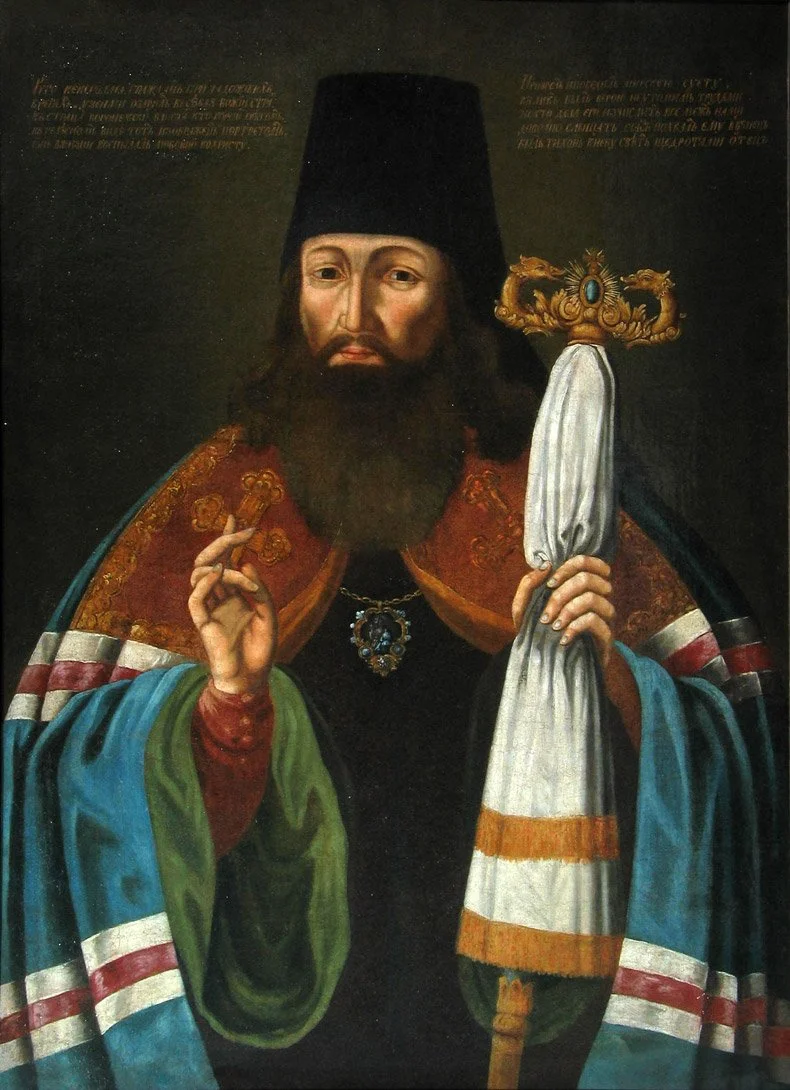
Tikhon's card belongs inside your wallet or tucked into the pages of a journal — somewhere private, for the private interior moments when the depression is most convincing and the path back to God seems too long to walk. He walked it himself, he mapped it honestly, and he has been walking alongside those in despair ever since. His face on a card in your pocket is a reminder that you are not the first person to feel this lost, and that the people who felt this lost before you found their way.
$3.00 — Hand-finished and prayed over in Austin, Texas Get This Prayer Card →Saint Gerasimos of Cephalonia — The Orthodox World's Greatest Miracle-Worker for Mental Illness
Gerasimos Notaras was born around 1506 into a noble family in the Peloponnese, spent years as a pilgrim in the Holy Land and on Mount Athos, and eventually settled on the island of Cephalonia in the Ionian Sea, where he lived as a hermit, founded a monastery, and died in 1579 at approximately seventy-three years of age. He was known during his lifetime for healing the sick and for his particular efficacy in cases involving what his contemporaries described as demonic oppression — what a modern reader, looking at the documented cases, would recognize as severe mental illness, psychosis, and other conditions that resisted every other form of treatment available in 16th-century Greece.
After his death, the healings did not stop. They intensified. The monastery he founded — the Monastery of the New Jerusalem on Cephalonia, today known as the Monastery of Saint Gerasimos — became the destination for Greek families across generations who brought loved ones suffering from mental illness that doctors could not treat. The tradition is specific and well-documented: on his feast days, particularly August 16 and October 20, thousands of pilgrims arrive on Cephalonia, many of them families accompanying people with severe psychiatric conditions. The ritual involves the faithful processing through the underground chapel where his relics are kept, sometimes being carried by family members when they cannot walk on their own. Healings are reported, documented, and in many cases attested by physicians.
Gerasimos is the Eastern Orthodox equivalent of Saint Dymphna in the West: the saint whose specific, centuries-long association with mental illness is not a modern interpretation or a loose metaphorical connection, but a direct, historically documented, institutionally sustained tradition of healing. The difference is that where Dymphna's tradition coalesced around the pastoral care model of Gheel, Gerasimos's tradition coalesced around direct miraculous intervention — the relic, the pilgrimage, the healing that cannot be explained. Both are real. Both continue.
The miracle documentation for Saint Gerasimos is among the most extensive for any Orthodox saint. The monastery archives preserve testimonies of healing going back to the 16th century, and the practice has continued without interruption to the present day. Greek physicians have published case studies and accounts of healings at Cephalonia that they describe as medically inexplicable. Greek psychiatrists have at various times tried to analyze the phenomenon clinically — and the honest among them have acknowledged that some of what they observed fell outside their ability to explain.
The most commonly reported category of miracle at Cephalonia involves severe psychiatric conditions — psychosis, violent behavior, profound depression, and states described in the tradition as demonic oppression — in which the pilgrimage and prayer at the relics was followed by improvement or resolution that had not occurred despite years of medical treatment. These are not all cases of spontaneous remission coincidentally occurring at a pilgrimage site. They are concentrated, recurrent, and long-documented enough to constitute a specific evidential tradition that the Orthodox Church has formally recognized.
O Saint Gerasimos of Cephalonia, great wonderworker and physician of the broken mind — you whose relics have healed the mentally ill for five centuries, to whose monastery generations of Greek families have carried their loved ones when hope had run out — receive my prayer now as you have received theirs.
I am bringing to you what those pilgrims brought to Cephalonia: a mind that will not rest, a will that cannot find its footing, a spirit that has been carrying more darkness than it knows how to hold. I cannot make the pilgrimage to your island. But I carry your image, and I believe that you hear me from wherever I am.
Intercede before God for healing in my mind and peace in my thoughts. Pray especially for those I love who are suffering in ways I cannot reach. You have been healing the unreachable for five hundred years. Pray for us, Saint Gerasimos.
Amen.
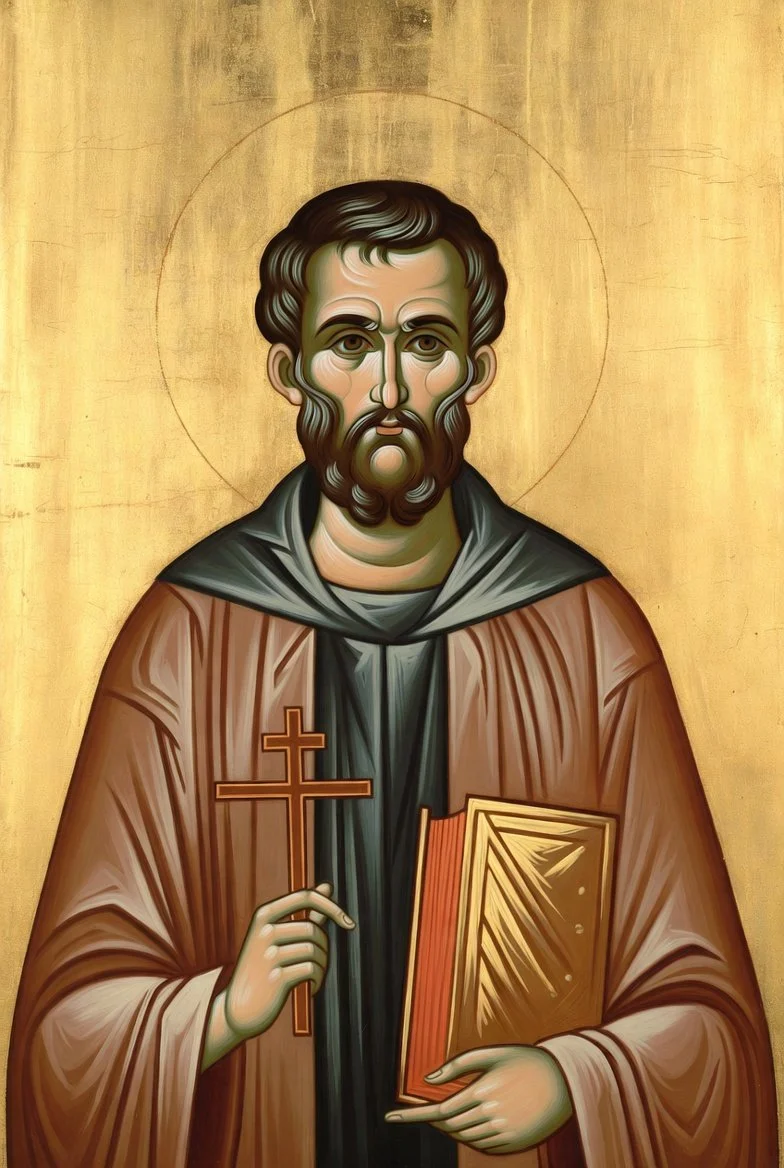
For families who cannot make the pilgrimage to Cephalonia — who carry a loved one's illness in their own bodies along with their own — keep Gerasimos's card somewhere you will find it when the crisis hits. On the dashboard for the drive to the hospital. In your purse during the appointment. In your pocket during the long wait for the medication to work. He has been receiving the prayers of exhausted families for five centuries. He knows how to hear them.
$3.00 — Hand-finished and prayed over Get This Prayer Card →Icons and Prayer Cards in Orthodox Devotion — The Theology of Carrying a Saint
In Orthodox theology, the icon is not a picture of a saint. It is a window — a point of contact between the material world and the spiritual reality it participates in. The Seventh Ecumenical Council (787 AD) defined the theology of sacred images precisely to address this: the honor given to the image passes to its prototype. When you look at an icon of Silouan or Gerasimos, you are not looking at paint and wood. You are looking through a window toward the living person depicted, who exists in the presence of God and is aware of your gaze.
This theology is not diminished by the format of a prayer card. A card bearing a saint's image carries the same theological logic as an icon mounted on an iconostasis — the scale changes, the portability changes, but the spiritual reality the image participates in does not. The tradition of portable icons is ancient: soldiers carried them to war, travelers tucked them under their robes, families kept them in pockets and pouches. The prayer card is the contemporary form of that tradition.
Why This Matters Specifically for Mental Health
Mental health crises rarely arrive at scheduled times. They spike in traffic, at 3 a.m., in the middle of a workday, in a restaurant when the panic starts and there is nowhere to go. The great strength of a prayer card over an icon on a wall at home is precisely this: it is where you are, when you need it. The Orthodox saints in this article are interceding for those who call on them regardless of where that call originates. But having their image physically with you — in your wallet, on your dashboard, tucked into the pocket of your coat — is a way of keeping the connection active, of reminding yourself in the worst moments that you are not praying alone, that someone has been where you are, and that their prayers are already on your behalf before you have found the words for yours.
Every prayer card from The Eastern Church is printed, cut, and finished by hand in Austin, Texas. Each card is prayed over throughout the entire creation process — not as a marketing claim but as a description of the practice. The cards are made one at a time, with intention, by someone who understands what the saints on them mean. All four saints in this article — Silouan, Porphyrios, Tikhon, and Gerasimos — have prayer cards available. Each is $3.00. Parish bulk orders are available at a discount for Orthodox parishes and mental health ministries who wish to distribute them.
Explore All Saints for Mental Health
The Eastern Church carries handcrafted prayer cards for saints from across the Orthodox and Catholic traditions specifically invoked for mental health, anxiety, depression, trauma, and spiritual suffering. Find the saint whose story matches your need — and carry them with you.
Browse All Mental Health Prayer Cards →Questions About Orthodox Saints and Mental Health
The Orthodox Tradition Has Always Known That the Soul Can Suffer — and That Help Is Near
Silouan survived fifteen years of what felt like total abandonment and came out bearing a love for all humanity that astonished everyone who met him. Porphyrios spent decades in a fragile body and counseled thousands toward the light he himself lived inside. Tikhon resigned a bishopric because he knew his own darkness, and turned that self-knowledge into theology that still heals people two and a half centuries later. Gerasimos built a monastery on an island and has been receiving the most broken people in Greece ever since, including people whose doctors had run out of ideas.
They are not waiting for you to have everything together before you come. They are interceding for you right now, alongside your prayer or in the absence of it. Carry one of them with you. In your pocket, your wallet, the console of your car. You do not need the right words when you reach for the card. You just need to reach.
Browse All Mental Health Prayer Cards →