Saint John Climacus: Complete Biography, The Ladder of Divine Ascent, and All 30 Steps Explained
Complete Biography & Spiritual Guide
Saint John Climacus: The Complete Life, The Ladder of Divine Ascent, and 30 Steps That Have Been Transforming Souls for 1,400 Years
Monk, abbot, mystic, and the author of the most widely read spiritual guide in Eastern Christianity — everything you need to know about the saint whose book the entire Eastern Church reads during Lent, and why his 30 rungs of spiritual ascent remain the most practical map to holiness ever written
There is a book that has sat beside the Bible and the Psalter on the desk of every serious Eastern Christian monk for fourteen hundred years. It has been copied by hand in more monastic scriptoria than almost any other Christian text. It was the first book printed by the Russian Orthodox Church when the printing press came to Moscow. It is read aloud in the refectories of Eastern monasteries during the entire season of Great Lent. And it was written by a man about whom we know almost nothing biographical — a monk so committed to hiddenness that he spent forty years in a cave in the Sinai Desert before reluctantly allowing himself to be made abbot, and then spent the last years of his life writing at the request of a fellow abbot who simply asked: tell us what you have learned.
His name was John. He lived at Mount Sinai, the mountain where Moses received the Law, and he is known to history by three names: John of the Ladder, from the Greek title of his masterwork; John of Sinai, from the mountain where he spent his entire adult life; and John Climacus, from the Greek word klimax (ladder), which gives the book its name and John his most enduring title. His feast day in the Eastern Church falls on March 30, and the Byzantine rite also commemorates him on the Fourth Sunday of Great Lent — the Sunday precisely midway through the forty-day fast — as a reminder to the faithful that the spiritual ascent they are undertaking during Lent is the same ascent mapped by John’s thirty steps. You are halfway up the Ladder. Keep climbing.
This article is the most complete treatment of John Climacus available in English for a general audience. It covers his life in full historical and geographic context, the content of every one of the Ladder’s thirty rungs, his place in the hesychast and Jesus Prayer traditions, the famous icon of the Ladder and its terrifying theological imagery, how to read the Ladder if you have never opened it, and what John’s teaching means for an ordinary Christian living in the modern world who is not, and will never be, a desert monk. Because John himself anticipated you. He wrote the Ladder for monks, but he wrote Step 25 — on humility — for every human being who has ever tried to be good and discovered how hard it is. He wrote it for you.
From Sinai Pilgrim to Desert Monk to Abbot: The Life of Saint John Climacus
John Climacus was born around 525 AD, probably in Palestine or possibly in Syria, and the precise circumstances of his early life are largely unknown — a fact that would have pleased him enormously. What we know comes primarily from a brief life written by a monk named Daniel of Raithu, who also requested the Ladder in the first place, and from the Ladder itself, in which John occasionally reveals biographical details as illustrations of spiritual points. He describes his own struggles, his failures, his observations of other monks’ spiritual battles and spiritual triumphs, and his experience of prayer. From these fragments, a portrait emerges of a man of extraordinary intellectual gifts, deep psychological insight, genuine compassion for struggling souls, and an almost complete indifference to his own reputation.
At the age of sixteen, John arrived at Mount Sinai as a pilgrim. Whether he came from a family of some learning (the depth and breadth of his reading suggests a solid education), whether he had experienced some prior spiritual crisis or transformation that drew him to the desert, whether he came with the intention of becoming a monk or simply arrived and found he could not leave — none of this is recorded. What we know is that he stayed. He became the disciple of an elder named Abba Martyrius, one of the practicing monks of the Sinai community, and spent approximately nineteen years under his direction before Martyrius died. The relationship between John and Martyrius was the formative one of his life: it established in him the total surrender of personal will to a spiritual guide that he would later describe in the Ladder as the essential foundation of monastic life, and the model of the elder-disciple relationship that shaped every aspect of his spiritual teaching.
Born: c. 525 AD, probably Palestine or Syria
Died: c. 606 AD, Mount Sinai (estimated; some sources give 649 AD)
Location: Monastery of Saint Catherine and its dependent hermitages, Mount Sinai (Sinai Peninsula, modern Egypt)
Vocation: Monk, hermit, abbot; not ordained a priest (probably)
Major work: The Ladder of Divine Ascent (Klimax tou Paradeisou), written c. 600 AD
Also wrote: To the Shepherd (a companion piece for abbots)
Feast day: March 30 (Eastern and Western calendars); Fourth Sunday of Great Lent (Byzantine rite)
Title: Saint, Venerable (in Eastern tradition: Hosios), Doctor of the Spiritual Life
Invoked for: Monks and all seeking spiritual progress; against pride, despondency, and temptation; for purity of heart and progress in prayer
Why “Climacus”: From the Greek klimax (ladder), the title of his masterwork
There is one recorded event from John’s discipleship under Martyrius that stands as a kind of prophetic sign for his entire life. John of Gaza — one of the great spiritual fathers of the 6th-century Palestinian desert tradition — reportedly encountered the young John when he visited Sinai with Martyrius for a liturgical celebration. He is said to have recognized immediately, without being told, that this young man would one day be a great abbot. “Who is this old man who has brought this child to me?” he allegedly asked — meaning not that John was old in years but that he was old in spirit. Whether the story is historically precise or a pious embellishment, it captures something real about what those who knew John must have sensed in him: a spiritual maturity that did not match his years.
Mount Sinai: Living at the Most Sacred Address in Christian Memory
To understand John Climacus, you need to understand the world in which he lived — because Mount Sinai in the 6th century was not a remote or obscure location. It was one of the most significant pilgrimage destinations in the entire Christian world: the mountain where Moses encountered the burning bush, where he received the Ten Commandments, where he saw the back of God and lived, where Elijah fled in despair and found God not in the earthquake or the fire but in the still small voice. For a Christian monk in the Byzantine world, living on this mountain was not a retreat from the sacred center of things; it was living at its very heart.
The monastic community at Sinai had been developing since the 4th century, when Christian hermits first began settling in the valleys around Jebel Musa (the Mountain of Moses). By the time John arrived in the mid-6th century, it was a well-established and sophisticated community. The great Monastery of Saint Catherine — one of the oldest continuously functioning monasteries in the world, still operating today — was built by Emperor Justinian between approximately 548 and 565 AD, essentially during John’s own lifetime. John would have known it under construction and lived to see it completed. The monastery was built around the site traditionally identified as the burning bush, and it enclosed a church dedicated to the Transfiguration of Christ — the moment when three disciples briefly saw the divine light that Moses had sought on this same mountain.
The desert around the monastery was dotted with hermitages, caves, and small cells where monks lived in various degrees of solitude. Some lived in community in the monastery; others lived in smaller dependent groups called lavras; others lived entirely alone in remote cells, coming together only for the Sunday Eucharist. John moved through all of these forms of monastic life during his years at Sinai. After Martyrius died, he chose the most solitary form: he withdrew to a place called Thola, a hermitage or cave community a considerable distance from the main monastery, where he lived for approximately forty years.
Forty Years in the Thola: The Making of a Spiritual Master
The forty years John spent in solitude at the Thola represent the longest and most formative period of his life — and the least documented. He lived, prayed, fasted, wept, struggled, and advanced. He kept notes. He observed his own interior life with what can only be described as scientific precision: the movements of pride, the tricks of self-deception, the anatomy of anger, the specific ways in which the vice of acedia (the noon-time demon of spiritual torpor and listlessness) attacks the soul, the almost unbearable lightness that sometimes follows intense prayer, the experiences of divine light that the hesychast tradition would later theorize systematically as the uncreated light of God. All of this went into his notebooks, and eventually into the Ladder.
He was not completely solitary during this period. Visitors came. Fellow monks sought his counsel. His reputation as a spiritual father spread slowly through the monastic network of the Sinai peninsula and beyond. The Ladder records his observations of monks at the Penitents’ Quarter near Alexandria, a remarkable institution where monks who had fallen into serious sin voluntarily submitted to an extremely severe regime of public penance and prayer. John visited this community and observed it with the careful eye of a physician observing patients: not judging but studying, understanding the pathology of sin and the genuine possibility of recovery from it. His description of the Penitents’ Quarter in Step 5 of the Ladder is one of the most vivid pieces of 6th-century monastic writing that survives.
He also had a disciple of his own during part of this period: a monk named Moses, whose death from a rockslide John records in the Ladder with a grief that is entirely unguarded and entirely characteristic of him. John cared about people. Despite his extraordinary solitude, despite the intellectual sophistication that distinguishes every page of the Ladder, John Climacus was not a cold system-builder. He was a pastor who happened to write at the highest level of spiritual theology. He mourned his disciple. He prayed for the souls of the monks he had observed struggling in the Penitents’ Quarter. He worried about beginners reading the Ladder without proper guidance. He never confused spiritual insight with spiritual success.
Reluctant Abbot: The Last Years and the Writing of the Ladder
After approximately forty years of solitude at the Thola, John was appointed abbot of the Monastery of Saint Catherine — the head of the entire Sinai monastic community. He accepted this position with the same reluctance that characterizes the best abbots in the Eastern tradition: not with false humility that secretly wants the honor, but with genuine alarm at the weight of the responsibility. The Ladder describes at length what an abbot must be, and reading those pages against the knowledge of who wrote them produces an almost unbearable picture of a man who understood perfectly well how far even the holiest of abbots falls short of the ideal.
It was during this final period, probably around 600 AD, that John Climacus was approached by John of Raithu, the abbot of the monastic community at Raithu on the Red Sea coast (modern Tur in the Sinai Peninsula). John of Raithu had heard of the Sinaite elder’s wisdom and wrote him a letter of remarkable warmth and urgency, asking him to compose a written guide to the spiritual life that could serve both monks and laypeople seeking to advance in holiness. The request included a specific image: he asked John to describe the spiritual life as a ladder reaching from earth to heaven, with the virtues as the rungs by which souls climb toward God. John accepted, and the result was the Ladder of Divine Ascent.
He wrote it as an old man, having spent eighty or more years in the spiritual combat he was describing. He wrote it at the request of someone else, not from any desire for literary fame. He completed it, then stepped down as abbot and returned to his solitude for the last year or so of his life. He died, according to tradition, shortly after completing the Ladder, approximately around 606 AD (some sources give 649 AD, which would make him extraordinarily old). He died as he had lived: quietly, without drama, with his face turned toward the mountain on which Moses had seen the back of God. He was immediately venerated as a saint.
The Ladder of Divine Ascent: What It Is, Why It Was Written, and Why It Has Endured
The Ladder of Divine Ascent (in Greek, Klimax tou Paradeisou — “the Ladder of Paradise”) is a guide to the spiritual life organized around the image of a ladder with thirty rungs reaching from earth to heaven. Each step addresses a specific virtue to be cultivated or vice to be overcome on the way toward union with God. The thirty rungs correspond to the thirty years of Christ’s hidden life before his public ministry — a symbolic connection that John makes explicit in his prologue, situating the entire work within the mystery of the Incarnation: the same Jesus who spent thirty years in hiddenness and growth before his manifestation to the world is the one who waits at the top of the Ladder, and the thirty rungs of the Ladder are the spiritual analogue of those thirty years.
The book is not a systematic theology. It is not a philosophical treatise. It is closer to what we might call a clinical manual written by the most experienced practitioner in the field: a detailed map of the interior landscape of a human soul attempting to move toward God, with precise descriptions of the obstacles and dangers at every stage, the symptoms of spiritual illness and the remedies available, the deceptions that pride plays at every level of spiritual development, and the specific qualities of divine grace as it makes itself felt in prayer. John wrote it from decades of firsthand experience and from his observations of hundreds of monks across the Sinai desert community. Every description in the Ladder rings with the specificity of something actually witnessed or personally endured.
The style is aphoristic, dense, and occasionally startling. John packs entire spiritual treatises into single sentences. He can be tender and can be devastating. He has almost no tolerance for spiritual complacency and an enormous tenderness for spiritual struggle. He addresses the reader directly throughout, sometimes with the urgency of a doctor telling a patient something the patient does not want to hear, and sometimes with the gentleness of the same doctor sitting beside the bed at three in the morning when the crisis is at its worst.
The Icon of the Ladder: Heaven, Hell, and the Monks Falling Off
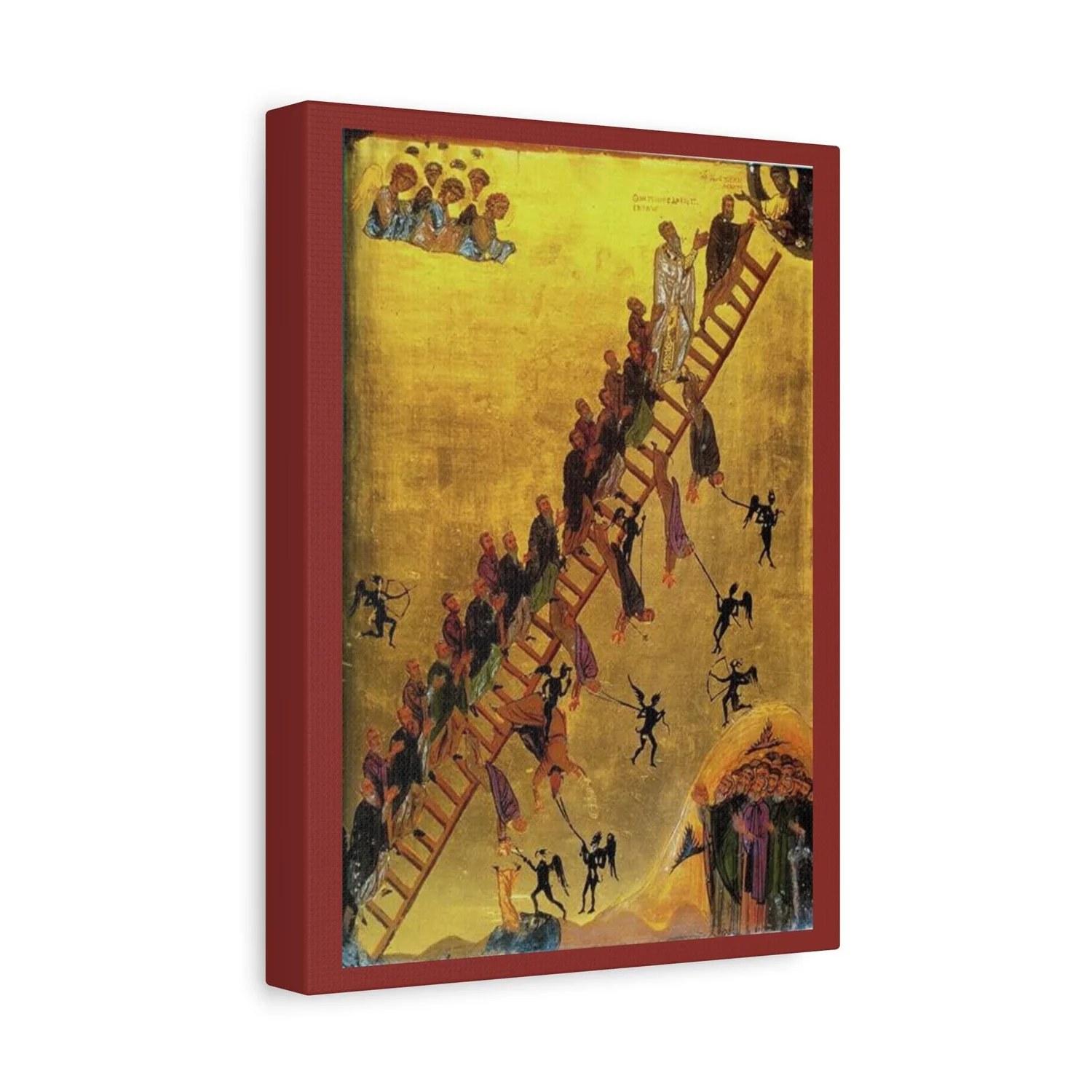
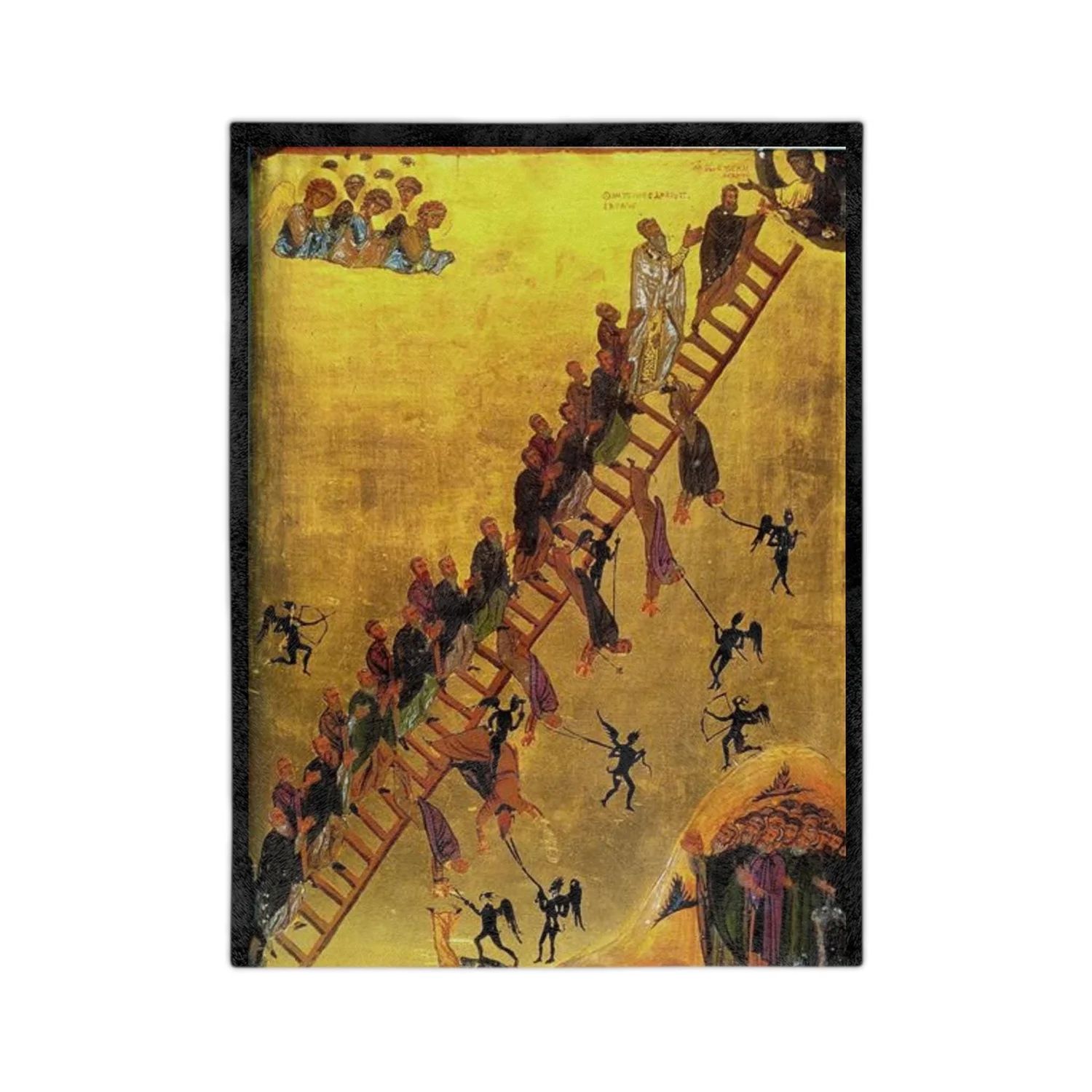
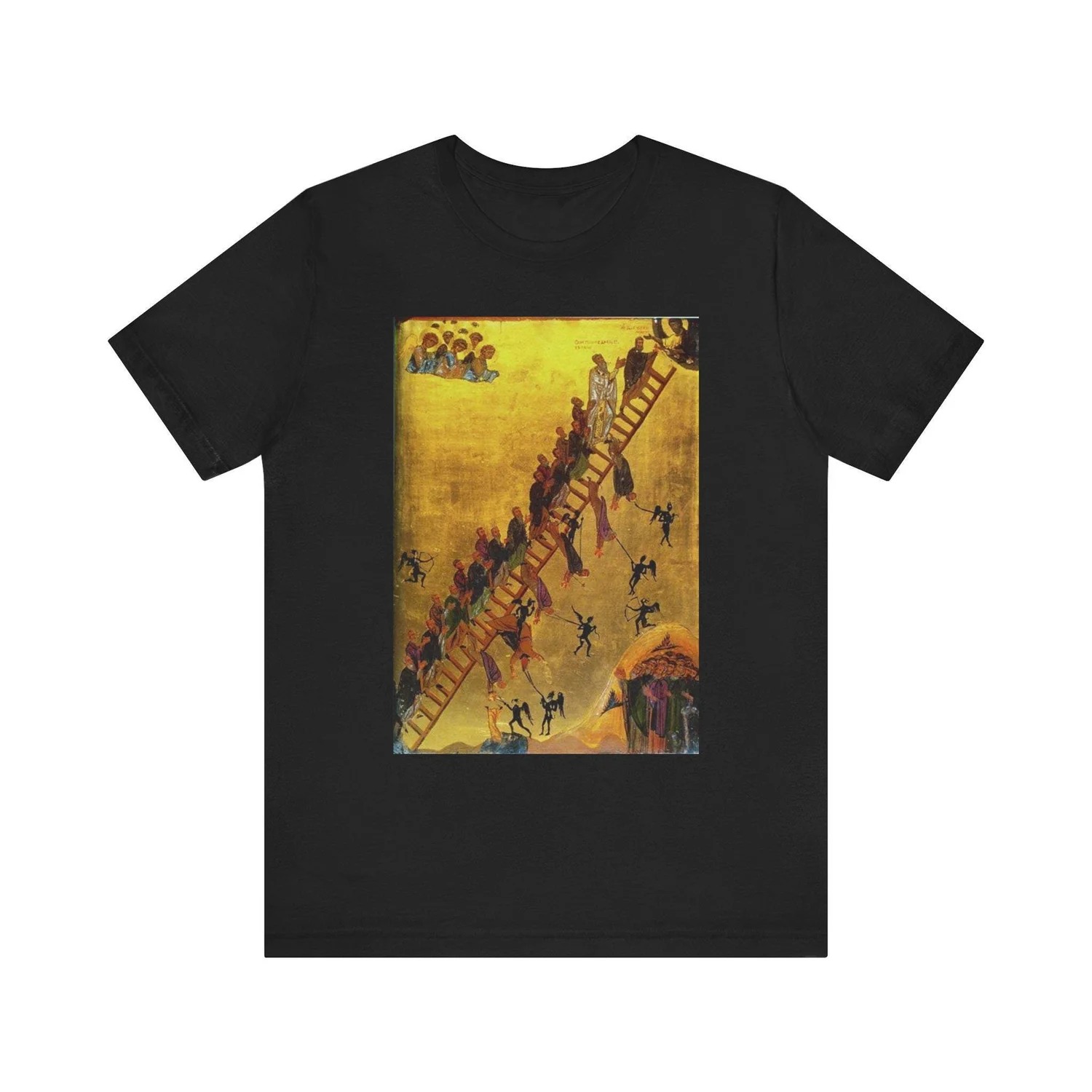
The Ladder of Divine Ascent is one of the few spiritual texts in Christian history that generated its own iconic image so powerful and so perfectly expressive of the text that the image became nearly inseparable from the book. Any Eastern Christian who has spent time in a monastery or a serious Eastern parish has likely encountered it: a long diagonal ladder reaching from the lower left of the image to the upper right, where Christ waits with outstretched arms at the top. On the ladder, monks are climbing. Some are being pulled upward by angels. Others are being dragged off the rungs by demonic figures who grab at their feet, their robes, their necks. Several are already falling, or have fallen, into a dark abyss at the bottom right of the image where mouths are open to receive them.
The most famous version of this icon was painted at Saint Catherine’s Monastery itself in the 12th century (around 1150 AD) and still hangs there. It is a masterpiece of theological art: it illustrates in a single image everything the Ladder teaches about the spiritual life. The ascent toward God is real. Progress is possible. But the ladder is steep, the demons are persistent, and no rung is safe until you have passed it. A monk who has climbed twenty-eight steps can fall from the twenty-ninth. Humility, which occupies Step 25, is required not merely at the beginning but all the way to the top, because it is the constant awareness of one’s own weakness that keeps a climber’s hands from slipping. And Christ at the top is not a distant reward; he is an active participant in the ascent, reaching down toward the climbers.
This icon is traditionally displayed in Eastern monasteries during Great Lent alongside the text of the Ladder itself. It is one of the most reproduced images in Eastern Christian iconography, and its power has not diminished with familiarity. If you look at it long enough, you start to notice that the monks falling from the upper rungs are falling farther than the monks falling from the lower rungs — and that the demons pulling at the higher rungs are working harder than the ones at the bottom. John understood that spiritual advancement makes you not less but more vulnerable to certain forms of attack, and the icon makes this visible with devastating clarity.
All 30 Rungs: A Step-by-Step Guide to the Ladder of Divine Ascent
What follows is the most complete English-language guide to all thirty steps of the Ladder available for a general audience: the title of each rung, what John actually teaches in it, the key insight, and what it means for an ordinary Christian who is not a desert monk. The rungs are color-coded by the three traditional groupings of the spiritual life.
The first four rungs establish the preconditions for any serious spiritual life. Without these, the higher rungs cannot be attempted.
John opens not with a gentle welcome but with a radical demand: the spiritual life begins with leaving behind everything that ties you to the world’s logic of self-sufficiency. For monks, this meant literal departure from family, property, and society. For John, the deeper meaning was interior: renunciation is the decision to stop organizing your life around your own comfort, approval, and security and to begin organizing it around God. He defines a monk in the famous passage: “A monk is a body ever constrained, a mind ever vigil, and a soul ever armed.” The key insight for non-monastics: you cannot seriously pursue holiness while simultaneously pursuing everything else. Renunciation is the acknowledgment that God requires priority, not a place at the table.
John distinguishes between leaving the world externally and genuinely releasing attachment to it interiorly. He is concerned here with the subtle persistence of worldly values inside the person who has physically withdrawn from the world: the monk who has left family but still craves their approval, the solitary who has abandoned wealth but still daydreams about it. True detachment is not the absence of things but the absence of the inordinate desire for things. The key insight: the spiritual life demands an ongoing interior work of release that is deeper and slower than any external change of circumstances.
This step addresses the virtue of voluntary exile — the deliberate choice to live as a stranger and pilgrim in this world rather than at home in it. John commends the practice of living among people who do not know you, where there is no reputation to protect and no history to lean on. The spiritual benefit is the stripping away of identity-props: when no one knows who you were or what you accomplished, you have nothing left but what you actually are before God. The key insight: most of us live too comfortably inside our own constructed identities. True spiritual growth requires some form of voluntary exposure to the unfamiliar.
Perhaps the longest single step in the Ladder, Step 4 is the most extended treatment of the virtue of obedience in the entire Eastern spiritual tradition. John describes obedience to a spiritual father as the death of self-will — not merely compliance with external commands but the surrender of the internal driver of one’s own judgment and preference in matters of spiritual direction. He illustrates this with stories of monks who submitted to irrational-seeming commands from their abbots and were transformed. The key insight: the deepest form of spiritual progress cannot happen while self-will is in command. Some form of voluntary submission to another person who can see what we cannot see in ourselves is indispensable.
The longest section of the Ladder, these nineteen steps cover the specific work of the spiritual life: diagnosing and treating the passions that obstruct union with God.
John’s treatment of repentance begins with his description of the Penitents’ Quarter near Alexandria — the community of monks who had fallen seriously and were submitting to a severe voluntary regime of penance, weeping, and prayer. John describes their condition with extraordinary compassion and without condemnation: he sees them as athletes of compunction rather than as failures. His definition of repentance (metanoia) is not primarily a feeling of guilt but a permanent reorientation of the entire person toward God. The key insight: repentance is not an event (confession and absolution) but a posture of the whole life.
John teaches that the constant, clear, and non-morbid awareness of one’s own mortality is one of the most powerful spiritual tools available. He is not talking about clinical depression or anxious obsession with death; he is talking about a clear-eyed recognition that this life ends and that every choice therefore carries ultimate weight. He observed that monks who kept death vividly before them were consistently freer from vanity, pride, and the petty grievances that waste spiritual energy. The key insight: the memory of death is not a meditation on darkness but a clarification of what matters. It is what gives the present moment its true weight.
One of the most distinctive concepts in the Eastern spiritual tradition, penthos (sacred mourning or compunction) is a grief that is simultaneously painful and joyful: the grief of recognizing the distance between what one is and what God calls one to be, accompanied by the joy of knowing that God’s mercy is greater than that distance. John describes monks who wept constantly during prayer — not in despair but in a state he calls “joyful sorrow” that seems from the outside like grief but from the inside feels like a kind of sweetness. The key insight: the ability to feel the weight of one’s own spiritual condition honestly, without despair, is a sign of spiritual health rather than its absence.
John identifies anger as one of the most destructive forces in the spiritual life and one of the hardest to uproot. He distinguishes between the anger that flares up involuntarily (a passion to be observed and not acted on) and the anger that is nurtured through resentment and rehearsal (a vice that corrodes the soul). He treats meekness not as mere temperamental placidity but as an active spiritual achievement — the hard-won capacity to receive injury without responding with injury. The key insight: anger at injustice done to others can be holy; anger in defense of the self is almost never spiritually safe.
John addresses the passion of bearing grudges — the nursing of old injuries, the mental replay of offenses received, the subtle pleasure of righteous resentment. He calls the remembrance of wrongs “the consummation of anger, the guardian of sins, the hatred of righteousness, the ruin of virtues.” The key insight: the person who carries old wrongs is carrying dead weight up the Ladder. The letting go of grievances is not optional kindness but spiritual necessity for anyone who wants to advance.
John treats the vice of speaking ill of others — whether in obvious malice or in the subtler forms of false pastoral concern (“I tell you this only so you can pray for him”) — as a particularly destructive spiritual failure because it combines harm to others with self-deception about one’s own motives. He notes that the person who slanders usually believes their assessment of the person they are slandering. The key insight: the need to speak critically of others is almost always a symptom of something unresolved in ourselves.
John’s treatment of silence is one of the most quoted sections of the Ladder. He is not simply recommending quietness; he is arguing that the interior noise of constant speech prevents the soul from attending to the deeper movements of God. He distinguishes between silence of the body (physical quiet), silence of the soul (freedom from the internal chatter of fantasies and memories), and silence of the intellect (the stillness in which God can be perceived). The key insight: words are not neutral. Every unnecessary word is a small withdrawal from the interior attention that prayer requires.
John addresses lying not only as a moral failure but as a spiritual pathology: the person who lies to others eventually loses the capacity for honesty with themselves and with God. He is particularly concerned with the lies that have become habitual, the “white lies” that are told so smoothly that the teller no longer notices the departure from truth. The key insight: interior prayer requires interior honesty, and interior honesty requires practice in exterior honesty. Lying corrodes the faculty of self-knowledge that the spiritual life depends on.
One of the most practically useful chapters in the Ladder for modern readers, Step 13 addresses acedia — the “noon-day demon” that the Desert Fathers identified as a particular danger of the solitary life and that we might recognize today as a combination of spiritual boredom, restlessness, loss of motivation, and the desperate desire to be somewhere other than where we are. John describes it with almost clinical precision: the monk suffering acedia cannot concentrate, finds his usual prayers tasteless, looks at the clock constantly, is irritated by everything in his cell and yearns to be elsewhere. The key insight: the remedy for acedia is patient, stubborn perseverance in one’s prayer and duty regardless of how they feel. The demon disappears when it finds it cannot move you.
John addresses gluttony not primarily as a moral failure about food but as a spiritual condition: the habit of satisfying every physical appetite promptly and completely, which trains the soul in a reflexive responsiveness to desire that makes the subtler demands of prayer very difficult to meet. Fasting, in John’s treatment, is not a penitential punishment but a school of self-command: the person who has learned to say no to hunger at noon can learn to say no to pride in the afternoon. The key insight: all the passions are connected. Mastery of the body is the necessary preliminary to mastery of the mind.
John’s treatment of chastity (or incorruptibility of body and soul) is among the most psychologically sophisticated passages in the Ladder. He distinguishes between the absence of sexual sin (which he regards as the mere beginning), the genuine transformation of the sexual appetite (which is rare and a gift of grace), and the full integration of the body into the spiritual life (which is the goal). He is notably sympathetic toward those who struggle seriously with chastity: he does not regard struggle as failure, and he is contemptuous of those who believe themselves to have achieved chastity through their own effort. The key insight: chastity is not primarily about what you do or don’t do with your body; it is about the integration of the whole person into the love of God.
Step 16 addresses material attachment in its economic form: the love of money and possessions, the anxiety about material security, the spiritual paralysis that comes from excessive concern for financial provision. John locates the root of avarice in a failure to trust God’s providential care: the person who hoards is the person who does not genuinely believe that God will provide. The key insight: avarice is ultimately a theological problem — a confession that God cannot be trusted — dressed up as a practical problem about material security.
The counterpart to Step 16, this step addresses the virtue of non-attachment to material goods and the specific spiritual freedom that comes from genuine poverty of spirit. John is not merely recommending ascetic practice but describing an interior state in which the soul has genuinely ceased to organize itself around material security and begun to organize itself around the security of God’s presence. The key insight: detachment from possessions is not an end in itself; it is the clearing of space for God to fill.
One of the Ladder’s more alarming concepts, insensibility (or “deadness of soul”) describes a condition in which the soul has become numb to its own spiritual state — unable to feel the movements of grace or the sting of conscience, operating on spiritual autopilot while the interior life quietly dies. John distinguishes this dangerous condition from genuine peace; the difference is that genuine peace is accompanied by clarity and attentiveness, while insensibility is characterized by a comfortable torpor. The key insight: the most dangerous spiritual state is not dramatic sinfulness but the absence of the felt need to change.
John treats literal sleep as a microcosm of the spiritual condition: the soul that is vigilant in its waking hours will tend toward healthy, moderate sleep; the soul that is scattered and spiritually asleep will tend toward excessive physical sleep. He is concerned here with the cultivation of inner watchfulness (nepsis — sobriety, attention, wakefulness of spirit) as the fundamental posture of the praying soul. The key insight: spiritual watchfulness is not nervous anxiety but the calm, open attention of a soul that knows God can speak at any moment and wants to be ready to hear.
Connected to Step 19, this step addresses the ascetic practice of vigil — prayer during the night hours — as a particularly powerful means of cultivating interior wakefulness and intimacy with God. John describes the night hours as uniquely suitable for prayer because the mind’s usual distractions are quieted and the soul can attend to God with a clarity that is harder to achieve during the day. The key insight: the ascetic practice of vigil is not primarily about punishing the body through sleep deprivation; it is about giving God the most undistracted hours of one’s life.
John addresses disordered fear — the irrational anxieties that can paralyze the soul and prevent it from the kind of decisive spiritual action that progress requires. He distinguishes between holy fear (the reverent awe before God that is the beginning of wisdom) and unmanly or childish fear (the anxiety about circumstances, people’s opinions, and contingencies that drives the soul to compulsive self-protection). The key insight: most chronic anxiety is a form of idolatry — an excessive investment in things that are not God, treated as though their loss would be the loss of everything.
John’s treatment of vainglory — the desire for human approval and recognition — is one of the most psychologically acute passages in the Ladder. He identifies it as the most persistent and shape-shifting of the passions: it attacks the person who has overcome obvious sins by substituting a subtler attachment to the good opinion of others. It attacks the ascetic by making him proud of his austerity. It attacks the humble man by making him proud of his humility. The key insight: vainglory is the final defense of the self against God — the last refuge of a soul that is not yet willing to be known only by God and not by men.
The culmination of the vices section of the Ladder, Step 23 addresses pride as the root of all the others — the fundamental orientation of a soul that has placed itself at the center of its own universe rather than placing God there. John describes pride in its most advanced spiritual form: not the obvious boastfulness of the beginner but the subtle and almost imperceptible self-sufficiency of the spiritually advanced person who has begun to attribute their progress to their own effort rather than to grace. He quotes the famous saying of the Desert Fathers: a demon fell from heaven through pride; a tax collector entered heaven through humility. The key insight: every other passion is conquered progressively; pride is conquered only by the revelation of God’s majesty before which pride simply cannot exist.
The final seven steps ascend into the highest regions of the spiritual life. John warns repeatedly that these steps cannot be attempted without the foundation of the earlier ones, and that the appearance of contemplative experience without the purification of the passions is one of the most dangerous forms of spiritual delusion.
As John moves into the higher rungs, he begins with the virtues that characterize a soul that has genuinely passed through the purgative process of the earlier steps. Meekness here is not temperamental mildness but the fruit of the hard work of Steps 8–23: a soul that no longer springs up defensively at every perceived slight, because it has nothing left to defend. Simplicity and guilelessness are related: the integrated soul has no need for the strategic complexity of a soul that is managing multiple self-images. The key insight: the higher spiritual virtues are not additions to the soul’s toolkit; they are what is left after the passions have been progressively stripped away.
The most celebrated single chapter in the Ladder and one of the greatest treatments of humility in the entire Christian tradition. John describes humility not as self-deprecation or false modesty but as the accurate perception of one’s own reality before God: the soul that has genuinely encountered God has also genuinely encountered the truth about itself, and the encounter with truth produces what the world calls humility but what the saints call simply realism. His most famous sentence on the subject is devastating in its precision: “Humility is the only virtue that no demon can imitate.” Pride can disguise itself as courage; false humility can disguise itself as genuine humility; but the actual interior state of a soul that has been genuinely enlarged by God’s presence cannot be counterfeited because there is nothing in the fallen world that produces it except grace. The key insight: genuine humility is not a performance and not an achievement; it is what happens to a soul that has genuinely met God.
Step 26 is the Ladder’s extended treatment of spiritual discernment — the capacity to distinguish between movements of grace and movements of the passions, between genuine progress and its counterfeits, between the consolations that come from God and the consolations that come from self-deception or demonic influence. John describes discernment as the rarest and most important of the spiritual gifts, and he is careful to note that it cannot be self-generated: it comes from the combination of long experience, genuine humility, and the counsel of a wise spiritual father. The key insight: the most spiritually dangerous person is the one who is certain they have discernment. True discernment is always accompanied by the recognition of its own insufficiency.
The centerpiece of the contemplative section of the Ladder, Step 27 is John’s most extended treatment of hesychia — the interior stillness that the Eastern tradition regards as the essential condition for contemplative prayer. John describes hesychia not as the absence of external noise (though that is part of it) but as a deep interior quiet in which the soul has ceased its compulsive movement and become capable of attending fully to the presence of God. He describes it as “the laying aside of thoughts” and “the undisturbed state of the soul.” This step is the foundation of what the later hesychast tradition (especially Gregory Palamas in the 14th century) would develop into a full theological account of contemplative union with the uncreated light of God. The key insight: hesychia is not emptiness but fullness — not the absence of God but the condition in which God can be most directly perceived.
Having spent twenty-seven steps preparing the conditions for it, John now addresses prayer directly — and what he says is simultaneously simpler and more demanding than anything in the preceding steps. He defines prayer as “the mother and queen of all the virtues” and “an alliance with God.” He describes the experience of prayer in its higher forms with lyrical precision: the soul that has been properly prepared begins to discover that prayer is not an activity it performs but an activity that is performed in it — that the impulse to cry out to God, to praise God, to weep before God, arises from a source deeper than the will. He introduces the Jesus Prayer in this step — the practice of the continuous repetition of a short invocation of Jesus’s name — as the most reliable path to this state of continuous prayer for ordinary people. The key insight: the goal of prayer is not to produce certain felt states in the person praying but to achieve continuous union with God in which the distinction between “when I am praying” and “when I am not praying” gradually disappears.
One of the most misunderstood concepts in Eastern spirituality, apatheia does not mean the absence of feeling but the liberation of feeling from the tyranny of the passions. The soul that has reached apatheia does not feel less; it feels more correctly — it loves what should be loved, grieves what should be grieved, rejoices in what genuinely warrants rejoicing, without the distortion that passion introduces. John describes it as “an angelic quality” and as the condition in which the body itself begins to be transformed by the soul’s union with God. He is careful to note that apatheia is not a permanent achievement but a state that must be continually renewed through humility and prayer. The key insight: the goal of the spiritual life is not to become less human but to become more fully human — which is to say, more like the perfect humanity of Christ.
The Ladder ends with a step that is not really a step but an arrival: the three theological virtues of faith, hope, and love, which John treats as the single summit of the entire ascent. But his treatment of love here is not the sentimental emotion that the word usually evokes; it is the love that Saint Paul describes in 1 Corinthians 13 and that John the Theologian identifies with the very nature of God. John writes: “Love is God, and whoever would define God is, as I see it, trying to measure the sand in the ocean.” At the top of the Ladder, words run out. The climber has arrived not at a concept but at a Person. The entire thirty-step ascent has been, from the beginning, a movement toward the moment when the soul meets its Maker not as a concept but as an experience — and the experience defeats every description. The key insight: the spiritual life does not end in a state or an achievement. It ends in a Person. Everything the Ladder teaches is simply the removal of what prevents the encounter.
The Ladder Is Not Just for Monks: What John Climacus Means for Ordinary Life in 2026
One of the great misreadings of the Ladder is the assumption that it is addressed only to monks and that its prescriptions — the vigils, the fasting, the complete submission to a spiritual father, the solitary life — have no application to ordinary Christians raising families, working jobs, and navigating the full complexity of life in the world. John anticipated this misreading. In his prologue, he addressed the book to “those who have renounced the world and those who are in the world,” explicitly including both categories of readers. And more importantly, the underlying dynamics of the spiritual life that the Ladder maps are not monastic dynamics; they are human dynamics.
The problem of anger in Step 8 is not a monastic problem. The noon-day demon of acedia in Step 13 has simply changed its medium: it no longer manifests primarily as the desire to abandon one’s cell and wander into the village, but as the compulsive reaching for the phone, the inability to sit still with a prayer for more than two minutes, the restless sense that somewhere else is more real than here. The problem of vainglory in Step 22 is not more prevalent in monasteries than in open-plan offices. The poverty of spirit commended in Step 17 is exactly as difficult — and exactly as liberating — for a parent in Austin, Texas, as for a monk in Sinai.
What the ordinary Christian will need to do is translate the monastic context of John’s prescriptions into the context of their own life. The “spiritual father” whom John regards as indispensable does not need to be a desert hermit; it can be a wise confessor, a serious spiritual director, an elder of your community whom you trust with the real state of your interior life. The “vigil” commended in Step 20 does not need to be an all-night prayer service; it can be thirty minutes of quiet prayer before the rest of the household wakes up. The “renunciation of the world” in Step 1 does not require you to leave your family; it requires you to stop letting the world’s logic of self-sufficiency, status, and security be the organizing principle of your life.
The Ladder is hard. John never pretended it was easy. But it is honest about why it is hard in a way that most popular spiritual reading is not, and that honesty is one of the things that makes it so permanently valuable. He does not tell you the spiritual life will feel good. He tells you it will require everything you have and give you everything worth having in return.



Saint John Climacus and the Jesus Prayer
The Jesus Prayer — “Lord Jesus Christ, Son of God, have mercy on me, a sinner” — is the most ancient and most widely practiced form of short-form prayer in the Eastern Christian tradition. Its use is documented across the desert tradition from the 4th century onward, and it was recommended by virtually every major figure of Egyptian and Palestinian monasticism. But it is in the Ladder that the Jesus Prayer first receives its most significant early theological treatment in the context of a complete account of the spiritual life.
In Step 28, John writes: “Let the remembrance of Jesus be present with your every breath. Then indeed you will appreciate the value of stillness.” He is not recommending an occasional practice; he is describing the goal of the entire spiritual program of the Ladder: a state of continuous prayer in which the name of Jesus has become so deeply embedded in the rhythm of the soul that it is present in every breath, every moment, every activity. The Jesus Prayer in John’s teaching is the instrumental form of this continuous presence — the short invocation that trains the soul toward the constant remembrance he is describing.
John’s recommendation of the Jesus Prayer sits within his larger treatment of hesychia (Step 27): the interior stillness that makes the soul capable of perceiving God’s presence. The repetition of the short prayer is the method by which the restless mind is gradually quieted; the continuous invocation of the Name is what creates the interior space in which hesychia becomes possible. John is not proposing a technique; he is describing a transformation. The Jesus Prayer is not a mantra that produces a psychological state; it is a continuous act of faith, hope, and love addressed to a Person who is present and who responds.
For a reader encountering John Climacus for the first time, the simplest practical takeaway from Step 28 is this: begin the Jesus Prayer. Begin it in your morning prayer. Carry it into your day. Say it when you have a free moment. Say it when you are angry (Step 8 recommends exactly this: the invocation of the Name as the specific antidote to the first surge of anger). Say it when acedia strikes (Step 13). Say it before you fall asleep. You do not need to reach Step 28 before beginning the prayer that Step 28 describes; the prayer is the way up the Ladder, not the prize at the top.
John Climacus and the Hesychast Tradition: The Ladder’s Place in Eastern Spiritual Theology
The word hesychasm comes from the Greek hesychia (stillness, quiet, interior peace) — the central concept of Step 27 of the Ladder and the concept that defines John Climacus’s entire spiritual project. Hesychasm is the Eastern Christian tradition of contemplative prayer oriented toward stillness, inner watchfulness (nepsis), and the experience of the divine light. It is not a philosophical school but a living spiritual practice, and its history stretches from the Desert Fathers of 4th-century Egypt through John Climacus in 6th-century Sinai to Gregory Palamas in 14th-century Mount Athos, where it became the subject of the greatest theological controversy in the history of the Eastern Church.
John Climacus occupies a pivotal position in this tradition. He is not the originator of hesychasm — the practice predates him by two centuries in the writings of Evagrius Ponticus and the Apophthegmata Patrum (Sayings of the Desert Fathers). But he is its most systematic early expositor in the context of a complete account of the spiritual life. The Ladder provides the hesychast tradition with something it had not previously had in written form: a full map of the interior life from the first steps of renunciation to the summit of contemplative union, with hesychia at the center as the point of convergence between the active (ascetic) and contemplative dimensions of the monastic life.
When Gregory Palamas fought in the 14th century for the legitimacy of the monks’ claim to experience the uncreated light of God in contemplation, he appealed directly to John Climacus as one of his primary witnesses. The Ladder’s descriptions of the experiences available in the higher rungs of prayer — the lightness, the warmth, the sense of God’s presence as something directly perceived rather than merely believed — provided Palamas with documented evidence from a widely venerated saint that the hesychast tradition he was defending was genuinely ancient and genuinely orthodox.
Who Influenced John Climacus and Who John Climacus Influenced
John Climacus did not emerge from nowhere. He was the inheritor of a rich and specific tradition, and he became the teacher of generations of spiritual masters who read him carefully and built on him. Understanding the lineage he stood in and the lineage he created is essential for situating the Ladder in the full history of Eastern Christian spirituality.
Who Shaped John
Evagrius Ponticus (345–399 AD), the brilliant and controversial Egyptian monk whose systematic account of the eight logismoi (thought-patterns or passions that attack the soul) provides the framework for most of the Ladder’s middle section. John never names Evagrius directly — possibly because Evagrius had been condemned for Origenist theology — but the influence is unmistakable. The organization of the Ladder’s treatment of the passions (acedia, vainglory, pride, anger, gluttony, and so on) follows the Evagrian framework closely while purging it of its Origenist theological implications.
The Desert Fathers of Egypt and Palestine, as preserved in the Apophthegmata Patrum and the writings of John Cassian. John Climacus had clearly read or heard most of this tradition deeply; the Ladder is saturated with their imagery, their stories, and their characteristic approach to spiritual advice (concrete, non-systematic, rooted in specific experience rather than abstract principle).
His own abba, Martyrius, whose specific teachings are not recorded but whose model of total, loving, patient direction of a disciple is clearly the foundation of everything John writes about obedience in Step 4 and the role of the spiritual father throughout the Ladder.
Barsanuphius and John of Gaza, the great 6th-century Palestinian spiritual directors whose correspondence with their disciples prefigures many of the Ladder’s concerns and who evidently knew of the young John at Sinai.
Who John Shaped
Hesychios of Sinai (possibly 8th–9th century), whose On Sobriety and Prayer is in many ways a practical commentary on Step 28 of the Ladder, developing John’s account of the Jesus Prayer and inner watchfulness into a systematic guide.
Symeon the New Theologian (949–1022), the greatest Byzantine mystical theologian, whose accounts of the experience of the divine light and the transforming effects of genuine repentance echo John Climacus throughout. Symeon is among the most eloquent voices in the post-Climacean tradition of Eastern mysticism.
Nikephoros the Hesychast (13th century) and Gregory of Sinai (c. 1265–1346), who brought the Sinaite hesychast tradition to Athos and developed the specific physical and psychophysical methods of the Jesus Prayer that would later be described in the Philokalia.
Gregory Palamas (1296–1359), who cited John Climacus extensively in his defense of the hesychast tradition against the philosopher Barlaam of Calabria. The Ladder’s account of the higher experiences of prayer provided Palamas with the patristic evidence he needed to argue that the monks’ experience of divine light was a genuine participation in God’s uncreated energies, not an illusion or a created effect.
The Philokalia (compiled 1782 by Nikodemos of the Holy Mountain and Makarios of Corinth), the great anthology of hesychast spiritual writing that became one of the most influential spiritual texts in modern Eastern Christianity. The Philokalia is in many ways an extended commentary on and elaboration of the Ladder: virtually every text in it is in conversation with John Climacus, either building on him, quoting him, or developing his themes.
The Russian Orthodox tradition, which embraced John Climacus with particular fervor. The Ladder was the first book printed by the Moscow printing press under Ivan the Terrible, and it remained the central spiritual text of Russian monasticism through the 18th-century revival of hesychasm led by Paisius Velichkovsky. The institution of startsy (spiritual elders) in Russian monasticism — which produced figures like Seraphim of Sarov and the Optina elders — is a direct continuation of the tradition of spiritual fatherhood that John Climacus describes in Step 4.

How to Read The Ladder: A Guide for Beginners and Inquirers
The Ladder of Divine Ascent is widely available in English in several good translations. The most commonly used and most complete is the translation by Colm Luibheid and Norman Russell in the Paulist Press Classics of Western Spirituality series. The translation by Holy Transfiguration Monastery (Boston) is the most literal and is the version most often used in Orthodox liturgical settings, particularly as the text read during Great Lent. Archimandrite Lazarus Moore’s translation, published as “The Ladder of Divine Ascent” by Harper & Brothers, is older but remains valuable. For readers who want a more accessible entry point, several Orthodox publishers have produced condensed versions or guided reading programs.
If You Have Never Read Spiritual Theology Before
Do not begin at Step 1 and read through to Step 30 on your first pass. This is an error John himself anticipates: in his prologue, he warns against readers who approach the Ladder without guidance and interpret the higher steps in ways that are harmful to beginners. Instead, begin with the steps that address your most pressing struggles. If you struggle with anger, read Step 8 first. If you are caught in spiritual dryness, read Step 13. If you are interested in prayer, read Step 28. If you are simply trying to understand what the Ladder is about, read Steps 25 (humility) and 30 (love) first, then work backward to understand why those summits require the preparation of the earlier rungs.
After this initial reading, get a confessor or a spiritual director. John is emphatic throughout the Ladder that the spiritual life cannot be navigated safely alone, and he is right. The Ladder maps the interior landscape with extraordinary precision, but a map is not a guide, and the interior landscape of your specific soul in your specific circumstances requires a person who knows you.
If You Are Reading During Great Lent
The Eastern Church reads the Ladder aloud during Great Lent at a pace that covers the entire text over the forty days of the fast. If you want to follow this liturgical reading pattern, divide the thirty steps by the forty days of Lent, reading roughly one step every day and a half. The John Climacus Sunday (Fourth Sunday of Great Lent) falls precisely at the midpoint of this reading and is celebrated with a special Liturgy in his honor. Approaching the book in this context — as part of the Church’s communal Lenten practice rather than as a private intellectual project — puts you inside the tradition in a way that solitary reading does not.
Common Misreadings to Avoid
The most common misreading of the Ladder is to treat it as a self-improvement program: a thirty-step process by which a sufficiently disciplined person can achieve holiness through their own effort. John would be appalled by this interpretation. Every step of the Ladder is premised on the absolute necessity of grace: the virtues he describes cannot be achieved; they can only be received, and they are received by the soul that has emptied itself sufficiently through the work of the earlier steps to be capable of holding them. The Ladder is not a human achievement ladder; it is a description of the progressive work of God in a soul that has cooperated with that work.
The second common misreading is to treat the higher steps as more important than the lower ones and to skip ahead. This is explicitly dangerous. John describes several cases of monks who tried to advance to contemplative prayer without having done the work of purifying the passions, and the results were consistently disastrous: spiritual pride, demonic delusion, and moral collapse. The foundation is not optional; it is the condition for the whole building.
Why John Climacus Is Read During Great Lent: The Fourth Sunday of Lent
The Byzantine liturgical calendar places John Climacus in Great Lent not once but twice. His general feast falls on March 30, which often falls within the Lenten period. But the Byzantine rite also gives him a specific Lenten commemoration on the Fourth Sunday of Great Lent — the Sunday that falls precisely at the midpoint of the forty-day fast.
The theological logic of this placement is elegant and deliberate. The Fourth Sunday of Great Lent is the inflection point of the Lenten journey: the faithful have completed twenty days of fasting, prayer, and intensified spiritual practice, and they stand at the midpoint looking both back at what they have accomplished and forward at what remains. At this midpoint, the Church places before them the figure of the monk who mapped the entire spiritual journey — who shows them where they are coming from and where they are going and who assures them that the ascent, though difficult, is possible and the summit is real.
The reading of the Ladder in monastic refectories during Great Lent is a practice that has continued for over a thousand years. The entire community listens to the text being read aloud while they eat — the physical nourishment of the meal and the spiritual nourishment of John’s words arriving simultaneously. In many monasteries this reading begins on the first day of Lent and proceeds through the entire text by Pascha. The monks are, in effect, climbing the Ladder in community during Lent, reading their map as they walk.
For Eastern Catholic and Orthodox Christians who observe Great Lent seriously, the Fourth Sunday of Lent is an invitation to take stock: how far have I climbed? Which rungs have I been genuinely working on this Lent? Which have I avoided? What is the demon that has been pulling hardest at my feet? John’s feast on this Sunday is not a distraction from the Lenten journey but its most precise diagnostic tool.
Prayers to Saint John Climacus
I have not yet begun the climb in any serious way. Or I have begun and fallen. Or I have climbed a few rungs and clung to them for years, afraid to go higher. Whatever rung I am on, I am not where I should be, and I know it. You knew this about every monk who came to you, and you did not drive them away.
Intercede for me before the God who waits at the top of the Ladder with outstretched arms. Ask Him to give me the grace to take the next step — just the next one, not all thirty. Ask Him to strengthen my will where it is weak, to humble my pride where it is strong, to give me the penthos that leads to joy rather than the despair that leads nowhere. And if I fall from whatever rung I have reached, ask Him to catch me, dust me off, and set my foot back on the lowest rung so I can begin again.
Saint John Climacus, Abbot of Sinai, teacher of the spiritual life, pray for me. Amen.
You saw monks like me. You wrote for monks like me. You knew that the most important thing is not where we are on the Ladder but that we are still on it. Ask God to give me the grace of the second half of Lent: the perseverance of Step 13, the humility of Step 25, the prayer of Step 28. And at the Paschal feast, may I arrive having climbed, however haltingly, one more rung than I was on when Lent began. Amen.
Troparion, Kontakion, and the Liturgical Memory of John Climacus
The Eastern Church honors Saint John Climacus with a full liturgical office on his feast day (March 30) and commemorates him with special hymns on the Fourth Sunday of Great Lent. The troparia and kontakia composed for him are among the most theologically precise in the Byzantine liturgical repertoire, compressing the entire meaning of the Ladder into a handful of lines.
On the Fourth Sunday of Great Lent, a special apolytikion (dismissal hymn) is also sung at Vespers and Matins, and the Divine Liturgy includes commemorative prokeimena and readings specific to John. In some Eastern Catholic and Orthodox parishes, the Ladder itself is displayed in the narthex during Lent, and icons of the Ladder icon are prominently displayed in the nave. The communal character of this commemoration is deliberate: the Church intends not merely to inform the faithful about John Climacus but to place them, together, at the midpoint of the Ladder and invite them to continue climbing.
Frequently Asked Questions About Saint John Climacus and the Ladder
The Ladder Is Still There. Climb.
Saint John Climacus died approximately fourteen hundred years ago. His body lies at Saint Catherine’s Monastery on Mount Sinai, which still stands, which still functions, which still receives pilgrims, which still reads the Ladder aloud in its refectory every Lent. The mountain is still the mountain where Moses saw the burning bush. The monks are still climbing. The demons are still pulling. Christ is still at the top with outstretched arms.
The Ladder John wrote is not a historical document. It is a live map of the interior landscape of a soul trying to reach God — your soul, in your circumstances, with your specific demons on your specific rungs. The question the Fourth Sunday of Lent poses every year, and that the Ladder poses every time you open it, is simple: which rung are you on? And then, more urgent: what are you waiting for?
Ladder of Divine Ascent Icon →Free Eastern Christian Marriage Books →