Saint Basil the Great: Bishop, Monk and Defender of the Poor
A Cappadocian bishop who shaped the language of the Trinity, gave Eastern monasticism its working principles, and built a city of charity outside Caesarea.
At a Glance
- Born
- About 329 or 330, Caesarea in Cappadocia (modern Turkey). The exact year is uncertain.
- Died
- Traditionally January 1, 379, at Caesarea. Some scholars place his death in late 378.
- Office
- Bishop of Caesarea in Cappadocia, from 370 until his death
- Feast days
- January 1 (Byzantine), January 2 (Roman Catholic, with Gregory of Nazianzus), January 30 (Three Holy Hierarchs)
- Titles
- Church Father, Doctor of the Church, one of the Three Cappadocian Fathers, one of the Three Holy Hierarchs
- Best known for
- On the Holy Spirit, the Asketikon, the Basiliad, the Divine Liturgy that bears his name
- A Family That Remembered Persecution
- Schooling and a Famous Friendship
- The Turn to the Ascetic Life
- The Asketikon and Eastern Monasticism
- Priest and Bishop of Caesarea
- Valens, Modestus and Imperial Pressure
- Famine, the Basiliad and the Poor
- One Essence and Three Persons
- On the Holy Spirit and the Hexaemeron
- The Liturgy of Saint Basil
- Death, Relics and Veneration
- Frequently Asked Questions
A Family That Remembered Persecution
Basil was born around 329 or 330 into a wealthy Christian family with roots in Cappadocia and Pontus, in what is now Turkey. Scholars cannot fix the year with certainty, and Philip Rousseau's entry in the Oxford Classical Dictionary openly acknowledges the debate. What is clear is the world he grew up in. The family had lived through the persecutions that ended only a few years before his birth, and they remembered them.
His paternal grandmother, Macrina the Elder, kept that memory alive. According to Basil himself, she had been taught by disciples of Gregory Thaumaturgus, the wonderworking bishop of Neocaesarea, and she handed on to her grandchildren a Christianity that reached back to the age of martyrs. His father, also named Basil, was a respected teacher of rhetoric. His mother, Emmelia, came from a Christian family that had suffered for its faith. Gregory of Nazianzus praises both parents in his funeral oration for Basil, Oration 43, and credits them with the moral formation of their children.
Tradition speaks of ten children. Several of them shaped the history of the Church. Macrina the Younger, Basil's eldest sister, turned the family estate at Annesi on the River Iris into an ascetic community, and her brother Gregory of Nyssa later wrote her biography, the Life of Macrina. Gregory of Nyssa himself became one of the greatest theologians of the early Church. Peter of Sebaste chose the ascetic life and was eventually made a bishop. Some Orthodox calendars also name the deaconess Theosebia as a sister of Basil and Gregory of Nyssa. That identification is disputed among historians, so it is best treated as a tradition and not as established fact.
Schooling and a Famous Friendship
Basil received the education of a young aristocrat. He studied first under his father and then in the schools of Caesarea. He went on to Constantinople and then to Athens, which was still the great center of rhetoric and philosophy in the Greek world. The rhetoricians Himerius and Prohaeresius are connected with his Athenian years, though the details of his teachers and his movements are not fully secure.
At Athens he deepened a friendship that would last, with turbulence, for the rest of his life. Gregory of Nazianzus, later called Gregory the Theologian, remembered the two of them as a pair who knew only two roads, the one to church and the one to their teachers. Gregory's Oration 43 gives the most intimate surviving picture of that companionship. It was a partnership of mutual encouragement, but it was never free of strain. Years later a quarrel over episcopal appointments tested the friendship, and a sober account has to admit that the affection was real and the disagreement was real too.
The Turn to the Ascetic Life
Basil came home to Caesarea with every qualification for a brilliant career as a teacher of rhetoric. Gregory of Nyssa says that he was proud of his learning, and that Macrina the Younger gently broke that pride and persuaded him toward the Christian philosophical life, meaning a life given to virtue and to God. Basil gives his own account of this change in Letter 223, which he wrote much later during his dispute with Eustathius of Sebaste. He says that he had wasted much time on vanities, and that he woke as from a deep sleep and looked at the wonderful light of the Gospel truth.
His conversion did not mean throwing away his education. He redirected it toward Scripture, common prayer, discipline and the care of the poor. The date of his baptism is not known, and no historian can responsibly name the year or the bishop who baptized him.
Basil then went looking for models. In Letter 223 he recalls visiting ascetics in Egypt, Palestine, Coele-Syria and Mesopotamia, and he admired their endurance in prayer, their poverty and their determination to live the Gospel literally. It is important to say that he did not invent Christian monasticism. Communal monasteries already existed in Egypt, and ascetic traditions were strong in Syria. His gift was to adapt and organize what he saw into a pattern that suited the Greek-speaking churches.
He then withdrew to a retreat in Pontus near Annesi and the River Iris. His Letters 2 and 14 to Gregory of Nazianzus describe the place and invite his friend to share the life there. Gregory came for a time, and the two spent their days in prayer, manual work and the study of Scripture and earlier Christian writers. Tradition credits them with compiling the Philocalia, an anthology from the works of Origen. This ancient collection should not be confused with the much later Philocalia of the Orthodox spiritual tradition that bears the same name.
The Asketikon and Eastern Monasticism
Basil's lasting monastic work is the Asketikon, a collection of answers to questions about Christian ascetic life. The familiar phrase "Rule of Saint Basil" hides a more complicated story. An earlier form, the Small Asketikon, has been lost in its original Greek. It survives in the Latin translation by Rufinus of Aquileia, known as the Regula Basili, and in a Syriac version called Questions of the Brothers. A later, expanded Great Asketikon contains the texts commonly called the Longer Responses and Shorter Responses. Scholars such as Anna Silvas have traced this growth, which shows that Basil kept revising his teaching and never issued one finished constitution.
What did he teach? He taught obedience to the commandments of Christ, common prayer, humility, manual labor, the reading of Scripture and mutual accountability. His most distinctive conviction was that Christian perfection cannot be separated from love of neighbor. Solitude can help prayer, but it also deprives a person of the chance to practice patience and mercy. For that reason he gave a central place to life in community without entirely rejecting the hermit's calling.
His influence traveled far. Saint Benedict names Basil in chapter 73 of his Rule as a guide for monks seeking perfection, and Benedict XVI mentioned the connection in his general audiences on Basil in 2007. At the same time, Eastern monasticism has never been a single uniform order following one rule. Different churches and regions developed their own customs, while drawing on Basil's principles.
Priest and Bishop of Caesarea
Basil's skill as a writer and administrator drew him back from his retreat. He became a presbyter under Eusebius, bishop of Caesarea, traditionally around 363, though summaries give different years. Relations with Eusebius were tense at first, and Basil withdrew for a time. He returned when the Church needed him in the face of doctrinal and political pressure.
After Eusebius died, Basil was elected bishop of Caesarea in 370. The election was contested, and the elder Gregory of Nazianzus, father of Basil's friend, helped to secure it. As metropolitan he had influence over many neighboring bishops, and he used it to strengthen those who held to the faith of Nicaea.
The Council of Nicaea in 325 had confessed that the Son is of one substance with the Father, but the argument did not end there. Basil faced Eunomius, who taught that God's essence is simply being unbegotten, and who therefore thought the Son was a different kind of being from the Father. He also opposed those who ranked the Holy Spirit below the Father and the Son. A fair account adds that the parties of the age were fluid. Many bishops changed positions or sharpened their words as the debate went on, and Basil often worked to bring together people who differed in vocabulary but could agree on the substance of the Nicene faith.
He sought allies in Athanasius of Alexandria, who died in 373, and he appealed to Pope Damasus of Rome for help for the troubled Eastern churches. The Church of Antioch was divided. Basil supported Meletius, while many Western leaders favored Paulinus. His Letter 239 to Eusebius of Samosata shows his frustration with the Western response. The evidence therefore does not support a picture of unconditional agreement with Rome, nor of rejection. He wanted cooperation, and he disagreed sharply with how Rome handled a particular Eastern dispute.
He also had painful conflict with Eustathius of Sebaste, an ascetic leader who had shaped Basil's early commitment to the monastic life. The two broke over the status of the Holy Spirit and over personal charges. Basil's Letter 223 is part of his defense. It is worth remembering that Eustathius had once been his guide before he became his opponent.
Valens, Modestus and Imperial Pressure
The Emperor Valens, who ruled the East from 364 to 378, favored a church policy that pressed hard on defenders of Nicaea. Basil refused to give way. The most famous story comes from Gregory's funeral oration. The prefect Modestus threatened Basil with confiscation, exile, torture and death. Basil answered that a man who owned almost nothing could lose little, that he counted the whole earth as God's, and that he looked forward to eternal life. Modestus is said to have remarked that no one had ever spoken to him that way.
Gregory adds that Valens once came to a church service where Basil presided and was overwhelmed by the order and gravity of the worship. These scenes are valuable testimony from a man who knew Basil well. They should still be read with care. Gregory was giving a funeral speech meant to praise his friend, and the exact words of the dialogues cannot be checked as a transcript.
Famine, the Basiliad and the Poor
Basil's most visible public work was his response to hunger. A severe famine struck Cappadocia around 368, before he became bishop. Gregory of Nazianzus says that grain owners hoarded food and waited for prices to rise while the poor suffered. Basil urged those who had supplies to share, organized contributions and helped to feed the hungry himself. His Homily in Time of Famine and Drought belongs to this period. The year 368 is the conventional dating by scholars and is not recorded in a surviving public register.
As bishop he built a large charitable complex outside Caesarea, later called the Basiliad. It was more than a single building. It housed travelers, cared for the sick and employed the staff to sustain that work. This is one of the few ancient charitable institutions where Basil's own letter supplies the evidence. In Letter 94, to the provincial governor Elias, he describes the church, the dwellings, the hospitality for strangers and the facilities for people who needed medical care, and he refers to physicians and the services that supported them.
Gregory also records that Basil welcomed people suffering from leprosy, and that he did not shrink from them. In a world that expelled such people from society, this was a bold act. It said that the dignity of the sick does not depend on their health.
A word of caution is needed about a popular claim. Basil is sometimes said to have founded the world's first hospital. The history of institutions for the sick is more tangled than that, with Greek, Roman and Christian strands. The Basiliad was certainly a landmark in organized Christian medical charity, and Benedict XVI called attention to it as an important origin of later hospitals. To call it the first in all history goes beyond the evidence.
His preaching on wealth was as strong as his building. In homilies such as the one on the text "I will tear down my barns" and the one addressed to the rich, he taught that possessions are gifts held in trust, and that keeping from the poor what they need is an injustice. His answer to poverty combined three things: the conversion of the wealthy, direct service to the suffering, and lasting institutions that could continue that service after one person's generosity ended.
One Essence and Three Persons
Basil's most important theological achievement was to help the Church find clear language for the Trinity. In the 360s he wrote Against Eunomius. Its first three books are accepted as authentic, while the fourth and fifth books transmitted under his name are regarded as doubtful or spurious. Eunomius argued that human reason can grasp God's essence through the idea of being unbegotten. Basil replied that this made God too small and made the Son lesser than the Father. He distinguished what Christians know from revelation and from God's works from what stays beyond human understanding.
From this struggle came the formula that Cappadocian theology made famous: one ousia and three hypostases. The first word means essence or nature. The second names the distinct personal reality of the Father, the Son and the Holy Spirit. The formula guards against two opposite errors, dividing God into three gods or collapsing the three into one undifferentiated person. Basil explains the distinction in Letter 236, addressed to Amphilochius of Iconium, by comparing a common nature to the particular individuals who share it. The comparison is a way to clarify words, and it does not mean that the persons of the Trinity are separate beings like three human individuals.
One textual warning belongs here. Letter 38, which appears among Basil's letters, offers a refined treatment of the same distinction, but its authorship is disputed. Johannes Zachhuber has argued from the language that Gregory of Nyssa wrote it, and other scholars defend Basil. Careful writers therefore rely on the authentic Letter 236 when they quote Basil on this point.
On the Holy Spirit and the Hexaemeron
Around 375 Basil wrote On the Holy Spirit for Amphilochius of Iconium. The book began with a dispute about how to pray. Opponents objected to the ending of a doxology that gives glory to the Father "with" the Son "together with" the Holy Spirit, and they preferred phrases that placed the Spirit lower. Basil defended the traditional form on the basis of Scripture, especially the baptismal command in Matthew 28:19, and on the practice of the Church at worship. The book argues that the Spirit shares the divine dignity of the Father and the Son and takes part in the work of sanctification.
It also made a lasting point about method, which is that the Church's prayer and sacraments are evidence of what the Church believes. In chapter 27 Basil lists inherited practices such as the sign of the cross, praying toward the east and certain baptismal rites, and argues that unwritten customs can carry authentic apostolic teaching. In its original setting the passage is part of an argument about liturgical language, and that context should stay in view when it is quoted in later debates about Scripture and Tradition.
Basil also left nine homilies on the six days of creation, called the Hexaemeron. In them he draws together Scripture, philosophy and the knowledge of nature available in his day, and he presents the world as ordered and good because it comes from divine wisdom. He shared the assumptions of late antiquity about the heavens and animals, so it would be misleading to read his remarks as early anticipations of modern science. Gregory of Nazianzus praised the work in Oration 43.
It is also worth noting what he did not live to see. Basil died before the First Council of Constantinople in 381, which reaffirmed Nicaea and spoke more fully about the Holy Spirit. He cannot be said to have attended or led it. His arguments and his work to organize bishops who held the Nicene faith nevertheless helped prepare the ground, together with Gregory of Nazianzus, Gregory of Nyssa, Athanasius and many others.
The Liturgy of Saint Basil
The Divine Liturgy of Saint Basil is one of the two principal eucharistic liturgies of the Byzantine tradition, the other being the Liturgy of Saint John Chrysostom. In the Byzantine rite it is celebrated on the Sundays of Great Lent, on Holy Thursday and Holy Saturday, on the eves of Christmas and Theophany, and on January 1, the commemoration of Saint Basil. That is ten celebrations in a usual year, although local calendars can vary.
It shares most of its structure with the Chrysostom liturgy. The main difference is in the priest's prayers, above all the long anaphora, the central eucharistic prayer. The Basilian anaphora recounts creation, the fall, providence, the Incarnation and redemption, and the sanctifying work of the Holy Spirit, and it contains extended intercessions for the Church and the world.
Did Basil write it? Here historians are cautious. Eastern tradition had attached his name to it by the sixth century, and the earliest surviving Greek manuscript, the Barberini codex, is usually dated around 780. Liturgical scholars such as Robert Taft and Stefano Parenti have shown that the text developed over time and contains material from after Basil's lifetime. Many scholars think the core of the structure goes back to the fourth century, but they do not agree that Basil personally composed the present text. The safest statement is that the liturgy comes from a tradition anciently associated with him and consistent with his theology. Other anaphoras bearing his name exist in Alexandrian and Syriac traditions, including a Maronite one, and they have their own histories.
Saint Basil, faithful bishop and friend of the poor, pray for those who lead and for those who serve. Give us courage to stand for the truth, hearts open to the hungry and the sick, and a love of prayer that holds our work together. Pray that we may glorify the Father, the Son and the Holy Spirit as one God. Amen.
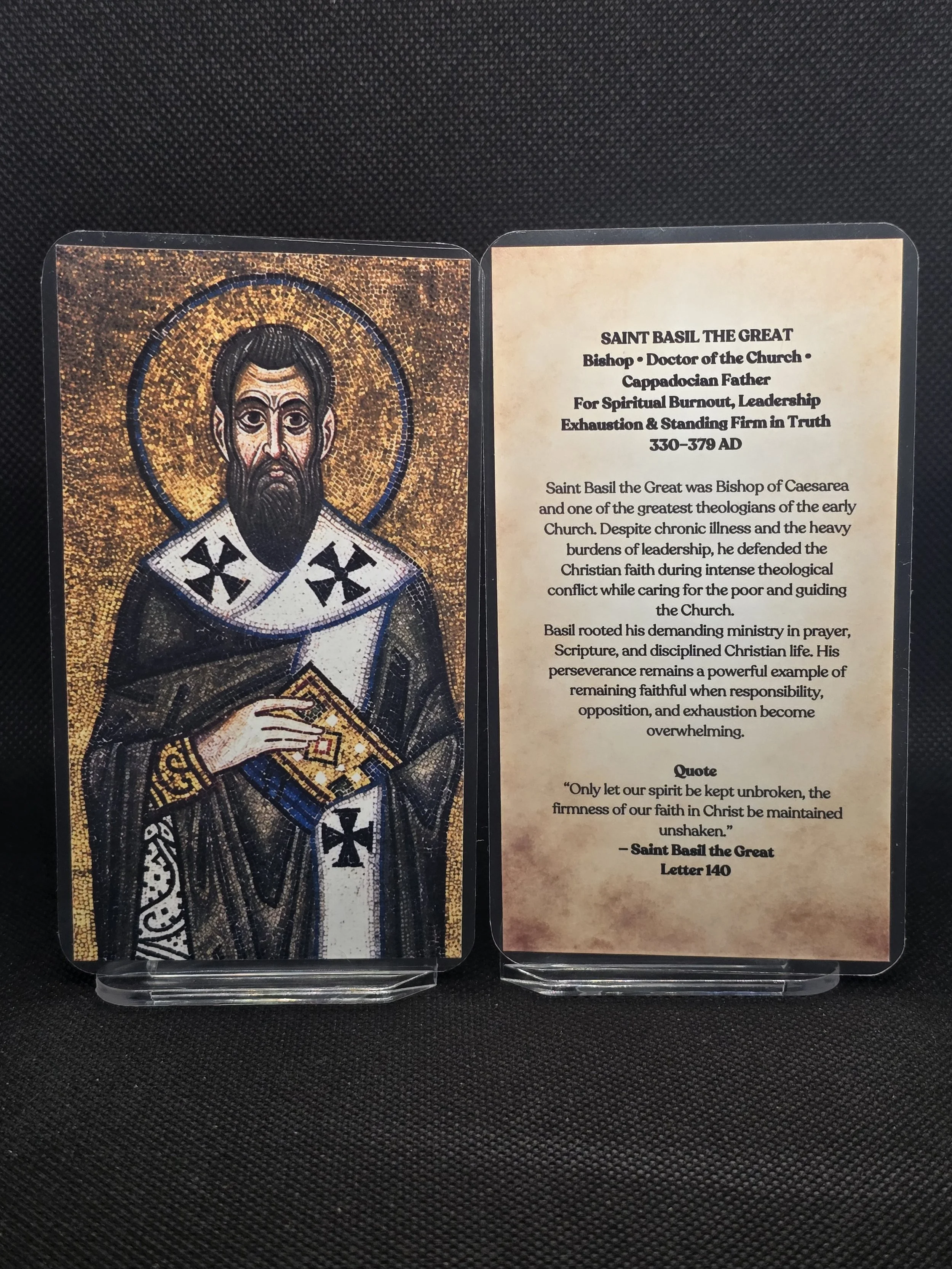
This is a short devotional prayer written for this page, and it is not an official text of the Church. A traditional prayer is printed on his prayer card.
Death, Relics and Veneration
Basil's health was poor for much of his life, and his austerity, heavy duties and the strain of church conflict wore him down. No one can give a medical diagnosis from this distance. He is traditionally said to have died on January 1, 379. Some modern scholarship prefers late 378, and neither the date nor the cause of death should be asserted without that qualification.
Gregory of Nazianzus describes the grief in the city, and the Catholic Encyclopedia preserves the tradition that Jews, pagans and strangers joined in the mourning. This is the main literary witness to his reputation at death, and as a funeral oration it must be read as praise. Reports about his relics are late. The Catholic Encyclopedia, drawing on the Bollandist scholars, notes that no relic tradition is securely documented before the twelfth century, and it mentions later claims connected with Bruges and the Naples Oratory. These show that relics were claimed and venerated, but they do not prove that the remains are his.
The Byzantine churches honor him with Gregory of Nazianzus and John Chrysostom as the Three Holy Hierarchs on January 30. According to Orthodox tradition, a dispute arose in Constantinople over which of the three was greatest, and Bishop John of Euchaita was told in a vision to establish one common feast. The Orthodox Church in America places the account in 1084. The vision belongs to tradition and cannot be verified, but the shared feast is a lasting part of Byzantine worship.
On January 1, Greek Christians bake the Vasilopita, Saint Basil's bread, with a coin hidden inside and a blessing for the person who finds it. A popular story says that Basil once distributed money to the poor by hiding it in loaves. That explanation is widely told, including by the Greek Orthodox Archdiocese of America, but it is not found in his writings or in the early accounts, so it is better understood as a pious tradition that honors his generosity.
Frequently Asked Questions
A Bishop for the Hungry and the Faithful
Basil joined a sharp mind to practical mercy. He defended the faith of Nicaea, taught monks to love their neighbors, and built a place where strangers and the sick were welcome. His prayer card is a small reminder to pray for those who lead and for those who serve.
View Prayer Card