Saint Thérèse of Lisieux: The Little Flower and the Little Way
A cloistered Carmelite who died at twenty-four, wrote one of the most widely read spiritual books of the modern age, and was named a Doctor of the Church.
At a Glance
- Born
- January 2, 1873, Alençon, France
- Died
- September 30, 1897, Lisieux Carmel, aged 24
- Beatified
- April 29, 1923 (Pius XI)
- Canonized
- May 17, 1925 (Pius XI)
- Doctor of the Church
- October 19, 1997 (John Paul II)
- Feast day
- October 1 (Roman Catholic calendar)
- Patron of
- Missions, florists, those who suffer from illness, France (secondary)
- Best known for
- The Little Way, Story of a Soul
- A Family of Saints
- Illness and the Smile of Our Lady
- Christmas 1886 and Pranzini
- Rome and Entering Carmel
- Life in the Lisieux Carmel
- The Little Way
- Illness, Darkness and Death
- Story of a Soul
- Canonization and Doctor of the Church
- Roses, Miracles and Relics
- Why She Reaches Eastern Christians
- Frequently Asked Questions
A Family of Saints
Marie-Françoise-Thérèse Martin was born in Alençon, in Normandy, on January 2, 1873, and baptized two days later in the church of Notre-Dame. Her father, Louis Martin, was a watchmaker and jeweler. Her mother, Marie-Azélie Guérin, called Zélie, ran a business making Alençon lace. They had nine children, and four of them died young. The five daughters who lived, Marie, Pauline, Léonie, Céline and Thérèse, all entered religious life. Louis and Zélie were canonized together by Pope Francis on October 18, 2015, which makes Thérèse one of the few saints whose parents are also officially recognized as saints.
The household was devout in an ordinary, working way. Prayer, Mass, charity and hard daily labor were woven together. Zélie ran a business while raising a large family, and her surviving letters show a capable and anxious mother who loved her children with great intensity. Louis was affectionate and contemplative, and he nicknamed his youngest daughter his "little queen." This early experience of being loved without condition shaped how Thérèse later spoke about God.
That security was broken early. Zélie died of breast cancer on August 28, 1877, when Thérèse was four. In November of that year Louis moved his daughters to Lisieux, near Zélie's brother Isidore Guérin and his family, and settled them in a house called Les Buissonnets. Pauline became a second mother to Thérèse. Thérèse attended the Benedictine school at Notre-Dame du Pré, where she was shy and often unhappy, and was later taught privately. When Pauline entered the Carmel of Lisieux on October 2, 1882, Thérèse felt that she had lost her mother a second time.
Illness and the Smile of Our Lady
Not long after Pauline left, Thérèse became seriously ill. She suffered headaches, trembling and episodes of confusion that frightened her family. On May 13, 1883, which was Pentecost Sunday, her sisters knelt around her bed and prayed before a statue of the Virgin Mary. Thérèse later wrote that the statue seemed to come alive and that Mary smiled at her, and that her suffering ended in that moment. The statue, often called the Virgin of the Smile, is kept in the chapel of the Lisieux Carmel.
It is worth being careful about what history can and cannot say here. That Thérèse became ill and then recovered is part of the record. That she experienced Mary's smile is her own testimony. The exact medical nature of the illness cannot be determined from this distance, and later writers have offered several explanations. Thérèse herself added that the aftermath was not peaceful. She was troubled by scruples and feared she had exaggerated what she had seen, a detail that shows how honest she was about her own inner life.
She made her First Communion on May 8, 1884, and was confirmed by Bishop Flavien Hugonin on June 14 of the same year. Her writings describe the Communion as an experience of deep union with Christ, and from this point her desire to give her whole life to God grew steadily stronger.
Christmas 1886 and the Prayer for Pranzini
Thérèse described herself as an overly sensitive child who cried easily and took offense at small things. On Christmas Eve 1886, after Midnight Mass, she overheard her father remark with some weariness that he hoped this would be the last year of the custom of putting gifts in her shoes. Ordinarily she would have burst into tears. This time she composed herself, went downstairs and opened her gifts cheerfully. She called this her complete conversion. From that night, she wrote, she began to think less of her own feelings and more of the needs of others.
That outward-facing love soon found a concrete object. In 1887 she read about Henri Pranzini, a man condemned for a triple murder in Paris. She began to pray for his conversion, offering sacrifices for a person she had never met. Pranzini was executed on August 31, 1887. Newspaper accounts reported that, just before the end, he kissed a crucifix, and Thérèse took this as the answer to her prayer. Whether he truly repented in his heart is something no historian can establish, and Thérèse herself claimed only what the newspaper reported. What matters for her story is the conviction that hidden prayer can reach people far away, which became the root of her later missionary vocation.
Rome and Entering Carmel
Thérèse wanted to join the Carmel of Lisieux, where Pauline and her older sister Marie were already nuns. The difficulty was her age. On May 29, 1887, she asked her father for permission, and he agreed. Her uncle Isidore and the Carmel's ecclesiastical superior, Canon Delatroëtte, thought she was too young, and the bishop did not give an answer.
In November 1887 she traveled to Italy on a diocesan pilgrimage with her father and her sister Céline. On November 20 the pilgrims were received by Pope Leo XIII. Against the strict rules of the audience, Thérèse spoke to the pope and asked permission to enter Carmel at fifteen. Popular retellings sometimes say that Leo XIII granted it. He did not. He told her that she would enter if God willed, and the decision stayed with her superiors. The bishop finally consented, and Thérèse entered the Lisieux Carmel on April 9, 1888, at the age of fifteen. She received the habit on January 10, 1889, and made her profession on September 8, 1890, the feast of the Nativity of Mary. She took the name Sister Thérèse of the Child Jesus and the Holy Face.
The Holy Face part of her name was not an ornament. During these years her father Louis suffered a severe mental and physical decline and was placed in a care facility. He died on July 29, 1894. Thérèse saw in his humiliation a share in the suffering face of Christ.
Life in the Lisieux Carmel
Carmel was not a quiet escape from difficulty. It meant enclosure, silence, long hours of liturgical prayer, manual work, strict obedience and constant life alongside women whose personalities she did not choose. Thérèse worked in the refectory, the laundry and the sacristy. She helped guide the younger sisters, although she never held the office of novice mistress, a detail that popular accounts often get wrong.
One of the best documented examples of how she lived is her care for an elderly sister, Sister Saint-Pierre, who was disabled and hard to please. Thérèse volunteered to help her to the refectory each evening. The old nun complained about how she was being carried and how fast she was walked. Thérèse recorded in Manuscript C that she kept at it, learning to anticipate what the sister needed and to smile at the complaints. It is a small story, and it contains the whole of her teaching in miniature.
In her last years she also took on two spiritual brothers by letter. Maurice Bellière and Adolphe Roulland were young priests or future priests headed for the missions, and she supported them with prayer and correspondence. This is the basis for her later title as patroness of the missions, even though she never left France.
The Little Way
The Little Way is the spiritual path Thérèse is best known for, and it is often misunderstood. It does not mean that holiness is easy or that small acts become holy merely because they are small. It starts from an honest look at weakness. Thérèse concluded that she would never reach holiness by her own strength, and that God did not require her to. Her weakness could become the place where she trusted God most completely. Pope Francis describes the Little Way as the way of trust and love in his 2023 apostolic exhortation C'est la confiance.
She found several images for this. The first is the little flower. At the opening of Manuscript A she compares souls to flowers in God's garden. Some are roses and lilies, and others are violets and daisies, and each is beautiful because it is what God made it to be. Holiness, for her, was not copying someone else's greatness but accepting her own place.
The second image is the elevator, which was a new invention in her day. In Manuscript C she writes that she was too small to climb the steep stairway of perfection, so Christ would lift her. Spiritual effort stays, but the lifting is grace. The third comes from Manuscript B. Thérèse wanted to be a missionary, a martyr, a priest and a teacher all at once, and then realized that every vocation is held together by charity. She wrote that in the heart of the Church she would be love.
The Little Way also has a concrete side. It meant being patient with sisters she found irritating, doing unnoticed work without complaint, accepting correction without answering back, and praying for people she could never meet. A fair reading adds one caution. Her context was a Carmelite convent with a strong culture of self-denial, so the Little Way is about letting love transform ordinary acts. It is not a command to accept harmful treatment from others.
Illness, Darkness and Death
During the night of April 2 to 3, 1896, at the start of Holy Week, Thérèse coughed up blood. It was the first clear sign of the pulmonary tuberculosis that would kill her. At almost the same time she entered a long period of spiritual darkness. Where heaven had once felt vivid and close, she now found herself assailed by thoughts that there was nothing beyond death. She described a darkness like the unbelief of people who reject God, and she wrote that she sat at the table of sinners and shared their bread. In Manuscript C she said she did not dare write the words of faith she was tempted to doubt.
This matters because Thérèse is sometimes pictured as permanently cheerful. Her confidence was real, but it was tested in the dark, and it did not depend on feeling. She went on praying and saying that she believed even when she felt nothing. That is why her story has comforted so many people who are depressed, doubtful or ill.
On July 8, 1897, she was moved to the infirmary. Her sisters kept notebooks of her conversations in these months, which were later published as Last Conversations. These records come from witnesses and not from Thérèse's own pen, so scholars treat them with more caution than her manuscripts. In them she told her sisters that she would spend her heaven doing good on earth, and on June 9 she said she would let fall a shower of roses. She died at the Lisieux Carmel on September 30, 1897, at the age of twenty-four. Her last words are traditionally given as "My God, I love you," as recalled by those at her bedside.
Story of a Soul
The book that made her famous was never planned as a single work. Manuscript A was written in 1895 at the request of her prioress, her sister Pauline (Mother Agnes of Jesus), and tells her childhood and early religious life. Manuscript B, written in September 1896 for her sister Marie, contains her most important theological reflections on love. Manuscript C, written in June and early July 1897 for Mother Marie de Gonzague, deals with her later years, charity, prayer and the trial of faith.
After her death, Pauline and the Carmel prepared the texts for publication. The first edition of Histoire d'une âme appeared in 1898. It was not a faithful transcript. The editors rearranged and smoothed the material, corrected the language, left out passages and presented writings addressed to different people as one narrative. The original manuscripts, however, survived. A facsimile edition was prepared by Father François de Sainte-Marie in 1956, a printed edition of the manuscripts followed in 1957, and the critical New Centenary Edition of her works came out in 1992. For this reason, careful writers cite the manuscript and folio for a quotation and not just the title of the book.
Canonization and Doctor of the Church
Devotion to Thérèse spread with astonishing speed after the publication of her book. Her cause for sainthood was introduced by Pope Pius X on June 10, 1914, and Pope Benedict XV recognized the heroic character of her virtue on August 14, 1921. Pope Pius XI beatified her on April 29, 1923, and canonized her at Saint Peter's on May 17, 1925. On December 14, 1927, he named her, together with Saint Francis Xavier, universal patroness of the Catholic missions. In 1944 she was also named a secondary patroness of France.
On October 19, 1997, the hundredth anniversary year of her death, Pope John Paul II declared her a Doctor of the Church in the apostolic letter Divini Amoris Scientia. She is one of only a few women to hold the title. The Church did not name her a Doctor for building an academic system. She received it because her writings express the gospel with originality and depth, and the title does not mean that every sentence she wrote is infallible.
Roses, Miracles and Relics
The Lisieux Carmel documents several healings that were examined in her cause. For her beatification these included the recovery of a seminarian named Charles Anne from tuberculosis in 1906 and of a sister, Louise de Saint-Germain, in 1916. For her canonization they included healings of Sister Gabrielle Trimusi in Parma and Maria Pellemans in Belgium. These were judged sufficient under the Church's procedures, which is not the same as a scientific proof of a supernatural cause.
The rose is her best known sign. It comes from her own flower language and her promise of a shower of roses. In popular devotion, receiving or noticing a rose has come to be taken as a sign that a prayer is heard, especially during the novena to her. The Society of the Little Flower and others warn that no known statement of Thérèse guarantees a physical rose to those who pray a certain novena, so a rose should be received as a gift of encouragement and never as a promised sign.
Her body was exhumed several times during the beatification process, in 1910, 1917 and 1923. It was not found incorrupt, and anyone who says so is mistaken. Her relics rest in the Carmel chapel at Lisieux, and the basilica of Saint Thérèse in the town draws pilgrims from across the world. Her relics have also toured France and many other countries, beginning with a national pilgrimage in 1945.
Saint Thérèse, Little Flower, you showed that love makes small things great. Pray for us who feel weak, tired or overlooked. Teach us to trust in the mercy of God, to do ordinary things with love, and to place our hands in the hands of Jesus. Amen.
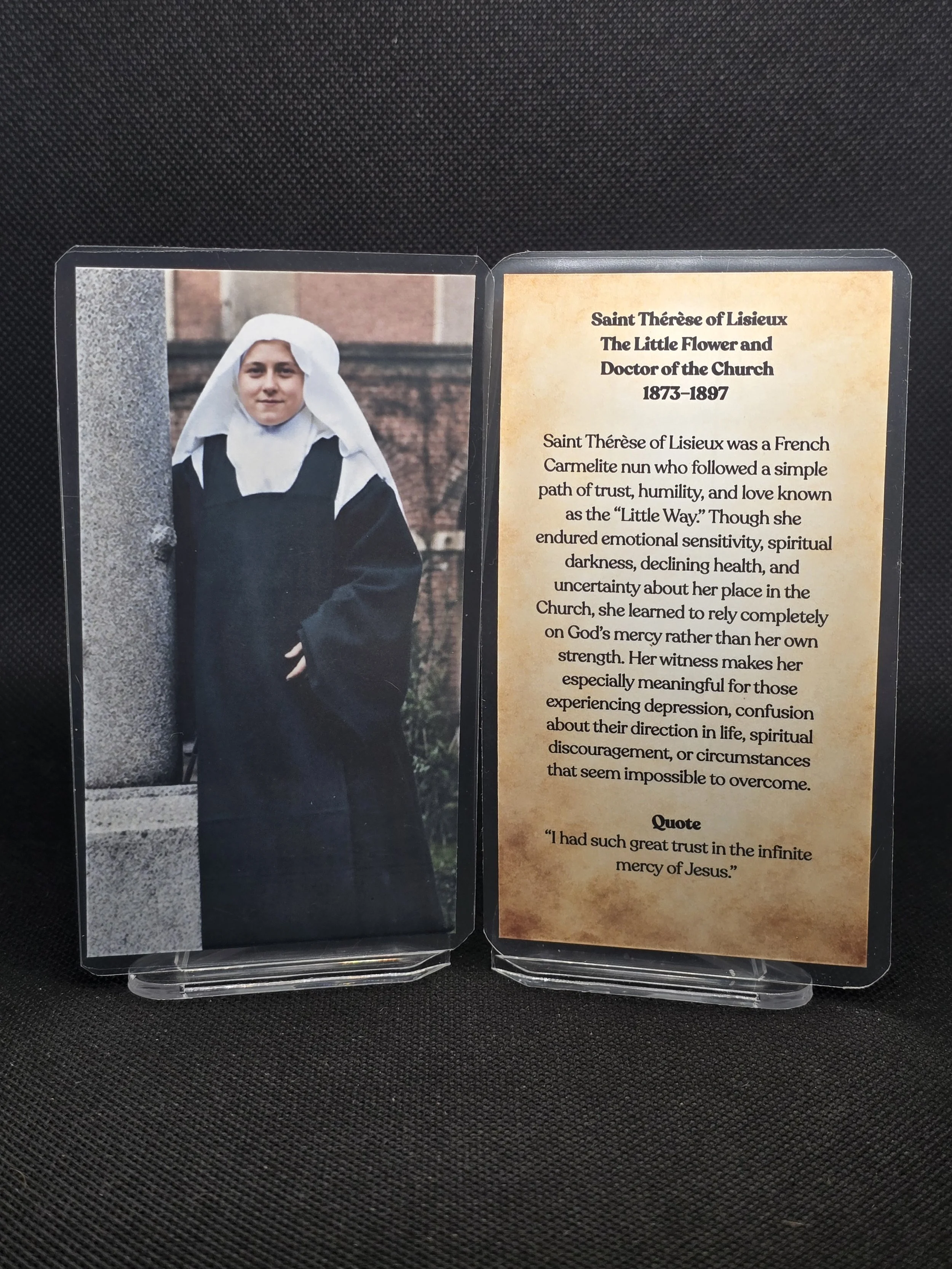
This is a short devotional prayer written for this page, and it is not an official text of the Church. A traditional novena prayer is printed on her prayer card.
Why She Reaches Eastern Christians
Thérèse was a Latin Catholic and a Discalced Carmelite, so her place in the Eastern churches deserves an honest description. John Paul II noted in Divini Amoris Scientia that she is venerated in both the Eastern and Western Catholic traditions. Among the Maronites, for example, there are monasteries dedicated to her in Lebanon, such as the Monastery of Saint Teresa of the Child Jesus at Tourzayya, and a Maronite congregation of Sisters of Saint Thérèse of the Child Jesus.
There is also a Byzantine Catholic connection. In 1932 Pope Pius XI named her a secondary patroness of the church of Saint Anthony the Hermit in Rome, which served Russian Catholics, and her feast was to be kept there according to the Slavic rite on May 17. That is a papal decision for Catholics, and it does not mean that the Orthodox Church recognizes her as a saint. Individual Orthodox readers have nevertheless loved her writing. Her emphasis on trust, humility and the mercy of God, and her honesty about weakness, speaks to the same longing for repentance and simplicity that runs through the Eastern spiritual tradition.
Frequently Asked Questions
Walking the Little Way
Thérèse never led an army, preached to crowds or founded an order. She loved the people next to her, trusted God in the dark and offered each small task. For anyone who feels too ordinary to be holy, that is her message. Her prayer card is a small reminder to carry with you.
View Prayer Card