Breaking News • Maronite Catholic Church • Lebanese Exiles in Israel • Updated November 3, 2026
Maronite Prayer Hall Desecrated in Nahariya: A Lebanese Exile Community, a Note Left on the Altar, and a Priest Who Chose Forgiveness
On the Feast of All Saints, a woman walked into a small Maronite worship space in northern Israel to prepare for evening prayer and found the statues smashed. This is the most complete account available of what happened, who the congregation is, why they are in Israel at all, and what is still unknown.
The Nahariya Attack: At a Glance
- What happened
- Statues and sacred images destroyed inside a Maronite Catholic prayer hall dedicated to Saints Peter and Paul
- When
- Discovered Sunday, November 1, 2026, the Feast of All Saints, shortly before evening worship (reported between about 5:30 and 5:45 p.m.)
- Where
- Nahariya, northern Israel, in space the city reportedly provides inside a municipal community center
- Images and objects damaged
- Statues and images of Jesus Christ, the Virgin Mary and Saint Charbel, among other devotional items
- The note
- A handwritten apology in English was found on the altar, asking the community’s forgiveness. The writer is unidentified. English was used, not Hebrew or Arabic, and no one has said why.
- The congregation
- Lebanese Maronites, many from families that fled southern Lebanon in May 2000. Estimated at 1,100 to 1,200 people, with several dozen at a normal Sunday service.
- The priest
- Father Rody Noura, himself a child refugee from Lebanon, who said he wants to forgive the person responsible
- Church response
- The Maronite Archeparchy of Haifa and the Melkite Archeparchy of Acre, Haifa, Nazareth and All Galilee both condemned the act
- Police
- Nahariya police opened an investigation. No arrest, suspect, motive or damage estimate had been reported as of November 3.
- Injuries
- None reported
What Happened on All Saints Day
On Sunday, November 1, 2026, a woman from the Lebanese Maronite community in Nahariya arrived at the community’s prayer hall to prepare for the evening service, which was due to begin at 7 p.m. It was the Feast of All Saints, one of the great days of the Catholic year, a day on which Christians remember the whole company of the holy dead. She found the room wrecked. Statues had been shattered. Sacred images had been slashed or torn and left on the floor.
The time she arrived varies by outlet, which is normal in the first hours of a story. Yoav Etiel of The Jerusalem Post places the discovery at about 5:30 p.m. Yair Kraus of Ynetnews and The Times of Israel put it at about 5:45 p.m. Father Rody Noura, the congregation’s priest, arrived afterward. The Times of Israel says he reached the hall at 6:10 p.m., and Ynetnews says he came 15 to 20 minutes after the discovery. By the time the evening prayer was due, the hall had become a crime scene and the people who had come to pray were standing outside.
Press accounts describe the damage in different pieces, and together they give a fuller picture. Ynetnews says religious images and symbols were smashed and left on the floor, among them depictions of the Virgin Mary and Saint Charbel Makhlouf, the hermit of Mount Lebanon who is the best loved saint of the Maronite Church. The Times of Israel says icons were slashed, including one of Jesus on the cross, and that statues were shattered. Daily Beirut names an image of the Sacred Heart of Jesus along with Saint Charbel. All Israel News adds that furniture and wall coverings were damaged. This was not spilled paint or a broken window. The things destroyed were the objects around which a displaced people had built its prayer.
No one was hurt. Police opened an investigation the same evening. The story reached the Vatican’s news service, the Israeli press in English and Hebrew, and Arabic and French-language Christian media within a day. As of November 3, no suspect has been publicly identified and no arrest has been reported.
Nahariya is a coastal city of about 60,000 people close to the Lebanese border, according to Vatican News. It was founded in the 1930s by Jewish immigrants from Germany, and today it is a mostly Jewish city that also has Arab Christian and Muslim residents, Russian-speaking and French-speaking communities, and a small group of Lebanese families who arrived in 2000. The Maronite congregation is one of the smallest parts of that mix.
The photographs belong to the outlets and photographers named below. We link to them instead of copying them, so the credit and the context stay with the original reports.
- Ynetnews, by Yair Kraus: several photographs of the damaged hall. The page lists no photographer credit.
- The Jerusalem Post, by Yoav Etiel: two photographs credited to the Maronite Church.
- The Times of Israel liveblog entry: the photograph of the handwritten note, credited to Father Rody Noura.
- The Christian Post, by Samantha Kamman: a full report that draws on the Jerusalem Post, Times of Israel and Vatican News coverage.
Part II
The Note on the Altar
The detail that sets this case apart from an ordinary report of vandalism is a piece of paper. On the altar, among the damage, the congregation found a handwritten note in English. The Times of Israel published a photograph of it, supplied by Father Noura. The Jerusalem Post, Daily Beirut and All Israel News quote the line “I don’t know what came over me.” The Christian Post reports that the note was addressed to a “deeply valued community,” apologized, asked for forgiveness, and ended with a drawn heart and a cross. Wording differs slightly from outlet to outlet because each quotes different parts. They agree on the substance. It was an apology, it was left on the altar, and it was signed by no one.
The note raises more questions than it answers, and it is worth being exact about what it can and cannot support.
What the Note Establishes
It establishes that someone left a written apology inside the hall after the damage was done, or at least that someone placed it there. It suggests that the writer did not mean the destruction as a declaration of contempt for the congregation. It also shows that the writer knew enough about Christian worship to draw a cross and leave the message on the altar rather than anywhere else in the room.
What the Note Does Not Establish
It does not identify the writer. It does not tell us the writer’s religion, age, nationality or state of mind. It does not prove that the person who wrote it is the person who broke the statues. And it does not prove or disprove a hate motive. A person can apologize for an act that began in hatred, and a person in crisis can destroy things they do not hate. Father Yosef Yaakov, the spokesperson for the Maronite community in Israel, told the Jerusalem Post that it was too early to say whether religious hatred was the motive. Responsible reporting therefore describes this as desecration and vandalism of a Christian place of worship. It does not call it a confirmed hate crime, and it does not call it a mental-health incident either. Both are theories, not findings.
Israeli press reports also say investigators were weighing both a religiously motivated act and the possibility of a personal crisis. Police have not confirmed either in the statements we could read. The apology is a clue. It is not a verdict.
Part II-B
Why Was the Note Written in English?
Any reader who knows where this happened will ask the obvious question. Nahariya is an Israeli city where the public language is Hebrew. The congregation speaks Arabic and prays in a Maronite liturgy that uses Arabic with Syriac. So why did the writer apologize in English?
The honest answer is that nobody knows, and the police have not said. The note is one handwritten page, and the only public description of the writer is that the writer is unidentified. What can be said is limited, and it should be kept separate from guessing.
What Is Reasonable to Say
First, the language does not point to one kind of person. English is widely used in Israel as a second language. It is taught in schools from an early age, it is the language of much of the country’s media, work and technology, and it is the first language of many immigrants, volunteers, students, pilgrims and foreign workers. Many Israelis, Arabs and Jews alike, are comfortable writing a short personal note in English.
Second, English is a neutral choice. A writer who did not know which language the congregation would read, or who did not want to write in the language that might reveal who they were, could reasonably pick English. The congregation includes Arabic speakers who grew up in Lebanon and Israeli-born children who speak Hebrew. English is the language most of them have in common with an outsider.
Third, the choice of English tells us nothing about hatred or remorse. A person writing under stress may reach for whatever language comes most easily.
What Should Not Be Concluded
The language should not be read as a clue to the writer’s nationality, religion or background, and it should not be used to point at any community. Investigators have not announced that the language helped identify anyone. Until police say more, the note’s language is an open detail, not evidence. This article treats it that way.
The Prayer Hall and Its Congregation
Readers who picture a church building should adjust the image. The Maronites of Nahariya do not worship in a freestanding church. The Jerusalem Post and Ynetnews describe a municipal building next to a public garden, and, according to Israel Hayom, the city made part of a community-center building available to the congregation roughly five years ago, around 2021. That means the vandalized room is a space inside a city-owned facility that the community uses for Catholic worship. It is not, as far as published sources show, a property owned by the archeparchy. All Israel News calls it part of the historic Nahariya Christian center, but no independent history of the building has been found, and it would be inaccurate to call it a historic church.
The size of the community is given as roughly 1,100 to 1,200 people by two different outlets. The Jerusalem Post, the Christian Post and All Israel News say about 1,100, and The Times of Israel says about 1,200. Those are estimates of the wider Lebanese Maronite community that looks to this hall, not a parish census. On an ordinary Sunday only several dozen people attend. On major feasts the number rises into the hundreds. All Saints Day, a Sunday this year, was exactly the kind of day on which the room would have filled.
The hall carries the name of Saints Peter and Paul. The Maronite Church’s own directory lists Father Rody Noura as pastor of a community of that name whose territory covers Acre, Tiberias and Kiryat Shmona. It does not list Nahariya as a separate territorial parish. The most careful way to describe it is as a local worship community, or pastoral station, within a wider Maronite pastoral structure for Lebanese families in northern Israel. Its canonical status as a full parish has not been confirmed, and this article does not claim it.
One more point about the hall matters for understanding the loss. The congregation is about 26 years old. The room is about five. For most of those 26 years the community made do with whatever it could find. A statue in such a room is not a decoration chosen from a catalog. It is something a family carried, or bought, or was given, and then placed with care in the only chapel it had.
Part IV
How Lebanese Maronites Came to Nahariya
To understand why there is a Lebanese Maronite congregation on Israel’s northern coast, you have to go back to the final years of the Lebanese civil war and to the strip of southern Lebanon that Israel held from 1985 until 2000, known as the security zone. Israel supported a local militia there, the South Lebanon Army, or SLA. It was largely Christian in leadership and in many of its villages, though it was not exclusively Maronite and included many Shiite and Druze members. Its enemies, chiefly Hezbollah, regarded it as a collaborator force.
In May 2000, Israel withdrew from southern Lebanon much faster than the SLA expected. The militia collapsed within days. Thousands of people who feared retaliation, former fighters and their families, gathered at the border fence. Estimates of how many entered Israel are generally around 7,000 people. Israel admitted them after a tense wait at the fence, and they were first housed in temporary accommodation before being moved to towns in the north.
Many did not stay. Some were returned to Lebanon in the early years, where they faced trial. Others emigrated to Europe and the Americas. A figure often cited for those who remained in Israel and their Israeli-born descendants today is around 3,500 people, though that number covers the whole community and not only Maronites. Nahariya, Acre, Kiryat Shmona, Haifa and Tiberias became home to Lebanese families who had suddenly become permanent exiles from villages they could see from the hills.
The Bishop Who Organized the Exile
The first Maronite archbishop of Haifa and the Holy Land, Paul Sayyah, who served from 1996 until 2012, has described how the Church responded. In an interview published in late May 2026, he recalled preparing for the possibility of arrivals roughly two weeks before the withdrawal and receiving an urgent call that families were at the border and the situation was out of control. He contacted priests in the north and went into Galilee himself.
Sayyah says he organized three pastoral communities for the newcomers: one centered on Acre for the coast, one for central Israel, and one centered on Kiryat Shmona for Upper Galilee. That arrangement explains something otherwise puzzling about Nahariya. A congregation of over a thousand people existed for more than two decades without being its own territorial parish and, for most of that time, without a church of its own. The Church had built a network of communities around families, not around buildings.
Life Between Two Countries
The exile was not only a change of address. In Lebanon the families were branded collaborators. In Israel they were Arabic speakers in a Hebrew-speaking country, Christians among a mostly Jewish population, and, to some neighbors, simply Arabs. A first-person account in The Jerusalem Post by Jonathan Feldstein of a man who arrived as a six-year-old describes hiding his Lebanese background at school, throwing away the lunch his mother packed, and growing up without a stable parish. Religious milestones were delayed because there was no organized clergy at first.
There was also the separation from family. Relatives left behind in Lebanon could not easily visit, and a funeral across the border could become a legal problem. When Patriarch Bechara Rai visited the Holy Land in May 2014, he met and prayed with Lebanese Maronites in Israel, including exiles from the SLA families. The visit was criticized in Lebanon as normalizing relations with Israel, and defended by Maronite officials as a pastor’s duty to all of his flock, not a political act. Lebanese Church leaders, including Sayyah, have argued over the years that the exiles deserve pastoral care and amnesty regardless of politics.
It is against that background that the object in the room should be read. A statue from Lebanon, if one was in fact among the damaged items, is a piece of the homeland. A worshipper was reported by Israel Hayom as saying that some of the statues had been brought from Lebanon, a detail we could not check against the original report. Father Noura told Ynetnews that some items had belonged to the community for many years, before he became its priest, and that he did not know for certain whether they came from Lebanon or were bought in Israel. Both can be true. Some items may have come from Lebanon, and no one can yet say which.

Part V
Father Rody Noura: From Refugee Boy to Pastor
The pastor who stood outside the damaged hall on November 1 knew exactly what it feels like to lose a place. Father Rody Noura, whose name is also transliterated Rudy or Rodi in some reports, was born in Lebanon around 1987. He was 13 years old in May 2000 when his family crossed into Israel. His father had served with the South Lebanon Army. In a July 2024 Catholic News Agency report, Noura described how the sudden departure left him struggling with the loss of his homeland and his sense of safety.
What changed his life, by his own account, was an encounter with the Neocatechumenal Way, the Catholic movement of formation in the faith. Through that community, he has said, he recovered hope. He went on to study at the Redemptoris Mater Seminary of Galilee, an interritual seminary that forms priests from several rites. The seminary’s own site announces the ordination of the first Maronite priest formed there, and the community’s own account identifies him as Noura. Reports give his ordination date as June 23, 2017; that date appears in a Vatican News interview that this article has not been able to open directly, so it should be treated as reported, not independently confirmed.
By 2024, Noura was ministering to about 4,000 Lebanese Christians scattered through northern Israel. His work included visiting the sick, teaching catechism to children, and assisting families who had been displaced again by cross-border rocket fire and the war along the Lebanon border. He has spoken of forgiving people he once regarded as enemies, as part of the change in his life.
His Response to the Attack
Given that history, his reaction on November 1 was not an improvisation. He told The Times of Israel that he wanted to forgive and show love to the person who did it, whom he described as someone who needs love and is angry about something in his life, and he added that everything can be repaired. He told Ynetnews that he forgives those responsible, that the act was unacceptable and immoral, and that he was not excusing it. He also said he suspects no one, and that in the community’s 26 years in Nahariya nothing like this had happened before.
That is a priest speaking in a way that matches what he said two years earlier, before the event. It is also a priest who, according to the same reporting, immediately turned to the practical work of asking the authorities to investigate. Forgiveness and a request for justice are not opposites. The Maronite archbishop’s statement says the same thing.
Part VI
The Responses of the Churches and Israel
The Maronite Archeparchy of Haifa and the Holy Land, in a statement signed by Archbishop Moussa El-Hage and summarized by Vatican News, called the attack grave and unacceptable, an assault on the sacred character of a place of worship and on the right to worship in safety. It said such acts can be neither justified nor tolerated. It asked the authorities and security services to investigate immediately and decisively, to identify, arrest and prosecute those responsible, and to protect the site so that it does not happen again. It said the community would keep using the hall for prayer. It also rejected answering harm with harm or destruction with hatred, while stating that forgiveness does not mean silence in the face of aggression. Catholic World News and Gaudium Press carried the statement too.
Archbishop El-Hage has led the Archeparchy since 2012 and succeeded Paul Sayyah. In 2022 he was detained for a time by Lebanese authorities on returning from Israel with aid for the community, a reminder of how politically exposed the ministry to these families still is.
The Melkite Greek Catholic Archeparchy of Acre, Haifa, Nazareth and All Galilee, headed by Archbishop Youssef Matta, issued its own statement. According to Terre Sainte Magazine, it expressed solidarity with the Maronites, called for an urgent investigation and concrete protection for all places of worship, and described the sacred character of a place of worship as a red line that must not be crossed under any pretext. That ecumenical gesture between two Eastern Catholic churches is worth noting. The Melkites and Maronites are distinct churches with different histories. When a Melkite archbishop signs a statement about a Maronite room, the message is that Christians in Galilee read one another’s wounds as their own.
On the Israeli side, Ambassador George Deek, the Foreign Ministry’s special envoy to the Christian world, called the vandalism disgraceful, noted that the community is made up of Lebanese Christians who stood with Israel and found a home there, said he had spoken with Father Noura to offer solidarity and help, and said those responsible must be identified and brought to justice. His comments appear in The Times of Israel. Father Noura said the municipality, the police and the Foreign Ministry all contacted the community right away and offered assistance.
What the Community Itself Says
Father Yosef Yaakov, the spokesperson for the Maronite community in Israel, spoke to the Jerusalem Post. He said the community was waiting for the police, that it was too early to judge the motive, and that worshippers were angry and distressed. Reports also say some members now feel unwelcome in the city, and that parents of the children who attend are worried about their safety. All Israel News adds that the community forgives the vandals while acknowledging deep pain. Those two things sit side by side in the reports: a public stance of forgiveness, and private fear.
Part VII
The Police Investigation
Nahariya police opened an investigation after receiving a complaint on the evening of November 1. According to the police statement quoted by the Jerusalem Post and Ynetnews, officers are using various investigative measures and examining all lines of inquiry, and Israel Police takes any violation of holy places and freedom of worship seriously. Ynetnews says police are examining all possibilities and will use every means to find those responsible.
The hall has no security cameras inside, according to Father Noura. Ynetnews notes that a nearby sports hall and a school may have cameras that recorded something. No report confirms that any footage has been recovered. Reports differ on how the intruder got in, and the method has not been clarified.
As of November 3, the following are all unconfirmed: the identity of the person responsible, whether more than one person was involved, whether the act was motivated by religion, the monetary value of the damage, and whether the apology note was written by the vandal. We searched for any report of an arrest or suspect and found none. Anyone writing about this case should hold these open.
Part VIII
Is This Part of a Pattern?
Christian communities in Israel and East Jerusalem have reported a worsening climate for several years. The Rossing Center for Education and Dialogue in Jerusalem, which monitors harassment of Christians, documented 155 incidents in 2025 in its annual report on harassment of Christians. Its overview breaks them down as 61 physical attacks, including spitting, 52 attacks on church property such as graffiti, damaged statues, stone-throwing and arson, 28 cases of harassment, and 14 cases of defaced public signs. The report gives somewhat different figures for two categories in different sections, so the exact split should be read with care. The Center calls its count the tip of the iceberg, and most of the cases it lists are in Jerusalem, especially in the Old City. Nahariya and Maronites do not appear in the portion of the report we could read.
The report finds that the people responsible in documented cases were Jewish, most of them teenagers or young adults, and that the more severe vandalism was more often linked to individuals on the margins of society. It also notes that police often responded supportively, while a high share of cases ended without a clear outcome.
Earlier reporting describes attacks on Maronite and other Catholic sites in the Galilee. Catholic News Service, republished by National Catholic Reporter, covered vandalism at a Catholic convent and a Maronite village. The Times of Israel’s French edition reported on a Maronite cemetery desecrated in Galilee, and AsiaNews in 2015 quoted a Maronite vicar who said police were doing nothing to catch vandals who attacked a Christian graveyard. More recently, i24NEWS reported that a man was arrested in Jaffa after crosses and statues were broken in a church there.
These facts form a background. They do not tell us who entered the room in Nahariya or why. A broken statue in a Jerusalem alley and a broken statue in a Nahariya community center may have different causes, and the apology note is a reminder that this case may not fit a simple template.
What can be said fairly is this. Christians in the Holy Land have good reason to ask that places of worship be protected, and the Maronite and Melkite statements asked for exactly that. Israeli officials responded promptly and publicly. And the evidence on motive in this case is not yet in.
Part IX
The Maronite Church in the Holy Land
The Nahariya congregation is a recent arrival to a very old Church. The Maronite Church traces itself to the monk Saint Maron, who died around the year 410 in Syria, and to the communities of monks and laity who gathered around his memory in the Orontes valley. In the seventh century the Maronites chose their first patriarch, John Maron, and over the centuries they moved into the mountains of Lebanon, where the rugged terrain protected them. Among the Eastern Catholic churches, they are unusual in having maintained communion with Rome throughout their history, and they worship in a liturgy in the Antiochene Syriac tradition with Arabic used alongside the Syriac of Jesus’ own region.
Maronites have also lived in the land that is now Israel for a very long time. The Maronite presence in upper Galilee goes back to at least the eighteenth century. The village of Kafr Bir’im was a Maronite village whose people were evacuated after the 1948 war and never allowed to return, settling mainly in Jish and Rameh. Jish today has a Maronite majority. Altogether there are an estimated 10,000 to 11,000 Maronites in Israel, according to Wikipedia’s summary of Maronites in Israel. The Archeparchy of Haifa and the Holy Land was established in 1996. At the last published count, around 2020 to 2021, it had about 10,000 members, six parishes and eleven priests, and a separate Patriarchal Exarchate in Jerusalem and Palestine served about 500 more. Since 2014 Maronites in Israel have been able to register as Aramean instead of Arab.
The Lebanese exiles of 2000 added a new layer. They did not displace the existing Maronite villages. They arrived as a second group with a different history and, often, a different politics. A published description notes that the Lebanese community’s main church is in Acre and that they tend to pray separately from the older Galilean Maronites. Nahariya, with its small room by a public garden, is one of the places where that community has put down roots.
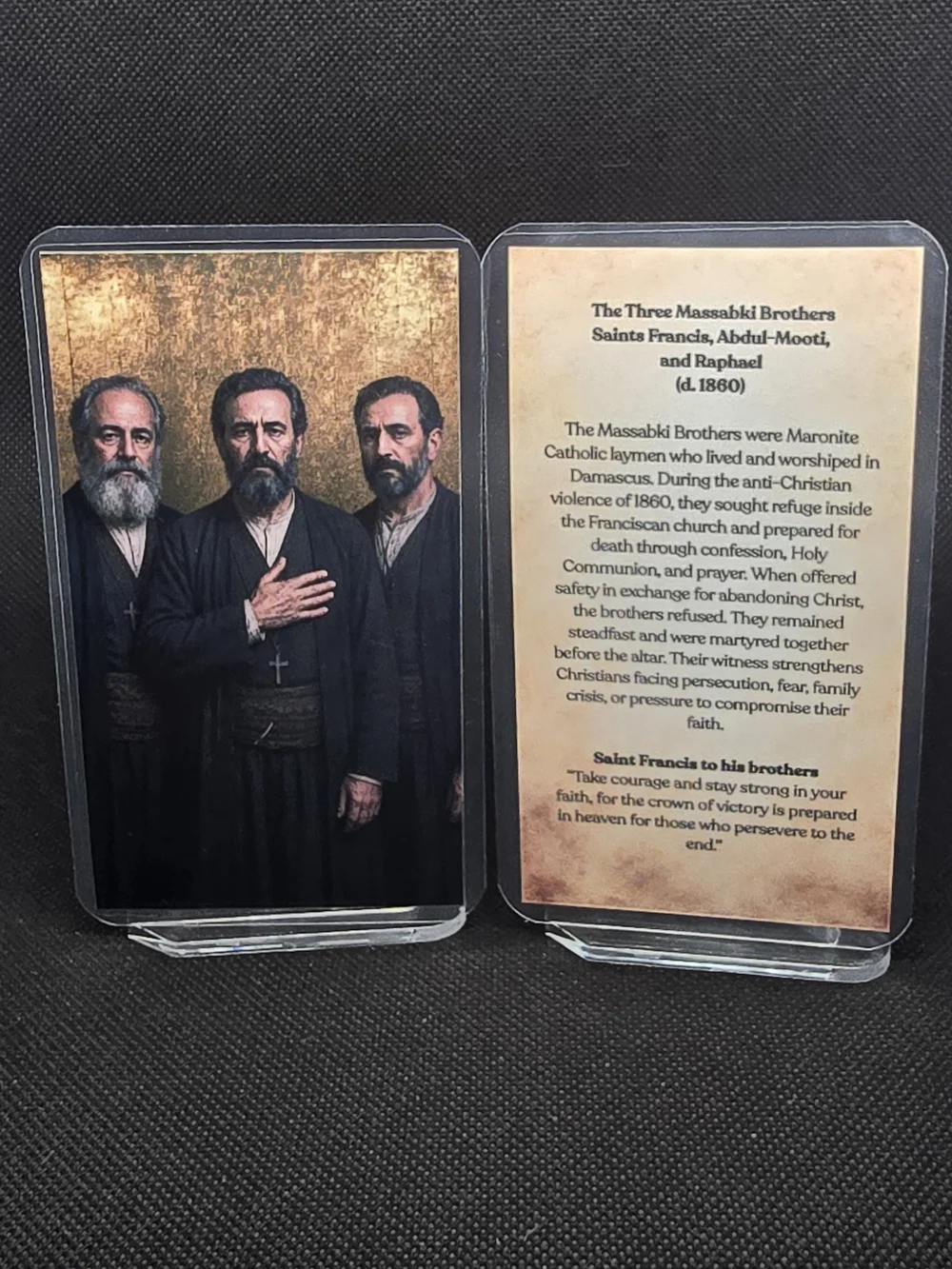
For readers who want to follow these threads, our guide to the Maronite saints introduces the figures every Maronite home knows. The story of the Church’s medieval struggles is told in our article on the Maronite schism of 1282 and the two patriarchs, and the Massabki martyrs show what Maronite fidelity under persecution looks like in modern times.
Part X
Peter, Paul, Charbel and the Saints of the Hall
Youssef Makhlouf was born in the mountain village of Bekaa Kafra in 1828 and entered the Lebanese Maronite Order as a young man, taking the name Charbel. He spent his later years as a hermit at the hermitage of Annaya, and he died on Christmas Eve, 1898. Within weeks reports of a light around his tomb and of healings began to spread. He was canonized in 1977, and his intercession is sought across Lebanon and the Lebanese diaspora, among Christians and Muslims alike. In many Maronite homes, his picture hangs where other families keep a crucifix.
That is why the report that his image was among those damaged in Nahariya lands as it does. For a displaced Lebanese family, Charbel is the saint of the country they left behind.
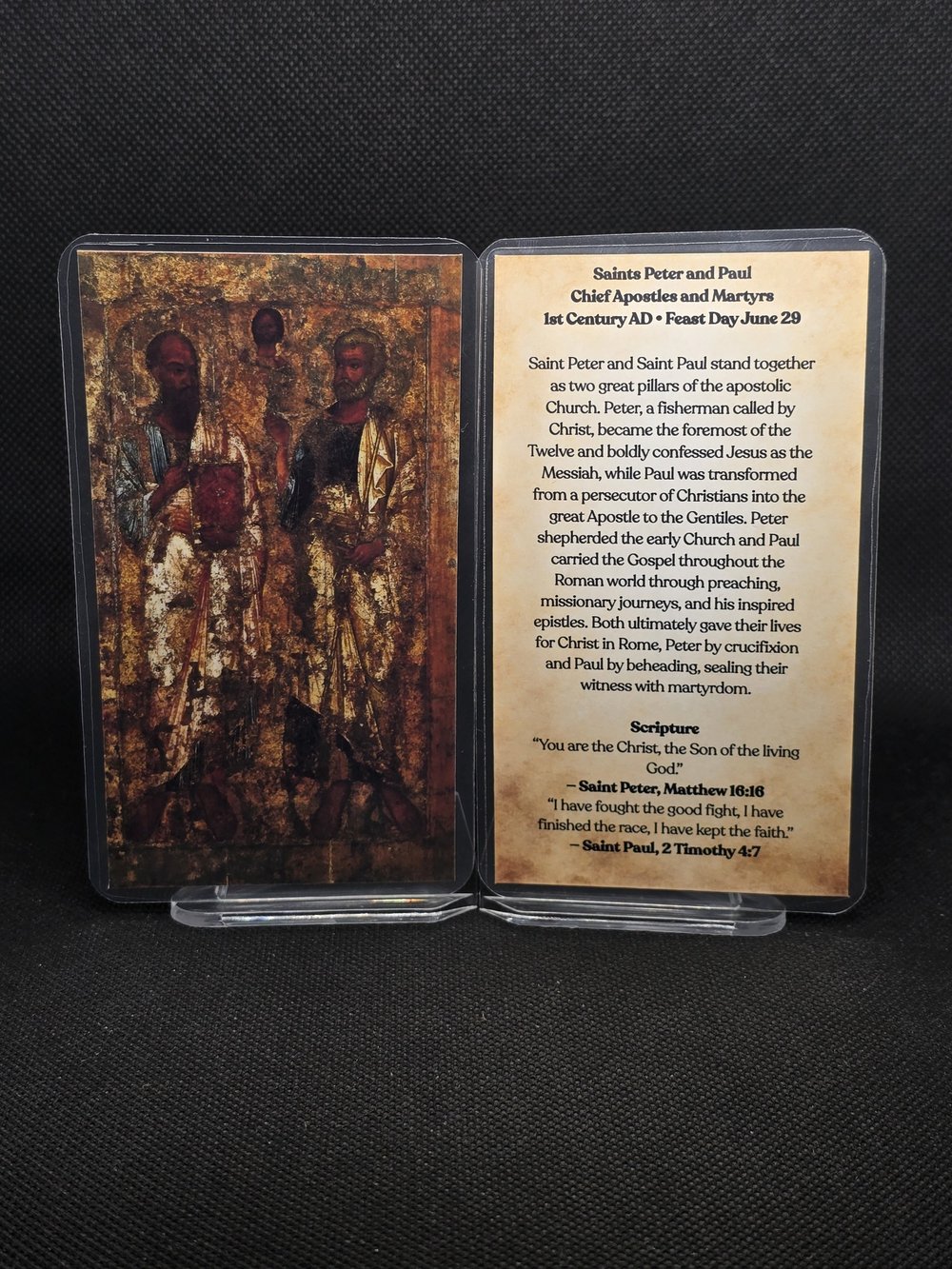
The hall’s patrons are the apostles Peter and Paul, whom the Eastern and Western Churches honor together on June 29. The pairing is old: one was the fisherman called to feed Christ’s sheep, the other the persecutor turned missionary. Both died in Rome under Nero. Churches placed under their name are often communities that must hold together very different people, and a congregation of exiles from different Lebanese villages in a foreign country fits that description.
The vandalism also fell on All Saints Day, the feast on which Catholics, East and West, remember that the Church is a communion of the living and the dead. The faith teaches that the saints are not distant. Their images in a prayer room are windows, not ornaments. A congregation that gathered on All Saints Day to find those windows smashed has been hurt in the very thing the feast celebrates.
Families who want a small sign of that communion at home can keep the Saint Charbel limited edition prayer card beside the Saints Peter and Paul prayer card. Both are small enough to carry. The Maronite devotional tradition is also kept through books. The Saint Charbel prayerbook and the Saints of the Maronite Tradition are two good places to begin, and the history of the Maronite Church explains how a mountain people kept its faith for sixteen centuries.

Part XI
What Is Still Unknown
A responsible account has to mark its own limits. The list below separates what has been confirmed from what remains open as of November 3, 2026.
The prayer hall was vandalized on November 1, 2026. Statues and images were destroyed. A handwritten apology was left on the altar. The Maronite and Melkite archeparchies condemned the act. Police opened an investigation. No injuries were reported.
That the room has been used for worship for about five years. That some statues came from Lebanon. That hate crime and a personal crisis are both under consideration. Father Noura’s exact ordination date. The exact number of people in the congregation.
Who did it, and why. Whether anyone has been arrested. The value of the damage. How the person entered. Whether the note is genuine. Whether services have resumed in the hall and what is being repaired. Where the community worshipped between 2000 and about 2021, and who served it before Father Noura. Whether the Nahariya group is a canonical parish or part of a wider one. These gaps would be filled by diocesan records or direct testimony from founding members of the congregation.
Part XII
Comparing the Reports: Where the Outlets Agree and Differ
Every outlet reporting on this story drew on a few of the same sources, mainly the Maronite community’s spokesperson, Father Noura, the Archeparchy’s statement and a short police statement. That is why the facts line up well and the differences are small. The table lays them out so a reader can see which details are firm and which depend on one outlet.
| Detail | What the reports say |
|---|---|
| Time of discovery | About 5:30 p.m. (Jerusalem Post, Christian Post, All Israel News, Daily Beirut). About 5:45 p.m. (Ynetnews, Times of Israel). |
| Who found it | A worshipper (Jerusalem Post). A woman from the community (Ynetnews). All Israel News says Father Yosef Yaakov found it. |
| Priest’s arrival | About 6:10 p.m. (Times of Israel). Fifteen to twenty minutes after the discovery (Ynetnews). |
| Service time | 7 p.m. (Jerusalem Post, All Israel News, Daily Beirut). |
| Community size | About 1,100 (Jerusalem Post, Christian Post, All Israel News, Daily Beirut). About 1,200 (Times of Israel). |
| Items named | Virgin Mary and Saint Charbel (Ynetnews). Jesus on the cross, slashed icon, shattered statues (Times of Israel, Christian Post). Sacred Heart and Saint Charbel (Daily Beirut). Furniture and wall coverings (All Israel News). |
| Origin of the items | Father Noura: some had been with the community for years, and he does not know if they came from Lebanon or were bought in Israel (Ynetnews). |
| Cameras | None inside. A nearby school and sports hall may have some (Ynetnews). |
| Motive | Unknown. Father Yosef Yaakov says it is too early to say (Jerusalem Post). Police are examining all lines of inquiry. |
| Building | Municipal building beside a public garden (Jerusalem Post, Ynetnews). Called part of the historic Nahariya Christian center (All Israel News). |
| Date of the Israeli withdrawal | All Israel News says July 2000. Other sources, including Archbishop Sayyah’s interview, place it in late May 2000, and this article follows them. |
Two further cautions apply. All Israel News says in one paragraph that the damage was found on Sunday morning and in another that it was found at 5:30 p.m., so its time should be treated with care. And several of the reports are, in part, republications or summaries of the Jerusalem Post and Times of Israel reports, so the number of outlets repeating a detail is not the same as the number of independent confirmations.
Part XIII
Sources and Reporters
- Ynetnews, reporter Yair Kraus, published November 2, 2026. Timeline, damage, Father Noura, cameras and police statement.
- The Jerusalem Post, reporter Yoav Etiel, published November 2, 2026, also on Yahoo News. Community size, Father Yosef Yaakov, police and Archeparchy statements. Photographs courtesy of the Maronite Church.
- The Times of Israel liveblog, November 2, 2026, no individual reporter named. The note photograph, Father Noura’s statements and Ambassador Deek’s comments.
- Vatican News, staff report, November 2, 2026. The Archeparchy of Haifa’s statement.
- The Christian Post, reporter Samantha Kamman, November 3, 2026. Report built from the Jerusalem Post, Times of Israel and Vatican News.
- All Israel News, staff, November 2, 2026. Father Yosef Yaakov and the community’s forgiveness.
- Daily Beirut, newsroom, November 2, 2026. Items named and the Lebanese angle.
- Terre Sainte Magazine, editorial staff, November 2, 2026. The Melkite statement.
- Catholic World News, November 3, 2026. A summary of the Vatican News report.
- Gaudium Press, the Archeparchy’s statement.
- Catholic News Agency, July 2024, via Catholic World Report: Father Noura and priests ministering in the border towns of Lebanon and Israel.
- Kataeb, May 2026: Archbishop Paul Sayyah on the Lebanese exiles in Israel.
- Jonathan Feldstein in The Jerusalem Post: a first-person account of a Lebanese Maronite boy who fled in 2000.
- Rossing Center, 2025 report on harassment of Christians.
- Maronites in Israel and Naharnet on Patriarch Rai’s 2014 visit.
Several reports this article refers to could not be opened directly and are not linked: the Israel Hayom and Mako reports in Hebrew, a Radio Ashams interview with Father Yosef Yaakov, and a December 2024 Vatican News interview with Father Noura. Where this article uses them, it says so and treats the detail as reported, not confirmed.
Part XIV
Timeline
- 1996: Archeparchy of Haifa and the Holy Land establishedThe Maronite Church receives its own archeparchy in the Holy Land, with Paul Sayyah as its first archbishop.
- May 2000: Israel withdraws from southern LebanonThe South Lebanon Army collapses. About 7,000 people, former fighters and their families, cross into Israel. Thirteen-year-old Rody Noura is among them.
- 2000 onward: Pastoral communities formedArchbishop Sayyah organizes communities for the exiles centered on Acre, central Israel and Kiryat Shmona. Families also settle in Nahariya.
- May 2014: Patriarch Rai visits the Holy LandThe Maronite patriarch meets Lebanese Maronites, including exiles, in a visit that draws criticism in Lebanon.
- 2012: Moussa El-Hage becomes archbishopHe succeeds Sayyah as head of the Maronite Archeparchy of Haifa and the Holy Land.
- 2017: Father Rody Noura ordainedReported date: June 23, 2017. He is described as the first Maronite priest formed at the Redemptoris Mater Seminary of Galilee.
- Around 2021: Municipal room made available in NahariyaIsrael Hayom reports that the city provides space in a community-center building for the congregation.
- 2022: Archbishop El-Hage detained in LebanonLebanese authorities hold him on his return from Israel.
- July 2024: Catholic News Agency interviews Father NouraHe describes his flight from Lebanon at 13, his conversion of heart, and his ministry to about 4,000 Lebanese Christians.
- 2025: Rossing Center documents 155 incidentsThe annual report on harassment of Christians in Israel and East Jerusalem is published in 2026.
- May 2026: Archbishop Sayyah interviewHe recalls how the Church organized the exiles in 2000.
- November 1, 2026: The desecrationThe prayer hall is found wrecked before evening worship on All Saints Day. A note is left on the altar. Both archeparchies issue condemnations.
- November 2, 2026: Investigation reportsPolice are examining several motives. Father Noura says he forgives. Ambassador George Deek offers help.
These three cards belong together in any Maronite home: the patron saints of the hall, the hermit of Annaya, and the Virgin of Harissa. They also make a modest gift for a family that has lost the images it prayed before.
Part XV
Prayers After a Desecration
Lord Jesus Christ, whom the saints adore and whose Mother stands beside every exile, look on the small room in Nahariya where your people gather. Its statues are broken and its images torn, and the people who came to pray on the feast of your saints stood outside the door.
Comfort the families who carried their faith across a border. Comfort the priest who has taught them to forgive. Give them back a place to sing the psalms in their own tongue, and do not let the work of a night take from them what you have given for a lifetime.
Keep them from answering evil with evil. Give them patience in the waiting for justice. Give the authorities wisdom to find the truth, and give every neighbor in that city the grace to stand beside them.
Saints Peter and Paul, pray for us. Saint Charbel, pray for us. Our Lady of Lebanon, pray for us. Amen.
Lord, we do not know who entered that room. You do. If it was hatred, soften it. If it was sorrow, heal it. If it was confusion, bring it light. Let the apology left on your altar be the first word of a longer journey, and turn the heart of the one who wrote it toward you.
As you taught us, we ask this for those who wrong us. Let your justice be done without cruelty, and your mercy be given without limit.
Lord, have mercy. Amen.
A Small Room, a Large History, and a Priest Who Answered With Mercy
A congregation that crossed a border in 2000 with almost nothing found a room in a city that was not its own, filled it with the saints of its homeland, and prayed there for five years. On All Saints Day someone broke what they had built, and left an apology behind. The investigation will answer who and why, or it will not. Whatever it finds, the community has already given its answer: justice for the crime, and mercy for the person.
We will update this article as police, the archeparchy and the congregation release more information.
Browse Maronite Prayer Cards →Frequently Asked Questions
