The Forgotten Crisis — 1282 AD
The 1282 Maronite Schism: The Story of the Two Patriarchs
Almost no one speaks of the decade when the Maronite Church fractured — when the peaks and valleys of Lebanon chose different souls to lead them, and two men simultaneously claimed the throne of Antioch
There is a decade in Maronite history that the history books skip over in a single sentence, if they mention it at all. Between 1282 and 1297, the Maronite Church carried a wound almost no outsider saw: not an attack from the Mamluks, not a persecution by an Ottoman governor, but something stranger and more revealing than either — a split from within, quiet as a schism can be when it happens among a people too small and too embattled to afford open conflict for long.
In 1282, Patriarch Daniel II of Hadshit died or was taken captive on the mountain he had spent his patriarchate defending. What happened next exposed a fault line that had been building for seventy years: the Maronite Church had two souls — one that looked toward Rome, the Crusaders, and the Latin West as the source of protection and renewal; and one that believed the mountain itself was the Maronite Church's only reliable protector, and that alliance with the Franks had brought the Mamluks' wrath down on Lebanon's cedar forests and its people alike.
The first faction elected Luca El-Bnehraney — Luke of Benharan — as Patriarch. The second would not accept him. Within months, Jeremiah III of Dmalsa was elected as a rival. For a brief, turbulent period, the Maronite Church had two men simultaneously claiming the See of Antioch and all the East. Two patriarchs. One ancient church. Two incompatible visions of what that church should be.
This is the complete account of that schism — drawn from every available historical source, including the foundational chronicle of Patriarch Estephan El Douaihy, the Crusades encyclopedias that document the factional dynamics, the village histories that preserve the memory of the 1283 Mamluk campaign, and the extraordinary archaeological discovery of eight naturally mummified bodies in the Qadisha Valley — human beings who died fleeing the crisis that defined this exact moment in Maronite history.
The World of 1282: A Church Between Two Empires
To understand 1282, you have to understand the century of pressure that preceded it. The Maronite Church had spent the Crusading period — from the arrival of Raymond of Toulouse in the mountains near Tripoli in 1099 to the mid-thirteenth century — in an unprecedented opening to the Latin West. After four centuries of mountain isolation following the Islamic conquests of Syria in 634-638 AD, the Crusaders had found the Maronites "in the mountains of Lebanon" and recognized in them something extraordinary: a Christian people who had maintained their faith entirely alone, without contact with Rome, without Frankish support, without the machinery of the Latin Church — and who had survived.
The relationship that developed was complex and deeply consequential. The Maronites provided the Crusaders with guides through the mountain passes, with scouts, archers, and intelligence about the terrain that Latin knights could not have acquired alone. As the historian William of Tyre described them: a "stalwart race" of "valiant fighters," of "great service to the Christians in the difficult engagements which they so frequently had with the enemy." In return, the Maronites gained something they had lacked for generations: political protection, economic access to Mediterranean trade, and formal recognition from Rome of their ancient patriarchal dignity.
But the Crusading alliance was always a gamble. A smaller people hitching its survival to a larger power is always betting that the power will last — and the Latin Crusader states, for all their extraordinary military achievement, were running out of time. The Mamluk dynasty that had replaced the Ayyubids in Egypt was proving to be something the Crusaders had never fully faced: a military system of professional slave-soldiers whose tactical brilliance and organizational coherence matched and then surpassed anything the Franks could put in the field. Sultan Baibars smashed the Principality of Antioch in 1268, reducing it to rubble. He attacked the Maronite mountain strongholds in the same year, his forces sowing destruction in Ehden, Bsharri, Hadath el-Jibbet, and Meifook — the heartland of Maronite Lebanon.
The date 1268 matters enormously for understanding 1282. Because 1268 was the year the Mamluks first came to the Maronite mountains — and the year that the Maronite anti-unionist faction could point to and say: this is what the alliance with the Franks has brought us. The Mamluks were not attacking the Maronites for their ancient faith or their Syriac liturgy. They were attacking them because they had sided with the Crusaders. The Maronite unionist faction had made Maronite Lebanon a target of Mamluk vengeance by embedding the church's survival in the survival of the Latin states — and the Latin states were dying.
Between 1268 and 1291, the Maronite Church operated under existential pressure from two directions simultaneously: external Mamluk military campaigns that could destroy villages and kill or capture patriarchs, and an internal debate over whether the church's alliance with Rome and the Crusaders was its salvation or its catastrophe.
The Mamluk timeline of attacks on the Maronite heartland: 1268 (Baibars — Ehden, Bsharri, Meifook destroyed); 1283 (Qalaoun — Jebbet Bsharri, Ehden, Patriarch captured); 1289 (fall of Tripoli — entire Frankish coastal presence ends); 1291 (fall of Acre — last Crusader fortress falls); 1305 (Kesrawan campaign — complete eradication).
The Unionist Soul: Jeremiah of Amshit and the Road to Rome
The unionist faction — those Maronites who embraced the deepening relationship with Rome and the Latin Church — had a founding patriarch whose shadow fell over everything that came after him: Jeremiah II of Amshit, who served as Patriarch from 1199 to 1230 and who, in 1215, did something no Maronite patriarch had ever done before. He traveled to Rome.
The journey of Jeremiah al-Amshiti to the Fourth Lateran Council under Pope Innocent III was not merely a diplomatic visit. It was a theological and political statement of the highest order. In walking into Saint Peter's, in sitting among the bishops and cardinals of the universal Church, in personally renewing the Maronite Church's communion with the successor of Peter, Jeremiah was declaring something that the mountain isolationists back in Lebanon neither expected nor entirely welcomed: the Maronite Church was part of something larger than Lebanon.
Pope Innocent III was so moved by the encounter that he ordered Jeremiah's portrait painted for Saint Peter's. The painting showed the Patriarch raising the host — the Eucharistic bread that, according to the story preserved by Patriarch Douaihy, had frozen miraculously in his hands during Mass before the Pope himself. The image of a mountain patriarch, still wearing the ancient vestments of the Syriac Antiochene tradition, holding the Eucharist before the throne of Rome — this was the visual symbol of the unionist vision at its most powerful.
The Lateran Council's formal decrees regarding the Maronite Church were consequential. The bull Quia divinae sapientiae required the Maronite bishops to adopt some Latin episcopal customs: wearing miters and rings, using communion vessels of precious metal, using bells to summon the faithful rather than the wooden boards that the Eastern tradition had long employed. The Maronite hierarchy was formally defined as a patriarch, two archbishops, and three bishops — a Latin diocesan structure imposed on a church that had previously organized itself organically from village and monastery. From this point forward, the Maronite Patriarch would be confirmed in office by the Pope and receive the pallium from the Latin Patriarch of Antioch.
These changes were not universally welcomed. The Crusades encyclopedia records explicitly that "not all Maronites supported this union, and there was resistance in particular from groups living in the mountains." This resistance was not heretical in origin or theological in character. It was the resistance of people who had survived four centuries of isolation precisely because they had not depended on any outside power — and who looked at the Latin ecclesiastical machinery being installed among them and saw, with the clarity of the marginal, the hidden cost of belonging.
The successors of Jeremiah of Amshit — Daniel of Shamat (1230–1239), John VI of Jaj (1239–1245), Chamoun IV of Blaouza (1245–1277), and Jacob II (1277–1278) — continued the unionist tradition but with diminishing political capital. Each Mamluk attack on the Maronite mountains strengthened the hand of those who had always said the alliance with the Franks was dangerous. And after 1268, when Baibars struck the Maronite heartland for the first time in living memory, the argument of the autonomists was no longer theoretical.
Peak vs. Valley: How Terrain Became Theology
To understand the 1282 schism is to understand Lebanese geography. The Maronite heartland is not a single place — it is a vertical world of dramatic contrasts between altitude and access, between the cedar forests of the high Bsharri peaks and the more accessible lowland villages of the Byblos-Batroun coast, between the cave monasteries of the Qadisha carved into sheer cliff faces and the market towns of the Jbeil plain where Frankish merchants traded. And for the Maronites of the thirteenth century, geography was destiny.
The High Peaks: Jebbet Bsharri and the Autonomist Heartland
Jebbet Bsharri — the district of Bsharri — sits in the high northern mountains of Lebanon, centered on the village of Bsharri itself at roughly 1,500 meters above sea level. From its heights one can see the Valley of the Qadisha below and the Mediterranean beyond, but the view's grandeur conceals the area's practical inaccessibility: to reach Jebbet Bsharri from the coast required climbing mountain passes that in winter were snowbound and in any season were defensible by small bands of determined men against much larger forces. This was not coincidence. The Maronite clans who had chosen these peaks had chosen them precisely because they were hard to reach.
The village of Hadshit — home of Patriarch Daniel II — lies in this high-mountain district, adjacent to the Bsharri region. That the patriarchal line included men from Hadshit speaks to the deeply ambiguous nature of this geographical divide: the unionist faction was not simply a coastal, lowland phenomenon. Mountain men could be unionists, and they were. But the culture of the high peaks — the muqaddamin (local clan chiefs), the hermits and monks of the cliff-face monasteries, the shepherds and cedar-wood workers who had lived for centuries with little contact with the outside world — was disproportionately autonomist in temperament.
The Sacred Valley: The Qadisha as Spiritual Fortress
The Qadisha Valley — whose name means "Holy" in Aramaic — was not the political heart of Maronite Lebanon but its spiritual one. Cut into the rock by the Qadisha River at the foot of Mount al-Makmal, the valley is a place of almost supernatural drama: sheer cliff walls hundreds of meters high, monastery cells carved directly into the stone, cave chapels adorned with ancient frescoes, and the sound of the river below that is never absent. The valley sheltered Christian monastic communities long before the Maronites arrived, and after the Islamic conquests it became the refuge of the Maronite Patriarch himself and the center of the church's interior life.
The monastery of Qannubin — founded traditionally in the 4th century under the Emperor Theodosius, its name derived from the Greek word for "community life" — was the Patriarch's residence for centuries and would become the formal See of the Maronite Patriarchate in the fifteenth century, remaining so for 500 years. The Maronite monks who lived in Qannubin and in the dozens of other cliff-face monasteries of the Qadisha were not political figures, but their spiritual authority was immense — and their sympathies tended toward the autonomist vision. They had built their world in the rock specifically to be unreachable by outside powers. The idea that the church should subordinate itself to Rome's administrative machinery was not a natural fit for men who had cut their cells into cliff faces to be alone with God.
The Accessible Coast: The Unionist Corridor
The third geographical dimension was the coastal plain and the accessible villages of the Byblos-Batroun region, where the Maronite Patriarchs had resided for most of the period from 938 to 1440 — the famous 502 years in the district of Jbeil recorded by Patriarch Douaihy. These lowland patriarchal residences — Yanuh, Mayfuq, Ilig — were places of greater contact with the outside world, with the Frankish merchants of the coastal cities, with the Dominican and Franciscan friars who came to the Maronite monasteries in the thirteenth century with books and theology and letters from Rome. It was from these more accessible positions that the unionist vision was most naturally cultivated.
| Territory | Character | Political Tendency | Key Places |
|---|---|---|---|
| Jebbet Bsharri (high peaks) | Altitude 1,200–1,800m; snowbound in winter; controlled by local muqaddamin clan chiefs | Autonomist — viewed Frankish alliance as dangerous; anti-Mamluk but also anti-Latin-imposition | Bsharri, Hadshit, Ehden, Hadath el-Jibbet |
| Qadisha Valley (sacred gorge) | 300m–900m; cliff-face monasteries; center of Maronite monastic life and patriarchal residence | Spiritual autonomy — prioritized the church's internal tradition over external alignment | Qannubin, Qozhaya, Mar Lishaa, Hawqa |
| Byblos-Batroun lowlands (accessible plain) | Coastal and sub-coastal; more contact with Frankish merchants, Dominican/Franciscan friars, trade | Unionist — Maronite Patriarchs resided here 938–1440; direct contact with Rome via friars and letters | Jbeil, Mayfuq, Yanuh, Ilig, Akoura, Jaj |
The "Peak vs. Valley" framing is ultimately too simple — what the geography reveals is a spectrum, not a binary. Men from the high mountain villages could be passionate unionists (as Daniel II of Hadshit was). Monks in the Qadisha could be indifferent to politics altogether. But the structural truth holds: the higher and more inaccessible the terrain, the more likely the community was to view outside alliances as liabilities rather than assets. The Maronite Church's internal division in 1282 was, in one reading, nothing more than a theological expression of altitude.
The Last Unionist on the Mountain: Patriarch Daniel II of Hadshit
Patriarch Daniel II of Hadshit served as Patriarch of Antioch and all the East from 1278 to 1282 — a tenure of only four years in the most dangerous period the Maronite Church had faced since the Islamic conquests six centuries earlier. He was a man from the mountain heartland — Hadshit is a village in the Bsharri district, at high altitude, deeply Maronite — who nonetheless held the unionist position and tried to maintain the connection with Rome that his predecessors had cultivated since Jeremiah of Amshit's famous journey in 1215.
What we know of Daniel II comes primarily from Patriarch Estephan El Douaihy's Annals, the foundational chronicle of Maronite history compiled in the seventeenth century and published in 1902. Douaihy records that in 1283 — either during or immediately after Daniel II's patriarchal tenure, depending on how one reads the dates — the Patriarch personally took command of the Maronite defense against the Mamluk armies of Sultan Qalaoun.
The image this passage preserves is extraordinary: a Patriarch of the Church, not a military commander by training or by calling, personally leading men in combat against the Mamluk army. For forty days he held the approach to Ehden — a village that was and remains one of the jewels of the Maronite north, set in the high mountains with a commanding view of the surrounding terrain. The Mamluks could not take it by force while the Patriarch held the approaches. They took it by treachery: the text says the Mamluks "captured Ehden only after they had seized the Patriarch by a ruse" — suggesting that Daniel II was lured out of his defensive position or taken prisoner through some act of deception, at which point the mountain resistance collapsed.
What happened to Daniel II after his capture is not recorded with certainty in surviving sources. Multiple sources describe the Mamluks as capturing the Maronite Patriarch and sending him "to his death" — and given the Mamluk practice of executing those who had resisted them, it is likely that Daniel II died as a prisoner or was executed. He is thus, in a real sense, a martyr-patriarch: a man who died defending his people from military assault while simultaneously being caught in an internal ecclesiastical struggle over the nature of those people's identity.
The paradox of Daniel II is the paradox of the 1282 schism itself: a man from the high mountain heartland, a native son of the autonomous Bsharri world, who nonetheless held the unionist position — and who died or was captured by the very Mamluk force that the autonomists had argued the Frankish alliance would bring down on them. His death, or capture, removed the last symbol of the unionist patriarchate from the mountain stage precisely when the autonomist faction was strong enough to act on its long-held dissatisfaction.
The Crisis of 1282: Two Patriarchs, One Throne
In 1282, with Daniel II gone or captured, the Maronite Church faced its standard succession question: who would be the next Patriarch of Antioch? The answer that came back was: both of them.
The Crusades encyclopedia is the most direct source on what happened: after the death (or capture) of the unionist Patriarch, "the opponents of the union with Rome succeeded in having their own candidate elected." This was Luca El-Bnehraney — Luke of Benharan — who appears in the official patriarchal lists as #38, with tenure from 1282 to 1283.
But the unionist faction did not accept him. They elected their own candidate: Jeremiah El-Damalsy — Jeremiah III of Dmalsa — who appears as #39, with tenure from 1283 to 1297.
The patriarchal list thus records two men in immediate succession (Luca 1282-1283, Jeremiah III 1283-1297) where the historical reality appears to have been a period of overlap: Luca elected by the autonomists in 1282, Jeremiah elected by the unionists as a counter-claim, with the two patriarchates existing simultaneously until the situation was resolved in Jeremiah III's favor by 1283 or shortly after — possibly because the Mamluk invasion itself removed the political conditions that had sustained Luca's position.
Luca El-Bnehraney
(Luke of Benharan)
Elected by the mountain faction — the anti-Frankish, autonomist wing of Maronite Christianity — immediately after Daniel II's departure. He represented the conviction that the Maronite Church's future lay in mountain independence rather than Roman alignment. His patriarchate lasted approximately one year before being superseded by the unionist resolution. He is #38 in the official patriarchal list.
Jeremiah III of Dmalsa
(Ermea El-Damalsy)
The counter-election — the unionist faction's response to Luca's elevation. He carried forward the tradition of Jeremiah II of Amshit and maintained (however tenuously) the connection with Rome. His fourteen-year patriarchate (1283–1297) spanned the fall of Tripoli (1289) and the fall of Acre (1291) — the complete collapse of the Crusader states whose alliance had been at the heart of the entire dispute. He is #39 in the official patriarchal list.
Two critical points must be established clearly for historical accuracy, particularly because secondary sources sometimes confuse the figures involved.
First: The "Jeremiah of Amshit" whose legacy animates the unionist faction is Jeremiah II of Amshit (1199–1230) — the great patriarch who traveled to Rome for Lateran IV. He was long dead by 1282. The actual counter-patriarch to Luca El-Bnehraney was Jeremiah III of Dmalsa (1283–1297). The unionist faction claimed the spiritual inheritance of Jeremiah II of Amshit, but the man they elected was his successor's successor's successor's successor — a completely different person from a completely different place.
Second: The naming convention in historical sources is confusing because there is also a "Daniel of Shamat" (Daniel al-Shamati, 1230-1239) — the immediate successor of Jeremiah II of Amshit — and a "Daniel II of Hadshit" (1278-1282). The Crusades encyclopedia refers to one of these as "Patriarch Daniel al-Shamati" in describing the 1282 crisis. Since the 1282 date matches Daniel II of Hadshit perfectly, the encyclopedia may be using an alternative rendering of his epithet or conflating the two Daniels in its narrative. This article uses Daniel II of Hadshit (1278-1282) as the unionist patriarch whose death/capture triggered the succession crisis, as this is consistent with the patriarchal lists preserved in Douaihy's Annals.
Luke of Benharan: The Autonomist Patriarch
Luca El-Bnehraney — Luke of Benharan — is one of the most obscure figures in all of Maronite history. He appears in the official patriarchal lists as #38, he served for approximately one year (1282–1283), and beyond these bare facts, the historical record is almost silent. This silence is itself historically meaningful: it is the silence that surrounds a disputed or irregular claim, someone whose legitimacy was contested at the time and whose memory was not preserved with the care accorded to the succession that superseded him.
What we can reconstruct from context is significant. Benharan (also rendered as Benhrani or Bnehraney) is a village in northern Lebanon — in the general territory of the Bsharri/Qadisha region that was the geographic center of the autonomist faction. Luke was thus a man of the mountain, elected by mountain people who had watched the Frankish alliance bring the Mamluks to their villages in 1268 and who, in 1282, were watching the Franks retreat from Crusader Syria before a Mamluk advance that no Latin army had been able to stop.
His election was, in its moment, a rational political decision. The argument for autonomy was not theological but strategic: the Maronite Church had survived six centuries of isolation in the mountains by depending on no one but God and the terrain. The Frankish alliance, for all the cultural enrichment and liturgical exchange it had brought, had made the Maronites targets. The Mamluks were attacking them specifically as allies of the Crusaders. If the Maronite Church simply withdrew from the Roman alignment — maintained its ancient rites, its mountain fortresses, its quiet faithfulness — perhaps the Mamluks would leave them alone as they had left other mountain Christian communities alone.
This was not a foolish calculation. It was ultimately wrong — the Mamluks attacked all Christian communities regardless of political alignment, as the subsequent devastations of 1289, 1291, and 1305 would prove — but it was the political logic that drove the autonomist election of Luca El-Bnehraney.
The Crusades encyclopedia notes that after Luca's election, "the tensions between the different Maronite factions had not been resolved" even by 1289 when Tripoli fell. This suggests that the schism's formal resolution — the emergence of Jeremiah III of Dmalsa as the sole recognized patriarch — did not immediately end the underlying factional tension. The mountain clans did not simply accept the unionist restoration because the Mamluks had won. The fracture ran deeper than a single succession dispute, and its echoes can be heard in the Maronite internal conflicts of subsequent centuries.
Jeremiah III of Dmalsa: The Unionist Restoration
Jeremiah III of Dmalsa served as Patriarch from 1283 to 1297 — fourteen years that encompassed the most catastrophic sequence of events in Crusader history since Saladin's reconquest of Jerusalem in 1187. He presided over the Maronite Church through the fall of Tripoli (1289), the fall of Acre and the complete expulsion of the Crusaders from the Levant (1291), and the continued Mamluk harassment of the mountain communities that had allied with the departing Franks.
Dmalsa (also rendered as Damalsa or Dmalse) is a village in northern Lebanon — geographically accessible to the patriarchal residences of the Byblos-Batroun district that had long been the base of the unionist patriarchs. His election by the unionist faction as a counter to Luca El-Bnehraney was the claim that Rome's connection must be maintained, that the vision of Jeremiah II of Amshit at Lateran IV in 1215 remained the proper vision for the Maronite future.
The historical resolution in favor of Jeremiah III appears to have been accelerated — if not caused — by the 1283 Mamluk invasion of Jebbet Bsharri, which we will examine in the next section. The capture of Daniel II of Hadshit by Mamluk forces, and the general devastation of the mountain communities that had supported the autonomist position, may have fatally weakened Luca El-Bnehraney's political base. If the muqaddamin of Bsharri who had supported his election were now either dead, fled, or under Mamluk occupation, the ground beneath his patriarchate literally disappeared.
Jeremiah III thus became the recognized Patriarch by default as much as by theological argument — sustained in his position not by the triumph of the unionist vision but by the military destruction of the autonomist heartland. This is a bittersweet victory: the unionist patriarch survived because the Mamluk sword had cut down the mountain communities that had opposed him.
The Crusades encyclopedia records that even under Jeremiah III, the contact between Rome and the Maronites was "interrupted" — the patriarch no longer applied for the pallium from Rome as his unionist predecessors had done. The reality on the ground was that the collapse of the Crusader states had severed the practical connections that had made the Roman relationship function. There were no more Frankish intermediaries, no more Latin patriarchs in Antioch to transmit the pallium, no more Crusader courts in whose sphere the Maronites could operate. Jeremiah III was nominally unionist in his theology, but his church was practically isolated — awaiting the Franciscan missionaries who would eventually reestablish contact with Rome in the fifteenth century.
The 1283 Mamluk Invasion: When the External Enemy Ended the Internal War
The Maronite internal schism of 1282 did not resolve itself through theological argument or ecclesiastical negotiation. It was resolved — or rather, forcibly overtaken — by external military catastrophe: the 1283 campaign of Mamluk Sultan Qalaoun against the Maronite mountains of northern Lebanon.
The Wikipedia article on the History of Kfarsghab, drawing on Douaihy's Annals and other Maronite chronicles, provides the precise historical frame: after a first Mamluk incursion into Jebbet Bsharri in 1268 under Baibars — "against the village of Hadath," in the very district where Daniel II of Hadshit would later serve as Patriarch — the Mamluk armies returned in 1283 under Sultan Qalaoun, "directed against the allies of the Franks in Jebbet Bsharri." The campaign was not indiscriminate religious persecution. It was targeted retaliation against the people who had provided military support to the Crusader states.
The same source records that the 1283 campaign "reinforced the position of the anti-Frankish party to which Ibn Al Sabha belonged" — a named individual from Kfarsghab who had collaborated with the Mamluks against his own Maronite neighbors. This detail is haunting: within the Maronite mountain community itself, there were those who had made their peace with Mamluk power, who had calculated that survival required accommodation rather than resistance. They were the ultimate autonomists — not seeking alliance with Rome or with the Franks, but with whoever held military power over the mountains.
The Douaihy account of Daniel II's defense is the most vivid military narrative in this entire episode. Sultan Qalaoun's forces — the same commander who would take Tripoli in 1289 and who had been methodically dismantling Crusader power across the Levant — drove into Jebbet Bsharri. The Patriarch personally led the Maronite defense. For forty days, Ehden held. The Patriarch held the approach road, denying the Mamluks the mountain town that was one of the key population centers of the region. Forty days is not a token resistance — it is a serious military campaign mounted by a church leader who understood that the survival of his people depended on holding the mountain.
The fall came through treachery, not battlefield defeat. "The Mamlouks captured Ehden only after they had seized the Patriarch by a ruse." The precise nature of the ruse is not recorded. Perhaps the Patriarch was lured into a negotiation. Perhaps he was surrounded during a reconnaissance. Perhaps a local collaborator, someone who had made the calculation that Mamluk favor was preferable to Maronite solidarity, revealed his position. The result was the capture of the man who was simultaneously the unionist Patriarch (or just-departed Patriarch) of the Maronite Church and the military commander of the Bsharri mountain resistance.
The 1283 Mamluk campaign accomplished in weeks what the theological arguments of the autonomist faction had been building toward for decades: it destroyed the political infrastructure of the unionist mountain position. The muqaddamin of Bsharri who had aligned with Daniel II's patriarchate were now dead, fled, or occupied. The village networks that had supported the unionist claim were devastated. Luca El-Bnehraney had been elected as the autonomist candidate by these mountain communities — but now those communities no longer had the capacity to sustain his position.
The bitter irony: The Mamluk sword that the autonomists had argued the Frankish alliance would bring upon the mountains fell upon the mountains regardless — and in falling, it destroyed the political base of the very faction that had been right about the danger of that alliance.
The Mummies of the Qadisha: Archaeological Evidence of 1283
History from the thirteenth century is usually composed of chronicles, patriarchal lists, and occasional references in the accounts of adversaries. What makes the 1282–1283 Maronite crisis unusual — and what elevates it from an obscure ecclesiastical dispute to a human story of extraordinary pathos — is that it left physical evidence that survived seven hundred years and was only discovered in the twentieth century.
Between 1989 and 1991, a team of four Lebanese speleologists — Fadi Baroudy, Pierre Abi Aoun, Paul Kahawaja, and Antoine Ghaouch, working under the scientific organization GERSL — spent two years exploring the cave system of the Qadisha Valley. In the cave known as 'Asi-al Hadath — Hadath cave, named for the village of Hadath that lay in the Jebbet Bsharri district — they found eight naturally mummified human bodies.
The mummies were dated to approximately 1283 AD.
The Wikipedia article on the Qadisha Valley records this discovery explicitly: "Eight well preserved natural mummies of villagers dating back to around 1283 A.D. were uncovered by Fadi Baroudy, Pierre Abi Aoun, Paul Kahawaja and Antoine Ghaouch, a team of speleologists from the GERSL scientific organisation in the Qadisha Valley between 1989 and 1991. These were found in the 'Asi-al Hadath cave along with a wealth of artifacts."
These eight people — men, women, presumably including children among the "villagers" — fled into the cave system of the Qadisha in 1283. They had artifacts with them, suggesting they had grabbed what they could carry. They did not come back out. Whether they were killed inside the cave, or whether they hid so successfully that they starved or froze before the danger passed, or whether some other cause ended their lives — the record does not say. What the record says is that they are there, in the rock, dated to the year of Qalaoun's campaign against Jebbet Bsharri, in the valley where the Maronite Patriarch had built his spiritual home.
The cave is named for Hadath — the same village of Hadath in Jebbet Bsharri that had experienced the first Mamluk incursion in 1268. The same village district from which Daniel II of Hadshit took his name. The speleologists who found the cave had used "Crusader and Mamluk chronicles in which Aassi al Hadath was mentioned" as their guide — the same chronicles that record the 1283 campaign. The archives and the archaeology confirm each other across seven centuries.
These eight mummies are the most intimate evidence we have of what the 1282 schism actually cost the Maronite people. Not the theological argument about Rome versus mountain independence, not the competition between two patriarchs for the See of Antioch — but eight human beings, in a cave, in 1283, who ran from the Mamluk armies and did not survive. They are the silent witnesses of a crisis that history almost forgot.
The Qadisha Valley Today: A Living Pilgrimage Site
The same valley where the 1282 crisis played out and where eight mummies were found still shelters ancient monasteries carved into the cliff face. It is one of the most extraordinary pilgrimage destinations in the world for Maronite and Eastern Catholic Christians — and you can visit it. Read our complete guide to Maronite pilgrimage in the United States and the heritage that connects American Maronites to this ancient landscape.
Read the Maronite Pilgrimage Guide →The Fall of Tripoli (1289) and the End of the Factional Divide
If the 1283 Mamluk campaign had weakened the autonomist faction by destroying its mountain base, the fall of Tripoli in 1289 ended the theological argument entirely. On the morning that Qalaoun's forces breached the walls of Tripoli — the great Crusader city at the mouth of the Qadisha River, the commercial and political capital of the County of Tripoli that had been the Maronite Church's primary point of contact with the Latin world — the premise that had divided the Maronite Church for seventy years dissolved.
The unionist argument had always been, at its core, that Rome and the Franks were the Maronite Church's allies and protectors. After 1289, the Franks were gone. From 1289 to 1291, the whole Lebanese coast fell to Mamluk forces. The cities of the Mediterranean — Tyre, Sidon, Beirut, and finally Acre in 1291 — fell one by one. According to the historian Theodore of Hama, "even in Kisrawan, not a monastery, church, or fort was saved from destruction." The network of Crusader presence that had sustained the unionist vision was not merely weakened — it had ceased to exist.
The Crusades encyclopedia states this consequence clearly: "The opposition to union with Rome had almost come to an end when the Mamlūks conquered the remaining parts of the county of Tripoli. All Maronites, whether in favor of union or not, suffered under the Mamlūks and now sought help against them from the West."
This is the final, terrible resolution of the 1282 schism. The faction that had been right about the danger of the Frankish alliance — the autonomists who had said that Rome and the Crusaders would bring the Mamluks to the mountains — was vindicated in its analysis. But the Mamluks came anyway, regardless of Maronite internal politics, because the Mamluks were not adjudicating the Maronite theological debate. They were clearing the Levant of all resistance, Christian and Muslim alike. And now, with the Crusaders gone, both factions had the same problem: how to survive under Mamluk rule without any external allies at all.
The historical irony is complete. The unionist faction wanted to preserve the Roman connection because they believed it was the source of Maronite strength. The autonomist faction wanted to sever it because they believed it was the source of Maronite danger. After 1291, the connection was severed by force — not by theological decision but by the fall of the last Latin fortress. And yet the Maronite Church survived, barely, huddled in its mountain monasteries and cliff-face caves, waiting for the fifteenth century and the Franciscan friars who would eventually reestablish contact with Rome and begin the slow reconstruction of what the Mamluks had destroyed.
What the Schism Tells Us About the Maronite Church
The 1282 schism is not simply a historical curiosity — an obscure succession dispute in a small medieval church that left no institutional trace. It is a window into the structural tensions that have defined the Maronite identity from the Crusades to the present: the tension between the church's Eastern heritage and its Western alignment, between mountain independence and Mediterranean engagement, between the Syriac monastic tradition carved into the cliffs of the Qadisha and the Roman administrative machinery that was installed at the Lateran Council of 1215.
The Two Souls Are Still Present
The "two souls" that produced the 1282 schism did not disappear when Luca El-Bnehraney's patriarchate ended. They continued to produce tensions within the Maronite Church for centuries: in the debates over Latinization that culminated at the Synod of Mount Lebanon in 1736; in the conflict between the Maronite Order (which championed Eastern distinctiveness) and the more Romanized ecclesiastical hierarchy; in the twentieth-century liturgical arguments about whether the Maronite liturgy should be restored to its ancient Syriac character or preserved in its Latinized form. These are all, in some sense, continuations of the argument that first produced two simultaneous patriarchs in 1282.
The New Lines Magazine has written of how, after the Mamluks consolidated control and stopped their reprisal raids, "Maronite chieftains reasserted themselves in the crescent of villages around Qadisha Valley" — and then "Maronites promptly feuded with each other — victims of neither empire nor Islam, but of themselves. For centuries, chieftains fought chieftains — mixing personal pride, political ambition, and social entitlement — as factions fought factions." The 1282 schism was the ecclesiastical expression of an internal Maronite fracture that had social and political dimensions far wider than a succession dispute.
Patriarch Douaihy and the Recovery of Memory
The fact that we know as much as we do about the 1282 schism is due almost entirely to the work of Patriarch Estephan El Douaihy (1630–1704) — the greatest historian the Maronite Church has produced, beatified in 2024, and the author of the Annals that preserve the primary narrative of the Mamluk period including the famous account of Daniel II of Hadshit's defense of Ehden. Douaihy spent decades in Rome researching Maronite history in the Vatican libraries and in the collection of the Congregation for the Propagation of the Faith, then returned to Lebanon to compile the most comprehensive account of the Maronite past that had ever been attempted.
He included Luca El-Bnehraney in the patriarchal list. He did not erase the disputed patriarch. This act of historical honesty — preserving the record of a period that the unionist tradition he represented might have preferred to forget — is what makes Douaihy's chronicle the essential source for this history. The Annals were compiled in the seventeenth century, published in 1902 by Rashid Shartouni, and remain the foundational document for any serious engagement with medieval Maronite history.
The Mountain as Theological Statement
Perhaps the deepest legacy of the 1282 schism is the understanding it provides of what the mountain meant — and means — in Maronite theology. The high peaks of the Bsharri district are not merely the physical location where the Maronite people happened to live after the Islamic conquests. They are a theological statement about the nature of the church: that it survived because it was unreachable, that its integrity was preserved by inaccessibility, that God had provided the mountains as a fortress in the same way that the Biblical Israelites understood the desert as a place of formation and the sea as a metaphor for divine rescue. The man who chose Bsharri over the coastal lowland was not simply choosing safety. He was choosing a particular understanding of how the church should relate to the powers of this world.
The 1282 schism was the moment when that choice became explicit — when the people who had always believed that God's provision was the mountain, not the alliance with Rome, elected their own patriarch and held their position for a year in the face of the institutional church. They were wrong about the practical outcome: the mountain did not save them from the Mamluks, and the Frankish alliance's collapse hurt everyone equally. But they were asking the right question, and the Maronite Church has never entirely resolved it.
Maronite Devotional Resources
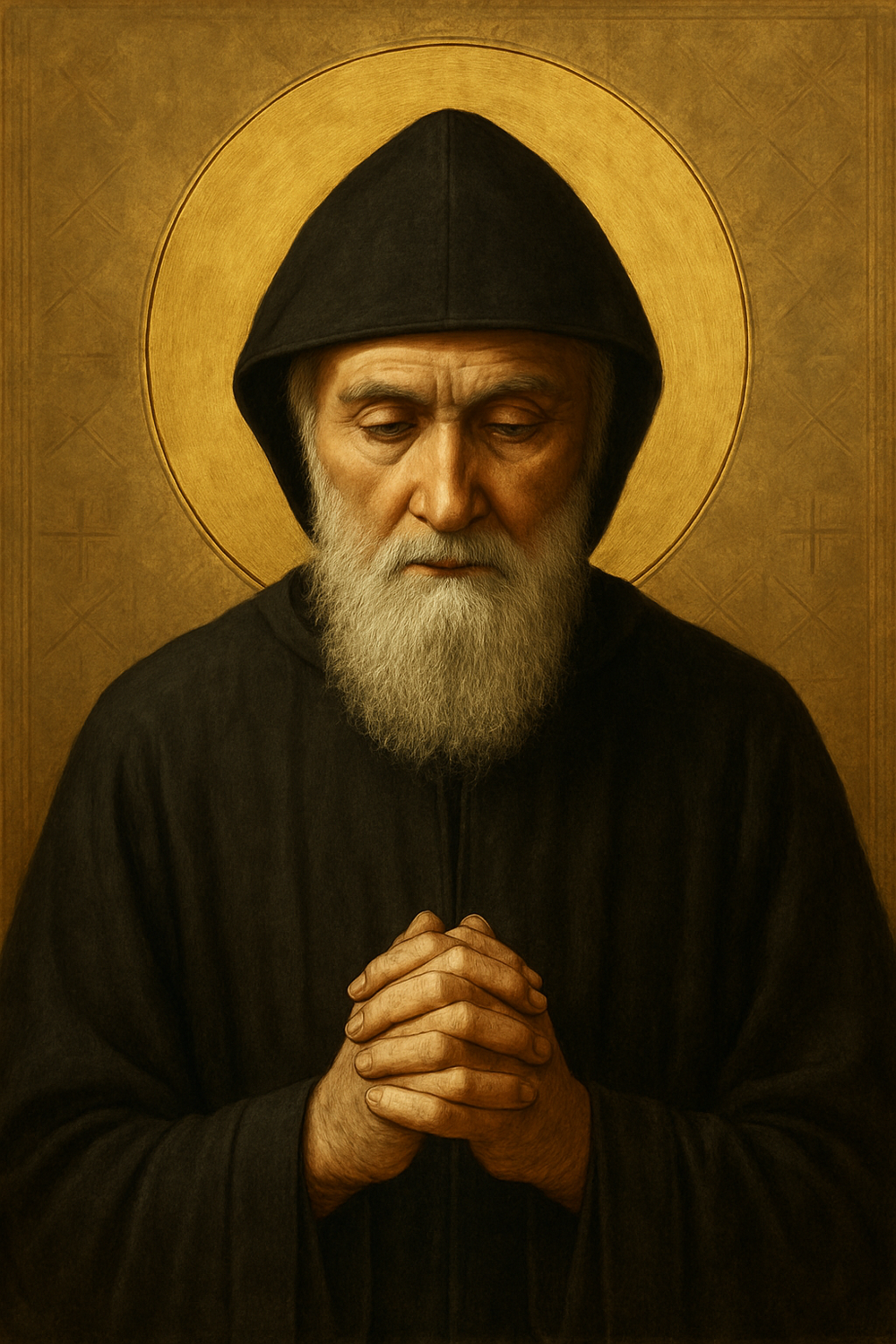
Saint Charbel: The Mountain Hermit Who Embodied Maronite Endurance


The Qadisha Valley Today: Where This History Lives
The landscape where the 1282 schism played out is not a ruined archaeological site. It is a living place, inhabited, prayed in, and still capable of producing the same spiritual intensity that drove men into cliff-face caves in the thirteenth century and kept the Maronite patriarchs in rock-cut monasteries for five centuries.
The Qadisha Valley — designated a UNESCO World Heritage Site — stretches for 35 kilometers from the Cedars of God above Bsharri to the city of Tripoli on the Mediterranean coast. The same valley that contained the eight mummies of 1283, the same cliff walls along which the Maronite Patriarch lived in hiding during the Mamluk years, are today accessible to pilgrims and visitors who walk the ancient paths between the monasteries. The Monastery of Qannubin — which became the formal See of the Maronite Patriarchate in 1440 and remained so for nearly 400 years — is still there, cut into the cliff face, its frescoes from the eighteenth and nineteenth centuries covering walls that were already ancient when the first patriarch moved in after the Mamluk devastations. Seventeen of the twenty-six Maronite Patriarchs are buried in the monastery of Sainte Marina in the Qadisha Valley — men who led the church through the Ottoman period, the Mamluk aftermath, and the modern Lebanese Republic, all resting in the same valley where the 1282 crisis left its most haunting evidence.
The Monastery of Qozhaya, on the opposite flank of the valley from Qannubin, houses the first printing press in the Middle East — established in 1585, used to print the Psalms in Syriac in 1610. That press, in that valley, represents the Maronite Church's intellectual survival after the Mamluk period: a community that had been nearly destroyed rebuilding itself through education, scholarship, and the preservation of its ancient Syriac language and heritage.
For Maronite Christians in the United States and the diaspora, the Qadisha is not merely a historical site. It is the place where the church was formed, where the patriarchs prayed and were buried, where Saint Charbel built his hermitage in the same mountains where Daniel II of Hadshit held off the Mamluk army for forty days. To visit it is to walk through the same terrain that the 1282 schism's protagonists — the unionists, the autonomists, the captured patriarch, the eight villagers who fled into the cave — knew as their home.
Maronite Pilgrimage in the United States
You don't have to travel to Lebanon to connect with the living Maronite tradition that survived the 1282 schism, the Mamluk devastations, and seven centuries of mountain endurance. Read our guide to Maronite pilgrimage sites in the United States — including Our Lady's Maronite Catholic Church in Austin, Texas, one of the only purpose-built Maronite churches in America designed from ancient Syriac architectural blueprints.
Read the Pilgrimage Guide →Further Reading
Go Deeper Into Maronite History and Theology


Free Christian Marriage Books — Rooted in the Ancient Eastern Tradition
The same Maronite and Eastern Christian tradition that produced the saints and patriarchs of this history also has profound wisdom for Christian marriage. Our free books — no paywall, no email required, every chapter available — draw on this ancient heritage and offer it to couples at every stage of their relationship.
Read Free Marriage Books →Frequently Asked Questions
Primary and Secondary Sources
This article is built entirely from documented historical sources. Given the obscurity of this period and the rarity of English-language scholarship on 13th-century Maronite history, the sources are listed in full so that readers — and the Maronite clergy and historians who may encounter this article — can verify, supplement, and challenge the reconstruction offered here.
- Patriarch Estephan El Douaihy, The Annals (Chronologie des Patriarches Maronites), compiled 17th century (Douaihy, 1630–1704), published in Arabic by Rashid Shartouni, 1902. — The foundational primary source for medieval Maronite history. Directly cited for the account of Daniel II of Hadshit's defense of Ehden, the forty-day resistance, and the capture by ruse. Quoted throughout this article via multiple secondary sources that preserve its text.
- "Maronites" entry, in The Crusades: An Encyclopedia, ed. Alan V. Murray, ABC-CLIO, 2006. Available via erenow.org. — The most direct scholarly source confirming that after the unionist patriarch's death in 1282, "the opponents of the union with Rome succeeded in having their own candidate elected." Confirms the factional dynamics and the 1289/post-Tripoli resolution of tensions.
- "List of Maronite Patriarchs", Maronite Heritage (maronite-heritage.com). — Preserves the patriarchal list in the Douaihy-Assemani tradition, showing Luca El-Bnehraney (#38, 1282–1283) and Jeremiah El-Damalsy (#39, 1283–1297) in immediate succession — the documentary backbone of the dual-patriarch account.
- "Maronite History", Our Lady of Lebanon, Easton (ololeaston.org), and Australian Blouza Association (blouza.com). — Both sites preserve extended quotations from Douaihy's Annals in English translation, including the crucial passage on Daniel II of Hadshit's defense of Ehden ("forty days") and capture by ruse (DOUAIHY, The Annals, 338).
- "History of Kfarsghab", Wikipedia (en.wikipedia.org/wiki/History_of_Kfarsghab). — Documents the 1268 and 1283 Mamluk campaigns against Jebbet Bsharri specifically, the "anti-Frankish party" active in the region, and the named collaborator Ibn Al Sabha from Kfarsghab who sided with the Mamluks — direct evidence of internal Maronite factional division during this period.
- "Kadisha Valley", Wikipedia (en.wikipedia.org/wiki/Kadisha_Valley). — Documents the Mamluk campaigns of Baibars (1268) and Qalaoun (1283) against the monastery-caves and villages of the Qadisha, and crucially records the discovery of eight natural mummies dated to "around 1283 AD" in the 'Asi-al Hadath cave by the GERSL team (1989–1991).
- "Maronite Church", Wikipedia (en.wikipedia.org/wiki/Maronite_Church). — Background on the Mamluk period persecutions (1268–1291), the fall of Tripoli, and the patriarchal sequence.
- "Maronite Christians and the Third Way", New Lines Magazine (newlinesmag.com). — Rich narrative of the Maronite-Crusader relationship, the Mamluk campaigns, and the internal feuding among Maronite chieftains in the Qadisha crescent after the Mamluk consolidation.
- "History of the Maronites", St. Joseph Maronite Catholic Church (sjmaronite.org), and Maronite Foundation (maronitefoundation.org/66). — Multiple sites preserve parallel versions of the canonical Maronite historical narrative, documenting that Patriarch Daniel from Hadshit "leader of the resistance was captured and executed" in the 1268–1283 period.
- "Aspects of Maronite History, Part Three", Eparchy of Saint Maron of Brooklyn (stmaron.org/marhist/part03). — Documents the Maronite-Crusader relationship, the Mamluk defeat of the Franks, and the capturing of the Maronite Patriarch during the late-13th-century crisis.
- "List of Maronite Patriarchs of Antioch", Wikipedia (en.wikipedia.org/wiki/List_of_Maronite_patriarchs_of_Antioch). — Notes that the patriarchal list follows the Series of Maronite Patriarchs written by Patriarch Estephan El Douaihy in the 17th century.
- "Maronite Church", Britannica (britannica.com). — Background on the Crusading relationship and Mamluk persecution period.
- "Maronites", Catholic Encyclopedia, NewAdvent (newadvent.org). — Historical background on the Maronite-Rome relationship and the Lateran IV connection.
- "The Maronite Church and The Future of Catholic Lebanon", FSSPX / Ad Orientem (liban.fsspx.org). — Notes the complete Maronite withdrawal into the Qadisha Valley after the Mamluk devastations.
A Church Forged in the Mountain
The Maronite Church that you encounter today — in Lebanon, in America, in Australia, in Brazil — is the direct descendant of the community that held Ehden for forty days and fled into the caves of the Qadisha with artifacts in their arms. It survived the two-patriarch crisis of 1282. It survived the Mamluk devastations. It survived the burning alive of its Patriarch in 1367. It is still here. The cedar mountains remember everything.
Browse Maronite Prayer Cards →