Our Lady’s Maronite Church Austin: America’s Only Ancient Syriac-Designed Church (Pilgrimage Guide)
A Maronite Pilgrimage Guide · Austin, Texas
A Church Out of Time
Why every Maronite Catholic in America — and every Catholic curious about the ancient Church — should make a pilgrimage to Our Lady's Maronite Church in Austin, Texas: the only purpose-built Maronite church in the country designed from ancient Syriac blueprints.
"It just looks like something picked up in the Holy Land and plopped down here in Austin."
There is a moment that happens to almost every Maronite who walks through the doors of Our Lady's Maronite Catholic Church in Austin, Texas for the first time. It is quiet. It is the moment your body registers something your mind has not yet fully processed: this does not feel like any church I have been in before.
It does not feel like the repurposed Protestant building where another Maronite community worships. It does not feel like the converted Roman Catholic church where so many of us grew up, with its Latin floor plan quietly whispering of a tradition that was never quite ours. It does not feel modern. It does not feel Western. It feels, somehow, like a memory you did not know you carried — like stepping into a church your great-great-grandparents knew in the mountains of Lebanon or on the plains of ancient Syria.
That feeling is not accidental. It is the entire point. Our Lady's Maronite Catholic Church in Austin was built — from foundation to dome — to make you feel exactly that way. Through years of theological research, intentional architectural decisions, and artisanal craftsmanship sourced from Lebanon to Mexico to Italy, this church was constructed as a deliberate act of identity recovery: an answer to the quiet crisis that has followed Maronite Catholics through centuries of diaspora and Latinization. What does our worship actually look like, in its own skin, in its own space, on its own terms?
The answer that rises fifty feet above a residential street in Austin, Texas — in the shape of a deep-maroon monolithic dome — is one of the most remarkable and underappreciated stories in American Catholic life. This is that story.

The deep-maroon dome with its central cross rises above East 51st Street in Austin. Photo: Monolithic Dome Institute
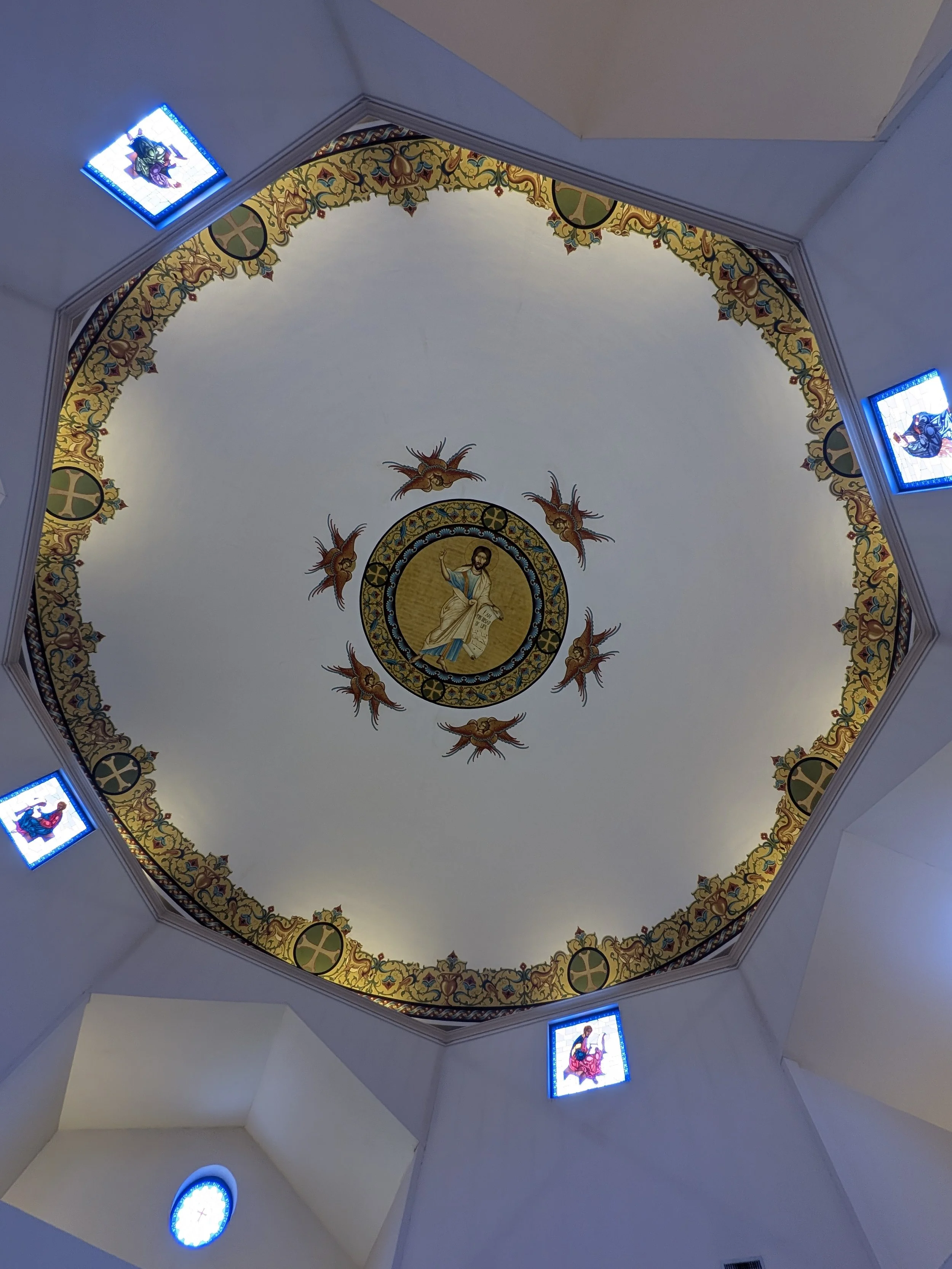
The sanctuary dome from below — 48 feet wide, 50 feet tall, with four stained-glass evangelist panels. Parishioners describe it as "looking up into heaven."
The Crisis That Built a Church
What Latinization did to Maronite worship — and why Austin refused to continue it
To understand why Our Lady's Maronite Church is extraordinary, you first have to understand what it was built in response to.
The Maronite Church is one of the oldest Christian communities on earth, tracing its origins to the followers of St. Maron, a 4th-century Syrian ascetic who lived near the Orontes River in northwestern Syria. The liturgical tradition that grew around his spiritual descendants is West Syriac in character — rooted in the Semitic Christianity of Antioch, shaped by Aramaic prayer, and architecturally expressed in a way entirely distinct from the Latin West. As Maronite liturgical scholar Chorbishop Seely Beggiani has written, it was formed at the crossroads of Hellenistic cities and the Semitic countryside — a "Semitic lung" within the broader Body of Christ.
For centuries, Maronite Christians built their churches to reflect this tradition: sanctuaries oriented toward the east at sunrise, a raised bema in the nave where the Word of God was proclaimed in the midst of the people, a sanctuary veil that opened and closed with the movement of the liturgy, iconographic programs drawn from Syriac manuscript tradition, and liturgies that preserved the oldest surviving Eucharistic prayers in all of Christendom — including the Anaphora of Sharar, considered by scholars the most ancient Eucharistic canon still in use anywhere in the universal Church.
Then came the Crusades, the Counter-Reformation, and centuries of well-intentioned but transformative influence from Rome. Maronite churches began to look more like their Latin neighbors. Pews replaced open nave floors. Altars moved against walls. The bema disappeared. The sanctuary veil vanished. Western statues supplanted Eastern icons. The loss was so complete that today, the Maronite tradition preserves an extraordinary Holy Thursday ritual memory: in many parishes, the celebrant's chair is placed in the center of the nave on that day — where the bema used to be — as a liturgical act of remembrance of a feature that vanished from the built space centuries ago. The prayer survived. The building did not.
When Maronite immigrants arrived in the United States, this displacement accelerated. Most communities purchased former Protestant buildings or adapted Roman Catholic parishes — faithfully and gratefully — but in spaces that were never designed for their tradition. The Second Vatican Council's decree Orientalium Ecclesiarum had explicitly urged Eastern Churches to retain their traditions "whole and entire," and where communities had fallen short, to take steps "to return to their ancestral traditions." For diaspora Maronite communities building in borrowed spaces, that return was architecturally impossible. The building of Our Lady's Maronite Church in Austin was, from its very conception, an answer to that decree.
A building committee was formed — Yolanda Teran, Roger El Khoury, Julia Sawyer, and the founding pastor — and architect William Scarmardo was selected. Contracts were signed in November 1997, ground was broken on Sunday, December 16, 1997, and by January 1999 the building was consecrated: 8,500 square feet of deliberately, unapologetically Eastern Christian space, rising above East 51st Street in Austin, Texas.
"The Monolithic Dome atop the sanctuary helped us create a church that reflects 2000 years of Christianity. And it's not your typical Western church. It is Eastern in design and it is unique."
The Ancient Blueprint
Qal'at Sim'an and the 5th-century grammar of Syrian pilgrimage architecture
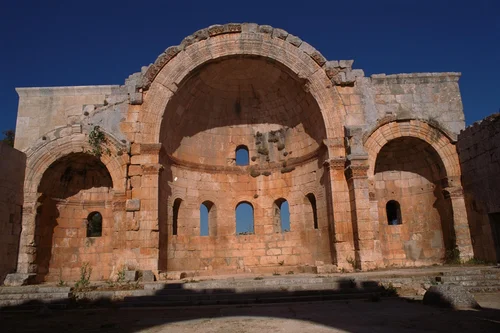
Qal'at Sim'an — the ruins of the Basilica of St. Simeon Stylites, northwestern Syria, built 474–491 AD under Emperor Zeno. Its four basilica arms radiated from a central octagonal space around the saint's column. Photo: Bernard Gagnon, Wikimedia Commons, CC BY-SA 3.0
Every great building begins with a model. For the Austin church, the model was nearly 1,500 years old.
The Basilica of St. Simeon Stylites — Qal'at Sim'an in Arabic, "the fortress of Simeon" — stands in ruins on a hillside in northwestern Syria, approximately 30 kilometers northwest of Aleppo. Built during the reign of Byzantine Emperor Zeno (474–491 AD), it was constructed around the most famous pilgrimage destination in the ancient world: the column upon which the ascetic monk Simeon had lived in prayer for decades, preaching twice daily to crowds from Gaul, Persia, and Britain.
The complex was not merely a church. It was a complete pilgrimage infrastructure: a cruciform martyrium centered on the column, a monastery, a baptistery, accommodations for pilgrims, and a processional via sacra lined with shops connecting the hilltop to the town below. It was pilgrimage architecture in the fullest sense — every element designed to receive, orient, and spiritually sustain the traveler who had come from across the known world to pray in one specific place.
Four basilica arms radiated from a central octagonal space at whose heart stood the remains of Simeon's column. The founding pastor of Our Lady's explicitly cited this complex as a blueprint for significant areas of the Austin church — not a loose aesthetic reference but a deliberate theological genealogy, anchoring the building to the actual Christian landscape of Syria in the late antique period, the very world in which the Maronite tradition was born.
And in the smaller chapel used for Wednesday services, the connection is made tangible in the most intimate way: the chapel altar is fashioned as a direct homage to the column of St. Simeon Stylites himself — a physical reminder that this tradition began not in a cathedral but on a pillar, and that the Eucharist is the ultimate pillar of encounter between God and humanity.
Behind this model lies an even deeper architectural genealogy. Christian sacred space itself began in ordinary domestic life: at Dura-Europos on the Euphrates, a private house was converted into a Christian assembly space around AD 240 — complete with a meeting hall and a baptistery — making it one of the oldest excavated Christian buildings in the world. From house church to Syriac basilica to the pilgrimage complex of Qal'at Sim'an: the arc of Christian building is an arc of increasingly intentional sacred space, each generation building more deliberately than the last. Our Lady's Maronite Church in Austin stands at the end of that arc — built with the same intentionality, for the same purpose, in a Texas city that would have been as surprising to Simeon as Austin might be to anyone.
The Bema
The Jerusalem of the Church — a liturgical geography restored after centuries of loss
Of all the features that distinguish Our Lady's from virtually every other Maronite parish in the United States, the most theologically significant is also the least immediately obvious: the bema.
In the ancient churches of northwest Syria — the same Limestone Massif where St. Maron lived — the bema was a raised platform placed in the nave, among the people, at the center of the congregation. The Limestone Massif holds the largest concentration of late antique churches in the world, dating from the later 4th century through the early 7th century, and within this landscape scholars have identified approximately 45 churches featuring a bema as a defining architectural element. These are not uniform structures. The bema's exact position varied by region and century — sometimes a central horseshoe platform in the nave, sometimes shifting toward the sanctuary — but in every case it functioned as the site of the Liturgy of the Word, the Table of Scripture, the place where the lector stood among the people to proclaim what the altar would enact.
Syriac liturgical commentary traditions, reaching back to the great Church Fathers of Edessa and Antioch, mapped the interior of the church as a cosmic theology. In this understanding, the bema represented "earthly Jerusalem" — the place of Christ's public ministry, his presence in the midst of humanity, the Incarnation made spatial. The sanctuary, at the east end, represented "heavenly Jerusalem" — the place of sacrifice, of the Eucharistic offering, of death and resurrection and gift. The procession from bema to altar was not a liturgical technicality. It was the enactment in space of the entire arc of salvation: from the Word spoken among the people, to the Word offered on the altar for the life of the world.
As Patriarch Rai's encyclical on the Maronite Liturgy states, the bema represents "Christ, the Lord, who dwells in the midst of the community, and He is their center point, and they gather around Him." The Eparchy of Saint Maron's catechetical essay frames the bema as a historically distinctive Maronite marker, one so deeply embedded in the tradition that even today, on Holy Thursday, many Maronite parishes place the celebrant's chair in the center of the nave — where the bema used to stand — as an act of living liturgical memory. The architecture is gone from most churches. The memory is not.
At Our Lady's Maronite Church in Austin, that memory has been given a body again. The parish describes a raised bema that encircles the altar on the east end — a feature explicitly linked in the church's own documentation to the Jewish synagogue tradition of the raised reading platform, honoring the Semitic and Jewish roots of Maronite worship that the Syriac tradition preserved with particular fidelity. Whether one reads this as a central nave platform in the strictest ancient sense or as a sanctuary-encircling raised space, the theological intention is identical: the Word belongs among the people, the liturgy moves from proclamation to sacrifice, and the building makes that movement visible. It is a liturgical geography that most Maronite churches in America simply cannot offer — because their buildings were never built to house it.
In ancient Syriac cosmological commentary, this movement — from bema (earthly Jerusalem) to altar (heavenly Jerusalem) — enacted the entire arc of salvation in a single liturgy. At Our Lady's, you can see this theology inscribed in the space itself.


The Dome and the Spire
Why the shape of the roof is a theological argument, not a stylistic preference
Western Catholic Tradition
Reaches upward. Expresses humanity's aspiration toward God — the ache of the creature for the Creator, the vertical strain of the finite toward the infinite. God is transcendent, above, calling us to ascend.
Syriac / Eastern Tradition
Descends. The vault of heaven coming down to meet the earth — God choosing to dwell among His people. "God is here — right in our midst and in our lives." The Incarnation expressed in concrete and light.
This distinction was not abstract for the builders of Our Lady's. It reflected a deep difference in theological sensibility between Western and Syriac Christian traditions. The dome at Our Lady's is 48 feet in diameter and rises 50 feet from the sanctuary floor — built using Monolithic Dome technology that allowed a seamless, column-free vault, giving every person in the congregation an unobstructed view of the sanctuary. The result, in the words of a parishioner, is "looking up into heaven" — precisely the effect Eastern Christian dome theology has always intended.
The Sanctuary Veil
One of the oldest liturgical practices in Christianity — preserved here when it has vanished from almost every other Maronite church in America
No single feature of Our Lady's Maronite Church will surprise a Roman Catholic visitor more than the sanctuary veil — the richly embroidered curtain that hangs before the altar and can be drawn closed or opened as the Qurbono moves from one sacred action to the next. In Western Catholic churches, the altar is always visible. Here, at certain moments, it is hidden. And that hiddenness is not an architectural quirk. It is a theology older than most of Western Christianity itself.
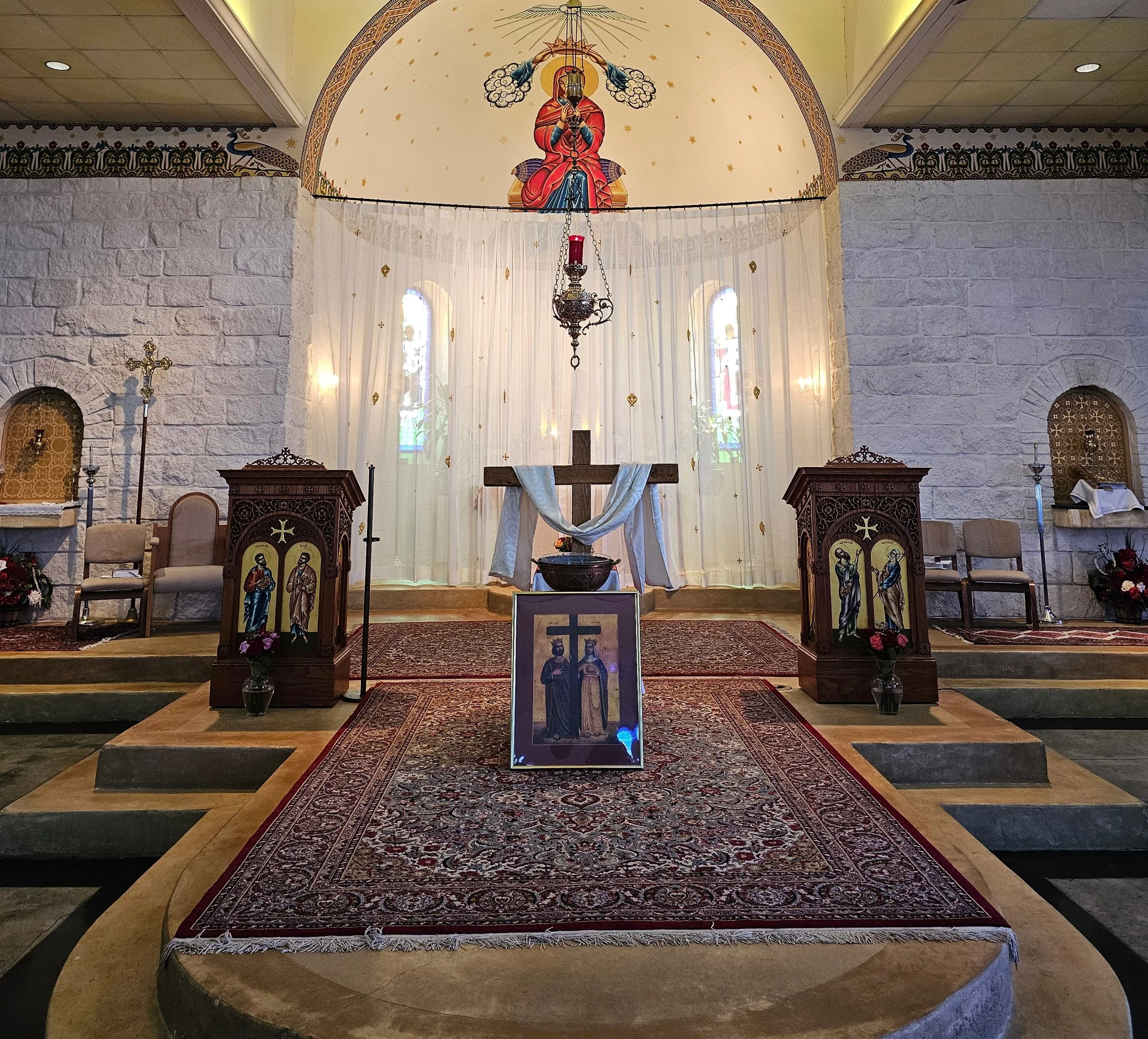
The Veil Closed
The sanctuary veil drawn closed — the altar hidden, the mystery veiled. The sacred action at the altar is set apart from the nave during the Liturgy of the Word, as it was in the earliest Syriac churches of Syria.
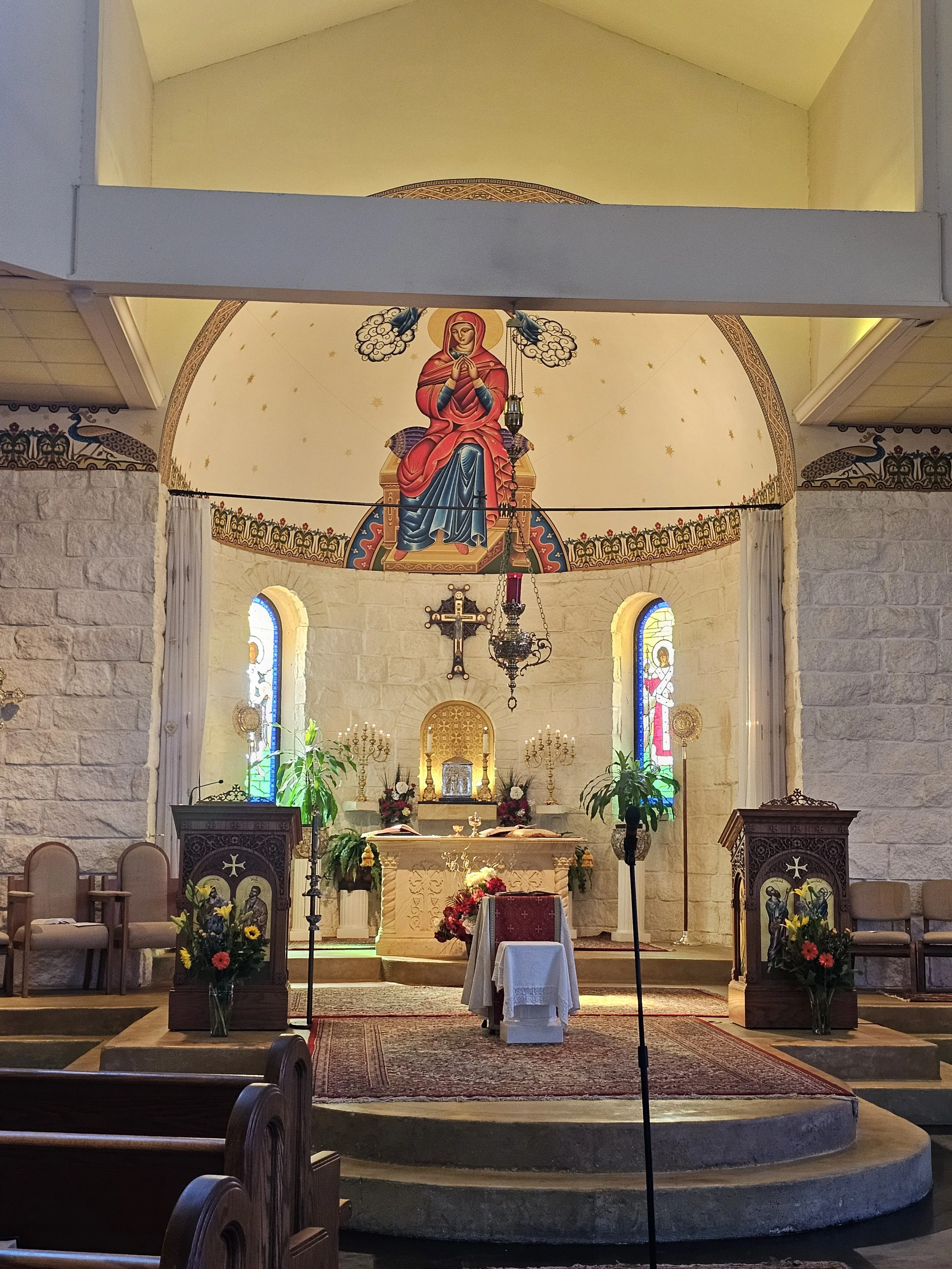
The Veil Opened
The sanctuary veil opened — the altar revealed, the Eucharistic action begins. Ancient Syriac writers described this moment as an image of the heavens themselves opening.
The sanctuary veil in Syriac Christian architecture has its roots not in medieval practice but in the very origins of Jewish and Christian worship. To understand what you are seeing at Our Lady's Maronite Church, you need to go back — far back — to the Tabernacle in the desert.
In the ancient Tabernacle that Moses built according to God's instructions, the innermost chamber — the Holy of Holies, where the Ark of the Covenant was kept and God's presence (the Shekinah) dwelled — was separated from the Holy Place by a woven curtain called the parochet, made of blue, purple, crimson, and white thread with cherubim embroidered directly into the fabric. Only the High Priest could pass through it, and only once a year, on the Day of Atonement. To everyone else, the place of God's dwelling was hidden. The veil was the boundary between earth and heaven, between the human and the divine, between time and eternity.
Then, at the moment of Christ's death on Golgotha, the Temple veil was torn from top to bottom (Matthew 27:51). Not from bottom to top — as if a human hand had pulled it — but from top to bottom, as if God Himself had opened it. The Holy of Holies was no longer hidden. The way into the presence of God was opened to all, not just to one high priest on one day of the year. As the Letter to the Hebrews declares, we now have "confidence to enter the Most Holy Place by the blood of Jesus, by a new and living way opened for us through the curtain" (Hebrews 10:19–20).
The earliest Christian churches carried this theology directly into their architecture. The altar, as the site of the Eucharistic sacrifice, was understood as the Christian equivalent of the Holy of Holies — the place where Christ's self-offering was made present, where heaven and earth met. And it was separated from the nave by a veil.
Christian
The Parochet: Veil of the Jerusalem Temple
The woven curtain separating the Holy of Holies from the Holy Place in Solomon's Temple and its successor. Josephus described it as a Babylonian tapestry embroidered with a panorama of the heavens. Only the High Priest could pass through it, once a year, on Yom Kippur. Theologically, it was the boundary between earth and heaven — the veil of the divine mystery.
The Veil Is Torn: The Crucifixion
At the moment of Christ's death, the Temple veil was torn from top to bottom (Matthew 27:51). Christ, the great High Priest, had entered the heavenly Holy of Holies "through his own blood" (Hebrews 9:12), opening the way for all. The mystery, once veiled, was opened. This event is the theological engine behind every liturgical veil in every Syriac church ever built.
The Earliest Christian Churches: A Simple Veil on a Rod
The earliest Christian sanctuaries, including some of the house churches of the apostolic era, restricted access to the altar at appropriate times via a simple veil or curtain suspended by a rope. This arrangement can still be seen in the ancient Syriac Church of St. Mark in Jerusalem. The altar functioned as the new Holy of Holies — the sanctuary of the Eucharistic sacrifice — and was veiled accordingly.
The Syriac Church: Veil as Theological Architecture
In the ancient Syriac church, the building was divided into three parts mirroring the Temple: the haykla (nave, for the faithful), the qestroma (chancel, for singers and lower clergy), and the qanke-qudsha (sanctuary, for priests). A curtain-veil separated the sanctuary from the chancel. The sanctuary was drawn closed during the Liturgy of the Word — when the Word was proclaimed from the bema in the nave — and opened when the Eucharistic action began. The great domed basilicas of Syria, including those of the Limestone Massif that shaped Maronite architecture, were built around this liturgical drama of concealment and revelation.
The Ciborium and Its Curtains in the Great Basilicas
In large Byzantine and Eastern churches, a domed canopy called a ciborium was placed over the altar, with curtains on rods that could be closed on all four sides. The historian notes that even in the Hagia Sophia in Constantinople, curtains were drawn closed during certain sections of the liturgy. The comparison with the biblical veil of the Temple was explicit and intentional. This tradition is still preserved in the Coptic and Armenian churches.
Syriac Church Fathers Write the Theology of the Veil
The Syriac Church Father Mar Yuhanon of Dara (+825 AD) explicitly described how the nave, chancel, and sanctuary of a Syriac church allegorically mirror the three parts of the Temple — and how the veil before the sanctuary corresponds to the veil of the Holy of Holies. Moses Bar Kepa (+903 AD) wrote that the sanctuary altar is Christ Himself, and the veil before it is the veil of divine mystery. These weren't architectural observations. They were theological statements about what the building is doing every time the liturgy unfolds within it.
Latinization Removes the Veil from Most Maronite Churches
Through centuries of Western influence, the sanctuary veil disappeared from most Maronite churches worldwide. In the United States, where Maronite parishes were overwhelmingly housed in repurposed Latin buildings, the veil had no architectural home. The Maronite Qurbono continued to contain the ancient "Prayer of the Veil" — but for most congregations, it had become an orphaned prayer: words without the thing they referred to.
Our Lady's Maronite Church Austin Restores the Living Veil
When Our Lady's Maronite Church was purpose-built in Austin, the sanctuary veil was restored as a living liturgical feature of the Qurbono — not as a museum piece, not as decoration, but as the actual embroidered curtain it has always been, drawn and opened with the movement of the Mass. It is believed to be the only active sanctuary veil in regular liturgical use at a Maronite church in the United States.
The Maronite Qurbono contains a specific prayer known as the Prayer of the Veil — one of the oldest surviving prayers in the Maronite liturgical tradition. It appears at the transition point in the liturgy, when the Liturgy of the Word is concluding and the Eucharistic service is about to begin. The prayer asks the faithful to seek forgiveness of their sins in preparation for the sacred action about to take place at the altar.
When the veil is drawn open at this moment, ancient Syriac writers see in this gesture an image of the opening of the heavens themselves. The Divine Liturgy on earth, in their understanding, is an earthly reflection of the eternal Divine Liturgy taking place in heaven. When the veil moves aside, it is not merely a practical gesture. It is the liturgical enactment of the torn Temple veil — the moment God's presence ceased to be hidden behind the Holy of Holies and became accessible to all, through the blood of Christ the High Priest.
There is a second interpretation of the Prayer of the Veil that is equally ancient: it refers to the lifting of the chalice veil, the cloth that covered the sacred gifts as they were carried in procession. When the veil over the chalice was removed, it signified that the offering was being presented to God — the gifts set apart, the sacrifice beginning. In either interpretation — the sanctuary veil or the chalice veil — the theology is the same: something was hidden that is now revealed. Something veiled is now open. The movement from concealment to disclosure is the movement of salvation itself.
For a Roman Catholic visiting for the first time, watching the sanctuary veil close and then open is an experience that cannot be explained before it is felt. You understand something in your body that your mind may only name later. The altar that in your own tradition is always in view is suddenly absent — hidden behind richly embroidered cloth. And when it is opened, and the sanctuary lights and the golden altar come into view, and the Eucharistic action begins, you grasp something you may have always intellectually believed but perhaps never physically experienced: that the holy is not always visible, that there are moments when we are being prepared before we are permitted to enter, and that the movement between those two states — preparation and participation, concealment and revelation — is the very structure of the Christian life.
Most Maronite Catholics in the United States have never seen the sanctuary veil in a church. Most have heard the "Prayer of the Veil" in the Qurbono but without the physical object it refers to. At Our Lady's Maronite Church in Austin, that gap — between the prayer and the thing the prayer describes — has been closed. The words and the action belong together again, as they did in the ancient Syriac churches of Syria fifteen centuries ago.
When you stand in that nave and watch the veil close, you are standing in a liturgical moment that connects you directly to the Temple of Jerusalem, to the Tabernacle in the desert, to the Syrian basilicas of the 4th and 5th centuries, to the cave churches of Lebanon, and to every Syriac Christian who ever understood the Eucharist as the tearing of the veil between God and humanity. That is not a metaphor. That is what is actually happening. And at this church, you can see it, and feel it, with your own eyes.
The Icons That Teach
The Rabbula Gospels, the cave-church mural, and icons as a pictorial of the liturgy
A church is not just its architecture. It is everything that inhabits that architecture. At Our Lady's, the iconographic program was chosen and executed with the same intentionality as the structural design — each image not merely decorative but catechetical, a visual text teaching the theology of the Qurbono to all who enter.
The dome icons — depicting the Mother of God and Christ — were modeled specifically on the Rabbula Gospels, a 6th-century illuminated Syriac Gospel book created at the Monastery of St. John of Zagba in Syria and now held in the Laurentian Library in Florence. The Rabbula Gospels are among the most important surviving witnesses to Syriac Christian visual tradition. To take these images and place them on the dome of a church in Austin, Texas, is to draw an unbroken visual line from 6th-century Syria to 21st-century America.
The execution of the iconographic program was itself an act of devotion. The Christ icon at the center of the dome — described in the parish's own anniversary documentation as the interior centerpiece — took iconographer James Campbell approximately one and a half years to design and create. Its installation required the removal of pews from the nave to allow a boom scaffold to reach the dome's apex. The weight of that process — the months of work, the careful planning, the physical labor of installation — was not incidental to the result. It was part of it.
Inside the bema sits a mural depicting Mary being crowned Queen of Heaven, painted by Campbell from photographs of an 11th-century original on the wall of a cave that served as a subterranean Maronite church in Lebanon. The Qadisha Valley cave churches represent one of the most intense chapters in Maronite history — a community that preserved its liturgy in stone chambers carved from mountain cliffs during centuries of persecution. That cave painting now lives in Austin. The parish brought the cave with them.
"Icons as a pictorial of the Liturgy" — every image at Our Lady's was chosen to teach the Syriac theology of the Mass through the ancient language of sacred symbol, following 6th-century manuscript tradition from Syria.
Every Detail, Sourced From the World
The bell, the columns, the marble, the water — nothing left to convention
The Bell from Beit Chebab
Cast at the Beit Chebab foundry in Lebanon — a village that has been Lebanon's primary bellmaking center since the 18th century, with a craft tradition tracing to the 1840s. Rung by rope, by human hands. The act of ringing is itself a prayer, and the sound carries the Lebanese mountains into Austin.
Madeira Stone Columns
Four Corinthian columns hand-carved in Mexico from Madeira stone honor the Roman architectural heritage of Antioch — the city from which the Maronite tradition traces its apostolic lineage.
The Living-Water Baptismal Font
Running water — a reference to Syriac baptismal theology: immersion in the "living waters" of the Jordan. The water does not stand still. Neither does new life in Christ.
32 Stained Glass Windows
Thirty-two windows fill the nave. Four panels in the dome depict the four Evangelists, continuing a tradition from the earliest domed Christian churches of the Byzantine world.
Carrara Marble Statue
The garden statue of the Blessed Mother was commissioned from the Carrara marble quarries — the same stone associated with Michelangelo. Thousands have gathered here for outdoor liturgies.
The 2065 Time Capsule
In 2015, the parish sealed a treasure chest of memories and sacred objects, to be opened on the 100th anniversary in 2065. The same long-horizon thinking that built the church is still building it — for grandchildren not yet born.
The Feast of St. Sharbel
An annual pilgrimage event — open to every Catholic, from every rite and tradition
For Roman Catholic visitors in particular: coming to Our Lady's on the feast of St. Sharbel is a genuinely rare opportunity in the United States. You will attend a Mass that is recognizably Catholic — the same faith, the same Eucharist, the same Lord — but expressed in a liturgical tradition that predates most of what you know as "Catholic worship." The Aramaic chants, the incense, the sanctuary veil drawing open, the blessing with a hand cross, the sign of peace flowing from the altar outward through the congregation — all of it will be familiar enough to follow and different enough to astonish. It is not a foreign experience. It is a deeper layer of your own faith, made visible.
St. Sharbel Makhlouf (1828–1898) is a canonized saint of the universal Catholic Church, venerated by Pope Paul VI who canonized him in 1977. His documented miracles of healing have been verified by the Vatican. Coming to pray before his relics at Our Lady's is not a Maronite devotion alone. It is a Catholic one, belonging to the whole Church.
Contact the parish directly at ourladysmaronite.org or (512) 458-3693 for the current feast-day schedule.


Stepping Into the Ancient Church
What no other church in America can give you — Maronite, West Syriac, or Roman Catholic
Most of us in the diaspora know our faith from two directions: from the prayers themselves, and from the stories we have been told about where those prayers come from. We know, intellectually, that our liturgy was shaped in Antioch. We know it carries the fingerprints of St. Ephrem the Syrian, of St. Maron, of the monk on the column and the hermit in the cave. But knowing is not the same as inhabiting.
At Our Lady's, you can inhabit it. You walk in facing east. Above you, the dome descends like the vault of heaven. You see the bema where the Syriac Church always placed it — among the people, where the Word belongs. You watch the sanctuary veil drawn closed, and in that closing you feel — not just intellectually understand — what it means that the holy is not always accessible on our schedule and by our presumption. And then, at the appointed moment, you watch it open. And you feel what the Syriac writers felt when they said that the opening of the veil is an image of the opening of the heavens. You stand before a cave-church mural from Lebanon. You hear a bell cast in the Lebanese mountains. You stand before an altar modeled on the column of St. Simeon. And if you come on the feast of St. Sharbel, you receive the oil of his healing in a church built the way the ancient Church built.
This is what a pilgrimage is for. Not merely to travel. To be placed, bodily and spiritually, inside the living history of your faith. For Maronite Catholics in America — for all of the West Syriac family — and for every Roman Catholic curious about the breadth of the Church's ancient traditions — there is no place in the United States closer to the early Church than this building, on this street, in this unlikely Texas city.
The dome above your head says what it has always said, in every Eastern Christian church where it has risen: He is here. He is among us. The veil has been torn. Come.
Plan Your Pilgrimage
Our Lady's Maronite Catholic Church welcomes pilgrims, visitors, and all who seek to encounter the ancient Eastern Christian tradition in the heart of Texas.