There is something quietly extraordinary about Saint Jude Thaddaeus. He appears only a handful of times in the Gospels. He left behind one of the shortest letters in the entire New Testament. He was martyred far from Jerusalem, in lands the other apostles rarely reached. And for centuries — truly, for centuries — Christians avoided praying to him.
Today, he may be the most invoked saint in the Catholic world. Novena cards to him are tucked inside wallets and taped to hospital walls. His name appears in newspaper columns, tattooed on arms, and whispered in darkened churches by people with nowhere else to turn. How did the most overlooked apostle become the saint of last resort? The answer runs through Scripture, through the ancient kingdoms of Armenia and Persia, through medieval theology, and through the psychology of desperate faith. This is the full story.
The Problem of Jude — Lost in Someone Else's Shadow
To understand Saint Jude, you first have to understand the problem. It begins with a name — one of the most damaged names in human history.
In the first century, "Judah" (rendered in Greek as Ioudas, in Latin as Judas) was one of the most common Jewish names. It honored the patriarch Judah, father of one of Israel's twelve tribes. Among the Twelve Apostles alone, there were apparently two men named Judas. One, of course, was Judas Iscariot — the betrayer. The other is our subject: Judas, son (or brother) of James, also called Thaddaeus.
After the crucifixion, the name Judas became radioactive in Christian communities. No saint was named Judas. No church was dedicated to Judas. The name that had been borne by kings and patriarchs was now synonymous with betrayal of God Himself. And in the process, the other Judas — the faithful apostle, the martyr, the man who gave us a letter of fire and urgency — was dragged under by association.
Medieval Christians were so nervous about confusing him with Iscariot that they simply… didn't pray to him. Why risk addressing your prayers to the wrong Judas? Why invoke a name so soiled by history? And so Jude sat largely unasked, his intercession unclaimed, his image unpainted, his feast day quietly observed and quickly forgotten.
This, scholars have argued, is precisely why he became the patron of lost causes. But we will get to that. First: who was he, actually?
What Scripture Actually Tells Us
The honest answer is: not very much — but what is there is remarkable.
The Name Problem in the Gospels
The four lists of the Twelve Apostles in the New Testament (Matthew 10:2–4, Mark 3:16–19, Luke 6:14–16, and Acts 1:13) present a small but significant problem. Matthew and Mark list an apostle named "Thaddaeus" (with Matthew adding the variant "Lebbaeus" in some manuscripts). Luke and Acts list instead "Judas of James" — which in Greek is ambiguous and could mean either "son of James" or "brother of James."
Most scholars and all major Christian traditions have concluded these are the same person. The name "Thaddaeus" likely comes from the Aramaic tad, meaning "breast" or "heart" — suggesting warmth, courage, or affection. It was probably a term of endearment or a second name used to distinguish him from Iscariot. Both names suggest a man of passionate devotion.
The Moment He Speaks
In the entire Synoptic tradition — Matthew, Mark, and Luke — Jude is listed but never quoted. He is background. He is present. He is faithful. But he does not speak. His one recorded moment of speech comes in the Gospel of John, and it is a profound one.
"Judas (not Iscariot) said to him, 'Lord, how is it that you will manifest yourself to us, and not to the world?'"
— John 14:22
This single verse does more to reveal Jude's character than any tradition or legend. The question comes during the Last Supper discourse, when Jesus has just promised to reveal Himself to those who love Him. Jude's question is not one of doubt — it is one of ardent, almost aching desire. He is the apostle who asks the question that every mystic eventually asks: Why can't the whole world see what I see?
Jesus' answer — "If anyone loves me, he will keep my word, and my Father will love him, and we will come to him and make our home with him" — is one of the most intimate responses Jesus gives to any individual question in the Gospels. That Jude drew it out is not incidental.
His Family and Relationship to Jesus
The Gospels record a list of Jesus' brothers: "James and Joseph and Simon and Judas" (Matthew 13:55; Mark 6:3). This Judas is traditionally identified with our apostle. Whether this "brotherhood" is biological, half-sibling, or cousin has been debated since the early Church. Jerome argued for cousin. Eastern tradition, including the Orthodox Church, tends to hold that these were children of Joseph from a prior marriage, making them stepbrothers of Christ. If either identification is correct, Jude grew up in proximity to Jesus — he knew him not only as teacher and Lord but as family.
Why "Thaddaeus"?
The dual names were likely a practical solution to an impossible problem. Early Christian communities needed a way to refer to this apostle without invoking the horror of Iscariot. "Thaddaeus" became the preferred name in Aramaic-speaking communities. By the medieval period in the West, he had become known almost exclusively as "Jude" — a shortened anglicization designed to put maximum distance between this beloved saint and the betrayer.
The Voice He Left Behind — The Epistle of Jude
If the Gospels give us almost nothing about Jude, his letter gives us everything about what he believed and feared.
The Epistle of Jude is twenty-five verses long — one of the shortest documents in the entire biblical canon. It was almost left out of Scripture entirely; several early Church fathers questioned its authenticity. Yet it survived, and if you read it carefully, you understand why. It is ferocious, urgent, and theologically dense in a way that rewards sustained attention.
A Letter of Warning and Urgency
Jude opens with a pivot. He says he intended to write about "our common salvation" but circumstances forced a change of plan. False teachers had infiltrated the community. They were distorting grace into license. They were denying Christ. And Jude's response is not measured: he reaches for every weapon in his theological arsenal.
He invokes the judgment on Israel in the desert. He invokes the fall of the angels. He invokes the destruction of Sodom and Gomorrah. And then — in a passage that shocked early readers and continues to fascinate scholars — he invokes the Book of Enoch.
"It was also about these that Enoch, the seventh from Adam, prophesied, saying, 'Behold, the Lord comes with ten thousands of his holy ones, to execute judgment on all and to convict all the ungodly of all their deeds of ungodliness...'"
— Jude 14–15, quoting 1 Enoch 1:9
This is a direct quotation from 1 Enoch — a Second Temple Jewish text widely read in the first century but not included in the Hebrew canon. That an apostle who grew up in the household of Jesus quotes this text as authoritative prophecy tells us something vital: the early Church was not operating in a hermetically sealed biblical world. (For a deep exploration of Enoch's place in early Christianity, see our articles on the Book of Enoch and the Church Fathers.)
What the Letter Reveals About Jude
Jude is not a gentle writer. He calls his opponents "waterless clouds," "wandering stars for whom the gloom of utter darkness has been reserved forever," "grumblers, malcontents, following their own sinful desires." He has the passion that his name — courageous heart — implies. But the letter ends in one of the most beautiful doxologies in the New Testament:
"Now to him who is able to keep you from stumbling and to present you blameless before the presence of his glory with great joy, to the only God, our Savior, through Jesus Christ our Lord, be glory, majesty, dominion, and authority, before all time and now and forever. Amen."
— Jude 24–25
The man who rails against apostasy in verse 13 is the same man who ends with radiant confidence in God's keeping power. This is the apostle: passionate, protective, theologically serious, and ultimately anchored in doxology.
The Apostle Goes East — Ministry & Mission
After the resurrection and Pentecost, the Twelve scattered. The New Testament says almost nothing about what happened to most of them. For Jude, the early Church traditions are remarkably consistent: he went east. Far east.
Eusebius of Caesarea records that after Pentecost the apostles went to "all nations." Origen, writing in the third century, names Jude as a missionary in Mesopotamia. The Apostolic Constitutions associate him with Edessa, a major Syriac Christian center in what is now southeastern Turkey. Various traditions add Judea, Samaria, Idumaea, Syria, Libya, and Arabia to his mission field. What is notable is that virtually every early source points him away from the Mediterranean heartland and toward the ancient world's eastern frontier — toward Persia, Mesopotamia, and the Caucasus.
The Shape of His Mission
This is not geographically random. The eastern Mediterranean and Mesopotamian regions had large Jewish diaspora communities dating back to the Babylonian exile. An apostle reaching these communities would have been working in familiar cultural and religious territory — following the deep network of synagogues and kinship connections that ran like veins through the ancient Near East. The fact that Syriac-speaking Christianity — the oldest continuous form of Eastern Christianity — identifies so strongly with apostolic foundations attributed to Jude suggests that whatever his precise itinerary, the churches he founded survived and remembered him.
Armenia's Founding Apostle — The Eastern Traditions
Of all the Eastern Christian traditions that claim a relationship with Saint Jude, none is more profound, more ancient, or more historically significant than the Armenian Apostolic Church.
The Founding Claim
The Armenian Apostolic Church — the world's oldest national Christian church, having adopted Christianity as a state religion in 301 AD — traces its founding directly to two apostles: Thaddaeus (Jude) and Bartholomew. According to Armenian tradition, Thaddaeus arrived in the Armenian kingdom around 43–66 AD, preaching in the regions of Artaz, Vaspurakan, Goghtn, Derzjan, and Sper — areas in modern eastern Turkey and northwestern Iran. He reportedly converted members of the royal family, including King Sanatrouk's daughter Sandukht, who became the first Armenian martyr. Thaddaeus himself was martyred by the king, who turned against him.
This tradition is attested in the fifth-century Armenian histories of Moses of Chorene, reflecting oral and written traditions of considerable antiquity. The Armenian church has maintained unbroken apostolic succession from these foundations.
Qara Kelisa — The Black Church
Qara Kelisa: One of the World's Oldest Churches
The monastery of Saint Thaddaeus — known in Persian as Qara Kelisa (Black Church) because of its dark basalt stone — stands in the mountains of northwestern Iran, in what was once the heart of ancient Armenia. It is UNESCO-listed and is considered by the Armenian Church to have been founded by the Apostle Thaddaeus himself in 66 AD, making it potentially the oldest surviving Christian church structure on earth.
Every summer, thousands of Armenian Christians from Iran, Armenia, and the diaspora make pilgrimage to this remote monastery. They come to pray at the tomb of the man they call Thaddeos Arakyal — Thaddaeus the Apostle — for healing, for children, for restoration of broken things. That this pilgrimage continues in the Islamic Republic of Iran, with official government support, speaks to its depth and antiquity. It is one of the most remarkable ongoing apostolic pilgrimages in the Christian world.
The Feast of Thaddaeus in the Armenian Church
The Armenian Apostolic Church celebrates the feast of the Holy Apostle Thaddaeus on the Saturday closest to June 19. It is not a minor observance. What strikes a careful observer is how different the Armenian veneration of Jude/Thaddaeus is from the Western tradition. In Armenia, he is not primarily the patron of lost causes. He is an apostolic founder — a man who brought the kerygma to their ancestors, who shed his blood on their soil, whose presence is embedded in their national and ecclesiastical identity. He is not invoked as a last resort. He is prayed to as a founding father.
The Syriac and Assyrian Traditions
The Syriac Christian traditions — including the Assyrian Church of the East, the Chaldean Catholic Church, and the Syriac Orthodox Church — also maintain deep connections to the apostolic mission of Thaddaeus in Mesopotamia. These communities, whose liturgical language descends directly from the Aramaic spoken by Jesus, hold Thaddaeus among their foundational figures alongside the Apostle Thomas. In the Assyrian tradition, the narrative of Jude/Thaddaeus in Edessa is not legendary embroidery but living history — the story of how their great-great-grandparents first heard the Gospel. These are communities that have paid for that heritage in blood through centuries of persecution, and they guard the memory of Thaddaeus as their spiritual patrimony.
The Georgian Connection
The Georgian Orthodox Church has traditions linking Andrew the Apostle to Georgia, but the network of early Christianity spreading through Armenia and into the Caucasus creates overlapping traditions where Jude's mission is part of the broader story of how the Gospel reached the ancient world east of the Black Sea.
The Abgar Legend & the Church of the East
One of the most fascinating stories in early Christian history — recorded by Eusebius of Caesarea in his Ecclesiastical History (Book 1, Chapter 13) — is the correspondence between Jesus and King Abgar V of Edessa.
The Story
Abgar, king of the city-state of Edessa (modern Şanlıurfa in southeastern Turkey), was gravely ill. Having heard reports of Jesus' miracles, he sent a letter to Jesus in Jerusalem. According to Eusebius, Jesus wrote back, praising Abgar's faith while promising to send "one of my disciples" after his resurrection. That disciple, tradition says, was Thaddaeus. He came to Edessa, healed Abgar, and preached the Gospel so effectively that Abgar converted along with much of his court.
This story is also connected to the Image of Edessa (the Mandylion) — a cloth bearing a miraculous image of Christ's face said to have been sent by Jesus to Abgar as a sign. The iconographic tradition of depicting Jude holding an image of Christ's face is a direct reference to this legend.
Historical Assessment
Modern historians treat the Abgar correspondence with skepticism — it does not appear in any sources outside Eusebius. Whether the story is literal history, pious legend, or an early theological narrative designed to establish apostolic authority for the Edessan church is debated. What is not debated is that Edessa was one of the earliest and most important centers of Christian life in the ancient world, and that its Christian community traced its origins to apostolic preaching from Jerusalem. The tradition places the apostle's mission at the very headwaters of Eastern Christianity.
Martyrdom — What We Know and What We Don't
The New Testament records nothing about how or where Jude died. The traditions, however, are remarkably consistent: he died with Simon the Zealot, and he died in Persia.
The Persian Martyrdom
The sixth-century text Passio Simonis et Judae describes their mission to Persia and their martyrdom there, killed by pagan priests when they refused to honor the Persian deities. The instrument of death varies by tradition: some accounts describe a club, others an axe, and some a halberd. The axe is most commonly depicted in Western iconography, which is why you see it prominently in nearly every painting and sculpture of Jude. Eastern iconography more often focuses on the flame (Pentecost) or the image of Christ held in his hands.
His Relics
Armenian tradition holds that his relics were first venerated in the region of his martyrdom in Persia. By the seventh century, relics attributed to Jude were in Beirut. In 954 AD, they were translated to Rome, where they are now enshrined in the Altar of Saints Simon and Jude in the left transept of St. Peter's Basilica. A significant portion of his relics also ended up in Toulouse, France, at the Basilica of Saint-Sernin — one of the great pilgrimage churches of medieval Europe and a stop on the Camino de Santiago. This translation to a major pilgrimage route meant thousands of pilgrims encountered Jude's shrine annually, contributing to the gradual revival of his cult in the medieval West.
The Apostle's Prayer
O most holy apostle, Saint Jude, faithful servant and friend of Jesus, the Church honors and invokes you universally as the patron of hopeless cases, of things almost despaired of. Pray for me, I am so helpless and alone. Make use, I implore you, of that particular privilege given to you to bring visible and speedy help where help is almost despaired of. Come to my assistance in this great need that I may receive the consolation and help of heaven in all my necessities, tribulations, and sufferings — and that I may praise God with you and all the elect forever. I promise you, O blessed Jude, to be ever mindful of this great favor, to always honor you as my special and powerful patron, and to gratefully encourage devotion to you. Amen.
How He Became the Saint of Lost Causes — The Medieval Development
The patronage of lost causes and desperate cases is not ancient. It is medieval — and its development is one of the most fascinating stories in the history of Christian popular devotion.
The Early Medieval Silence
Through the first millennium of Christianity, Jude was not especially prominent in the Western Church. He had a feast day, he had relics, and he had a letter in the canon. But he was not a major figure in popular piety. In the East he was venerated as a founder. In the West, he was respected but not invoked with particular urgency. The problem was the name. Medieval Christians, highly attuned to the significance of names and deeply anxious about spiritual misdirection, were genuinely nervous. To accidentally address Judas Iscariot — the man who handed God over for silver — was a spiritual horror too significant to risk lightly. So prayers went elsewhere.
Saint Bridget of Sweden and the Divine Revelation
The key turning point is associated with Saint Bridget of Sweden (1303–1373), the great mystic and foundress of the Bridgettine Order, later declared a patron saint of Europe. In her Revelations — one of the most widely-read spiritual texts of the medieval period — Jude is specifically identified as a powerful intercessor for hopeless and desperate cases, precisely because he was so rarely prayed to. The logic is quietly brilliant: because Christians had long avoided him, Jude was not "busy." He would hear your prayer promptly. He had cause to be grateful to those who overcame the stigma of his name. He would not disappoint them.
Saint Bernard of Clairvaux
An earlier thread runs through Saint Bernard of Clairvaux (1090–1153), the most influential churchman of the twelfth century. Bernard wrote about Jude's unique position — the saint overlooked by Christians, waiting to help those who came to him as a last resort. His authority gave the patronage theological weight that popular piety alone could not have supplied.
The Claretians and the American Explosion
The modern explosion of Jude devotion in the twentieth century is largely traceable to the Claretians, who established the National Shrine of Saint Jude at Our Lady of Guadalupe Church in Chicago. In 1929 — the year of the Great Depression's beginning — a Jude novena was published as a paid notice in the Chicago Tribune. It included a request: if the novena was answered, publish a notice of thanks in return. Within weeks, the back pages of the Tribune were filling with brief, grateful announcements: Thank you, Saint Jude. The economic desperation of the Depression poured like fuel on a fire. By mid-century, Jude devotion had become one of the defining features of American Catholic popular piety.
Why Desperate Cases — Not Just Hard Ones
The specific phrase "patron of lost causes" is precise in a way that matters. Lost causes are not merely difficult situations. They are situations where human resources have been exhausted — where medicine, strategy, relationship, and will have all been spent, and nothing remains but prayer itself. Jude does not compete with other saints in their areas of specialty. He inherits the cases that have nowhere else to go. This means his intercession is invoked at the exact threshold where faith either collapses or becomes most purely itself.
The Theology of Last Resort — What Jude Reveals About Faith
Why does a saint of lost causes resonate so powerfully? It is worth sitting with this question, because the answer reveals something important about the nature of Christian prayer itself.
The Theology of Desperate Petition
Christian theology has always maintained a tension around petitionary prayer. God is sovereign. His will is perfect. He does not need our instruction. And yet — Scripture is saturated with commands to ask, seek, knock. The persistent widow (Luke 18). The friend asking for bread at midnight (Luke 11). Even Jesus in Gethsemane: not my will, but yours — but a genuine petition was made. Intercessory prayer through the saints exists within this same tension. It is not magic. It is not coercing a reluctant God. In the classical theology of saintly intercession, the saints are those who have been so transformed by love that their prayers flow within the current of God's own will. To ask Jude to intercede is to ask someone who sees clearly — from the other side of death and resurrection — to pray with you.
Why the "Impossible" Matters
There is something spiritually accurate about Jude's patronage that goes beyond the historical accident of his name. He was, himself, a man who watched what appeared impossible become actual. He was present at the feeding of multitudes. He was in the Upper Room at Pentecost. He preached in Persia — not exactly a favorable field. The Epistle of Jude ends with God "able to keep you from stumbling." That phrase — the ability of God to preserve what seems certain to fall — is the theological ground of the lost causes patronage. Jude doesn't promise outcomes. He points to a God whose capacity for intervention exceeds human categories of possible and impossible.
Marriage, Crisis, and the Saint of Last Resort
Among the most common intentions brought to Saint Jude are marriages in crisis. Couples in situations where reconciliation seems impossible — where communication has broken down, where trust has shattered, where human effort alone has accomplished nothing — have long turned to Jude. He is patron not because marriage is a lost cause, but because the people in those marriages have sometimes reached the exact threshold where genuine prayer becomes possible again.
Praying to Jude Today — Resources for Devotion
Devotion to Saint Jude is as alive as it has ever been. His prayer cards are among the most requested in Catholic and Eastern Christian communities worldwide. His shrines draw pilgrims year-round. His name appears in testimonies of answered prayer from every corner of the globe.
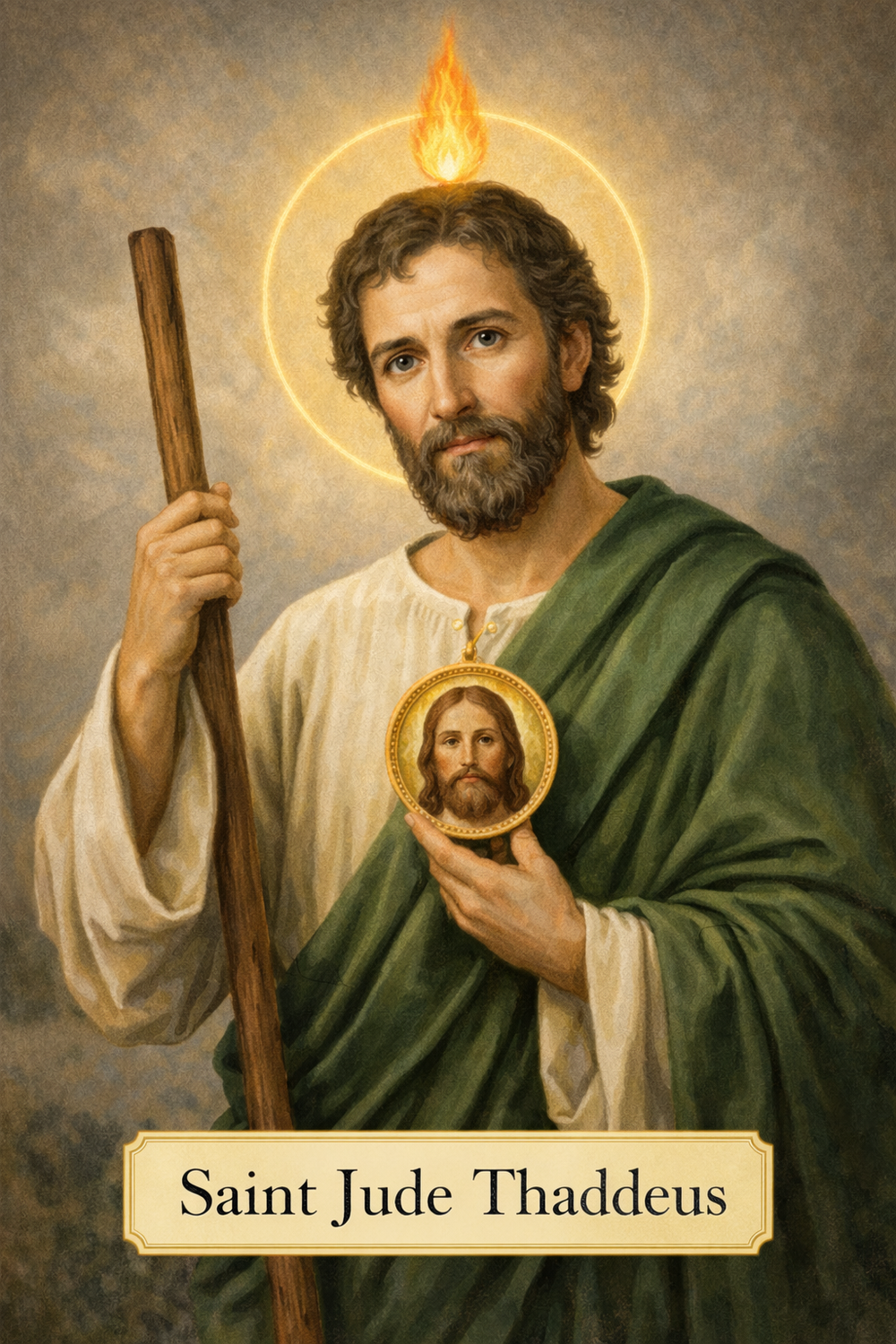
Saint Jude Thaddaeus
A beautiful prayer card bearing the traditional image of Saint Jude — suited for personal devotion, gifting to someone in a hard season, or placing in a prayer corner.
Get the Prayer Card →Complete Saint Jude Devotional Collection
Everything below is handpicked for those with a devotion to Saint Jude — for personal prayer, a prayer corner, or as a meaningful gift.

St. Jude Figure on Base — Heavenly Protectors, Renaissance Collection
View on Amazon
Exquisite Rosary — Saint Jude Cross
View on Amazon
St. Jude Flameless LED Devotional Prayer Candle
View on Amazon
14K Gold Catholic Saint Jude Necklace
View on Amazon
Saint Jude Silver Necklace
View on Amazon
14K Gold Plated Saint Jude Necklaces for Women
View on AmazonFrequently Asked Questions About Saint Jude
Is Saint Jude the same as Judas Iscariot?
No. They are entirely different people who share the same underlying Hebrew name, Judah. Jude (Thaddaeus) was a faithful apostle who preached, wrote a canonical epistle, and died a martyr. Judas Iscariot was the betrayer. The confusion of their names is one reason Jude was historically underinvoked — and one reason he became associated with lost causes.
Why is Saint Jude the patron of lost causes?
The patronage developed in the medieval Western Church, influenced by Saint Bridget of Sweden's revelations and promoted by Saint Bernard of Clairvaux. Because Christians avoided praying to anyone named Judas, Jude was considered "overlooked" — and therefore both especially responsive to those who overcame the stigma to pray to him, and uniquely available for the cases others had abandoned.
What is the difference between Eastern and Western veneration of Jude?
In the West, Jude is primarily invoked as the patron of desperate cases — a last resort intercessor. In the East, particularly in the Armenian Apostolic Church, he is venerated as a founding apostle who brought the Gospel to their nation. The Armenian church at Qara Kelisa (Black Church) in Iran is dedicated to him and remains an active pilgrimage site. The Eastern traditions see him as a spiritual patriarch; the Western tradition sees him as the great intercessor for the impossible.
What do we know about the Epistle of Jude?
It is one of the shortest letters in the New Testament — twenty-five verses — and one of the most theologically dense. Jude wrote it to warn a community about false teachers who had infiltrated their ranks. Most notably, he directly quotes the Book of Enoch (1 Enoch 1:9), indicating that first-century apostolic Christianity engaged the broader Second Temple Jewish literary tradition. The letter ends with one of the New Testament's most magnificent doxologies.
How did Saint Jude die?
Tradition holds that he was martyred in Persia (modern Iran) alongside Simon the Zealot, killed by pagan priests when he refused to offer sacrifice to Persian deities. This is why his most common iconographic symbol is an axe held in his hand.
What is the Thaddaeus Monastery in Iran?
Known as Qara Kelisa (the Black Church), it is a UNESCO World Heritage Site in northwestern Iran believed by the Armenian Church to have been founded by the Apostle Thaddaeus in 66 AD — potentially the oldest surviving Christian church structure on earth. Every year, tens of thousands of Armenian Christians make pilgrimage to it, continuing an unbroken tradition of apostolic veneration.
What does Jude's name "Thaddaeus" mean?
Thaddaeus likely derives from the Aramaic word for "heart" or "courageous heart." Similarly, the variant name "Lebbaeus" means something similar — warm-hearted, courageous. Both names suggest a man of passionate devotion, entirely consistent with the fiery, urgent character visible in his epistle.
Saint Jude Thaddaeus remains, nearly two thousand years after his martyrdom in Persia, one of the most invoked names in Christianity. He wrote twenty-five verses. He asked one recorded question. He traveled to the ends of the known world and died there. And then, by the strange logic of God's providence, his very obscurity became the source of his power.
The saint nobody prayed to became the saint everyone turns to when they have nowhere else to go.
Perhaps that is the answer to the question he asked at the Last Supper — the one about why Christ does not reveal Himself to the whole world at once. Perhaps Jude had to learn, across his own life and death and the centuries of his cult's strange development, that revelation comes quietly, obliquely, through the most unlikely vessels. Through a short letter full of fire. Through a dark stone church in the mountains of Iran. Through a newspaper novena in the Great Depression. Through you, praying in the dark, to the apostle whose name nobody dared say.
Saint Jude Thaddaeus, pray for us.