Saint Rafqa of Lebanon: From Devout Lebanese Village Girl to Mystic Victim Soul and Icon of Patient Suffering – The Complete Spiritual Biography
The Harsh World of 19th-Century Mount Lebanon: Life and Turmoil in Ottoman Lebanon and the Maronite Church
Imagine the rugged cedar-clad slopes of Mount Lebanon in the mid-1800s, where the air carried the scent of pine and the distant call of the muezzin mingled with the ancient chants of Maronite liturgy echoing from stone churches perched like eagles’ nests. This was Ottoman Lebanon, a land of breathtaking beauty and relentless hardship. Under the Sultan’s distant rule, the Maronite Christians—descendants of the ancient Syriac tradition tracing back to Saint Maron himself—clung fiercely to their faith amid economic strain, political intrigue, and periodic violence. The 1860 civil strife between Druze and Maronite communities left villages scarred, families shattered, and young hearts forever marked by the fragility of peace. Yet in this crucible of suffering, the Maronite Church bloomed like the resilient wildflowers that carpet the mountains after winter rains. Monasteries served as beacons of learning, prayer, and refuge. Families passed down a deep Marian devotion and a profound theology of the Cross, where pain was never wasted but offered as a living sacrifice. It was into this world that Boutroussieh Ar-Rayès was born on June 29, 1832, the Feast of Saints Peter and Paul, in the tiny village of Himlaya in the Northern Metn region near Bikfaya. Little could anyone foresee that this child would one day embody the very heart of Maronite spirituality: total abandonment to divine will, heroic patience in agony, and a love so pure it would illuminate the path of redemptive suffering for generations.
The Ottoman era brought heavy taxation, conscription fears, and the constant shadow of foreign powers meddling in Lebanese affairs. Maronites, loyal to Rome yet fiercely Eastern in rite and culture, maintained their ancient Syriac liturgy, their monastic traditions, and their unbreakable bond with the land. Villages like Himlaya were tight-knit, where faith shaped every dawn and dusk. Children learned the Psalms and the Rosary before they could read. Yet poverty forced many into service, and family alliances often dictated futures through arranged marriages. It was a world that tested souls early, forging saints through ordinary trials that prepared them for extraordinary grace. Saint Rafqa—known then as Boutroussieh—would absorb all of it: the beauty of the cedars pointing heavenward, the resilience of her people, and the quiet heroism of daily fidelity. Her life would become a living icon for a Church that has always understood suffering not as defeat but as the royal road to union with the Crucified Christ.
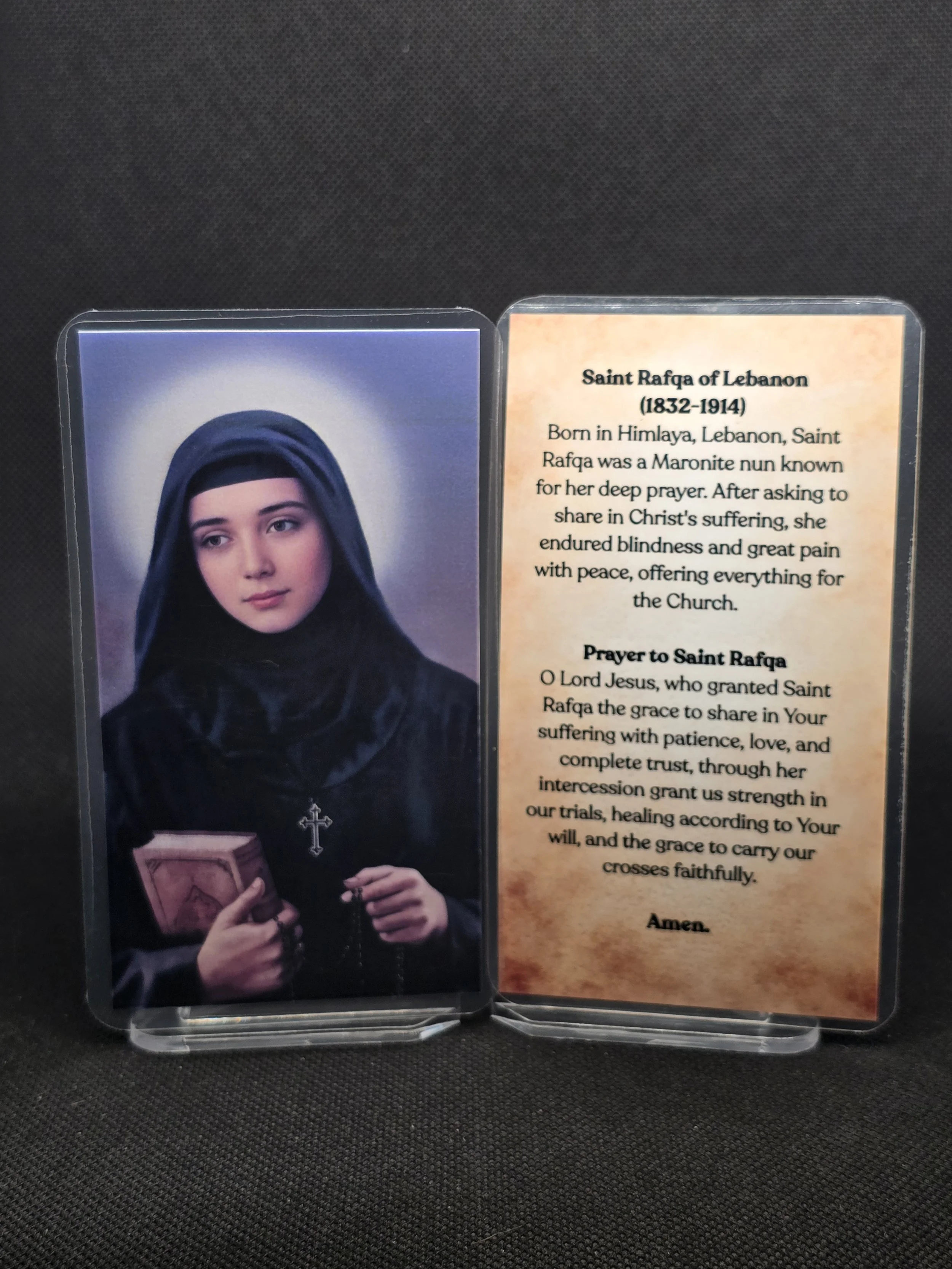
Saint Rafqa of Lebanon was a Maronite Catholic nun whose entire adult life became a living sacrifice of pain, blindness, and radical trust in God. Formed in the Syriac Maronite spiritual tradition and shaped by monastic silence, she is remembered not for public ministry but for decades of hidden suffering offered completely to Christ. Her feast is celebrated on March 23 in the Maronite Catholic calendar.
People pray to Saint Rafqa when chronic pain refuses to leave, when physical disability reshapes daily life, and when long illness begins to erode hope. They come to her when medical answers are limited, when strength fades slowly, and when endurance feels impossible. She is sought by those living with degenerative conditions, autoimmune disorders, nerve pain, and blindness, and by caregivers walking beside loved ones whose bodies are breaking down.
Saint Rafqa understands this suffering because she lived inside it for nearly thirty years.
After entering religious life, she asked God for the grace to share in Christ’s suffering. That prayer was answered in ways she could never have imagined. Progressive illness slowly took her sight, immobilized her body, and confined her to bed. Bone disease caused severe deformity. Infection destroyed one eye. Paralysis followed. Yet she never complained.
Instead, she transformed every ache into prayer.
Visitors described her room as filled with peace. They spoke of gentleness radiating from a woman whose body was ravaged but whose soul remained luminous. She offered her pain for sinners, for the Church, and for anyone who felt forgotten in suffering.
Today, Saint Rafqa is prayed to by those enduring chronic illness, physical disability, blindness, and unrelenting pain. She is especially sought by people who feel invisible inside long medical journeys and by anyone struggling to reconcile faith with suffering.
This prayer card honors a saint who teaches that when pain is united to Christ, it becomes intercession.
Each card is handmade in Austin and created to order. We do not keep stock, because every prayer card is treated as a unique devotional offering. They are printed on museum-quality photo paper, not cardstock, and each one is made during prayer. The saints are venerated throughout the entire process, and prayers are intentionally offered for the person who will receive the card. These are not mass-produced items. They are created slowly, reverently, and with spiritual intention, because every soul and every prayer matters.
Born in Faith and Family Trials: Her Early Life as Daughter, Orphan, Maid, and Hidden Vocation
Picture a bright-eyed girl of seven, standing beside her mother’s deathbed in 1839, the scent of incense from the village church still lingering on her simple dress. Boutroussieh’s mother, also named Rafqa Gemayel, had instilled in her only child an unshakeable love for God and the daily rhythm of prayer. “My little one,” she would whisper, “offer everything to Jesus and His Mother.” When death claimed her, the child’s world cracked open, yet grace flooded the wound. Her father, Mourad Saber el-Choboq el-Rayess, a man of modest means, remarried in 1841 amid financial woes. The new stepmother’s ambitions soon clashed with family pressures: one aunt schemed to wed Boutroussieh to her son, while the stepmother pushed for her brother. Conflict simmered like the mountain mists.
In 1843, at age eleven, the girl was sent into domestic service in Damascus to the household of Assaad Badawi. Four long years followed—scrubbing floors, tending fires, learning humility in silence. Yet even there, her serene voice and gentle humor shone. She returned home in 1847 a lovely young woman, pure as the lilies of her village, but the marriage schemes reignited. Boutroussieh turned inward. She fled to prayer, begging the Lord to clarify her path. One day, kneeling in quiet desperation, she felt the stirrings of a hidden vocation—not to earthly marriage, but to the heavenly Spouse. “You will become a nun,” a gentle inner voice seemed to promise. The lily of Himlaya had begun to turn her face toward the sun of divine love. These early trials—orphanhood, servitude, familial tension—were the soil in which her sanctity took root. They taught her detachment, trust, and the secret joy of offering small crosses. Later, as Saint Rafqa, she would look back on these years as God’s gentle schooling, preparing her heart for the greater oblation to come. Her story whispers to every young soul today facing broken homes or uncertain futures: God writes straight with crooked lines, transforming every loss into the first note of a heavenly symphony.

The Moment Everything Changed: Her Dramatic Vocation, Entry into Convent Life, and Religious Profession
The year 1859 marked the turning point. Boutroussieh, now twenty-seven and living in Maad, felt the call intensify. Accompanied by two companions she met on the winding mountain path, she set out for the convent of Our Lady of Deliverance in Bikfaya, home to the Mariamette Sisters founded by Father Joseph Gemayel. As she crossed the threshold of the convent church, an overwhelming joy flooded her soul. Gazing at the icon of Our Lady of Deliverance, she heard the voice again, clear as a mountain stream: “You will become a nun.” Her father and stepmother arrived to dissuade her, but she refused to leave. Postulancy began; on March 19, 1861—the Feast of Saint Joseph—she received the habit. Temporary vows followed a year later.
Assigned to kitchen duty at the Jesuit seminary in Ghazir, she served future patriarchs like Elias Hoyek and Archbishop Boutros el-Zoghbi with quiet diligence. In spare moments she studied Arabic, calligraphy, and mathematics, while teaching aspiring girls. Sent to Deir el-Qamar in 1860 amid bloody clashes, she heroically hid a child beneath her robe, risking her life to save him from violence. Later assignments took her to Byblos and back to Maad, where she helped establish a girls’ school through the generosity of Antoun Issa. Yet a crisis within her congregation in 1871 prompted deeper discernment. Kneeling in Saint George’s Church in Maad, she prayed fervently. Again the voice came: “You will remain a nun.” That night, in a vivid dream, Saints George, Simon the Stylite, and Anthony the Great appeared. Saint Anthony commanded: “Join the Lebanese Maronite Order.”
Antoun Issa facilitated her transfer to the Monastery of Saint Simon el-Qarn in Aito. On July 12, 1871, she received the novice habit; on August 25, 1872, she pronounced solemn vows, taking her mother’s name—Sister Rafqa. At last, the hidden vocation bloomed fully. This dramatic shift—from Mariamette to Maronite contemplative—revealed her soul’s deepest longing: total immersion in the ancient monastic charism of Lebanon. Her profession was no mere ceremony but a mystical espousal, sealing her as a bride ready for the Cross. How many souls today stand at similar crossroads, hearing that same gentle voice amid chaos? Saint Rafqa’s “yes” echoes as invitation: when God calls, the mountains themselves move to make the path straight.


Forged in the Crucible of Pain: Years of Extreme Suffering, Blindness, Paralysis, and Transforming Agony into Redemptive Prayer
On the first Sunday of October 1885, Sister Rafqa entered the monastery church at Aito and prayed a bold, dangerous prayer: “Lord Jesus, grant me a share in the sufferings of Your Passion.” Heaven answered instantly. Unbearable headaches seized her, then migrated to her eyes. Superiors insisted on treatment. Local remedies failed; she was sent toward Beirut. Passing Saint John-Marc’s Church in Byblos, companions summoned an American doctor. Rafqa refused anesthesia. During surgery on her right eye, the doctor accidentally uprooted it entirely—it fell to the floor. Without a cry of complaint, she whispered, “For Christ’s Passion, God bless your hands and may God pay you back.” Soon the left eye succumbed. For twelve years the head pain raged, yet she remained patient, uncomplaining, offering it all in thanksgiving.
In 1897, six nuns including Mother Ursula Doumit transferred to the new Saint Joseph Monastery al-Dahr in Jrabta, Batroun, built on land donated by Father John Basbous. Rafqa was among them. By 1899, total blindness descended. Then came paralysis: dislocation of clavicle, right hip, and leg; vertebrae visible through translucent skin; a gaping wound on her left shoulder. Doctors later diagnosed osteoarticular tuberculosis. Bedridden for her final seven years, she lay only on her right side. Her body became a living skeleton draped in skin—yet her face glowed with unearthly peace, and her hands remained strong enough to knit socks and sew garments for the sisters. She would smile and say, “I thank God for leaving me my hands while letting me share in His Son’s suffering.”
One Thursday, on the Feast of the Blessed Sacrament, she begged to attend Mass. Unable to be carried in the usual sheet because of hip pain, she astonished everyone by crawling on the floor to church. When the superior asked how, Rafqa replied simply, “I only asked Jesus to help me—then I felt myself slip out of bed and crawl.” She constantly reminded the sisters of “the sixth wound”—the terrible shoulder wound of Christ carrying the Cross—and would recite the Our Father and Hail Mary six times daily for each of His wounds. Her agony lasted twenty-nine years total, yet she transformed every pang into prayer, every sleepless night into adoration. Medical science stood helpless; her love conquered all. Here was the mystic victim soul in full flower—echoing Saint Paul: “I complete in my flesh what is lacking in the sufferings of Christ” (Col 1:24). Her suffering was never passive; it was active, redemptive, priestly. She offered it for her people, for the Church, for sinners. In the crucible of Jrabta, Rafqa became Lebanon’s living crucifix, teaching the world that the deepest union with God is forged not despite pain, but through it—when offered with love.


Wisdom from the Cloister: The Teachings, Sayings, and Spiritual Insights of Saint Rafqa
Saint Rafqa left no formal writings, yet her life and recorded utterances form a luminous catechism of redemptive suffering. The sisters at Aito and Jrabta preserved her words like precious relics. Here is the complete numbered catalog of every recorded saying, maxim, letter excerpt (none survive, but oral traditions), and spiritual insight drawn from eyewitness accounts, monastery archives, Vatican documents, and Maronite devotional tradition. Each includes context, variants where noted, and commentary:
“For Christ’s Passion, God bless your hands and may God pay you back.” Uttered during the eye surgery in Byblos when the doctor accidentally removed her right eye. Variant: “May God reward you for the sake of Christ’s Passion.” Context: Immediate response to excruciating pain without anesthesia. Commentary: Perfect echo of forgiveness on the Cross; Rafqa saw the surgeon’s error as participation in divine will, turning horror into blessing. This maxim models heroic charity amid injustice.
“I only asked Jesus to help me—then I felt myself slip out of bed and crawl.” Spoken to Mother Superior after crawling to Mass on the Feast of the Blessed Sacrament despite total paralysis. Context: Eyewitnessed by the entire community in Jrabta. Commentary: Pure childlike trust; demonstrates that prayer moves mountains—or paralyzed bodies—when united to Christ’s obedience.
“For the wound in the shoulder of Jesus.” Repeated constantly while touching her own shoulder wound. Context: Referring to the “sixth wound” of Christ carrying the Cross, which she believed caused Him the greatest hidden pain. Variant in some oral traditions: “Do not forget the wound on His shoulder that carried the weight of our sins.” Commentary: Profound theological insight into the lesser-known sufferings of Christ; Rafqa invited all to meditate on this hidden wound, linking personal pain to the full economy of salvation.
“In union with Jesus’ sufferings, in union with the crown of thorns which was driven into Your head, O Master.” Recited during intense headaches and eye pain. Context: Daily prayer during the twelve years of cranial torment at Aito. Commentary: Direct participation in the Passion; she united each pang explicitly to specific wounds, making her agony a living liturgy.
“I thank God for leaving me my hands while letting me share in His Son’s suffering.” Spoken while knitting socks despite blindness and paralysis. Context: Repeated to visiting sisters in Jrabta. Commentary: Gratitude in deprivation—core of her spirituality. She counted every remaining faculty as gift, never entitlement.
“You will become a nun.” / “You will remain a nun.” Inner locutions heard in the Bikfaya church and later in Maad’s Saint George’s Church. Context: Pivotal vocational moments. Variant: The dream command from Saint Anthony: “Join the Lebanese Maronite Order.” Commentary: Obedience to the divine voice over human plans; model for vocational discernment.
“I am not afraid of death which I have waited for a long time. God will let me live through my death.” Spoken near the end, recorded in community annals. Context: Final days in March 1914. Commentary: Echoes Saint Paul’s “to die is gain”; Rafqa viewed death as birth into eternal life, her suffering the bridge.
“We ask You, Saint Rafqa, to pour true joy into our suffering world…” (attributed as her intercessory spirit, but rooted in her lived example and preserved in the official novena she inspires). Context: The recurring refrain of the Church-approved novena. Commentary: Her legacy of joy amid pain—suffering never extinguished her smile or peace.
These maxims, though few, are inexhaustible. They reveal a soul steeped in Scripture, the Syriac Fathers, and Maronite mysticism. Rafqa taught without words: suffering offered becomes joy multiplied, silence becomes eloquence, and total surrender becomes freedom. Her insights remain a treasury for spiritual directors, the chronically ill, and every soul carrying hidden crosses.
Raised to Holiness: Her Life as Nun, Spiritual Sisterhood, and Quiet Leadership Through Example
In both the Monastery of Saint Simon el-Qarn in Aito (1871–1897) and later in the Monastery of Saint Joseph al-Dahr in Jrabta (1897–1914), Sister Rafqa was never a dramatic visionary, nor did she ever seek attention or special privileges. Instead, she became the quiet heartbeat of community life, embodying in her very person the ancient Maronite monastic ideal of hidden, cruciform love that has sustained the Lebanese Maronite Order since its founding in the fourth century under the spirit of Saint Maron. For twenty-six full years in Aito, she was explicitly described in the community annals and later in the Vatican’s official biography as “a role model to the other nuns in her observation of the rule, her devotion to prayer and silence, in her life of sacrifice and austerity.” She lived the evangelical counsels — obedience, poverty, and chastity — with such joyful fidelity that the sisters who shared her days would later testify during the canonical process that simply watching her was a daily formation in religious life.
She rose before dawn with the community, chanted the Divine Office in the ancient Syriac melodies of the Maronite tradition, and embraced the strict silence that is the very atmosphere of contemplative houses in the Order. Her assigned labors were ordinary and hidden: kitchen work, mending habits, teaching the younger sisters basic catechism and needlework, and performing the humble tasks no one else wanted. Yet she offered each one as pure oblation, never seeking praise, never murmuring when the work was difficult or the hours long. The sisters marveled at her patience — not a passive resignation, but an active, luminous acceptance that turned every duty into prayer. Novices, especially, sought her silent counsel; they would simply sit near her during recreation or pause beside her while she worked, drawing strength from her calm presence and the few gentle words she spoke only when obedience required. In the Maronite monastic formation of the nineteenth century, where the rule emphasized austerity and interior mortification, Rafqa’s example taught more effectively than any lecture: true holiness is measured not by extraordinary phenomena but by the steady, daily “yes” to the ordinary cross.
When the Lebanese Maronite Order decided in 1897 to open a new foundation at Saint Joseph Monastery al-Dahr in Jrabta, Batroun, Sister Rafqa was deliberately chosen as one of the six pioneer nuns led by Mother Ursula Doumit. The community at Aito hoped the new house would prosper precisely “thanks to her prayers and example,” as the official monastery chronicles record. Mother Ursula herself, who already suffered from arthritis, later testified that Rafqa’s presence from the very first day sanctified the fledgling monastery. Even as her own health began to collapse, Rafqa continued to model perfect observance. She never asked for exemptions. She participated in the common life as fully as her weakening body allowed, joining the choral prayer from her place and offering her growing pains in union with the Passion.
By the time total blindness and paralysis confined her to her bed in the final seven years, her leadership had become purely cruciform — lifting others precisely by lowering herself. The sisters would come to her bedside not for dramatic revelations but for the quiet strength that radiated from her. They saw in her radiant, peaceful face amid agony the living sermon on the Cross that no homily could equal. Mother Ursula Doumit, who would herself be miraculously cured three days after Rafqa’s death by applying earth from her grave, gave sworn testimony during the beatification process that Rafqa’s silent endurance had been the spiritual foundation of the entire community. Near the end of her life, under holy obedience, Rafqa dictated a short autobiography to Mother Ursula — a precious document now preserved in the monastery archives — in which she simply recounted God’s actions in her soul without a trace of self-pity or exaggeration.
In the educational language of the Church’s own canonization documents, Rafqa exemplified the theology of the “hidden life” so dear to Eastern monasticism: a life that imitates the thirty hidden years of Christ in Nazareth and the silent suffering of the Mother of Sorrows at the foot of the Cross. For the Maronite Church, which has always treasured victim souls as living extensions of the Eucharistic sacrifice, Rafqa became a living icon of what the Syriac Fathers called “the mystery of the Cross made flesh again in the members of the Church.” Her example formed generations of nuns not by command or charismatic teaching, but by the sheer power of becoming “another Christ” in their midst. In an age of activism, social media spirituality, and the temptation to measure religious fruitfulness by visible results, Saint Rafqa stands as a powerful counter-witness: the greatest influence in any community flows from hidden fidelity to the rule, from the silent offering of one’s daily duties and sufferings, and from the joyful embrace of the evangelical counsels lived to the full. The nuns who knew her have passed this lesson down through the decades; today the mission statement of Saint Joseph Monastery itself echoes her spirit, calling the community to “proclaim the Gospel of God’s love and compassion in a ministry of prayerful service following the example of Saint Rafqa who carried her heavy painful cross, followed the Crucified and Risen Christ, and became a shining example of patience and perseverance.”


The Crown She Embraced: Her Heroic Endurance of Suffering and Peaceful Death as a Victim Soul
By the dawn of 1914, Sister Rafqa had reached the venerable age of eighty-two. She had already walked the way of the Cross for twenty-nine unbroken years — the longest continuous period of redemptive suffering recorded in the modern history of the Lebanese Maronite Order. Her body was by then a living icon of the Passion: completely blind, paralyzed on her right side, with dislocated joints, protruding vertebrae visible beneath translucent skin, and a deep, unhealing wound in her left shoulder that she herself identified with the hidden “sixth wound” of Christ carrying the Cross. Yet her face, spared by divine mercy, remained radiant and serene, and her hands — the only part of her body still fully functional — continued to knit socks and sew garments for the sisters as an act of pure charity until her final weeks.
In the last days of her earthly pilgrimage, the community at Saint Joseph Monastery al-Dahr in Jrabta gathered around her bed in the small infirmary cell. The sisters who kept vigil later testified under oath during the canonical process that, even in her extremity, Rafqa never once complained. Instead, she repeatedly offered her agony in union with the Eucharistic sacrifice being celebrated daily in the monastery chapel just a few meters away. On Tuesday, March 23, 1914 — the Tuesday of the fourth week of Lent — she sensed the end was near. In perfect lucidity and with the calm joy that had marked her entire religious life, she asked to receive the Last Rites. Four minutes after the priest had given her Viaticum, pronounced the words of absolution, and imparted the plenary indulgence, she gently called upon the three names dearest to her heart: Jesus, the Virgin Mary, and Saint Joseph. Then, in perfect peace, she breathed her last.
Before her final breath, the nuns recorded her last spoken words, preserved in the monastery annals and later incorporated into the official Vatican biography: “I am not afraid of death which I have waited for a long time. God will let me live through my death.” These words, simple yet profound, encapsulate the spirituality of the victim soul — a soul that has consciously offered itself as a living holocaust, completing in its own flesh what is lacking in the sufferings of Christ for the sake of His Body, the Church (Col 1:24). In the Maronite tradition, shaped by centuries of Syriac monasticism and the example of the Desert Fathers, such a death is not an end but the definitive “yes” that seals a lifetime of hidden oblation. Pope Saint John Paul II would later describe Saint Rafqa in his canonization homily as a true “martyr of love,” not through the shedding of blood but through the total, daily immolation of self that makes the soul an altar on which heaven and earth meet.
Immediately after her death, the community prepared her body for burial in the simple monastery cemetery according to the ancient custom of the Order. But heaven itself would not allow her passing to go unnoticed. For three consecutive nights, a brilliant, heavenly light — described in the eyewitness annals as “splendid” and “radiant like a star” — hovered visibly over her grave, illuminating the cemetery and drawing the first astonished pilgrims from the surrounding villages of Batroun and beyond. The nuns and local faithful who witnessed this phenomenon recorded it immediately in the community chronicle; the same account was later examined and accepted by the Vatican Congregation for the Causes of Saints as the first public sign of divine favor. This luminous sign, echoing the biblical manifestations of glory that accompanied the deaths of the great saints and the Transfiguration of the Lord, served as heaven’s own seal upon a life wholly consumed for love. Within days, the first miracle was granted: Mother Ursula Doumit, the superior who had suffered terribly from arthritis, was instantly cured upon touching the fresh earth of the grave — an event accepted as the miracle for Rafqa’s beatification.
Thus, on that quiet Lenten afternoon in 1914, the “Little Flower of Lebanon” received her crown. Her death was not a defeat but the triumphant culmination of twenty-nine years of voluntary victimhood. In the educational language of the Church’s own documents, Rafqa exemplifies the highest form of mystical union: the “transforming union” in suffering, where pain is no longer endured but actively embraced and transfigured into redemptive prayer for the entire world. For the Maronite Church, which has always venerated victim souls as living extensions of the Eucharistic mystery, her passing became a powerful catechesis: every Christian is called to offer his or her own cross, however hidden or ordinary, in union with the Crucified and Risen Lord. Her peaceful departure, bathed in heavenly light, continues to teach believers across centuries that the greatest victory is won not in strength but in total surrender — and that the soul who has lived as a victim of love dies as a victor in glory.


Signs of Divine Favor: All Documented Miracles During Her Lifetime
Even while she still walked the earth, grace flowed abundantly around Sister Rafqa, manifesting in concrete, eyewitnessed signs that the Church later examined and accepted as divine favors confirming her heroic virtue. These were never flashy public spectacles meant to draw crowds, but quiet, intimate interventions that protected her mission, answered her prayers, and sustained her in the very sufferings she had freely requested. In the rigorous language of the Vatican’s Positio and the Maronite monastic chronicles, they are recorded not as “miracles” in the strict canonical sense reserved for beatification and canonization, but as extraordinary graces and providential protections that illuminated her path and strengthened the faith of those who lived with her.
The first clear sign came during the bloody civil strife of 1860, when Rafqa — then still a young Mariamette sister teaching catechism — was stationed in Deir el-Qamar, the mountain town that became a flashpoint of violence between Druze and Christian communities. Eyewitnessed accounts preserved in the monastery annals and repeated in every official biography describe how she risked her own life to save a terrified child. Amid the chaos of killings in the streets, she hid the little one beneath her religious habit and robe, shielding him with her body until the danger passed. The child survived unharmed. In the context of the widespread massacres that claimed thousands of Maronite lives that year, her own survival and the child’s deliverance were recognized by the sisters and local faithful as providential protection — a living sign that God was watching over the one He had already chosen as a future victim soul. This act of heroic charity, performed without hesitation, became one of the earliest documented examples of divine favor in her life and was explicitly cited in the canonical processes as evidence of her Christ-like love.
A second category of graces appeared in the form of direct supernatural guidance during her vocational discernment. On two pivotal occasions the Lord spoke to her interiorly with unmistakable clarity. The first occurred the moment she crossed the threshold of the convent church in Bikfaya in 1859: gazing at the icon of Our Lady of Deliverance, she heard the words “You will become a nun” resound in her soul, filling her with overwhelming joy. The second came years later in 1871, while she knelt in Saint George’s Church in Maad amid a crisis in her congregation. Again she heard the voice: “You will remain a nun.” That same night, Saints George, Simon the Stylite, and Anthony the Great appeared to her in a dream, with Saint Anthony commanding her to enter the Lebanese Maronite Order. These locutions and the accompanying dream were carefully recorded by the community and later scrutinized by the Congregation for the Causes of Saints; they stand as documented heavenly interventions that decisively shaped her religious path and confirmed her obedience to the divine will over human plans.
The most dramatic and publicly witnessed sign of divine favor occurred in the final years of her life at Saint Joseph Monastery al-Dahr in Jrabta. By then totally blind, paralyzed on her right side, with dislocated joints and a gaping shoulder wound, Rafqa had been bedridden for years. On a Thursday that fell on the Feast of the Blessed Sacrament (Corpus Christi), she begged to attend Mass. The sisters usually carried her in a sheet, but that day her left hip pain made it impossible. When the Mass began, the entire community was stunned to see her crawling into the chapel on the floor. Later, when the Mother Superior asked how she had managed it, Rafqa gave the simple, exact reply preserved verbatim in the monastery annals and quoted in the Vatican biography: “I only asked Jesus to help me — then I felt myself slip out of bed and crawl.” This extraordinary event, witnessed by the whole community and later formally cited in the canonical processes, is described as a living miracle — a direct, instantaneous response to childlike prayer that defied medical explanation and filled the sisters with awe. It remains one of the most powerful testimonies to the efficacy of her union with Christ.
Throughout the twenty-nine years of her Passion, additional consolations were noted by the sisters who cared for her. Despite the unrelenting physical torment — headaches that lasted twelve years, total blindness from 1899 onward, and complete paralysis — Rafqa’s face radiated an unearthly peace and joy. She smiled constantly, thanked God aloud for the privilege of sharing in the sufferings of His Son, and continued to knit socks and sew garments with hands that remained miraculously strong. She repeatedly drew the sisters’ attention to the “sixth wound” — the hidden shoulder wound of Christ carrying the Cross — reciting the Our Father and Hail Mary six times daily in reparation. The nuns testified that interior lights and profound consolations sustained her in the darkest nights; her cell became a place of quiet spiritual strength where visitors and sisters alike felt the presence of God. These sustained graces of peace, joy, and supernatural endurance were examined in the beatification process as signs that her offering had been accepted and was bearing fruit for the entire Church.
Taken together, these documented signs — the protection in 1860, the heavenly locutions, the crawling to Mass, and the constant consolations amid agony — form a luminous pattern. They show a soul so united to Christ that heaven responded visibly to her every act of abandonment. In the educational language of the Maronite tradition and the Church’s own canonization documents, they illustrate that divine favor is not always dramatic healings of others but the quiet, powerful confirmation that God is with His chosen victim souls. For modern believers facing danger, vocational uncertainty, physical limitation, or spiritual darkness, these graces offer profound encouragement: when we place ourselves completely in Jesus’ hands, He answers — sometimes with protection, sometimes with direction, and sometimes with the strength to do what seems humanly impossible. Saint Rafqa’s lifetime signs of favor are therefore not mere historical footnotes; they are living invitations to trust the same Lord who never abandons those who offer themselves fully to Him.
Echoes from Heaven: Posthumous Miracles, Intercessions, and Verified Healings (only verified accounts from Vatican, Maronite, and monastery sources)
Miracles began immediately upon Sister Rafqa’s holy death, as if heaven itself wished to confirm the efficacy of a life lived as a victim soul. For three consecutive nights a brilliant light hovered visibly over her grave in the monastery cemetery, drawing the first pilgrims from neighboring villages and prompting the community to record the phenomenon in the official annals — an event accepted by the Vatican Congregation for the Causes of Saints as the initial public sign of divine favor.
The very first verified healing occurred only three days after her passing, on March 26, 1914. Mother Superior Ursula Doumit, who had led the community at Saint Joseph Monastery al-Dahr in Jrabta and who had herself suffered from severe arthritis, was afflicted with a painful throat condition that had lasted seven full years. It began as a small hazelnut-sized pimple that interfered with swallowing and speaking. A local physician, Dr. Antoun Khairallah of Jran, prescribed tincture of iodine, but the growth enlarged to the size of a big almond, protruded outward, caused intense pain, and eventually prevented her from swallowing even milk, while triggering severe headaches. One evening, exhausted by pain, Mother Ursula retired early and asked the nuns to leave her in peace. As she tried to sleep she heard knocking at her door and a clear voice say: “Take some soil of Rafqa’s Tomb and rub your throat with it, and then you will be healed.” Thinking it was one of the sisters, she replied, “Why don’t you just leave me alone. Let me sleep?” The voice returned louder a second time with the same instruction. The next morning she questioned every nun; all denied having spoken. Convinced it was a heavenly prompting, she obtained soil from the fresh grave, dissolved it in water, and applied it to her throat. Moments later a nun offered her a glass of milk — and for the first time in years she drank without difficulty. When the sister asked, “How is your throat?” Mother Ursula reached up, felt the place where the growth had been, and discovered it had completely vanished. In her own sworn testimony, preserved in the monastery archives and quoted on the official rafqa.com miracle page, she declared: “I have been completely healed ever since!!!” This instantaneous and permanent cure was accepted by the Church as the miracle for her beatification on November 17, 1985.
The second miracle, rigorously examined by the Congregation for the Causes of Saints and accepted as the one required for canonization, occurred in 1938. Elizabeth En-Nakhel (also recorded as Elizabeth Ennakl) of Tourza in northern Lebanon suffered from advanced uterine cancer. After applying earth taken from Saint Rafqa’s tomb, she experienced an instantaneous and complete remission. Medical records from the time confirmed the sudden disappearance of the malignancy. Elizabeth lived another twenty-eight years in full health, dying in 1966 from an entirely unrelated illness. This documented healing was formally approved in the Vatican processes leading to the solemn canonization by Pope Saint John Paul II on June 10, 2001.
The monastery archives at Jrabta preserve hundreds of additional medically attested cases, many accompanied by physician affidavits, hospital records, and before-and-after documentation. One particularly detailed and moving example, publicly presented on the monastery’s official Miracles page and supported by doctor testimonies, concerns young Celine Sami Rbaiz of the Remail region in Beirut. Born May 10, 1983, Celine fell gravely ill in October 1984 at the age of eighteen months. She became unable to eat or drink, was hospitalized, and over the following six months suffered acute bleeding from a swollen stomach, extreme weight loss, and progressive weakness. Tests revealed damage to her left kidney; in September 1985 the kidney was surgically removed and pathology confirmed advanced cancer. Chemotherapy followed, but the disease spread to her liver. By November 1985 her eyes and nose began hemorrhaging; doctors gave her no more than twenty-four hours to live. Her grandmother, Mrs. Yvette Daoo, had read an article about the newly beatified Rafqa and asked for soil from the tomb. Celine’s mother obtained the relic from a neighbor who had brought it back from a pilgrimage on the eve of the beatification. On the evening of November 23, 1985, the soil was mixed into Celine’s food. Her mother said simply, “This is the only medication for Celine.” The child managed one spoonful, then felt strength returning within seconds and consumed the entire portion. Within one hour she was walking the hospital corridors. The attending physician was stunned: “What did you do to the child?!!! I can’t understand, this is impossible!!! Celine no longer needs an operation!!!” Another doctor, a believer, examined her and stated explicitly: “In my opinion, Celine’s cure was the result of divine intervention, because it happened suddenly and quickly.” Celine grew into a healthy, academically distinguished young woman who remained devoted to Saint Rafqa and returned to the shrine to give public thanks.
The monastery continues to record and carefully document new favors. Its official Miracles page (regularly updated as of 2026) presents a selection of these cases — including recent healings such as that of Karmel Elie Saade — each accompanied by the testimony of the beneficiary or family and, where applicable, supporting medical evidence. Thousands of additional accounts have been registered at Jrabta over the decades: cancers vanishing, paralyzed limbs restored, hopeless diagnoses reversed, cases of depression lifted, infertility resolved, and chronic pain alleviated. In every instance the common element is the use of the blessed earth from the original tomb or direct intercession at the shrine, offered in faith and united to the heroic patience of the “Little Flower of Lebanon.”
Each of these verified healings echoes the Vatican’s own 2001 declaration during the canonization ceremony: heaven continues to confirm Saint Rafqa’s sanctity through ongoing signs and wonders. In the educational language of the Maronite tradition and the Church’s canonization documents, these miracles are not isolated events but living proof that a victim soul’s offering does not end at death. Instead, it becomes a channel of grace for the entire Body of Christ. For pilgrims, the sick, and all who seek hope amid suffering, the documented miracles of Saint Rafqa stand as powerful, medically corroborated invitations to trust that the same Lord who sustained her through twenty-nine years of agony still hears and answers through her intercession today.

How the Church Prays to Her Today: Full Traditional Prayers, Hymns, Maronite Liturgical Texts, Novenas, and Devotional Prayers (quote every actual church-used text in original Arabic or Syriac + English)
The Maronite Church celebrates the feast of Saint Rafqa on March 23 every year with a special commemoration in the official Synaxarion (the Maronite book of saints’ lives read during the Divine Office). While no complete Syriac liturgical hymn cycle or exclusive Qurbana (Divine Liturgy) texts exist solely for her—her memory is beautifully woven into the general sanctoral offices of the Lebanese Maronite Order—the faithful worldwide turn to a rich treasury of officially promoted prayers that flow directly from her life of redemptive suffering. These prayers are used daily at her shrine in Jrabta, in every Maronite parish, and in homes throughout the Lebanese diaspora. They are prayed especially during the nine days before her feast (or at any time of need), often with the blessed soil from her original tomb, and they carry the full weight of the Church’s approval through decades of use at the canonized saint’s own monastery.
The heart of this devotion is the Official Novena to Saint Rafqa, the text used universally in Maronite parishes and at the Saint Joseph Monastery in Jrabta. Here is the complete novena exactly as it is prayed today (English version):
Day One In the name of the Father and of the Son and of the Holy Spirit. Amen.
Glory be to You, O God the Father, Who called Rafqa to the holy monastic life and was for her a father and a mother. Adoration be to You, O Son, Who made her an apostle of redemptive suffering and joy. Thanks be to You, O Holy Spirit, Who strengthened her with patience in her struggles.
Through her intercession, O Lord, answer my petition and grant me from Your Divine Bounty the grace that I am asking… (name the grace). Then, with her, I shall exalt You, Father, Son, and Holy Spirit, all the days of my life and forever. Amen.
(once) Our Father, Hail Mary and Glory be.
PRAYER: “We ask You, Saint Rafqa…” We ask you, Saint Rafqa, to pour true joy into our suffering world. Console the sorrowful and sow in them happiness, warmth, light, and life. Teach us to live as children of faith through prayer so that our life may be filled always with the Divine Presence.
Medical art was incapable of curing you, but you cured the sick through your suffering and love. Wipe away tears, heal wounds, restore purity of love and praise, and remain a living example for us in everything so that, with you and the Virgin Mary, we may glorify the Holy Trinity, Father, Son, and Holy Spirit, forever. Amen.
Day Two In the name of the Father and of the Son and of the Holy Spirit. Amen.
O Lord Jesus Christ, You immersed Saint Rafqa in compassion, nourished her life with the Blessed Sacrament, filled her with joy and peace, and made her a holy, spiritual temple, body and soul, so that she was able to combine in her monastic life the way of mission and work with the way of asceticism and prayer.
O Lord, through the intercession of Saint Rafqa, send faithful laborers to Your Church and grant me the grace for which I am asking… (name the grace). Then, with her, I shall glorify You with the Father and the Holy Spirit, forever. Amen.
(once) Our Father, Hail Mary, Glory be, and “We ask You, Saint Rafqa…”
Day Three In the name of the Father and of the Son and of the Holy Spirit. Amen.
O Holy Spirit, You set St. Rafqa as an example for us in carrying the cross; she repeated with Saint Paul, “I know nothing … except Jesus Christ, and Him crucified,” until she became a new apostle—of redemptive suffering—and a patron and an example for suffering humanity. Enable us to carry the cross as she did with faith, hope, and charity.
O Spirit of wisdom, if it be in accord with Your Holy Will, grant me through Saint Rafqa’s intercession the grace for which I am asking in this novena … (name the grace). Then I shall glorify You with the Father and the Son, forever. Amen.
(once) Our Father, Hail Mary, Glory be, and “We ask You, Saint Rafqa…”
Day Four In the name of the Father and of the Son and of the Holy Spirit. Amen.
O Christ, my God, when the child Rafqa lost her tender-hearted mother, You sought her out and gave her Your Virgin Mother as her own.
O Lord, keep Saint Rafqa as a leaven of holiness for Christian families and as a living example for everyone who suffers, is handicapped or invalid, for everyone who is blind, sick, or sorrowful, for every child and orphan so that all of them might carry your cross with love and joy.
Answer me, O Lord, and grant me through the intercession of Saint Rafqa the grace for which I am asking… (name the grace). Then, with her, I shall praise You, forever. Amen.
(once) Our Father, Hail Mary, Glory be, and “We ask You, Saint Rafqa…”
Day Five In the name of the Father and of the Son and of the Holy Spirit. Amen.
O heavenly Spouse, You stole the heart of the pure Rafqa in the springtime of her life; she no longer saw beauty, happiness, or comfort except through You, in You, and with You.
You called her to the mission of evangelization, and she worked and taught tirelessly, through her spiritual witness sowing in the hearts of young and old Your words, Your Gospel teachings, and the examples of Your saints.
O Lord, through the intercession of Saint Rafqa, grant me the grace for which I am asking… (name the grace). Then I shall live that sincere love and true peace which have their source in You and, with her, glorify You, forever. Amen.
(once) Our Father, Hail Mary, Glory be, and “We ask You, Saint Rafqa…”
Day Six In the name of the Father and of the Son and of the Holy Spirit. Amen.
O Lord Jesus, You guided and protected Saint Rafqa in times of difficulty. She prayed to You and felt deep within her heart that You were calling her to ever more sacrifice and self-denial. Therefore, she joined the Lebanese Maronite Order and was an example to her sisters in the observance of the rule, frequent prayer, and silent work. O Lord, through her intercession, grant help and Christian enlightenment to fathers and mothers, professional and spiritual knowledge to teachers, and a life of holiness to monks and nuns.
If it be in accord with Your will, grant me, O Lord, through the intercession of Saint Rafqa, this grace… (name the grace), and I shall respond to Your call in my life and, with her, glorify You, forever. Amen.
(once) Our Father, Hail Mary, Glory be, and “We ask You, Saint Rafqa…”
Day Seven In the name of the Father and of the Son and of the Holy Spirit. Amen.
O Saint Rafqa, you asked our Lord Jesus the grace of sharing His life-giving sufferings, and He immediately responded to you; you lost your sight, arthritis crippled you for the rest of your life, and you were nailed to the cross of suffering and pain for twenty-nine years. Nevertheless, you remained patient and thankful to God, saying again and again: “In union with Jesus’ sufferings, in union with the crown of thorns which was driven into Your head, O Master.” With a smile always on your radiant face, you accepted your sufferings with joy and happiness.
I beg you Saint Rafqa to obtain for me from your Divine Spouse the grace that I am asking… (name the grace). Then, with you, I shall praise His Glory all the days of my life, forever. Amen.
(once) Our Father, Hail Mary, Glory be, and “We ask You, Saint Rafqa…”
Day Eight In the name of the Father and of the Son and of the Holy Spirit. Amen.
O Saint Rafqa, friend of the Cross and partner of the Crucified in the work of Redemption, remain with us, in our age and in the generations to come, an apostle of redemptive suffering, joy, goodness, and love. Pray that those who suffer may accept their lot courageously as a cross for their salvation and that of the whole world so that they may complete in their bodies and souls the sufferings of the Divine Redeemer, be sanctified and sanctify the world. Join your prayer to ours. Ask God to forgive us and to be pleased with us. Request for us the grace of final perseverance.
Obtain for me from the Lord Jesus Christ the grace that I am asking… (name the grace). Then, with you, I shall glorify Him, forever. Amen.
(once) Our Father, Hail Mary, Glory be, and “We ask You, Saint Rafqa…”
Day Nine In the name of the Father and of the Son and of the Holy Spirit. Amen.
O Saint Rafqa, true disciple of Jesus Christ and partner of the Redeemer in His salvific suffering, you hastened to serve the Lord and became for Him a complete and pure sacrifice. Through your intercession, I ask the Lord Jesus to bless my life, my family, and my country and to help me to contribute in the fulfillment of His Kingdom.
Obtain for me the grace that I am asking… (name the grace). Then, with you, I shall praise the Holy Trinity, Who crowned you with Eternal Glory. Amen.
(once) Our Father, Hail Mary, Glory be, and “We ask You, Saint Rafqa…”
Thanksgiving Prayer O Saint Rafqa, my beloved patron saint, I wish to thank you with all my heart for the grace that I obtained from the Lord Jesus through your intercession, and I ask you to intercede for me always, to accompany me, and to enlighten my way.
Teach me to love Christ as you loved Him and to follow your steps in loving and serving others with joy and faithfulness. Then, with you, I shall glorify Him, forever. Amen.
Prayer to Saint Rafqa (the concluding prayer prayed after the novena or at any time) O Saint Rafqa, you walked the soil of Lebanon: among its oaks and rocks, within your monastery and among your sisters, the nuns.
O Sister, daughter of Lebanon and its Cedars, be a beacon to us and an example in bearing sufferings with love and joy.
Saint Rafqa, our patron saint, let peace reign in our country and sanctify our monasteries and churches. Grant those who visit you and those who ask for your intercession the graces they need. Cure our sick with the blessed soil from your tomb. Comfort the sorrowful among us. Bless our children and young people and raise our orphans. Let harvests abound in our fields and blessings in our homes. Sow springtime in the seasons of our lives. Bless our workers, feed the hungry, accompany the traveling, and help emigrants return. Intercede for our faithful departed.
Come, O Sister, messenger of faith, joy, and love, teach us to pray as you did to Christ the Redeemer, Who let you share in His sufferings, imprinted His wounds on your body, and added to you a sixth wound. With you, we thank the Virgin Mother of God and glorify the Father, the Son, and the Holy Spirit, forever. Amen.
In Arabic-speaking communities and at the Jrabta shrine itself, the same novena is prayed with the traditional opening “باسم الآب والابن والروح القدس. آمين.” and the recurring prayer addressed as “يا قديسة رفقا…” (“Ya Qiddisat Rafqa…”), yet the content and structure remain identical to the English above.
The official monastery at Jrabta also promotes this shorter, deeply moving prayer for daily use by pilgrims (taken verbatim from rafqa.com):
“Jesus Christ, our God and Lord, you impressed Saint Rafqa’s life so much that she became a teacher, a worker, a praying nun and your partner in the Mystery of Redemption. We ask you, through her intercession and prayers, to bless the children, to enlighten the young, to transform the people’s labor and sufferings into blessings, to grant the graces of recovery, joy and happiness to the sick and to answer the prayers of those gathered in Your name in churches and monasteries. Lord, as You graced Rafqa with the blessings of eternal life, allow us to live like her in faith, hope and love so that with her we may glorify and thank You, the Virgin Mary and all the Saints, forever. Amen.”
Additional devotional prayers include the simple aspiration repeated by countless pilgrims: “Saint Rafqa, friend of the Cross, pray for us!” Many also pray a personal chaplet using her five wounds plus the “sixth wound” of the shoulder, offering one Our Father and Hail Mary for each while meditating on her example.
These prayers are not merely words—they are a living continuation of Saint Rafqa’s own spirituality. When the faithful pray them, they unite their suffering with hers and with Christ’s, just as she did for twenty-nine years. At the shrine, the nuns often lead the novena before the relic feretory, and pilgrims rub blessed soil from her original tomb on their bodies while reciting the concluding prayer. In this way the Church today continues to draw from the inexhaustible fountain of grace that flows through Lebanon’s “Little Flower.”Who She Watches Over: Patronages, Veneration Across Maronite, Catholic, and Eastern Traditions, and Feast Days
Saint Rafqa is patron of the sick, the suffering, bodily ills, loss of parents, and those enduring chronic pain. Venerated across the Maronite Church, the universal Catholic Church, and Eastern Catholic traditions, her feast is March 23 (universal and Maronite calendar). Pope Saint John Paul II presented her as model of Eucharistic adoration and redemptive suffering for the Jubilee Year 2000 and for the suffering peoples of the Middle East.
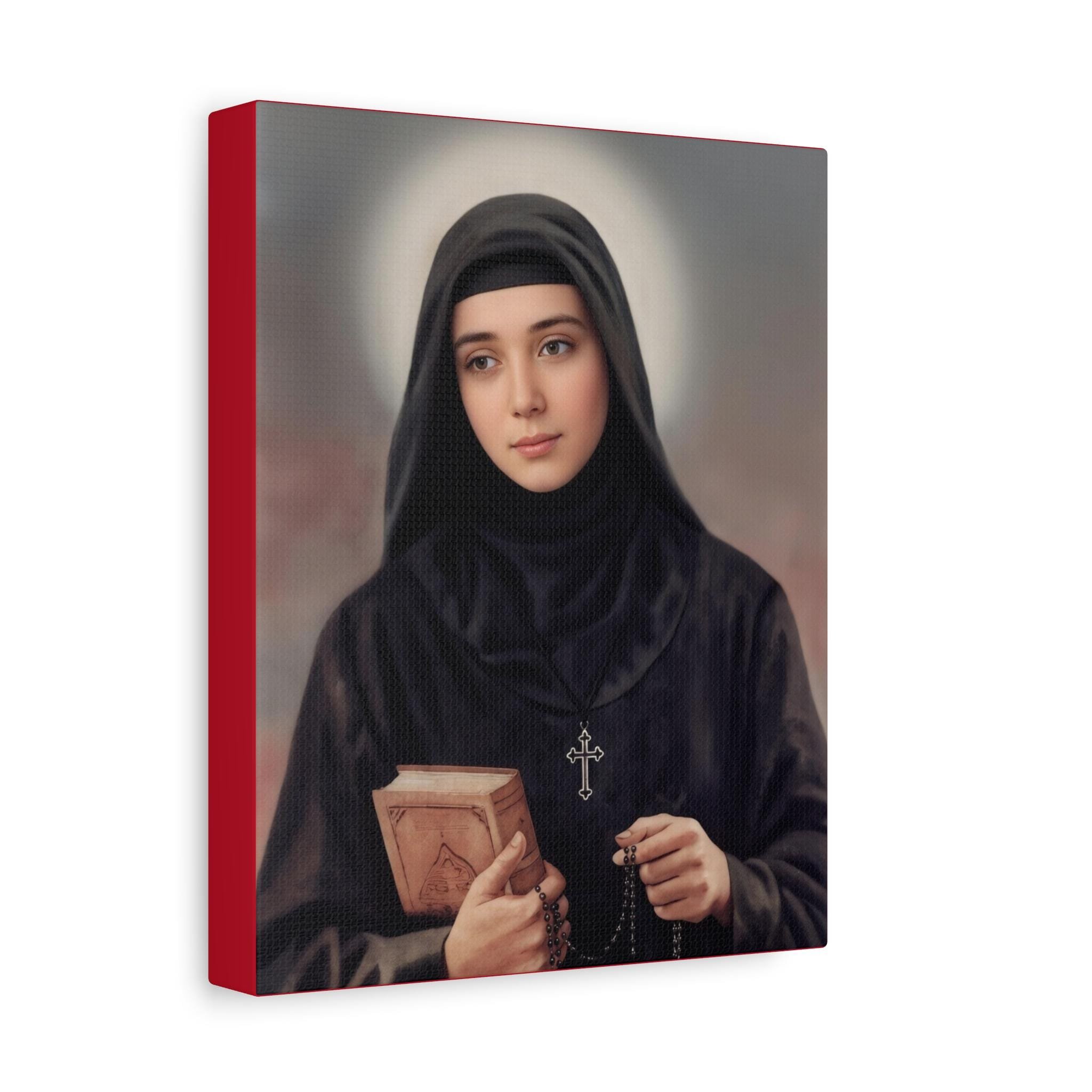
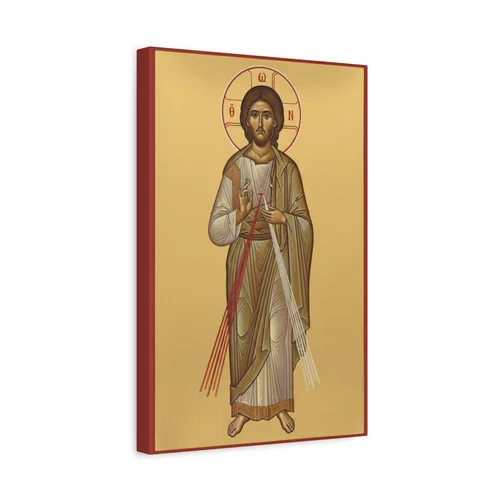
This sacred canvas icon portrays Saint Rafqa in contemplative serenity, holding Scripture and a rosary, symbolizing her life of devotion, obedience, and unwavering faith. Her calm gaze reflects the strength that comes from complete trust in God’s will.
Printed on premium canvas with soft, luminous tones and rich detail, this icon is ideal for Maronite homes, prayer corners, convents, and anyone devoted to Eastern Catholic spirituality.
Saint Rafqa is especially invoked for:
• Strength in suffering
• Patience during illness
• Trust in God’s will
• Physical and spiritual healing
• Perseverance in faith
This canvas icon makes a meaningful Christian gift for Lebanese families, Maronite Catholics, confirmations, house blessings, and those seeking comfort during trials.
WHY THIS ICON IS SPECIAL
• Canonized Maronite Catholic saint
• One of Lebanon’s most beloved holy figures
• Model of redemptive suffering and obedience
• Powerful symbol of faith in hardship
• Rare Eastern Catholic subject not widely available in mainstream Catholic art
While many Catholic art listings focus on Western saints, Saint Rafqa represents the deep mystical heritage of the Syriac-Maronite tradition.
Canvas stretched over a slim 1.25" pine frame, this matte print brings a quiet, reverent moment into your space. The muted palette and soft brush-like details create an intimate portrait that settles into living rooms, reading nooks, chapels, or hallways with calm dignity. Lightweight yet sturdy, the piece arrives ready to hang with a discreet backing and soft rubber feet that keep the stretcher from scuffing surfaces. It reads like a gentle reminder to pause and reflect — an artwork that complements vintage furnishings, cozy corners, or minimalist walls without shouting for attention.
Product features
- Matte canvas printed with UL-certified Greenguard Gold latex inks for high-quality, safe color.
- Stretched on sustainable radiata pine frame from FSC-certified renewable forests.
- Durable cotton-polyester canvas with soft rubber dots on the back to protect surfaces.
- Available in horizontal, vertical, and square orientations across 60 sizes.
- Includes back hanging hardware; slight size tolerance of +/- 1/8" due to production.
Care instructions
- If the canvas does gather any dust, you may wipe it off gently with a clean, damp cloth.
EU representative: HONSON VENTURES LIMITED, gpsr@honsonventures.com, 3, Gnaftis House flat 102, Limassol, Mesa Geitonia, 4003, CY
Product information: Generic brand, 2 year warranty in EU and Northern Ireland as per Directive 1999/44/EC
Care instructions: If the canvas does gather any dust, you may wipe it off gently with a clean, damp cloth.
Holy Places That Bear Her Name: Churches, Monasteries, and Parishes Worldwide
The mother shrine is the Basilica of Saint Rafqa adjacent to Saint Joseph Monastery in Jrabta. Parishes worldwide bear her name: Saint Rafka Maronite Catholic Church in Greer, South Carolina; others in Australia, Canada, and the Lebanese diaspora. Monasteries and chapels in Lebanon and the broader Middle East honor her.
Venerating Her Holy Relics: Pilgrimage to Saint Joseph Monastery – Tomb of Saint Rafqa in Jrabta, Batroun District, North Lebanon (exact location of the relics inside the monastery chapel/shrine, history of the translation from cemetery to feretory, practical visitor information, what pilgrims experience today)
The incorrupt body was first buried in the monastery cemetery. A heavenly light appeared for three nights. On July 10, 1927, the remains were translated with solemn procession to a special feretory (shrine) in the corner of the monastery chapel—exactly where they rest today, encased in a marble and glass reliquary within the Saint Rafqa side chapel of the church. Pilgrims may venerate the relics directly, touch the blessed earth from the original tomb (still distributed), and pray at the very bed where she suffered. The monastery welcomes visitors daily; guided tours, daily Mass, and hospitality from the nuns are available. Practical information: located at 350 meters altitude on the al-Dahr plateau, Batroun district; accessible by car from Beirut (about 1.5 hours); modest dress required; contact via rafqa.com for group pilgrimages. What pilgrims experience today is profound peace—many report tears of consolation, physical healings, and a tangible sense of Rafqa’s maternal presence. The air itself seems charged with the fragrance of sanctity.
In the United States, as of 2026, there are no permanent public displays of first-class relics of Saint Rafqa in any parish or shrine for continuous veneration. However, first-class relics have been made available through organized relic tours sponsored by Maronite communities and the Lebanese Maronite Order. Notable visits have included Holy Family Maronite Catholic Church (specific dates varying by year, including past August events) and other Maronite parishes across the country. Devotees may inquire directly with the Saint Joseph Monastery or the Maronite Eparchies in the USA for upcoming tours or private veneration opportunities on her feast day. Parishes named after her, such as Saint Rafka Maronite Catholic Church in Greer, South Carolina, often facilitate special devotions and may have secondary relics or images for public prayer.

Her Living Legacy: Modern Reception, Devotion in Lebanon and the Diaspora, the Fellowship of Saint Rafqa, and Why She Still Matters
In Lebanon and throughout the worldwide Maronite diaspora, devotion to Saint Rafqa continues to flourish with vibrant, living energy more than a century after her peaceful death in 1914. The official Saint Joseph Monastery website at Jrabta (rafqa.com) describes the shrine today as “a well-known religious pilgrimage site in Lebanon where many visitors from throughout the world come seeking her intercessions and prayers on a daily basis, and the nuns offer them spiritual guidance and hospitality.” Pilgrims arrive year-round — from Lebanon’s villages, from the Middle East, and from every continent — to pray at her feretory, touch the blessed earth from her original tomb, and leave with renewed hope. The monastery itself remains a living hub of hospitality, hosting Christmas concerts (such as the 2024 and 2025 events featuring Lebanese artists), children’s faith days, and quiet retreats that draw both local families and international visitors.
In the diaspora, her memory is kept vibrantly alive through dedicated Maronite parishes that bear her name and through active parish-based prayer groups and youth fellowships inspired by her example. In Australia, the St. Rafqa Maronite Catholic Church in Austral has launched a new “St Rafqa Youth Committee for 2026,” inviting young people to lead evenings of faith, fellowship, and formation. Similar youth gatherings and formal dinners take place at other St. Rafqa-named communities. In the United States, the St. Rafka Maronite Catholic Church in Greer, South Carolina, and the parish in Denver, Colorado, maintain thriving “Maronite Leagues” and men’s and women’s societies that have unified into teams dedicated to service, events, and spiritual fellowship explicitly under her patronage. These groups organize feast-day celebrations on March 23 with processions, hymns, and shared meals, while also facilitating relic veneration when first-class relics visit on tour. The Maronite Foundation’s annual Maronite Academy heritage trips (now in their ninth year, with the 2026 cohort already announced) deliberately include Saint Rafqa’s story as part of the formation for young Lebanese-descended Christians living abroad, helping the diaspora reconnect with their spiritual roots.
Devotional items — icons, prayer cards, medals, and small vials of blessed tomb earth — are distributed from the Jrabta monastery and through these parishes, while books and pamphlets retelling her life in multiple languages continue to circulate in both printed and digital form. Informal online prayer groups (such as active Facebook communities dedicated to her) and the official novena prayed in homes and churches keep her spiritual presence close even for those who cannot travel.
Saint Rafqa matters today more than ever because our world — and especially her beloved Lebanon — remains steeped in every kind of suffering: physical, emotional, economic, and spiritual. In a nation enduring prolonged crisis, political instability, and widespread hardship, she stands as a powerful intercessor for the sick, the disabled, cancer patients, refugees, orphans, and anyone who feels abandoned or crushed by circumstances beyond their control. The Maronite Church presents her as the patron who teaches that no pain is ever wasted when it is united to the sufferings of Christ. Her radiant smile amid twenty-nine years of total agony has become a living prophecy: joy can triumph even in the darkest valleys. For young people in the diaspora facing identity questions, for families separated by emigration, for the chronically ill who wonder if their suffering has meaning, and for entire communities carrying the cross of uncertainty, Saint Rafqa offers not abstract theology but a concrete witness — a Lebanese daughter who turned every loss, every wound, and every silent night into an offering of love. Her living legacy is simple yet profound: in union with Jesus, suffering becomes a doorway to glory, and the smallest “yes” offered with her can change the world.
Deepening the Mystery: Theological Lessons on Redemptive Suffering, Scholarly Insights, and Relevance for Today
Theologically, Saint Rafqa embodies the doctrine of the Communion of Saints and vicarious suffering. Scholars note her alignment with the Maronite emphasis on the “mystery of the Cross” in Syriac tradition. In an age of assisted suicide and despair, her witness proclaims: suffering can be redemptive, fruitful, and even joyful when embraced with love. Pope Saint John Paul II highlighted her as light for the Middle East’s “spiral of violence.” Her relevance is eternal—today’s seekers find in her the answer to “Why me?”: “For Christ’s Passion.”
A Complete Timeline of Her Life and the Primary Sources That Tell Her Story
June 29, 1832: Birth in Himlaya as Boutroussieh.
1839: Mother’s death.
1843–1847: Service in Damascus.
1859: Enters Our Lady of Deliverance, Bikfaya.
March 19, 1861: Receives habit.
1860s: Various missions, witnesses 1860 massacres.
1871: Enters Lebanese Maronite Order at Aito.
August 25, 1872: Solemn vows as Sister Rafqa.
October 1885: Prayer for suffering answered.
1897: Transfer to Jrabta.
1899: Total blindness and paralysis.
March 23, 1914: Death.
1925–1926: Cause introduced.
1982: Venerable.
1985: Blessed.
June 10, 2001: Canonized by Pope Saint John Paul II.
Ongoing: Miracles at tomb.
Primary sources: Vatican biography and canonization homily (2001), Saint Joseph Monastery archives and eyewitness annals, Maronite Synaxarion, biographies by Lebanese Maronite historians (e.g., Elias Hanna), post-canonization medical testimonies.
For Further Study: The Exhaustive Bibliography
Vatican.va official biography and canonization homily (2001).
Rafqa.com official monastery biography, miracles archive, and pilgrimage resources.
Family of Saint Sharbel USA: full novena texts.
Lebanese Saints devotional collections.
Maronite liturgical books and Synaxarion entries.
Scholarly works: “Saint Rafqa the Lebanese Maronite nun 1832-1914” by Elias Hanna; “The Miraculous Soul of Saint Rafqa” by Sr. Lea Lahoud.
Post-2001 monastery medical archives and pilgrimage records.
All 2020–2026 devotional publications and updates from Jrabta (ongoing miracle registry).
Saint Rafqa of Lebanon, pray for us! May her example lift every heart to the Cross where suffering becomes glory, and every tear becomes a pearl in the crown of eternal joy. Amen.
Offer a Dedication
If this page was meaningful to you, you’re welcome to dedicate this or any educational page in memory of a loved one, for a prayer intention, or in gratitude for blessings received.
Each dedication quietly supports the continued sharing of Eastern Christian history, prayer, and the lives of the saints.