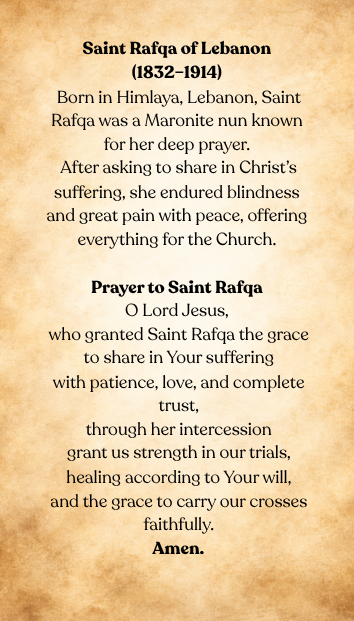
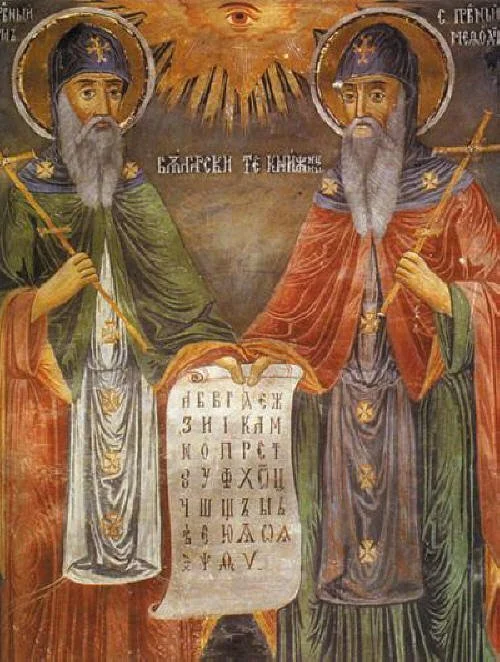
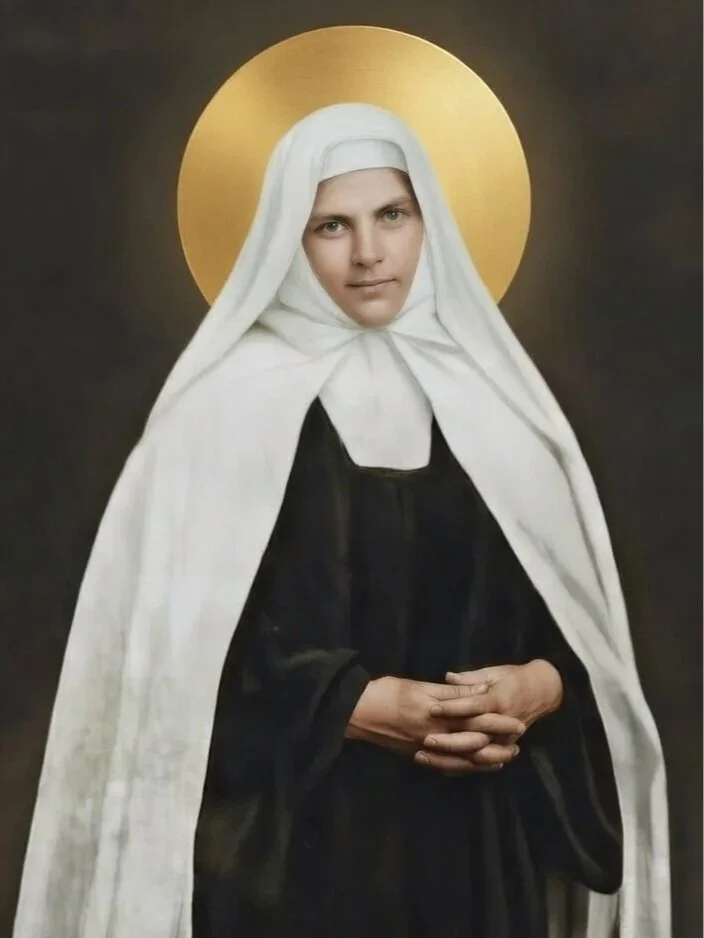
Saint Rafqa Prayer Card – Patron for Silent Suffering, Mystical Union with Christ & Peace When Life Is Reduced to Prayer
$3.00

Saint Rafqa lived a life that most people would call unbearable, yet she called it grace.

Honored in the Maronite Catholic Church and throughout Eastern Catholic tradition, Rafqa did not become holy by accomplishing great external works. She became holy by surrendering everything inwardly. Her sanctity unfolded through radical acceptance, mystical union with Christ, and a quiet offering of self that lasted decades. Her feast day is commemorated on March 23.

People come to Saint Rafqa when their world becomes very small.

They come when independence fades and identity feels stripped away. They come when prayer is all that remains, when relationships change because illness or limitation has altered everything, and when life feels reduced to waiting. They come when suffering is no longer dramatic but monotonous, when days blur together, and when faith must exist without momentum.

Rafqa understands this kind of interior death.

She lived nearly thirty years confined to a bed, blind, paralyzed, and dependent on others for even the smallest movements. She lost not only health, but usefulness in the worldly sense. She lost privacy. She lost autonomy. She lost any ability to distract herself from pain.

Yet what emerged in that silence was something rare.

She entered a profound mystical union with Christ, offering herself completely for the salvation of souls. Her room became a chapel. Her breath became prayer. Her suffering became participation in the Passion.

Today, Saint Rafqa is prayed to by those whose lives have narrowed because of illness, disability, aging, or circumstances they cannot escape. She is especially sought by people learning how to live meaningfully when productivity disappears and by anyone searching for peace when life feels reduced to survival.

This prayer card honors a saint who teaches that when everything external is taken away, God may be preparing something deeper within.

Each card is handmade in Austin and created to order. We do not keep stock, because every prayer card is treated as a unique devotional offering. They are printed on museum-quality photo paper, not cardstock, and each one is made during prayer. The saints are venerated throughout the entire process, and prayers are intentionally offered for the person who will receive the card. These are not mass-produced items. They are created slowly, reverently, and with spiritual intention, because every soul and every prayer matters.

Saint Rafqa lived a life that most people would call unbearable, yet she called it grace.

Honored in the Maronite Catholic Church and throughout Eastern Catholic tradition, Rafqa did not become holy by accomplishing great external works. She became holy by surrendering everything inwardly. Her sanctity unfolded through radical acceptance, mystical union with Christ, and a quiet offering of self that lasted decades. Her feast day is commemorated on March 23.

People come to Saint Rafqa when their world becomes very small.

They come when independence fades and identity feels stripped away. They come when prayer is all that remains, when relationships change because illness or limitation has altered everything, and when life feels reduced to waiting. They come when suffering is no longer dramatic but monotonous, when days blur together, and when faith must exist without momentum.

Rafqa understands this kind of interior death.

She lived nearly thirty years confined to a bed, blind, paralyzed, and dependent on others for even the smallest movements. She lost not only health, but usefulness in the worldly sense. She lost privacy. She lost autonomy. She lost any ability to distract herself from pain.

Yet what emerged in that silence was something rare.

She entered a profound mystical union with Christ, offering herself completely for the salvation of souls. Her room became a chapel. Her breath became prayer. Her suffering became participation in the Passion.

Today, Saint Rafqa is prayed to by those whose lives have narrowed because of illness, disability, aging, or circumstances they cannot escape. She is especially sought by people learning how to live meaningfully when productivity disappears and by anyone searching for peace when life feels reduced to survival.

This prayer card honors a saint who teaches that when everything external is taken away, God may be preparing something deeper within.

Each card is handmade in Austin and created to order. We do not keep stock, because every prayer card is treated as a unique devotional offering. They are printed on museum-quality photo paper, not cardstock, and each one is made during prayer. The saints are venerated throughout the entire process, and prayers are intentionally offered for the person who will receive the card. These are not mass-produced items. They are created slowly, reverently, and with spiritual intention, because every soul and every prayer matters.

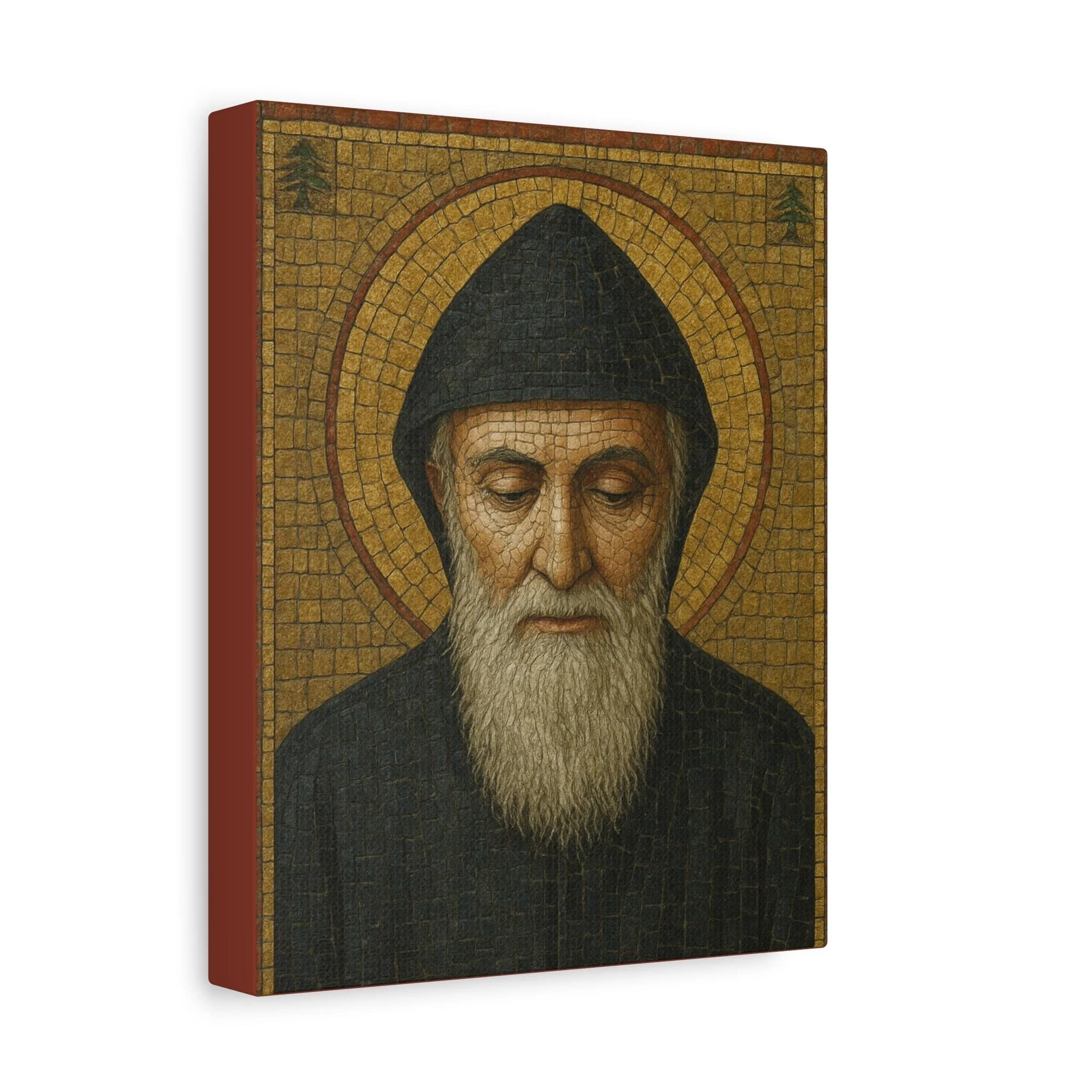
Saint Charbel Mosaic Icon Canvas | Maronite Catholic Wall Art Saint Charbel Mosaic Icon Canvas | Maronite Catholic Wall Art Saint Charbel Mosaic Icon Canvas | Maronite Catholic Wall Art Saint Charbel Mosaic Icon Canvas | Maronite Catholic Wall Art Saint Charbel Mosaic Icon Canvas | Maronite Catholic Wall Art Saint Charbel Mosaic Icon Canvas | Maronite Catholic Wall Art Saint Charbel Mosaic Icon Canvas | Maronite Catholic Wall Art Saint Charbel Mosaic Icon Canvas | Maronite Catholic Wall Art Saint Charbel Mosaic Icon Canvas | Maronite Catholic Wall Art Saint Charbel Mosaic Icon Canvas | Maronite Catholic Wall Art Saint Charbel Mosaic Icon Canvas | Maronite Catholic Wall Art Saint Charbel Mosaic Icon Canvas | Maronite Catholic Wall Art
Sizes:
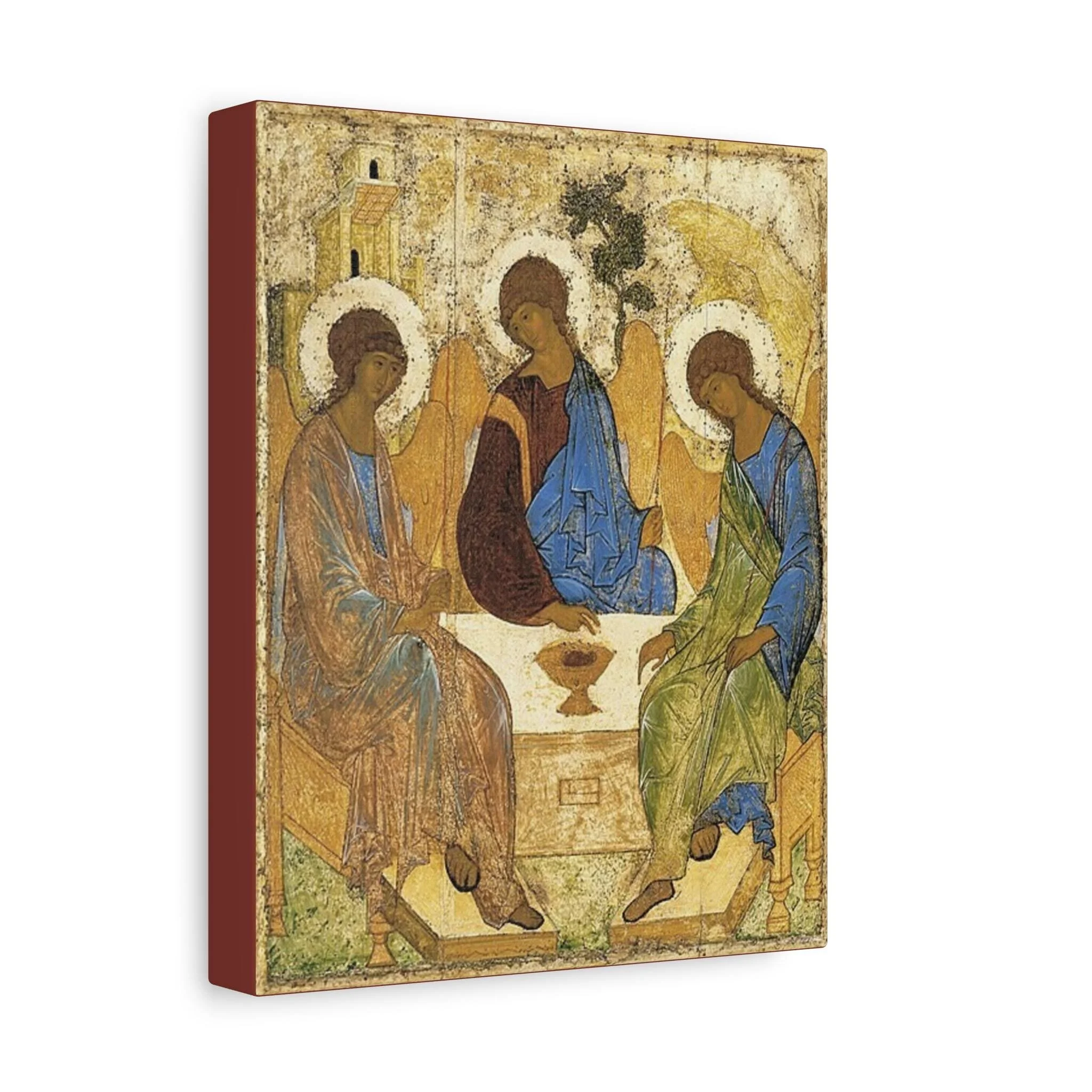
Rublev Holy Trinity Icon Canvas | Orthodox Christian Art Rublev Holy Trinity Icon Canvas | Orthodox Christian Art Rublev Holy Trinity Icon Canvas | Orthodox Christian Art Rublev Holy Trinity Icon Canvas | Orthodox Christian Art Rublev Holy Trinity Icon Canvas | Orthodox Christian Art Rublev Holy Trinity Icon Canvas | Orthodox Christian Art Rublev Holy Trinity Icon Canvas | Orthodox Christian Art Rublev Holy Trinity Icon Canvas | Orthodox Christian Art Rublev Holy Trinity Icon Canvas | Orthodox Christian Art Rublev Holy Trinity Icon Canvas | Orthodox Christian Art Rublev Holy Trinity Icon Canvas | Orthodox Christian Art Rublev Holy Trinity Icon Canvas | Orthodox Christian Art
Sizes:
  • The Life & Story

    Saint Rafqa was born in 1832 in Himlaya, Lebanon, into a Maronite Catholic family shaped by hardship and faith. Orphaned early, she learned dependence on God before she ever entered religious life. As a young woman, she joined a convent, drawn by a desire for prayer, simplicity, and complete belonging to Christ.

    Her early years were marked by ordinary religious duties. She taught, prayed in community, and lived quietly, unknown outside her convent walls. Yet inwardly, she felt called to deeper surrender. According to her own testimony, she asked Christ to allow her to share in His suffering.

    That prayer reshaped her entire existence.

    An attempted medical treatment for eye pain caused irreversible damage, leading to blindness. Soon afterward, severe arthritis and neurological pain began attacking her body, gradually immobilizing her completely. Over time, she lost nearly all voluntary movement and spent the rest of her life confined to bed.

    Her condition did not stabilize.

    It worsened.

    Her joints twisted painfully. Her muscles weakened. Her body became rigid and fragile. She required constant assistance and could no longer participate in communal life.

    What might have crushed her spirit instead purified it.

    Rafqa embraced a life of total interior offering. She united every sensation to Christ, believing her suffering had redemptive meaning. She prayed continually, often thanking God for allowing her to participate in His Cross. Those who cared for her noticed that despite her condition, she radiated calm and gentleness.

    Visitors left her room changed.

    They arrived to comfort her and departed strengthened themselves.

    She died in 1914, leaving no writings and no visible legacy except the memory of peace flowing from a body that had every reason to despair.

    Her holiness was not productive.

    It was sacrificial.

  • Miracles & Patronage

    Saint Rafqa is remembered as a powerful intercessor for those whose lives have been reduced by suffering and who must learn to live spiritually in very small spaces.

    She is especially beloved by people navigating loss of independence and identity.

    Patron Saint Of:

    • Silent suffering and hidden sacrifice

    • Mystical union with Christ

    • Loss of independence through illness or disability

    • Peace when life feels reduced to survival

    • Accepting God’s will in prolonged limitation

    • Caregivers supporting immobilized loved ones

    • Finding spiritual purpose when productivity ends

    Miracles and Ongoing Intercession

    After her death, many reported physical healings through her intercession, but just as many testified to profound interior peace during ongoing illness rather than instant cures. Her incorrupt body strengthened devotion, particularly among Maronite faithful seeking strength rather than escape.

    Some experience emotional stability after years of fear. Others describe a deepening of prayer when external activity disappears. Many speak of learning how to live gently inside limitations they once resisted.

    Her miracles arrive quietly.

    They come as acceptance replacing panic.
    They come as prayer rising in silence.
    They come as Christ becoming enough when everything else fades.

    Saint Rafqa teaches that when movement stops, love does not.

  • Traditional Prayer

    Holy Saint Rafqa, bride of Christ and hidden victim soul, pray for us. Intercede for those confined by suffering, obtain peace for the weary, and teach us to surrender completely to God’s will. Amen.

    Personal Prayer

    Saint Rafqa, silent mystic and companion of those whose lives have narrowed, pray for me.

    You lived when your world became very small. You remained faithful when everything external disappeared. You taught that prayer can exist even when movement cannot.

    I bring you my limitations.

    If my life feels reduced, help me see meaning.
    If I feel forgotten, remind me of Christ’s closeness.
    If I struggle with dependence, teach me surrender.

    Teach me how to live spiritually when productivity ends. Teach me how to offer weakness without resentment. Teach me how to trust God when days blur together.

    Stand beside those confined by illness.
    Stand beside the elderly who feel invisible.
    Stand beside caregivers who feel overwhelmed.

    Saint Rafqa, you transformed stillness into worship.

    By your intercession, may Christ fill my small world with His presence and teach me how to love faithfully even when everything feels stripped away.

    Amen.

  • Common Questions (FAQ)

    Q: What is Saint Rafqa known for?
    She is known for embracing decades of immobilizing illness as a mystical offering to Christ, living in profound peace while confined to bed.

    Q: When is Saint Rafqa’s feast day?
    Her feast is celebrated on March 23 in the Maronite Catholic calendar.

    Q: Which Christian traditions venerate Saint Rafqa?
    She is honored primarily within the Maronite Catholic Church and Eastern Catholic tradition.

    Q: Why do people pray to Saint Rafqa for acceptance or peace?
    Because she lived nearly thirty years in complete physical limitation while remaining spiritually radiant. Many seek her intercession when struggling with loss of independence, prolonged confinement, or learning how to find meaning inside suffering.