Saint Sergius of Radonezh: Hermit, Abbot and Spiritual Father of Russia
A forest hermit who founded the Trinity monastery, revived communal monastic life in medieval Russia, and became the most beloved saint of the Russian land.
At a Glance
- Born
- Traditionally May 3, 1314, at Varnitsa near Rostov. Scholars also propose 1319 and 1322, so the year is uncertain.
- Baptismal name
- Bartholomew (Varfolomei)
- Died
- September 25, 1392, at the Trinity monastery near Radonezh
- Parents
- Saints Cyril and Maria, a family of Rostov
- Feast days
- September 25 (repose), July 5 (uncovering of relics), August 24 (appearance of the Theotokos)
- Titles
- Venerable Father, Abbot of the Russian Land, Wonderworker of Radonezh
- Best known for
- Founding the Holy Trinity monastery, now the Trinity-Sergius Lavra at Sergiev Posad
- How We Know About Sergius
- Bartholomew of Rostov
- The Boy Who Could Not Read
- Into the Forest
- From Hermitage to Monastery
- The Communal Reform and His Disciples
- Princes, Peacemaking and Kulikovo
- Visions and Miracles in the Life
- Death, Relics and Veneration
- Rublev and the Trinity Icon
- Why He Matters to Eastern Christians
- Frequently Asked Questions
How We Know About Sergius
Sergius of Radonezh is one of the most loved figures in Russian Christianity, and most of what is told about him comes from one source, the Life written by Epiphanius the Wise. Epiphanius was a monk of the Trinity monastery who knew people that had known Sergius. The National Library of Russia places the completion of his Life around 1417 to 1418, about a quarter century after the saint's death. That is close enough to preserve real memories, but late enough that a religious purpose shaped the telling.
There is a further complication. Epiphanius's original manuscript has not survived. The text we have was revised in the fifteenth century by Pachomius the Serb, a hagiographer who had worked on Mount Athos. Pachomius shortened some passages, polished the style and added material on the finding of the relics and on later miracles. So an edition labeled as the Life by Epiphanius may contain material that cannot be securely traced to Epiphanius himself.
This article follows a simple rule. Where the Life describes the daily labor, discipline and family life of the monastery, it is a valuable witness. Where it describes visions, miracles and marvels, we report them as the tradition of the Church and make clear that they cannot be tested by ordinary historical methods. Where scholars disagree, as they do about his birth year and about the Battle of Kulikovo, we say so plainly.
Bartholomew of Rostov
The saint was born Bartholomew, in a boyar family connected with the principality of Rostov. His father Cyril served the local princes, and his mother Maria is described in the Life as a deeply devout woman. The tradition gives May 3, 1314 as the day of his birth, at the village of Varnitsa near Rostov the Great. Modern scholars have proposed 1319 and 1322 as well, and no medieval document settles the question. The honest statement is that he was born in the early fourteenth century, most likely between about 1314 and 1322.
He had two brothers, Stephen, who was older, and Peter, who was younger. Epiphanius records that Bartholomew was obedient to his parents even after he began to long for the monastic life. According to the Life, the child cried out from his mother's womb three times during the Divine Liturgy, and as an infant he refused his mother's milk on fast days. These are signs of a future vocation in the style of Byzantine hagiography. They belong to tradition, and the Life offers no independent evidence for them.
The family's fortunes fell as Moscow extended its power over neighboring principalities. Epiphanius describes heavy tribute, confiscations and the humiliation of Rostov's nobles under Moscow's Grand Prince Ivan Kalita. Cyril eventually moved his family to Radonezh, in Moscow's territory. The Orthodox Church in America dates the move to about 1328, though that date is a reconstruction. The move matters because it set Bartholomew in the forest country northeast of Moscow, where his life's work would unfold.
The Boy Who Could Not Read
The best-known story of his childhood concerns reading. Bartholomew's brothers learned their letters, but he struggled, was punished by his teacher and laughed at by his classmates, and he prayed with tears that God would let him read the Scriptures. One day his father sent him to look for some lost horses. In a field he met an elderly monk praying under an oak. The boy waited until the monk finished and then asked for his prayers.
The elder prayed, gave him a small piece of blessed bread and told him that from then on he would understand the Scriptures. When Bartholomew took the boy's visitor home, the elder asked him to read the Psalter, and to his parents' astonishment he read well. The stranger left, and the family took him for an angel. The scene was made famous in the nineteenth century by the painter Mikhail Nesterov in The Vision of the Youth Bartholomew.
As history, the Life shows that the community remembered Sergius as a person who longed for Scripture and found understanding in humility and prayer. The encounter with the elder, the sudden literacy and the monk's disappearance cannot be independently verified, and it is best read as a tradition about God's grace working through a patient child. That is why many parents and students still turn to him in difficulties with learning, although the sources we consulted do not give him a formal, universally recognized patronage of students.
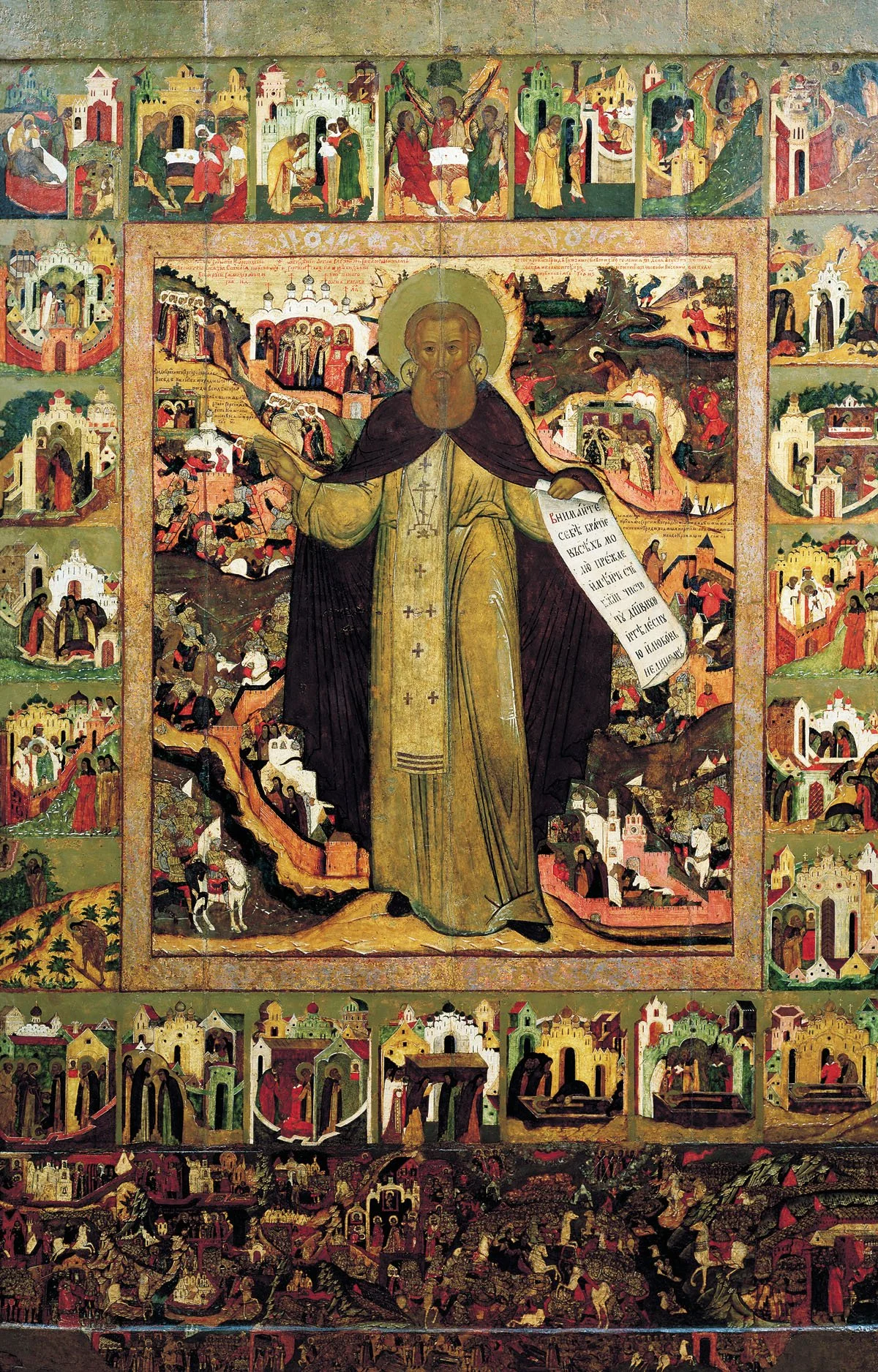
Into the Forest
As Bartholomew grew up he wished to become a monk, but his parents asked him to wait because they were old and needed him. He agreed. After they died, around 1334 to 1337 by different reckonings, he gave away his inheritance. His brother Stephen, whose wife had also died, had already become a monk at Khotkovo. The two brothers set out together into the forest in search of a place of solitude.
They found a clearing near a stream on the hill known as Makovets, close to the site of the present Lavra. There they built a hut and a small wooden chapel dedicated to the Holy Trinity. The dedication would become the heart of Sergius's legacy. The Life places the consecration of the chapel under Metropolitan Theognostus. The traditional date of the monastery's founding is 1337, but the sources do not settle the exact order of events. Scholars have proposed dates stretching into the early 1340s, and the monastery is better pictured as growing slowly from a private hermitage into a settled brotherhood.
Stephen did not last long. The cold, hunger and isolation were too harsh, and he left for the Epiphany Monastery in Moscow, where he came to know the future Metropolitan Alexis. Bartholomew stayed. He asked an abbot named Metrophanes to tonsure him, and according to the Life this took place on October 7, the day of the martyrs Sergius and Bacchus, which is why he received the name Sergius. The Life gives his age as about twenty-three. The year depends on the disputed date of his birth, so the often repeated date of October 7, 1337 is a tradition and cannot be treated as a proven fact.
The Life spends many pages on his trials in the forest: hunger, cold, fear and what Epiphanius calls attacks of demons. The forest played for northern Russia the role the deserts of Egypt and Palestine had played for the early monks, and the Orthodox Church in America presents Sergius as a pioneer of this forest monasticism.
From Hermitage to Monastery
One of the best-known stories of these years concerns a bear. The Life says that a hungry bear came to Sergius's cell. He put out bread for it on a log, and the animal came back again and again. When bread was scarce, he gave the bear his own share and went hungry himself. The story is part of the early tradition and not a later popular addition, but it remains a hagiographic account. It shows a saint who meets danger with mercy, and it has made Sergius a patron of peaceful dealings with the natural world in the Russian imagination.
Sergius hoped to remain alone, but his reputation spread, and men came asking to live near him. Epiphanius says he warned them of the hardship. Those who stayed built cells around the chapel, and the traditional number of the first brothers is twelve, an approximate figure and not an administrative record. Sergius worked with his hands for the brothers. He cut wood, carried water, baked bread, sewed clothing and built cells. The Life insists that a spiritual father serves instead of demanding service.
In time the brothers asked him to become their abbot. He accepted ordination and became the hegumen of the community. Orthodox sources date this to about 1354 and name Bishop Athanasius of Volyn as the ordaining bishop, though the chronology depends on how one reconstructs the monastery's early years. A story illustrates how he led. When the monastery ran short of bread, he agreed to do carpentry for a brother who had some poor bread, and accepted that bread as his payment. For Epiphanius, this showed that no one is above labor.
The Communal Reform and His Disciples
The early Trinity community was a group of monks who each lived in their own cell and cared for their own needs. As the brotherhood grew, this became hard to manage. Food, clothing, property and guests had to be shared fairly. The alternative was communal, or cenobitic, monasticism, in which monks hold goods in common, obey one superior and share work and worship. Byzantine monasticism had models for this, above all the rule of the Studion monastery in Constantinople.
The Orthodox tradition says that Patriarch Philotheus of Constantinople heard of Sergius, sent him a cross, a monastic garment and a letter urging a common rule, and that Metropolitan Alexis supported the change. David Miller, writing in the Encyclopedia of Russian History, links the move to the Studion rule and dates it to about 1377. The Orthodox Church in America places the patriarch's initiative earlier, around 1354. These dates should not be merged into one confident date, and a careful writer says that the reform took place sometime in the third quarter of the fourteenth century.
The change was not welcomed by all. According to the Life, tension developed over the abbot's authority, and Stephen, who had returned to the monastery, was at the center of it. Instead of fighting his brother, Sergius left. He went to the Kirzhach River and founded a new community dedicated to the Annunciation of the Theotokos. The Trinity brothers later appealed to Metropolitan Alexis, who told Sergius to return, and he obeyed, leaving his disciple Roman to lead Kirzhach.
Sergius is often called a hesychast, a follower of the Eastern tradition of stillness and inner prayer. The comparison is fair as a description of his spiritual world, which belonged to the era of the Byzantine hesychast revival. Scholars caution, however, that there is no solid evidence that he practiced a particular method or that he read the works of Gregory Palamas. A responsible account describes him as close to that spiritual climate without claiming to know his private prayer.
His influence spread through his disciples. Among the monastic founders linked to him by the National Library of Russia are Nikon of Radonezh, who succeeded him at the Trinity monastery, Roman of Kirzhach, Andronicus of Moscow, Theodore of Simonov, Athanasius of Vysotsky and Sabbas of Storozhi. The number of monasteries tied to him is disputed. Miller counts six foundations with good evidence of his help and four more reported by tradition, while other Orthodox summaries speak of almost thirty founded by direct disciples and many more touched indirectly. These figures count different things and should not be treated as equal.
Monasteries in the forest brought farmers, craftsmen and settlers, and they became centers of farming, books and teaching. This was a tension in his legacy. Sergius is remembered for deep poverty, yet the institutions that followed his example eventually grew wealthy in land and influence.
Princes, Peacemaking and Kulikovo
Sergius wanted solitude, but princes and bishops sought his counsel. He was close to Metropolitan Alexis of Moscow, and his monastery became a place where spiritual and political authority met. David Miller points to episodes that are better documented than the Kulikovo legend. He baptized Prince Yuri, a son of Dmitri of Moscow, in 1374, and another son, Pyotr, on July 29, 1385. In 1385 he also helped to reconcile Dmitri with Prince Oleg of Ryazan. Miller regards a story that Sergius closed the churches of Nizhny Novgorod in 1365 as probably apocryphal.
A well-known tradition says that Alexis, near death, offered Sergius the metropolitanate and that Sergius refused out of humility, usually dated to 1378. The New Catholic Encyclopedia and Orthodox sources preserve it. The real succession was more tangled, with Constantinople supporting Cyprian and Moscow favoring other candidates, and Miller notes correspondence between Sergius and Cyprian. The story may be told as a lesson in humility, but it is not a documented offer of an office.
The Battle of Kulikovo took place on September 8, 1380. Grand Prince Dmitri Ivanovich of Moscow defeated the army of Mamai, a commander of the Golden Horde, and became known as Dmitri Donskoy. Kulikovo was not the end of Mongol rule. Stella Rock warns against treating it as a final liberation, since the tribute continued and the Horde could still intervene.
The tradition about Sergius is well known. Dmitri visited the Trinity monastery before the battle, received Sergius's blessing and a prediction of victory, and Sergius sent two monks with military experience, Alexander Peresvet and Andrei Oslyabya. Peresvet is said to have fought a Tatar champion in single combat. The earliest accounts of the battle do not tell this as one connected story. A message or blessing from Sergius appears in later narratives, and the personal meeting and the warrior monks appear in expanded versions such as the Tale of the Battle with Mamai. Miller connects the growth of Sergius's role as a protector of the land with the fifteenth century revisions of the Life by Pachomius.
It is therefore uncertain that Sergius personally sent these monks, that both were members of his house, or that the duel happened as the legend describes. Tradition also says that Sergius spent the day of the battle in prayer at his monastery and knew by spiritual insight that victory had been granted. Nothing contemporary confirms that. The safest conclusion is that a connection between Sergius and Dmitri is well founded, while the exact events before Kulikovo are disputed. A fair account neither accepts every detail nor claims he had no part.
Visions and Miracles in the Life
The Life attributes many wonders to Sergius. They are presented here as the tradition of the Church, which means they tell us what the community believed and cannot be checked as historical events.
When the brothers lacked water, the Life says that Sergius prayed and made the sign of the cross at a pool of rain water, and a spring flowed which people came to believe could heal. A father brought his sick son to him, and the boy died on the way. Sergius prayed over the body, and the child revived. Typically, Sergius suggested the boy had only been chilled and had recovered in the warmth of his cell, and he avoided any claim to be a wonderworker. In another account, a man whose family thought him possessed was brought to the monastery and recovered after the community prayed. The language of possession is the source's own explanation, and no modern diagnosis can be made from it.
At night, the Life says, Sergius heard a voice, looked out and saw a great light and a crowd of beautiful birds around the monastery. He understood this as a sign that his spiritual descendants would be many. Disciples reportedly saw a radiant stranger serving beside him at the Divine Liturgy, whom Sergius identified as an angel and told them not to speak of while he lived.
The most celebrated vision is the appearance of the Mother of God. While Sergius was praying before her icon, he told his disciple Micah that a wondrous visit was near. The Theotokos appeared with the Apostles Peter and John in great light. Sergius fell to the ground, and she told him that his prayers for the monastery were heard and that she would watch over it. The Orthodox Church in America places this in 1385 and keeps it on August 24. The date belongs to church tradition and is not confirmed by contemporary records, and the narrative also depends on the later revisions of the Life.
Death, Relics and Veneration
According to the Life, Sergius felt that his death was near and prepared the brothers. He chose his disciple Nikon to lead the monastery, and the official history of the Lavra says he handed over the community about six months before he died and then turned to silence. He gave final instruction to the brothers, received the Eucharist and died in prayer on September 25, 1392. That date is accepted in Orthodox and Catholic reference works.
The monastery suffered badly in the invasion led by Edigei in 1408 and was rebuilt over the following years under Nikon. The tradition says that Sergius appeared to a layman and asked that his burial place be cared for. During work on a new cathedral his remains were uncovered on July 5, 1422, according to the Orthodox Church in America, and his body and clothing were reported to be remarkably preserved even though water had surrounded the grave. That is the traditional account of the discovery. It is not a modern scientific examination, and the evidence we have covers the tradition and not the condition of the remains. The relics were later placed in the stone Trinity Cathedral, consecrated in 1426 according to the Orthodox Church in America, and they remain a center of pilgrimage at the Lavra.
The date of his glorification is not a single clear moment. Orthodox summaries often give 1452, but his veneration grew over time, and David Miller finds recognition much earlier. It is safer to speak of a growing cult than of one act of canonization.
Rublev and the Trinity Icon
Andrei Rublev's icon of the Holy Trinity is closely tied to the tradition of Sergius's monastery, but the link has to be stated carefully. The surviving icon was painted after Sergius died. He did not commission it, and he did not watch it being painted. It belongs to the time of Nikon and the brothers who kept his legacy alive.
Art historians have not agreed on a single year. Some link it to an earlier wooden church, and others to the decoration of the stone cathedral in the 1420s. The Tretyakov Gallery, which holds the icon, gives approximately 1422 to 1427, a respected museum dating that still sits within a scholarly debate. The Lavra's own history says that Nikon commissioned Rublev and Daniel the Black to decorate the new cathedral after the uncovering of the relics. The icon shows the three angels who visited Abraham and has long been read as a picture of the unity of the Trinity, the same mystery to which Sergius dedicated his first chapel.
Venerable Father Sergius, abbot of the Russian land, pray for students who struggle to learn and for all who long for a quiet life of prayer. Teach us humility in our work, peace with our neighbors, and trust in the Holy Trinity. Amen.
This is a short devotional prayer written for this page, and it is not an official liturgical text. The traditional troparions to Saint Sergius are published by the Orthodox Church in America.
Why He Matters to Eastern Christians
For Orthodox readers Sergius is one of the main founders of Russian monasticism, remembered for his example of work and humility, for the Trinity monastery, for the communal life he promoted and for the disciples who spread across northern Russia. He carried the ideals of the Desert Fathers into a new setting. Where the early monks sought the deserts of Egypt, Syria and Palestine, he sought the forests of northern Rus.
His life also reminds us that Russian Christianity did not grow in isolation. In his day the Russian Church still belonged to the Patriarchate of Constantinople, and the contacts with Patriarch Philotheus and with Metropolitan Alexis show how connected the monastery was to the wider Byzantine world. John Meyendorff's Byzantium and the Rise of Russia is a good introduction to that background. For Byzantine Catholics and other Eastern Christians who value the shared inheritance of monastic prayer, his gentle, working monasticism is easy to recognize, although our sources here come mostly from Orthodox writers and do not describe a specific Eastern Catholic devotion.
Frequently Asked Questions
A Quiet Father of a Whole Land
Sergius never sought power. He built a small chapel in the woods, worked beside his brothers, and taught by example. His prayer card is a small reminder of his humility and his trust in the Holy Trinity.
View Prayer Card